- Market Value (2025): USD 0.81 Bn
- Estimated Value (2026): USD 0.95 Bn
- Forecast Value (2036): USD 4.80 Bn
- CAGR (2026-2036): 17.6%
What is the pickleball paddles market forecast to be worth by 2036?
USD 0.95 billion in 2026 to USD 4.80 billion by 2036, at 17.6% CAGR.
- The pickleball paddles market crossed a valuation of USD 0.81 billion in 2025.
- Revenue is expected to increase from USD 0.95 billion in 2026 to USD 4.80 billion by 2036.
- The market is forecast to record a 17.6% CAGR from 2026 to 2036 as regular players convert into repeat paddle purchases.
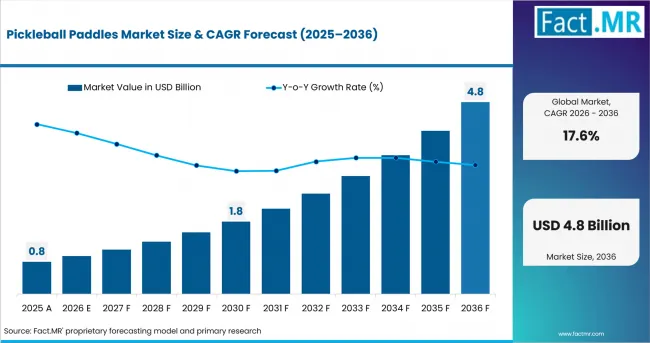
Pickleball Paddles Market Value Analysis | Source: Fact.MR
What are the defining numbers behind pickleball paddles growth?
USD 3.85 billion absolute opportunity by 2036. India, China and the United Kingdom lead the country CAGR view.
- Demand Drivers in the Market
- United States participation gives paddle suppliers the largest near-term addressable base for replacement cycles and upgrade purchases.
- Club formation supports mid-price paddles because new players often test demo paddles before buying their first personal paddle.
- Paddle testing supports certified product demand because tournament players need approved equipment before entering sanctioned events.
- Online retail supports smaller paddle brands because launch cycles can move faster than traditional sporting goods planograms.
- Key Segments Analyzed
- By Weight Class: Mid Weight is expected to account for 57.0% share in 2026 because most recreational and club players want stability without the hand fatigue created by heavier paddles.
- By Construction: Honeycomb Core is projected to capture 54.0% share in 2026 as polymer honeycomb remains common across starter paddles and certified tournament products.
- By Player Type: Recreational Players are estimated to hold 52.0% share in 2026 because the largest buyer pool still plays for social and fitness reasons before entering tournaments.
- By Sales Channel: Online Retail is forecast to secure 48.0% share in 2026 since direct-to-consumer launches help brands explain new shapes without waiting for store resets.
- By Material: Carbon Fiber is likely to represent 46.0% share in 2026 because raw carbon faces have become the reference point for spin-focused and premium paddles.
- By Price Tier: Mid Price is predicted to contribute 42.0% share in 2026 as club buyers move above starter kits but still avoid the highest pro-tier price points.
- By Paddle Shape: Elongated is anticipated to account for 39.0% share in 2026 because reach and two-handed backhand use make elongated paddles common in competitive play.
- Analyst Opinion
- Shambhu Nath Jha of Fact.MR states "I see pickleball paddles moving from novelty gear into a measured equipment category. Retailers now ask whether the paddle stays legal and whether the brand can replace it when testing rules shift."
- Strategic Implications
- Paddle brands should design power within USA Pickleball test margins before scaling new carbon or foam-core launches.
- Retailers should split shelf space between entry bundles and mid-price paddles because buyers often upgrade after club play begins.
- Clubs can use demo programs to convert trial players into repeat paddle buyers without pushing premium products too early.
- Suppliers should track counterfeit risk and certification updates because delisting can move quickly through online reviews.
Participation gives the category a larger base than most new racket sports. The Sports and Fitness Industry Association reported 24.3 million United States pickleball participants in 2025. USA Pickleball also displayed 5,051 approved paddle models in June 2026. That model count shows why brands compete through carbon face construction and testing control.
Certification has become a commercial filter after USA Pickleball prepared its paddle and ball rebound test for launch in Q4 2024. Brands with clean testing records gain retailer confidence. Brands built only around high-power claims face delisting risk and inventory write-downs.
How does the pickleball paddles market break down by segment?
Mid Weight leads at 57.0%. Honeycomb Core follows with 54.0% share in 2026.
Which weight class dominates?
Mid Weight leads at 57.0% share in 2026.
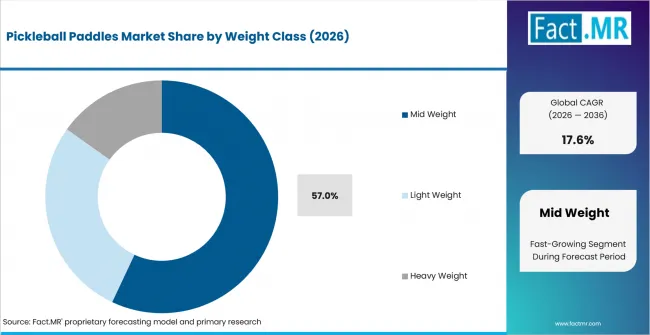
Pickleball Paddles Market Analysis By Weight Class | Source: Fact.MR
Mid Weight paddles are expected to remain the main buyer choice in 2026 because they balance reach, swing speed and control for most club players. Light paddles keep value in fast doubles play. Heavy paddles stay smaller because wrist fatigue matters during longer sessions.
Which construction type dominates?
Honeycomb Core accounts for 54.0% share in 2026.
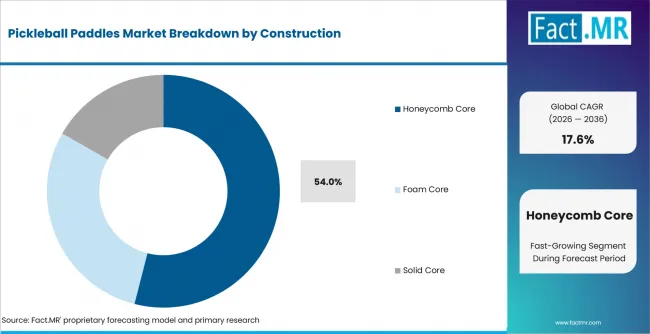
Pickleball Paddles Market Analysis By Construction | Source: Fact.MR
Polymer honeycomb keeps the construction lead because established paddle makers can produce it consistently across starter and tournament lines. Foam-core paddles are gaining trial among premium brands. Buyers still compare touch first and certification status second before paying for a new build.
Which player type dominates?
Recreational Players represent 52.0% share in 2026.
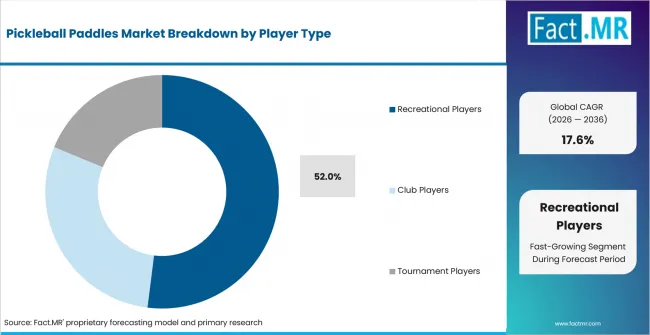
Pickleball Paddles Market Analysis By Player Type | Source: Fact.MR
Recreational Players are estimated to hold the largest share because social and fitness play still creates more paddle purchases than tournament entry. Many buyers begin with borrowed club paddles or starter kits. Replacement purchases begin once weekly play becomes a routine.
Which sales channel dominates?
Online Retail is forecast at 48.0% share in 2026.
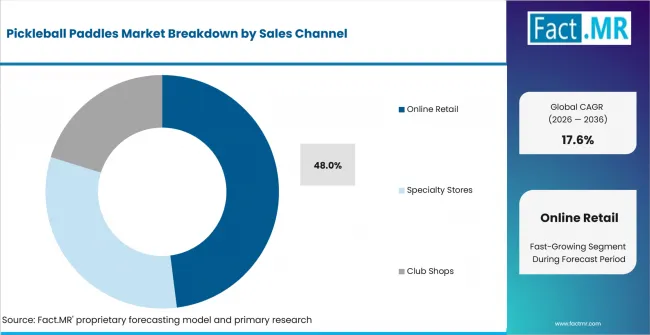
Pickleball Paddles Market Analysis By Sales Channel | Source: Fact.MR
Online Retail has a pricing and education advantage because paddle brands can show construction, certification status and player reviews on the same page. Product videos help buyers compare feel before in-store testing. Specialty stores keep value where players want local advice and demo access.
Which material dominates?
Carbon Fiber captures 46.0% share in 2026.
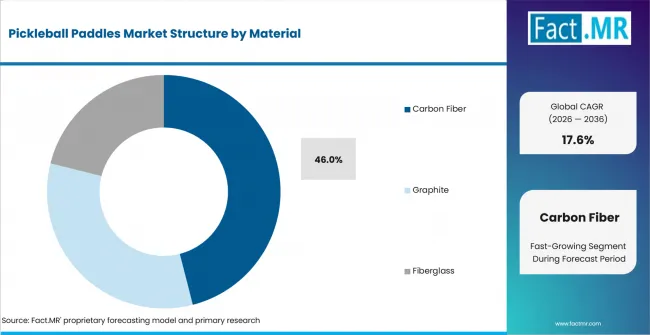
Pickleball Paddles Market Analysis By Material | Source: Fact.MR
Carbon Fiber captures 46.0% share in 2026 because raw carbon fiber faces have become the premium reference for spin and surface feel. Graphite paddles remain relevant in lighter mid-price products. Fiberglass keeps a place where entry buyers prefer lower prices.
Which price tier dominates?
Mid Price contributes 42.0% share in 2026.
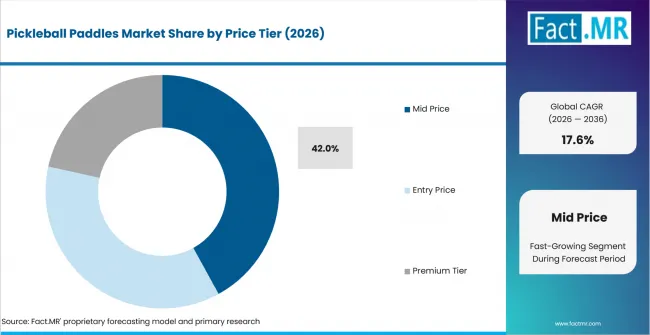
Pickleball Paddles Market Analysis By Price Tier | Source: Fact.MR
Mid Price paddles are projected to account for the largest price-tier share because club players often upgrade without paying USD 250-plus. Entry paddles remain useful for trial sessions and family sets. Pro-tier products gain value when athletes and reviewers validate them after rule checks.
Which paddle shape dominates?
Elongated paddles account for 39.0% share in 2026.
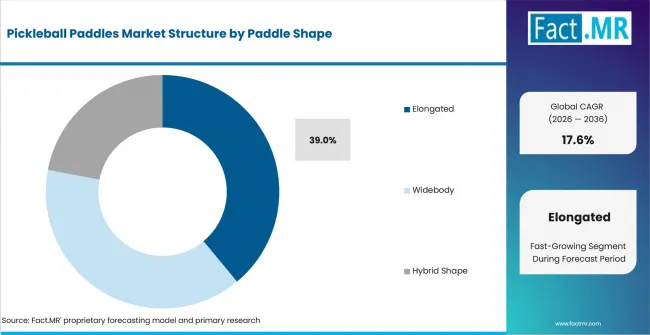
Pickleball Paddles Market Analysis By Paddle Shape | Source: Fact.MR
Elongated paddles are anticipated to lead the shape view because added reach matters in singles and higher-level doubles. Standard shapes still suit new players who want a larger hitting zone. Hybrid shapes are gaining attention as brands try to balance reach with quick hand speed.
What is accelerating pickleball paddles demand, and what is holding it back?
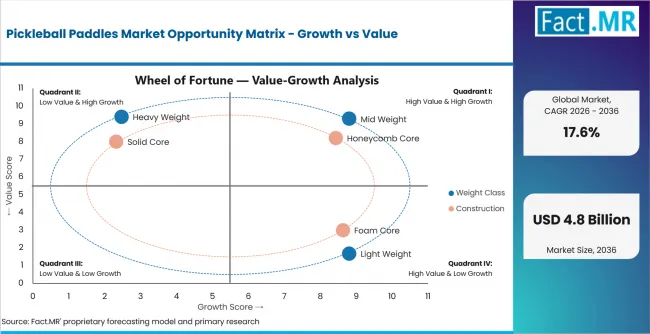
Pickleball Paddles Market Opportunity Matrix Growth Vs Value | Source: Fact.MR
Regular player conversion and carbon paddle upgrades support demand. Certification shifts and copycat supply restrain wider premium pricing. The wider pickleball equipment shelf is moving from starter bundles toward paddle replacement and upgrade cycles.
Players who started with borrowed gear now compare carbon face texture and core feel. That change raises average selling price without depending only on new participants. Retailers tracking sports equipment assortments now separate recreational paddles from certified tournament paddles. This helps premium brands defend shelf space when testing records and warranty terms are clear. It also gives mid-price brands room to win club buyers with simpler product stories.
Expansion is constrained by certification risk and fast product imitation. The JOOLA MOD TA-15 refresh program showed how a rule change can affect sanctioned play from July 2025. Low-cost imports also pressure entry pricing when buyers cannot verify surface durability or approved status.
Where do the biggest pickleball paddles opportunities sit?
Certified carbon paddles, mid-price club kits and Asia-Pacific launch programs.
- Certified Carbon Paddles: Brands can sell higher-price paddles when power and surface feel remain inside testing limits.
- Mid-Price Club Kits: Club packs can convert new players because demo sessions reduce the risk of buying the wrong paddle.
- Practice Ecosystems: The pickleball machine category is important as drill clubs often buy paddles and practice gear together. The same buyer can also move into sensor-based sports gear when coaching programs use sensors and video to improve repeat play.
Which countries are scaling pickleball paddles fastest?
India 24.5% and China 21.8% lead the country view. United Kingdom 20.2%, Australia 19.5% and Canada 18.9% follow. Japan 18.4% and United States 16.9% complete the top seven.
Based on regional analysis, the pickleball paddles market is segmented into North America and Western Europe. East Asia and South Asia and Pacific are also covered. Latin America and Middle East and Africa complete the regional scope.
.webp "Top Country Growth Comparison Pickleball Paddles Market Cagr (2026 2036)")
Top Country Growth Comparison Pickleball Paddles Market Cagr (2026 2036) | Source: Fact.MR
| Country | CAGR |
|---|---|
| India | 24.5% |
| China | 21.8% |
| United Kingdom | 20.2% |
| Australia | 19.5% |
| Canada | 18.9% |
| Japan | 18.4% |
| United States | 16.9% |
Source: Fact.MR analysis. Updated Jun 22, 2026
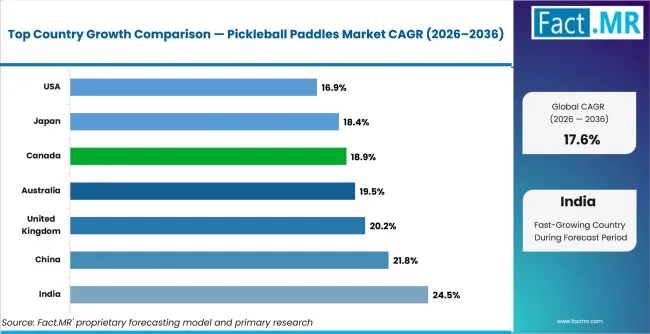
Pickleball Paddles Market Cagr Analysis By Country | Source: Fact.MR
What powers India’s faster rise?
24.5% CAGR, supported by new tournament supply and a low base for paddle ownership.
India is projected to record a 24.5% CAGR through 2036 because organized pickleball is still converting from urban trial play into paid club use. The All India Pickleball Association reported more than 10,000 active players and national events in 2025. That base is small compared with the United States. It gives paddle brands room to sell starter and mid-price products through academies.
How does China shape paddle supply?
21.8% CAGR, supported by manufacturing depth and regional event growth.
China matters first as a sourcing and manufacturing base for composite paddles. Local suppliers can shorten sample cycles when brands test new faces and cores. The same supply chain is linked with continuous fiber-reinforced thermoplastic composites used in light and stiff sporting goods. China is expected to expand at 21.8% CAGR through 2036 because domestic play and export programs can grow together.
Why does the United Kingdom matter?
20.2% CAGR, supported by larger indoor events and tournament paddle checks.
United Kingdom buyers are moving from casual club play into better organized events. Pickleball England reported 2,350 players at the 2025 English Open. It also reported 1,375 players at the 2025 English Nationals. The English Nationals tested 243 paddles and reported a 3.7% failure rate. The United Kingdom is forecast to grow at 20.2% CAGR through 2036 because event checks make certified paddles more visible to club players.
What supports Australia’s outlook?
19.5% CAGR, supported by venue spread and member growth.
Australia has a wide club network and a rising tournament calendar. Pickleball Australia reported more than 155,000 casual players and over 500 venues in 2026. It also reported 299 dedicated affiliates and 19,500 members. Australia is expected to advance at 19.5% CAGR through 2036 because organized play creates a direct path from trial sessions to paddle upgrades.
How is Canada scaling demand?
18.9% CAGR, supported by high participation and club membership depth.
Canada already has a large participation base for a country of its size. Pickleball Canada estimated 1.80 million current players in its 2026 survey. It also reported 93,888 paid members in 2025. Canada is projected to rise at 18.9% CAGR through 2036 because club membership gives suppliers a clear route into repeat paddle replacement.
Why is Japan a relevant commercial market?
18.4% CAGR, supported by governance alignment and formal sport development.
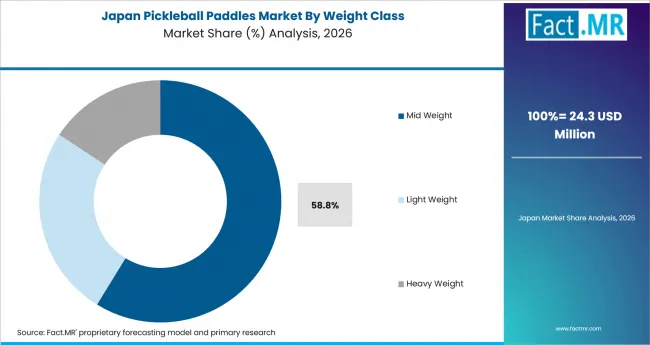
Pickleball Paddles Market Japan Market Share Analysis By Weight Class | Source: Fact.MR
Japan moved toward a clearer sport structure when the Japan Pickleball Association and Pickleball Japan Federation signed a merger agreement in March 2026. A single governing body helps brands understand event rules and approval pathways. Japan is forecast at 18.4% CAGR through 2036 because a unified structure can support retail listings and club programs.
What keeps the United States central?
16.9% CAGR, led by the largest player base and deeper replacement cycles.
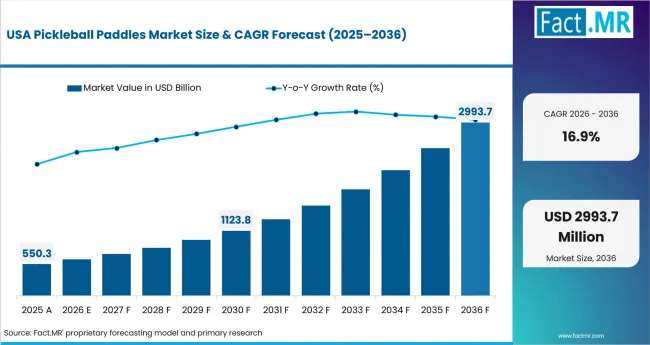
Pickleball Paddles Market Country Value Analysis | Source: Fact.MR
The United States has the deepest near-term paddle revenue base. The Sports and Fitness Industry Association reported 24.3 million United States players in 2025. USA Pickleball also reported 82,613 known courts. Its 2025 growth report also listed 18,258 places to play. The United States is expected to post 16.9% CAGR through 2036 because volume is high but growth starts from a larger base.
Who leads the pickleball paddles landscape?
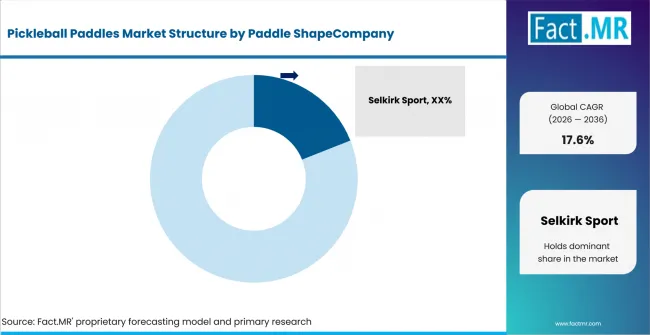
Pickleball Paddles Market Analysis By Company | Source: Fact.MR
Selkirk Sport and JOOLA lead through paddle technology and certification readiness. Franklin Sports leads in retail reach. Paddletek and HEAD add scale through established racket-sports distribution. Wilson Sporting Goods adds reach through wider racket-sports channels.
Competition is split between pickleball-first brands and larger sporting goods suppliers. Buyers compare face feel and approved status before they compare athlete sponsorship. Warranty clarity also matters because surface wear can change how a paddle performs after repeated play.
Premium brands increasingly borrow thinking from sensor-based rackets because player feedback now shapes paddle shape and balance choices. Selkirk Sport launched the SLK ERA Power in June 2025 and the OMNI in June 2026. The OMNI launch put a USD 300 price point around foam-core construction and adjustable weighting. That shows how premium brands are using tunable feel to defend higher pricing.
JOOLA’s March 2025 Pro IV launch carried dual certification from USA Pickleball and the United Pickleball Association of America. Its March 2026 Pro V launch added KineticFrame and the Kosmos hybrid shape. That sequence shows how certification and athlete feedback now sit inside product planning.
Carbon-face brands also watch polyacrylonitrile fiber supply because precursor cost affects carbon fiber economics. Franklin Sports remains relevant through broad retail distribution and its FS Tour paddle series. Paddletek keeps value through the Bantam line and pro-player credibility. CRBN’s TruFoam Genesis 4 shows how smaller brands can use full-foam design to compete against larger names.
Retail programs also pair paddles with performance apparel because clubs often buy gear around the same player season. The next competitive layer connects paddle testing with sports analytics as clubs and coaches increasingly translate feel into measurable play outcomes.
Providers that combine certified performance and retail consistency should be better placed through 2036. Smaller brands can still win when they move quickly. They need clean documentation and replacement support when rules change.
Which companies are the key players?
Selkirk Sport, JOOLA and Franklin Sports are key players. Paddletek, HEAD and Wilson Sporting Goods are also profiled. CRBN Pickleball completes the company set.
- Selkirk Sport
- JOOLA
- Franklin Sports
- Paddletek
- HEAD
- Wilson Sporting Goods
- CRBN Pickleball
Bibliography
- Alphabet Inc. (2024, October 29). 2024 Q3 earnings call. Alphabet Investor Relations.
- CodeRabbit. (2025, December 17). AI vs human code gen report: AI code creates 1.7x more issues than human code. CodeRabbit.
- GitClear. (2025). AI Copilot code quality: 2025 look back at 12 months of data. GitClear.
- Booth, H., Souppaya, M., Vassilev, A., Ogata, M., Stanley, M., & Scarfone, K. (2024, July). Secure software development practices for generative AI and dual-use foundation models: An SSDF community profile (NIST SP 800-218A). National Institute of Standards and Technology.
- Dohmke, T. (2025, May 19). GitHub Copilot: Meet the new coding agent. GitHub Blog.
- Sports and Fitness Industry Association. (2026). U.S. pickleball participation statistics.
- USA Pickleball. (2026, January 30). Annual growth reports.
- USA Pickleball. (2026). Approved paddle list.
- USA Pickleball. (2026, January 16). USA Pickleball and Pickleball Instruments to launch paddle field-testing program at Golden Ticket events.
- JOOLA. (2024, December 31). UPDATE | JOOLA MOD TA-15 paddle refresh program.
- Pickleball Canada. (2026, May 6). Pickleball in Canada – 2026 survey.
- Pickleball England. (2026, January 4). Final 2025 AGM.
- Pickleball Australia. (2026). We dink different.
- Pickleball Australia. (2024, December 4). Pickleball Australia annual report 2023–24.
- All India Pickleball Association. (2025, March 4–9). Team India shines at WPC Asia Pickleball Open 2025.
- Pickleball Japan. (2026, April 10). Official unification site.
- Selkirk Sport. (2025, June 24). Selkirk Sport launches new SLK ERA Power, designed to support aggressive play.
- Selkirk Sport. (2026, June 2). Selkirk Sport unveils the OMNI, a new standard for all-court pickleball paddles.
- JOOLA. (2025, March 4). JOOLA unveils dual-certified Pro IV and Agassi Pro pickleball paddles.
- JOOLA. (2026, March 3). JOOLA reimagines paddle innovation with new Pro V collection.
- Paddletek. (2026). Bantam EX-L Pro.
- HEAD. (2026). Pickleball paddles.
- Wilson Sporting Goods. (2026). Shop pickleball paddles.
- CRBN Pickleball. (2025, August 4). The story behind the TruFoam Genesis 4 paddle (and who it’s for).
This Report Address
- Strategic intelligence on pickleball paddles across material, construction, price tier, player type, sales channel, paddle shape and weight class.
- Segment analysis covers carbon fiber and honeycomb core paddles. Mid-price and recreational buyer segments are also covered.
- Regional outlook covers India and China. United Kingdom and Australia are covered next. Canada, Japan and the United States complete the country view.
- Competitive analysis of Selkirk Sport, JOOLA and Franklin Sports. Paddletek and HEAD are also profiled. Wilson Sporting Goods and CRBN Pickleball complete the company set.
- Source-led market sizing uses participation base and certified paddle count. Court count and product price bands support the forecast.
What is the pickleball paddles market forecast to be worth by 2036?
What does the pickleball paddles market cover?
Finished pickleball paddles sold to recreational players, club players and tournament users.
The pickleball paddles market covers finished paddles used in sanctioned and non-sanctioned play. It includes carbon fiber paddles and graphite paddles. Fiberglass, hybrid and wood paddles are also included when sold as standalone products or player kits.
What is included in the scope?
Composite paddles and carbon paddles. Replacement purchases and first-time starter paddles are also included.
The scope includes finished paddle revenue across online retail and specialty stores. Club shops, mass retail and team sales are also covered. The forecast includes recreational paddles, mid-price club paddles and certified tournament paddles.
What is excluded from the scope?
Balls and nets are excluded from the revenue base. Shoes and court construction are also excluded. Tournament fees are outside the scope.
The scope excludes pickleballs and portable nets. It also excludes shoes and bags. Apparel and court installation are excluded as separate revenue lines. Coaching fees and league fees are excluded unless bundled with a paddle sale.
How was the analysis built?
65+ official and federation pages were reviewed. Company and standards pages were also checked. 25+ countries were screened with supplier and retail assumptions.
- Primary Research Inputs:
- Public company disclosures and federation pages were reviewed. Supplier catalogs and approved paddle lists were used to check active product supply.
- Desk Research:
- Desk research reviewed USA Pickleball rules, federation updates and official participation pages. Company launch pages and product pages were checked for 2025 and 2026 activity.
- Market-Sizing and Forecasting:
- Forecasting used player counts, paddle replacement rates and average selling price assumptions. The 2026 value was reconciled against certified model count and brand coverage.
- Data Validation and Update Cycle:
- Estimates were checked against Sports and Fitness Industry Association data and USA Pickleball equipment records. Canada and England federation data supported country modeling. Australia and India federation data added cross-checks.
Segmentation
What is the report’s scope and coverage?
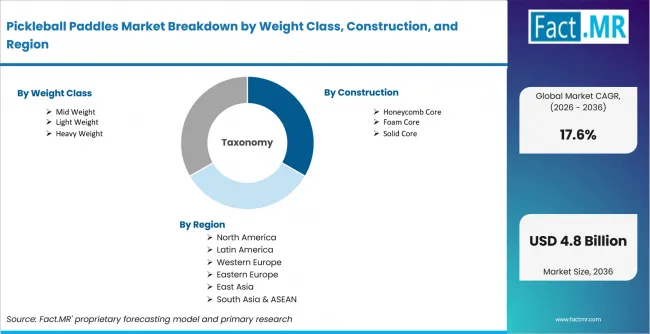
Pickleball Paddles Market Breakdown By Weight Class, Construction, And Region | Source: Fact.MR
| Attribute | Details |
|---|---|
| Quantitative Units | USD Billion in services in 2026 to USD Billion by 2036 |
| Market Definition | Finished pickleball paddles sold to recreational, club and tournament players |
| Material | Carbon Fiber, Graphite, Fiberglass, Wood, Hybrid |
| Construction | Honeycomb Core, Foam Core, Solid Core, Edgeless, Thermoformed |
| Price Tier | Entry Price, Mid Price, Premium Tier, Pro Tier |
| Player Type | New Players, Recreational Players, Club Players, Tournament Players, Professionals |
| Sales Channel | Online Retail, Specialty Stores, Club Shops, Mass Retail, Team Sales |
| Paddle Shape | Standard Shape, Elongated, Widebody, Hybrid Shape |
| Weight Class | Light Weight, Mid Weight, Heavy Weight |
| Regions Covered | North America, Western Europe, East Asia, South Asia and Pacific, Latin America, Middle East and Africa |
| Countries Covered | India, China, United Kingdom, Australia, Canada, Japan and United States |
| Key Companies Profiled | Selkirk Sport, JOOLA, Franklin Sports, Paddletek, HEAD, Wilson Sporting Goods and CRBN Pickleball |
| Forecast Period | 2026 to 2036 |
| Approach | Hybrid top-down and bottom-up approach using player base, approved paddle count, court count, product price bands and company validation |
Source: Fact.MR analysis. Updated Jun 22, 2026
How is the market segmented?
-
By Material:
- Carbon Fiber
- Graphite
- Fiberglass
- Wood
- Hybrid
-
By Construction:
- Honeycomb Cre
- Fam Cre
- Slid Cre
- Edgeless
- Thermoformed
-
By Price Tier:
- Entry Price
- Mid Price
- Premium Tier
- Pro Tier
-
By Player Type:
- New Players
- Recreational Players
- Club Players
- Tournament Players
- Professionals
-
By Sales Channel:
- Online Retail
- Specialty Stores
- Club Shops
- Mass Retail
- Team Sales
-
By Paddle Shape:
- Standard Shape
- Elongated
- Widebody
- Hybrid Shape
-
By Weight Class:
- Light Weight
- Mid Weight
- Heavy Weight
-
By Region:
- North America
- United States
- Canada
- Mexico
- Latin America
- Brazil
- Argentina
- Rest of Latin America
- Europe
- United Kingdom
- Germany
- France
- Spain
- Rest of Europe
- East Asia
- China
- Japan
- South Korea
- Suth Asia and Pacific
- India
- Australia
- ASEAN
- Rest of South Asia and Pacific
- Middle East and Africa
- GCC Countries
- South Africa
- Rest of Middle East and Africa
- North America
Frequently Asked Questions
What is the current outlook for the Pickleball Paddles Market?
How is the Pickleball Paddles Market expected to evolve in the coming years?
What growth trend is expected in the Pickleball Paddles Market?
Which material leads the Pickleball Paddles Market?
Which paddle construction type holds the leading position in the market?
Which distribution channel leads sales in the Pickleball Paddles Market?
Which country is emerging as a key growth market for pickleball paddles?
Why is the United States important to the Pickleball Paddles Market?
What is the primary driver of demand in the Pickleball Paddles Market?
What is the main challenge facing pickleball paddle manufacturers?
Who worked on this report


Preview the report firsthand - request a free sample
Free SampleGet the brochure for pricing and purchase details
Download PDF