- Base Value(2026): 11.2 Bn
- Estimated Value(2026): 11.2 Bn
- Forecast Value (2036): 14.5 Bn
- CAGR (2026 - 2036): 2.6%
Knee Replacement Market Forecast and Outlook 2026 to 2036
In 2025, the knee replacement market surpassed a valuation of USD 11.0 billion. Based on Fact.MR analysis, demand for knee replacement systems is estimated to grow to USD 11.2 billion in 2026 and USD 14.5 billion by 2036. Fact.MR projects a CAGR of 2.6% during the forecast period.
Between 2026 and 2036, the market is projected to create an absolute dollar opportunity of USD 3.3 billion. This steady expansion reflects non-discretionary surgical demand from aging osteoarthritis populations combined with OEM value uplift from robotic surgery platform adoption. Structural constraints include CMS reimbursement compression in the United States and average selling price pressure from emerging-market manufacturers.
John Rogers, CFO Smith & Nephew, said the company is mindful of how it is deploying capital on its existing platforms as it builds up to the launch of Landmark in the second half of the year. For that reason, he said, the company expects its growth in the U.S. knee market to be "softer" in the first quarter, grow a little bit in Q2, and then accelerate in the second half of the year.
Country growth reflects aging demographics, health insurance expansion, and robotic adoption maturity. India leads at 5.2% CAGR, driven by Ayushman Bharat scheme reimbursement expansion and growing private hospital investment. Thailand follows at 4.8% on medical tourism inflows and JCI-accredited hospital robotic surgery investment. Malaysia posts 4.0% on MoH procurement programme expansion. Canada registers 3.0% from provincial waiting list reduction programmes. Spain grows at 2.9% as NHS procedure volumes align with aging population demand.
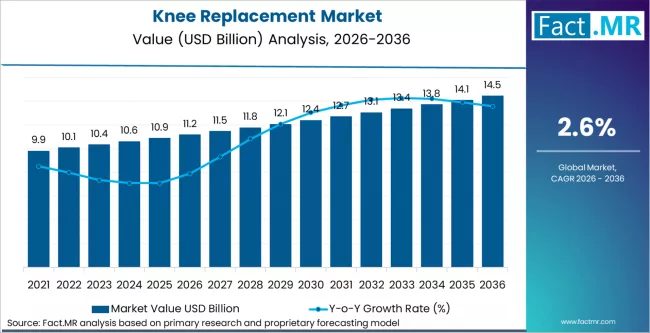
Knee Replacement Market Market Value Analysis | Source: Fact.MR
| Metric | Value |
|---|---|
| Estimated Value in 2026 | USD 11.2 billion |
| Forecast Value in 2036 | USD 14.5 billion |
| Forecast CAGR (2026 to 2036) | 2.6% |
Source: Fact.MR analysis. Updated Mar 9, 2026
Market Definition
The knee replacement market includes implants used to replace damaged knee joints caused by osteoarthritis, rheumatoid arthritis, or trauma. Products include total, partial, and revision knee implants with fixed or mobile bearing designs. Procedures are performed in hospitals, ambulatory surgical centres, and orthopaedic clinics.
Market Inclusions
Includes global and regional revenue forecasts from 2026 to 2036 by product type, implant type, and end user. Covers total, partial, and revision implants across hospitals, ASCs, and orthopaedic clinics. Also includes implant pricing trends, robotic surgery adoption, reimbursement analysis, and cementless fixation penetration.
Market Exclusions
Excludes robotic surgery equipment sold without implants, knee braces, pharmaceutical treatments, and soft tissue repair devices. Hip, ankle, and shoulder replacements are excluded. Physiotherapy services and implant removal procedures without replacement are also excluded.
Research Methodology
- Primary Research: Interviews with orthopaedic surgeons, hospital procurement heads, ASC administrators, reimbursement analysts, and implant distributors across North America, Europe, and Asia Pacific.
- Desk Research: Sources included OEM earnings calls, national joint registries, CMS reimbursement schedules, health ministry procurement records, NICE appraisals, and orthopaedic guidelines from 2024-2025.
- Market Sizing and Forecasting: A hybrid model combined procedure volume estimates with implant price data by product type. Robotic surgery adoption and reimbursement trends informed growth projections.
- Data Validation and Update Cycle: Results validated using manufacturer revenues, joint registry data, hospital procedure databases, and reimbursement updates with annual forecast reviews.
Knee Replacement Market Summary
- Market Definition
- Knee replacement systems are implants used to replace damaged knee joints, including total, partial, and revision implants across hospitals, ASCs, and orthopaedic clinics.
- Demand Drivers
- Aging populations are increasing osteoarthritis cases, expanding the pool of eligible knee replacement patients.
- Robotic-assisted surgery increases procedure value through bundled implant and technology platforms.
- Health insurance expansion in India and Southeast Asia is increasing access to knee replacement procedures.
- Key Segments Analyzed
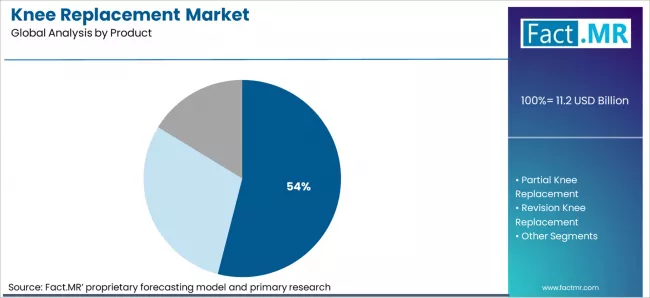
- By Product: Total Knee Replacement holds 54% share in 2026 due to high prevalence of advanced osteoarthritis requiring full joint replacement.
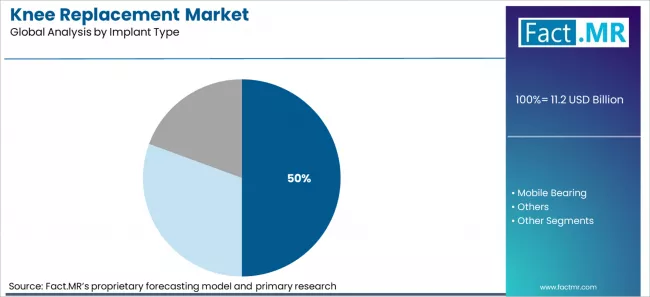
- By Implant Type: Fixed Bearing accounts for 50% share due to proven long-term outcomes and lower cost.
- By End User: Hospitals hold 64% share due to infrastructure required for complex arthroplasty procedures.
- By Geography: Asia Pacific leads, contributing the highest expansion rates.
- Analyst Opinion at FACT.MR
- Shambhu Nath Jha, Principal Consultant at Fact.MR, states that market growth is driven by rising procedure volumes in emerging markets and higher system value in developed regions through robotic surgery and advanced implants.
- Strategic Implications
- Implant manufacturers should expand robotic surgery partnerships to secure implant demand at robotic-equipped hospitals.
- Distributors should focus on India and Southeast Asia where insurance expansion and hospital growth are increasing procedure volumes.
- Manufacturers should develop cementless and patient-specific implants targeting younger and more active patients.
- Methodology
- Market sizing combined national procedure volumes with average implant selling prices, validated through manufacturer disclosures and registry reports.
- Reimbursement changes, robotic surgery adoption, and ASC procedure migration were benchmarked using CMS, NICE, and health ministry records.
- Regional forecasts used population aging data, hospital capacity expansion, insurance enrolment statistics, and surgeon interviews.
Segmental Analysis
Knee Replacement Market Analysis by Product
Knee Replacement Market Analysis By Product | Source: Fact.MR
Based on FACT.MR's knee replacement market report, Total Knee Replacement systems are estimated to hold 54% share in 2026. Total knee procedures dominate due to high prevalence of end-stage osteoarthritis affecting all knee compartments, where full joint resurfacing provides better pain relief and function than partial implants.
- Zimmer Biomet ROSA ASC Expansion: In January 2025, Zimmer Biomet expanded ROSA Knee robotic placements in U.S. ambulatory surgical centres to support rising outpatient total knee procedures and bundled implant contracts. [2]
- Stryker Cementless Total Knee Launch: In 2024, Stryker expanded the Triathlon Cementless total knee system with MAKO robotic alignment, targeting younger patients and premium academic hospital adoption. [3]
- Partial Knee Procedure Volume Growth: In 2024, Smith & Nephew expanded surgeon training for the JOURNEY UNI partial knee system, supporting rising partial procedure adoption in the UK, Australia, and Germany. [4]
Knee Replacement Market Analysis by Implant Type
Knee Replacement Market Analysis By Implant Type | Source: Fact.MR
Based on FACT.MR's knee replacement market report, Fixed Bearing implants hold about 50% share in 2026. They dominate due to strong long-term survivorship data and lower manufacturing cost under reimbursement pressure.
- DePuy Synthes ATTUNE Revision Investment: In 2025, DePuy Synthes expanded the ATTUNE Revision knee system targeting rising revision procedures linked to growing primary implant volumes. [5]
- Cementless Fixation Registry Trend: In 2025, the National Joint Registry reported cementless knee procedures rising from 8% in 2019 to over 18% by 2024, reflecting surgeon confidence and OEM investment. [6]
- Mobile Bearing Clinical Data: In 2024, Aesculap presented clinical data on its Columbus mobile bearing knee system showing improved outcomes in younger active patients. [7]
Key Dynamics
Drivers, Restraints, and Opportunities
FACT.MR analysts observe the knee replacement market evolving from a volume-driven implant segment to a technology-driven platform market. Growth reflects aging population demand and higher system value from robotics, cementless implants, and patient-specific technologies.
Market dynamics balance rising procedure volumes in emerging markets with reimbursement pressure in mature markets. Insurance expansion in Asia Pacific increases procedure access while lower pricing moderates global average selling price growth.
- Aging Population Osteoarthritis Burden: The Global Burden of Disease Study 2024 estimates over 650 million osteoarthritis patients globally, with knee osteoarthritis the largest segment driving procedure demand. [8]
- Robot Assisted Surgery Adoption: Stryker reported over 200,000 MAKO total knee procedures globally in 2024, confirming strong growth and higher implant contract value at robotic-equipped hospitals.
- India Ayushman Bharat Reimbursement Expansion: In 2024, India's PMJAY programme increased reimbursement for knee replacement, expanding surgical access for more than 550 million beneficiaries. [9]
Regional Analysis
The knee replacement market is analysed across Asia Pacific, Europe, North America, Latin America, and Middle East and Africa, spanning 40+ countries with distinct demand profiles shaped by aging demographics, reimbursement structures, robotic surgery adoption, and medical device regulatory frameworks. The full report offers market attractiveness analysis based on procedure volume growth and payer trends.
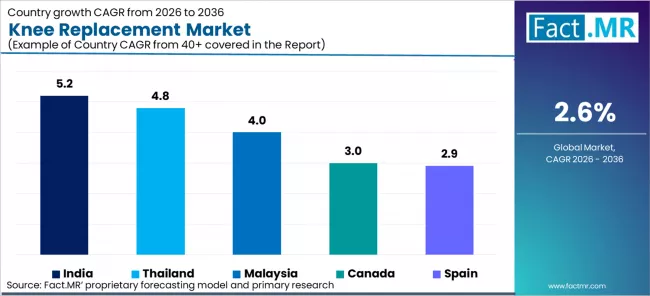
Knee Replacement Market Cagr Analysis By Country | Source: Fact.MR
| Country | CAGR (2026-2036) |
|---|---|
| India | 5.2% |
| Thailand | 4.8% |
| Malaysia | 4.0% |
| Canada | 3.0% |
| Spain | 2.9% |
Source: Fact.MR analysis. Updated Mar 9, 2026
Source: Fact.MR (FACT.MR) analysis, based on proprietary forecasting model and primary research
Asia Pacific Knee Replacement Market Analysis
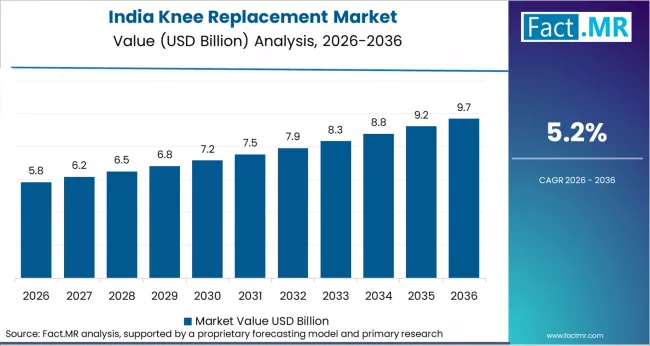
Knee Replacement Market Country Value Analysis | Source: Fact.MR
- India: Rising insurance coverage and expanding private hospital infrastructure are accelerating knee replacement demand in India, with the market projected to grow at 5.2% CAGR through 2036. PMJAY increased reimbursement for knee replacement in 2024, expanding access to over 550 million beneficiaries. Meril Life Sciences expanded implant production in Gujarat in 2024. Stryker India reported strong orthopaedic growth driven by private hospital expansion.
- Thailand: Strong medical tourism and supportive regulatory reforms are strengthening Thailand’s position as a regional hub for orthopaedic procedures, with the market projected to grow at 4.8% CAGR through 2036. The 2024 Medical Devices Act update simplified implant approvals for global manufacturers. Bumrungrad and Bangkok Hospital expanded orthopaedic medical tourism programmes. UHC reimbursement for knee replacement increased in 2025.
- Malaysia: Expanding specialist capacity and growing adoption of robotic surgery are supporting steady market development in Malaysia, with knee replacement demand expected to grow at 4.0% CAGR through 2036. The Ministry of Health expanded the National Specialist Register in 2024, increasing arthroplasty surgeons. The national implant formulary added cementless knee systems. KPJ Healthcare and IHH Malaysia expanded robotic surgery suites.
FACT.MR's Asia Pacific analysis covers India, Thailand, Malaysia, Japan, South Korea, China, Australia and New Zealand, and ASEAN markets. The report includes CAGR projections, reimbursement timelines, robotic surgery adoption, and hospital expansion data.
Europe Knee Replacement Market Analysis
- Spain: Increased public healthcare funding and backlog reduction programmes are driving gradual growth in Spain’s knee replacement procedures, with the market projected to grow at 2.9% CAGR through 2036. Regional governments increased funding in 2024 to reduce orthopaedic surgery waiting lists. SECOT updated guidelines in 2025 recommending robotic surgery for high volume centres. Stryker expanded MAKO placements in major private hospital groups.
- Canada: Canada's knee replacement market is projected to grow at 3.0% CAGR through 2036. Provincial health systems expanded arthroplasty funding to reduce waiting times. The Canadian Joint Replacement Registry reported rapid growth in robotic knee procedures by 2024. Zimmer Biomet expanded ROSA Knee systems across Ontario and Quebec hospitals.
FACT.MR's European analysis covers Germany, France, the United Kingdom, Italy, Spain, the Netherlands, the Nordics, and Rest of Europe. The report includes registry outcome comparisons, robotic surgery adoption timelines, reimbursement trends, and country CAGR projections.
Competitive Aligners for Market Players
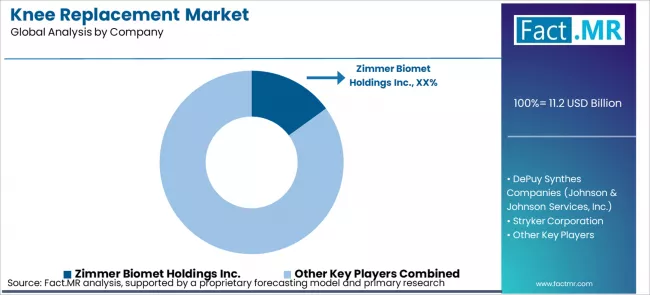
Knee Replacement Market Analysis By Company | Source: Fact.MR
The global knee replacement market is moderately concentrated, with a few large companies controlling a major share of revenue. Key players include Zimmer Biomet, Stryker, DePuy Synthes, Smith & Nephew, and Medacta. These companies maintain strong positions through long standing hospital agreements, surgeon training programs, and large distribution networks. Competition is no longer based only on implant design. It increasingly revolves around integrated surgical platforms that combine implants, robotics, and digital surgical planning.
Companies with robotic surgery ecosystems hold a clear strategic advantage. Platforms such as MAKO SmartRobotics from Stryker and ROSA Knee System create long term partnerships with hospitals. These systems link implants with surgical technology, training, and data driven procedure planning. Conformis also differentiates itself through customized implant designs for unique patient anatomy.
Hospitals typically approve more than one implant supplier to maintain pricing competition. However, robotic platforms create higher switching costs because surgeons are trained on specific systems and hospitals invest heavily in related infrastructure. As a result, incumbent platform providers often retain strong positions once their technology is established.
Recent Development
- In January 2025, Zimmer Biomet announced ROSA Knee robotic system expansion into ambulatory surgical centres across the United States, targeting the growing outpatient total knee replacement segment enabled by CMS reimbursement parity.
- In November 2024, Smith & Nephew disclosed commercial launch of its CORI Surgical System software upgrade incorporating AI-driven intraoperative guidance for total knee balancing, targeting high-volume hospital orthopaedic programmes.
Key Players
- Zimmer Biomet Holdings Inc.
- DePuy Synthes Companies (Johnson & Johnson Services, Inc.)
- Stryker Corporation
- Aesculap, Inc.
- Conformis
- MicroPort Scientific Corporation
- Medacta International
- Smith & Nephew
Bibliography
- [2] Zimmer Biomet Holdings Inc. (2025). Press Release: ROSA Knee System Expansion into Ambulatory Surgical Centres. January 2025. zimmerbiomet.com
- [3] Stryker Corporation. (2025). Q4 2024 Earnings Call Transcript: MAKO SmartRobotics Global Procedure Volume Data. January 2025. investors.stryker.com
- [4] Smith & Nephew plc. (2024). Annual Report and Clinical Update: JOURNEY UNI Partial Knee Replacement Adoption. November 2024. smith-nephew.com
- [5] DePuy Synthes / Johnson & Johnson MedTech. (2025). Press Release: ATTUNE Revision Knee System Programme Update. January 2025. jnjmedtech.com
- [6] National Joint Registry for England, Wales, Northern Ireland and the Isle of Man. (2025). 21st Annual Report 2024: Cementless Fixation Trend in Total Knee Replacement 2019-2024. njrcentre.org.uk
- [7] Aesculap Inc. / B. Braun. (2024). Clinical Data: Columbus Mobile Bearing Total Knee Outcomes in Active Patients Under 65. AAOS Annual Meeting, February 2024. bbraun.com
- [8] World Health Organization. (2024). Osteoarthritis Fact Sheet: Global Burden and Aging Population Projections. who.int
- [9] National Health Authority, Government of India. (2024). PMJAY Orthopaedic Procedure Reimbursement Rate Revision: Total Knee Replacement Package Update. March 2024. pmjay.gov.in
This Report Addresses
- Strategic intelligence on aging population-driven procedure volume growth in India and Southeast Asia, robotic surgery platform adoption across North America and Europe, CMS and national health service reimbursement dynamics, and ASC procedure migration trends.
- Market size and forecast: valued at USD 11.2 billion in 2026, projected to reach USD 14.5 billion by 2036 at a 2.6% CAGR, segmented by product, implant type, end user, and region.
- Growth opportunity mapping across total knee robotic surgery bundling, cementless fixation implant adoption, India PMJAY reimbursement activation, and Southeast Asia medical tourism orthopaedic procedure expansion.
- Country CAGR outlook: India (5.2%), Thailand (4.8%), Malaysia (4.0%), Canada (3.0%), and Spain (2.9%) with detailed health system and reimbursement driver analysis by country.
- Competitive analysis of Zimmer Biomet, Stryker, DePuy Synthes, Smith & Nephew, Conformis, Medacta, and MicroPort covering robotic platform positioning, implant portfolio breadth, surgeon training investment, and emerging market distribution depth.
- Product and technology tracking including MAKO total knee expansion, ROSA ASC migration, CORI AI guidance upgrade, ATTUNE Revision development, cementless fixation registry reporting, and patient-specific implant programme expansion.
- Regulatory impact analysis covering CMS FY2025 IPPS rates, NICE arthroplasty guidance, India PMJAY package list update, Malaysia MoH Formulary revision, Spain SECOT clinical guideline update, and ANVISA registration timeline improvement in Brazil.
- Report delivered in Excel datasets, PowerPoint summary, and detailed PDF supported by joint registry data, manufacturer earnings disclosures, health ministry procurement records, and primary research interviews.
Segmentation
Scope of Report
| Items | Values |
|---|---|
| Quantitative Units | USD 11.2 billion (2026) to USD 14.5 billion (2036), at a CAGR of 2.6% |
| Market Definition | Knee replacement systems include total, partial, and revision implants used to replace damaged knee joints, available in fixed and mobile bearing designs and used in hospitals, ambulatory surgical centres, and orthopaedic clinics. |
| Product | Total Knee Replacement, Partial Knee Replacement, Revision Knee Replacement |
| Implant Type | Fixed Bearing, Mobile Bearing, Others |
| End User | Hospitals, Ambulatory Surgical Centers, Orthopedic Clinics, Others |
| Application Coverage | Total knee arthroplasty for osteoarthritis, partial knee resurfacing, revision knee replacement, robot assisted procedures, cementless implants, patient specific implants, and outpatient knee replacement surgeries. |
| Regions Covered | Asia Pacific, Europe, North America, Latin America, Middle East and Africa |
| Countries Covered | India, Thailand, Malaysia, Japan, South Korea, China, Australia and New Zealand, ASEAN, Rest of Asia Pacific, Germany, United Kingdom, France, Italy, Spain, Netherlands, Nordics, Rest of Europe, United States, Canada, Mexico, Brazil, Chile, Rest of Latin America, Kingdom of Saudi Arabia, UAE, South Africa, Turkey, Rest of Middle East and Africa |
| Key Companies Profiled | Zimmer Biomet Holdings Inc., DePuy Synthes Companies (Johnson & Johnson), Stryker Corporation, Aesculap Inc., Conformis, MicroPort Scientific Corporation, Medacta International, Smith & Nephew |
| Forecast Period | 2026 to 2036 |
| Approach | A hybrid top down and bottom up model was used. Top down inputs included procedure volumes, aging population trends, and insurance reimbursement expansion. Bottom up analysis used implant prices by product type, robotic surgery premiums, replacement cycles, and distributor margin insights from industry interviews. |
Source: Fact.MR analysis. Updated Mar 9, 2026
Knee Replacement Market by Segments
-
By Product :
- Total Knee Replacement
- Partial Knee Replacement
- Revision Knee Replacement
-
By Implant Type :
- Fixed Bearing
- Mobile Bearing
- Others
-
Based on End User :
- Hospitals
- Ambulatory Surgical Centers
- Orthopedic Clinics
- Others
-
Region :
- North America
- USA
- Canada
- Mexico
- Latin America
- Brazil
- Chile
- Rest of Latin America
- Western Europe
- Germany
- UK
- Italy
- Spain
- France
- Nordic
- BENELUX
- Rest of Western Europe
- Eastern Europe
- Russia
- Poland
- Hungary
- Balkan & Baltic
- Rest of Eastern Europe
- East Asia
- China
- Japan
- South Korea
- South Asia and Pacific
- India
- ASEAN
- Australia & New Zealand
- Rest of South Asia and Pacific
- Middle East & Africa
- Kingdom of Saudi Arabia
- Other GCC Countries
- Turkiye
- South Africa
- Other African Union
- Rest of Middle East & Africa
- North America
Frequently Asked Questions
How large is the knee replacement market in 2025?
What will the market size be in 2026?
What is the projected market size by 2036?
What is the expected CAGR?
Which product segment leads the market?
Which implant type dominates?
Which end user holds the largest share?
Which country shows the fastest growth?
What role does robotic surgery play?
What is the primary restraint?
Who worked on this report


Preview the report firsthand - request a free sample
Free SampleGet the brochure for pricing and purchase details
Download PDF