- Base Value(2025): 360 Mn
- Estimated Value(2026): 390 Mn
- Forecast Value (2036): 881 Mn
- CAGR (2026 - 2036): 8.5%
Lactoferrin Ice Cream Inclusions Market Forecast and Outlook By Fact.MR
In 2025, the lactoferrin ice cream inclusions market was valued at USD 360 million. Based on Fact.MR analysis, demand for lactoferrin ice cream inclusions is estimated to grow to USD 390 million in 2026 and USD 881 million by 2036. FACT.MR projects a CAGR of 8.5% during the forecast period.
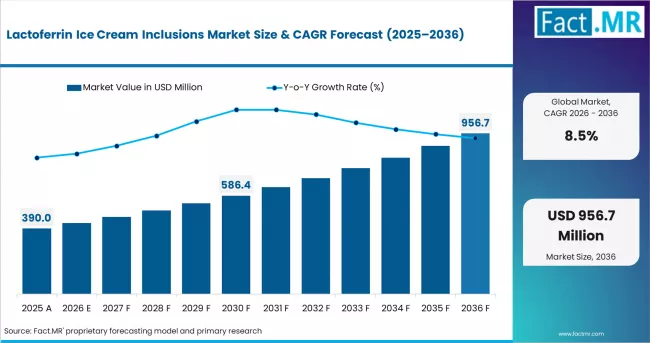
Lactoferrin Ice Cream Inclusions Market Market Value Analysis | Source: Fact.MR
| Metric | Value |
|---|---|
| Estimated Value in 2026 | USD 390 million |
| Forecast Value in 2036 | USD 881 million |
| Forecast CAGR (2026 to 2036) | 8.5% |
Source: Fact.MR analysis. Updated Apr 22, 2026
Summary of the Lactoferrin Ice Cream Inclusions Market
- Market Definition
- Market covers lactoferrin-based inclusion ingredients in powder, encapsulated, and liquid formats for functional ice cream and frozen dairy applications.
- Demand Drivers
- Immunonutrition demand in South Korea and India is driving adoption.
- United States clean-label trends are increasing encapsulated bead demand.
- China dairy category expansion is boosting powder inclusion procurement.
- Key Segments Analyzed
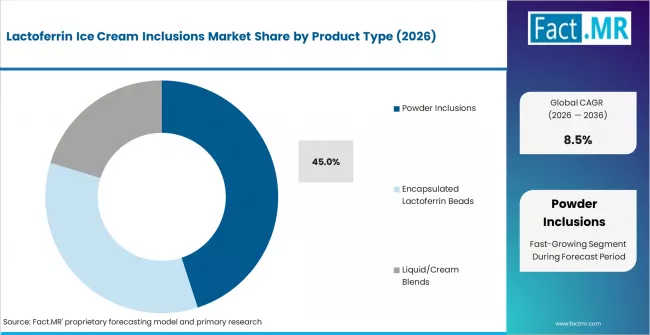
- By Product Type: Powder inclusions lead 45% in 2026 due to cost and processing ease.
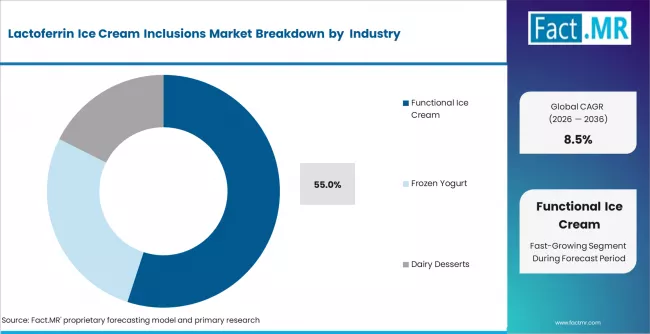
- By Application: Functional ice cream leads 55% in 2026 as the core format.
- By Distribution Channel: B2B supply leads 48% in 2026 driven by large-scale procurement.
- Analyst Opinion at FACT.MR
- Shambhu Nath Jha states that bioactivity-validated inclusions outperform commodity formats. Encapsulation stability is a key requirement. Buyers prefer suppliers with co-extraction capability and cold-chain assurance. GRAS and EU approvals strengthen positioning.
- Strategic Implications
- Invest in GRAS and EU approvals to access U.S. and European markets.
- Develop freeze-thaw stability data for South Korea and Japan markets.
- Build partnerships with Fonterra, Glanbia, and Synlait Milk for supply integration.
- Methodology
- Market sizing uses producer revenues and inclusion volumes validated with recent trade data.
- Includes EFSA approvals, FSSAI frameworks, and certification data.
- Forecasts consider dairy demand trends, encapsulation adoption, and expert inputs.
Between 2026 and 2036, the market is projected to create USD 491 million in absolute opportunity. Growth is driven by expanding functional dairy categories and immunonutrition awareness. Lactoferrin bioactivity claims are attracting premium ice cream brands. Expansion is limited by extraction yield constraints and high per-unit inclusion costs. Encapsulation stability across freeze-thaw cycles remains a formulation challenge.
Procurement is consolidating around certified lactoferrin ingredient suppliers. Buyers require documented bioactivity assays and cold-chain integrity guarantees. Functional ice cream and frozen yogurt brands are narrowing supplier panels to partners with validated whey protein co-extraction capability. GRAS status and EU novel food dossier approvals are prerequisites for new entrant qualification. Commodity-grade bovine lactoferrin faces margin compression.
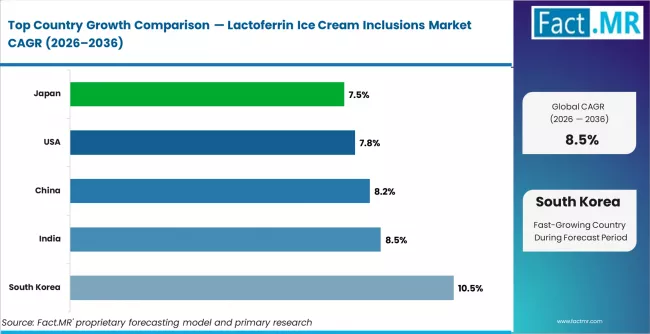
South Korea leads with a CAGR of 10.5% through 2036. Premium K-wellness ice cream and infant dairy lines are driving fortified inclusion demand. India follows at 8.5%, supported by functional dairy expansion and nutraceutical fortification adoption. China records 8.2%, driven by mother-and-child dairy product growth and domestic lactoferrin processing investments. The United States posts 7.8%, anchored by established functional food retail and clean-label fortification demand. Japan records 7.5%, supported by ingredient innovation in premium frozen dairy and established regulatory frameworks.
Segmental Anlaysis
Lactoferrin Ice Cream Inclusions Market Analysis by Product Type
Lactoferrin Ice Cream Inclusions Market Analysis By Product Type | Source: Fact.MR
Based on FACT.MR's lactoferrin ice cream inclusions market report, consumption of powder inclusions is estimated to hold 45% share in 2026. Powder formats dominate because they integrate easily into standard ice cream base mixing processes. They offer cost efficiency and ambient temperature storage stability compared to liquid or encapsulated formats.
- Fonterra Lactoferrin Supply Expansion: Fonterra expanded its pharmaceutical-grade lactoferrin production capacity in 2024. This supported increased supply to functional food and frozen dairy inclusion markets globally. [4]
- Ingredia Encapsulated Bead Launch: Ingredia SA launched a freeze-thaw stable encapsulated lactoferrin bead format targeting functional ice cream manufacturers in 2025. The product meets EU novel food and GRAS requirements. [5]
- Powder Format Logistics Advantage: Cold-chain data from 2024-2025 specialty dairy ingredient trade records confirms powder inclusions maintain bioactivity across standard frozen dairy distribution conditions without the additional cold-chain requirements of liquid blends.
Lactoferrin Ice Cream Inclusions Market Analysis by Application
Lactoferrin Ice Cream Inclusions Market Analysis By Application | Source: Fact.MR
Based on FACT.MR's lactoferrin ice cream inclusions market report, consumption of functional ice cream is estimated to hold 55% share in 2026. Functional ice cream is the primary commercial format for lactoferrin fortification. Premium ice cream brands use it to deliver immune-support and infant wellness positioning to health-conscious consumers.
- Glanbia Functional Dairy Programme: Glanbia plc expanded its functional dairy ingredient programme in 2024. It supplies lactoferrin inclusion formats to premium ice cream and frozen dessert brands across North America and Europe. [6]
- Synlait Milk Nutritional Platform Development: Synlait Milk developed a nutritional ingredient platform in 2024 targeting functional frozen dairy formats including lactoferrin-fortified ice cream and yogurt inclusions for the Asia Pacific market. [7]
- Frozen Yogurt Category Growth Trend: Euromonitor data from 2024 confirms frozen yogurt is the fastest-growing sub-category within functional frozen dairy, with lactoferrin fortification emerging as a key premium differentiation lever among South Korean and Japanese brands.
Drivers, Restraints, and Opportunities
Lactoferrin Ice Cream Inclusions Market Opportunity Matrix Growth Vs Value | Source: Fact.MR
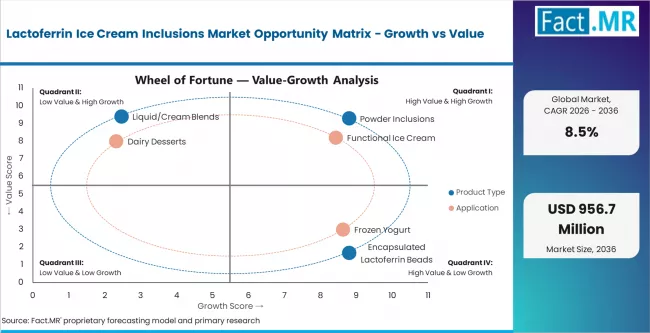
FACT.MR notes that the lactoferrin ice cream inclusions market is an emerging but scaling bioactive dairy segment. Demand is driven by immunonutrition trends and premium dairy product expansion. Clean-label positioning and scientific validation support growth.
The market shows clear quality segmentation. Commodity lactoferrin faces margin pressure from low-cost supply. Encapsulation costs and regulatory approvals remain barriers. Bioactive-grade and encapsulated formats command 40–60% price premiums. Revenue growth is driven by value addition, not volume alone.
- South Korea K-Wellness Fortification Driver: Ministry of Food and Drug Safety updated standards in 2024. Lactoferrin intake limits were expanded. Brands such as Binggrae and Lotte Foods are developing fortified ice cream. [1]
- India Functional Dairy Expansion: Market growth accelerated in 2024–2025. FSSAI updated bioactive protein guidelines. Amul and Mother Dairy initiated lactoferrin trials. [2]
- EU Encapsulation Technology Adoption: EFSA updated safety assessments in 2024. This clarified regulatory pathways. Ingredia and Glanbia expanded encapsulated supply programmes in 2024–2025. [3]
Regional Analysis
The lactoferrin ice cream inclusions market is assessed across Asia Pacific, Europe, North America, Latin America, and Middle East and Africa, covering 40+ countries with distinct demand profiles shaped by functional dairy regulation maturity, bioactive ingredient approval frameworks, premium food retail infrastructure, and nutritional fortification procurement models. The full report offers market attractiveness analysis by region and country.
.webp "Top Country Growth Comparison Lactoferrin Ice Cream Inclusions Market Cagr (2026 2036)")
Top Country Growth Comparison Lactoferrin Ice Cream Inclusions Market Cagr (2026 2036) | Source: Fact.MR
| Country | CAGR (2026 to 2036) |
|---|---|
| South Korea | 10.5% |
| India | 8.5% |
| China | 8.2% |
| United States | 7.8% |
| Japan | 7.5% |
Source: Fact.MR analysis. Updated Apr 22, 2026
Source: Fact.MR (FACT.MR) analysis, based on proprietary forecasting model and primary research
Lactoferrin Ice Cream Inclusions Market Cagr Analysis By Country | Source: Fact.MR
Asia Pacific Lactoferrin Ice Cream Inclusions Market Analysis
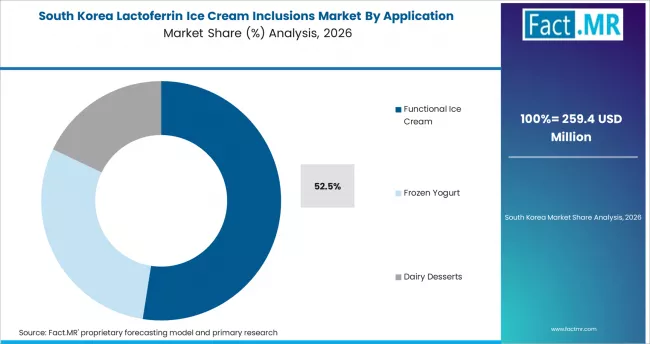
Lactoferrin Ice Cream Inclusions Market South Korea Market Share Analysis By Application | Source: Fact.MR
Asia Pacific Lactoferrin Ice Cream Inclusions Market Analysis
Asia Pacific is the fastest-expanding consumption base. Growth is driven by K-wellness in South Korea, dairy demand in China, and premiumisation in India. Fonterra and Synlait Milk support B2B and retail inclusion channels.
- South Korea: Demand is projected at 10.5% CAGR through 2036. South Korea Ministry of Food and Drug Safety updated health functional food standards in April 2024. This expanded approved lactoferrin intake levels and bioactivity claims for frozen dairy. Binggrae and Lotte Foods are developing premium lactoferrin-fortified ice cream products targeting health-conscious consumers. Procurement is driven by strict bioactivity validation, regulatory compliance, and documented ingredient stability requirements.
- India: Functional dairy expansion supports projected growth at 8.5% CAGR through 2036. India FSSAI updated bioactive protein labelling in 2024. This created structured pathways for lactoferrin claims in frozen dairy. Amul and Mother Dairy are piloting fortified ice cream formats. Imports from Fonterra and Glanbia support supply. Urban premium retail channels are driving adoption.
Fact.MR’s analysis covers South Korea, India, China, Japan, ASEAN, and ANZ. It includes regulatory timelines, procurement benchmarks, and adoption trends.
Europe Lactoferrin Ice Cream Inclusions Market Analysis
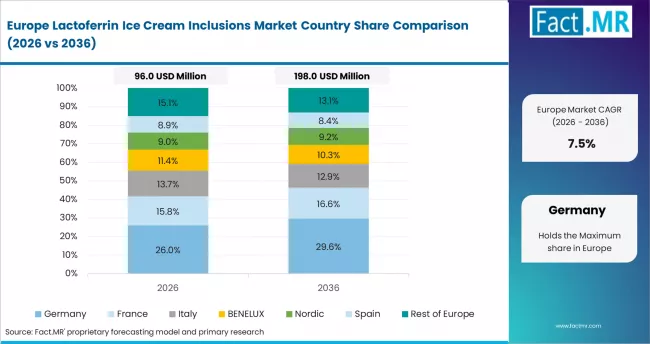
Lactoferrin Ice Cream Inclusions Market Europe Country Market Share Analysis, 2026 & 2036 | Source: Fact.MR
Europe is a regulatory and clean-label benchmark market. EFSA approval processes define entry timelines. Ingredia and Glanbia lead through encapsulation expertise and validated supply.
- Germany: Clinical-grade ingredient validation drives projected growth at 8.8% CAGR through 2036. Germany EFSA compliance requirements shape procurement. Frozen dairy manufacturers prioritise encapsulated lactoferrin formats with documented stability. Premium private label and branded ice cream segments are expanding functional ingredient adoption.
- United Kingdom: Retail-led functional dessert demand supports projected growth at 8.6% CAGR through 2036. United Kingdom clean-label positioning and immune-health claims drive innovation. Procurement follows strict regulatory validation. Brands are focusing on premium SKUs with bioactive ingredient differentiation.
Fact.MR covers Germany, France, the UK, Italy, Spain, Denmark, Switzerland, and Rest of Europe. It includes EFSA compliance data and adoption trends.
North America Lactoferrin Ice Cream Inclusions Market Analysis
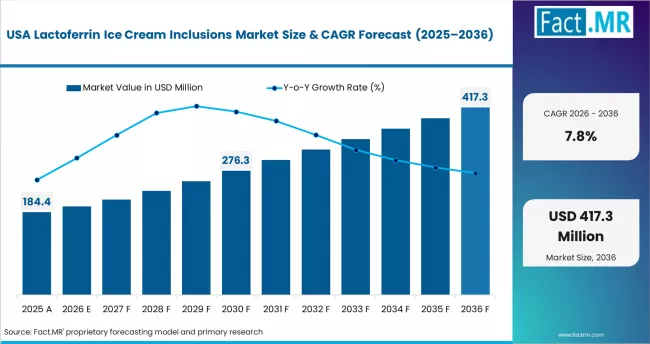
Lactoferrin Ice Cream Inclusions Market Country Value Analysis | Source: Fact.MR
North America is a clean-label and functional ingredient market. Demand is driven by premium ice cream and health-focused consumers. Fonterra and Glanbia lead supply through GRAS-certified networks.
- United States: United States FDA GRAS pathway supports 7.8% CAGR through 2036. Fonterra expanded GRAS self-affirmation in 2024 for new formats. Clean-label and immune-support positioning drive demand. Premium brands are sourcing encapsulated and powder formats through long-term B2B agreements.
Fact.MR covers the United States, Canada, and Mexico. It includes GRAS benchmarks, procurement trends, and category growth data.
Competitive Aligners for Market Players
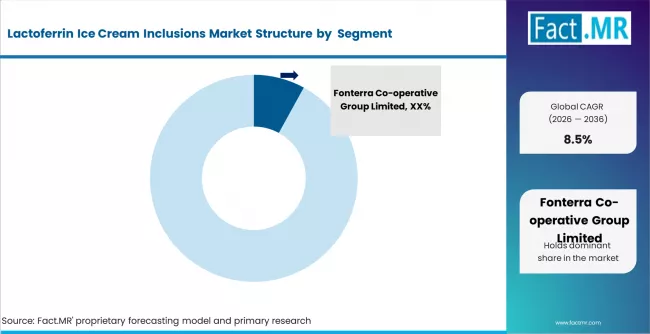
Lactoferrin Ice Cream Inclusions Market Analysis By Company | Source: Fact.MR
The competitive landscape of the lactoferrin ice cream inclusions market is moderately concentrated and driven by upstream ingredient control, bioactivity validation, and downstream B2B partnerships. A limited group of global dairy ingredient producers dominates supply, while smaller formulation and encapsulation specialists operate in niche segments. Competition is defined less by price and more by purity, regulatory compliance, and functional performance in frozen applications.
Large-scale producers such as Fonterra, Synlait Milk, FrieslandCampina, and Glanbia control a significant share of global lactoferrin supply. These companies leverage integrated dairy value chains, advanced extraction technologies, and strong regulatory capabilities to maintain leadership. Their ability to produce high-purity lactoferrin at scale and meet stringent food safety standards gives them a structural advantage in supplying premium inclusion formats.
Specialty players such as Ingredia and MILEI GmbH compete through encapsulation expertise and bioactivity-focused formulations. These companies differentiate by offering stabilised bead formats and validated functional performance across freeze–thaw cycles, which are critical for ice cream applications. Innovation in encapsulation and delivery systems is a key competitive lever in this segment.
The market also includes a fragmented layer of regional suppliers and emerging players. Companies such as Hilmar Cheese and Tatua focus on cost-efficient production and regional distribution strategies. However, their market access is often limited by the need for clinical validation and regulatory approvals. Procurement dynamics further reinforce concentration. Large dairy manufacturers prefer long-term contracts with established suppliers that offer consistent quality, cold-chain reliability, and regulatory documentation. As a result, companies with integrated supply chains and proven bioactive performance continue to command premium pricing, while smaller suppliers remain confined to low-volume or price-sensitive segments.
Key Players
- Fonterra Co-operative Group Limited
- Glanbia plc
- Synlait Milk Limited
- Ingredia SA
- Bega Cheese Limited
Bibliography
- [1] Ministry of Food and Drug Safety, South Korea. (2024). Health Functional Food Ingredient Standards Update 2024: Revised Lactoferrin Daily Intake Levels and Bioactivity Claim Approval for Fortified Frozen Dairy Products Under Korean Health Functional Food Act. mfds.go.kr
- [2] Food Safety and Standards Authority of India (FSSAI). (2024). Functional Dairy Labelling Standards Update 2024: Bioactive Protein Health Claim Registration Pathways for Lactoferrin-Fortified Frozen Dairy Products Under Food Safety and Standards Act 2006. fssai.gov.in
- [3] European Food Safety Authority (EFSA). (2024). Safety Assessment of Encapsulated Lactoferrin as a Novel Food Ingredient in Functional Dairy and Frozen Food Applications: Updated Scientific Opinion Under EU Novel Food Regulation 2015/2283. efsa.europa.eu
- [4] Fonterra Co-operative Group. (2024). Annual Report 2024: Pharmaceutical-Grade Lactoferrin Production Capacity Expansion at New Zealand Facilities to Support Growing Functional Food and Frozen Dairy Ingredient Market Demand. fonterra.com/investor-relations
- [5] Ingredia SA. (2025). Product Launch Announcement: Freeze-Thaw Stable Encapsulated Lactoferrin Bead Format for Functional Ice Cream and Frozen Dairy Manufacturers Meeting EU Novel Food and GRAS Compliance Requirements. ingredia.com/news
- [6] Glanbia plc. (2024). Annual Report 2024: Functional Dairy Ingredient Programme Expansion Including Dedicated Lactoferrin Supply Agreements for Premium Ice Cream Brands Across North America and Asia Pacific Markets. glanbia.com/investor-relations
- [7] Synlait Milk Limited. (2024). Investor Update: Nutritional Ingredient Platform Development Targeting Functional Frozen Dairy Formats Including Lactoferrin-Fortified Ice Cream and Frozen Yogurt Inclusion Supply for Asia Pacific Customers. synlait.com/investor-centre
This Report Addresses
- Strategic insights on lactoferrin ice cream inclusion demand across functional frozen dairy clean-label fortification, B2B ingredient procurement consolidation, and premium ice cream brand immunonutrition positioning.
- Market forecast from USD 390 million in 2026 to USD 881 million by 2036, at 8.5% CAGR.
- Opportunity mapping across South Korea MFDS functional dairy standard expansion, India FSSAI bioactive protein claim frameworks, EU EFSA encapsulated lactoferrin novel food assessments, and North American GRAS-compliant functional ice cream brand adoption.
- Segment analysis by product type, application, and distribution channel. Covers powder inclusions, encapsulated beads, and liquid/cream blend formats across functional ice cream, frozen yogurt, and dairy dessert end uses.
- Regional outlook covering Asia Pacific premiumisation-driven functional dairy growth, Europe EFSA novel food compliance-led procurement, and North America clean-label bioactive ice cream brand adoption.
- Competitive landscape of Fonterra, Glanbia plc, Synlait Milk, Ingredia SA, and Bega Cheese covering bioactivity validation, encapsulation technology, and B2B supply agreement structures.
- Regulatory analysis covering South Korea MFDS 2024 functional food standards, FSSAI 2024 bioactive dairy labelling guidelines, EFSA encapsulated lactoferrin safety assessments, and FDA GRAS notification programme updates.
- Report delivery in PDF, Excel, and presentation formats supported by validated producer data, functional dairy procurement benchmarks, and industry expert inputs.
Lactoferrin Ice Cream Inclusions Market Definition
The lactoferrin ice cream inclusions market covers bioactive lactoferrin-based ingredient formats incorporated into frozen dairy and dessert products. Key products include powder inclusions, encapsulated lactoferrin beads, and liquid or cream blends.
Lactoferrin Ice Cream Inclusions Market Inclusions
Covers global and regional forecasts from 2026 to 2036 by product type, application, and distribution channel. Includes powder, encapsulated bead, and liquid formats across functional ice cream, frozen yogurt, and dairy desserts.
Lactoferrin Ice Cream Inclusions Market Exclusions
Excludes dietary supplements, infant formula, and standalone lactoferrin ingredients. Finished branded frozen desserts are excluded. Standard whey and milk proteins without lactoferrin bioactivity are not included. Focus remains on functional inclusion formats.
Lactoferrin Ice Cream Inclusions MarketResearch Methodology
- Primary Research: Interviews with lactoferrin producers, dairy formulators, procurement specialists, and encapsulation providers across key markets.
- Desk Research: Uses data from Fonterra, Glanbia, and Ingredia. Includes EFSA databases, FSSAI frameworks, and 2024–2025 trade data.
- Market-Sizing and Forecasting: Uses a hybrid model based on producer revenues, volume by format, and pricing benchmarks by bioactivity grade.
- Data Validation and Update Cycle: Validated using producer data, procurement benchmarks, and expert interviews with dairy and ingredient buyers.
Segmentation
Scope of Report
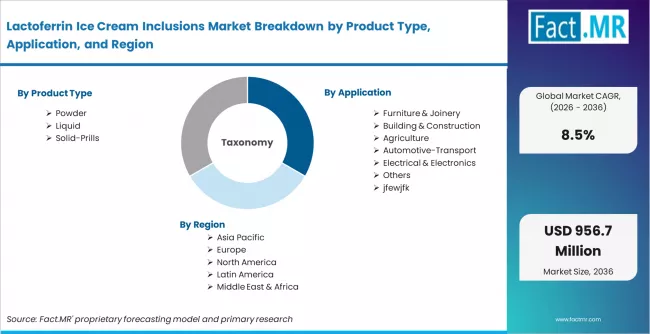
Lactoferrin Ice Cream Inclusions Market Breakdown By Product Type, Application, And Region | Source: Fact.MR
| Attribute | Details |
|---|---|
| Quantitative Units | USD 390 million (2026) to USD 881 million (2036), at a CAGR of 8.5% |
| Market Definition | Bioactive lactoferrin-based inclusion ingredients in powder, encapsulated bead, and liquid/cream blend formats, supplied with bioactivity validation and regulatory compliance documentation for functional ice cream, frozen yogurt, and dairy dessert manufacturers globally. |
| Product Type Segmentation | Powder Inclusions, Encapsulated Lactoferrin Beads, Liquid/Cream Blends |
| Application Segmentation | Functional Ice Cream, Frozen Yogurt, Dairy Desserts |
| Distribution Channel Segmentation | B2B Ingredient Supply, Retail Packaged Products, Foodservice |
| Application Coverage | Immune-support and nutritional fortification in premium ice cream, frozen yogurt, and dairy dessert formulations across functional food retail, B2B ingredient supply, and foodservice channels. |
| Regions Covered | North America, Europe, Asia Pacific, Latin America, Middle East and Africa |
| Countries Covered | USA, Canada, Mexico, Germany, UK, France, Italy, Spain, Denmark, Switzerland, Nordic, BENELUX, China, Japan, South Korea, India, ASEAN, Australia and New Zealand, Brazil, Argentina, Colombia, Saudi Arabia, GCC, Turkey, South Africa, Rest of MEA |
| Key Companies Profiled | Fonterra, Glanbia plc, Synlait Milk, Ingredia SA, Bega Cheese |
| Forecast Period | 2026 to 2036 |
| Approach | Hybrid top-down and bottom-up model using lactoferrin ingredient producer revenues, frozen dairy inclusion volume estimates by product type and application, average selling prices by format and bioactivity grade, regulatory approval benchmarks, and primary interviews with functional food buyers and frozen dairy formulators. |
Source: Fact.MR analysis. Updated Apr 22, 2026
Lactoferrin Ice Cream Inclusions Market by Segments
-
By Product Type:
- Powder Inclusions
- Encapsulated Lactoferrin Beads
- Liquid/Cream Blends
-
By Application:
- Functional Ice Cream
- Frozen Yogurt
- Dairy Desserts
-
By Distribution Channel:
- B2B Ingredient Supply
- Retail Packaged Products
- Foodservice
-
By Region:
- North America
- United States
- Canada
- Mexico
- Latin America
- Brazil
- Argentina
- Colombia
- Rest of Latin America
- Western Europe
- Germany
- United Kingdom
- France
- Italy
- Spain
- Denmark
- Switzerland
- Nordic Countries
- BENELUX
- Rest of Western Europe
- Eastern Europe
- Russia
- Poland
- Hungary
- Balkan and Baltic
- Rest of Eastern Europe
- East Asia
- China
- Japan
- South Korea
- South Asia and Pacific
- India
- ASEAN
- Australia and New Zealand
- Rest of South Asia and Pacific
- Middle East and Africa
- Kingdom of Saudi Arabia
- Other GCC Countries
- Turkey
- South Africa
- Rest of Middle East and Africa
- North America
Frequently Asked Questions
How large is the global lactoferrin ice cream inclusions market in 2025?
What will the market size be in 2026?
What is the projected market size by 2036?
What is the expected CAGR from 2026 to 2036?
Which product type segment is poised to lead the market?
Which application segment holds the largest share?
Which country shows the fastest growth in the market?
What are lactoferrin ice cream inclusions used for?
What drives demand in this market?
Who are the key players in the market?
Who worked on this report


Preview the report firsthand - request a free sample
Free SampleGet the brochure for pricing and purchase details
Download PDF