- Base Value(2025): 0.7 Bn
- Estimated Value(2026): 0.8 Bn
- Forecast Value (2036): 1.4 Bn
- CAGR (2026 - 2036): 5.5%
Lactoferrin from Bovine Whey for Infant Nutrition Market Forecast and Outlook By Fact.MR
In 2025, the lactoferrin from bovine whey for infant nutrition market was valued at USD 0.7 billion. Based on Fact.MR analysis, demand for lactoferrin from bovine whey for infant nutrition is estimated to grow to USD 0.8 billion in 2026 and USD 1.4 billion by 2036. FACT.MR projects a CAGR of 5.5% during the forecast period.
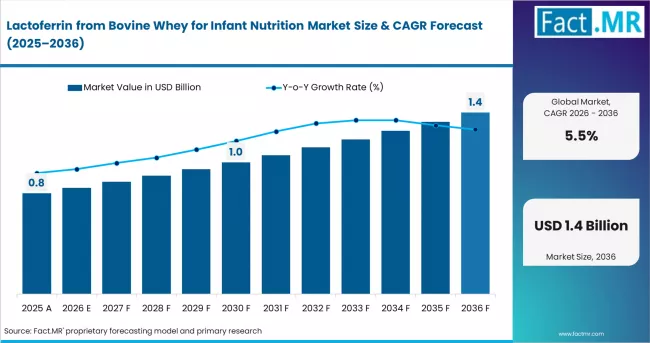
Lactoferrin From Bovine Whey For Infant Nutrition Market Market Value Analysis | Source: Fact.MR
| Metric | Value |
|---|---|
| Estimated Value in 2026 | USD 0.8 billion |
| Forecast Value in 2036 | USD 1.4 billion |
| Forecast CAGR (2026 to 2036) | 5.5 |
Source: Fact.MR analysis. Updated Apr 14, 2026
Summary of Lactoferrin from Bovine Whey for Infant Nutrition Market
- Market Definition
- The market covers bovine whey-derived lactoferrin supplied as food-grade and pharmaceutical-grade spray-dried and freeze-dried ingredient to infant formula and dietary supplement manufacturers globally.
- Demand Drivers
- China's GB standards and premiumisation are accelerating lactoferrin adoption in infant formula.
- United States demand is rising with GRAS approvals and preventive health awareness.
- India drives regulatory demand through FSSAI mandates.
- Key Segments Analyzed
- By Application: Infant formula leads with 49% share in 2026, driven by lactoferrin's closeness to human milk composition and clinical evidence for immunity and iron absorption benefits.
- By Product Type: Spray-dried leads with 66% share, preferred for ease of incorporation into infant formula dry blending processes and cost-effective large-volume supply.
- By Grade: Food-grade holds 68% share, serving the bulk of infant formula and functional food applications. Pharmaceutical-grade is the fastest-growing segment.
- By Geography: China leads at 9.5% CAGR through updated GB standards and middle-class demand. Australia and the U.S. anchor premium production supply.
- Analyst Opinion at FACT.MR
- Shambhu Nath Jha, Principal consultant at Fact.MR opines that producers must diversify into precision fermentation, as whey-based supply limits will create pricing and volume constraints amid rising demand.
- Strategic Implications
- Invest in fermentation alongside whey extraction to overcome supply limits.
- Expand pharmaceutical-grade offerings with clinical validation.
- Secure FSANZ, FDA, and FSSAI approvals for multi-market access.
- Methodology
- Market sizing is based on production volumes, pricing, and validated company data.
- Forecasts incorporate premiumisation trends, regulatory shifts, and expert interviews.
The market is projected to generate approximately USD 0.6 billion in incremental revenue between 2026 and 2036, reflecting steady, premium-led expansion. Growth is fundamentally supported by the ongoing premiumisation of infant formula, particularly in China and United States, where lactoferrin serves as a critical bioactive differentiator associated with immunity and gut health benefits. However, volume expansion remains structurally constrained by upstream supply limitations, as bovine whey extraction yields are inherently low at roughly 0.1 mg of lactoferrin per ml of cow’s milk, creating a persistent supply bottleneck that moderates overall market scaling despite strong downstream demand.
Country-level performance reflects regulatory rigor, consumer health awareness, and dairy infrastructure maturity. China leads at 9.5% CAGR through 2036, driven by updated GB standards and strong middle-class demand for premium formula. United States follows at 8.3%, supported by preventive health trends and expanded lactoferrin production capacity. South Korea records 8.1% amid high preference for science-backed ingredients. Australia grows at 8.0% due to export strength and regulatory approvals, while United Kingdom posts 7.6%, supported by favorable regulations and rising demand for immune-focused infant nutrition.
Segmental Analysis
Lactoferrin from Bovine Whey for Infant Nutrition Market Analysis by Application
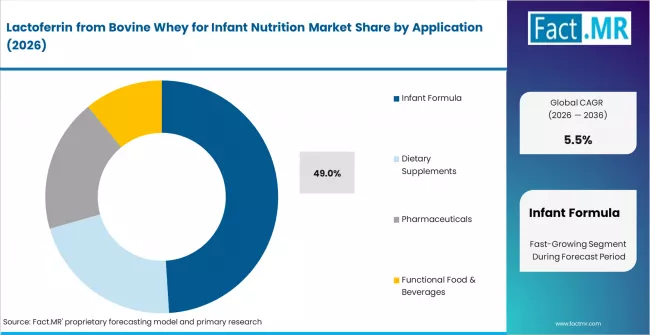
Lactoferrin From Bovine Whey For Infant Nutrition Market Analysis By Application | Source: Fact.MR
Based on FACT.MR's lactoferrin from bovine whey for infant nutrition market report, infant formula applications hold 49% share in 2026. Lactoferrin’s similarity to human milk and its antimicrobial and iron absorption benefits make it a key differentiator for premium infant formula brands across China, South Korea, and the United States.
- FrieslandCampina GRAS Confirmation: In January 2025, FrieslandCampina Ingredients confirmed Vivinal Lactoferrin’s GRAS status for certain U.S. infant and toddler formula applications. This enables wider commercial use by manufacturers. The company operates the world’s largest bovine lactoferrin facility in Veghel, Netherlands. The facility has 80 metric tonnes annual capacity. [3]
- Dietary Supplement Growth: In September 2024, Helaina raised USD 45 million in Series B funding. This supports the launch of effera. The product targets women’s health, active nutrition, and healthy aging. This signals expansion beyond infant formula. [6]
- China Formula Demand: China’s SAMR approved nearly 600 infant formulas by end of 2023 under updated GB standards. By 2024, more than 1,028 formulas received GB-compliant registrations. Premium brands are gaining share through bioactive ingredients like lactoferrin. [7]
Lactoferrin from Bovine Whey for Infant Nutrition Market Analysis by Product Type
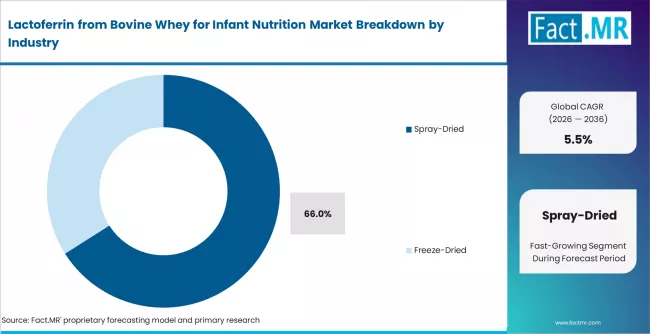
Lactoferrin From Bovine Whey For Infant Nutrition Market Analysis By Product Type | Source: Fact.MR
Based on FACT.MR’s analysis, spray-dried lactoferrin holds 66% share in 2026. Spray drying preserves biological activity. It also produces powder suitable for infant formula blending. FrieslandCampina uses this method to ensure purity and usability.
- FrieslandCampina Spray-Dry Expansion: FrieslandCampina expanded its Veghel facility in 2023. Capacity reached 80 metric tonnes annually. The expansion uses spray drying technology. The company cites improved biological purity for infant formula. The facility runs on green electricity. It also ensures full supply traceability.
- Freeze-Dried Technology Advance: De Novo Foodlabs secured USD 1.5 million in August 2024. The funding supports NanoFerrin development. This is a fermentation-derived lactoferrin. It is produced in freeze-dried form. It targets pharmaceutical and high-purity supplement use.
- Spray-Dry Supply Logistics: Synlait produced about 37 metric tonnes in 2022. Production occurred at its Dunsandel facility. The output supported infant formula markets across China, Australia, and North America. The company operates under SAMR and FSANZ approvals. [8]
Drivers, Restraints, and Opportunities
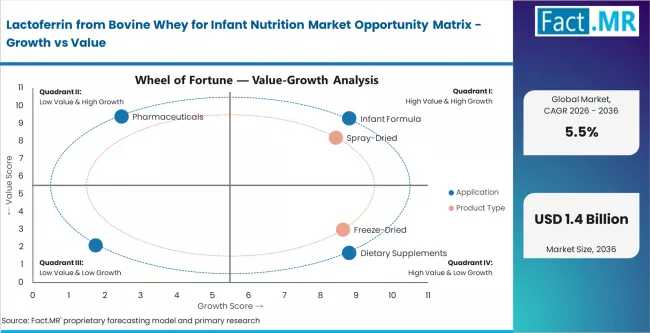
Lactoferrin From Bovine Whey For Infant Nutrition Market Opportunity Matrix Growth Vs Value | Source: Fact.MR
FACT.MR analysts note that bovine whey lactoferrin is now a core bioactive ingredient. It is widely used in global infant formula. Pricing ranges from USD 300 to USD 3,000 per kg. Supply remains constrained due to limited extraction from bovine milk. Spray-dried food-grade lactoferrin faces no substitution pressure.
This is due to regulatory approval and clinical validation. However, supply is tightening as inclusion rates increase. Precision fermentation is emerging as an alternative. FrieslandCampina and Triplebar Bio are advancing this route. Whey-derived lactoferrin continues to command premium pricing. This will continue until fermentation reaches scale.
- China GB Standards Regulatory Driver: China’s National Health Commission introduced GB 5009.299-2024. This standard defines lactoferrin measurement methods. It also released GB 25596-2025. This updates infant formula standards. These changes reinforce regulatory adoption. More than 130 manufacturers are impacted. [1] [2]
- U.S. GRAS Regulatory Expansion: FrieslandCampina Ingredients received GRAS confirmation in January 2025. This applies to Vivinal Lactoferrin in U.S. infant formula. It enables broader use across manufacturers.
- Precision Fermentation Supply Pipeline: In March 2024, FrieslandCampina partnered with Triplebar Bio. The goal is fermentation-derived lactoferrin. In February 2025, Vivici raised EUR 32.5 million. Funding came from APG/ABP, DSM-Firmenich, and Fonterra. This supports scale-up of alternative dairy proteins. [4] [5]
Regional Analysis
The lactoferrin from bovine whey for infant nutrition market is assessed across East Asia, North America, Europe, Oceania, South Asia, and Middle East and Africa, covering 40 or more countries with distinct demand profiles shaped by infant formula regulation intensity, premium formula adoption rates, dairy extraction infrastructure, and bioactive ingredient clinical validation acceptance. The full report provides market attractiveness analysis by region and country.
.webp "Top Country Growth Comparison Lactoferrin From Bovine Whey For Infant Nutrition Market Cagr (2026 2036)")
Top Country Growth Comparison Lactoferrin From Bovine Whey For Infant Nutrition Market Cagr (2026 2036) | Source: Fact.MR
| Country | CAGR (2026 to 2036) |
|---|---|
| China | 9.5% |
| United States | 8.3% |
| South Korea | 8.1% |
| Australia | 8.0% |
| United Kingdom | 7.6% |
Source: Fact.MR analysis. Updated Apr 14, 2026
Source: Fact.MR (FACT.MR) analysis, based on proprietary forecasting model and primary research
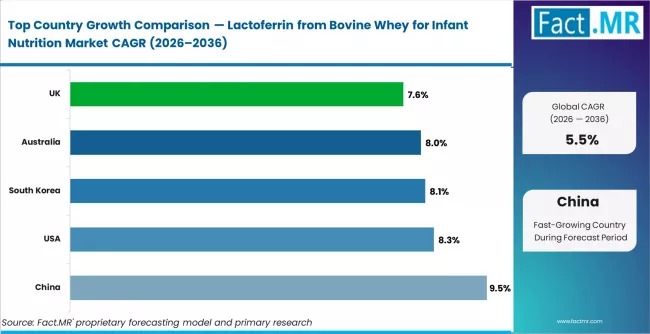
Lactoferrin From Bovine Whey For Infant Nutrition Market Cagr Analysis By Country | Source: Fact.MR
Asia Pacific Lactoferrin from Bovine Whey for Infant Nutrition Market Analysis
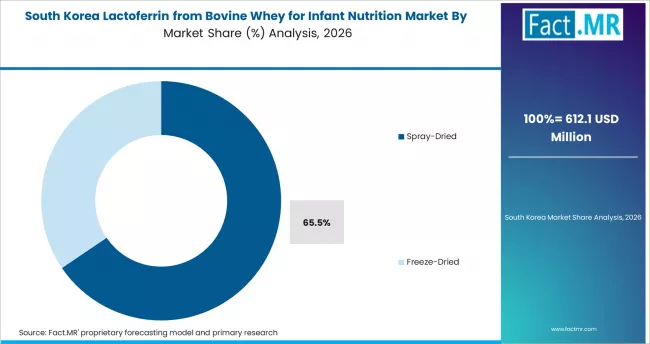
Lactoferrin From Bovine Whey For Infant Nutrition Market South Korea Market Share Analysis By Product Type | Source: Fact.MR
Asia Pacific is the largest and fastest-growing region. Growth is driven by regulatory upgrades in China and premium formula demand in South Korea. Fonterra, FrieslandCampina, and Synlait supply through import channels and long-term contracts.
- China: Growth advances at 9.5% CAGR through 2036. Regulatory updates are the main driver. GB 5009.299-2024 standardised lactoferrin testing in formula. GB 25596-2025 further strengthened nutrient standards. Over 130 registered manufacturers are expanding lactoferrin use. Procurement is tied to GB registration timelines and long-term supply agreements.
- South Korea: Expansion continues at 8.1% CAGR through 2036. Consumers show strong preference for clinically validated ingredients. MFDS guidelines require substantiated health claims. Premium brands such as Maeil Dairies and Namyang rely on lactoferrin differentiation. Imports from FrieslandCampina and Fonterra ensure supply stability.
- Australia: Growth progresses at 8.0% CAGR through 2036. FSANZ approved lactoferrin use in infant formula in 2023 under Application A1253. Maximum usage is set at 40 mg per 100 kJ. Synlait secured early commercial advantage. Strong dairy infrastructure and export approvals support supply to China and domestic markets.
FACT.MR's analysis covers China, Japan, Australia, and South Korea. Readers can find GB regulatory data, premium formula trends, and supplier contract insights.
North America Lactoferrin from Bovine Whey for Infant Nutrition Market Analysis
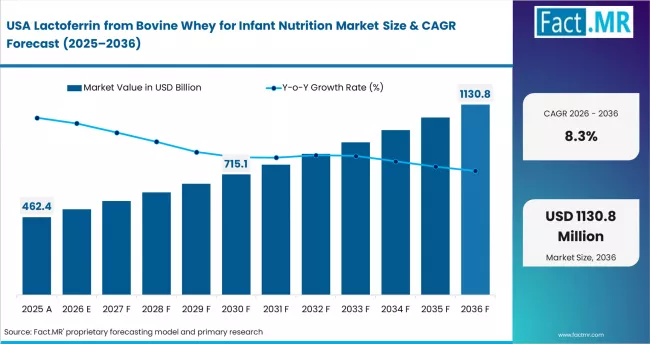
Lactoferrin From Bovine Whey For Infant Nutrition Market Country Value Analysis | Source: Fact.MR
North America is a growing premium ingredient market. GRAS approvals and preventive health trends are expanding lactoferrin use. FrieslandCampina DOMO, Glanbia, and Ingredia supply major formula manufacturers.
- United States: Momentum builds at 8.3% CAGR through 2036. GRAS confirmation of Vivinal Lactoferrin in January 2025 expanded supplier access. The infant formula market exceeds USD 4 billion. Brands such as Abbott, Mead Johnson, and Nestlé are increasing bioactive ingredient use. FDA GRAS pathways provide predictable regulatory access.
FACT.MR's analysis covers United States, Canada, and Mexico. Readers can find GRAS data, market structure insights, and adoption benchmarks.
Europe Lactoferrin from Bovine Whey for Infant Nutrition Market Analysis
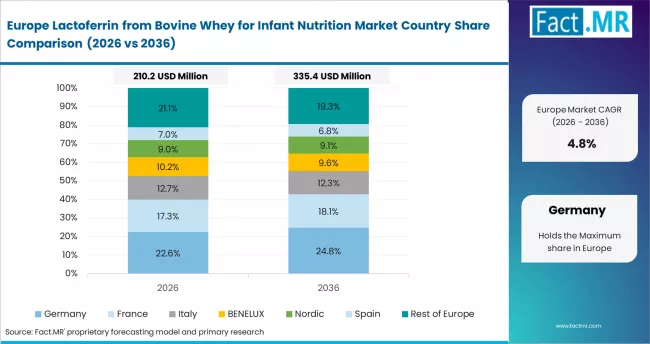
Lactoferrin From Bovine Whey For Infant Nutrition Market Europe Country Market Share Analysis, 2026 & 2036 | Source: Fact.MR
Europe is a regulation-driven production and consumption region. EFSA opinions support ingredient approval. Dairy infrastructure in the Netherlands and Scandinavia supports supply. FrieslandCampina leads global production.
- United Kingdom: Growth holds at 7.6% CAGR through 2036. The UK Food Standards Agency maintains alignment with EFSA safety opinions. Demand for premium formula is rising in retail and pharmacy channels. Brands such as Aptamil and SMA emphasise immune-support benefits. Supply is sourced from Dutch and New Zealand producers. Retail-led procurement drives ingredient specification.
FACT.MR's analysis covers Germany, France, United Kingdom, Italy, Spain, and Rest of Europe. Readers can find EFSA data, regulatory comparisons, and supply benchmarks.
Competitive Aligners for Market Players
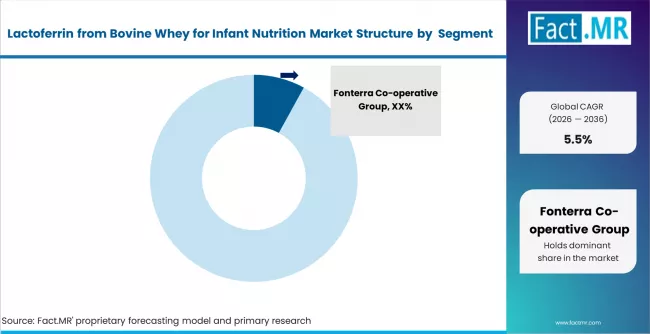
Lactoferrin From Bovine Whey For Infant Nutrition Market Analysis By Company | Source: Fact.MR
The lactoferrin from bovine whey for infant nutrition market exhibits a moderately concentrated structure, with a small group of leading dairy ingredient producers controlling the majority of global supply. Fonterra, FrieslandCampina Ingredients, Synlait, and Bega Cheese together account for over 65% of total production. Competitive dynamics in this market are shaped less by pricing pressures and more by factors such as extraction efficiency, production scalability, and the ability to secure regulatory approvals across key infant formula markets. Structural supply limitations remain a defining feature, as bovine milk contains only about 0.1 mg of lactoferrin per ml, inherently restricting output and sustaining premium pricing across the value chain.
Among these players, FrieslandCampina Ingredients holds a notable advantage due to its large-scale production capabilities and established regulatory footprint. Its facility in Veghel, the Netherlands, is the world’s largest bovine lactoferrin production site, supported by GRAS status in the U.S. and long-standing supply agreements with major infant formula manufacturers. Fonterra leverages its extensive milk supply network in New Zealand and has taken a forward-looking approach by investing in Vivici, signaling intent to diversify production through precision fermentation technologies. Meanwhile, Synlait strengthens its position through dedicated spray-drying infrastructure and multi-region regulatory approvals, including FSANZ and SAMR.
Large infant formula companies such as Abbott, Danone, Nestlé, and Mead Johnson mitigate supply risk through dual sourcing strategies and long-term procurement agreements. Regulatory frameworks, particularly in China, create high switching barriers, ensuring supplier continuity and stable revenue streams for approved producers.
Key Players
- Fonterra Co-operative Group
- FrieslandCampina DOMO
- Glanbia Plc
- Synlait Ltd.
- Ingredia
- Milei GmbH
- Beston Global Food
- Saputo Inc.
- Savencia SA
Bibliography
- [1] National Health Commission of China. GB 5009.299-2024 National Food Safety Standard: Determination of Lactoferrin in Food HPLC Method for Bovine Lactoferrin in Infant Formula and Modified Milk Products. 2024. codeofchina.com/standard/GB5009.299-2024
- [2] National Health Commission and State Administration for Market Regulation, China. GB 25596-2025 National Food Safety Standard: General Principles for FSMP Infant Formula 50 New National Food Safety Standards Released. March 2025. cirs-group.com/en/food/china-new-fsmp-infant-formula-standard
- [3] FrieslandCampina Ingredients. Vivinal Lactoferrin GRAS Confirmation for U.S. Infant and Toddler Formula Applications and Capacity Overview: 80 Metric Tonnes Annual Production at Veghel Netherlands Facility. January 2025. frieslandcampinaingredients.com
- [4] FrieslandCampina Ingredients and Triplebar Bio. Precision Fermentation-Derived Lactoferrin Breakthrough Announcement: Commercial Scale Production Partnership to Address Bovine Milk Extraction Volume Constraints. March 2024. foodnavigator.com/Article/2024/03/21/frieslandcampina-invests-in-lactoferrin-made-by-precision-fermentation
- [5] Vivici. Series A Funding Round: EUR 32.5 Million Raised from APG/ABP, Invest-NL, DSM-Firmenich, and Fonterra to Accelerate Global Expansion of Precision Fermentation-Derived Dairy Proteins. February 2025. mordorintelligence.com/industry-reports/lactoferrin-market
- [6] Helaina Inc. Series B Funding Round: USD 45 Million Raised from Avidity Partners to Support Commercial Launch of effera Human Lactoferrin for Women's Health and Active Nutrition Markets. September 2024. databridgemarketresearch.com/reports/global-lactoferrin-market
- [7] State Administration for Market Regulation, China. Summary of GB Standards Implementation Data: 592 Infant Formulas Approved in 2023, Cumulative 1,028 Registrations Under New GB Standards. June 2024. nutraingredients.com/Article/2024/07/03/china-approved-nearly-600-infant-formulas-in-2023
- [8] Food Standards Australia New Zealand. Application A1253 Approval: Voluntary Use of Bovine Lactoferrin as Nutritive Substance in Infant Formula at Maximum 40 mg/100 kJ Submitted by Synlait Milk Ltd. February 2023. food.chemlinked.com/news/food-news/australia-and-new-zealand-approves-the-use-of-bovine-lactoferrin
This Report Addresses
- Strategic insights on lactoferrin demand across infant formula, dietary supplements, pharmaceuticals, and functional foods, covering regulatory pathways, supply constraints, and premiumisation trends.
- Market forecast from USD 0.8 billion in 2026 to USD 1.4 billion by 2036, reflecting a CAGR of 5.5%.
- Growth opportunity mapping across China GB-driven premiumisation, United States GRAS expansion, South Korea bioactive demand, Australia FSANZ approvals, and United Kingdom regulatory access.
- Segment analysis by application, product type (spray-dried, freeze-dried), grade (food, pharma), and function (iron absorption, gut health, antimicrobial, immune support).
- Regional outlook covering East Asia demand growth, North America expansion, Europe supply leadership, and Oceania export-driven infrastructure.
- Competitive analysis of Fonterra, FrieslandCampina, Synlait, Glanbia, Ingredia, Milei GmbH, Savencia, Beston Global Food, and Saputo.
- Technology tracking including precision fermentation, spray vs freeze drying, pharmaceutical-grade purification, and scale-up timelines.
- Report available in PDF, Excel, and presentation formats, supported by primary research and regulatory databases (2024–2025).
Lactoferrin from Bovine Whey for Infant Nutrition Market Definition
The lactoferrin from bovine whey for infant nutrition market covers extraction, processing, and supply of lactoferrin, an iron-binding glycoprotein derived from dairy whey byproducts. Supplied in spray-dried and freeze-dried forms, it is used as a premium bioactive ingredient in infant formula to enhance iron absorption, support gut microbiota, and provide antimicrobial protection.
Lactoferrin from Bovine Whey for Infant Nutrition Market Inclusions
Includes global and regional forecasts from 2026 to 2036 by application, product type, grade, and function. Covers food-grade and pharmaceutical-grade bovine whey lactoferrin across infant formula, dietary supplements, pharmaceuticals, and functional foods.
Lactoferrin from Bovine Whey for Infant Nutrition Market Exclusions
Excludes lactoferrin from non-bovine sources and precision fermentation-derived variants. Also excludes finished infant formula products, focusing only on bovine whey lactoferrin as an ingredient.
Lactoferrin from Bovine Whey for Infant Nutrition Research Methodology
- Primary Research: Interviews with infant formula procurement managers, ingredient buyers, and dairy R&D teams across China, United States, South Korea, Australia, and United Kingdom.
- Desk Research: Analysis of FSANZ, FSSAI, FDA GRAS, Chinese GB standards, EFSA, and disclosures from Fonterra, FrieslandCampina, and Synlait (2024–2025).
- Market Sizing and Forecasting: Based on whey lactoferrin production volumes, pricing by grade and form, and infant formula demand using a hybrid top-down and bottom-up model.
- Data Validation and Update Cycle: Validated through capacity data, regulatory approvals, and expert inputs, with regular updates.
Segmentation
Scope of Report
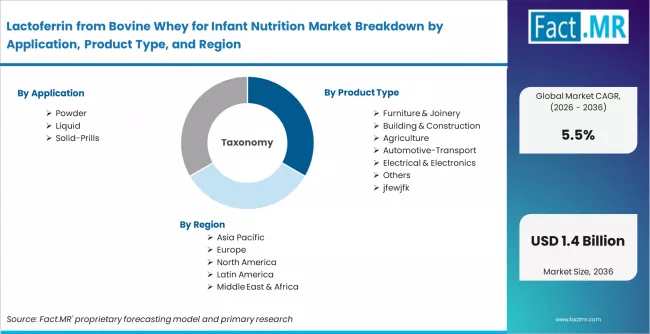
Lactoferrin From Bovine Whey For Infant Nutrition Market Breakdown By Application, Product Type, And Region | Source: Fact.MR
| Attribute | Details |
|---|---|
| Quantitative Units | USD 0.8 billion (2026) to USD 1.4 billion (2036), at a CAGR of 5.5% |
| Market Definition | Lactoferrin an iron-binding glycoprotein extracted from bovine whey as a dairy byproduct and supplied in spray-dried and freeze-dried powder forms as a bioactive ingredient to infant formula manufacturers, dietary supplement producers, and pharmaceutical companies globally. |
| Application Segmentation | Infant Formula, Dietary Supplements, Pharmaceuticals, Functional Food & Beverages |
| Product Type Segmentation | Spray-Dried, Freeze-Dried |
| Grade Segmentation | Food-Grade, Pharmaceutical-Grade |
| Function Segmentation | Iron Absorption, Gut Health & Microbiome, Antimicrobial, Immune Support |
| Application Coverage | Premium infant formula bioactive fortification, dietary supplement immune support, pharmaceutical-grade clinical nutrition, functional food iron enrichment, and toddler formula health positioning. |
| Regions Covered | North America, Europe, East Asia, South Asia and Pacific, Oceania, Middle East and Africa |
| Countries Covered | USA, Canada, Mexico, Germany, UK, France, Italy, Spain, Nordic, BENELUX, China, Japan, South Korea, India, ASEAN, Australia and New Zealand, Brazil, Argentina, Saudi Arabia, GCC, Turkey, South Africa, Rest of MEA |
| Key Companies Profiled | Fonterra Co-operative Group, FrieslandCampina DOMO, Glanbia Plc, Synlait Ltd., Ingredia, Milei GmbH, Beston Global Food, Saputo Inc., Savencia SA |
| Forecast Period | 2026 to 2036 |
| Approach | Hybrid top-down and bottom-up model using bovine whey lactoferrin production volumes by grade and form, average selling prices, infant formula application demand benchmarks, regulatory approval databases, and primary interviews with dairy ingredient buyers and infant formula procurement managers. |
Source: Fact.MR analysis. Updated Apr 14, 2026
Lactoferrin from Bovine Whey for Infant Nutrition Market by Segments
-
By Application:
- Infant Formula
- Dietary Supplements
- Pharmaceuticals
- Functional Food & Beverages
-
By Product Type:
- Spray-Dried
- Freeze-Dried
-
By Grade:
- Food-Grade
- Pharmaceutical-Grade
-
By Function:
- Iron Absorption
- Gut Health & Microbiome
- Antimicrobial
- Immune Support
-
By Region:
- North America
- United States
- Canada
- Mexico
- Latin America
- Brazil
- Mexico
- Argentina
- Chile
- Rest of Latin America
- Western Europe
- Germany
- United Kingdom
- France
- Italy
- Spain
- Nordic Countries
- BENELUX
- Rest of Western Europe
- Eastern Europe
- Russia
- Poland
- Hungary
- Balkan and Baltic
- Rest of Eastern Europe
- East Asia
- China
- Japan
- South Korea
- South Asia and Pacific
- India
- ASEAN
- Australia and New Zealand
- Rest of South Asia and Pacific
- Middle East and Africa
- Kingdom of Saudi Arabia
- Other GCC Countries
- Turkey
- South Africa
- Rest of Middle East and Africa
- North America
Frequently Asked Questions
How large is the lactoferrin from bovine whey for infant nutrition market in 2025?
What will the market size be in 2026?
What is the projected market size by 2036?
What is the expected CAGR of the lactoferrin from bovine whey for infant nutrition market?
What is the absolute dollar opportunity in this market?
Which application segment leads the market?
Which product type segment holds the largest share?
Which country shows the fastest growth?
Which grade segment is growing fastest?
Who worked on this report


Preview the report firsthand - request a free sample
Free SampleGet the brochure for pricing and purchase details
Download PDF