Ladle and Tundish Auxiliary Products Market (2026 - 2036)

Ladle and Tundish Auxiliary Products Market Size and Share Forecast Outlook 2026 to 2036

Core Findings

    Ladle and Tundish Auxiliary Products Market Forecast Outlook 2026 to 2036

    The ladle and tundish auxiliary products market is projected to reach USD 2.7 billion in 2026, growing to USD 3.9 billion by 2036, with a CAGR of 3.7%.

    Key Takeaways from Ladle and Tundish Auxiliary Products Market

    • Ladle and Tundish Auxiliary Products Market Value (2026): USD 2.7 billion
    • Ladle and Tundish Auxiliary Products Market Forecast Value (2036): USD 3.9 billion
    • Ladle and Tundish Auxiliary Products Market Forecast CAGR (2026 to 2036): 3.7%
    • Leading Segment in Ladle and Tundish Auxiliary Products Market: Integrated (BF-BOF) Steelmaking Route (62%)
    • Key Growth Region in Ladle and Tundish Auxiliary Products Market: Asia Pacific
    • Key Players in Ladle and Tundish Auxiliary Products Market: Vesuvius plc, RHI Magnesita N.V., Krosaki Harima Corporation, Shinagawa Refractories Co., Ltd., Calderys, SaintGobain S.A., Morgan Advanced Materials plc, Refratechnik GmbH, POSCO Chemical Co., Ltd., Harima Ceramics Co., Ltd.
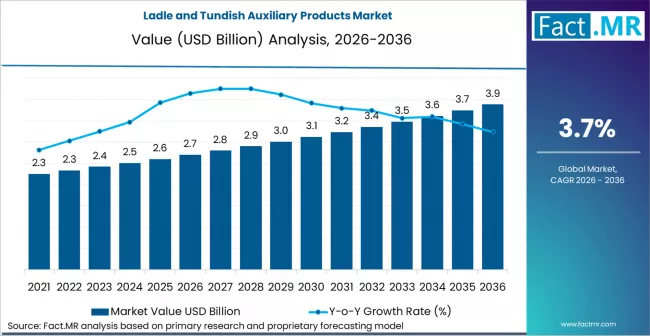
    Ladle And Tundish Auxiliary Products Market Market Value Analysis

    Procurement priorities in this market are shaped by a focus on product reliability and performance, with buyers emphasizing long-term cost-effectiveness and minimizing downtime in steel production. Risk aversion drives many buyers to favor established suppliers with a proven track record, which often leads to vendor lock-in. This reduces flexibility, as switching suppliers can incur significant costs, not only in terms of procurement but also in adjusting production systems to new equipment.

    Switching costs further complicate decisions, as new suppliers may require additional training, integration efforts, or process re-engineering. As such, procurement strategies are often centered on ensuring continuity and stability rather than short-term cost savings, with strong emphasis placed on long-term supplier relationships and the reliability of auxiliary products in critical steel production processes.

    Ladle and Tundish Auxiliary Products Market

    Metric Value
    Estimated Value in (2026E) USD 2.7 billion
    Forecast Value in (2036F) USD 3.9 billion
    Forecast CAGR (2026 to 2036) 3.7%

    Category

    Category Segments
    Product Type Slide Gates and Nozzles; SENs or Shrouds and Pour Tubes; Porous Plugs and Argon Purging; Tundish Furniture Auxiliaries
    Steelmaking Route Integrated (BF-BOF); Electric Arc Furnace
    Steel Grade Carbon Steel; Alloy Steel; Stainless Steel
    Casting Product Slab; Bloom; Billet
    Purchase Mode Standalone Components; Bundled with Refractories or Services
    Region North America; Europe; Asia Pacific; Latin America; Middle East & Africa

    Segmental Analysis: Ladle and Tundish Auxiliary Products Market

    What is the Analysis of the Steelmaking Route Segment in the Ladle and Tundish Auxiliary Products Market?
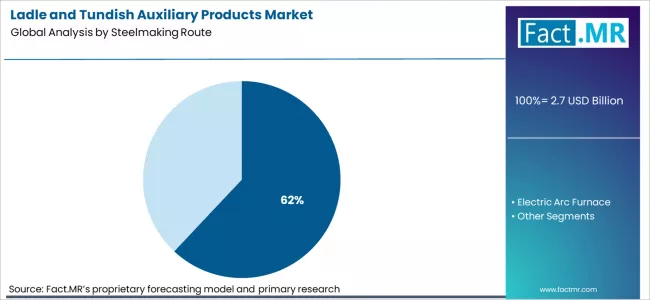
    Ladle And Tundish Auxiliary Products Market Analysis By Steelmaking Route

    The steelmaking route significantly influences the demand for ladle and tundish auxiliary products. The Integrated (BF-BOF) route holds a 62% market share in 2026. This dominant share is attributed to the large-scale integrated mills, particularly in the Asia-Pacific region, which require frequent replacement of tundish linings and ladle shrouds due to consistent throughput. In contrast, the Electric Arc Furnace (EAF) segment accounts for 38% of the market share. While smaller in volume, this segment is expanding due to the global push for decarbonized steel production. EAF operations involve more frequent thermal cycles, resulting in higher demands for auxiliary refractories that can withstand thermal shock. The transition toward EAF in response to decarbonization mandates is contributing to the market share growth of this segment.

    What is the Analysis of the Steel Grade Segment in the Ladle and Tundish Auxiliary Products Market?
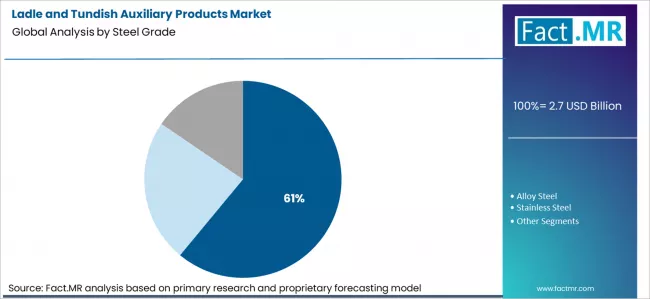
    Ladle And Tundish Auxiliary Products Market Analysis By Steel Grade

    The steel grade segment plays a crucial role in determining the type of ladle and tundish auxiliary products used in steel production. Carbon Steel accounts for the largest share, holding 61% of the market in 2026. This segment requires standard auxiliary products, which are used in high-volume applications in construction and infrastructure. Alloy Steel follows with a 24% market share. This segment focuses on specialized products designed to minimize inclusions and gas pick-up, including argon purging plugs and high-alumina ladle refractories. Stainless Steel, requiring the most specialized auxiliary products, holds 15% of the market share. The products used in this segment, such as basic tundish flux and magnesia-carbon bricks, are essential for maintaining the precise chromium and nickel balance required for corrosion resistance, crucial for high-quality stainless steel production.

    Country

    Country Drivers Restraints Trends
    USA Steady steel production and continuous casting processes sustain demand for ladle shrouds, nozzles, and tundish products to ensure high throughput and quality. High energy and maintenance costs limit frequent upgrades of auxiliary components. Shift toward longerlife refractory and precision nozzles to reduce downtime.
    China Largest global steel output increases consumption of ladle and tundish auxiliaries for efficient flow control and reduced reoxidation. Raw material supply constraints and environmental inspection pressures can disrupt refractory supplies. Rapid expansion of continuous casting capacity drives new auxiliary product adoption.
    India Growing integrated steel capacity and casting installations raise requirement for tundish and ladle consumables. Limited local production of specialized refractories drives reliance on imports. Rising use of advanced shrouds and flow control products as industry modernizes.
    Germany Advanced metallurgical processes and quality standards support steady auxproduct usage in steel and foundry sectors. Stringent environmental compliance increases operating costs for auxiliary product use. Increased use of engineered refractory consumables to optimize casting quality.
    Japan Highly automated steelmaking and precision casting demand consistent quality from ladle and tundish consumables. Slow growth in crude steel output restrains incremental consumable demand. Continued preference for highperformance, longerlasting auxiliary products.
    South Korea Strong steel and heavy industry drive demand for auxiliary flow control and refractory products. Volatile raw material pricing affects cost of ladle and tundish components. Adoption of innovative materials that improve casting efficiency.
    Brazil Expanding steel and metals processing supports auxiliary product demand for casting processes. Economic volatility can delay capital expenditures on new equipment and consumables. Focus on durable tundish linings and optimized flow control products to boost uptime.

    Analysis of the Ladle and Tundish Auxiliary Products Market by Key Country
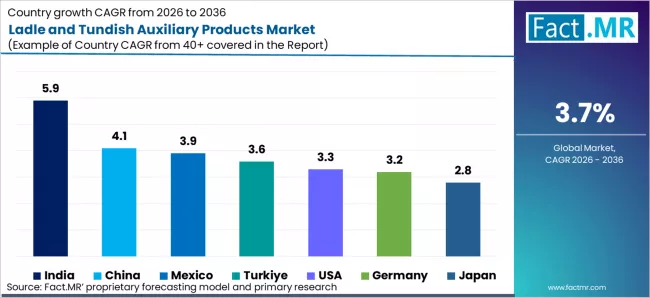
    Ladle And Tundish Auxiliary Products Market Cagr Analysis By Country

    Country CAGR (Forecast Period)
    USA 3.3%
    China 4.1%
    India 5.9%
    Germany 3.2%
    Japan 2.8%
    Mexico 3.9%
    Turkiye 3.6%

    The report covers an in-depth analysis of 40+ countries; top-performing countries are highlighted below.

    What Factors Drive Growth in the USA Ladle and Tundish Auxiliary Products Market?

    The 3.3% growth in the USA ladle and tundish auxiliary products market is driven by the modernization of domestic steel mills supported by federal infrastructure spending and protective trade policies. Domestic steel production is stabilizing, and U.S. mills are prioritizing clean steel technologies, which require specialized ladle purging plugs and tundish nozzles. These products offer superior gas-tightness and wear resistance, essential for high-performance casting. The Occupational Safety and Health Administration (OSHA) enforces safety standards for high-temperature fluid handling, prompting the adoption of automated ladle slide gate systems. This focus on reshoring for the automotive and renewable energy sectors ensures steady demand for auxiliary products.

    What Drives Growth in the China Ladle and Tundish Auxiliary Products Market?

    China's 4.1% growth in the ladle and tundish auxiliary products market is driven by the Ministry of Industry and Information Technology (MIIT) and the Work Plan for Stabilizing Growth in the Steel Industry. This plan targets quality and structural optimization while restricting the expansion of inefficient production capacity. Chinese mills are investing in advanced ladle shroud systems and alumina-carbon well blocks for ultra-low emission upgrades. With the reintroduction of export licenses for over 300 steel products, there is a strong push for producing higher-quality steel. This drives demand for auxiliary products that can withstand longer casting sequences and more aggressive slag chemistry.

    How Does India Achieve Growth in the Ladle and Tundish Auxiliary Products Market?

    India's ladle and tundish auxiliary products market is expected to grow at 5.9%, supported by the National Steel Policy 2017, which targets a crude steel capacity of 300 Million Tonnes by 2030. The Production Linked Incentive (PLI) Scheme incentivizes specialty steel production, requiring high-precision tundish flow control devices and specialized nozzle filling sands. India’s focus on infrastructure and urbanization further boosts demand for auxiliary products that support continuous casting in growing steel clusters. With per capita steel consumption below the global average, India is positioned for sustained growth in the metallurgical sector, ensuring long-term demand for auxiliary products.

    What Influences Growth in the Germany Ladle and Tundish Auxiliary Products Market?

    Germany's 3.2% growth rate in the ladle and tundish auxiliary products market is shaped by a shift toward climate-neutral steel manufacturing driven by the German Steel Association and the Federal Ministry of Economic Affairs (BMWK). The transition to Hydrogen-based Direct Reduction (H-DRI) and Electric Arc Furnace (EAF) routes requires specialized ladle and tundish consumables that can handle the unique thermal and chemical stresses of secondary metallurgy in EAF-based shops. The phase-out of free EU ETS emission certificates by 2026 further incentivizes the adoption of high-efficiency flow control systems, driving demand for premium auxiliary products.

    How Does Japan Achieve Growth in the Ladle and Tundish Auxiliary Products Market?

    Japan’s 2.8% growth in the ladle and tundish auxiliary products market is driven by the Ministry of Economy, Trade and Industry (METI) through its Manufacturing Industry X vision, which emphasizes high-value-added production and digital transformation. Japanese steelmakers are integrating AI-driven monitoring for casting processes, creating a demand for ladle and tundish auxiliary products compatible with smart refractory management systems. METI’s focus on decarbonization technologies promotes the development of energy-efficient nozzle systems and longer-life flow control components, ensuring that Japan maintains its position as a leader in high-precision metallurgy.

    Why is the Mexico Ladle and Tundish Auxiliary Products Market Expanding?

    Mexico's 3.9% growth in the ladle and tundish auxiliary products market is driven by protectionist trade measures and increased public investment in steel-intensive projects. Starting in January 2026, Mexico’s steel tariffs will rise, promoting domestic production and enhancing the competitiveness of local mills. The government’s Plan Mexico to invest in steel-intensive infrastructure, including 3,000 km of new roads, supports the demand for ladle and tundish consumables. The expansion of port facilities and investments in transportation networks further enhance the logistics of domestic steel production, ensuring a steady supply of auxiliary products.

    How Does Turkiye Achieve Growth in the Ladle and Tundish Auxiliary Products Market?

    Turkiye’s 3.6% growth rate in the ladle and tundish auxiliary products market is supported by the country's strategic position as a global manufacturing hub and its robust construction sector. The Turkish government’s export target of $273.8 billion by 2025 drives demand for steel, necessitating high-capacity utilization in steel mills. The automotive and machinery sectors, which require high-quality continuous casting outcomes, contribute to increased consumption of auxiliary products like tundish impact pads and specialized dam systems. Investments in infrastructure and megaprojects ensure consistent demand for high-performance ladle and tundish maintenance materials.

    How Will the Shift to Autonomous Flow Control and Smart Refractories Reshape the Ladle and Tundish Auxiliary Market?
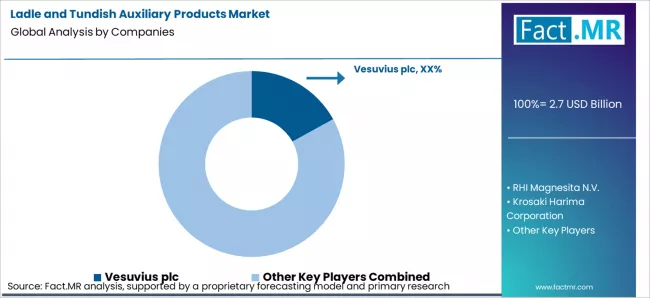
    Ladle And Tundish Auxiliary Products Market Analysis By Company

    The ladle and tundish auxiliary market is rapidly transitioning from traditional refractory supply to automated, data-synchronized flow control systems. In 2024-2025, RHI Magnesita led the charge by commissioning the first fully robotic solution for caster operations in India, reducing hazardous human intervention in tundish areas. This marks the beginning of autonomous flow management using AI-driven technologies. By 2026 and beyond, smart assemblies will replace traditional products like stoppers and nozzles, integrating real-time wear data to adjust casting speeds autonomously. Meanwhile, regional shifts like Calderys’ new facility in Saudi Arabia signal growing self-sufficiency in high-demand steel hubs. As decarbonized consumables become essential, carbon-per-ton-poured metrics will redefine product performance, positioning smart refractories as a critical factor for operational efficiency and sustainability. This transformation will decouple plant performance from manual labor constraints, reducing secondary metallurgy downtime by 15-20%.

    Key Players of the Ladle and Tundish Auxiliary Products Market

    • Vesuvius plc
    • RHI Magnesita N.V.
    • Krosaki Harima Corporation
    • Shinagawa Refractories Co., Ltd.
    • Calderys
    • Saint‑Gobain S.A.
    • Morgan Advanced Materials plc
    • Refratechnik GmbH
    • POSCO Chemical Co., Ltd.
    • Harima Ceramics Co., Ltd.

    Scope of the Report

    Items Values
    Quantitative Units (2026) USD Billion
    Product Type Slide Gates and Nozzles, SENs or Shrouds and Pour Tubes, Porous Plugs and Argon Purging, Tundish Furniture Auxiliaries
    Steelmaking Route Integrated (BF-BOF), Electric Arc Furnace
    Steel Grade Carbon Steel, Alloy Steel, Stainless Steel
    Casting Product Slab, Bloom, Billet
    Purchase Mode Standalone Components, Bundled with Refractories or Services
    Regions Covered North America, Europe, Asia Pacific, Latin America, Middle East & Africa
    Countries Covered United States, Canada, Mexico, Germany, United Kingdom, France, Japan, South Korea, China, India, Brazil, and other countries
    Key Companies Profiled Vesuvius plc, RHI Magnesita N.V., Krosaki Harima Corporation, Shinagawa Refractories Co., Ltd., Calderys, SaintGobain S.A., Morgan Advanced Materials plc, Refratechnik GmbH, POSCO Chemical Co., Ltd., Harima Ceramics Co., Ltd.
    Additional Attributes Dollar revenue by product type, steelmaking route, steel grade, casting product, purchase mode, and region; regional demand trends, competitive landscape, technological advancements in ladle and tundish auxiliary products, operational performance optimization initiatives, and product development strategies

    Ladle and Tundish Auxiliary Products Market Key Segments

    • Product Type

      • Slide Gates and Nozzles
      • SENs or Shrouds and Pour Tubes
      • Porous Plugs and Argon Purging
      • Tundish Furniture Auxiliaries
    • Steelmaking Route

      • Integrated (BF-BOF)
      • Electric Arc Furnace
    • Steel Grade

      • Carbon Steel
      • Alloy Steel
      • Stainless Steel
    • Casting Product

      • Slab
      • Bloom
      • Billet
    • Purchase Mode

      • Standalone Components
      • Bundled with Refractories or Services
    • Region

      • North America
        • USA
        • Canada
        • Mexico
      • Europe
        • Germany
        • UK
        • France
        • Italy
        • Spain
        • Nordic Countries
        • BENELUX
        • Rest of Europe
      • Asia Pacific
        • China
        • Japan
        • South Korea
        • India
        • Australia
        • Rest of Asia Pacific
      • Latin America
        • Brazil
        • Argentina
        • Rest of Latin America
      • Middle East and Africa
        • Kingdom of Saudi Arabia
        • United Arab Emirates
        • South Africa
        • Rest of Middle East and Africa
      • Other Regions
        • Oceania
        • Central Asia
        • Other Markets

    Bibliographies

    • European Commission, Joint Research Centre. (2023). Best available techniques (BAT) reference document for iron and steel production. European Union.
    • World Steel Association. (2024). Continuous casting operations: Ladle and tundish practices, flow control, and refractory consumption. World Steel Association.
    • International Organization for Standardization. (2023). Refractory materials for steelmaking-Classification, performance testing, and service life evaluation. ISO.
    • Bureau of Indian Standards. (2024). Refractory products for steel ladles and tundishes-Design, installation, and maintenance requirements. Government of India.
    • Occupational Safety and Health Administration. (2024). Safety considerations for molten metal handling, ladle systems, and tundish operations. U.S. Department of Labor.

    Table of Content

    1. Executive Summary
      • Global Market Outlook
      • Demand to side Trends
      • Supply to side Trends
      • Technology Roadmap Analysis
      • Analysis and Recommendations
    2. Market Overview
      • Market Coverage / Taxonomy
      • Market Definition / Scope / Limitations
    3. Research Methodology
      • Chapter Orientation
      • Analytical Lens and Working Hypotheses
        • Market Structure, Signals, and Trend Drivers
        • Benchmarking and Cross-market Comparability
        • Market Sizing, Forecasting, and Opportunity Mapping
      • Research Design and Evidence Framework
        • Desk Research Programme (Secondary Evidence)
          • Company Annual and Sustainability Reports
          • Peer-reviewed Journals and Academic Literature
          • Corporate Websites, Product Literature, and Technical Notes
          • Earnings Decks and Investor Briefings
          • Statutory Filings and Regulatory Disclosures
          • Technical White Papers and Standards Notes
          • Trade Journals, Industry Magazines, and Analyst Briefs
          • Conference Proceedings, Webinars, and Seminar Materials
          • Government Statistics Portals and Public Data Releases
          • Press Releases and Reputable Media Coverage
          • Specialist Newsletters and Curated Briefings
          • Sector Databases and Reference Repositories
          • FMR Internal Proprietary Databases and Historical Market Datasets
          • Subscription Datasets and Paid Sources
          • Social Channels, Communities, and Digital Listening Inputs
          • Additional Desk Sources
        • Expert Input and Fieldwork (Primary Evidence)
          • Primary Modes
            • Qualitative Interviews and Expert Elicitation
            • Quantitative Surveys and Structured Data Capture
            • Blended Approach
          • Why Primary Evidence is Used
          • Field Techniques
            • Interviews
            • Surveys
            • Focus Groups
            • Observational and In-context Research
            • Social and Community Interactions
          • Stakeholder Universe Engaged
            • C-suite Leaders
            • Board Members
            • Presidents and Vice Presidents
            • R&D and Innovation Heads
            • Technical Specialists
            • Domain Subject-matter Experts
            • Scientists
            • Physicians and Other Healthcare Professionals
          • Governance, Ethics, and Data Stewardship
            • Research Ethics
            • Data Integrity and Handling
        • Tooling, Models, and Reference Databases
      • Data Engineering and Model Build
        • Data Acquisition and Ingestion
        • Cleaning, Normalisation, and Verification
        • Synthesis, Triangulation, and Analysis
      • Quality Assurance and Audit Trail
    4. Market Background
      • Market Dynamics
        • Drivers
        • Restraints
        • Opportunity
        • Trends
      • Scenario Forecast
        • Demand in Optimistic Scenario
        • Demand in Likely Scenario
        • Demand in Conservative Scenario
      • Opportunity Map Analysis
      • Product Life Cycle Analysis
      • Supply Chain Analysis
      • Investment Feasibility Matrix
      • Value Chain Analysis
      • PESTLE and Porter’s Analysis
      • Regulatory Landscape
      • Regional Parent Market Outlook
      • Production and Consumption Statistics
      • Import and Export Statistics
    5. Global Market Analysis 2021 to 2025 and Forecast, 2026 to 2036
      • Historical Market Size Value (USD Million) Analysis, 2021 to 2025
      • Current and Future Market Size Value (USD Million) Projections, 2026 to 2036
        • Y to o to Y Growth Trend Analysis
        • Absolute $ Opportunity Analysis
    6. Global Market Pricing Analysis 2021 to 2025 and Forecast 2026 to 2036
    7. Global Market Analysis 2021 to 2025 and Forecast 2026 to 2036, By Product Type
      • Introduction / Key Findings
      • Historical Market Size Value (USD Million) Analysis By Product Type, 2021 to 2025
      • Current and Future Market Size Value (USD Million) Analysis and Forecast By Product Type, 2026 to 2036
        • Slide Gates and Nozzles
        • SENs or Shrouds and Pour Tubes
        • Porous Plugs and Argon Purging
        • Tundish Furniture Auxiliaries
      • Y to o to Y Growth Trend Analysis By Product Type, 2021 to 2025
      • Absolute $ Opportunity Analysis By Product Type, 2026 to 2036
    8. Global Market Analysis 2021 to 2025 and Forecast 2026 to 2036, By Steelmaking Route
      • Introduction / Key Findings
      • Historical Market Size Value (USD Million) Analysis By Steelmaking Route, 2021 to 2025
      • Current and Future Market Size Value (USD Million) Analysis and Forecast By Steelmaking Route, 2026 to 2036
        • Integrated (BF-BOF)
        • Electric Arc Furnace
      • Y to o to Y Growth Trend Analysis By Steelmaking Route, 2021 to 2025
      • Absolute $ Opportunity Analysis By Steelmaking Route, 2026 to 2036
    9. Global Market Analysis 2021 to 2025 and Forecast 2026 to 2036, By Steel Grade
      • Introduction / Key Findings
      • Historical Market Size Value (USD Million) Analysis By Steel Grade, 2021 to 2025
      • Current and Future Market Size Value (USD Million) Analysis and Forecast By Steel Grade, 2026 to 2036
        • Carbon Steel
        • Alloy Steel
        • Stainless Steel
      • Y to o to Y Growth Trend Analysis By Steel Grade, 2021 to 2025
      • Absolute $ Opportunity Analysis By Steel Grade, 2026 to 2036
    10. Global Market Analysis 2021 to 2025 and Forecast 2026 to 2036, By Casting Product
      • Introduction / Key Findings
      • Historical Market Size Value (USD Million) Analysis By Casting Product, 2021 to 2025
      • Current and Future Market Size Value (USD Million) Analysis and Forecast By Casting Product, 2026 to 2036
        • Slab
        • Bloom
        • Billet
      • Y to o to Y Growth Trend Analysis By Casting Product, 2021 to 2025
      • Absolute $ Opportunity Analysis By Casting Product, 2026 to 2036
    11. Global Market Analysis 2021 to 2025 and Forecast 2026 to 2036, By Purchase Mode
      • Introduction / Key Findings
      • Historical Market Size Value (USD Million) Analysis By Purchase Mode, 2021 to 2025
      • Current and Future Market Size Value (USD Million) Analysis and Forecast By Purchase Mode, 2026 to 2036
        • Standalone Components
        • Bundled with Refractories or Services
      • Y to o to Y Growth Trend Analysis By Purchase Mode, 2021 to 2025
      • Absolute $ Opportunity Analysis By Purchase Mode, 2026 to 2036
    12. Global Market Analysis 2021 to 2025 and Forecast 2026 to 2036, By Region
      • Introduction
      • Historical Market Size Value (USD Million) Analysis By Region, 2021 to 2025
      • Current Market Size Value (USD Million) Analysis and Forecast By Region, 2026 to 2036
        • North America
        • Latin America
        • Western Europe
        • Eastern Europe
        • East Asia
        • South Asia and Pacific
        • Middle East & Africa
      • Market Attractiveness Analysis By Region
    13. North America Market Analysis 2021 to 2025 and Forecast 2026 to 2036, By Country
      • Historical Market Size Value (USD Million) Trend Analysis By Market Taxonomy, 2021 to 2025
      • Market Size Value (USD Million) Forecast By Market Taxonomy, 2026 to 2036
        • By Country
          • USA
          • Canada
          • Mexico
        • By Product Type
        • By Steelmaking Route
        • By Steel Grade
        • By Casting Product
        • By Purchase Mode
      • Market Attractiveness Analysis
        • By Country
        • By Product Type
        • By Steelmaking Route
        • By Steel Grade
        • By Casting Product
        • By Purchase Mode
      • Key Takeaways
    14. Latin America Market Analysis 2021 to 2025 and Forecast 2026 to 2036, By Country
      • Historical Market Size Value (USD Million) Trend Analysis By Market Taxonomy, 2021 to 2025
      • Market Size Value (USD Million) Forecast By Market Taxonomy, 2026 to 2036
        • By Country
          • Brazil
          • Chile
          • Rest of Latin America
        • By Product Type
        • By Steelmaking Route
        • By Steel Grade
        • By Casting Product
        • By Purchase Mode
      • Market Attractiveness Analysis
        • By Country
        • By Product Type
        • By Steelmaking Route
        • By Steel Grade
        • By Casting Product
        • By Purchase Mode
      • Key Takeaways
    15. Western Europe Market Analysis 2021 to 2025 and Forecast 2026 to 2036, By Country
      • Historical Market Size Value (USD Million) Trend Analysis By Market Taxonomy, 2021 to 2025
      • Market Size Value (USD Million) Forecast By Market Taxonomy, 2026 to 2036
        • By Country
          • Germany
          • UK
          • Italy
          • Spain
          • France
          • Nordic
          • BENELUX
          • Rest of Western Europe
        • By Product Type
        • By Steelmaking Route
        • By Steel Grade
        • By Casting Product
        • By Purchase Mode
      • Market Attractiveness Analysis
        • By Country
        • By Product Type
        • By Steelmaking Route
        • By Steel Grade
        • By Casting Product
        • By Purchase Mode
      • Key Takeaways
    16. Eastern Europe Market Analysis 2021 to 2025 and Forecast 2026 to 2036, By Country
      • Historical Market Size Value (USD Million) Trend Analysis By Market Taxonomy, 2021 to 2025
      • Market Size Value (USD Million) Forecast By Market Taxonomy, 2026 to 2036
        • By Country
          • Russia
          • Poland
          • Hungary
          • Balkan & Baltic
          • Rest of Eastern Europe
        • By Product Type
        • By Steelmaking Route
        • By Steel Grade
        • By Casting Product
        • By Purchase Mode
      • Market Attractiveness Analysis
        • By Country
        • By Product Type
        • By Steelmaking Route
        • By Steel Grade
        • By Casting Product
        • By Purchase Mode
      • Key Takeaways
    17. East Asia Market Analysis 2021 to 2025 and Forecast 2026 to 2036, By Country
      • Historical Market Size Value (USD Million) Trend Analysis By Market Taxonomy, 2021 to 2025
      • Market Size Value (USD Million) Forecast By Market Taxonomy, 2026 to 2036
        • By Country
          • China
          • Japan
          • South Korea
        • By Product Type
        • By Steelmaking Route
        • By Steel Grade
        • By Casting Product
        • By Purchase Mode
      • Market Attractiveness Analysis
        • By Country
        • By Product Type
        • By Steelmaking Route
        • By Steel Grade
        • By Casting Product
        • By Purchase Mode
      • Key Takeaways
    18. South Asia and Pacific Market Analysis 2021 to 2025 and Forecast 2026 to 2036, By Country
      • Historical Market Size Value (USD Million) Trend Analysis By Market Taxonomy, 2021 to 2025
      • Market Size Value (USD Million) Forecast By Market Taxonomy, 2026 to 2036
        • By Country
          • India
          • ASEAN
          • Australia & New Zealand
          • Rest of South Asia and Pacific
        • By Product Type
        • By Steelmaking Route
        • By Steel Grade
        • By Casting Product
        • By Purchase Mode
      • Market Attractiveness Analysis
        • By Country
        • By Product Type
        • By Steelmaking Route
        • By Steel Grade
        • By Casting Product
        • By Purchase Mode
      • Key Takeaways
    19. Middle East & Africa Market Analysis 2021 to 2025 and Forecast 2026 to 2036, By Country
      • Historical Market Size Value (USD Million) Trend Analysis By Market Taxonomy, 2021 to 2025
      • Market Size Value (USD Million) Forecast By Market Taxonomy, 2026 to 2036
        • By Country
          • Kingdom of Saudi Arabia
          • Other GCC Countries
          • Turkiye
          • South Africa
          • Other African Union
          • Rest of Middle East & Africa
        • By Product Type
        • By Steelmaking Route
        • By Steel Grade
        • By Casting Product
        • By Purchase Mode
      • Market Attractiveness Analysis
        • By Country
        • By Product Type
        • By Steelmaking Route
        • By Steel Grade
        • By Casting Product
        • By Purchase Mode
      • Key Takeaways
    20. Key Countries Market Analysis
      • USA
        • Pricing Analysis
        • Market Share Analysis, 2025
          • By Product Type
          • By Steelmaking Route
          • By Steel Grade
          • By Casting Product
          • By Purchase Mode
      • Canada
        • Pricing Analysis
        • Market Share Analysis, 2025
          • By Product Type
          • By Steelmaking Route
          • By Steel Grade
          • By Casting Product
          • By Purchase Mode
      • Mexico
        • Pricing Analysis
        • Market Share Analysis, 2025
          • By Product Type
          • By Steelmaking Route
          • By Steel Grade
          • By Casting Product
          • By Purchase Mode
      • Brazil
        • Pricing Analysis
        • Market Share Analysis, 2025
          • By Product Type
          • By Steelmaking Route
          • By Steel Grade
          • By Casting Product
          • By Purchase Mode
      • Chile
        • Pricing Analysis
        • Market Share Analysis, 2025
          • By Product Type
          • By Steelmaking Route
          • By Steel Grade
          • By Casting Product
          • By Purchase Mode
      • Germany
        • Pricing Analysis
        • Market Share Analysis, 2025
          • By Product Type
          • By Steelmaking Route
          • By Steel Grade
          • By Casting Product
          • By Purchase Mode
      • UK
        • Pricing Analysis
        • Market Share Analysis, 2025
          • By Product Type
          • By Steelmaking Route
          • By Steel Grade
          • By Casting Product
          • By Purchase Mode
      • Italy
        • Pricing Analysis
        • Market Share Analysis, 2025
          • By Product Type
          • By Steelmaking Route
          • By Steel Grade
          • By Casting Product
          • By Purchase Mode
      • Spain
        • Pricing Analysis
        • Market Share Analysis, 2025
          • By Product Type
          • By Steelmaking Route
          • By Steel Grade
          • By Casting Product
          • By Purchase Mode
      • France
        • Pricing Analysis
        • Market Share Analysis, 2025
          • By Product Type
          • By Steelmaking Route
          • By Steel Grade
          • By Casting Product
          • By Purchase Mode
      • India
        • Pricing Analysis
        • Market Share Analysis, 2025
          • By Product Type
          • By Steelmaking Route
          • By Steel Grade
          • By Casting Product
          • By Purchase Mode
      • ASEAN
        • Pricing Analysis
        • Market Share Analysis, 2025
          • By Product Type
          • By Steelmaking Route
          • By Steel Grade
          • By Casting Product
          • By Purchase Mode
      • Australia & New Zealand
        • Pricing Analysis
        • Market Share Analysis, 2025
          • By Product Type
          • By Steelmaking Route
          • By Steel Grade
          • By Casting Product
          • By Purchase Mode
      • China
        • Pricing Analysis
        • Market Share Analysis, 2025
          • By Product Type
          • By Steelmaking Route
          • By Steel Grade
          • By Casting Product
          • By Purchase Mode
      • Japan
        • Pricing Analysis
        • Market Share Analysis, 2025
          • By Product Type
          • By Steelmaking Route
          • By Steel Grade
          • By Casting Product
          • By Purchase Mode
      • South Korea
        • Pricing Analysis
        • Market Share Analysis, 2025
          • By Product Type
          • By Steelmaking Route
          • By Steel Grade
          • By Casting Product
          • By Purchase Mode
      • Russia
        • Pricing Analysis
        • Market Share Analysis, 2025
          • By Product Type
          • By Steelmaking Route
          • By Steel Grade
          • By Casting Product
          • By Purchase Mode
      • Poland
        • Pricing Analysis
        • Market Share Analysis, 2025
          • By Product Type
          • By Steelmaking Route
          • By Steel Grade
          • By Casting Product
          • By Purchase Mode
      • Hungary
        • Pricing Analysis
        • Market Share Analysis, 2025
          • By Product Type
          • By Steelmaking Route
          • By Steel Grade
          • By Casting Product
          • By Purchase Mode
      • Kingdom of Saudi Arabia
        • Pricing Analysis
        • Market Share Analysis, 2025
          • By Product Type
          • By Steelmaking Route
          • By Steel Grade
          • By Casting Product
          • By Purchase Mode
      • Turkiye
        • Pricing Analysis
        • Market Share Analysis, 2025
          • By Product Type
          • By Steelmaking Route
          • By Steel Grade
          • By Casting Product
          • By Purchase Mode
      • South Africa
        • Pricing Analysis
        • Market Share Analysis, 2025
          • By Product Type
          • By Steelmaking Route
          • By Steel Grade
          • By Casting Product
          • By Purchase Mode
    21. Market Structure Analysis
      • Competition Dashboard
      • Competition Benchmarking
      • Market Share Analysis of Top Players
        • By Regional
        • By Product Type
        • By Steelmaking Route
        • By Steel Grade
        • By Casting Product
        • By Purchase Mode
    22. Competition Analysis
      • Competition Deep Dive
        • Vesuvius plc
          • Overview
          • Product Portfolio
          • Profitability by Market Segments (Product/Age /Sales Channel/Region)
          • Sales Footprint
          • Strategy Overview
            • Marketing Strategy
            • Product Strategy
            • Channel Strategy
        • RHI Magnesita N.V.
        • Krosaki Harima Corporation
        • Shinagawa Refractories Co., Ltd.
        • Calderys
        • Saint‑Gobain S.A.
        • Morgan Advanced Materials plc
        • Refratechnik GmbH
        • POSCO Chemical Co., Ltd.
        • Harima Ceramics Co., Ltd.
    23. Assumptions & Acronyms Used

    List Of Table

    • Table 1: Global Market Value (USD Million) Forecast by Region, 2021 to 2036
    • Table 2: Global Market Value (USD Million) Forecast by Product Type, 2021 to 2036
    • Table 3: Global Market Value (USD Million) Forecast by Steelmaking Route, 2021 to 2036
    • Table 4: Global Market Value (USD Million) Forecast by Steel Grade, 2021 to 2036
    • Table 5: Global Market Value (USD Million) Forecast by Casting Product, 2021 to 2036
    • Table 6: Global Market Value (USD Million) Forecast by Purchase Mode, 2021 to 2036
    • Table 7: North America Market Value (USD Million) Forecast by Country, 2021 to 2036
    • Table 8: North America Market Value (USD Million) Forecast by Product Type, 2021 to 2036
    • Table 9: North America Market Value (USD Million) Forecast by Steelmaking Route, 2021 to 2036
    • Table 10: North America Market Value (USD Million) Forecast by Steel Grade, 2021 to 2036
    • Table 11: North America Market Value (USD Million) Forecast by Casting Product, 2021 to 2036
    • Table 12: North America Market Value (USD Million) Forecast by Purchase Mode, 2021 to 2036
    • Table 13: Latin America Market Value (USD Million) Forecast by Country, 2021 to 2036
    • Table 14: Latin America Market Value (USD Million) Forecast by Product Type, 2021 to 2036
    • Table 15: Latin America Market Value (USD Million) Forecast by Steelmaking Route, 2021 to 2036
    • Table 16: Latin America Market Value (USD Million) Forecast by Steel Grade, 2021 to 2036
    • Table 17: Latin America Market Value (USD Million) Forecast by Casting Product, 2021 to 2036
    • Table 18: Latin America Market Value (USD Million) Forecast by Purchase Mode, 2021 to 2036
    • Table 19: Western Europe Market Value (USD Million) Forecast by Country, 2021 to 2036
    • Table 20: Western Europe Market Value (USD Million) Forecast by Product Type, 2021 to 2036
    • Table 21: Western Europe Market Value (USD Million) Forecast by Steelmaking Route, 2021 to 2036
    • Table 22: Western Europe Market Value (USD Million) Forecast by Steel Grade, 2021 to 2036
    • Table 23: Western Europe Market Value (USD Million) Forecast by Casting Product, 2021 to 2036
    • Table 24: Western Europe Market Value (USD Million) Forecast by Purchase Mode, 2021 to 2036
    • Table 25: Eastern Europe Market Value (USD Million) Forecast by Country, 2021 to 2036
    • Table 26: Eastern Europe Market Value (USD Million) Forecast by Product Type, 2021 to 2036
    • Table 27: Eastern Europe Market Value (USD Million) Forecast by Steelmaking Route, 2021 to 2036
    • Table 28: Eastern Europe Market Value (USD Million) Forecast by Steel Grade, 2021 to 2036
    • Table 29: Eastern Europe Market Value (USD Million) Forecast by Casting Product, 2021 to 2036
    • Table 30: Eastern Europe Market Value (USD Million) Forecast by Purchase Mode, 2021 to 2036
    • Table 31: East Asia Market Value (USD Million) Forecast by Country, 2021 to 2036
    • Table 32: East Asia Market Value (USD Million) Forecast by Product Type, 2021 to 2036
    • Table 33: East Asia Market Value (USD Million) Forecast by Steelmaking Route, 2021 to 2036
    • Table 34: East Asia Market Value (USD Million) Forecast by Steel Grade, 2021 to 2036
    • Table 35: East Asia Market Value (USD Million) Forecast by Casting Product, 2021 to 2036
    • Table 36: East Asia Market Value (USD Million) Forecast by Purchase Mode, 2021 to 2036
    • Table 37: South Asia and Pacific Market Value (USD Million) Forecast by Country, 2021 to 2036
    • Table 38: South Asia and Pacific Market Value (USD Million) Forecast by Product Type, 2021 to 2036
    • Table 39: South Asia and Pacific Market Value (USD Million) Forecast by Steelmaking Route, 2021 to 2036
    • Table 40: South Asia and Pacific Market Value (USD Million) Forecast by Steel Grade, 2021 to 2036
    • Table 41: South Asia and Pacific Market Value (USD Million) Forecast by Casting Product, 2021 to 2036
    • Table 42: South Asia and Pacific Market Value (USD Million) Forecast by Purchase Mode, 2021 to 2036
    • Table 43: Middle East & Africa Market Value (USD Million) Forecast by Country, 2021 to 2036
    • Table 44: Middle East & Africa Market Value (USD Million) Forecast by Product Type, 2021 to 2036
    • Table 45: Middle East & Africa Market Value (USD Million) Forecast by Steelmaking Route, 2021 to 2036
    • Table 46: Middle East & Africa Market Value (USD Million) Forecast by Steel Grade, 2021 to 2036
    • Table 47: Middle East & Africa Market Value (USD Million) Forecast by Casting Product, 2021 to 2036
    • Table 48: Middle East & Africa Market Value (USD Million) Forecast by Purchase Mode, 2021 to 2036

    List Of Figures

    • Figure 1: Global Market Pricing Analysis
    • Figure 2: Global Market Value (USD Million) Forecast 2021 to 2036
    • Figure 3: Global Market Value Share and BPS Analysis by Product Type, 2026 and 2036
    • Figure 4: Global Market Y to o to Y Growth Comparison by Product Type, 2026 to 2036
    • Figure 5: Global Market Attractiveness Analysis by Product Type
    • Figure 6: Global Market Value Share and BPS Analysis by Steelmaking Route, 2026 and 2036
    • Figure 7: Global Market Y to o to Y Growth Comparison by Steelmaking Route, 2026 to 2036
    • Figure 8: Global Market Attractiveness Analysis by Steelmaking Route
    • Figure 9: Global Market Value Share and BPS Analysis by Steel Grade, 2026 and 2036
    • Figure 10: Global Market Y to o to Y Growth Comparison by Steel Grade, 2026 to 2036
    • Figure 11: Global Market Attractiveness Analysis by Steel Grade
    • Figure 12: Global Market Value Share and BPS Analysis by Casting Product, 2026 and 2036
    • Figure 13: Global Market Y to o to Y Growth Comparison by Casting Product, 2026 to 2036
    • Figure 14: Global Market Attractiveness Analysis by Casting Product
    • Figure 15: Global Market Value Share and BPS Analysis by Purchase Mode, 2026 and 2036
    • Figure 16: Global Market Y to o to Y Growth Comparison by Purchase Mode, 2026 to 2036
    • Figure 17: Global Market Attractiveness Analysis by Purchase Mode
    • Figure 18: Global Market Value (USD Million) Share and BPS Analysis by Region, 2026 and 2036
    • Figure 19: Global Market Y to o to Y Growth Comparison by Region, 2026 to 2036
    • Figure 20: Global Market Attractiveness Analysis by Region
    • Figure 21: North America Market Incremental Dollar Opportunity, 2026 to 2036
    • Figure 22: Latin America Market Incremental Dollar Opportunity, 2026 to 2036
    • Figure 23: Western Europe Market Incremental Dollar Opportunity, 2026 to 2036
    • Figure 24: Eastern Europe Market Incremental Dollar Opportunity, 2026 to 2036
    • Figure 25: East Asia Market Incremental Dollar Opportunity, 2026 to 2036
    • Figure 26: South Asia and Pacific Market Incremental Dollar Opportunity, 2026 to 2036
    • Figure 27: Middle East & Africa Market Incremental Dollar Opportunity, 2026 to 2036
    • Figure 28: North America Market Value Share and BPS Analysis by Country, 2026 and 2036
    • Figure 29: North America Market Value Share and BPS Analysis by Product Type, 2026 and 2036
    • Figure 30: North America Market Y to o to Y Growth Comparison by Product Type, 2026 to 2036
    • Figure 31: North America Market Attractiveness Analysis by Product Type
    • Figure 32: North America Market Value Share and BPS Analysis by Steelmaking Route, 2026 and 2036
    • Figure 33: North America Market Y to o to Y Growth Comparison by Steelmaking Route, 2026 to 2036
    • Figure 34: North America Market Attractiveness Analysis by Steelmaking Route
    • Figure 35: North America Market Value Share and BPS Analysis by Steel Grade, 2026 and 2036
    • Figure 36: North America Market Y to o to Y Growth Comparison by Steel Grade, 2026 to 2036
    • Figure 37: North America Market Attractiveness Analysis by Steel Grade
    • Figure 38: North America Market Value Share and BPS Analysis by Casting Product, 2026 and 2036
    • Figure 39: North America Market Y to o to Y Growth Comparison by Casting Product, 2026 to 2036
    • Figure 40: North America Market Attractiveness Analysis by Casting Product
    • Figure 41: North America Market Value Share and BPS Analysis by Purchase Mode, 2026 and 2036
    • Figure 42: North America Market Y to o to Y Growth Comparison by Purchase Mode, 2026 to 2036
    • Figure 43: North America Market Attractiveness Analysis by Purchase Mode
    • Figure 44: Latin America Market Value Share and BPS Analysis by Country, 2026 and 2036
    • Figure 45: Latin America Market Value Share and BPS Analysis by Product Type, 2026 and 2036
    • Figure 46: Latin America Market Y to o to Y Growth Comparison by Product Type, 2026 to 2036
    • Figure 47: Latin America Market Attractiveness Analysis by Product Type
    • Figure 48: Latin America Market Value Share and BPS Analysis by Steelmaking Route, 2026 and 2036
    • Figure 49: Latin America Market Y to o to Y Growth Comparison by Steelmaking Route, 2026 to 2036
    • Figure 50: Latin America Market Attractiveness Analysis by Steelmaking Route
    • Figure 51: Latin America Market Value Share and BPS Analysis by Steel Grade, 2026 and 2036
    • Figure 52: Latin America Market Y to o to Y Growth Comparison by Steel Grade, 2026 to 2036
    • Figure 53: Latin America Market Attractiveness Analysis by Steel Grade
    • Figure 54: Latin America Market Value Share and BPS Analysis by Casting Product, 2026 and 2036
    • Figure 55: Latin America Market Y to o to Y Growth Comparison by Casting Product, 2026 to 2036
    • Figure 56: Latin America Market Attractiveness Analysis by Casting Product
    • Figure 57: Latin America Market Value Share and BPS Analysis by Purchase Mode, 2026 and 2036
    • Figure 58: Latin America Market Y to o to Y Growth Comparison by Purchase Mode, 2026 to 2036
    • Figure 59: Latin America Market Attractiveness Analysis by Purchase Mode
    • Figure 60: Western Europe Market Value Share and BPS Analysis by Country, 2026 and 2036
    • Figure 61: Western Europe Market Value Share and BPS Analysis by Product Type, 2026 and 2036
    • Figure 62: Western Europe Market Y to o to Y Growth Comparison by Product Type, 2026 to 2036
    • Figure 63: Western Europe Market Attractiveness Analysis by Product Type
    • Figure 64: Western Europe Market Value Share and BPS Analysis by Steelmaking Route, 2026 and 2036
    • Figure 65: Western Europe Market Y to o to Y Growth Comparison by Steelmaking Route, 2026 to 2036
    • Figure 66: Western Europe Market Attractiveness Analysis by Steelmaking Route
    • Figure 67: Western Europe Market Value Share and BPS Analysis by Steel Grade, 2026 and 2036
    • Figure 68: Western Europe Market Y to o to Y Growth Comparison by Steel Grade, 2026 to 2036
    • Figure 69: Western Europe Market Attractiveness Analysis by Steel Grade
    • Figure 70: Western Europe Market Value Share and BPS Analysis by Casting Product, 2026 and 2036
    • Figure 71: Western Europe Market Y to o to Y Growth Comparison by Casting Product, 2026 to 2036
    • Figure 72: Western Europe Market Attractiveness Analysis by Casting Product
    • Figure 73: Western Europe Market Value Share and BPS Analysis by Purchase Mode, 2026 and 2036
    • Figure 74: Western Europe Market Y to o to Y Growth Comparison by Purchase Mode, 2026 to 2036
    • Figure 75: Western Europe Market Attractiveness Analysis by Purchase Mode
    • Figure 76: Eastern Europe Market Value Share and BPS Analysis by Country, 2026 and 2036
    • Figure 77: Eastern Europe Market Value Share and BPS Analysis by Product Type, 2026 and 2036
    • Figure 78: Eastern Europe Market Y to o to Y Growth Comparison by Product Type, 2026 to 2036
    • Figure 79: Eastern Europe Market Attractiveness Analysis by Product Type
    • Figure 80: Eastern Europe Market Value Share and BPS Analysis by Steelmaking Route, 2026 and 2036
    • Figure 81: Eastern Europe Market Y to o to Y Growth Comparison by Steelmaking Route, 2026 to 2036
    • Figure 82: Eastern Europe Market Attractiveness Analysis by Steelmaking Route
    • Figure 83: Eastern Europe Market Value Share and BPS Analysis by Steel Grade, 2026 and 2036
    • Figure 84: Eastern Europe Market Y to o to Y Growth Comparison by Steel Grade, 2026 to 2036
    • Figure 85: Eastern Europe Market Attractiveness Analysis by Steel Grade
    • Figure 86: Eastern Europe Market Value Share and BPS Analysis by Casting Product, 2026 and 2036
    • Figure 87: Eastern Europe Market Y to o to Y Growth Comparison by Casting Product, 2026 to 2036
    • Figure 88: Eastern Europe Market Attractiveness Analysis by Casting Product
    • Figure 89: Eastern Europe Market Value Share and BPS Analysis by Purchase Mode, 2026 and 2036
    • Figure 90: Eastern Europe Market Y to o to Y Growth Comparison by Purchase Mode, 2026 to 2036
    • Figure 91: Eastern Europe Market Attractiveness Analysis by Purchase Mode
    • Figure 92: East Asia Market Value Share and BPS Analysis by Country, 2026 and 2036
    • Figure 93: East Asia Market Value Share and BPS Analysis by Product Type, 2026 and 2036
    • Figure 94: East Asia Market Y to o to Y Growth Comparison by Product Type, 2026 to 2036
    • Figure 95: East Asia Market Attractiveness Analysis by Product Type
    • Figure 96: East Asia Market Value Share and BPS Analysis by Steelmaking Route, 2026 and 2036
    • Figure 97: East Asia Market Y to o to Y Growth Comparison by Steelmaking Route, 2026 to 2036
    • Figure 98: East Asia Market Attractiveness Analysis by Steelmaking Route
    • Figure 99: East Asia Market Value Share and BPS Analysis by Steel Grade, 2026 and 2036
    • Figure 100: East Asia Market Y to o to Y Growth Comparison by Steel Grade, 2026 to 2036
    • Figure 101: East Asia Market Attractiveness Analysis by Steel Grade
    • Figure 102: East Asia Market Value Share and BPS Analysis by Casting Product, 2026 and 2036
    • Figure 103: East Asia Market Y to o to Y Growth Comparison by Casting Product, 2026 to 2036
    • Figure 104: East Asia Market Attractiveness Analysis by Casting Product
    • Figure 105: East Asia Market Value Share and BPS Analysis by Purchase Mode, 2026 and 2036
    • Figure 106: East Asia Market Y to o to Y Growth Comparison by Purchase Mode, 2026 to 2036
    • Figure 107: East Asia Market Attractiveness Analysis by Purchase Mode
    • Figure 108: South Asia and Pacific Market Value Share and BPS Analysis by Country, 2026 and 2036
    • Figure 109: South Asia and Pacific Market Value Share and BPS Analysis by Product Type, 2026 and 2036
    • Figure 110: South Asia and Pacific Market Y to o to Y Growth Comparison by Product Type, 2026 to 2036
    • Figure 111: South Asia and Pacific Market Attractiveness Analysis by Product Type
    • Figure 112: South Asia and Pacific Market Value Share and BPS Analysis by Steelmaking Route, 2026 and 2036
    • Figure 113: South Asia and Pacific Market Y to o to Y Growth Comparison by Steelmaking Route, 2026 to 2036
    • Figure 114: South Asia and Pacific Market Attractiveness Analysis by Steelmaking Route
    • Figure 115: South Asia and Pacific Market Value Share and BPS Analysis by Steel Grade, 2026 and 2036
    • Figure 116: South Asia and Pacific Market Y to o to Y Growth Comparison by Steel Grade, 2026 to 2036
    • Figure 117: South Asia and Pacific Market Attractiveness Analysis by Steel Grade
    • Figure 118: South Asia and Pacific Market Value Share and BPS Analysis by Casting Product, 2026 and 2036
    • Figure 119: South Asia and Pacific Market Y to o to Y Growth Comparison by Casting Product, 2026 to 2036
    • Figure 120: South Asia and Pacific Market Attractiveness Analysis by Casting Product
    • Figure 121: South Asia and Pacific Market Value Share and BPS Analysis by Purchase Mode, 2026 and 2036
    • Figure 122: South Asia and Pacific Market Y to o to Y Growth Comparison by Purchase Mode, 2026 to 2036
    • Figure 123: South Asia and Pacific Market Attractiveness Analysis by Purchase Mode
    • Figure 124: Middle East & Africa Market Value Share and BPS Analysis by Country, 2026 and 2036
    • Figure 125: Middle East & Africa Market Value Share and BPS Analysis by Product Type, 2026 and 2036
    • Figure 126: Middle East & Africa Market Y to o to Y Growth Comparison by Product Type, 2026 to 2036
    • Figure 127: Middle East & Africa Market Attractiveness Analysis by Product Type
    • Figure 128: Middle East & Africa Market Value Share and BPS Analysis by Steelmaking Route, 2026 and 2036
    • Figure 129: Middle East & Africa Market Y to o to Y Growth Comparison by Steelmaking Route, 2026 to 2036
    • Figure 130: Middle East & Africa Market Attractiveness Analysis by Steelmaking Route
    • Figure 131: Middle East & Africa Market Value Share and BPS Analysis by Steel Grade, 2026 and 2036
    • Figure 132: Middle East & Africa Market Y to o to Y Growth Comparison by Steel Grade, 2026 to 2036
    • Figure 133: Middle East & Africa Market Attractiveness Analysis by Steel Grade
    • Figure 134: Middle East & Africa Market Value Share and BPS Analysis by Casting Product, 2026 and 2036
    • Figure 135: Middle East & Africa Market Y to o to Y Growth Comparison by Casting Product, 2026 to 2036
    • Figure 136: Middle East & Africa Market Attractiveness Analysis by Casting Product
    • Figure 137: Middle East & Africa Market Value Share and BPS Analysis by Purchase Mode, 2026 and 2036
    • Figure 138: Middle East & Africa Market Y to o to Y Growth Comparison by Purchase Mode, 2026 to 2036
    • Figure 139: Middle East & Africa Market Attractiveness Analysis by Purchase Mode
    • Figure 140: Global Market - Tier Structure Analysis
    • Figure 141: Global Market - Company Share Analysis

    - FAQs -

    How big is the ladle and tundish auxiliary products market in 2026?

    The global ladle and tundish auxiliary products market is estimated to be valued at USD 2.7 billion in 2026.

    What will be the size of ladle and tundish auxiliary products market in 2036?

    The market size for the ladle and tundish auxiliary products market is projected to reach USD 3.9 billion by 2036.

    How much will be the ladle and tundish auxiliary products market growth between 2026 and 2036?

    The ladle and tundish auxiliary products market is expected to grow at a 3.7% CAGR between 2026 and 2036.

    What are the key product types in the ladle and tundish auxiliary products market?

    The key product types in ladle and tundish auxiliary products market are slide gates and nozzles, sens or shrouds and pour tubes, porous plugs and argon purging and tundish furniture auxiliaries.

    Which steelmaking route segment to contribute significant share in the ladle and tundish auxiliary products market in 2026?

    In terms of steelmaking route, integrated (bf-bof) segment to command 62.0% share in the ladle and tundish auxiliary products market in 2026.

    Ladle and Tundish Auxiliary Products Market