- Market Value (2025): USD 4.1 Mn
- Estimated Value (2026): USD 4.5 Mn
- Forecast Value (2036): USD 11.2 Mn
- CAGR (2026-2036): 9.5%
What is the Laser Cancer Therapy Market forecast to be worth by 2036?
USD 4.5 million in 2026 to USD 11.2 million by 2036 at a 9.5% CAGR.
- The market reached USD 4.1 million in 2025.
- Demand is projected to increase from USD 4.5 million in 2026 to USD 11.2 million by 2036.
- The market is forecast to expand at a 9.5% CAGR from 2026 to 2036 as specialist oncology teams extend local treatment capacity and replenish procedure-specific fibres, probes and applicators.
What are the defining numbers behind Laser Cancer Therapy Market growth?
The USD 6.7 million absolute opportunity between 2026 and 2036 combines additional system placements with repeat purchases of consumables. Adoption depends on how frequently an installed platform can serve appropriate oncology cases, making referral pathways and clinical support central to revenue expansion.
- Demand Drivers in the Market
- Hospitals developing less invasive local treatment services create a purchasing route for cancer-specific laser systems. The National Cancer Institute describes laser use in selected local treatments and notes that some procedures can be performed on an outpatient basis. Where clinical suitability is established, shorter procedural pathways can strengthen the investment case for medical laser systems. [1]
- Light-activated treatments require the illumination system to match the photosensitizer and treatment site. This creates demand for wavelength-specific platforms, compatible fibres and dose-delivery controls as specialist centres offer photodynamic therapy. The NCI distinguishes laser illumination from other light sources, so only the laser component falls within this market. [2]
- A procedure programme generates accessory orders after the initial capital purchase. Hospitals need the appropriate fibre geometry, applicator and safety interface for each approved use. Procurement teams therefore evaluate a system together with the availability and cost of its compatible consumables.
- New clinical applications can bring laser equipment into specialist treatment pathways. The UK Health Research Authority describes the SLITT-GBM study combining surgery with laser-induced thermal therapy for bilateral glioblastomas. Such research creates a route for clinical evaluation; broader purchasing depends on subsequent evidence, approvals and service decisions. [6]
- Key Segments Analyzed
- Laser Therapy Systems hold 42.6% of Product in 2026. The platform establishes the treatment capability and determines which delivery accessories a hospital can use.
- Within Procedure Type, Minimally Invasive Surgery represents 63.7% in 2026 as endoscopic and image-guided access routes connect local energy delivery with specialist surgical workflows.
- Integrated Surgical Systems account for 55.2% of Technology Setting in 2026, supported by coordinated planning, energy delivery and procedural control.
- Direct Sales capture 62.7% of Distribution Channel in 2026. Capital-equipment buyers need configuration, commissioning and training discussions with the supplier.
- Mid Range Clinical Systems represent 44.8% of Pricing Tier in 2026, reflecting the purchasing case for sufficient treatment capability within a defined hospital capital budget.
- Analyst Opinion at Fact.MR
- Shambhu Nath Jha, Principal Consultant, Fact.MR
- The decisive commercial question is whether a centre can turn a laser installation into a dependable treatment service. Wavelength capability has value when clinicians can identify suitable cases, schedule the procedure and obtain the correct consumables. Suppliers that resolve those practical requirements have a stronger basis for repeat orders than those relying on equipment specifications alone.
- Strategic Implications
- Manufacturers should link system proposals to an indication-specific service plan, including training, compatible delivery tools and technical response times.
- Hospital buyers should examine the complete cost per eligible procedure, including disposables, maintenance and any imaging time required for the treatment pathway.
- Accessory suppliers need dependable replenishment for fibres and applicators because a missing compatible item can prevent use of an otherwise available system.
- Clinical-development teams should separate research activity from routine adoption when planning inventory and commercial expansion.
How does the Laser Cancer Therapy Market break down by segment?
The market is segmented by Product, Procedure Type, Technology Setting, Distribution Channel and Pricing Tier.
Why do Laser Therapy Systems lead Product?
Laser Therapy Systems hold 42.6% of Product in 2026.
The capital platform governs energy output, wavelength options and compatibility with treatment accessories. A hospital entering laser oncology first needs a system capable of supporting its intended procedures; subsequent orders depend on that installed base.
Modulight describes the ML7710 as a multichannel platform with configurable wavelengths, calibration functions and safety interfaces. These features illustrate why buyers assess treatment configuration and support alongside the initial equipment price. The requirement overlaps with surgical laser systems when a platform is used within an operative procedure. [3]
Why does Minimally Invasive Surgery lead Procedure Type?
Minimally Invasive Surgery holds 63.7% of Procedure Type in 2026.
An endoscopic route or a precisely positioned probe can bring laser energy to a local target. The purchasing consequence is a need for compatible access instruments, visualization and procedural training, rather than a laser generator in isolation.
The attraction of minimally invasive surgery must be assessed for each indication. The NCI notes that specialist training and strict safety measures are necessary for laser treatment. Hospitals with trained teams and appropriate facilities are better placed to convert clinical demand into equipment use. [1]
Why do Integrated Surgical Systems lead Technology Setting?
Integrated Surgical Systems hold 55.2% of Technology Setting in 2026.
During a cancer procedure, visualization, targeting and energy delivery must work together. Integration can reduce separate equipment handoffs and help the clinical team maintain a consistent treatment sequence.
Compatibility remains a purchasing constraint: a hospital must assess how the laser fits its existing theatre, imaging and safety arrangements. Where endoscopic access is involved, the performance of endoscopy devices affects the delivery pathway. An integrated configuration earns its premium only if it supports the intended workflow without creating additional scheduling restrictions.
Why do Direct Sales lead Distribution Channel?
Direct Sales hold 62.7% of Distribution Channel in 2026.
A capital-equipment sale involves questions that extend beyond catalogue specifications. Buyers need to establish available configurations, service obligations, staff training and the handling of procedure-specific accessories before committing funds.
Direct engagement also gives suppliers a clearer view of the intended case mix. Distributors remain useful for geographic access and routine replenishment, while online procurement is better suited to familiar, repeat-order items once compatibility has been established.
Why do Mid Range Clinical Systems lead Pricing Tier?
Mid Range Clinical Systems hold 44.8% of Pricing Tier in 2026.
Clinical departments must balance the intended treatment range against capital budgets and expected utilization. A mid-range platform can meet a defined set of procedures without requiring a department to purchase every available configuration.
The relevant economic comparison includes uptime, support and disposable expenditure. A lower acquisition price can lose its advantage when maintenance delays or expensive compatible accessories raise the cost of delivering the service. Premium systems need a credible case mix that uses their additional capabilities.
What is accelerating Laser Cancer Therapy Market adoption, and what is holding it back?
Demand advances when an oncology service can deliver an indication-specific procedure reliably. It slows when patient eligibility, equipment expense or staff availability prevents routine use. Laser treatment also competes with other local interventions, and clinical guidelines can favour an alternative for a particular condition. These distinctions keep the forecast tied to actual treatment pathways rather than to cancer incidence alone.
The following directional estimates describe approximate effects on CAGR under changes in adoption and purchasing conditions. They are scenario sensitivities, overlap with one another and should not be added together.
Drivers Impact Analysis
| Factor | (~) % Impact on CAGR | Geographic Relevance | Impact Timeline |
|---|---|---|---|
| Specialist local-treatment service expansion | +0.8% | Germany, USA and Japan | 2026-2029 |
| Procedure-linked fibre and applicator replenishment | +0.5% | All five countries | 2026-2036 |
| Indication-matched light-delivery platforms | +0.4% | USA and Japan | 2028-2032 |
Source: Fact.MR analysis. Updated Sep 7, 2026
Additional installations are most plausible where referral centres can assemble a repeatable caseload. Recurring accessories provide a second revenue stream, but their demand follows completed procedures and product compatibility rather than the number of machines sold.
Opportunity Impact Analysis
| Factor | (~) % Impact on CAGR | Geographic Relevance | Impact Timeline |
|---|---|---|---|
| Clinical translation of interstitial laser procedures | +0.4% | UK, Germany and USA | 2029-2036 |
| Service-supported installations in referral centres | +0.3% | Brazil | 2028-2032 |
| Compatible accessory portfolios for existing platforms | +0.2% | All five countries | 2026-2030 |
Source: Fact.MR analysis. Updated Sep 7, 2026
Suppliers can develop opportunities through clinical translation and support for existing equipment. A practical expansion strategy matches the device, delivery accessories and service contract to the intended indication before extending distribution.
Restraints Impact Analysis
| Factor | (~) % Impact on CAGR | Geographic Relevance | Impact Timeline |
|---|---|---|---|
| Capital cost and limited eligible case volumes | -0.7% | All five countries | 2026-2030 |
| Specialist training and treatment-room requirements | -0.5% | Brazil and UK | 2026-2031 |
| Indication limits and competing local therapies | -0.4% | All five countries | 2026-2036 |
Source: Fact.MR analysis. Updated Sep 7, 2026
Training shortages and a narrow pool of eligible patients can leave an installation underused. NCI guidance identifies equipment expense and specialist availability as limitations, reinforcing the need to connect commercial forecasts with treatment capacity. [1]
Which countries are scaling the Laser Cancer Therapy Market through 2036?
- Germany: Coordinated cancer-care structures create a route for specialist centres to evaluate local treatment technologies within established oncology services.
- Brazil: Regional differences in cancer burden make referral planning, technical support and dependable accessory supply important to specialist equipment purchasing.
- USA: Established local-treatment pathways and specialist surgical teams support equipment evaluation based on procedure suitability, safety and recurring cost.
- UK: Research-led evaluation of interstitial laser techniques creates a specialist route to adoption, with routine expansion dependent on clinical and service decisions.
- Japan: Drug-device treatment pathways create tightly specified demand for compatible laser illumination, with regulatory indications determining the addressable clinical use.
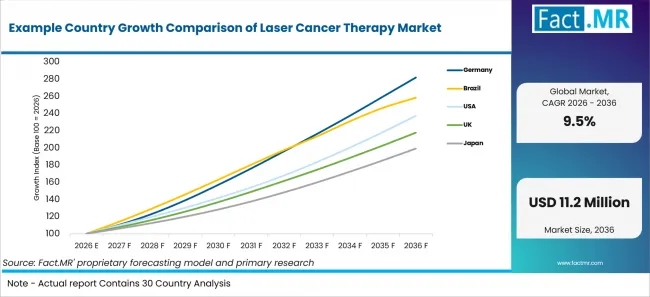
Example Country Growth Comparison Of Laser Cancer Therapy Market | Source: Fact.MR
Country CAGR (2026-2036)
| Country | CAGR, 2026-2036 |
|---|---|
| Germany | 10.9% |
| Brazil | 10.0% |
| USA | 9.0% |
| UK | 8.1% |
| Japan | 7.1% |
Source: Fact.MR analysis. Updated Sep 7, 2026
What is driving Germany's growth through 2036?
Germany is forecast to expand at a 10.9% CAGR from 2026 to 2036.
Germany's Federal Ministry of Health identifies improved oncology care structures and better connections between services as priorities in the renewed National Cancer Plan. For laser suppliers, the commercial implication is a concentrated group of specialist buyers able to assess clinical fit and service requirements. [4]
Purchasing will depend on the relevant department's indication mix and capacity to support the procedure. A coordinated cancer network can improve referral quality, but each installation still needs an individual utilization case.
What is driving Brazil's growth through 2036?
Brazil is forecast to expand at a 10.0% CAGR from 2026 to 2036.
INCA's 2026 esophageal-cancer incidence estimates are presented by state, emphasizing that oncology demand is geographically uneven. These figures describe the disease burden, not a count of patients suitable for laser therapy. [5]
The market opportunity lies in referral hospitals that can combine patient assessment with the required procedural expertise. Suppliers serving those centres need maintenance coverage and accessory logistics that remain dependable beyond the initial installation.
What is driving USA's growth through 2036?
The USA is forecast to expand at a 9.0% CAGR from 2026 to 2036.
The NCI describes laser applications across selected cancer and precancer treatments, including local ablation and photodynamic therapy. For US hospitals, this supports indication-specific purchasing discussions rather than a single procurement case covering every tumour type. [1, 2]
Hospitals can link capital decisions to expected referrals, room availability and accessory expenditure. Clinical capability is the entry requirement; sustained procedure volume determines whether the installation generates repeat commercial demand.
What is driving UK's growth through 2036?
The UK is forecast to expand at an 8.1% CAGR from 2026 to 2036.
The Health Research Authority's SLITT-GBM study summary describes the evaluation of combined surgery and laser-induced thermal therapy for bilateral glioblastomas. The programme illustrates how laser approaches can enter the UK through carefully specified clinical research. [6]
Commercial demand first develops around centres capable of undertaking the procedure and collecting meaningful outcomes. Suppliers need to align equipment, training and service support with that concentration of expertise rather than assume immediate adoption across general hospitals.
What is driving Japan's growth through 2036?
Japan is forecast to expand at a 7.1% CAGR from 2026 to 2036.
PMDA documentation links the BioBlade Laser System with cetuximab sarotalocan for unresectable, locally advanced or recurrent head and neck cancer. The important purchasing mechanism is the coordinated drug-device pathway: illumination must meet the requirements of the treatment, and equipment demand remains indication-specific. [7]
Hospitals need trained teams, treatment planning and compatible accessories before offering the service. These requirements support specialist purchasing and recurring delivery-tool demand, while limiting extrapolation to unrelated cancers.
Who Leads the Laser Cancer Therapy Market?
Key players in the Laser Cancer Therapy Market include Modulight Inc., whose ML7710 platform is positioned for oncology-related light delivery. Therapeutic-laser purchasing depends on wavelength suitability, calibration, fibre compatibility and application support. Product availability and clinical use remain subject to the relevant indication and jurisdiction. [3]
Several other oncology businesses influence equipment purchasing through different technologies. Varian Oncology operates within Siemens Healthineers' oncology activities, while Accuray and Reflexion Medical supply radiation-treatment platforms. Neusoft Medical Systems and Shinva Medical Instrument also participate in the radiotherapy equipment environment. Their radiation systems are distinct from lasers that deliver therapeutic light. [9, 11, 12, 13, 15]
LAP GmbH Laser Applikationen provides lasers for patient positioning in radiotherapy, a support function rather than tumour ablation. MN Medical operates as a distributor and service partner for radiotherapy equipment. Those roles affect installation and service relationships but do not establish therapeutic-laser manufacturing. [8, 10]
ViewRay Incorporated is a legacy reference in the oncology equipment sector. ViewRay Systems was established in 2024 following the acquisition of ViewRay's assets and supplies the MRIdian radiation-therapy system. This corporate succession and the distinction between radiotherapy and laser treatment are material when hospitals compare suppliers. [14]
Which companies are the key providers?
Modulight Inc. supplies therapeutic laser platforms; LAP GmbH Laser Applikationen supplies positioning lasers; MN Medical provides radiotherapy distribution and service; Varian Oncology, Neusoft Medical Systems, Accuray, Shinva Medical Instrument, Reflexion Medical and the successor to ViewRay Incorporated participate in the broader radiation-oncology equipment environment.
- Modulight Inc.
- LAP GmbH Laser Applikationen
- MN Medical
- Varian Oncology
- Neusoft Medical Systems
- Accuray
- Shinva Medical Instrument
- Reflexion Medical
- ViewRay Incorporated (successor)
Bibliography
- National Cancer Institute. (2021). Lasers to Treat Cancer. National Institutes of Health.
- National Cancer Institute. (2025). Photodynamic Therapy to Treat Cancer. National Institutes of Health.
- Modulight. (n.d.). ML7710 Medical Laser Platform for Clinical Use. Modulight.
- Federal Ministry of Health. (2026). Der Nationale Krebsplan stellt sich vor. Federal Government of Germany.
- Instituto Nacional de Cancer. (2026). Neoplasia maligna do esofago: taxas brutas de incidencia. Ministry of Health, Brazil.
- Health Research Authority. (2026). SLITT-GBM Study: Surgery and LITT for Bilateral Glioblastomas. NHS Health Research Authority.
- Pharmaceuticals and Medical Devices Agency. (n.d.). Approved Medical Devices: BioBlade Laser System, Fiscal Year 2020. PMDA.
- LAP GmbH Laser Applikationen. (n.d.). Products for Radiation Therapy. LAP.
- Siemens Healthineers. (n.d.). Bringing Intelligence to the Cancer Care Continuum. Siemens Healthineers.
- MN Medical. (n.d.). Directions of Work. MN Medical.
- Neusoft Medical Systems. (n.d.). RT Series. Neusoft Medical Systems.
- Accuray. (n.d.). Radiosurgery. Accuray.
- Shinva. (n.d.). Radiotherapy Equipment. Shinva.
- ViewRay Systems. (n.d.). Investors: Company Formation and MRIdian A3i. ViewRay Systems.
- RefleXion Medical. (n.d.). SCINTIX Therapy. RefleXion Medical.
This Report Answers
- How do system installations translate into recurring accessory demand?
- Which procedural and technology settings support laser-equipment purchasing?
- What limits utilization after a hospital commissions a platform?
- How do country-specific treatment pathways affect commercial expansion?
- Which supplier roles belong to therapeutic lasers, positioning systems and radiotherapy?
What does the Laser Cancer Therapy Market cover?
The market covers commercial revenue from laser systems and associated consumables used to deliver cancer-directed laser procedures. Equipment revenue relates to therapeutic light delivery, while recurring revenue includes compatible fibres, probes, applicators and associated safety or control components. Treatment activity is considered across minimally invasive and non-invasive procedural categories.
What is included in the scope?
Included products comprise ablation, photodynamic, interstitial and surgical laser systems, together with dedicated accessories.
The analysis considers integrated and standalone configurations, direct and indirect purchasing, and standard, mid-range and premium pricing tiers. Drug-activated light therapy is included only to the extent that a laser system or accessory generates the revenue.
What is excluded from the scope?
Standalone photosensitizer drugs, professional treatment fees, diagnostic-only imaging, LED-only photodynamic devices and general aesthetic lasers are excluded.
Radiation-therapy machines and lasers used only for patient positioning do not contribute therapeutic-laser revenue. Products for non-cancer procedures are excluded unless their cancer-directed use can be distinguished, and general surgical instruments are outside scope unless integral to the laser offering.
How Was the Analysis Built?
- Primary Research: Relevant respondent groups are surgical oncologists, interventional specialists, laser-safety personnel, hospital procurement managers and equipment service teams. Their expertise addresses patient selection, treatment-room requirements, commissioning, accessory use and equipment downtime.
- Desk Research: Clinical guidance, regulatory device information, public research summaries, cancer-service policy and manufacturer technical materials provide context for indications, treatment delivery and supplier roles.
- Market Sizing and Forecasting: The commercial framework separates capital installations from recurring accessory revenue. Forecast interpretation considers eligible procedure volumes, utilization per installation, accessory consumption, replacement cycles and the mix of integrated and standalone platforms.
- Data Validation and Update Cycle: Reviews distinguish therapeutic lasers from positioning lasers and ionizing-radiation systems. Updates track indication changes, clinical adoption, compatible accessory availability, service capacity and corporate ownership. Directional impact estimates express changes in purchasing conditions rather than additive contributions to the forecast.
Segmentation
What is the report's scope and coverage?
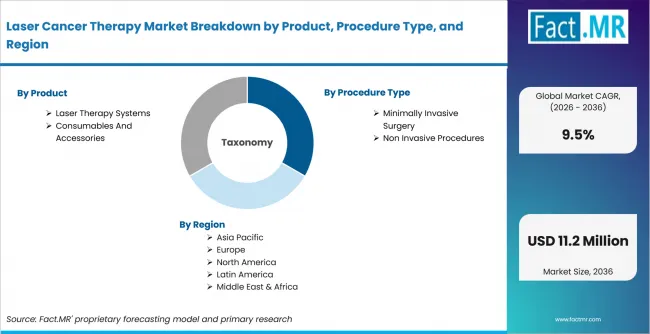
Laser Cancer Therapy Market Breakdown By Product, Procedure Type, And Region | Source: Fact.MR
| Attribute | Details |
|---|---|
| Quantitative Units | USD million |
| Market Definition | The market covers commercial revenue from laser systems and associated consumables used to deliver cancer-directed laser procedures. |
| Segments Covered | Product; Procedure Type; Technology Setting; Distribution Channel; Pricing Tier |
| Countries Covered | Germany; Brazil; USA; UK; Japan |
| Key Companies Profiled | Varian Oncology; Modulight Inc.; LAP GmbH Laser Applikationen; MN Medical; Neusoft Medical Systems; Accuray; Shinva Medical Instrument; ViewRay Incorporated; Reflexion Medical |
| Historical Period | 2021 to 2025 |
| Forecast Period | 2026 to 2036 |
| Base Year | 2025 |
| Market Value, 2025 | USD 4.1 million |
| Market Value, 2026 | USD 4.5 million |
| Market Value, 2036 | USD 11.2 million |
| CAGR, 2026-2036 | 9.5% |
| Absolute Opportunity | USD 6.7 million |
| Approach | Product-revenue analysis distinguishing laser installations and recurring accessories, with procedure utilization, clinical eligibility and replacement demand informing forecast interpretation. |
Source: Fact.MR analysis. Updated Sep 7, 2026
How is the market segmented?
-
By Product
- Laser Therapy Systems
- Ablation Laser Systems
- Photodynamic Therapy Systems
- Interstitial Laser Therapy Systems
- Laser Surgical Systems
- Consumables And Accessories
- Laser Fibers
- Probes And Applicators
- Safety And Control Systems
- Laser Therapy Systems
-
By Procedure Type
- Minimally Invasive Surgery
- Image Guided Laser Surgery
- Endoscopic Laser Procedures
- Non Invasive Procedures
- Drug Activated Light Therapy
- Targeted Cancer Cell Destruction
- Minimally Invasive Surgery
-
By Technology Setting
- Integrated Surgical Systems
- Standalone Laser Systems
-
By Distribution Channel
- Direct Sales
- Indirect Sales
- Medical Device Distributors
- Online Procurement Platforms
-
By Pricing Tier
- Mid Range Clinical Systems
- Standard Laser Systems
- Premium Oncology Laser Systems
Frequently Asked Questions
What is the Laser Cancer Therapy Market value in 2026?
At what CAGR is the market projected to grow?
What is the projected market value by 2036?
Which segment leads Product?
Which segment leads Procedure Type?
Which segment leads Technology Setting?
Which segment leads Distribution Channel?
Which segment leads Pricing Tier?
Which countries are analyzed?
What drives recurring demand after a system is installed?
What is the main restraint on adoption?
Are radiotherapy systems part of therapeutic laser revenue?
Which companies provide products in this market?
Who worked on this report


Preview the report firsthand - request a free sample
Free SampleGet the brochure for pricing and purchase details
Download PDF