- Base Value(2025): 393.4 Mn
- Estimated Value(2026): 409.3 Mn
- Forecast Value (2036): 585.5 Mn
- CAGR (2026 - 2036): 4.1%
Lateral Flow Assay Component Market Forecast 2026 to 2036
In 2025, the lateral flow assay component market was valued at USD 393.4 million. Based on FMR's analysis, demand for lateral flow assay components is estimated to grow to USD 409.3 million in 2026 and USD 585.5 million by 2036. FMR projects a CAGR of 4.1% during the forecast period.
The absolute dollar growth from 2026 to 2036 is USD 176.2 million. This growth is driven by the increasing adoption of lateral flow assay technologies in diagnostics, healthcare, and life sciences, particularly for point-of-care testing and rapid diagnostic applications. The market benefits from the growing demand for quicker, cost-effective testing solutions across various medical and pharmaceutical sectors. However, challenges such as regulatory hurdles and the need for consistent innovation may impact growth in certain regions.
As Chris Yates, Chief Executive Officer of Abingdon Health plc, noted regarding innovation and growth in the lateral flow diagnostics market, ‘As we emerge from the COVID-19 pandemic, I believe we are seeing significant further awareness of, and expansion in, the use of lateral-flow tests… with this growth driven by innovation, shifting the industry back into a phase of significant growth.’
China leads with a CAGR of 5.2%, supported by its growing healthcare sector and increasing demand for diagnostic solutions. India follows with a 4.9% CAGR, driven by rising healthcare investments and the demand for affordable diagnostic tools. Germany grows at 3.8%, reflecting strong healthcare infrastructure and demand for high-quality diagnostic components. Japan grows at 3.6%, benefiting from advancements in medical technology and point-of-care diagnostics. The USA shows slower growth at 3.4%, reflecting a mature market but sustained demand for advanced diagnostics and innovative healthcare solutions.
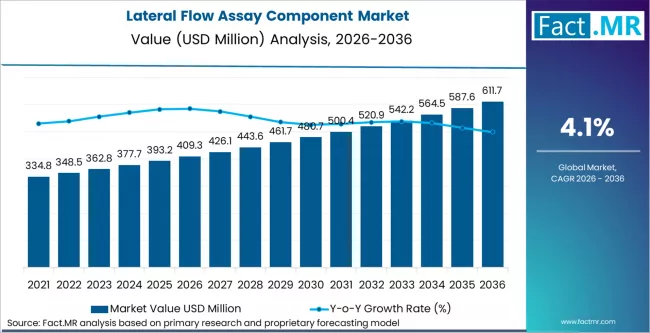
Lateral Flow Assay Component Market Market Value Analysis | Source: Fact.MR
Lateral Flow Assay Component Market Definition
The Lateral Flow Assay Component Market refers to the production and sale of parts used in lateral flow tests (such as membranes, pads, housings, and reagents) that enable rapid, point‑of‑care diagnostic results.
Market Inclusions
This report covers global and regional market sizes for lateral flow assay components over a defined forecast period, including key component types, end‑use sectors, and distribution channels.
Market Exclusions
The scope excludes finished diagnostic test kits, unrelated laboratory instruments, and reagents not specific to lateral flow technologies.
Research Methodology
- Primary Research: Interviews were conducted with diagnostic developers, component suppliers, and industry specialists.
- Desk Research: Data was sourced from industry reports, regulatory filings, and trade association publications.
- Market‑Sizing and Forecasting: A hybrid model combining top‑down healthcare diagnostics demand with bottom‑up shipment data was used.
- Data Validation and Update Cycle: Findings were validated through expert review and aligned with recent production and trade figures.
Summary of the Lateral Flow Assay Component Market
-
Market Definition
- The Lateral Flow Assay Component Market encompasses components used in lateral flow tests (such as membranes, pads, and cassettes) that enable rapid, point-of-care diagnostic results. These components are integral to diagnostics in healthcare, food safety, and veterinary applications.
-
Demand Drivers
- Rising Demand for Rapid Diagnostics: There is an increasing adoption of lateral flow assay technologies in diagnostics, particularly for point-of-care and rapid diagnostic applications in healthcare.
- Advancements in Medical Technology: The integration of lateral flow assays with new medical devices and technologies, such as mobile health applications, is driving growth in diagnostic sectors.
- Cost-effective Testing Solutions: Lateral flow assays offer a low-cost, quick testing alternative, contributing to their adoption in a wide range of industries, including healthcare and pharmaceutical testing.
- Health and Safety Concerns: Global health initiatives and the ongoing need for reliable, cost-effective testing, especially in response to pandemics, are fueling the demand for lateral flow assays.
-
Key Segments Analyzed
- Product Type: Membranes are expected to capture 42.7% of the market share by 2026. These are critical for the functionality of lateral flow assays, serving as the medium that captures and processes the sample.
- Application: Clinical diagnostics is projected to dominate the market with a 40% share by 2026, as lateral flow assays become integral in medical diagnostics, including infectious disease detection, pregnancy tests, and disease monitoring.
-
Analyst Opinion at FactMR
- "The lateral flow assay component market is witnessing steady growth driven by the increased adoption of rapid, on-site testing technologies in healthcare and life sciences. With a growing demand for quicker diagnostics, especially in critical care and infectious diseases, this market is set to expand significantly." - Shambhu Nath Jha, Principal Consultant at FactMR.
-
Strategic Implications/Executive Takeaways
- Focus on developing high-quality membranes that improve test accuracy, speed, and reliability, especially for clinical diagnostics and food safety testing.
- Invest in innovations that enhance the sensitivity and functionality of lateral flow assays, as these are critical for applications in health crises and remote diagnostics.
- Target emerging markets, particularly in Asia-Pacific, where healthcare infrastructure is rapidly expanding, and diagnostic solutions are in high demand.
-
Methodology
- Sourced from primary research with diagnostic developers, component suppliers, and industry specialists.
- Benchmarked against trends in diagnostic demand, healthcare infrastructure, and global health needs.
Segmental Analysis
Lateral Flow Assay Component Market Analysis by Product
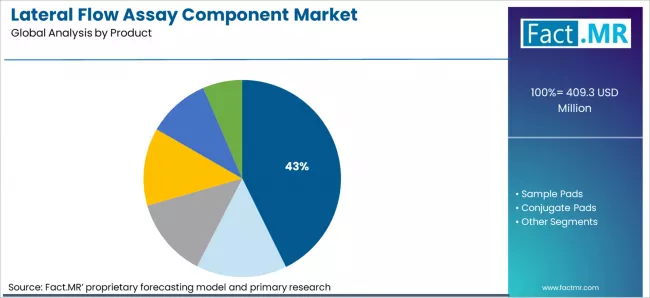
Lateral Flow Assay Component Market Analysis By Product | Source: Fact.MR
- Market Overview: Membranes are projected to capture 42.7% of the lateral flow assay component market by 2026. Membranes play a critical role in lateral flow assays, serving as the medium for capturing and processing samples. These membranes are essential for the accuracy and reliability of lateral flow tests, which are used in diagnostics and other testing applications.
- Demand Drivers:
- Core Component in Diagnostic Kits: Membranes are central to the function of lateral flow assay devices, which are used for rapid diagnostic tests in clinical and laboratory settings. As demand for point-of-care diagnostics grows, the need for high-quality membranes is increasing.
- Accuracy and Sensitivity: Membranes ensure that samples are properly filtered and that reactions occur correctly within the assay system, driving their demand in applications that require high sensitivity and precision, such as clinical diagnostics and food safety testing.
- Innovation and Customization: As lateral flow assay technology advances, there is growing demand for specialized membranes that can handle a wide range of sample types and improve test results. Customization of membrane properties (e.g., porosity, surface chemistry) is further driving market growth.
Lateral Flow Assay Component Market Analysis by Application
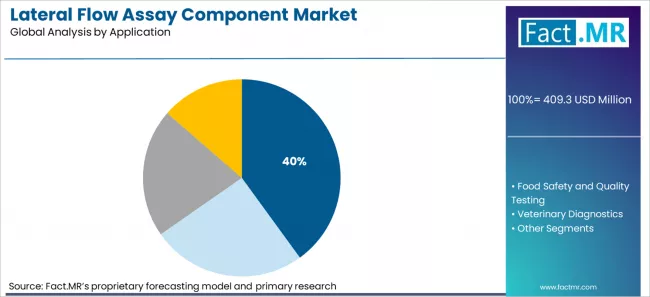
Lateral Flow Assay Component Market Analysis By Application | Source: Fact.MR
- Market Overview: Clinical diagnostics is expected to capture 40% of the market share by 2026. Lateral flow assays are widely used in clinical diagnostics for rapid testing, including tests for infectious diseases, pregnancy, and other medical conditions. The demand for these components is particularly driven by the growing need for fast, reliable, and easy-to-use diagnostic tests.
- Demand Drivers:
- Rising Demand for Point-of-Care Diagnostics: The growing need for quick and accurate diagnostics in clinical settings, especially for infectious diseases and chronic conditions, is fueling the demand for lateral flow assay components in clinical diagnostics. These assays provide fast results, improving patient care and reducing time-to-treatment.
- Increase in Home and Remote Testing: With the rise of telemedicine and home healthcare, lateral flow assays are becoming more popular for self-testing applications. This shift toward at-home diagnostics is driving demand for lateral flow assay components that offer ease of use, accuracy, and quick results.
- Global Health Initiatives and Pandemics: The ongoing demand for rapid diagnostic tests, particularly in response to pandemics and outbreaks (e.g., COVID-19), is further accelerating the adoption of lateral flow assays in clinical diagnostics. This application sector is expected to grow as healthcare systems continue to adopt more cost-effective, rapid testing solutions.
Lateral Flow Assay Component Market Drivers, Restraints, and Opportunities
FMR analysts observe that the lateral flow assay component market is a growing diagnostic segment driven by widespread use of rapid tests in clinical diagnostics, point‑of‑care screening, and infection control. Historically, lab‑based assays dominated diagnostics; as demand shifted toward fast, low‑cost testing (e.g., infectious diseases, pregnancy, biomarkers), structural need for high‑quality membranes, pads, and conjugates grew. The 2026 valuation reflects steady demand tied to healthcare access expansion and routine screening protocols.
While demand for basic lateral flow strips remains large, advanced components that improve sensitivity and quantitative readouts are gaining share. These engineered parts carry higher per‑unit prices, contributing to net market value growth even as unit volumes scale with decentralized testing adoption. The market exists because point‑of‑care testing continues to expand in clinical and non‑clinical settings where rapid, reliable results are required.
- Decentralized Testing Demand: Growth in point‑of‑care and at‑home diagnostics drives adoption of lateral flow formats that replace slower lab tests.
- Regulatory Performance Standards: Requirements such as FDA EUA and CE marking for diagnostic accuracy push manufacturers toward higher‑precision components with defined sensitivity criteria.
- Regional Healthcare Dynamics: In North America and Europe strong screening programs and reimbursement policies support advanced lateral flow use, while in parts of Asia‑Pacific cost‑led strips remain significant.
Regional Analysis
The market analysis covers key global regions, including Asia Pacific, Europe, North America, and South Asia. It is segmented geographically, with specific market dynamics for each region. The full report provides a detailed market attractiveness analysis.
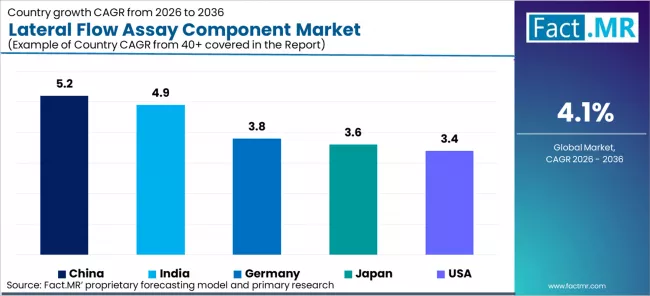
Lateral Flow Assay Component Market Cagr Analysis By Country | Source: Fact.MR
| Country | CAGR (2026-2036) |
|---|---|
| China | 5.2% |
| India | 4.9% |
| Germany | 3.8% |
| Japan | 3.6% |
| USA | 3.4% |
Source: Fact.MR analysis. Updated Feb 24, 2026
Source: Fact MR (FMR) analysis, based on proprietary forecasting model and primary research.
Asia Pacific:
In Asia Pacific, China and India lead the demand for lateral flow assay components, driven by the increasing demand for diagnostic testing and the rapid growth of the healthcare sector.
- China: Demand for lateral flow assay components in China is projected to rise at 5.2% CAGR through 2036. China’s rapidly expanding healthcare infrastructure and increasing focus on diagnostic testing contribute to the growing demand for lateral flow assays.
- India: Demand for lateral flow assay components in India is projected to rise at 4.9% CAGR through 2036. India’s growing healthcare needs and increased adoption of diagnostic technologies continue to drive the market for lateral flow assay components.
Europe:
In Europe, Germany and Japan are significant markets for lateral flow assay components, supported by strong healthcare systems and increasing demand for diagnostic tools.
- Germany: Demand for lateral flow assay components in Germany is projected to rise at 3.8% CAGR through 2036. Germany’s advanced healthcare infrastructure and focus on early-stage diagnostics continue to boost the demand for lateral flow assays in clinical and home settings.
- Japan: Demand for lateral flow assay components in Japan is projected to rise at 3.6% CAGR through 2036. Japan’s aging population and increased demand for diagnostic tools drive steady market growth for lateral flow assays.
North America:
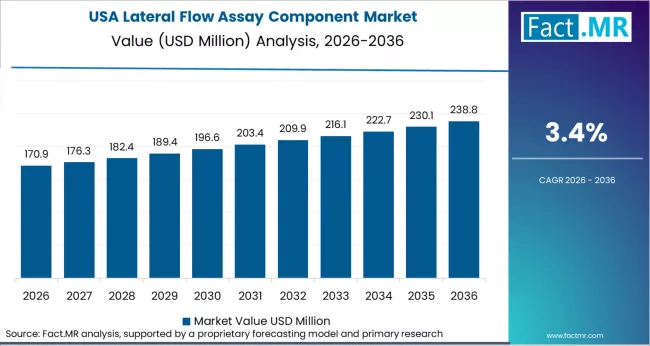
Lateral Flow Assay Component Market Country Value Analysis | Source: Fact.MR
In North America, the USA remains a key market for lateral flow assay components, driven by advancements in diagnostic technologies and the growing focus on point-of-care testing.
- USA: Demand for lateral flow assay components in the U.S. is projected to rise at 3.4% CAGR through 2036. The growing emphasis on rapid diagnostics and expansion of point-of-care testing in healthcare settings contribute to steady demand for lateral flow assay components.
Fact MR's analysis of the Lateral Flow Assay Component Market in Asia Pacific, Europe, North America, and South Asia consists of country-wise assessments that include China, India, Germany, Japan, and the USA. Readers can find detailed trends, regulatory updates, and company-specific investments shaping the market’s growth in these countries.
How Are Key Players Competing in the Lateral Flow Assay Component Market?
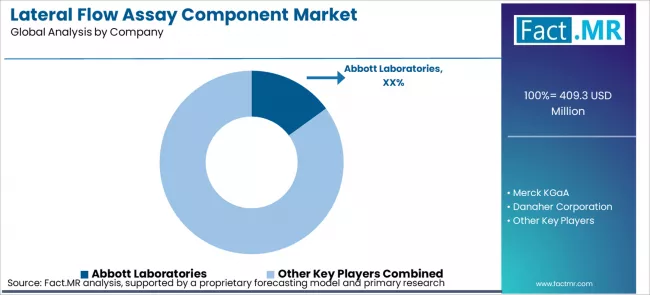
Lateral Flow Assay Component Market Analysis By Company | Source: Fact.MR
In the lateral flow assay component market, Abbott Laboratories and Merck KGaA lead with their robust portfolio of assay components, offering integrated solutions for rapid diagnostics. Danaher Corporation and Sartorius Stedim Biotech stand out by providing specialized reagents, membranes, and analyzers that enhance test accuracy. Advanced Microdevice Pvt. Ltd. and Ahlstrom-Munksjö focus on advanced membrane technologies and high-quality substrates that improve the sensitivity and reliability of lateral flow assays. Nupore Filtration Systems and DCN Diagnostics contribute by offering filtration and sample preparation components. Ballya Bio and PerkinElmer, Inc. specialize in providing consumables and detection platforms, expanding the availability and accessibility of diagnostic solutions for a wide range of applications. These companies continuously innovate in response to growing demand for efficient, reliable, and rapid diagnostic tools across healthcare and environmental testing sectors.
Recent Industry Developments
- Effective February 2, 2026, the U.S. FDA officially replaced its decades-old Quality System Regulation (QSR) with the Quality Management System Regulation (QMSR). This final rule incorporates the international ISO 13485:2016 standard by reference, meaning all LFA component and finished kit manufacturers distributing in the U.S. must now comply with this globally harmonized, risk-based quality system.
- Merck’s Industrial Scale-up of Hi-Flow Plus Membranes (Corporate): In late 2024/2025, Merck (operating as MilliporeSigma in the U.S.) broke ground on its first domestic facility in Sheboygan, Wisconsin, specifically dedicated to the production of Hi-Flow Plus lateral flow nitrocellulose membranes. This multi-million dollar strategic investment is designed to secure the supply chain for rapid diagnostic kits, moving beyond the pandemic-era shortages to support permanent growth in point-of-care testing.
- Sartorius Expansion in South Korea (Corporate): As of January 2026, Sartorius is finalizing the construction of its new integrated production site in Songdo, South Korea, which will serve as a hub for the entire Asian market. This facility is a key part of Sartorius's global research and production infrastructure expansion, focusing on high-margin recurring consumables, including the membranes and filter technologies essential for the next generation of multiplex LFAs.
Key Players of the Lateral Flow Assay Component Market
- Abbott Laboratories
- Merck KGaA
- Danaher Corporation
- Sartorius Stedim Biotech (part of Sartorius AG)
- Advanced Microdevice Pvt. Ltd.
- Ahlstrom-Munksjö
- Nupore Filtration Systems
- DCN Diagnostics
- Ballya Bio
- PerkinElmer, Inc.
Report Scope
| Metric | Value |
|---|---|
| Quantitative Units | USD 409.3 billion (2026) to USD 585.5 billion (2036), at a CAGR of 4.1% |
| Market Definition | The Lateral Flow Assay Component Market includes the various components used in lateral flow assays, commonly used for diagnostics in healthcare, food safety, veterinary testing, and drug development. |
| By Product | Membranes, Sample Pads, Conjugate Pads, Absorbent Pads, Laminates, Cassettes and Housings, Other Products |
| By Application | Clinical Diagnostics, Food Safety and Quality Testing, Veterinary Diagnostics, Drug Development and Quality Testing, Other Applications |
| Regions Covered | North America, Latin America, Europe, East Asia, South Asia, Oceania, Middle East and Africa |
| Countries Covered | United States, Canada, Mexico, Brazil, Argentina, Germany, France, United Kingdom, Italy, Spain, China, India, Japan, South Korea, Indonesia, Australia, and 40+ countries |
| Key Companies Profiled | Abbott Laboratories, Merck KGaA, Danaher Corporation, Sartorius Stedim Biotech (part of Sartorius AG), Advanced Microdevice Pvt. Ltd., Ahlstrom-Munksjö, Nupore Filtration Systems, DCN Diagnostics, Ballya Bio, PerkinElmer, Inc. |
| Forecast Period | 2026 to 2036 |
| Approach | Hybrid top-down and bottom-up market modeling validated through primary interviews with manufacturers and supported by trade data benchmarking and market research. |
Source: Fact.MR analysis. Updated Feb 24, 2026
Bibliographies
- U.S. Food and Drug Administration. (2026, February 2). Quality Management System Regulation (QMSR): Final rule aligning 21 CFR Part 820 with ISO 13485:2016. U.S. Food and Drug Administration.
- Merck KGaA. (2024). Lateral flow assay technologies and membrane solutions for clinical diagnostics. Merck KGaA.
- Merck KGaA. (2024). Merck invests in expansion of Hi-Flow Plus membrane manufacturing capacity in Sheboygan, Wisconsin [Press release]. Merck KGaA.
- Sartorius AG. (2026, January). Sartorius completes construction of new integrated production site in Songdo, South Korea [Press release]. Sartorius AG.
This report addresses:
- Market intelligence enabling comprehensive assessment of leading countries and product segments across the Lateral Flow Assay Component Market globally.
- Market volume (sales units) estimates and 10-year revenue forecasts from 2026 to 2036, validated through manufacturer shipment data, channel partner surveys, and country-level demand modeling.
- Growth opportunity mapping across product types (Membranes, Sample Pads, Conjugate Pads, Absorbent Pads, Laminates, Cassettes and Housings, Other Products), applications (Clinical Diagnostics, Food Safety and Quality Testing, Veterinary Diagnostics, Drug Development and Quality Testing, Other Applications).
- Segment and regional revenue forecasts by product type, application, and geography across 40+ countries.
- Competition strategy analysis covering dealer network structure, recent developments, product portfolio, USPs, and market share analysis.
- Product and regulatory compliance tracking aligned with diagnostic accuracy standards and healthcare sector requirements.
- Regulatory impact analysis addressing testing standards, accuracy requirements, and market access regulations across key markets.
- Report delivery in PDF, Excel, PowerPoint, and interactive dashboard formats for executive, procurement, and operational planning use.
Segmentation
Lateral Flow Assay Component Market Key Segments
-
Product :
- Membranes
- Sample Pads
- Conjugate Pads
- Absorbent Pads
- Laminates
- Cassettes and Housings
- Other Products
-
Application :
- Clinical Diagnostics
- Food Safety and Quality Testing
- Veterinary Diagnostics
- Drug Development and Quality Testing
- Other Applications
-
Region :
- North America
- USA
- Canada
- Mexico
- Europe
- Germany
- UK
- France
- Italy
- Spain
- Nordic Countries
- BENELUX
- Rest of Europe
- Asia Pacific
- China
- Japan
- South Korea
- India
- Australia
- Rest of Asia Pacific
- Latin America
- Brazil
- Argentina
- Rest of Latin America
- Middle East and Africa
- Kingdom of Saudi Arabia
- United Arab Emirates
- South Africa
- Rest of Middle East and Africa
- Other Regions
- Oceania
- Central Asia
- Other Markets
- North America
Frequently Asked Questions
How large is the demand for Lateral Flow Assay Components in the global market in 2026?
What will be the market size of Lateral Flow Assay Components in the global market by 2036?
What is the expected demand growth for Lateral Flow Assay Components in the global market between 2026 and 2036?
Which product is expected to dominate the market?
Which region is expected to show the highest growth rate for Lateral Flow Assay Components?
How significant is the growth outlook for India in this market?
What is the growth outlook for Germany in this report?
What is the growth forecast for Japan in the Lateral Flow Assay Components market?
What is the growth forecast for the United States in the Lateral Flow Assay Components market?
Which company is identified as a leading player in the Lateral Flow Assay Components market?
What are Lateral Flow Assay Components used for?
What does the Lateral Flow Assay Components market include in this report?
How is the market forecast developed in this report?
What is meant by the Lateral Flow Assay Components market in this report?
Who worked on this report


Preview the report firsthand - request a free sample
Free SampleGet the brochure for pricing and purchase details
Download PDF