- Base Value(2026): 2.0 Bn
- Estimated Value(2026): 2.0 Bn
- Forecast Value (2036): 4.2 Bn
- CAGR (2026 - 2036): 7.6%
Enzyme Activity Assays Market Forecast and Outlook 2026 to 2036
Enzyme activity assays market stands at USD 2 billion in 2026 and reaches USD 4.2 billion by 2036, reflecting a 7.60% CAGR.
Enzyme Activity Assays Market Key Takeaways
- Enzyme Activity Assays Market Value (2026): USD 2.0 billion
- Enzyme Activity Assays Market Forecast Value (2036): USD 4.2 billion
- Enzyme Activity Assays Market Forecast CAGR: 7.6%
- Leading Application in Enzyme Activity Assays Market: High-throughput screening (HTS)
- Key Growth Regions in Enzyme Activity Assays Market: North America, Europe, Asia Pacific, Latin America, Middle East & Africa
- Top Players in Enzyme Activity Assays Market: Thermo Fisher Scientific, Merck KGaA (Sigma-Aldrich), Danaher, Revvity, Bio-Rad Laboratories
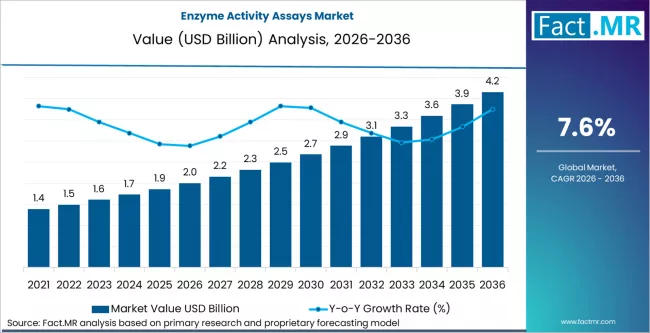
Enzyme Activity Assays Market Market Value Analysis | Source: Fact.MR
Demand forms around repeatable measurement rather than exploratory screening. Pharmaceutical quality groups, contract laboratories, and kit suppliers work within fixed protocols tied to release decisions. Workflow design starts with sample preparation, reagent stability, calibration curves, and acceptance windows.
Once a method enters routine use, substitution becomes rare due to validation files and cross site comparability needs. Purchasing teams evaluate vendors on lot consistency, documentation depth, and audit response times. Production planning follows batch campaigns, control charts, and shelf life limits. Capacity expands through parallel lines and automated liquid handling rather than new test concepts. Pricing references tests completed and retest avoidance. Data packages move through quality systems with version locks. Volume growth reflects deployment across manufacturing, stability programs, and contract testing networks, not research cycles or procurement spikes.
Enzyme Activity Assays Market
| Metric | Value |
|---|---|
| Market Value (2026) | USD 2.0 billion |
| Forecast Value (2036) | USD 4.2 billion |
| Forecast CAGR (2026-2036) | 7.6% |
Source: Fact.MR analysis. Updated Jan 29, 2026
Category
| Category | Segments |
|---|---|
| Assay Format or Product Type | Microplate-based enzyme assay kits; Fluorometric activity assay kits; Colorimetric activity assay kits; Luminescent activity assay kits; Radiometric or specialized assays; Custom assay development and validation |
| Primary Application or Use Case | High-throughput screening (HTS); Enzyme kinetics and mechanism studies; Bioprocess or biologics QC; Clinical research and biomarker studies; Academic basic research |
| End User | Pharma and biotech; CROs or screening providers; Academic and government labs; Diagnostic labs and developers; Industrial biotech or food and chem |
| Region | North America; Europe; Asia Pacific; Latin America; Middle East & Africa |
Source: Fact.MR analysis. Updated Jan 29, 2026
Segmental Analysis
By Assay Format or Product Type, Why Do Microplate Based Enzyme Assay Kits Lead the Enzyme Activity Assays Market?
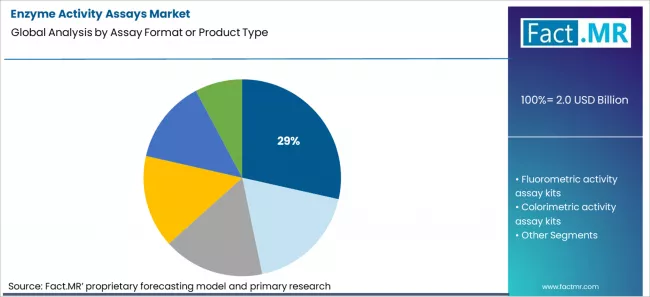
Enzyme Activity Assays Market Analysis By Assay Format Or Product Type | Source: Fact.MR
Fact.MR evaluation shows that microplate based enzyme assay kits hold 28.50% share because they fit directly into the way laboratories already organize daily work. The unmet need is not higher sensitivity in isolated cases but consistent, repeatable measurement across many samples. These kits turn enzyme testing into a routine workflow step rather than a special procedure. For users, the value is functional and operational, centered on speed, comparability, and throughput. The format supports standardized protocols and predictable scheduling. For suppliers, it anchors recurring purchasing patterns tied to ongoing projects. Its position reflects how assay formats succeed when they align with established laboratory habits and capacity planning.
By Primary Application or Use Case, Why Does High Throughput Screening Represent the Largest Segment in the Enzyme Activity Assays Market?
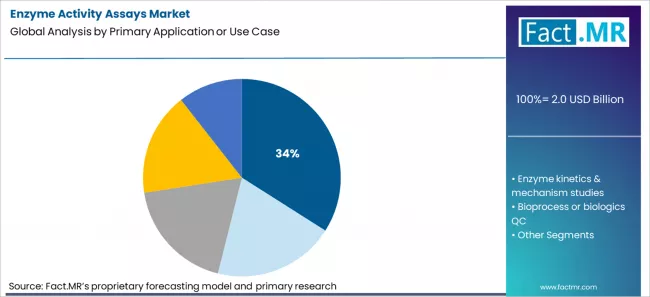
Enzyme Activity Assays Market Analysis By Primary Application Or Use Case | Source: Fact.MR
In Fact.MR compiled datasets, high throughput screening accounts for 34.00% share because it addresses a structural constraint in research and development, which is the need to test large libraries under fixed time and budget limits. The unmet need is not detailed characterization of each candidate but rapid elimination of weak options. This shifts enzyme assays from occasional experiments to continuous filtering tools. For organizations, the value is practical and economic, tied to decision speed and pipeline efficiency. The application becomes part of routine project management rather than exploratory science. Its scale reflects how screening driven workflows now define early stage research operations.
Country
| Country | Driver | Restraint | Trend |
|---|---|---|---|
| USA | Strong pharma and biotech R&D demand | High cost of advanced assay platforms | High throughput automation adoption |
| UK | Academic and clinical research funding | Budget pressure in public labs | Shift to standardized assay kits |
| Germany | Industrial biotech and diagnostics base | Strict validation and QA requirements | Integration into GMP workflows |
| China | Rapid expansion of biopharma manufacturing | Quality standardization gaps | Localization of assay reagents |
| India | Growth in generics and biosimilars testing | Limited high-end lab infrastructure | Outsourcing of assay services |
Source: Fact.MR analysis. Updated Jan 29, 2026
Analysis of the Enzyme Activity Assays Market by Key Country
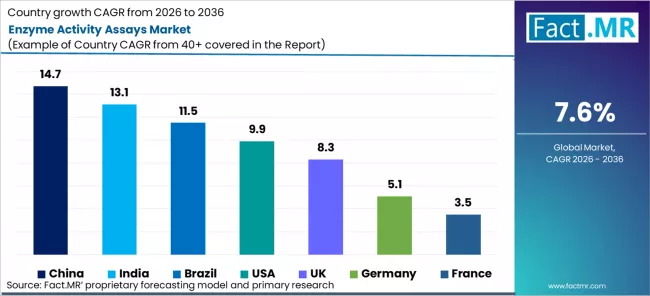
Enzyme Activity Assays Market Cagr Analysis By Country | Source: Fact.MR
| Country | CAGR (2026-2036) |
|---|---|
| USA | 9.9% |
| Brazil | 11.5% |
| China | 14.7% |
| India | 13.1% |
| Germany | 5.1% |
| France | 3.5% |
| U.K. | 8.3% |
Source: Fact.MR analysis. Updated Jan 29, 2026
The report covers an in-depth analysis of 40+ countries; top-performing countries are highlighted below.
How is the enzyme activity assays market developing in the United States?
The enzyme activity assays market in the United States follows a 9.9% growth path through 2036. Drug discovery, translational research, and screening programs already rely on high throughput laboratory workflows. Enzyme assays sit early in these pipelines because they provide fast functional confirmation before expensive downstream studies. Pharmaceutical companies and contract research organizations standardize assay panels across sites to control reproducibility. Academic laboratories add steady volume through funded oncology, metabolism, and immunology programs. Automation raises test density per instrument. Expansion comes from heavier usage inside existing laboratories rather than from a rapid increase in the number of research facilities.
How is the enzyme activity assays market evolving in Brazil?
The enzyme activity assays market in Brazil expands at an 11.5% rate through 2036. Private diagnostic chains and contract research providers account for most new capacity. Many pharmaceutical and biotech projects send routine screening work to centralized service laboratories. Enzyme assays gain share because they shorten decision cycles in early development. University laboratories in major cities add demand through collaborative research projects. Equipment upgrades replace manual protocols with semi-automated systems. Testing activity concentrates into fewer, larger facilities. Growth comes from consolidation of laboratory workloads and higher utilization of service platforms rather than from broad based creation of new research centers.
What explains the expansion of the enzyme activity assays market in China?
The enzyme activity assays market in China moves on a 14.7% growth trajectory through 2036. Domestic drug development programs build large parallel screening platforms across science parks and research clusters. Enzyme assays serve as early stage filters because they scale easily and control attrition. Once a method enters a platform laboratory, thousands of samples follow the same workflow. Contract research organizations and state institutes replicate these setups across regions. Purchasing decisions focus on throughput and standardization. Expansion follows infrastructure rollout and laboratory network replication rather than short term project cycles or individual research group buying behavior.
Why is the enzyme activity assays market growing quickly in India?
The enzyme activity assays market in India advances at 13.1% per year through 2036. Contract research and manufacturing services shape most laboratory expansion. Global sponsors route large screening volumes to centralized facilities that operate at high utilization. Enzyme assays remain a cost efficient way to sort compound libraries and validate early targets. Public research institutes add volume through funded biology and biochemistry programs. Automation spreads across top tier laboratories, raising throughput per instrument. The market grows through concentration of testing activity inside service hubs and sustained workload inflow rather than through domestic project creation alone.
How is the enzyme activity assays market progressing across Europe?
The enzyme activity assays market in Europe grows at 6.7% per year through 2036. Demand develops inside a mature system of pharmaceutical firms, public research institutes, and multinational service providers. Many laboratories already operate at high technical standards, which limits sudden capacity expansion. Enzyme assays remain routine tools in pathway analysis and screening programs. Purchasing decisions move through long planning and funding cycles. Cross border research projects add incremental workload. Growth comes from modernization of existing laboratories, replacement of older platforms, and gradual increases in testing intensity rather than from rapid creation of new facilities.
What keeps the enzyme activity assays market in Germany on a measured path?
The enzyme activity assays market in Germany follows a 5.1% growth path through 2036. Research organizations emphasize method validation, documentation, and long equipment lifecycles. Pharmaceutical and academic laboratories already run stable assay platforms with established workflows. New formats enter only after extended comparison studies. Purchasing decisions often bundle instruments, software, and service contracts into multiyear plans. Volume increases come from deeper project pipelines rather than from additional laboratories. Progress stays linked to incremental modernization and protocol updates inside existing institutions, which keeps expansion steady and structurally conservative.
Why is the enzyme activity assays market expanding slowly in France?
The enzyme activity assays market in France progresses at 3.5% per year through 2036. Public research institutions and hospital linked laboratories dominate testing activity. Budget planning cycles and centralized procurement shape equipment renewal schedules. Many facilities continue to use established platforms with long replacement intervals. Enzyme assays remain essential; though total test volumes rise slowly because project counts grow at a measured pace. Private contract research adds some activity in major cities. The market expands mainly through gradual capacity refresh and limited modernization rather than through structural changes in the research landscape.
How does the enzyme activity assays market in the United Kingdom differ from its peers?
The enzyme activity assays market in the United Kingdom advances at 8.3% per year through 2036. University research clusters and contract research organizations generate much of the laboratory workload. Enzyme assays support screening programs in oncology, inflammation, and metabolic disease research. Funding cycles create periods of purchasing followed by consolidation. Shared facilities increase utilization of existing platforms rather than adding many new laboratories. Biotech startups contribute project turnover and variability in demand. Growth remains tied to service laboratory usage and project flow rather than continuous expansion of physical research infrastructure.
Who controls routine laboratory workflows in enzyme activity assays, and why does that position matter more than individual kit performance?
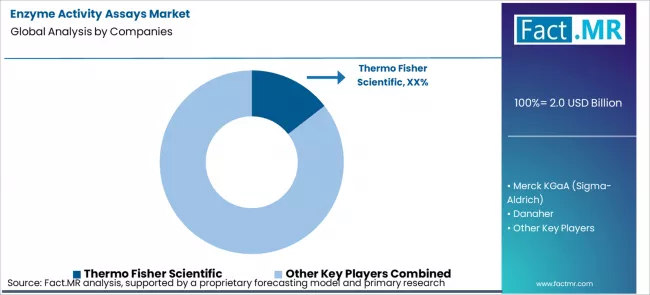
Enzyme Activity Assays Market Analysis By Company | Source: Fact.MR
Most purchasing decisions in enzyme activity assays are made at the level of laboratory workflow standardization rather than at the level of single experiments. Thermo Fisher Scientific, Merck KGaA through Sigma Aldrich, Danaher, Revvity, and Bio Rad are embedded in daily lab operations through instruments, consumables, reagents, and quality control systems that are qualified together. Once a laboratory validates an assay family on a given platform, replacement requires method revalidation, documentation updates, and staff retraining, which creates operational inertia. Danaher and Thermo Fisher benefit from broad instrument and reagent portfolios that allow bundle selling and long term supply agreements. Merck and Bio Rad hold strong positions in reference reagents and controls that anchor method consistency. Revvity is tied closely to screening and applied research workflows. Scale supports global service coverage, regulatory documentation, and supply continuity. Process discipline in manufacturing, lot consistency, and support now protects share more reliably than marginal differences in assay chemistry.
Key Players in Enzyme Activity Assays Market
- Thermo Fisher Scientific
- Merck KGaA (Sigma-Aldrich)
- Danaher
- Revvity
- Bio-Rad Laboratories
- Others
References
- U.S. Department of Health and Human Services, National Institutes of Health, National Center for Advancing Translational Sciences. (2023). Assay guidance manual.
- U.S. Food and Drug Administration. (2024). M10 bioanalytical method validation and study sample analysis: Guidance for industry.
- U.S. Food and Drug Administration. (2023). Bioanalytical method validation: Guidance for industry. U.S. Department of Health and Human Services.
- U.S. Food and Drug Administration. (2024). Clinical Laboratory Improvement Amendments (CLIA). U.S. Department of Health and Human Services.
- U.S. Department of Health and Human Services, National Institutes of Health, National Institute of Allergy and Infectious Diseases. (2024). Clinical assay development: Stages of development, qualification, and validation.
Segmentation
Scope of the Report
| Items | Values |
|---|---|
| Quantitative Units (2026) | USD billion |
| Assay Format or Product Type | Microplate-based enzyme assay kits, fluorometric activity assay kits, colorimetric activity assay kits, luminescent activity assay kits, radiometric or specialized assays, custom assay development and validation |
| Primary Application or Use Case | High-throughput screening (HTS), enzyme kinetics and mechanism studies, bioprocess or biologics QC, clinical research and biomarker studies, academic basic research |
| End User | Pharma and biotech, CROs or screening providers, academic and government labs, diagnostic labs and developers, industrial biotech or food and chem |
| Regions Covered | Asia Pacific, Europe, North America, Latin America, Middle East & Africa |
| Countries Covered | United States, Canada, Mexico, Germany, United Kingdom, France, Italy, Spain, China, Japan, South Korea, India, Australia & New Zealand, ASEAN, Brazil, Chile, Saudi Arabia, Turkey, South Africa, and other regional markets |
| Key Companies Profiled | Thermo Fisher Scientific, Merck KGaA (Sigma-Aldrich), Danaher, Revvity, Bio-Rad Laboratories |
| Additional Attributes | Dollar by sales by assay format, application, and end user; focus on validated protocols, lot consistency, and audit-ready documentation; demand driven by HTS expansion, bioprocess QC, and contract testing networks |
Source: Fact.MR analysis. Updated Jan 29, 2026
Enzyme Activity Assays Market Segmentation
-
Assay Format or Product Type :
- Microplate-based enzyme assay kits
- Fluorometric activity assay kits
- Colorimetric activity assay kits
- Luminescent activity assay kits
- Radiometric or specialized assays
- Custom assay development & validation
-
Primary Application or Use Case :
- High-throughput screening (HTS)
- Enzyme kinetics & mechanism studies
- Bioprocess or biologics QC
- Clinical research & biomarker studies
- Academic basic research
-
End User :
- Pharma & biotech
- CROs or screening providers
- Academic & government labs
- Diagnostic labs & developers
- Industrial biotech or food & chem
-
Region :
- Asia Pacific
- China
- Japan
- South Korea
- India
- Australia & New Zealand
- ASEAN
- Rest of Asia Pacific
- Europe
- Germany
- United Kingdom
- France
- Italy
- Spain
- Nordic
- BENELUX
- Rest of Europe
- North America
- United States
- Canada
- Mexico
- Latin America
- Brazil
- Chile
- Rest of Latin America
- Middle East & Africa
- Kingdom of Saudi Arabia
- Other GCC Countries
- Turkey
- South Africa
- Other African Union
- Rest of Middle East & Africa
- Asia Pacific
Frequently Asked Questions
How big is the enzyme activity assays market in 2026?
What will be the size of enzyme activity assays market in 2036?
How much will be the enzyme activity assays market growth between 2026 and 2036?
What are the key product types in the enzyme activity assays market?
Which primary application or use case segment to contribute significant share in the enzyme activity assays market in 2026?
Who worked on this report


Preview the report firsthand - request a free sample
Free SampleGet the brochure for pricing and purchase details
Download PDF