- Base Value(2026): 1.2 Bn
- Estimated Value(2026): 1.2 Bn
- Forecast Value (2036): 2.3 Bn
- CAGR (2026 - 2036): 6.8%
Latex and Occupational Allergy Market Forecast and Outlook 2026 to 2036
The latex and occupational allergy market is likely to be valued at USD 1.2 billion in 2026 and increases to USD 2.3 billion by 2036, reflecting a 6.80% CAGR.
Latex and Occupational Allergy Market Key Takeaways
- Latex and Occupational Allergy Market Value (2026): USD 1.2 billion
- Latex and Occupational Allergy Market Forecast Value (2036): USD 2.3 billion
- Latex and Occupational Allergy Market Forecast CAGR: 6.8%
- Leading Type in Latex and Occupational Allergy Market: Latex-specific IgE and laboratory diagnostics
- Key Growth Regions in Latex and Occupational Allergy Market: North America, Europe, Asia Pacific, Latin America, Middle East & Africa
- Top Players in Latex and Occupational Allergy Market: Ansell, Thermo Fisher Scientific, Siemens Healthineers, Medline Industries, Cardinal Health
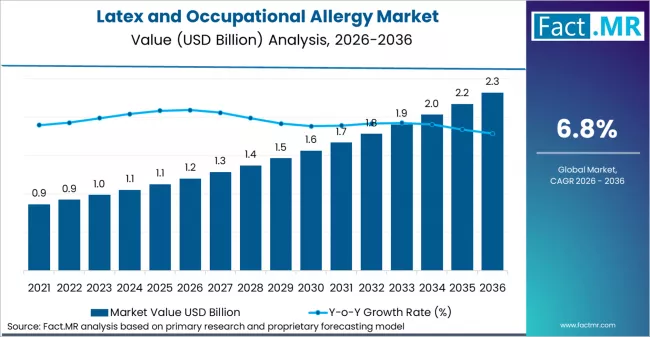
Latex And Occupational Allergy Market Market Value Analysis | Source: Fact.MR
This segment covers products and services used to identify, manage, and prevent reactions linked to workplace exposure in healthcare, manufacturing, and laboratory settings. Demand is tied to safety policies, staff screening programs, and substitution of high-risk materials rather than to consumer choice cycles.
Employers and institutions focus on reliable testing, clear labeling, and consistent supply of alternative materials to limit operational risk. Once protocols and approved product lists are set, they tend to remain stable since changes affect training, procurement lists, and compliance documentation. Growth follows wider adoption of preventive programs, stricter workplace standards, and broader coverage of screening and protection measures rather than rapid changes in product formats or treatment approaches.
Latex and Occupational Allergy Market
| Metric | Value |
|---|---|
| Market Value (2026) | USD 1.2 billion |
| Forecast Value (2036) | USD 2.3 billion |
| Forecast CAGR 2026 to 2036 | 6.8% |
Source: Fact.MR analysis. Updated Jan 28, 2026
Category
| Category | Segments |
|---|---|
| Products and Services | Latex-specific IgE and lab diagnostics; Patch testing and occupational provocation testing; Latex-free PPE and medical consumables substitution; Occupational health screening and surveillance programs; Clinical management (anaphylaxis kits, care pathways) |
| Use Case or Setting | Healthcare worker sensitization screening and management; Surgical and perioperative latex-safe protocols; Dental clinics latex exposure mitigation; Industrial manufacturing worker allergy programs; Other occupational settings |
| End User | Hospitals; Occupational health clinics; Diagnostic laboratories; Government procurement groups; Others |
| Region | North America; Europe; Asia Pacific; Latin America; Middle East & Africa |
Source: Fact.MR analysis. Updated Jan 28, 2026
Latex and Occupational Allergy Market Segmental Analysis
Why Do Latex-Specific IgE and Laboratory Diagnostics Anchor Most Product And Service Demand?
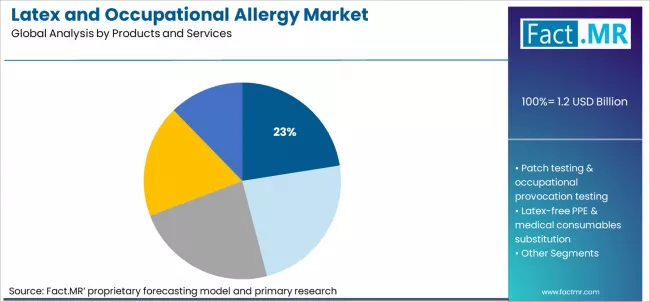
Latex And Occupational Allergy Market Analysis By Products And Services | Source: Fact.MR
Latex-specific IgE and laboratory diagnostics hold a 23% share within the latex and occupational allergy market by products and services. These tests sit at the entry point of risk identification across hospitals, dental clinics, and industrial health programs. Clinicians use objective markers to document sensitization status before exposure management plans are set. Occupational health files often require baseline results and periodic rechecks, which increases test volume per worker over time. Laboratory workflows also support standardized reporting and audit trails for compliance reviews. Procurement teams plan recurring contracts around these assays rather than around episodic interventions. Patch testing, PPE substitution, and clinical kits address defined stages. The routine role of laboratory confirmation keeps diagnostics as the main starting block for program design.
Why Does Healthcare Worker Sensitization Screening and Management Lead Use Cases?
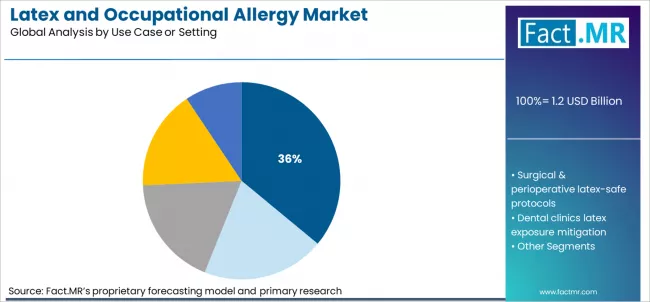
Latex And Occupational Allergy Market Analysis By Use Case Or Setting | Source: Fact.MR
Healthcare worker sensitization screening and management account for 36% of use cases in this market. Hospitals and clinics employ large staffs who face repeated contact with gloves, catheters, and other latex-containing items. Occupational policies require periodic assessment, documentation, and follow-up actions tied to staffing and credentialing cycles. Exposure logs and incident reports create steady review workloads. Program managers coordinate testing, training, and material substitution within the same workforce, which concentrates activity in this setting. Surgical and dental protocols remain important, and industrial programs add volume. The continuous staffing turnover and audit cadence in healthcare settings keep screening and management as the dominant use case across services and products.
What are the Drivers, Restraints, and Key Trends of the Latex and Occupational Allergy Market?
- Drivers: Awareness of allergic reactions among healthcare workers, industrial personnel, and consumer segments, combined with workplace health and safety requirements for at-risk individuals, is shaping demand for testing, diagnostic support services, and alternative materials to manage latex and occupational allergies.
- Restraint: Limited access to standardized screening protocols in some regions, variability in workplace accommodation policies, and inconsistent reimbursement coverage for allergy testing constrain widespread implementation in certain industries.
- Trend 1: Increased adoption of comprehensive screening and diagnostic tools that identify specific allergenic responses and sensitization markers.
- Trend 2: Rising use of non-latex alternatives and education programs to reduce exposure risk and support workplace health strategies.
Analysis of the Latex and Occupational Allergy Market by Key Country
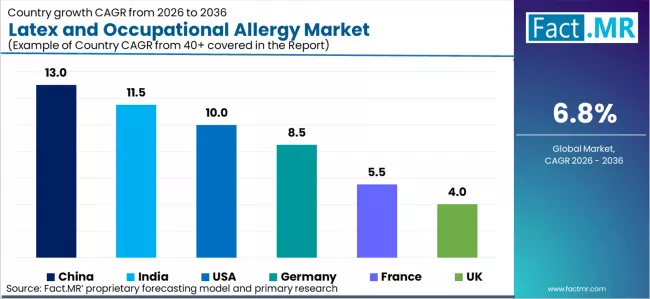
Latex And Occupational Allergy Market Cagr Analysis By Country | Source: Fact.MR
| Country | CAGR 2026 to 2036 |
|---|---|
| USA | 10.0% |
| China | 13.0% |
| India | 11.5% |
| Germany | 8.5% |
| France | 5.5% |
| UK | 4.0% |
Source: Fact.MR analysis. Updated Jan 28, 2026
The report covers an in-depth analysis of 40+ countries; top-performing countries are highlighted below.
How Are Hospital Procurement Policies and Workplace Safety Programs Shaping the Latex and Occupational Allergy Market in USA?
Latex and occupational allergy management in USA is driven by workplace safety rules, hospital procurement standards, and employer risk control programs. The Latex and Occupational Allergy Market in USA expands near 10.0% per year through 2036 as screening, substitution, and allergy prevention protocols become more formal. Demand centers on latex free gloves, protective equipment, and clearer labeling systems. Buyers focus on compliance documentation, supply reliability, and product traceability. Procurement decisions balance cost, litigation exposure, and clinical acceptance. Volume growth follows healthcare expansion and tighter workplace audits. The Latex and Occupational Allergy Market in USA remains anchored in regulation and institutional policy rather than consumer driven awareness cycles.
Why Do Manufacturing Scale and Compliance Programs Matter for the Latex and Occupational Allergy Market in China?
Workplace health management in China increasingly links industrial safety rules with export and hospital compliance requirements. The Latex and Occupational Allergy Market in China grows near 13.0% per year through 2036 as factories and healthcare systems replace higher risk materials. Demand focuses on glove substitution, exposure control, and standardized labeling. Buyers prioritize scale, availability, and documentation readiness. Procurement strategies favor large suppliers with broad product portfolios. Volume growth follows expansion of regulated manufacturing and healthcare capacity. The Latex and Occupational Allergy Market in China develops through industrial upgrading and compliance pressure rather than litigation driven employer behavior or voluntary workplace health programs.
What Is Driving Structured Expansion of the Latex and Occupational Allergy Market in India?
Healthcare expansion and formal workplace safety systems are reshaping allergy management practices in India. The Latex and Occupational Allergy Market in India advances near 11.5% per year through 2036 as hospitals and organized employers adopt clearer prevention protocols. Demand centers on latex free medical supplies, staff training, and improved labeling practices. Buyers emphasize availability, cost control, and supplier reach. Procurement decisions often follow institutional guidelines rather than department level preferences. Volume growth tracks private hospital growth and corporate workplace formalization. The Latex and Occupational Allergy Market in India progresses through system building and policy adoption rather than litigation pressure or employee driven reporting trends.
How Do Clinical Guidelines and Risk Management Culture Shape the Latex and Occupational Allergy Market in Germany?
Occupational health standards in Germany place strong emphasis on prevention, documentation, and material substitution. The Latex and Occupational Allergy Market in Germany grows near 8.5% per year through 2036 as hospitals and industrial employers tighten compliance programs. Demand focuses on certified latex free products, traceability, and staff training. Buyers emphasize supplier audits and consistent specifications. Procurement decisions remain conservative and rule based. Volume growth follows healthcare service expansion and stricter workplace inspections. The Latex and Occupational Allergy Market in Germany remains shaped by institutional risk management frameworks rather than rapid changes in product technology or employer branding around workplace wellness.
Why Do Public Healthcare Structures Influence the Latex and Occupational Allergy Market in France?
Allergy prevention practices in France are closely tied to centralized healthcare standards and workplace health regulation. The Latex and Occupational Allergy Market in France grows near 5.5% per year through 2036 as hospitals and public employers standardize material substitution policies. Demand centers on approved medical supplies, protective equipment, and consistent labeling systems. Buyers emphasize compliance, accreditation, and documentation. Procurement decisions are cautious and often coordinated at institutional levels. Volume growth follows gradual healthcare capacity expansion and regulatory updates. The Latex and Occupational Allergy Market in France develops through public system procedures rather than private litigation risk or aggressive employer driven health initiatives.
How Are Cost Controls and Service Capacity Shaping the Latex and Occupational Allergy Market in UK?
Workplace allergy management in UK remains closely linked to public healthcare funding and operational capacity. The Latex and Occupational Allergy Market in UK grows near 4.0% per year through 2036 as hospitals and employers adopt essential substitution and awareness programs. Demand focuses on basic latex free alternatives, staff guidance, and standardized labeling. Buyers emphasize cost efficiency, supplier reliability, and compliance with national frameworks. Procurement decisions often follow centralized purchasing systems. Volume growth follows incremental expansion of healthcare services. The Latex and Occupational Allergy Market in UK remains constrained by budget priorities and staffing pressures rather than rapid policy shifts or technology driven change.
How Do Hospital Protocols and Risk Management Policies Shape Competition in the Latex and Occupational Allergy Market?
Latex And Occupational Allergy Market Analysis By Company | Source: Fact.MR
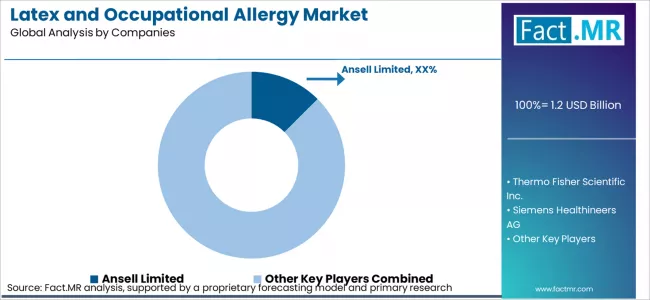
Demand in the latex and occupational allergy market is structured by institutional risk policies, procurement standards, and staff safety protocols rather than by discretionary purchasing. Hospitals and laboratories first define exposure thresholds, approved material lists, and substitution rules for gloves, devices, and consumables. Ansell and Medline hold positions through broad portfolios that allow facilities to standardize across departments. Cardinal Health competes where distribution reach and contract coverage influence compliance programs. Thermo Fisher and Siemens Healthineers participate through diagnostics, testing workflows, and monitoring tools that support identification and management of sensitization risks. Buyers evaluate suppliers using product consistency, documentation quality, training support, and continuity of supply during contract periods. Committees also consider transition effort when replacing latex containing items across large inventories. Once a protocol set is approved, purchasing volumes follow staff counts and procedure activity. Supplier movement usually occurs after policy updates, incident reviews, or changes in occupational health guidance.
Key Players in Latex and Occupational Allergy Market
- Ansell Limited
- Thermo Fisher Scientific Inc.
- Siemens Healthineers AG
- Medline Industries, LP
- Cardinal Health, Inc.
- Others
References
- European Commission. (2024). Proposal for a regulation of the European Parliament and of the Council on packaging and packaging waste and repealing Directive 94/62/EC. European Commission.
- Ngamchokwathana, C. (2023). Latex anaphylaxis in a healthcare worker and occupational sensitization. SAGE Open Medical Case Reports, 11, 1-5.
- National Institute for Occupational Safety and Health. (2023). Preventing allergic reactions to natural rubber latex in the workplace. U.S. Department of Health and Human Services.
- Occupational Safety and Health Administration. (2023). Latex allergy - Safety and health topics. U.S. Department of Labor.
- U.S. Department of Health and Human Services, Head Start Program. (2024). Latex allergy safety practices. Head Start.
Segmentation
Scope of the Report
| Items | Values |
|---|---|
| Quantitative Units (2026) | USD billion |
| Products and Services | Latex-specific IgE and lab diagnostics, patch testing and occupational provocation testing, latex-free PPE and medical consumables substitution, occupational health screening and surveillance programs, clinical management (anaphylaxis kits, care pathways) |
| Use Case or Setting | Healthcare worker sensitization screening and management, surgical and perioperative latex-safe protocols, dental clinics latex exposure mitigation, industrial manufacturing worker allergy programs, other occupational settings |
| End User | Hospitals, occupational health clinics, diagnostic laboratories, government procurement groups, others |
| Regions Covered | Asia Pacific, Europe, North America, Latin America, Middle East & Africa |
| Countries Covered | United States, Canada, Mexico, Germany, United Kingdom, France, Italy, Spain, China, Japan, South Korea, India, Australia & New Zealand, ASEAN, Brazil, Chile, Saudi Arabia, Turkey, South Africa, and other regional markets |
| Key Companies Profiled | Ansell Limited, Thermo Fisher Scientific, Siemens Healthineers, Medline Industries, Cardinal Health |
| Additional Attributes | Dollar by sales by products and services, use case, and end user; focus on screening programs, material substitution, and compliance documentation; demand driven by workplace safety policies and institutional procurement |
Source: Fact.MR analysis. Updated Jan 28, 2026
Latex and Occupational Allergy Market Segmentation
-
Products and Services :
- Latex-specific IgE & lab diagnostics
- Patch testing & occupational provocation testing
- Latex-free PPE & medical consumables substitution
- Occupational health screening & surveillance programs
- Clinical management (anaphylaxis kits, care pathways)
-
Use Case or Setting :
- Healthcare worker sensitization screening & management
- Surgical & perioperative latex-safe protocols
- Dental clinics latex exposure mitigation
- Industrial manufacturing worker allergy programs
- Other occupational settings
-
End User :
- Hospitals
- Occupational Health Clinics
- Diagnostic Laboratories
- Government Procurement Groups
- Others
-
Region :
- Asia Pacific
- China
- Japan
- South Korea
- India
- Australia & New Zealand
- ASEAN
- Rest of Asia Pacific
- Europe
- Germany
- United Kingdom
- France
- Italy
- Spain
- Nordic
- BENELUX
- Rest of Europe
- North America
- United States
- Canada
- Mexico
- Latin America
- Brazil
- Chile
- Rest of Latin America
- Middle East & Africa
- Kingdom of Saudi Arabia
- Other GCC Countries
- Turkey
- South Africa
- Other African Union
- Rest of Middle East & Africa
- Asia Pacific
Frequently Asked Questions
How big is the latex and occupational allergy market in 2026?
What will be the size of latex and occupational allergy market in 2036?
How much will be the latex and occupational allergy market growth between 2026 and 2036?
What are the key product types in the latex and occupational allergy market?
Which use case or setting segment to contribute significant share in the latex and occupational allergy market in 2026?
Who worked on this report


Preview the report firsthand - request a free sample
Free SampleGet the brochure for pricing and purchase details
Download PDF