- Base Value(2025): 4 Bn
- Estimated Value(2026): 5.2 Bn
- Forecast Value (2036): 94 Bn
- CAGR (2026 - 2036): 34.8%
Lighting As A Service Market Forecast 2026 to 2036
In 2025, the lighting as a service (LaaS) market was valued at USD 4 billion. Based on Fact MR's analysis, demand for LaaS is estimated to grow to USD 5.2 billion in 2026 and USD 94 billion by 2036. FMI projects a CAGR of 34.8% during the forecast period.
The absolute dollar growth from 2026 to 2036 is USD 88.8 billion. This significant growth is driven by the increasing shift towards energy-efficient and sustainable lighting solutions, where businesses and municipalities adopt subscription-based models to reduce capital expenditure while improving energy management. As governments push for sustainability initiatives and smart city developments, LaaS is emerging as a cost-effective solution to manage lighting infrastructure. However, challenges such as initial setup costs and the need for widespread infrastructure deployment may impact growth in some regions.
As Kevin Maughan, Founder and Chief Executive Officer of UrbanVolt, noted regarding the shift to service‑based lighting solutions, “Our mission is to educate and inspire our clients to reduce their carbon footprint and accelerate the world’s transition to a sustainable future.”
China leads with a CAGR of 47%, driven by aggressive government policies promoting energy efficiency and rapid urbanization. India follows with 43.5%, supported by increasing demand for energy-saving technologies in rapidly developing urban centers. Germany grows at 40%, benefiting from strong sustainability policies and growing interest in smart city solutions. France shows growth at 36.5%, driven by government-backed energy efficiency initiatives. The UK grows at 33.1%, reflecting the increasing adoption of smart, sustainable lighting solutions. The USA grows at 29.6%, supported by high demand for energy-efficient lighting in commercial and public sectors. Brazil shows slower growth at 26.1%, driven by growing interest in energy-saving lighting solutions in Latin America.
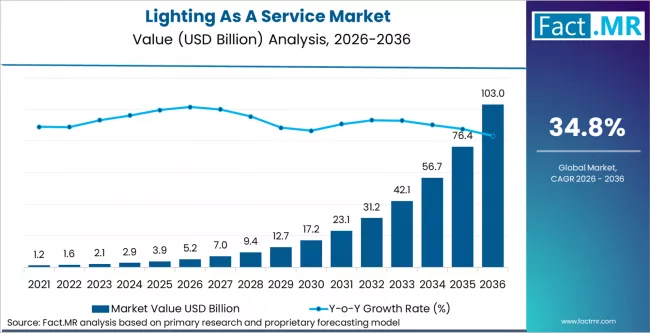
Lighting As A Service Market Market Value Analysis | Source: Fact.MR
Lighting As A Service Market
| Metric | Value |
|---|---|
| Estimated Value in (2026E) | USD 5.2 billion |
| Forecast Value in (2036F) | USD 94 billion |
| Forecast CAGR (2026 to 2036) | 34.8% |
Source: Fact.MR analysis. Updated Mar 2, 2026
Lighting As A Service Market Definition
The Lighting As A Service Market involves subscription‑based solutions where lighting hardware, installation, maintenance, and energy management are provided under long‑term service contracts rather than traditional capital purchase models.
Market Inclusions
This report covers global and regional market sizes for lighting as a service over a defined forecast period, including service models, technology types (LED, connected lighting), verticals (commercial, industrial, public sector), and delivery channels.
Market Exclusions
The scope excludes one‑time lighting equipment sales without service contracts, unrelated energy services not tied to lighting performance, and general electrical infrastructure products.
Research Methodology
- Primary Research: Interviews were conducted with service providers, facility managers, and lighting system integrators.
- Desk Research: Data was sourced from industry reports, energy services publications, and trade association data.
- Market‑Sizing and Forecasting: A hybrid model combining top‑down service adoption forecasts with bottom‑up deployment and revenue data was used.
- Data Validation and Update Cycle: Findings were validated through expert review and aligned with recent adoption and revenue statistics.
Summary of the Lighting As A Service Market
- Market Definition
- The Lighting As A Service (LaaS) Market involves the provision of lighting systems-including luminaries, controls, software, and communication systems-through long-term service contracts, rather than traditional capital purchase models. It focuses on providing energy-efficient and smart lighting solutions for commercial, industrial, and municipal applications, ensuring energy savings, improved maintenance, and sustainability.
- Demand Drivers
- Sustainability Initiatives: Growing government regulations and global sustainability goals encourage businesses and municipalities to adopt energy-efficient lighting solutions.
- Smart City Developments: Increasing adoption of smart city solutions, which require energy-efficient, remotely controlled, and highly adaptable lighting systems.
- Energy Cost Reduction: Businesses and public organizations are shifting to LaaS to reduce operational costs by avoiding high initial investments and transferring maintenance and energy management responsibilities to service providers.
- Technological Advancements: Integration of smart technologies such as IoT, sensors, and data analytics in lighting systems boosts demand for LaaS.
- Key Segments Analyzed
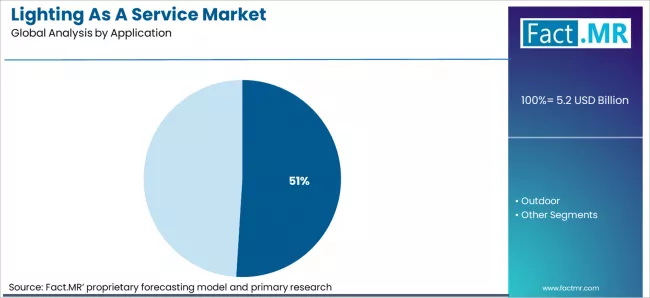
- Application: Indoor applications are projected to dominate with 51% of the market share in 2026 due to high demand for energy-efficient lighting in commercial and industrial spaces.
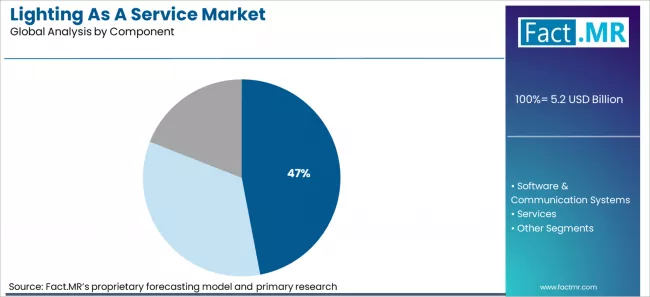
- Component: Luminaries and controls are expected to capture 47% of the market, as they form the core of any LaaS offering, providing essential lighting output and smart management features.
- Geography: China leads with the highest CAGR at 47%, followed by India (43.5%) and Germany (40%).
- Analyst Opinion at FMR
- Shambhu Nath Jha, Principal Consultant at Fact MR, comments, “The Lighting as a Service market is poised for explosive growth, driven by the increasing need for energy-efficient and flexible lighting solutions across industries. The LaaS model offers cost-effective, scalable, and sustainable lighting solutions, positioning it as the preferred choice in the move toward smart cities and energy-efficient urban infrastructure.”
- Strategic Implications/Executive Takeaways
- Focus on Smart and Flexible Lighting Solutions: Companies should prioritize the development of flexible, connected lighting solutions that cater to the needs of modern businesses and municipalities, focusing on energy savings and ease of management.
- Invest in Emerging Markets: With rapid urbanization and growing adoption of sustainable practices, investing in emerging markets such as China, India, and Brazil presents significant growth opportunities for LaaS providers.
- Leverage Partnerships: Partner with governments and municipalities to integrate energy-efficient lighting solutions as part of broader urban development and smart city projects.
- Methodology
- Primary research through interviews with service providers, facility managers, and lighting system integrators.
- Data sourced from industry reports, energy services publications, and trade association data.
- Market sizing and forecasting using a hybrid model combining top-down service adoption forecasts with bottom-up deployment and revenue data.
Segmental Analysis
Lighting As A Service Market Analysis by Application
Lighting As A Service Market Analysis By Application | Source: Fact.MR
- Market Overview: Indoor applications are expected to capture 51% of the Lighting as a Service (LaaS) market by 2026. Indoor lighting solutions, particularly in commercial and industrial buildings, are the primary use case for LaaS due to the demand for energy-efficient, flexible, and intelligent lighting systems that optimize workspace environments.
- Demand Drivers:
- Energy Efficiency and Cost Savings: Indoor lighting accounts for a significant portion of a building’s energy consumption. LaaS allows businesses to install energy-efficient lighting solutions with no upfront costs, paying only for usage over time, which helps companies reduce energy bills and maintenance costs.
- Smart Lighting Integration: As businesses increasingly adopt smart building technologies, the demand for connected and smart lighting solutions grows. LaaS providers offer integrated systems with real-time monitoring, automation, and remote control, which are highly appealing for indoor applications in offices, warehouses, and commercial spaces.
- Sustainability and Regulatory Compliance: Growing emphasis on sustainability and the adoption of green building standards (e.g., LEED) are pushing businesses to adopt energy-efficient indoor lighting solutions. LaaS providers offer an ideal model for meeting regulatory requirements and environmental goals without large initial investments.
Lighting As A Service Market Analysis by Component
Lighting As A Service Market Analysis By Component | Source: Fact.MR
- Market Overview: Luminaries and controls are projected to account for 47% of the Lighting as a Service market by 2026. Luminaries and control systems are the most critical components in LaaS, providing the actual lighting output and management features. These components are central to the functionality and value proposition of LaaS offerings.
- Demand Drivers:
- Integration of Smart Controls: The integration of smart controls with LED luminaries in LaaS solutions allows for real-time monitoring, energy management, and automated adjustments to optimize energy use and lighting quality. The ability to control lighting remotely, adjust brightness, and set schedules is driving the adoption of advanced luminaries and controls in LaaS models.
- Demand for Efficient Lighting Solutions: Energy-efficient LED technology is at the core of LaaS. LED luminaries, combined with smart controls, offer long lifespan, lower energy consumption, and reduced maintenance, making them a crucial component of any LaaS model.
- Customization and Flexibility: The growing trend toward customizable lighting solutions for different indoor environments (e.g., offices, factories, retail stores) drives the demand for versatile luminaries and controls. These systems enable businesses to tailor lighting settings to specific needs, enhancing employee productivity, customer experience, and operational efficiency.
Lighting as a Service Market Drivers, Restraints, and Opportunities
FMR analysts observe that the lighting as a service (LaaS) market is a growth‑aligned, subscription‑driven segment catalyzed by the shift from traditional lighting ownership to outcome‑based solutions that deliver energy efficiency, lower operating cost, and improved maintenance. Historically, businesses and institutions purchased and maintained lighting fixtures outright; as LED technology matured and energy management became a priority, structural demand emerged for pay‑per‑use models that bundle design, installation, financing, and ongoing service under a recurring fee. The 2026 valuation reflects this transition, with uptake tied to corporate sustainability targets, energy performance contracting, and a broader shift toward “as‑a‑service” procurement in facilities management.
While capital purchase of LED systems remains common in cost‑sensitive segments, LaaS models are gaining share because they eliminate upfront investment and transfer performance risk to service providers. These recurring revenue arrangements carry higher lifetime value and support market growth even where unit installations grow at a moderate pace. The market exists because organizations seek predictable operating expenses, faster ROI on lighting upgrades, and assurance of performance through service agreements.
- Operational Expense Shift: Organizations adopt LaaS to convert large upfront lighting costs into predictable service fees, replacing traditional capital purchase models.
- Energy & Sustainability Standards: Regulations and corporate ESG reporting expectations push facilities toward certified energy‑efficient lighting solutions under service contracts.
- Regional Adoption Patterns: In North America and Europe, strong ESCO activity and regulatory support for energy performance drive higher LaaS uptake compared with regions with slower financing adoption.
Regional Analysis
The market analysis covers key global regions, including East Asia, South Asia, Western Europe, North America, and Latin America. It is segmented geographically, with specific market dynamics for each region. The full report provides a detailed market attractiveness analysis.
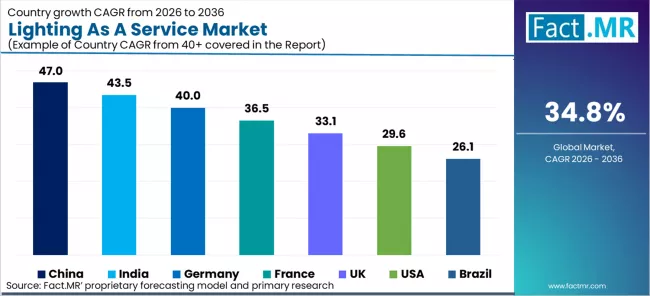
Lighting As A Service Market Cagr Analysis By Country | Source: Fact.MR
| Country | CAGR (2026 - 2036) |
|---|---|
| China | 47.0% |
| India | 43.5% |
| Germany | 40.0% |
| France | 36.5% |
| UK | 33.1% |
| USA | 29.6% |
| Brazil | 26.1% |
Source: Fact.MR analysis. Updated Mar 2, 2026
Source: Fact MR (FMR) analysis, based on proprietary forecasting model and primary research.
East Asia:
In East Asia, China and India are leading the demand for lighting as a service (LaaS), driven by rapid urbanization, a growing focus on energy efficiency, and increasing government initiatives supporting sustainable infrastructure.
- China: Demand for lighting as a service in China is projected to rise at 47.0% CAGR through 2036. China’s large-scale urbanization and growing emphasis on energy-efficient lighting solutions continue to drive exceptional growth in the LaaS market.
- India: Demand for lighting as a service in India is projected to rise at 43.5% CAGR through 2036. India’s rapid urban development and government-led energy efficiency initiatives contribute to steady market growth for LaaS.
Western Europe:
In Western Europe, Germany and France are key markets for lighting as a service, driven by strong government support for energy-efficient solutions, advancements in smart city projects, and rising demand for sustainable lighting.
- Germany: Demand for lighting as a service in Germany is projected to rise at 40.0% CAGR through 2036. Germany’s focus on sustainability, smart city development, and increasing adoption of energy-saving technologies continue to fuel the growth of the LaaS market.
- France: Demand for lighting as a service in France is projected to rise at 36.5% CAGR through 2036. France’s commitment to energy efficiency and growing demand for smart lighting systems contribute to market expansion.
- United Kingdom: Demand for lighting as a service in the UK is projected to rise at 33.1% CAGR through 2036. The UK’s growing push for energy-efficient infrastructure and adoption of smart lighting solutions continue to support LaaS market growth.
North America:
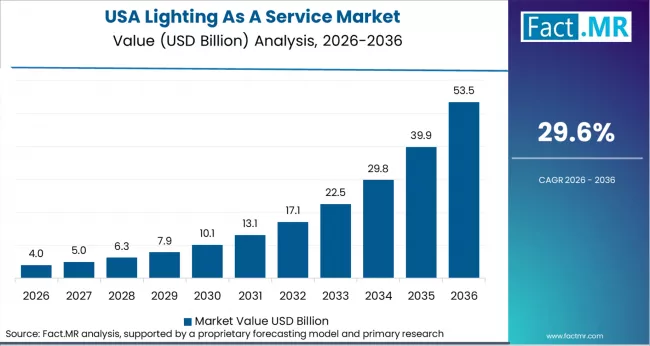
Lighting As A Service Market Country Value Analysis | Source: Fact.MR
In North America, the USA is a significant market for lighting as a service, supported by the rise of smart cities, increasing demand for energy-efficient solutions, and strong technological advancements in lighting systems.
- USA: Demand for lighting as a service in the U.S. is projected to rise at 29.6% CAGR through 2036. The USA’s focus on smart city developments, energy-efficient lighting solutions, and sustainability initiatives continue to drive demand for LaaS.
Latin America:
In Latin America, Brazil is the leading market for lighting as a service, driven by increasing energy demands, urbanization, and the growing adoption of sustainable lighting technologies.
- Brazil: Demand for lighting as a service in Brazil is projected to rise at 26.1% CAGR through 2036. Brazil’s rising urban population and government support for green initiatives continue to contribute to steady growth in the LaaS market.
Fact MR's analysis of the Lighting As A Service Market in East Asia, South Asia, Western Europe, North America, and Latin America consists of country-wise assessments that include China, India, Germany, France, the United Kingdom, the USA, and Brazil. Readers can find detailed trends, regulatory updates, and company-specific investments shaping the market’s growth in these countries.
How Are Key Players Competing in the Lighting As A Service Market?
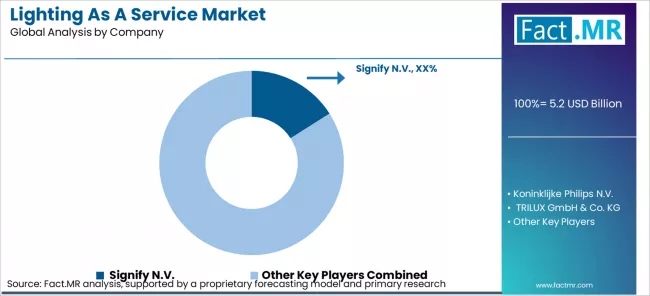
Lighting As A Service Market Analysis By Company | Source: Fact.MR
The Lighting as a Service (LaaS) Market is seeing strong competition, with Signify N.V. and Koninklijke Philips N.V. leading with comprehensive, energy-efficient lighting solutions and advanced connected technologies. TRILUX GmbH & Co. KG and UrbanVolt Ltd. are driving innovation by offering smart, energy-saving lighting solutions, while Facility Solutions Group (FSG) focuses on providing cost-effective, customized lighting services for commercial clients. Orion Energy Systems, Inc. stands out with its energy-efficient retrofit solutions for industries. Siemens AG and Schneider Electric SE integrate digital controls and automation to enhance energy management in their services. Legrand S.A., Eaton Corporation plc, and Acuity Brands, Inc. offer flexible, scalable solutions for businesses looking to reduce energy costs and improve sustainability. Honeywell International Inc. further strengthens its position by incorporating smart lighting technology into its broader energy management offerings. These players focus on providing cost-effective, sustainable lighting solutions, emphasizing smart features, energy efficiency, and ease of service.
Recent Industry Developments
- Signify & Solas Capital € LaaS Framework: In late June 2025, Signify (formerly Philips Lighting) entered a major framework agreement with Solas Capital to finance energy-efficient LED and connected lighting projects with zero upfront costs for private and public sector customers across Europe.
- DesignLights Consortium (DLC) SSL V6.0 Launch: The DesignLights Consortium released its SSL V6.0 and LUNA V2.0 technical requirements in final form on November 3, 2025, which increase weighted average efficacy thresholds by 14% and establish new controllability criteria effective January 5, 2026.
- EU Mercury-Added Lamp Phase-Out (RoHS): Under Regulation (EU) 2017/852, the European Union has mandated the phase-out of most mercury-containing lamps for general lighting by December 31, 2025, or 2026 (depending on category), driving a massive market shift toward LED-as-a-Service retrofits.
Key Players of the Lighting As A Service Market
- Signify N.V.
- Koninklijke Philips N.V.
- TRILUX GmbH & Co. KG
- UrbanVolt Ltd.
- Facility Solutions Group (FSG)
- Orion Energy Systems, Inc.
- Siemens AG
- Schneider Electric SE
- Legrand S.A.
- Eaton Corporation plc
- Acuity Brands, Inc.
- Honeywell International Inc.
Report Scope
| Metric | Value |
|---|---|
| Quantitative Units | USD 5.2 billion (2026) to USD 94 billion (2036), at a CAGR of 34.8% |
| Market Definition | The Lighting As A Service Market includes the provision of lighting systems, including luminaries, controls, software, and communication systems, along with services for commercial, industrial, and municipal applications. |
| By Component | Luminaries and Controls, Software & Communication Systems, Services |
| By Application | Indoor, Outdoor |
| By End-Use | Commercial, Industrial, Municipal |
| Regions Covered | North America, Latin America, Europe, East Asia, South Asia, Oceania, Middle East and Africa |
| Countries Covered | United States, Canada, Mexico, Brazil, Argentina, Germany, France, United Kingdom, Italy, Spain, China, India, Japan, South Korea, Indonesia, Australia, and 40+ countries |
| Key Companies Profiled | Signify N.V., Koninklijke Philips N.V., TRILUX GmbH & Co. KG, UrbanVolt Ltd., Facility Solutions Group (FSG), Orion Energy Systems, Inc., Siemens AG, Schneider Electric SE, Legrand S.A., Eaton Corporation plc, Acuity Brands, Inc., Honeywell International Inc. |
| Forecast Period | 2026 to 2036 |
| Approach | Hybrid top-down and bottom-up market modeling validated through primary interviews with manufacturers and supported by trade data benchmarking and market research. |
Source: Fact.MR analysis. Updated Mar 2, 2026
Bibliographies
- DesignLights Consortium. (2025/2026, November 3). DesignLights Consortium releases final version of SSL V6.0 and LUNA V2.0 technical requirements [Industry update]. DesignLights Consortium.
- European Commission. (2025/2026). EU mandates phase-out of mercury-containing lamps for general lighting under Regulation (EU) 2017/852 [Regulatory update]. European Commission.
- Solas Capital AG. (2025/2026, June). Solas Capital partners with Signify to finance LED lighting projects across European markets [Partnership announcement]. Solas Capital AG.
- Signify N.V. (2025). Innovative lighting as a service (LaaS) solutions for commercial and residential sectors. Signify N.V.
- TRILUX GmbH & Co. KG. (2025). Transforming the lighting industry: TRILUX's approach to energy-efficient and sustainable lighting as a service. TRILUX GmbH & Co. KG.
- UrbanVolt Ltd. (2025). UrbanVolt's lighting as a service model: Reducing carbon footprints with smart lighting solutions. UrbanVolt Ltd.
This report addresses:
- Market Intelligence enabling a comprehensive assessment of leading countries and service segments across the Lighting As A Service Market globally.
- Market Volume (Sales Units) estimates and 10-year revenue forecasts from 2026 to 2036, validated through service provider surveys, demand modeling, and data collection.
- Growth Opportunity Mapping across components (Luminaries and Controls, Software & Communication Systems, Services), applications (Indoor, Outdoor), end-use sectors (Commercial, Industrial, Municipal), and regions.
- Segment and Regional Revenue Forecasts by components, applications, and regions across 40+ countries.
- Competition Strategy Analysis covering dealer network structure, recent developments, product portfolio, USPs, and market share analysis.
- Product and Regulatory Compliance Tracking aligned with industry standards for energy efficiency, smart building technology, and regulatory frameworks.
- Regulatory Impact Analysis addressing global market compliance, sustainability standards, and evolving energy-efficient lighting technologies.
- Report Delivery in PDF, Excel, PowerPoint, and interactive dashboard formats for executive, procurement, and operational planning use.
Segmentation
Lighting As A Service Market Key Segments
-
Component :
- Luminaries and Controls
- Software & Communication Systems
- Services
-
Application :
- Indoor
- Outdoor
-
End-Use Industry :
- Commercial
- Industrial
- Municipal
-
Region :
- North America
- USA
- Canada
- Mexico
- Europe
- Germany
- UK
- France
- Italy
- Spain
- Nordic Countries
- BENELUX
- Rest of Europe
- Asia Pacific
- China
- Japan
- South Korea
- India
- Australia
- Rest of Asia Pacific
- Latin America
- Brazil
- Argentina
- Rest of Latin America
- Middle East and Africa
- Kingdom of Saudi Arabia
- United Arab Emirates
- South Africa
- Rest of Middle East and Africa
- Other Regions
- Oceania
- Central Asia
- Other Markets
- North America
Frequently Asked Questions
How large is the demand for Lighting As A Service in the global market in 2025?
What will be the market size of Lighting As A Service in the global market by 2036?
What is the expected demand growth for Lighting As A Service in the global market between 2026 and 2036?
Which application is expected to dominate the market?
Which region is expected to show the highest growth rate for Lighting As A Service?
How significant is the growth outlook for India in this market?
What is the growth outlook for Germany in the Lighting As A Service market?
What is the growth forecast for France in the Lighting As A Service market?
What is the growth forecast for the United Kingdom in the Lighting As A Service market?
What is the growth forecast for the United States in the Lighting As A Service market?
What is the growth forecast for Brazil in the Lighting As A Service market?
Which company is identified as a leading player in the Lighting As A Service market?
What is Lighting As A Service used for?
What does the Lighting As A Service market include in this report?
How is the market forecast developed in this report?
What is meant by the Lighting As A Service market in this report?
Who worked on this report


Preview the report firsthand - request a free sample
Free SampleGet the brochure for pricing and purchase details
Download PDF