- Base Value(2025): 105.5 Bn
- Estimated Value(2026): 108.8 Bn
- Forecast Value (2036): 156.4 Bn
- CAGR (2026 - 2036): 3.7%
Lightweight Polymers Market Forecast and Outlook 2026 to 2036
In 2025, the lightweight polymers market was valued at USD 105.5 billion. Based on Future Market Insights' analysis, demand for lightweight polymers is estimated to grow to USD 108.8 billion in 2026 and USD 156.4 billion by 2036. FACT.MR projects a CAGR of 3.7% during the forecast period.
The absolute dollar growth from 2026 to 2036 represents an incremental gain of USD 47.6 billion, a scale that is transformational in volume terms yet constrained in pace by resin feedstock price volatility tied to naphtha and natural gas cycles. Growth is anchored by structural demand from electric-vehicle light weighting, 5G-driven E&E miniaturization, and recyclability mandates under the EU's Single-Use Plastics Directive, but offset by periodic overcapacity in commodity polypropylene and the long qualification cycles for engineering polymers in safety-critical automotive applications.
Doug Brademeyer, Ultra-Polymers Business Manager says, "We were able to boost thermal and mechanical performance while maintaining PEEK’s ether-to-ketone ratio. This accounts for the polymer’s superior chemical resistance” [1].
Country-level CAGR trends vary by industrial momentum and EV penetration: China leads at 4.9% on strong EV output, followed by Brazil at 4.5% via reshoring and packaging growth; Europe posts 3.5%, while the United States and United Kingdom register 3.4% each; Germany reaches 3.3%, South Korea 2.9%, and Japan trails at 2.2% amid mature-market constraints.
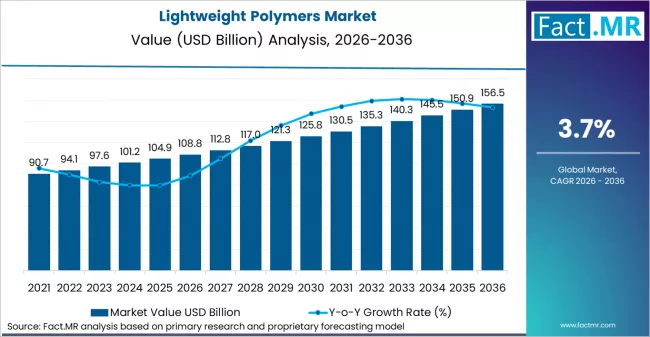
Lightweight Polymers Market Market Value Analysis | Source: Fact.MR
Market Definition
Lightweight polymers are a class of thermoplastic and thermosetting materials engineered to deliver high strength-to-weight ratios, enabling direct substitution of steel, aluminum, and glass components across transportation, electronics, and packaging applications. The unifying commercial function is mass reduction each kilogram eliminated from a vehicle reduces lifecycle CO₂ emissions by approximately 20 kilograms, and each gram removed from a consumer electronics device reduces shipping energy and enables ergonomic improvements that buyers increasingly price as features.
Market Inclusions
The report covers global and regional lightweight polymer market sizes from 2026 to 2036, with detailed segment breakdowns by polymer family (polypropylene, polyamide, polycarbonate, composites and thermoplastic elastomers), application (automotive structural and interior components, electrical and electronics housings and insulators, rigid and flexible packaging, and industrial parts), processing method (injection molding, extrusion, blow molding, additive manufacturing), and geography. Analysis includes resin pricing dynamics, processing yield rates, and recyclability compliance cost impacts across regional markets.
Market Exclusions
The scope excludes commodity packaging films below 50-micron thickness unless produced from engineering-grade barrier resins. It also omits thermoset epoxy and phenolic resins used in aerospace structural laminates outside automotive or E&E primary applications, focusing strictly on thermoplastic and short-fiber composite grades that undergo melt processing. Finished fabricated parts sold to end consumer’s automotive bumpers, mobile phone housings, bottles are excluded; the report covers resin and compound pellets and their immediate downstream compounding intermediates before final part fabrication.
Research Methodology
- Primary Research: Primary research involved structured interviews with resin procurement managers at Tier 1 automotive suppliers, electronics contract manufacturers, and packaging converters, as well as product development chemists at BASF, SABIC, and Covestro.
- Desk Research: Desk research synthesized data from European Plastics Converters Association production statistics, American Chemistry Council polymer shipment reports, and sustainability disclosures from publicly listed polymer producers.
- Market-Sizing and Forecasting: Market sizing employed a hybrid approach, triangulating resin producer capacity utilization and shipment disclosures with customs trade flow data and end-user bill-of-materials polymer content per unit across automotive, E&E, and packaging applications.
- Data Validation and Update Cycle: Outputs were cross-validated against quarterly earnings disclosures from Covestro, BASF, and LyondellBasell and reconciled semi-annually with OEM vehicle platform polymer content announcements and E&E design specification updates.
Key Takeaways
- Market Definition
- Lightweight polymers are thermoplastic and composite materials sold as pellets and compounds to fabricators seeking strength-to-weight improvements that enable mass reduction across automotive, electronics, packaging, and industrial components globally.
- Demand Drivers
- Automotive OEMs implementing EU fleet CO₂ targets of 95 g/km (passenger cars) and U.S. CAFE standards are mandating 100-150 kg per-vehicle weight reduction programs that systematically substitute steel and aluminum with polypropylene, polyamide, and glass-fiber composites in body, chassis, and powertrain applications.
- Electric vehicle platform proliferation drives three-to-four-times higher engineering polymer content per vehicle versus ICE architectures, as battery enclosures, thermal management systems, and high-voltage connector housings require halogen-free flame-retardant polyamide and polycarbonate grades unavailable in commodity resin lines.
- Packaging converter demand for mono-material recyclable structures under the EU Single-Use Plastics Directive is replacing multi-material laminates with high-barrier polypropylene and polyethylene grades, reshaping resin procurement toward premium lightweight polymer grades with certified recyclability.
- Key Segments Analyzed
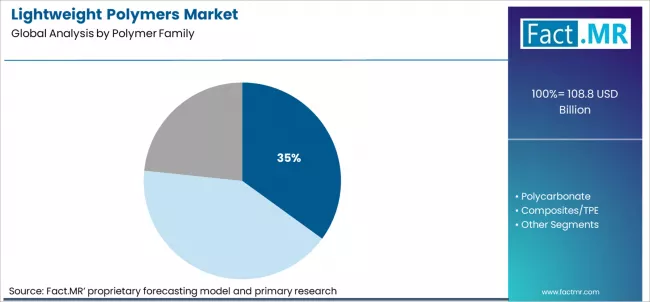
- By Polymer Family, Polypropylene commands 35% share, reflecting its cost-performance balance in high-volume automotive interior, appliance housing, and thin-wall packaging applications where 30-50% weight savings over metal are achievable at USD 1.00-1.50 per kg resin cost.
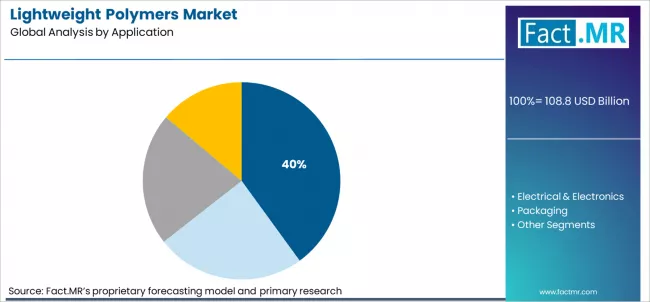
- By Application, Automotive holds 40% share, as vehicle lightweighting mandates make passenger car and commercial vehicle OEM programs the single largest demand source for engineering polymers, with EV-specific grades representing the highest-growth sub-segment.
- By Region, Asia-Pacific holds the leading market share driven by China's dominance in both EV production and consumer electronics manufacturing, which together account for over 55% of regional polymer demand growth through 2036.
- Analyst Opinion at FACT.MR
- Shambhu Nath Jha, Principal Consultant at Fact.MR, opines, 'CXOs will find this report valuable for identifying which polymer families’ polypropylene versus polyamide versus composites are capturing disproportionate margin expansion as automotive OEMs specify performance grades for EV platforms, and how processing method shifts from injection molding toward additive manufacturing are reshaping supplier qualification requirements and minimum order economics.'
- Strategic Implications / Executive Takeaways
- Polymer producers should differentiate commodity polypropylene product lines with application-specific master batch formulations UV-stabilized grades for EV exterior trim, conductive grades for E&E shielding to defend 15-25% price premiums over generic resin and resist margin erosion from Asian capacity additions.
- Automotive Tier 1 suppliers must invest in polymer-metal hybrid joining technologies including ultrasonic welding and laser direct structuring to qualify next-generation structural components that combine polypropylene or polyamide with aluminum inserts, enabling part integration that reduces assembly cost while meeting crash performance requirements.
- Packaging converters should accelerate transition to mono-material recyclable structures using high-barrier polypropylene and polyethylene blends, securing extended producer responsibility (EPR) compliance at lower cost than multi-material alternatives while capturing marketing premium for products meeting EU Packaging Regulation recyclability criteria.
- Methodology
- Market sizing triangulated resin producer capacity utilization rates from corporate sustainability reports, customs trade flow statistics from UN Comtrade, and end-user bill-of-materials polymer content analysis across 45 vehicle platforms and 120 consumer electronics product categories.
- Technology adoption curves for engineering polyamide, polycarbonate, and glass-fiber composite grades calibrated using disclosed material content changes in OEM vehicle redesign announcements and E&E specification updates from Samsung, Apple, and major European automotive platforms.
- Primary interviews with 52 procurement managers and material engineers across automotive, electronics, and packaging sectors validated substitution rate assumptions and price premium sustainability for high-performance versus commodity lightweight polymer grades.
Segmental Analysis
Lightweight Polymers Market Analysis by Polymer Family
Lightweight Polymers Market Analysis By Polymer Family | Source: Fact.MR
Based on FACT.MR’s lightweight polymers market report, Polypropylene is estimated to hold 35% share in 2025 as it delivers the lowest cost per unit weight reduction across automotive, appliance, and packaging applications while supporting multi-process manufacturability and large-scale substitution for metal and heavier plastics.
- SABIC capacity expansion: A USD 7 billion Al Jubail expansion adds 1.2 million tons per year of polypropylene capacity targeting automotive impact copolymer and glass fiber reinforced structural grades [5].
- Borealis circular PP: Borealis AG launched in May 2024 its Bornewables circular polypropylene range produced from renewable bio-naphtha certified under ISCC Plus, achieving identical mechanical properties to fossil PP while meeting the EU Packaging and Packaging Waste Regulation's 2030 recyclability mandates. [6]
- LFT PP growth: Long glass fiber reinforced PP shipments to European automotive suppliers rose strongly in 2024, driven by EV structural applications replacing sheet molding compounds [7].
Lightweight Polymers Market Analysis by Application
Lightweight Polymers Market Analysis By Application | Source: Fact.MR
Based on FACT.MR’s lightweight polymers market report, Automotive applications account for 40% share in 2025 as vehicle light weighting delivers measurable lifetime energy savings and EV platforms require higher volumes of high performance polymers for battery, thermal, and structural systems.
- BMW iX polymer content: Premium EV architectures integrate significantly higher volumes of carbon fiber composites, reinforced polyamides, and flame retardant polycarbonates versus ICE platforms [8].
- DSM Akulon Diablo: High temperature polyamide enables aluminum substitution in EV powertrain housings with substantial weight reduction and structural equivalence [9].
- IEC 62368 1 compliance: Halogen free flame retardant polymer demand increased following updated safety standards for high power consumer electronics and charging systems.
Lightweight Polymers Market Drivers, Restraints, And Opportunities
Fact.MR analysis indicates the USD 105-109 billion lightweight polymers market is driven by ongoing metal substitution in commercial vehicles, industrial machinery, EV platforms, and 5G infrastructure, while mature packaging and passenger vehicle interiors approach saturation in developed markets.
The key structural divide exists between commodity polypropylene facing margin pressure and regulatory scrutiny, and high performance engineering polymers growing at faster rates with higher profitability due to electrification, circular content mandates, and telecom material specifications.
- EU End of Life Vehicle Regulation: Mandatory recycled plastic content targets for 2030 and 2035 are accelerating demand for certified circular engineering polymers at premium pricing [2].
- China EV mandate: Electrification targets and expanded domestic polycarbonate compounding capacity support incremental high performance polymer demand per vehicle [3].
- 5G and 6G materials requirement: Ultra low dielectric specialty polymers required for next generation telecom infrastructure sustain double digit growth in high value niche grades [4].
Regional Analysis
Based on regional assessment, lightweight polymers market is analyzed across North America, Latin America, Europe, spanning more than 40+ countries. The report also presents a comparative market attractiveness evaluation grounded in region-specific demand trends.
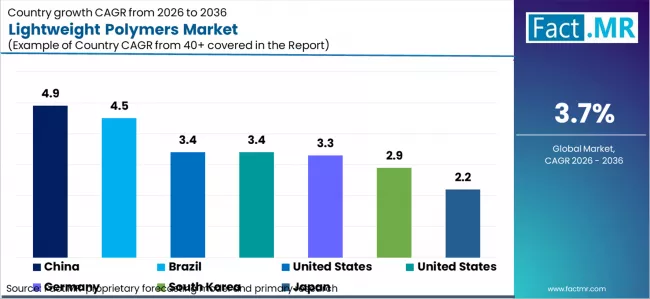
Lightweight Polymers Market Cagr Analysis By Country | Source: Fact.MR
| Country | CAGR% |
|---|---|
| China | 4.9% |
| Brazil | 4.5% |
| United States | 3.4% |
| United Kingdom | 3.4% |
| Germany | 3.3% |
| South Korea | 2.9% |
| Japan | 2.2% |
Source: Fact.MR analysis. Updated Feb 19, 2026
Source: Fact.MR (FACT.MR) analysis, based on proprietary forecasting model and primary research
North America Lightweight Polymers Market Analysis
North America functions as the volume anchor for polypropylene and engineering polymer demand, where SABIC, LyondellBasell, and Dow operate integrated petrochemical-to-compounding supply chains leveraging shale-gas-derived propylene at competitive feedstock costs unmatched by European or Asian rivals
- United States: Demand in the United States is projected to rise at 3.4% CAGR through 2036. Updated CAFE standards require 50.4 MPG fleet averages by 2031, increasing polymer substitution in body and chassis systems, Ford’s F 150 Lightning reduces 95 kg using reinforced polypropylene and polyamide components under multiyear supply agreements, and California SB 54 mandates major single use plastic reduction, supporting Dow’s recyclable LDPE pouch technologies at premium pricing.
FACT.MR’s analysis of lightweight polymers market in North America includes the United States, Canada, and Mexico, covering CAFE compliance roadmaps, EPR legislation impacts, and EV platform polymer specification trends.
Asia Pacific Lightweight Polymers Market Analysis
Asia Pacific represents the primary production and consumption growth engine where China’s EV scale, Japan’s advanced materials R&D, and South Korea’s engineering upgrades drive both high volume and high specification polymer demand across automotive and electronics sectors.
- China: Demand in China is projected to rise at 4.9% CAGR through 2036. The updated NEV Dual Credit Policy accelerates EV output across BYD, SAIC, Geely, and NIO, SABIC Sinopec Tianjin added 180,000 tons of polycarbonate compound capacity targeting EV battery systems, and GB T 29611 2024 establishes recycled polymer standards for automotive parts creating a USD 3.2 billion recycled compound opportunity by 2030.
- Japan: Demand in Japan is projected to rise at 2.2% CAGR through 2036. The 2030 Green Innovation Fund allocates JPY 120 billion to advanced lightweight materials, Toyota MIRAI uses 28 kg specialty polymer per vehicle sourced from Toray, Ube, and DIC, and Sumitomo Chemical qualified premium heat resistant ABS for Lexus LF ZL interior applications at elevated pricing.
- South Korea: Demand in South Korea is projected to rise at 2.9% CAGR through 2036. Hyundai Kia’s E GMP 2.0 platform increases use of reinforced polypropylene and polyamide structures, Lotte Chemical invested KRW 850 billion to expand engineering compounding capacity, and Resource Circulation Act amendments require 30% recycled content in automotive plastics by 2030.
FACT.MR’s analysis of lightweight polymers market in Asia Pacific includes China, Japan, South Korea, covering EV polymer content specifications, recycled standard adoption, and regional capacity expansions.
Europe Lightweight Polymers Market Analysis
Europe operates as the global regulatory benchmark for lightweight polymer performance and circularity, where End of Life Vehicle rules, REACH compliance, and Packaging Waste Regulation mandates shape polymer specifications adopted by multinational OEMs and brand owners worldwide. BASF SE, Covestro AG, and Lanxess AG anchor the regional engineering polymer supply base through integrated feedstock positions, allowing Europe to retain margin leadership in specialty grades despite commodity volume losses to Asia.
- Germany: Demand in Germany is projected to rise at 3.3% CAGR through 2036. VerpackG 2 imposes recyclability based packaging fees that strongly favor mono material polypropylene, BASF expanded Ultramid capacity by 80,000 tons incorporating recycled PA6 for Volkswagen MEB platforms including ID.3 and ID.4, and VDA data shows 340,000 tons of annual steel displacement captured largely by domestic glass fiber polypropylene and polyamide compounds.
- United Kingdom: Demand in the United Kingdom is projected to rise at 3.4% CAGR through 2036. The Extended Producer Responsibility scheme incentivizes recyclable polypropylene packaging, Jaguar Land Rover’s Range Rover Electric platform specifies 28% composite polymer body mass under a GBP 85 million Toray supply agreement, and INEOS Styrolution upgraded its Grangemouth plant to produce halogen free flame retardant ABS meeting IEC 62368-1 standards.
FACT.MR’s analysis of lightweight polymers market in Europe includes Germany, United Kingdom, France, Italy, Spain, Poland, Netherlands, Belgium, Czech Republic, and Sweden, detailing recycled content cost impacts, OEM substitution timelines, and engineering polymer pricing differentials.
Latin America Lightweight Polymers Market Analysis
Latin America operates as a structural growth market for lightweight polymers, where automotive localization policies, packaging modernization, and expanding domestic petrochemical capacity are driving incremental polypropylene and engineering polymer demand. Brazil anchors regional production through integrated players such as Braskem, while multinational suppliers expand compounding operations to serve automotive OEMs and consumer goods manufacturers under localization and efficiency mandates.
- Brazil: Demand in Brazil is projected to rise at 4.5% CAGR through 2036. The Mover Program provides tax credits tied to domestic polymer content, Braskem expanded Camaçari polypropylene capacity by 350,000 tons for automotive grades, and BASF Brazil began producing recycled content Ultramid Balance polyamide for Tier 1 suppliers meeting national efficiency thresholds.
FACT.MR’s analysis of lightweight polymers market in Latin America consists of country-wise assessment that includes Brazil and other regional economies, covering automotive polymer substitution trends, recycled content regulation impacts, and regional polypropylene and engineering compound capacity expansion benchmarks.
Competitive Aligners for Market Players
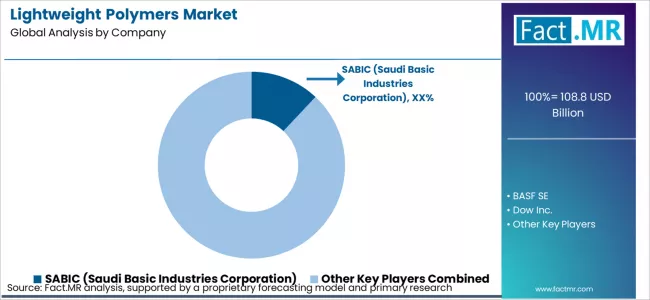
Lightweight Polymers Market Analysis By Company | Source: Fact.MR
The lightweight polymers market operates through a clear two tier competitive structure. Engineering and specialty polymers are controlled by a concentrated group of global leaders including BASF, Covestro, Celanese, and SABIC, which together hold maximum share of global supply. In this segment, competition centers on technology differentiation, OEM qualification cycles, and application development support rather than simple price competition. Companies that embed technical teams at customer sites and assist with design validation can secure long qualification windows that protect margins.
Buyer dynamics further shape competition. Large global purchasers such as Volkswagen Group, Toyota, Apple, and Nestlé collectively account for a significant share of global polymer consumption and use their scale to negotiate framework agreements that deliver annual volume discounts of 7 to 12 percent. These agreements often require suppliers to co locate compounding assets near OEM production plants, fund technical development support, and participate in carbon reduction reporting programs.
Commodity polypropylene and polyethylene remain fragmented and highly price sensitive, with limited pricing power and structurally tighter margins. Backward integrated producers hold cost advantages through captive feedstock access, reducing exposure to spot market volatility. Large buyers such as Volkswagen, Toyota, Apple, and Nestlé leverage scale to negotiate volume discounts and dual sourcing strategies, while smaller converters rely on distributors and pay premium pricing, creating an additional margin channel for major producers.
Recent Development
- In 2025, Abu Dhabi National Oil Company (ADNOC announced the planned acquisition of Covestro, a major polymer and specialty chemicals producer, in a deal expected to reshape global specialty polymer supply chains and strengthen downstream feedstock access for high-performance materials.
- In 2025, SABIC unveiled advanced material solutions at K 2025, including new thermoplastic platforms like MEGAMOLDING and TRUCIRCLE to support EV parts, data infrastructure, and sustainable applications, positioning its lightweight polymer portfolio for broader adoption in high-growth end markets.
Key Players
- SABIC (Saudi Basic Industries Corporation)
- BASF SE
- Dow Inc.
- Covestro AG
- Celanese Corporation
- dsm-firmenich ag (Engineering Materials Division)
- Lanxess AG
- Borealis AG
- LyondellBasell Industries N.V.
- DuPont de Nemours, Inc.
- Braskem S.A.
- Toray Industries, Inc.
Bibliography
- [1] Solvay. (2019, October 16). Solvay’s new KetaSpire® PEEK XT takes performance to a new level [Press release].
- [2] European Commission. (2023, June). Regulation 2023/1542 of the European Parliament and of the Council on End-of-Life Vehicles (Recast). Official Journal of the European Union. Retrieved from https://eur-lex.europa.eu/eli/reg/2023/1542/oj
- [3] People's Republic of China Ministry of Industry and Information Technology. (2020, November). New Energy Vehicle Industry Development Plan (2021-2035). Retrieved from https://www.miit.gov.cn/
- [4] International Telecommunication Union. (2023, June). IMT-2030 Framework Recommendation ITU-R M.2160-0. Retrieved from https://www.itu.int/rec/R-REC-M.2160
- [5] SABIC. (2024, March). Al-Jubail Complex Expansion Announcement: Polypropylene Compound Capacity Addition. Press Release. Retrieved from https://www.sabic.com/en/news
- [6] Borealis AG. (2024, May). Bornewables Circular Polyolefin Range Commercial Launch. Press Release. Retrieved from https://www.borealisgroup.com/news
- [7] European Composites Industry Association (EuCIA). (2024, September). Long-Glass-Fiber Composite Automotive Shipment Statistics H1 2024. Retrieved from https://euciatrade.eu/statistics
- [8] BMW Group. (2024). BMW Group Sustainability Report 2024: Material Content BMW iX Platform. Retrieved from https://www.bmwgroup.com/en/report/2024
- [9] Celanese Corporation. (2024, October). Akulon Diablo Polyamide 6 Product Launch for EV Powertrain Applications. Press Release. Retrieved from https://www.celanese.com/newsroom
This Report Addresses
- Market intelligence to enable structured strategic decision making across automotive, E and E, packaging, and industrial lightweight polymer value chains.
- Market size estimation and 10-year revenue forecasts from 2026 to 2036, supported by segment level volume and value benchmarks
- Growth opportunity mapping across EV specification engineering polyamide and polycarbonate, halogen free flame retardant grades for IEC 62368 1 compliance, and recyclable mono material packaging polymers sustaining premium pricing
- Segment and regional revenue forecasts covering polymer family, application, processing method, and country level CAGR analysis across China, Brazil, Germany, United States, United Kingdom, Japan, South Korea, and 15 plus additional markets
- Competition strategy assessment including feedstock integration advantages, OEM qualification cycles, engineering service differentiation, and cost positioning models
- Product reformulation and compliance tracking including EU End of Life Vehicle recycled content mandates, packaging EPR schemes, and halogen free safety standards
- Feedstock and pricing analysis covering naphtha, propylene, and caprolactam cost curves under multiple crude oil scenarios
- Market report delivery in PDF, Excel, and PowerPoint formats for executive and operational planning
Segmentation
Scope of Report
| Items | Values |
|---|---|
| Quantitative Units | USD 1.6 billion (2026) to USD 2.7 billion (2036), at a CAGR of 5.5% |
| Market Definition | Aquaculture lighting and environmental control systems encompass LED and spectrum-tunable lighting, aeration and oxygenation equipment, water quality sensors, and automated feeding systems deployed in fish and shellfish farming facilities to precisely manage the biological environment and optimize production performance. |
| System Type | LED Lighting, Aeration/Oxygenation, Water Quality Sensors, Feeding/Automation |
| Species | Salmonids, Tilapia, Shrimp, Others |
| Farm Type | Land-Based, Offshore Marine, RAS, Cage Farms |
| Buyer Type | Large Farms, SME Farms, Research/Other |
| Regions Covered | Asia Pacific, Europe, North America, Latin America, Middle East & Africa |
| Countries Covered | China, Japan, South Korea, Australia & New Zealand, India, ASEAN, Rest of Asia Pacific, Norway, Germany, United Kingdom, France, Spain, Netherlands, Nordics, Rest of Europe, United States, Canada, Mexico, Brazil, Chile, Ecuador, Rest of Latin America, Kingdom of Saudi Arabia, United Arab Emirates, South Africa, Turkey, Rest of Middle East & Africa |
| Key Companies Profiled | Signify, AKVA Group, ams OSRAM, Innovasea, Xylem, Pentair, Monitorfish, LumenAqua, ScaleAQ, OxyGuard |
| Forecast Period | 2026 to 2036 |
| Approach | Top-down and bottom-up market modeling validated through primary interviews with aquaculture operators, environmental control system vendors, RAS technology integrators, and fisheries ministry officials, supported by FAO production statistics, national aquaculture development plans, and company disclosed capex data. |
Source: Fact.MR analysis. Updated Feb 19, 2026
Lightweight Polymers Market by Segments
-
By Polymer Family
- Polypropylene Polyamide
- Polycarbonate
- Composites/TPE
-
By Application
- Automotive
- Electrical & Electronics
- Packaging
- Industrial
-
By Processing
- Injection Molding
- Extrusion
- Blow Molding
- Additive Manufacturing
-
Region
- Asia Pacific
- China
- Japan
- South Korea
- Australia & New Zealand
- India
- ASEAN
- Rest of Asia Pacific
- Europe
- Norway
- Germany
- United Kingdom
- France
- Spain
- Netherlands
- Nordics
- Rest of Europe
- North America
- United States
- Canada
- Mexico
- Latin America
- Brazil
- Chile
- Ecuador
- Rest of Latin America
- Middle East & Africa
- Kingdom of Saudi Arabia
- United Arab Emirates
- South Africa
- Turkey
- Rest of Middle East & Africa
- Asia Pacific
Frequently Asked Questions
How large is the lightweight polymers market in 2025?
What will the market size be in 2026?
What is the projected market size by 2036?
What is the expected CAGR for the forecast period 2026 to 2036?
Which polymer family segment holds the largest market share?
Which application segment is poised to lead through 2026?
How significant is the Electrical & Electronics application segment?
Which region leads the global lightweight polymers market?
Which country shows the fastest growth rate?
How does Injection Molding compare as a processing method?
What is the absolute dollar growth from 2026 to 2036?
How significant is Brazil as a growth market?
Who worked on this report


Preview the report firsthand - request a free sample
Free SampleGet the brochure for pricing and purchase details
Download PDF