- Base Value(2025): 92.30 Mn
- Forecast Value (2035): 269.2 Mn
- CAGR (2035): 12.2%
Lithium Metaborate Market Outlook (2025 to 2035)
The global Lithium Metaborate Market is expected to reach USD 269.2 million by 2035, up from USD 82.6 million in 2024. During the forecast period 2025 to 2035, the industry is projected to expand at a CAGR of 11.3%.
The lithium metaborate market is performing well in its strong position as an electrolyte additive in lithium-ion batteries. It is superbly soluble, thermally stable, and promotes the conductivity of advanced batteries, making it irreplaceable in this type of formulation. The move to high-performance energy storage, particularly in the electric vehicle and portable electronics industries, also increases the demand, with lithium lactate incorporated into advancing battery chemistries, enhancing cycle stability and charge and discharge capacity.
2025-to-2035.webp "Us Lithium Metaborate Market Value(usd Billion)2025 To 2035")
Us Lithium Metaborate Market Value(usd Billion)2025 To 2035 | Source: Fact.MR
What are the drivers of the Lithium Metaborate Market ?
Lithium Metaborate market is projected to measure high levels of growth due to the increased use of sophisticated lithium-based batteries in electric cars and portable electronic gadgets. Lithium metaborate can boost the electrolyte by being highly soluble, having a high ionic conductivity, and ability to withstand extremes in temperatures, all needed in the next generation energy storage.
New battery chemistries are being introduced, which integrate lithium lactate in order to achieve longer life, high charge efficiency, and protection against thermal runaway. Increased investments in solid-state and high-voltage battery technology are also leading to an urgent need to ensure high-performance, stable additives, which make lithium metaborate an important ingredient when the high-density and thermally-resistant battery technologies progress.
What are the regional trends of the Lithium Metaborate Market ?
The regional trends of the Lithium Metaborate Market indicate the intensity of the batteries innovation, EV adoption, and the localization of battery materials. There is substantial growth in North America because of the expansion of both domestic battery manufacturing and the number of EVs, especially in the U.S., where the government incentives are increasing advanced energy storage projects.
The main focus of Europe is to make the batteries more sustainable with countries such as Germany and France going elaborately into lithium salt development in solid-state cells.
China, South Korea, and Japan have Asia-Pacific dominating the global demand in supply chains and exaggerated expansion of gigafactories. In the meantime, the undeveloped countries are switching to lithium metaborate through the localization of the downstream cell assembly.
What are the challenges and restraining factors of the Lithium Metaborate Market?
Lithium metaborate market battles with elements of standardization as a result of variable performance of different fusion sample preparation environments, in particular, among different XRF and ICP analytical procedures. Such variation is a hindrance in repeatability and international benchmarking. The other major lock is absence of area-specific production base and resorting to imports especially in the region of Asia-Pacific and Latin America.
There are environmental regulations that relate to handling and disposal of lithium that further tack on added costs of compliance. Furthermore, downstream diversification is limited by lack of awareness of the applications of lithium borates besides laboratory applications. Market colonization is weak and the supply chains are fragmented and there exist a lack of technical skill in techniques of fusion chemistry hindering wider commercial application and supply rates.
Country-Wise Insights
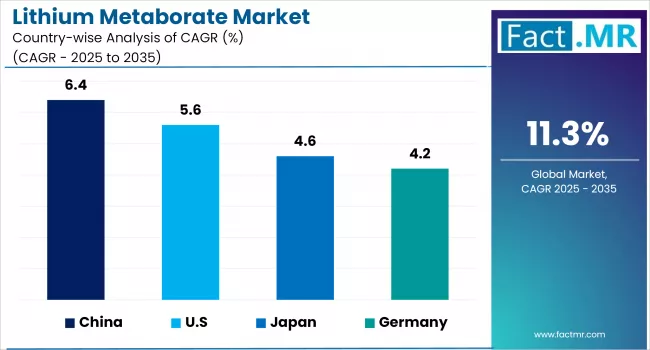
Lithium Metaborate Market By Country | Source: Fact.MR
U.S. market driven by battery innovation and regulatory support
The U.S. market of lithium metaborate is dictated by highly sophisticated demands in the battery diagnostic, mineral analysis, and polymer analysis in the defense and healthcare industries. New uses of borates are becoming evident in high-purity borate to produce biodegradable batteries, solid-state electrolyte development, and military-grade electronics. Laboratories such as Argonne National Laboratory are researching lithium lactate and borate derivatives as sources of conductivity enhancement and resistance to high temperatures.
2025-to-2035.webp "Us Lithium Metaborate Market Country Value(usd Billion)2025 To 2035")
Us Lithium Metaborate Market Country Value(usd Billion)2025 To 2035 | Source: Fact.MR
Newer lithium salt chemistries are being developed by startups with the assistance of the Inflation Reduction Act to create safer chemistries. The development of regulatory guidelines and requirements within EPA and DOE are encouraging early development at pilot levels of production and the growing number of implantable medical devices is stimulating inquiry in non-toxic compounds based on borates to enhance analysis and materials.
China scales lithium metaborate with integrated supply and exports
Vertically integrated lithium supply chains and increased domestic consumption of the chemical in battery materials testing, rare earth analysis, and industrial cement testing labs are causing a boom in China lithium metaborate market. Once local chemical companies ramp up large-scale production of lithium carbonate and hydroxides, they will be ready to ramp up production of lithium borates at the scale necessary to generate fusion targets both for XRF fusion and to use as battery precursors.
In the REE characterization, government supported organizations like Baotou Research Institute are testing the borate fusions. The reason is the country is beefing up exports to Southeast Asia and Middle East. Focus on internalities in synthetic reagents fit in with the Chinese-wide drive towards high-accuracy package consumable and geochemical characterization.
Germany advances high-purity borates for analytics and sustainability goals
The German lithium metaborate market has been centered in the widespread analytical instrumentation and the regulatory emphasis in environmental compliance and cement quality control assays as well as battery recycling branches. Sustained demand is due to the existence of high-quality lab chemical manufacturers such as Merck KGaA and the adoption of XRF fusion in mineralogical verification.
Under the High-Tech Strategy of Germany, there are ongoing initiatives that are promoting ultra-pure borate fluxes that work with next-gen analytical devices by the private sector working in partnership with the government. Also, the continued R&D in the lithium borates in the prospective non-flammable electrolyte chemistries, particularly in the automotive battery recycling sector, is defining a niche requirement in the advanced materials laboratory and regulatory compliance tracking certifications departments all over the nation.
Category-Wise Analysis
XRF fusion drives core demand in mineral analysis labs
Lithium metaborate market is mostly catalyzed by the fact that it is used as a fusion flux in XRF sample preparation, especially in cement, mining and metallurgical industries. High-purity fluxes are also being developed by the manufacturers with the specificity to eliminate the matrix effects and increase analytical precision.
Applying more lithium tetraborate to silicate-rich matrices, North American and European manufacturing plants and advanced laboratories are tailor-matching flux compositions, which enhances fusion efficiency. Automation of fusion bead preparation and standardization procedures is also on the rise, most notably in QA/QC applications. Lithium metaborate is essential in the mineral certification and production control labs with the increased requirements of minimal contamination, reproducible elemental analysis.
High-purity analytical grade supports precision elemental spectroscopy workflows
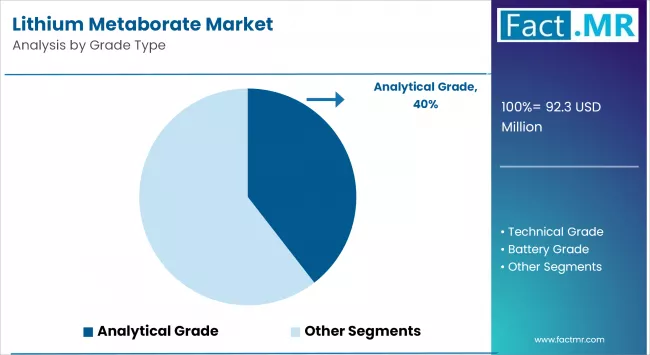
Lithium Metaborate Market By Grade Type | Source: Fact.MR
Analytical-grade lithium metaborate is also gaining popularity on account of its high purity, low-moisture pick up, and the consistency between batches, which play an imperative role when it comes to the high-stakes aspect of elemental analysis. The dominant drivers on this segment are the high standards of laboratory procedure that are used both in regulatory analysis, geochemical testing, and environment monitoring. Our demand in the world market particularly focuses on the U.S., Germany and Japan where ultra-clean fluxes are needed in precision laboratories to perform spectrometric analysis.
Suppliers of analytical-grade forms are also providing a growing variety of ISO-certified analytical-grade forms in both powder and pre-fused bead forms. Also, the advent of compatibility with automated fusion equipment is moving the process faster. As labs strive to achieve the trace levels of detection, the use of analytical-grade borates is important in terms of getting accurate data and being in compliance.
Mining sector relies on borate flux for ore testing
Sample fusion to analyse ore and concentrates remains one of the major end-uses applications of lithium metaborate in the mining and metallurgy sector. Increasing witch of rare earths, lithium, soda ash and base metals were stimulating use in both open pit and underground mines too. The onsite and third-party labs in Australia, Canada, and South Africa use borate fluxing to provide a quick turnaround of an elemental assay.
Metallurgical test plants also are standardizing the lithium metaborate processes in the feedstock qualifying processes and optimization of inputs to smelters. The use of lithium borates in fire assay alternatives is beginning to appear around the world in operations that are driven by sustainability-based operations in a bid to reduce lead-based reagents in the handling of analytical work.
Competitive Analysis
Key players in the Lithium Metaborate market include Merck KGaA (Sigma-Aldrich), Thermo Fisher Scientific Inc., SPEX CertiPrep (Ametek, Inc.), Imerys Performance Minerals, Hunan Skychem Industrial Co., Ltd, Avantor Inc. (JT Baker, Macron Fine Chemicals), Anachemia Science (Part of VWR International), LECO Corporation, American Elements, Strem Chemicals.
The increasing requirement of high-purity reagents in elemental analysis and diagnosis of battery materials is the force behind the improved competition seen in the lithium metaborate market. The major players are also concentrating on the enrichment of purity, low contamination of processing, and the formation of flux that is tailored to industry-specific uses such as XRF and ICP. The focus within innovation is on the enhancement of fusion efficiency, moisture sensitivity and provide pre-fused bead formats.
Multinationals are increasing the scale of manufacturing in North America, Europe and East Asia to counter the demand in these regions and minimise the risks in the supply chain. Established strategic bonds with suppliers of analytical instruments and lab automation systems are enhancing market leverage, whereas an ISO/REACH certification is increasingly an essential factor.
Recent Development
- In March 2025, Thermo Fisher Scientific teamed up with the Pacific Northwest National Laboratory (PNNL) to help develop a new synthesis method using Li 2 O (lithium oxide) sublimation as a means of producing nickel-rich cathodes as single-crystal materials.
- In March 2025, Nobian patented and tested a new, chlor-alkali based electrolytic process to convert lithium chloride into battery-grade lithium hydroxide monohydrate.
Fact.MR has provided detailed information about the price points of key manufacturers of Lithium Metaborate Market positioned across regions, sales growth, production capacity, and speculative technological expansion, in the recently published report.
Methodology and Industry Tracking Approach
The Global Lithium Metaborate Market 2025 report has been prepared after analyzing more than 300 sources of information and research, such as peer-reviewed journals, patents on fusion chemistry, regulatory reports, import-export statistics, and financial information about suppliers. To confirm the trends, and measure segmental growth, data triangulation, and sophisticated statistical measures were used including multivariate regressions, factor analysis, and demand elasticity models. The information about the industry was collected in the form of interviews with over 100 stakeholders such as lab managers, mining QC coordinators, chemical procurement executives, and analytical equipment integrators. The patterns of the demand in different regions, preferences of the purity-grades, and the prices were benchmarked along with normalized weighting aligned with the volumes of the trade and adoption of the instrumentation in 30 countries.
With Fact.MR monitoring consumer behavior, product efficacy, industry trends, and market opportunities since 2018, this report is becoming an authoritative source of information that stakeholders can rely on.
Segmentation
Segmentation of Lithium Metaborate Market
-
By Grade Type :
- Analytical Grade
- Technical Grade
- Battery Grade
- High-Purity/Ultra-Pure Grade
-
By Application :
- X-Ray Fluorescence (XRF) Sample Preparation
- Inductively Coupled Plasma (ICP) Analysis
- Battery Electrolyte Research
- Rare Earth Element (REE) Testing
- Cement and Mineral Quality Control
- Academic & Industrial Research
- Glass and Ceramic Fluxing
- Metal & Alloy Composition Testing
-
By End Use Industry :
- Mining & Metallurgy
- Cement & Building Materials
- Environmental Testing Laboratories
- Academic & Research Institutions
- Electronics & Semiconductors
- Battery & Energy Storage
- Chemical Manufacturing
- Government & Defense Research Labs
-
By Form Type :
- Powder
- Granules
- Pellets
- Pre-Fused Discs
- Tablets/Beads
-
By Distribution Channel :
- Direct Sales (Manufacturer to End User)
- Distributors & Channel Partners
- Online Scientific Portals
- Laboratory Equipment Suppliers
-
By Region :
- North America
- Latin America
- Western Europe
- Eastern Europe
- East Asia
- South Asia & Pacific
- Middle East & Africa
Frequently Asked Questions
What was the Global Lithium Metaborate Market Size Reported by Fact.MR for 2025?
Who are the Major Players Operating in the Lithium Metaborate Market?
What is the Estimated Valuation of the Lithium Metaborate Market in 2035?
What Value CAGR did the Lithium Metaborate Market Exhibit Over the Last Five Years?
Who worked on this report


Preview the report firsthand - request a free sample
Free SampleGet the brochure for pricing and purchase details
Download PDF