- Base Value(2025): 14.2 Bn
- Forecast Value (2035): 128.1 Bn
- CAGR (2035): 26.2%
Virtual Try-On Market Outlook 2025 to 2035
The global virtual try-on Market is expected to reach USD 128.1 billion by 2035, up from USD 14.2 Billion in 2025. During the forecast period 2025 to 2035, the industry is projected to expand at a CAGR of 24.6%.
The robust growth of e-commerce, the increasing popularity of personalized shopping experiences, and the ongoing development of AR and AI technology are pushing the virtual try-on market. As consumers want more convenience and security of online purchases, an aspect called virtual try-on allows them to view products interactively by visualizing fashion, eyewear, cosmetics, and accessories. The growth in smartphone penetration, omnichannel retailing strategies, and low returns add further utility to the role of the market in transforming digital commerce and customer engagement.
Quick Stats for Virtual Try-On Market
- Industry Value (2025): USD 14.2 Billion
- Projected Value (2035): USD 128.1 Billion
- Forecast CAGR (2025 to 2035): 24.6%
- Leading Segment (2025): Apparel & Footwear (36.4% Market Share)
- Fastest Growing Country (2025-2035): India (26.4% CAGR)
- Top Key Players: DeepAR, 3DLOOK Inc., Perfect Corp, metadome.ai, Wannaby Inc., Vue.ai, Zalando, L'Oréal, IKEA and Sephora
2025-to-2035.webp "Us Virtual Try On Market Value(usd Billion)2025 To 2035")
Us Virtual Try On Market Value(usd Billion)2025 To 2035 | Source: Fact.MR
What are the drivers of the Virtual Try-On Market?
The virtual try-on sector is experiencing a massive boom due to focus by retailers and brands on creating immersion in their digital customer activities to establish long-term trust and mitigate frictions on online purchases. As e-commerce volumes are increasing at accelerated rates globally, retailers are turning to omnichannel strategies inclusive of augmented reality (AR), artificial intelligence (AI), and 3D visualization-based virtual try-on technologies as a means of both streamlining the conversion process and helping to identify new methods of product discovery and personalization.
Challenges to regulatory and commercial imperatives that seek to limit product returns are also driving adoption at scale, as virtual try-on will help to remove fit uncertainty in fashion, eyewear, beauty, and accessories. The emerging trend of shopping without direct contact with retail stores- catalyzed by increasing smartphone usage and social media-based transaction activities- is augmenting the merit of interactive product tests.
Cooperation among retailers, technology solutions, and platform integrators are also increasing the accessibility of custom-made solutions at the same time. The combination of such technological, commercial, and behavioral needs is setting up virtual try-on as a central pillar in creating the next generation retail innovation and online commerce expansion.
What are the regional trends of the Virtual Try-On Market?
The regional environment of the virtual try-on market is expressive of different adoption routes that are determined by the level of penetration of technology, the level of maturity of retail, as well as consumer behavior. Innovation is most advanced in North America, with high volumes of e-commerce, well-developed AR/AI centres, and high adoption rates in fashion, eyewear and cosmetics. The growth in Europe is also strengthened by data privacy laws, sustainable fashion trends, and inclusion of a virtual try-on in multichannel luxury markets.
The Asia-Pacific region is becoming the second-largest retail hub fastest and this has been driven by the popularity of smart phones, social commerce sites and increased fashion consumption among youth in China, India and Southeast Asia. In Japan and South Korea, precision in applications is pushing ahead with try-on applications being integrated with smart mirrors and in-store digital experiences.
Latin America is making momentum in the area of beauty and apparel online retail, especially in Brazil and Mexico. In the meantime, many new markets in the Middle East and Africa are utilizing increased digital penetration and government retail modernization efforts to integrate a trial-on process within their consumer outreach efforts.
What are the challenges and restraining factors of the Virtual Try-On Market?
Virtual try-on market has one of the greatest problems of standardization of accuracy and appearance on a wide range of devices, platforms, and product types. The variation of results in terms of AR/AI performance, lighting environment, and the designing of user interfaces creates unreliable customer experience and constrains trust and adoption.
The fact that development costs and integration are complex with the current e-commerce ecosystem are also considered as a restrain to smaller retailers in implementing it. Facial scans and biometric inputs also heighten the risk of data privacy and cybersecurity that further draw the scrutiny of regulators.
Further, the divisible nature of vendor networks and inability to have the solutions synergise each other makes scalability hard thus necessitating higher standardization, investment and synergy in a bid to leverage the full potential of the market.
Country-Wise Insights
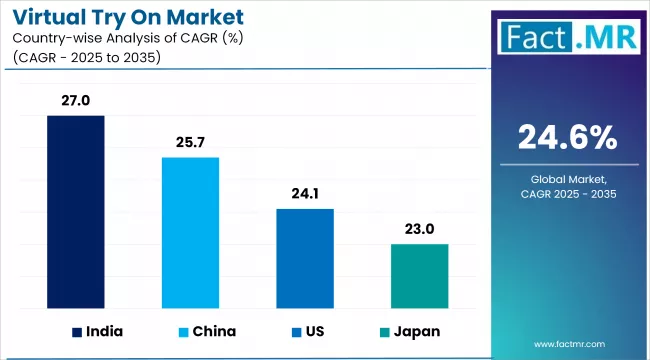
Virtual Try On Market By Country | Source: Fact.MR
U.S. drives Virtual Try-On with advanced AR and omnichannel retail
The American Virtual Try-On market is propelled by its well-established e-commerce infrastructure and high number of citizens who prefer to make digitally immersive buying decisions.
Women clothing, sunglasses, and cosmetics clothing stores and businesses are implementing artificial intelligence and augmented reality-based platforms to drive optimization and lower the rate of returns. The area of integration with omnichannel strategies is growing, and such department stores and direct-to-consumer brands have smart mirrors and try-on apps.
2025-to-2035.webp "Us Virtual Try On Market Country Value(usd Billion)2025 To 2035")
Us Virtual Try On Market Country Value(usd Billion)2025 To 2035 | Source: Fact.MR
Robust R&D intensity, combined with regulatory clarity on use of data and consumer protection, has precipitated acceleration in the scale of the AR try-on applications. Tech provider and retailer synergies are growing adoption across categories with beauty and apparel being the most penetrated. Demand and sophistication in smartphones is moving the U.S. towards becoming a global innovation leader in next-generation try-on solutions.
China leads adoption via e-commerce, social commerce, and AI
The Chinese Virtual Try-On market is confined by high penetration of smartphones, a rapidly growing e-commerce segment and well developed social commerce. Use-cases of AR try-on are being integrated with platforms like Alibaba, JD.com, and Douyin as a normal consumer engagement experience into apparel and accessories and beauty products.
Neighboring technology companies are inventing affordable AI-powered products to make the benefits of try-on available to masses of people. High consumer demand concerning an experiential and personalized shopping, especially with the younger generations, is impelling adoption.
The enhanced policy of the Chinese government promoting the increase of digital retailing and AI technology has helped to scale with the fast-fashion and luxury as well as beauty industries leading the adoption. The heavy dependence on the mobile-first shopping and livestream commerce activities is cementing the role of AR try-on as an inseparable portion of conversion rates-driven approaches, which further proves that China represents the leader in terms of the sales and usage volumes.
India’s Virtual Try-On growth fueled by smartphones and e-commerce
India is shaping up to be among the fastest-growing Virtual Try-On market, driven by an exploding e-commerce market and the high rate of digitalization of its young population. The digital fashion and beauty companies use AR/AI-based virtual trial technology as a means of consumer attraction and as a competitive advantage to win the attention of tech-savvy customers in competition with others.
Regional retailers are beginning to take advantage of smartphone-ready AR because it is inexpensive to utilize and does not require any IT infrastructure. As the middle-class population disposes of a higher and higher disposable income, and the demands on individualized shopping are increasing, all the range of technologies offering the possibility of trying on something advertised increases in popularity as well, even in the tier-1 and tier-2 cities.
Strategic alliance between domestic e-commerce platforms and international AR providers is increasing access to the better features. Although the regulatory landscape remains a work in progress, retail digitizing and mobile-first shopping apps adoption in India makes it one of the most important growth vectors when it comes to virtual try-on technologies. ;
Category-Wise Analysis
Augmented Reality drives scalable, personalized, immersive retail try-ons
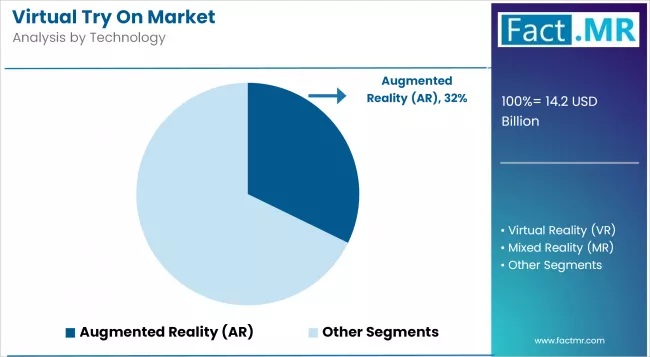
Virtual Try On Market By Technology | Source: Fact.MR
The augmented reality sub sector recorded a high growth where they are used as the backbone of immersive try-on capabilities to visualize apparel, eyewear, and cosmetics in real-time and in high-fidelity. Realism, spatial mapping, and cross-platform applicability throughout smartphones and smart mirrors are all being optimized by the continual developments of the AR frameworks.
With retailers working to ensure that rates of returns drop to a minimum and consumer confidence is improved, AR is being optimised to be more and more scalable and able to interface within the e-commerce environment more seamlessly.
Even more, the growing integration with AI is also helping to personalize it, offering better outcomes that consumers can enjoy. Due to cloud-based deployment, the dominance and the inseparability remain, and AR helps to increase adoption rates throughout the global retail ecosystems.
Apparel leads virtual try-ons with realistic, AI-driven fitting rooms
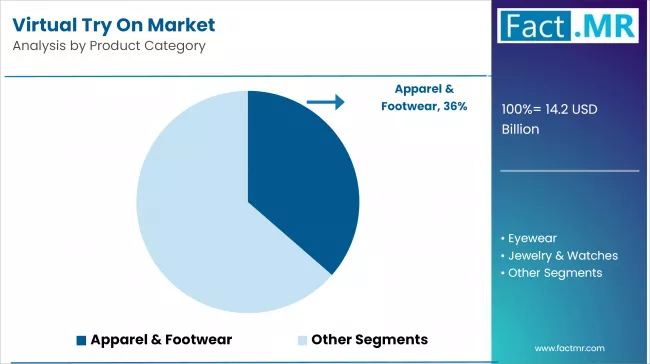
Virtual Try On Market By Product Category | Source: Fact.MR
The clothing and apparel segment is leading the adoption trend in the virtual try-on market as it is the only method of changing the digital buying process with realistic virtual fitting rooms. 3D garment visualization has helped fashion retailers to eliminate the size-fit concern and purchase hesitancy in online shopping.
This level of integration with recommendation engines that use AI will deliver the suggestion of style, fit and color based on the customer preferences, which further increases conversion rates. Concerned with the increase in sustainability pressures, virtual try-on helps apparel brands to reduce waste and the logistics emissions related to returns.
Together with the growing demand in fast-fashion and high-quality online shopping, apparel is the most promising area.
Cloud deployment enables scalable, cost-effective, omnichannel virtual try-ons.
The cloud based deployment is becoming the most viable deployment model of virtual try-on, and is rapidly emerging as the most scalable and cost friendly one ensuring that perfect integration is done across retail platforms without much hustle in terms of infrastructure investment.
Cloud delivery increases the pace of implementation even in large-scale enterprises and smaller retailer businesses since it reduces the physical time and effort to roll out software by supporting centralized data management, application of software updates and inter-device compatibility.
The SaaS based model guarantees cost-effectiveness and accessibility, especially in the emerging markets where omnichannel implementation is speedily augmenting.
As consumers increasingly want a smooth and personalized online shopping experience, cloud architecture enables AR display, AI-related analytics, and cross-border delivery with minimal data delay. The cloud-based solutions continue to sustain long-term market growth as retailers increasingly prefer agile and global reach of their products.
Competitive Analysis
Key players in the Virtual Try-On Market include DeepAR, 3DLOOK Inc., Perfect Corp, metadome.ai, Wannaby Inc., Vue.ai, Zalando, L'Oréal, IKEA and Sephora The virtual try-on market is rising as more and more brand and retailers compete on immersive digital experience, customer engagement and lower returns
. Organizations are making tremendous investments in highly sophisticated AR/AI, 3D modeling and instant rendering to enhance precision and customization. There is an evident move towards omnichannel integration where virtual try-on is used as an online and in-store solution in mobile applications and smart mirrors.
The strategic partnering of fashion houses and beauty brands with technological providers is driving innovation, whereas startups are bringing new cost-effective software as a service solution to the market. An upsurge in investments, the proliferation of regional platforms, as well as collaborations with e-commerce giants, is increasing competition on the global scale.
Recent Development
- In January 2025, Amazon reported that it is winding down the service of Prime Try Before You Buy. Following the example of its Amazon competitor, the e-commerce giant has prioritized the development of an AI-powered Virtual Try-On and size recommendation tool, as a way to reduce costs and increase the level of customer engagement through more scalable solutions.
- In March 2025, the AI-powered fashion company Doji was funded by Alexis Ohanian, co-founder of Reddit, in his VC firm Seven Seven Six. A beta release of its avatar-based virtual try-on application where the firm enables consumers to create a near-life replica of their avatars using selfies to experiment with design apparel online indicates that investors are increasingly positive of more immersive retail technology.
Fact.MR has provided detailed information about the price points of key manufacturers of Virtual Try-On Market positioned across regions, sales growth, production capacity, and speculative technological expansion, in the recently published report.
Methodology and Industry Tracking Approach
The 2025 Global Virtual Try-On Market report was prepared after surveying 12,500 stakeholders across 35 countries gathered at a minimum of 350 respondents per market. Two-thirds of them were retailers and end users (examples are fashion brand, cosmetics, and eyewear providers), whereas one-third were industry professionals (technology developers, e-commerce managers, and supply chain experts).
Data gathering took place between July 2024 and June 2025, consisting of adoption patterns, investment priorities, user experience challenges and regulatory risk. More than 300 secondary sources (academic studies, patents, financial disclosures and regulatory filings) were studied. Advanced statistical techniques, like regression analysis were used to be precise in weighting by region, demographics and market size distribution.
With Fact.MR monitoring consumer behavior, product efficacy, industry trends, and market opportunities since 2018, this report is becoming an authoritative source of information that stakeholders can rely on.
Segmentation
Segmentation of Virtual Try-On Market
-
By Product Category :
- Apparel & Footwear
- Eyewear
- Jewelry & Watches
- Beauty & Cosmetics (makeup, hair color, skincare)
- Furniture & Home Décor
- Accessories (bags, hats, etc.)
- Others (sporting goods, automotive interiors, etc.)
-
By Deployment Mode :
- Cloud-Based (SaaS Platforms)
- On-Premise / In-Store Systems
- Hybrid Deployment (Cloud + In-Store Integration)
-
By Technology :
- Augmented Reality (AR)
- Virtual Reality (VR)
- Mixed Reality (MR)
- Artificial Intelligence (AI) & Computer Vision
- 3D Reconstruction & Simulation
- Machine Learning & Deep Learning Algorithms
-
By End-Use Industry :
- Retailers & Direct-to-Consumer (D2C) Brands
- E-commerce Marketplaces
- Specialty Retail Chains
- Technology Developers
- Omnichannel Enterprises
-
By Region :
- North America
- Latin America
- Western Europe
- Eastern Europe
- East Asia
- South Asia & Pacific
- Middle East & Africa
Frequently Asked Questions
What was the Global Virtual Try-On Market Size Reported by Fact.MR for 2025?
Who are the Major Players Operating in the Virtual Try-On Market?
What is the Estimated Valuation of the Virtual Try-On Market in 2035?
What Value CAGR did the Virtual Try-On Market Exhibit Over the Last Five Years?
Who worked on this report


Preview the report firsthand - request a free sample
Free SampleGet the brochure for pricing and purchase details
Download PDF