- Base Value(2025): 7.7 Bn
- Estimated Value(2026): 9.2 Bn
- Forecast Value (2036): 54.6 Bn
- CAGR (2026 - 2036): 19.5%
Cognitive Commerce Market Overview, Growth Outlook, and Forecast by Fact.MR
- In 2025, the cognitive commerce market was valued at USD 7.7 billion.
- Demand for cognitive commerce solutions is projected to grow to USD 9.2 billion in 2026 and reach USD 54.6 billion by 2036.
- The market is expected to expand at a CAGR of 19.5% during the forecast period.
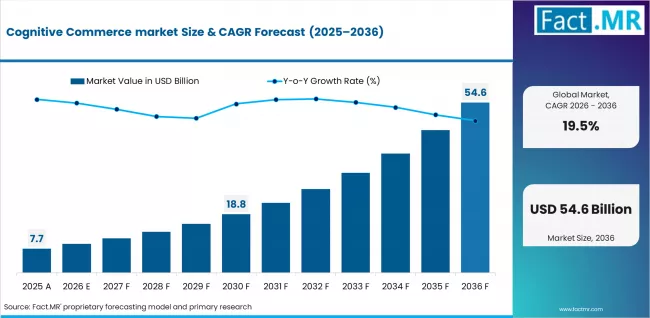
Cognitive Commerce Market Value Analysis | Source: Fact.MR
The cognitive commerce market is projected to create an absolute dollar opportunity of USD 45.4 billion between 2026 and 2036. This reflects a revolutionary growth journey rather than an incremental one, fueled by growing uptake of generative AI, conversational commerce systems, hyper-personalization of shopping experiences, autonomous AI agents, and smart digital commerce environments. The growth trend will likely persist owing to increasing spending by businesses on AI-enabled customer engagement, omnichannel retailing, predictive commerce, and agentic commerce, but potential impediments could include data protection issues, AI governance challenges, integration difficulties, and substantial implementation costs.
Summary of the Cognitive Commerce Market
- Market Snapshot
- Global cognitive commerce market revenue stood at USD 9.2 billion in 2026 and is forecast to reach USD 54.6 billion by 2036.
- At a 19.5% CAGR from 2026 to 2036, the market is set to expand ~5.9x in value, creating an absolute dollar opportunity of USD 45.4 billion.
- Growth is being driven by increasing adoption of generative AI, conversational commerce, intelligent product discovery, and autonomous shopping technologies across digital commerce ecosystems.
- Rising demand for hyper-personalized customer experiences and AI-powered engagement platforms is accelerating cognitive commerce deployment globally.
- Integration of machine learning, natural language processing, predictive analytics, and agentic AI is transforming digital commerce operations and customer interaction models.
- Demand and Growth Drivers
- Growing popularity of AI-based personalization in shopping experience
- Growing demand for conversational commerce and intelligent virtual shopping assistant
- Development of omnichannel retail and digital commerce ecosystem
- Increasing enterprise investments in generative AI and agentic commerce solutions
- Need for solutions that provide:
- Intelligent product recommendations
- Real-time customer engagement
- Predictive purchasing insights
- Automated customer interaction
- Faster and more contextual shopping experiences
- AI-driven revenue optimization
- Product and Segment View
- Mobile Commerce holds 34.8% of commerce channel share in 2026, emerging as the leading segment.
- Machine Learning & Predictive Analytics account for 27.8% of technology share in 2026, positioning them as the dominant technology segment.
- Personalized Recommendations represent 21.6% of application share in 2026, reflecting strong demand for AI-driven customer personalization.
- Retail & eCommerce account for 39.2% of end-use industry share in 2026, supported by increasing AI integration across digital retail platforms.
- Conversational Commerce and Voice Commerce are projected to witness the fastest growth through 2036 due to rapid advancements in generative AI and conversational AI technologies.
- Geography and Competitive Outlook
- Prospects for growth exist in North America, Europe, and Asia Pacific owing to the growing digital commerce penetration rate and the increased use of artificial intelligence within enterprises.
- Some of the major growth regions in the cognitive commerce market include India (21.3% CAGR), Japan (21.2% CAGR), China (20.9% CAGR), United States (18.7% CAGR), South Korea (18.1% CAGR), United Kingdom (17.7% CAGR), and Germany (17.1% CAGR) throughout the forecast period.
- Growth opportunities for the market depend on:
- Increased spending on AI-based commerce infrastructure
- Rise in omnichannel and mobile-first retail environments
- Popularity of conversation AI and autonomous commerce solutions
- Adoption of intelligent customer engagement technologies
- Key companies active in this market include: Amazon, Alibaba Group, Google, Microsoft, Salesforce, Adobe, IBM, SAP, Shopify, Oracle, and others.
- Analyst Opinion
- Shambhu Nath Jha, Principal Consultant at Fact.MR, opines, “Leaders at the CXO level are expected to recognize that the future competitive advantage in the Cognitive Commerce Market will increasingly depend on delivering AI-driven personalized customer experiences, conversational commerce capabilities, and autonomous shopping ecosystems rather than simply expanding digital commerce infrastructure.
Cognitive Commerce Market — At a Glance
| Attribute | Details |
|---|---|
| Market Value 2025 | USD 7.7 Billion |
| Market Value 2026 | USD 9.2 Billion |
| Market Value 2036 | USD 54.6 Billion |
| Absolute Dollar Opportunity | USD 45.4 Billion |
| Total Growth | 493.50% |
| CAGR | 19.50% |
| Growth Multiple | 5.9x |
| Key Demand Theme | Rising adoption of generative AI, conversational commerce, hyper-personalized shopping experiences, omnichannel retail transformation, intelligent customer engagement platforms, and autonomous AI-driven commerce ecosystems |
| Leading Commerce Channel | Mobile Commerce |
| Commerce Channel Share | 34.80% |
| Leading Technology | Machine Learning & Predictive Analytics |
| Technology Share | 27.80% |
| Leading Application | Personalized Recommendations |
| Application Share | 21.60% |
| Leading End-Use Industry | Retail & E-Commerce |
| End-Use Industry Share | 39.20% |
| Key Growth Regions | East Asia, South Asia & Pacific, North America |
| Key Companies | Amazon, Alibaba Group, Google, Microsoft, Salesforce, Adobe, IBM, SAP, Shopify, Oracle |
| Segmentation by Commerce Channel | Web Commerce, Mobile Commerce, Social Commerce, Voice Commerce |
| Segmentation by Technology | Generative AI, Machine Learning & Predictive Analytics, Natural Language Processing (NLP), Computer Vision, Autonomous AI / Agentic Commerce, Recommendation Engines, Knowledge Graphs & Semantic AI |
| Segmentation by Application | Personalized Recommendations, Conversational Commerce, Intelligent Search & Discovery, Pricing & Revenue Optimization, Supply Chain & Inventory Intelligence, Fraud Detection & Risk Management, Customer Service Automation, Demand Forecasting, Visual Search & Discovery |
| Segmentation by End-Use Industry | Retail & E-Commerce, Consumer Goods, BFSI, Healthcare, Travel & Hospitality |
| Segmentation by Region | North America, Latin America, East Asia, South Asia & Pacific, Western Europe, Eastern Europe, Middle East & Africa |
Source: Fact.MR analysis. Updated May 14, 2026
Key Growth Drivers, Constraints, and Opportunities
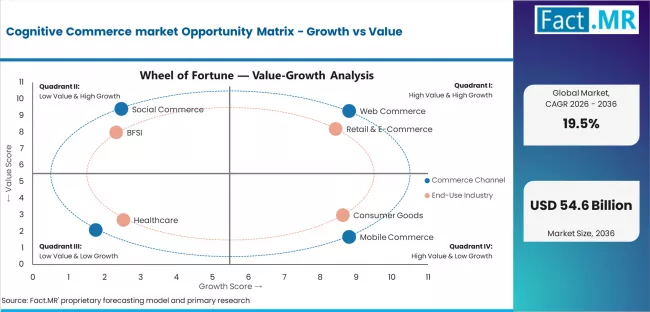
Cognitive Commerce Market Opportunity Matrix Growth Vs Value | Source: Fact.MR
Key Factors Driving Growth
- The fast pace of adoption for generative AI, conversational AI, and hyperpersonalization solutions is fueling demand for cognitive commerce offerings in the digital commerce space.
- Growing penetration of omnichannel retail, mobile commerce and AI based customer engagement solutions are driving the market globally.
- Growing investments by enterprises in predictive analytics, recommendation engine, intelligent search, and autonomous shopping assistants are helping in the adoption in the retail, BFSI, healthcare, and CPG sectors.
| Growth Driver | Demand Impact | Time Horizon | Key Impact Area | Fact.MR Insight |
|---|---|---|---|---|
| Rapid adoption of generative AI and conversational commerce technologies | High | Short–Mid Term | Personalized customer engagement & intelligent shopping experiences | Increasing enterprise investments in AI-powered shopping assistants, conversational AI, and hyper-personalized commerce platforms are accelerating cognitive commerce adoption globally. |
| Expansion of omnichannel retail and mobile-first commerce ecosystems | High | Short–Mid Term | Omnichannel commerce optimization & customer experience enhancement | Retailers and digital commerce platforms are increasingly integrating cognitive commerce technologies to deliver seamless cross-channel customer interactions and real-time personalization. |
| Rising deployment of predictive analytics and recommendation engines | Medium-High | Mid–Long Term | Intelligent product discovery & revenue optimization | Growing use of machine learning and behavioral analytics is supporting demand for intelligent recommendation systems, predictive purchasing insights, and dynamic pricing solutions. |
| Advancements in autonomous AI and agentic commerce technologies | Medium-High | Mid–Long Term | Autonomous shopping & AI-driven commerce automation | Development of autonomous AI agents and intelligent commerce ecosystems is enabling automated purchasing workflows, contextual decision-making, and next-generation digital shopping experiences. |
| Increasing investments in AI-powered customer service and intelligent search platforms | Medium-High | Mid–Long Term | Customer service automation & intelligent commerce infrastructure | Rising adoption of NLP, intelligent search, and AI-driven engagement technologies is enhancing digital customer interaction, operational efficiency, and commerce platform scalability. |
Source: Fact.MR analysis. Updated May 14, 2026
Key Market Constraints
- High fees for implementation and integration and the lack of necessity for so much advanced technology may cause small and medium businesses to not adopt AI commerce platforms.
- Market participants could face challenges in their operations and compliance due to data privacy concerns, cybersecurity threats, and evolving AI governance regulations.
- The integration of cognitive commerce solutions with legacy systems within enterprise organizations is complex and may present a barrier to adoption in traditional retail and enterprise environments.
Key Opportunity Areas
- Growing adoption of AI-based conversational commerce, virtual shopping assistants and independent commerce platforms are driving lucrative market opportunities.
- The expansion in social commerce, voice commerce and mobile-first retail ecosystems is fueling demand for intelligent commerce solutions.
- Increasing investments in hyper-personalized customer engagement, predictive purchase analytics and real-time commerce optimization are favoring a long-term growth in the market.
Segment-wise Analysis of the Cognitive Commerce Market
- Mobile Commerce accounts for 34.8% share of the commerce channel segment in 2026, driven by increasing smartphone penetration, rapid adoption of AI-powered shopping applications, and expanding mobile wallet ecosystems across digital commerce platforms.
- Machine Learning & Predictive Analytics hold 27.8% share of the technology segment in 2026, supported by growing deployment of recommendation engines, customer behavior analytics, predictive purchasing insights, and intelligent commerce optimization solutions.
- Personalized Recommendations represent 21.6% share of the application segment in 2026, owing to rising demand for hyper-personalized shopping experiences, intelligent product discovery, and AI-driven customer engagement across digital retail ecosystems.
The cognitive commerce market is segmented by commerce channel, technology, application, end-use industry, and region.
Which Commerce Channel Segment Topped the Cognitive Commerce Market?
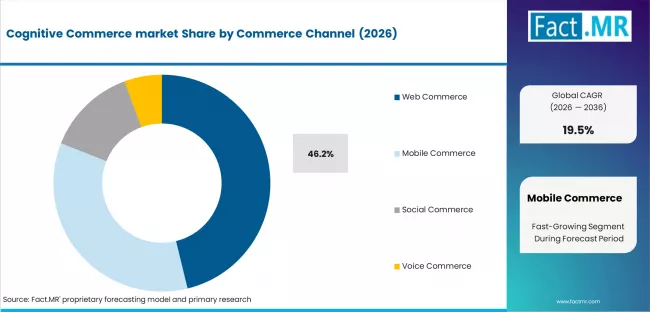
Cognitive Commerce Market Analysis By Commerce Channel | Source: Fact.MR
It is projected that Web Commerce will capture the largest market share of 46.2% in the market by 2026. Such a large market share is mainly driven by factors such as high penetration rates of smartphones, growing popularity of AI-based shopping apps, increased adoption of mobile wallets, and greater preference among consumers for using their mobile phones for shopping purposes.
Which Technology Segment Accounts for the Highest Share in the Market?
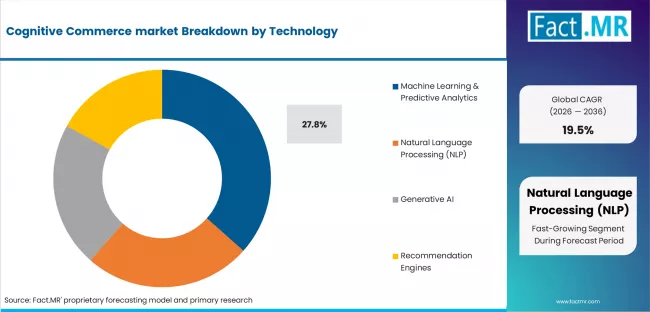
Cognitive Commerce Market Analysis By Technology | Source: Fact.MR
The largest market share of 27.8% is anticipated to be captured by Machine Learning and Predictive Analytics in the technology segment by 2026. This dominance will be fueled by greater usage of recommendation engines, predictive buying analytics, intelligent behavior analysis of customers, dynamic pricing, and demand forecasting systems.
Which Application Segment Leads the Market?
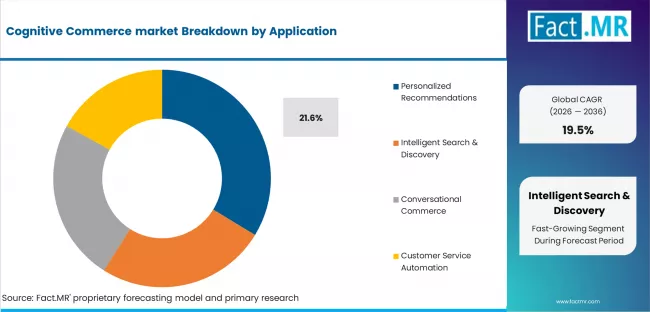
Cognitive Commerce Market Analysis By Application | Source: Fact.MR
Personalized Recommendation Engines are expected to capture the biggest market share of 21.6% in 2026 due to increasing interest in hyper-personalized customer engagement, intelligent discovery of products, and improvement of shoppers’ experience using AI. Companies are becoming more interested in improving conversion rates, customer retention, and average purchase size by using personalized recommendations.
Which End-Use Industry Segment Holds the Largest Share in the Market?
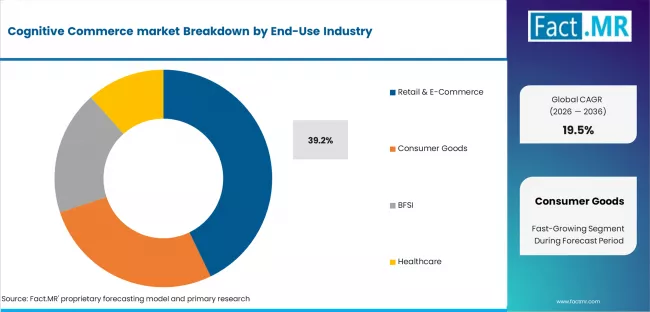
Cognitive Commerce Market Analysis By End Use Industry | Source: Fact.MR
Retail & E-Commerce is expected to emerge as the leading end-use industry segment, accounting for 39.2% share in 2026. This growth is supported by increasing investments in omnichannel retail transformation, AI-powered customer engagement platforms, conversational commerce solutions, and intelligent digital shopping ecosystems across global retail markets.
Regional Outlook Across Key Markets
The geographies that have been covered in this study include North America, Latin America, Western Europe, Eastern Europe, East Asia, South Asia & Pacific, and Middle East & Africa. Analysis of regions would cover the assessment of AI adoption by enterprises, digital commerce capabilities, transformation in retail through omnichannel strategies, mobile commerce penetration, patterns of consumer engagement through digital channels, and opportunities within industries that would lead to cognitive commerce adoption.
.webp "Top Country Growth Comparison Cognitive Commerce Market Cagr (2026 2036)")
Top Country Growth Comparison Cognitive Commerce Market Cagr (2026 2036) | Source: Fact.MR
CAGR Table
| Country | CAGR (%) |
|---|---|
| India | 21.3% |
| Japan | 21.2% |
| China | 20.9% |
| South Korea | 18.1% |
| United States | 18.7% |
| United Kingdom | 17.7% |
| Germany | 17.1% |
Source: Fact.MR analysis. Updated May 14, 2026
Source: Fact.MR (FMR) analysis, based on proprietary forecasting model and primary research.
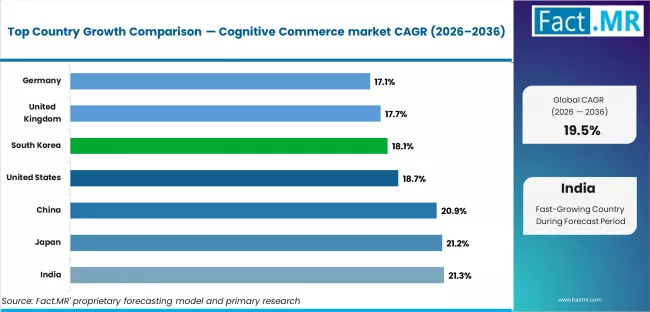
Cognitive Commerce Market Cagr Analysis By Country | Source: Fact.MR
North America Cognitive Commerce Market
North America is the “center of excellence” for AI digital commerce ecosystems in the Cognitive Commerce Market as a result of high enterprise AI adoption, sophisticated cloud infrastructure, developed ecommerce systems, and substantial investments in customer engagement solutions. Amazon remains highly competitive with AI-based recommendation systems and intelligent commerce platforms, organisation and Google extending enterprise AI commerce infrastructure. Salesforce and Adobe are consolidating their position in the market with solutions for personalised and omnichannel commerce powered by AI.
- U.S.: Demand for cognitive commerce solutions in the U.S. is projected to rise at 18.7% CAGR through 2036. Growth is driven by increasing enterprise investments in generative AI, conversational commerce, intelligent search, recommendation engines, and omnichannel customer engagement technologies across retail, BFSI, healthcare, and digital marketplaces. Expansion of AI-powered customer analytics and autonomous shopping ecosystems is further accelerating market adoption.
- Canada: Market growth in Canada is supported by rising digital commerce penetration, increasing enterprise AI investments, and growing adoption of intelligent customer engagement platforms across retail and financial services industries. Businesses are increasingly integrating predictive analytics and conversational AI technologies to improve customer experience and operational efficiency.
Europe Cognitive Commerce Market
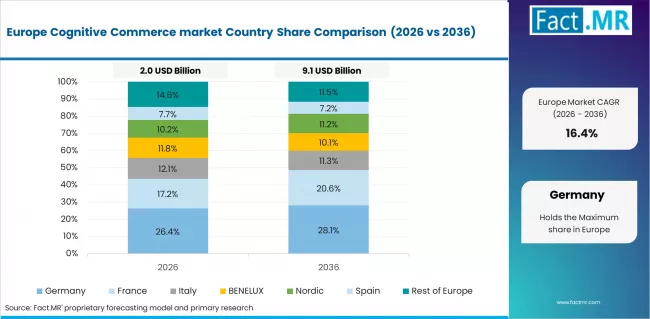
Cognitive Commerce Market Europe Country Market Share Analysis, 2026 & 2036 | Source: Fact.MR
Europe serves as the “standard region for responsible AI-driven digital commerce transformation” in the Cognitive Commerce Market with a strong data privacy policies, increasing AI legislation, mature retail digitization, and growing enterprise emphasis on customer personalization solutions. SAP remains a strong player in enterprise commerce across the whole of Europe, while Adobe and Salesforce are making inroads with AI-powered customer experience solutions in regional retail landscapes.
- Germany: Demand for cognitive commerce solutions in Germany is projected to rise at 17.1% CAGR through 2036, driven by strong industrial digitalization, omnichannel retail expansion, and increasing enterprise investments in AI-powered commerce intelligence and intelligent customer interaction systems.
- U.K.: Cognitive commerce demand in the U.K. is expected to grow at 17.7% CAGR through 2036 due to rising adoption of conversational commerce, intelligent recommendation engines, and AI-driven digital engagement technologies across retail, BFSI, and ecommerce platforms.
- France: Demand for cognitive commerce technologies in France is supported by increasing digital retail transformation, growth of AI-powered customer personalization platforms, and rising investments in intelligent digital commerce infrastructure.
East Asia Cognitive Commerce Market
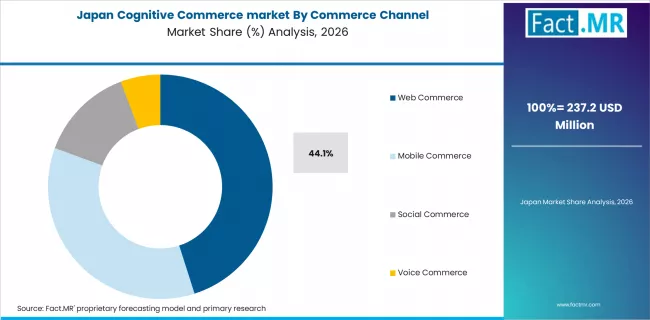
Cognitive Commerce Market Japan Market Share Analysis By Commerce Channel | Source: Fact.MR
East Asia is the “global scale-up hub for AI native commerce ecosystems” in the Cognitive Commerce Market due to high levels of digital adoption, mature mobile commerce systems, massive AI spending, and a robust ecommerce infrastructure. Alibaba Group continues to lead in AI enabled digital commerce and intelligent recommendation technology, while Samsung and regional technology providers enable accelerated growth of intelligent commerce ecosystems.
- China: Demand for cognitive commerce solutions in China is projected to rise at 20.9% CAGR through 2036, driven by large-scale adoption of AI-powered commerce platforms, rapid expansion of social commerce, intelligent shopping ecosystems, and growing investments in generative AI technologies across ecommerce and digital payment ecosystems.
- Japan: Cognitive commerce demand in Japan is expected to grow at 21.2% CAGR through 2036 due to increasing enterprise focus on intelligent automation, conversational AI, personalized customer engagement, and autonomous commerce technologies across retail and digital services industries.
- South Korea: Demand for cognitive commerce technologies in South Korea is forecast to expand at 18.1% CAGR through 2036, supported by advanced digital infrastructure, strong mobile commerce penetration, widespread adoption of AI-powered shopping technologies, and increasing investments in intelligent retail ecosystems.
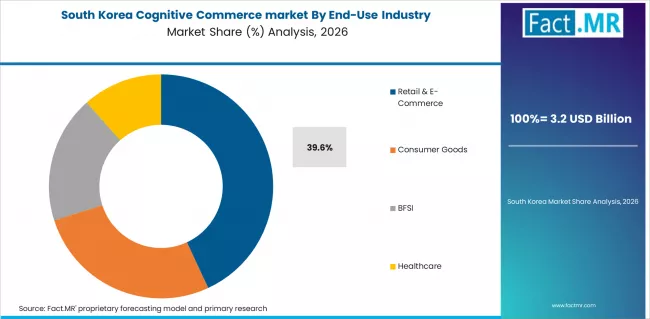
Cognitive Commerce Market South Korea Market Share Analysis By End Use Industry | Source: Fact.MR
South Asia & Pacific Cognitive Commerce Market
South Asia & Pacific is being recognized as the “region of high-growth for mobile-first cognitive commerce transformation’’ owing to fast growth of ecommerce, rising mobile penetration, adoption of digital payment options, and more investments from enterprise AI. Local retailers and ecommerce sites are increasingly utilizing recommendation engines powered by AI, conversational commerce solutions, and intelligent customer engagement tools.
- India: Demand for cognitive commerce solutions in India is projected to rise at 21.3% CAGR through 2036, driven by rapid expansion of mobile commerce, digital payments, AI-powered retail ecosystems, and growing investments in generative AI and customer personalization technologies across ecommerce platforms.
Fact.MR’s analysis of the Cognitive Commerce Market consists of country-wise assessment across North America, Latin America, Europe, East Asia, South Asia & Pacific, and Middle East & Africa. Readers can find detailed insights on regional demand trends, AI adoption patterns, omnichannel commerce transformation, intelligent customer engagement technologies, competitive benchmarking, regulatory developments, and long-term growth outlook across major global markets.
Competitive Benchmarking and Company Positioning
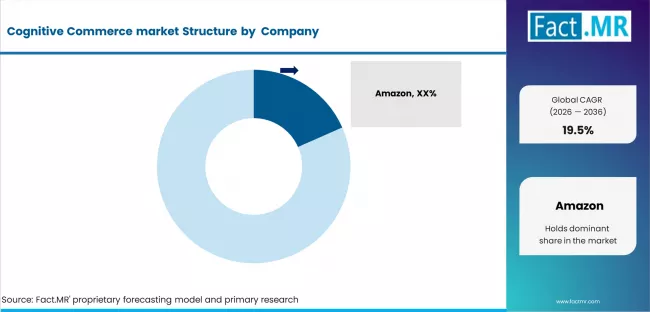
Cognitive Commerce Market Analysis By Company | Source: Fact.MR
Leading Companies Shaping the Cognitive Commerce Market
The market is fairly fragmented, with prominent players including Amazon, Alibaba Group, Google, Microsoft, Salesforce, Adobe, IBM, SAP, Shopify, and Oracle. Players in the industry are competing for AI personalization, the quality of suggestion engines, conversation commerce implementation, omnichannel commerce intelligence, scalability and real-time consumer interaction excellence. Established companies retain competitive advantage with sophisticated AI infrastructure, cloud ecosystems, enterprise commerce platforms, strategic alliances, and deep digital commerce integration across retail, BFSI, healthcare and CPG.
Leading technology companies are focusing on developing AI-based customer experience platform, hyper personalized commerce ecosystem and omnichannel engagement solutions to improve customer retention and revenue. Regional and niche companies are competing by offering industry-specific cognitive commerce solutions, customizable AI recommendation systems, and affordable deployment models catering to mid-sized enterprises and digital-first merchants.
Recent Industry Developments
- Amazon – Rufus AI Shopping Assistant Expansion (August 2025)
- Amazon announced that its generative AI-powered shopping assistant “Rufus” had been used by more than 1 crore customers in India, strengthening the company’s position in conversational commerce, intelligent product discovery, and AI-driven personalized shopping experiences across its ecommerce ecosystem. [1]
- Salesforce – Agentic Commerce Protocol Support with Stripe (October 2025)
- Salesforce announced support for the Agentic Commerce Protocol in collaboration with Stripe to enable AI-powered autonomous purchasing, conversational checkout experiences, and intelligent commerce workflows across enterprise digital commerce ecosystems. [2]
- Adobe – CX Enterprise Agentic AI Platform Introduction (March 2026)
- Adobe introduced CX Enterprise during Adobe Summit to redefine customer experience orchestration through agentic AI capabilities, enabling personalized commerce journeys, intelligent engagement workflows, and AI-driven customer interaction management across digital commerce platforms. [3]
- Shopify – Agentic Commerce Platform Expansion (January 2026)
- Shopify expanded its agentic commerce platform capabilities to connect merchants with AI-powered conversational shopping environments, enabling intelligent product discovery, AI-driven transactions, and autonomous commerce interactions across digital ecosystems. [4]
- SAP – Autonomous Enterprise AI Expansion (May 2026)
- SAP unveiled its Autonomous Enterprise strategy during SAP Sapphire, introducing AI-powered enterprise automation, intelligent workflow orchestration, and autonomous commerce capabilities designed to strengthen customer engagement and operational intelligence across enterprise environments. [5]
Leading Companies Shaping the Cognitive Commerce Market
- Amazon
- Alibaba Group
- Microsoft
- Salesforce
- Adobe
- IBM
- SAP
- Shopify
- Oracle
Sources and Research References
- [1] Amazon, “Amazon AI assistant Rufus has been used by 1 crore+ customers”, August 2025
- [2] Salesforce, “Salesforce Announces Support for Agentic Commerce Protocol with Stripe”, October 2025
- [3] Adobe, “Adobe Redefines Customer Experience Orchestration Vision in the Agentic AI Era with Introduction of CX Enterprise”, March 2026
- [4] Shopify, “The agentic commerce platform: Shopify connects any merchant to every AI conversation”, January 2026
- [5] SAP, “SAP Unveils the Autonomous Enterprise”, May 2026
Cognitive Commerce Market Definition
The cognitive commerce market offers AI-based digital commerce solutions and services which leverage technologies including generative AI, machine learning, natural language processing, predictive analytics, computer vision, autonomous AI agents to provide superior customer engagement and commerce intelligence. Such products allow for personalized recommendations, conversational commerce, smart product discovery, automated customer engagement, pricing dynamics, fraud prevention, and demand prediction. Instead of using traditional e-commerce systems, cognitive commerce solutions make use of real-time customer information and contextual data to create dynamic, highly personalized user experiences. The market caters to an array of industries including retail & e-commerce, consumer goods, BFSI, healthcare, and travel & hospitality across web, mobile, social, and voice commerce channels.
Cognitive Commerce Market Inclusions
The market assessment report covers the projection size of global and regional market for 2025 to 2036. It covers commerce channel, technology, application and end-use industry segments and provides detailed analysis of global and regional adoption, competitive landscape, AI integration strategies, pricing dynamics, customer engagement transformation, and industry specific regulatory frameworks. Additionally, the report anticipates trends related to generative AI adoption, conversational commerce, autonomous AI agents, omnichannel retail transformation, intelligent search, predictive analytics, and personalized commerce experiences; and investment outlook and opportunity assessment by key industry and geography.
Cognitive Commerce Market Exclusions
Traditional e-commerce platforms and digital commerce solutions that do not use AI-enabled technologies including but not limited to machine learning (ML), natural language processing (NLP), generative AI, predictive analytics, and autonomous AI agents are not within the scope of this report. The report excludes nonintelligent rule-based recommendation systems, traditional cognitive-free CRM systems, basic digital payment systems, basic marketing automation software or old school commerce solutions with no intelligent personalization, conversational AI or risk adaptive decision-making tools.
Cognitive Commerce Market Research Methodology
-
Primary Research
- Fact.MR conducted a rigorous research methodology to access the interviewees in the AI commerce platform providers, digital commerce solution vendors, cloud service providers, AI technology developers, retail automation experts, enterprise IT consultants, and end user in Retail & e-commerce, BFSI, healthcare and CPG industries to validate the majority of the market findings and adoption trends.
- Desk Research
- The research draws on company annual reports and investor presentations, reports on AI adoption, government reports on the digital economy, regulatory publications, white papers, trade journals, data from trade associations, intelligence on enterprise spend on AI, and reports on digital commerce infrastructure.
- Market-Sizing and Forecasting
- Fact.MR adopted a hybrid market modeling approach combining bottom-up revenue analysis of cognitive commerce solution providers with top-down assessment of enterprise AI and digital commerce spending across major industries and regions.
- Data Validation and Update Cycle
- The market estimates were validated by triangulating primary interviews, company financials, regional AI adoption trends, technology penetration, and historic digital commerce trends. Projections are updated periodically to take into account changing AI investments, regulatory activities, enterprise digital transformation programs, and innovations in generative AI and autonomous commerce solutions.
Segmentation
Scope of Analysis
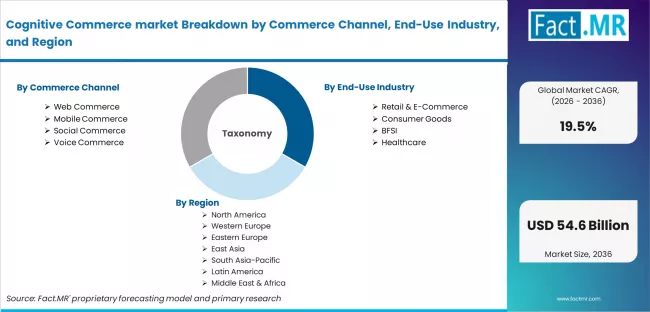
Cognitive Commerce Market Breakdown By Commerce Channel, End Use Industry, And Region | Source: Fact.MR
Parameter |
Details |
|---|---|
| Quantitative Units | USD 7.7 Billion (2025) to USD 54.6 Billion (2036), at a CAGR of 19.5% |
| Market Definition | The Cognitive Commerce Market covers AI-powered digital commerce solutions designed to enhance customer engagement, personalized shopping experiences, intelligent product discovery, conversational commerce, predictive purchasing, and autonomous commerce operations across digital commerce ecosystems. These solutions integrate technologies such as generative AI, machine learning, natural language processing (NLP), predictive analytics, computer vision, recommendation engines, and autonomous AI agents to optimize omnichannel retail, customer interaction, pricing strategies, demand forecasting, and commerce intelligence across web, mobile, social, and voice commerce platforms. |
| Regions Covered | North America, Eastern Europe, Western Europe, East Asia, South Asia & Pacific, Latin America, Middle East & Africa |
| Countries Covered | USA, Canada, UK, Germany, China, Japan, India, South Korea, Brazil, Saudi Arabia, UAE, and 20+ countries |
| Key Companies | Amazon, Alibaba Group, Google, Microsoft, Salesforce, Adobe, IBM, SAP, Shopify, Oracle |
| Forecast Period | 2026 to 2036 |
| Approach | Hybrid demand-side and top-down methodology based on enterprise AI adoption, digital commerce expansion, omnichannel retail transformation, conversational commerce growth, AI-powered personalization adoption, and increasing investments in intelligent customer engagement technologies, validated through primary interviews with AI platform providers, digital commerce companies, cloud infrastructure vendors, enterprise technology providers, ecommerce operators, and retail industry experts across key regions. |
Source: Fact.MR analysis. Updated May 14, 2026
Analysis by Commerce Channel, Technology, Application, End-Use Industry, and Region
-
Cognitive Commerce Market by Commerce Channel:
- Web Commerce
- Desktop Commerce
- Browser-Based Platforms
- Web Marketplaces
- B2B Portals
- Mobile Commerce
- Shopping Applications
- Mobile Wallet Commerce
- In-App Purchases
- App-Based Marketplaces
- Social Commerce
- Influencer Commerce
- Livestream Commerce
- Social Marketplace Commerce
- Creator Commerce
- Voice Commerce
- Smart Speaker Commerce
- Voice Ordering
- AI Voice Assistants
- Conversational Purchasing
- Web Commerce
-
Cognitive Commerce Market by Technology:
- Generative AI
- Machine Learning & Predictive Analytics
- Natural Language Processing (NLP)
- Computer Vision
- Autonomous AI / Agentic Commerce
- Recommendation Engines
- Knowledge Graphs & Semantic AI
-
Cognitive Commerce Market by Application:
- Personalized Recommendations
- Conversational Commerce
- Intelligent Search & Discovery
- Pricing & Revenue Optimization
- Supply Chain & Inventory Intelligence
- Fraud Detection & Risk Management
- Customer Service Automation
- Demand Forecasting
- Visual Search & Discovery
-
Cognitive Commerce Market by End-Use Industry:
- Retail & E-Commerce
- Online Retail
- Omnichannel Retail
- Marketplace Commerce
- D2C Commerce
- Consumer Goods
- FMCG
- Beauty & Personal Care
- Fashion & Apparel
- Consumer Electronics
- BFSI
- Digital Banking
- Embedded Finance
- Insurance Commerce
- Payment Platforms
- Healthcare
- Digital Pharmacies
- Telehealth Platforms
- Healthcare Marketplaces
- Wellness Commerce
- Travel & Hospitality
- Travel Booking
- Hotel Platforms
- Vacation Rentals
- Retail & E-Commerce
-
Cognitive Commerce Market by Region:
- North America
- USA
- Canada
- Mexico
- Latin America
- Brazil
- Chile
- Rest of LATAM
- East Asia
- China
- Japan
- South Korea
- Taiwan
- South Asia & Pacific
- India
- Singapore
- Australia
- ASEAN
- Western Europe
- Germany
- France
- U.K.
- Italy
- Spain
- BENELUX
- Nordic
- Rest of Western Europe
- Eastern Europe
- Poland
- Hungary
- Czech Republic
- Balkan & Baltics
- Rest of Eastern Europe
- Middle East and Africa
- Kingdom of Saudi Arabia
- United Arab Emirates
- South Africa
- Rest of Middle East and Africa
- North America
Frequently Asked Questions
How large is the demand for Cognitive Commerce in the global market in 2025?
What will be the market size of the Cognitive Commerce Market by 2036?
What is the expected demand growth for the Cognitive Commerce Market between 2026 and 2036?
Which commerce channel segment is expected to dominate the market?
Which technology segment is expected to hold the highest market share?
How significant is the growth outlook for India in this market?
Which company is identified as a leading player in the Cognitive Commerce Market?
Who worked on this report


Preview the report firsthand - request a free sample
Free SampleGet the brochure for pricing and purchase details
Download PDF