- Market Value (2025): USD 29.1 Bn
- Estimated Value (2026): USD 31.8 Bn
- Forecast Value (2036): USD 76.0 Bn
- CAGR (2026-2036): 9.1%
What is the Longevity Wellness Pharmaceutical Market forecast to be worth by 2036?
USD 31.8 billion in 2026 to USD 76.0 billion by 2036, at 9.1% CAGR.
- The Longevity Wellness Pharmaceutical Market reached USD 29.1 billion in 2025.
- Demand is projected to rise from USD 31.8 billion in 2026 to USD 76.0 billion by 2036.
- The market is forecast to record a 9.1% CAGR from 2026 to 2036 as age-related disease programs move through clinically governed development and commercialization pathways.
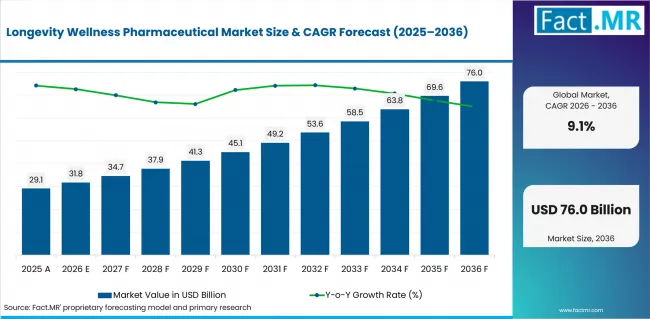
Longevity Wellness Pharmaceutical Market Value Analysis | Source: Fact.MR
What are the defining numbers behind Longevity Wellness Pharmaceutical Market growth?
USD 46.9 billion absolute opportunity between 2025 and 2036, led by Senolytic Drugs, Healthy Aging applications; and Hospitals within the quantified segmentation.
- Demand Drivers in the Market
- Aging populations increase the number of patients living with multiple age-related conditions, raising demand for therapies that preserve function or modify disease progression.
- Drug developers are organizing programs around defined diseases and measurable functional endpoints because broad preventive claims face higher evidence and safety thresholds.
- Hospitals and specialty clinics provide governed settings for administration, monitoring, adverse-event management; and biomarker-led assessment.
- Public research programs and biopharma collaborations are widening the target pipeline around aging biology, regeneration, and healthy lifespan.
- Key Segments Analyzed
- By Product Type: Senolytic Drugs are projected to hold 28.0% share in 2026 because they convert senescent-cell biology into a pharmacologic treatment proposition.
- By Application: Healthy Aging is projected to hold 34.0% share in 2026 because it spans functional decline and longevity enhancement before one late-stage disease dominates care.
- By End User: Hospitals are projected to hold 32.0% share in 2026 because advanced and chronic therapies require specialist oversight, safety monitoring, and coordinated pharmacy access. Clinical workflow constraints remain relevant to the personalized medicine and stem cell therapy markets.
- By Distribution Channel: Hospital Pharmacies, Inpatient Pharmacies, Outpatient Pharmacies; and Retail Pharmacies form the defined channel universe and support different administration and monitoring needs.
- By Drug Class: Small Molecule Drugs, Senolytics, mTOR Inhibitors; and Biologics define the defined drug-class coverage.
- Analyst Opinion at Fact.MR
- Shambhu Nath Jha, Pricipal Consultant at Fact.MR, states: “Longevity pharmaceutical demand will not be won by broad anti-aging language. The commercial route begins with a defined disease or functional endpoint that regulators; clinicians; and payers can evaluate. Developers that pair validated biomarkers with chronic-use safety and reliable specialty distribution will have the clearest path to durable adoption.”
- Strategic Implications
- Developers should anchor programs to a defined indication or functional endpoint before using longevity positioning in commercial communication.
- Biomarker plans should be built alongside clinical development so efficacy signals can be interpreted consistently across sites and patient groups.
- Commercial models should account for chronic-use safety, adherence, specialty distribution; and payer review before scale-up decisions are made.
- Hospitals and specialty pharmacies should define administration, monitoring, and escalation responsibilities before adopting advanced modalities.
How does the Longevity Wellness Pharmaceutical Market break down by segment?
Senolytic Drugs lead Product Type at 28.0%, Healthy Aging leads Application at 34.0%, and Hospitals lead End User at 32.0% in 2026.
Why do Senolytic Drugs lead Product Type?
Senolytic Drugs are projected to account for 28.0% share in 2026.
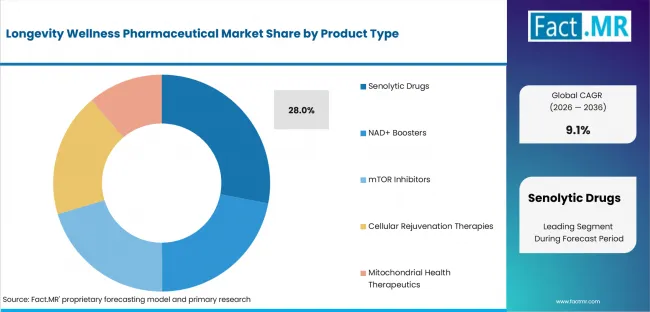
Longevity Wellness Pharmaceutical Market Analysis By Product Type | Source: Fact.MR
Senolytic Drugs lead because they give developers a direct pharmacologic route to address senescent-cell burden within the defined pharmaceutical boundary. Commercial credibility still depends on a clear indication, a measurable endpoint, and a safety profile suitable for the intended duration of use.
Dasatinib-Based Therapies, Fisetin-Based Therapies, and NAD+ Boosters complete the defined Product Type universe. They remain qualitatively important because each faces a different evidence; dosing; and chronic-use assessment.
Why does Healthy Aging lead Application?
Healthy Aging is projected to account for 34.0% share in 2026.
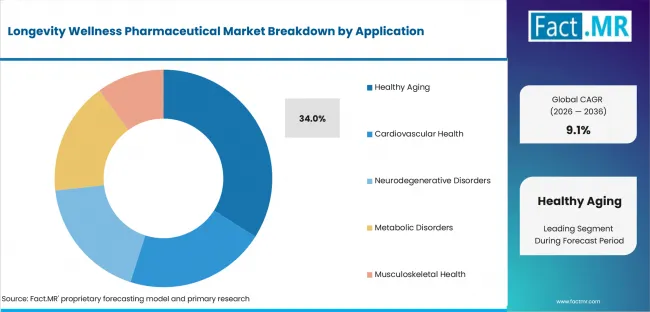
Longevity Wellness Pharmaceutical Market Analysis By Application | Source: Fact.MR
Healthy Aging leads because it covers the broadest commercial objective within the market: preserving function and delaying age-related decline before a single late-stage disease dominates treatment. The application can support indication-led development without collapsing the category into general wellness services.
Age-Related Functional Decline, Longevity Enhancement, and Cardiovascular Health remain important application paths. Their commercial value depends on whether the therapy can show a measurable benefit that regulators; clinicians; and payers can assess.
Why do Hospitals lead End User?
Hospitals are projected to account for 32.0% share in 2026.
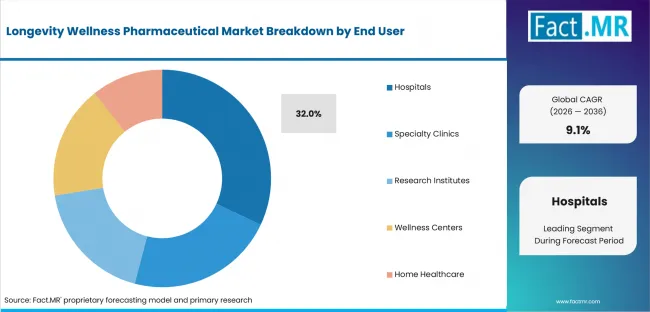
Longevity Wellness Pharmaceutical Market Analysis By End User | Source: Fact.MR
Hospitals lead because advanced therapies and chronic treatment programs often need specialist diagnosis, controlled administration, adverse-event response; and coordinated pharmacy support. These capabilities make hospitals central to evidence generation and early commercial use. Data governance connects this demand with the cell therapy technologies and gene therapy markets.
Public Hospitals, Private Hospitals, and Specialty Clinics serve different access routes. Public systems can extend reach after approval; private centers may move earlier on specialist programs; and specialty clinics can concentrate expertise around defined age-related conditions.
How do Distribution Channels shape market access?
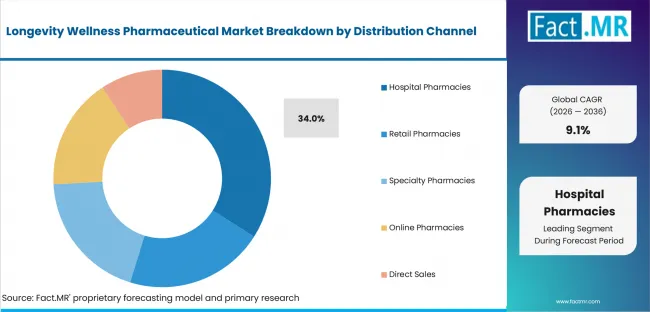
Longevity Wellness Pharmaceutical Market Analysis By Distribution Channel | Source: Fact.MR
Hospital Pharmacies and Inpatient Pharmacies support products that require controlled administration or close monitoring. Outpatient Pharmacies and Retail Pharmacies become more relevant when a therapy can move into repeat ambulatory use without weakening prescribing, safety, and adherence controls.
How does Drug Class influence development strategy?
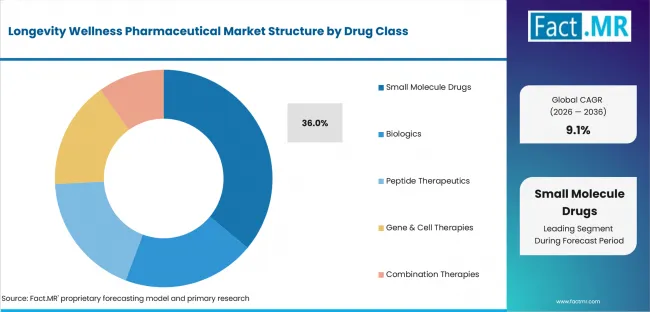
Longevity Wellness Pharmaceutical Market Analysis By Drug Class | Source: Fact.MR
Small Molecule Drugs, Senolytics, mTOR Inhibitors; and Biologics form the defined Drug Class universe. Drug-class choice affects manufacturing; administration; monitoring; and distribution; so clinical and commercial planning must be developed together rather than treated as separate workstreams.
What is accelerating Longevity Wellness Pharmaceutical Market adoption, and what is holding it back?
Age-linked multimorbidity and indication-led development support demand. Evidence, safety, reimbursement; and biomarker validation remain the main conversion barriers; while disease-specific programs create the clearest route from aging biology to commercial therapy.
Drivers Impact Analysis
| DRIVER | QUALITATIVE RELEVANCE | GEOGRAPHIC RELEVANCE | IMPACT TIMELINE |
|---|---|---|---|
| Age-linked multimorbidity and functional decline | High | USA, Europe, and Japan | Long term (>= 4 years) |
| Indication-led programs for age-related disease | High | North America and Europe | Medium term (2-4 years) |
| Hospital and specialty pharmacy capacity | Medium | USA, Japan, Germany; and UK | Medium term (2-4 years) |
| Public healthy-lifespan research programs | Medium | USA and Japan | Long term (>= 4 years) |
| Biopharma partnerships around human aging biology | Medium | USA and Europe | Medium term (2-4 years) |
Source: Fact.MR analysis. Updated Aug 3, 2026
- Age-linked multimorbidity: The market expands when treatment focuses on preserving function or modifying a defined age-related disease rather than selling a general wellness promise. This demand base is durable because clinical need persists across the forecast period.
- Indication-led development: A defined disease or functional endpoint gives regulators and payers a clearer basis for benefit-risk assessment. Eli Lilly’s Kisunla approval for early symptomatic Alzheimer’s disease illustrates the commercial importance of a specific indication and confirmed pathology.
Opportunity Impact Analysis
| OPPORTUNITY | QUALITATIVE RELEVANCE | GEOGRAPHIC RELEVANCE | IMPACT TIMELINE |
|---|---|---|---|
| Validated biomarkers for defined endpoints | High | USA, Japan, and Germany | Medium term (2-4 years) |
| Disease-specific regenerative programs | High | USA and Europe | Long term (>= 4 years) |
| Chronic-use delivery and adherence support | Medium | North America and Europe | Long term (>= 4 years) |
| Hospital-led evidence generation | Medium | Japan, UK, and Germany | Medium term (2-4 years) |
Source: Fact.MR analysis. Updated Aug 3, 2026
- Validated biomarkers: Biomarkers can shorten the distance between broad aging biology and a measurable development endpoint. Their value is highest when they are linked to a defined disease or functional change and are validated against clinically meaningful outcomes.
Restraints Impact Analysis
| RESTRAINT | QUALITATIVE RELEVANCE | GEOGRAPHIC RELEVANCE | IMPACT TIMELINE |
|---|---|---|---|
| Evidence and safety thresholds for preventive use | High | Global | Short term (<= 2 years) |
| Regulatory indication and payer coverage dependency | High | USA, Germany, UK; and Canada | Medium term (2-4 years) |
| Chronic-use safety and monitoring burden | High | Global | Long term (>= 4 years) |
| Biomarker validation and endpoint acceptance | Medium | USA, Europe, and Japan | Medium term (2-4 years) |
Source: Fact.MR analysis. Updated Aug 3, 2026
- Evidence and safety thresholds: Broad preventive use asks healthy or less-symptomatic people to accept treatment risk over a long period. Developers therefore need stronger proof of benefit, duration, and adverse-event management than a general anti-aging claim can provide. Provider adoption conditions also affect the cell and gene therapy cdmo and cell and gene therapy clinical trials markets.
- Reimbursement dependency: Demographic need does not automatically become paid demand. FDA indications, formal benefit assessment, NHS evaluation; and provincial formulary decisions determine whether a clinically promising therapy reaches routine use.
Which countries are scaling Longevity Wellness Pharmaceutical Market fastest?
USA leads at 10.0% CAGR, followed by Japan at 9.7%, Germany at 9.4%; UK at 9.1%; Canada at 8.8%; Australia at 8.5%; and Brazil at 8.2% through 2036.
Regional coverage includes North America, Latin America, Western Europe; Eastern Europe; East Asia; South Asia and Pacific; and the Middle East and Africa.
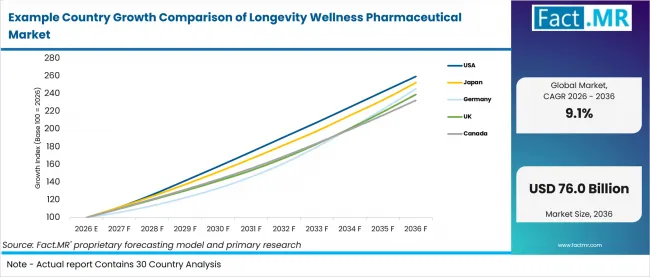
Example Country Growth Comparison Of Longevity Wellness Pharmaceutical Market | Source: Fact.MR
| COUNTRY | CAGR, 2026 to 2036 |
|---|---|
| USA | 10.0% |
| Japan | 9.7% |
| Germany | 9.4% |
| UK | 9.1% |
| Canada | 8.8% |
| Australia | 8.5% |
| Brazil | 8.2% |
Source: Fact.MR analysis. Updated Aug 3, 2026
What is shaping USA's outlook through 2036?
10.0% CAGR through 2036, supported by research hospitals, specialty clinics; and integrated pharmacy networks.
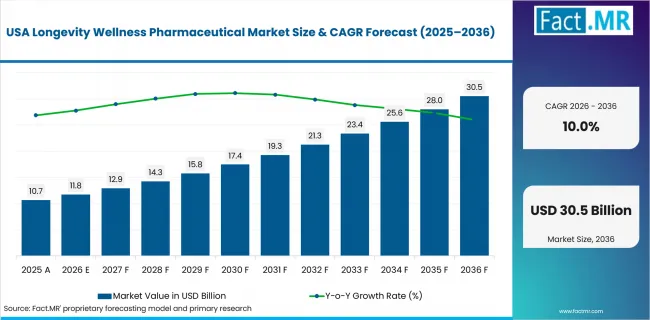
Longevity Wellness Pharmaceutical Market Country Value Analysis | Source: Fact.MR
Research hospitals, specialty clinics, and integrated pharmacy networks are positioned to test biomarker-led therapies; while commercial uptake remains tied to FDA indications and payer coverage. Demand for Longevity Wellness Pharmaceutical products in the USA is forecast to expand at 10.0% CAGR from 2026 to 2036.
What is shaping Japan's outlook through 2036?
9.7% CAGR through 2036, supported by hospital-centered specialist care and nationally coordinated research.
Japanese providers rely on hospital-centered specialist care and nationally coordinated research, making local evidence and institutional partnerships important for advanced and preventive therapies. Adoption of Longevity Wellness Pharmaceutical products in Japan is estimated to rise at 9.7% CAGR from 2026 to 2036.
What is shaping Germany's outlook through 2036?
9.4% CAGR through 2036, shaped by statutory insurance, specialist centers; and formal benefit assessment.
Statutory insurance, specialist centers, and formal benefit assessment shape purchasing in Germany; so demographic need does not automatically become reimbursed demand. Sales of Longevity Wellness Pharmaceutical products in Germany are forecast to grow at 9.4% CAGR from 2026 to 2036.
What is shaping the UK's outlook through 2036?
9.1% CAGR through 2036, with NHS evaluation and service planning determining the route to access.
NHS adoption concentrates evaluation, procurement, and service planning. This structure can support broad access after approval but slows uptake when capacity or value evidence is incomplete. Demand for Longevity Wellness Pharmaceutical products in the UK is forecast to expand at 9.1% CAGR from 2026 to 2036.
What is shaping Canada's outlook through 2036?
8.8% CAGR through 2036, with provincial formulary decisions shaping access across hospital systems.
Provincial formularies and hospital systems control access in Canada, creating multiple reimbursement decisions for the same therapy and uneven specialist availability across the country. Adoption of Longevity Wellness Pharmaceutical products in Canada is forecast to rise at 8.8% CAGR from 2026 to 2036. Procurement scrutiny appears in the drug discovery services and drug discovery technologies markets.
Who leads the Longevity Wellness Pharmaceutical Market?
AbbVie Inc. is a leading company in the market.
Competition separates scaled commercialization, advanced modalities, and longevity-native discovery. AbbVie Inc.; Pfizer Inc.; Eli Lilly and Company; and Sanofi S.A. bring prescription-channel and development scale. Novartis AG; Bayer AG; and Life Biosciences emphasize advanced therapeutic modalities and disease-specific regeneration.
BioAge Labs, Juvenescence, and Cambrian BioPharma organize programs around human aging biology; platform discovery; or portfolio building. Competitive credibility depends on the quality of the clinical endpoint; chronic-use safety; manufacturability; specialty distribution; and the ability to convert a research program into an authorized indication.
In July 2024, Eli Lilly and Company received FDA approval for Kisunla (donanemab-azbt) for adults with early symptomatic Alzheimer’s disease and confirmed amyloid pathology. The once-monthly intravenous therapy uses amyloid imaging and permits treatment stopping after plaque removal.
In December 2024, BioAge Labs and Novartis AG announced a multi-year collaboration using BioAge’s human longevity data to identify drug targets for age-related diseases and conditions. The arrangement combines a longevity-data discovery platform with Novartis drug-development capability.
In September 2025, Bayer AG reported that BlueRock dosed the first patient in the Phase III exPDite-2 trial of bemdaneprocel for Parkinson’s disease. The investigational therapy implants stem-cell-derived dopaminergic neuron precursors intended to replace neurons lost to disease.
Which companies are the key providers?
AbbVie Inc. and Novartis AG are leading companies in the market.
- AbbVie Inc.
- Novartis AG
- Pfizer Inc.
- Eli Lilly and Company
- Sanofi S.A.
- Bayer AG
- BioAge Labs
- Life Biosciences
- Juvenescence
- Cambrian BioPharma
Bibliography
- World Health Organization. (2025, October 1). Ageing and health.
- U.S. Food and Drug Administration. (2021, June 3). Important Patient and Consumer Information About Regenerative Medicine Therapies.
- Advanced Research Projects Agency for Health. (2026, February 24). ARPA-H awards research teams to add more healthy years to Americans’ lives as they age.
- Japan Agency for Medical Research and Development. (2025, January 29). Toward the Realization of Medical Care that Enables People to Live Healthy Even at Age 100: Moonshot Goal 7 Symposium 2024.
- Statistics Bureau of Japan. (2025). Statistical Handbook of Japan 2025.
This Report Addresses
- The report provides strategic intelligence on the Longevity Wellness Pharmaceutical Market across Product Type, Application, End User; Distribution Channel; and Drug Class.
- Segment analysis quantifies Senolytic Drugs, Healthy Aging, and Hospitals as the reported 2026 share leaders and discusses the remaining channel and drug-class universe qualitatively.
- Country outlook compares the USA, Japan, Germany; UK; Canada; Australia; and Brazil through 2036.
- Competitive analysis profiles ten providers and identifies AbbVie Inc. as the only company with an assigned numerical share at 11.6%.
- Scope assessment separates clinically governed therapies from nutraceuticals, cosmetics, diagnostics; devices; wellness services; and investigational pipeline value.
- Methodology explains the primary research, desk research, market-sizing; forecasting; and validation process used for the assessment.
What does the Longevity Wellness Pharmaceutical Market cover?
Prescription and clinically governed pharmaceutical, biologic, peptide; gene; cell; and combination therapies used for healthy aging or defined age-related conditions.
The Longevity Wellness Pharmaceutical Market covers revenue from therapies sold within the stated Product Type, Application, End User; Distribution Channel; and Drug Class universe. The commercial boundary requires a pharmaceutical or clinically governed treatment function rather than a broad wellness promise. Patient-monitoring needs also shape the AI driven drug discovery platforms and therapeutic drug monitoring markets.
The market differs from general anti-aging and wellness spending because revenue must be tied to in-scope therapeutic products. Downstream hospital or clinic service revenue and the value of investigational pipelines are outside the market boundary.
What is included in the scope?
Clinically governed therapies across healthy aging and defined age-related conditions, sold through hospital, outpatient; and retail pharmacy pathways.
The scope includes Senolytic Drugs, Dasatinib-Based Therapies, Fisetin-Based Therapies; and NAD+ Boosters. Application coverage includes Healthy Aging; Age-Related Functional Decline; Longevity Enhancement; and Cardiovascular Health. End users include Hospitals; Public Hospitals; Private Hospitals; and Specialty Clinics. Distribution Channel and Drug Class coverage follows the stated taxonomy listed in the report.
What is excluded from the scope?
Diagnostics, devices, stand-alone nutraceuticals; cosmetics; wellness services; and investigational pipeline value are outside the market boundary.
The scope excludes downstream hospital or clinic service revenue, diagnostics, devices; stand-alone nutraceuticals; cosmetics; wellness services; investigational pipeline value; and adjacent or substitute products. These exclusions prevent double-counting and keep the forecast tied to revenue from in-scope therapeutic products.
How was the analysis built?
Primary interviews, desk research, hybrid market sizing; and cross-source validation were used to test the revenue boundary and forecast logic.
- Primary Research
- Structured consultations with pharmaceutical manufacturers, clinical-development teams, distributors; hospital and specialty pharmacy stakeholders; clinicians; procurement participants; and subject-matter experts examine product boundaries; purchasing authority; channel economics; evidence thresholds; safety monitoring; and adoption frictions.
- Desk Research
- The review covers regulator publications, national statistics, public health programs; company filings and newsrooms; clinical-trial information; standards; peer-reviewed literature; and public procurement or reimbursement material.
- Market-Sizing and Forecasting
- A hybrid bottom-up and top-down model reconciles in-scope manufacturer revenue, product and drug-class participation, application mix; end-user demand; distribution channels; company disclosures; and country adoption conditions.
- Data Validation and Update Cycle
- Figures and claims are cross-checked across source types and reconciled to the stated revenue boundary. Validation excludes downstream service revenue, diagnostics, devices; stand-alone wellness products; and investigational pipeline value. Qualification requirements remain important to the clinical trial management systems and clinical trial logistics markets.
Segmentation
What is the report’s scope and coverage?
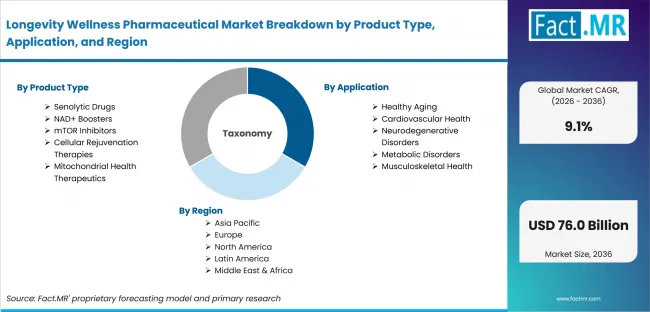
Longevity Wellness Pharmaceutical Market Breakdown By Product Type, Application, And Region | Source: Fact.MR
| Attribute | Details |
|---|---|
| Quantitative Units | USD Billion in 2025; USD Billion in 2026; USD Billion by 2036 at CAGR |
| Market Definition | Revenue from prescription or clinically governed pharmaceutical, biologic, peptide; gene; cell; and combination therapies sold within the stated segmentation universe for healthy aging or defined age-related conditions. |
| Product Type | Senolytic Drugs; Dasatinib-Based Therapies; Fisetin-Based Therapies; NAD+ Boosters |
| Application | Healthy Aging; Age-Related Functional Decline; Longevity Enhancement; Cardiovascular Health |
| End User | Hospitals; Public Hospitals; Private Hospitals; Specialty Clinics |
| Distribution Channel | Hospital Pharmacies; Inpatient Pharmacies; Outpatient Pharmacies; Retail Pharmacies |
| Drug Class | Small Molecule Drugs; Senolytics; mTOR Inhibitors; Biologics |
| Regions Covered | North America; Latin America; Western Europe; Eastern Europe; East Asia; South Asia and Pacific; Middle East and Africa |
| Countries Covered | USA; Japan; Germany; UK; Canada; Australia; Brazil |
| Key Companies Profiled | AbbVie Inc.; Novartis AG; Pfizer Inc.; Eli Lilly and Company; Sanofi S.A.; Bayer AG; BioAge Labs; Life Biosciences; Juvenescence; Cambrian BioPharma |
| Forecast Period | 2026 to 2036 |
| Approach | Fact.MR applies a hybrid bottom-up and top-down approach, reconciling in-scope manufacturer revenue, product and channel evidence; country adoption conditions; and the forecast series. |
Source: Fact.MR analysis. Updated Aug 3, 2026
How is the market segmented?
-
By Product Type
- Senolytic Drugs
- Dasatinib-Based Therapies
- Fisetin-Based Therapies
- NAD+ Boosters
- Nicotinamide Riboside Products
- Nicotinamide Mononucleotide Products
- mTOR Inhibitors
- Rapamycin-Based Drugs
- Rapalog Therapies
- Cellular Rejuvenation Therapies
- Stem Cell-Based Therapeutics
- Regenerative Biologics
- Mitochondrial Health Therapeutics
- Antioxidant Therapeutics
- Mitochondrial Peptide Therapies
- Senolytic Drugs
-
By Application
- Healthy Aging
- Age-Related Functional Decline
- Longevity Enhancement
- Cardiovascular Health
- Vascular Health
- Heart Disease Prevention
- Neurodegenerative Disorders
- Alzheimer's Disease
- Parkinson's Disease
- Metabolic Disorders
- Type 2 Diabetes
- Obesity Management
- Musculoskeletal Health
- Osteoporosis
- Sarcopenia
- Healthy Aging
-
By End User
- Hospitals
- Public Hospitals
- Private Hospitals
- Specialty Clinics
- Anti-Aging Clinics
- Regenerative Medicine Clinics
- Research Institutes
- Government Research Centers
- Academic Institutes
- Wellness Centers
- Longevity Clinics
- Personalized Wellness Centers
- Home Healthcare
- Home Care Providers
- Remote Patient Management
- Hospitals
-
By Distribution Channel
- Hospital Pharmacies
- Inpatient Pharmacies
- Outpatient Pharmacies
- Retail Pharmacies
- Chain Pharmacies
- Independent Pharmacies
- Specialty Pharmacies
- Biologics Pharmacies
- Precision Medicine Pharmacies
- Online Pharmacies
- E-Commerce Platforms
- Direct-to-Consumer Platforms
- Direct Sales
- Manufacturer Distribution
- Healthcare Provider Agreements
- Hospital Pharmacies
-
By Drug Class
- Small Molecule Drugs
- Senolytics
- mTOR Inhibitors
- Biologics
- Monoclonal Antibodies
- Recombinant Proteins
- Peptide Therapeutics
- Bioactive Peptides
- Mitochondrial Peptides
- Gene & Cell Therapies
- Gene Editing Therapies
- Stem Cell Therapies
- Combination Therapies
- Drug-Nutraceutical Combinations
- Multi-Target Therapies
- Small Molecule Drugs
-
By Region
- North America
- Latin America
- Western Europe
- Eastern Europe
- East Asia
- South Asia and Pacific
- Middle East & Africa
Frequently Asked Questions
Which Product Type leads the Longevity Wellness Pharmaceutical Market?
Which Application leads the market?
Which End User leads the market?
Which country records the highest CAGR?
How does Japan perform in the market?
How does Germany perform in the market?
How does the UK perform in the market?
How does Canada perform in the market?
What is the primary driver in the market?
What is the main restraint?
Why are validated biomarkers important?
Which company has a quantified market share?
What does the market include?
What is outside the market scope?
How does Australia perform in the market?
How does Brazil perform in the market?
Which Distribution Channels are covered?
Which Drug Classes are covered?
Who worked on this report


Preview the report firsthand - request a free sample
Free SampleGet the brochure for pricing and purchase details
Download PDF