Low-Smoke Flame-Retardants Market (2026 - 2036)

Low-Smoke Flame-Retardants Market Size and Share Forecast Outlook 2026 to 2036

Core Findings

    Low-Smoke Flame-Retardants Market Forecast Outlook 2026 to 2036

    The low-smoke flame-retardants market is projected to reach USD 4.1 billion in 2026 and grow to USD 7.4 billion by 2036, reflecting a CAGR of 6.1%.

    Key Takeaways from Low-Smoke Flame-Retardants Market

    • Low-Smoke Flame-Retardants Market Value (2026): USD 4.1 billion
    • Low-Smoke Flame-Retardants Market Forecast Value (2036): USD 7.4 billion
    • Low-Smoke Flame-Retardants Market Forecast CAGR 2026 to 2036: 6.1%
    • Leading Segment in Low-Smoke Flame-Retardants Market: Powder (61%)
    • Key Growth Region in Low-Smoke Flame-Retardants Market: Asia Pacific
    • Key Players in Low-Smoke Flame-Retardants Market: Clariant AG, Albemarle Corporation, ICL Group Ltd., LANXESS AG, Nabaltec AG, Huber Engineered Materials (a J.M. Huber Corporation company), Italmatch Chemicals S.p.A., BASF SE, RTP Company, J.M. Huber Corporation
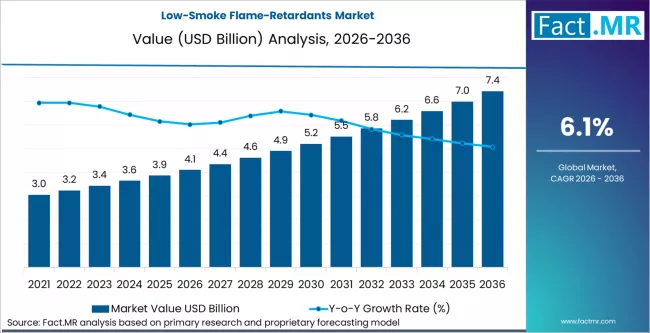
    Low Smoke Flame Retardants Market Market Value Analysis

    Capital intensity will play a significant role in shaping market expansion, as manufacturers invest in developing advanced flame-retardant solutions that comply with stringent safety standards. With the need for high-quality materials in industries such as construction, automotive, and electronics, the return timelines for investments may span several years, particularly when entering new markets or scaling production.

    Selective investment will be crucial, as companies must prioritize R&D, technology adoption, and regulatory compliance to maintain a competitive edge. Companies with a focused strategy on sustainable solutions or niche applications may see quicker returns, while those in more commoditized segments will need to balance cost management and innovation. Understanding market trends and aligning investments accordingly will ensure strong positioning in this growing yet competitive market.

    Low-Smoke Flame-Retardants Market

    Metric Value
    Estimated Value in (2026E) USD 4.1 billion
    Forecast Value in (2036F) USD 7.4 billion
    Forecast CAGR 2026 to 2036 6.1%

    Category

    Category Sub-Segment
    By Chemistry ATH (aluminum trihydrate); MDH (magnesium hydroxide); Phosphorus-based FRs; Nitrogen/intumescent systems; Smoke suppressants & synergists; Others
    By Application Wire & cable LSZH compounds; Construction materials; Transportation interiors; Electrical/electronics housings; Furniture & textiles
    By Form Powder; Granules; Masterbatch; Liquid dispersions
    By End-Use Industry Building & construction; Power & telecom cables; Automotive & rail; Electronics; Others
    Region North America; Europe; Asia Pacific; Latin America; Middle East & Africa

    Segmental Analysis

    What is Driving the Dominance of Powder Form in the Low-Smoke Flame-Retardants Market?
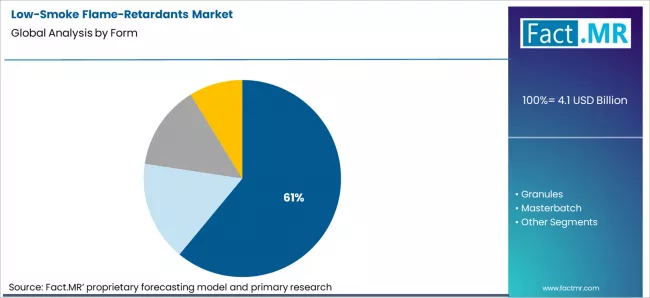
    Low Smoke Flame Retardants Market Analysis By Form

    Powder form leads the low-smoke flame-retardants market with 61% of the market share in 2026. This dominance is due to the ease of integration and effective dispersion in various materials during the manufacturing process. Powders are highly suitable for applications that require a consistent and efficient flame-retardant performance, especially in wire and cable LSZH compounds. Their ability to be uniformly mixed with other compounds while maintaining their flame-retardant properties makes them the preferred form for many industries, including electrical, construction, and automotive.

    What is the Role of Wire & Cable LSZH Compounds in the Low-Smoke Flame-Retardants Market?
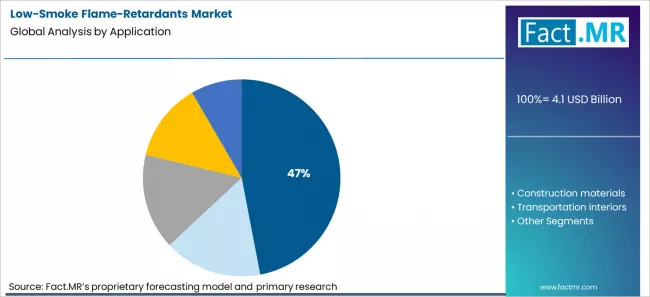
    Low Smoke Flame Retardants Market Analysis By Application

    Wire & cable LSZH compounds account for 47% of the market share in 2026. Low-Smoke Zero Halogen (LSZH) compounds are widely used in the wire and cable industry to provide enhanced fire safety with minimal smoke production in case of fire. The demand for flame-retardants in LSZH compounds is driven by the need for safer, environmentally friendly materials in cables used in public and industrial infrastructures. These compounds are critical in reducing health hazards and improving safety standards in buildings, transportation systems, and other high-risk areas.

    What are the Drivers, Restraints, and Key Trends in the LowSmoke FlameRetardants Market?

    Demand for low smoke flame retardants is shaped by safety and regulatory requirements in building materials, electrical and electronics housings, transportation interiors, and industrial equipment where reduced smoke density and toxicity are critical during fire incidents. Engineers and specifiers choose formulations that deliver effective flame inhibition while limiting dense, hazardous smoke that can impede evacuation and compromise visibility in enclosed spaces. Procurement teams prioritize additives that meet stringent fire performance standards (UL, EN, ASTM) and integrate with base polymers without degrading mechanical or processing properties. Higher costs relative to conventional flame retardants can constrain adoption in cost sensitive products, and variability in regulatory criteria across regions adds complexity to material selection and global compliance planning.

    Key trends include development of halogen free chemistries that balance fire performance with environmental and health profiles, and expansion of tailored solutions optimized for specific polymer families (e.g., polyolefins, engineering plastics) to reduce formulation trial cycles and improve processing consistency.

    Analysis of the Low-Smoke Flame-Retardants Market by Key Country
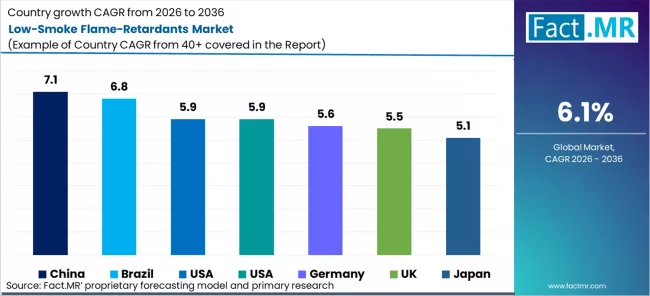
    Low Smoke Flame Retardants Market Cagr Analysis By Country

    Country CAGR 2026 to 2036
    USA 5.9%
    Japan 5.1%
    South Korea 5.9%
    Germany 5.6%
    China 7.1%
    UK 5.5%
    Brazil 6.8%

    The report covers an in-depth analysis of 40+ countries; top-performing countries are highlighted below.

    What is Driving the Growth of the Low-Smoke Flame-Retardants Market in the USA?

    The USA’s Low-Smoke Flame-Retardants market is projected to grow at 5.9%, driven by the increasing demand for flame-retardant materials in sectors such as automotive, electronics, and construction. As regulatory pressure to meet fire safety standards intensifies, manufacturers are adopting low-smoke, non-toxic flame retardants to reduce health risks during fires. The push for sustainable and safer materials in consumer products and infrastructure, combined with the growing focus on reducing harmful emissions, supports the adoption of these flame retardants in various applications, ensuring continued market growth in the U.S.

    How is the Low-Smoke Flame-Retardants Market Expanding in Japan?

    Japan’s Low-Smoke Flame-Retardants market is growing at 5.1%, supported by the country’s strong focus on safety standards and fire prevention technologies. As Japan’s automotive and electronics sectors prioritize fire safety in the design of high-performance components, the demand for low-smoke flame retardants is increasing. Japan’s strict environmental regulations and commitment to reducing hazardous chemicals in products drive the adoption of flame retardants that offer both safety and environmental protection. With continuous advancements in material science, Japan is well-positioned to integrate low-smoke flame retardants into a wide range of applications, ensuring steady market growth.

    What Factors Are Fueling the Growth of the Low-Smoke Flame-Retardants Market in South Korea?

    South Korea’s Low-Smoke Flame-Retardants market is projected to grow at 5.9%, driven by the country’s expanding automotive and electronics industries, which require high-performance, fire-resistant materials. As safety standards in South Korea’s manufacturing sector become increasingly stringent, the demand for low-smoke flame-retardants rises. The country’s focus on improving material properties for improved safety and sustainability, combined with growing consumer awareness of environmental issues, further accelerates the adoption of low-smoke, eco-friendly flame retardants in a wide range of products, contributing to the market’s growth.

    What is Contributing to the Growth of the Low-Smoke Flame-Retardants Market in Germany?

    Germany’s Low-Smoke Flame-Retardants market is growing at 5.6%, supported by the country’s advanced automotive, construction, and electronics industries. As manufacturers seek to meet stringent fire safety and environmental regulations, the demand for low-smoke, high-performance flame retardants continues to rise. Germany’s strong focus on sustainable, safe materials in high-end applications is driving the use of these flame retardants, particularly in electric vehicle manufacturing and energy-efficient buildings. With a growing emphasis on reducing hazardous substances and improving fire safety, Germany remains a key market for low-smoke flame-retardants in Europe.

    How is the Low-Smoke Flame-Retardants Market Evolving in China?

    China’s Low-Smoke Flame-Retardants market is expanding at 7.1%, driven by the rapid industrialization and increasing focus on fire safety across sectors such as automotive, electronics, and construction. As the country improves its fire safety standards, the demand for low-smoke flame retardants in consumer products and industrial applications grows. Additionally, China’s efforts to reduce toxic emissions and promote safer, more sustainable materials contribute to the widespread adoption of low-smoke flame retardants. The growing automotive and electronics sectors further support the market expansion as China continues to lead in manufacturing high-performance, fire-resistant materials.

    What is Driving the Growth of the Low-Smoke Flame-Retardants Market in the UK?

    The UK’s Low-Smoke Flame-Retardants market is growing at 5.5%, driven by the country’s commitment to improving fire safety and reducing the environmental impact of hazardous chemicals. As the UK’s construction, automotive, and electronics industries adopt more sustainable and safer fire-retardant materials, the demand for low-smoke flame retardants continues to rise. With regulatory frameworks pushing for the reduction of harmful substances in consumer products, the UK’s focus on safe, high-performance materials ensures the steady growth of the low-smoke flame-retardants market, particularly in infrastructure and high-tech industries.

    What is Contributing to the Growth of the Low-Smoke Flame-Retardants Market in Brazil?

    Brazil’s Low-Smoke Flame-Retardants market is expanding at 6.8%, supported by the growing demand for fire-resistant materials in the automotive, construction, and electronics sectors. As Brazil’s regulatory landscape evolves to emphasize fire safety and environmental responsibility, manufacturers are increasingly turning to low-smoke flame retardants to meet new safety standards. The automotive and construction industries, in particular, drive demand for these additives as they prioritize safer and more sustainable materials. Brazil’s ongoing industrial development and focus on improving manufacturing practices contribute to the strong growth of the low-smoke flame-retardants market in the country.

    How Are Key Players Competing in the Low-Smoke Flame-Retardants Market?
    Low Smoke Flame Retardants Market Analysis By Company

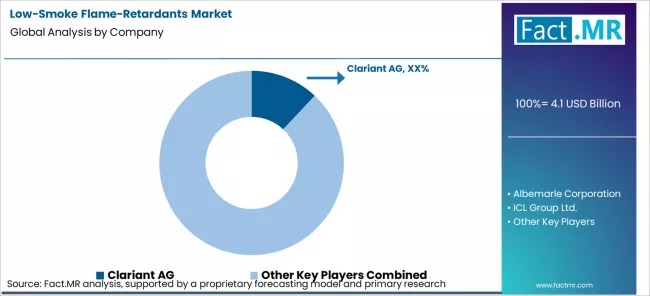
    In the low-smoke flame-retardants market, major players are advancing product innovation to meet evolving fire safety standards, with a focus on reducing smoke emissions while ensuring effective flame retardancy. Clariant AG and Albemarle Corporation lead the charge with innovative flame-retardant solutions that address the growing demand for safer materials in industrial applications. ICL Group Ltd. and LANXESS AG emphasize eco-friendly alternatives, focusing on smoke reduction in addition to superior fire resistance. Nabaltec AG and Huber Engineered Materials provide non-halogenated products to meet regulatory requirements. Companies like Italmatch Chemicals S.p.A., BASF SE, RTP Company, and J.M. Huber Corporation are focusing on advancing additive flame retardant technologies that offer effective performance without compromising environmental safety.

    Recent Industry Developments

    • Product Launch - Avient launches halogen-free flame-retardant TPE grades for USB-C cable jackets (Jun 27, 2023) Avient introduced halogen-free FR TPE grades (positioned for cable jacketing) aligned with low-smoke/LSZH-type compliance needs in wire & cable applications.
    • Capacity Expansion - Clariant inaugurates Exolit® OP flame retardant plant at Daya Bay (Oct 12, 2023) Clariant started up a new plant producing its organophosphorus, halogen-free Exolit OP flame retardants, increasing supply for E&E, transportation, and other low-smoke material systems.
    • Product Launch - Clariant highlights launch of melamine-free Exolit™ AP (2024) as an SVHC-free innovation (Apr 24, 2025 post referencing the 2024 launch) Clariant states it successfully launched melamine-free Exolit AP in 2024, positioning it as an SVHC-free solution while maintaining high fire performance-relevant for low-smoke halogen-free formulations.

    Key Players of the Low-Smoke Flame-Retardants Market

    • Clariant AG
    • Albemarle Corporation
    • ICL Group Ltd.
    • LANXESS AG
    • Nabaltec AG
    • Huber Engineered Materials
    • Italmatch Chemicals S.p.A.
    • BASF SE
    • RTP Company
    • J.M. Huber Corporation

    Scope of the Report

    Items Values
    Quantitative Units (2026) USD 4.1 Billion
    By Chemistry ATH (Aluminum Trihydrate), MDH (Magnesium Hydroxide), Phosphorus-based FRs, Nitrogen/Intumescent Systems, Smoke Suppressants & Synergists, Others
    By Application Wire & Cable LSZH Compounds, Construction Materials, Transportation Interiors, Electrical/Electronics Housings, Furniture & Textiles
    By Form Powder, Granules, Masterbatch, Liquid Dispersions
    By End-Use Industry Building & Construction, Power & Telecom Cables, Automotive & Rail, Electronics, Others
    Regions Covered North America, Europe, Asia Pacific, Latin America, Middle East & Africa
    Countries Covered United States, Canada, Mexico, Germany, United Kingdom, France, Japan, South Korea, China, India, Brazil, and other countries
    Key Companies Profiled Clariant AG, Albemarle Corporation, ICL Group Ltd., LANXESS AG, Nabaltec AG, Huber Engineered Materials (a J.M. Huber Corporation company), Italmatch Chemicals S.p.A., BASF SE, RTP Company, J.M. Huber Corporation
    Additional Attributes Dollar revenue by chemistry, application, form, end-use industry, and region; regional demand trends, competitive landscape, technological advancements in low-smoke flame retardants, operational performance optimization initiatives, and product development strategies

    Low-Smoke Flame-Retardants Market Key Segments

    • By Chemistry :

      • ATH (aluminum trihydrate)
      • MDH (magnesium hydroxide)
      • Phosphorus-based FRs
      • Nitrogen/intumescent systems
      • Smoke suppressants & synergists
      • Others
    • By Application :

      • Wire & cable LSZH compounds
      • Construction materials
      • Transportation interiors
      • Electrical/electronics housings
      • Furniture & textiles
    • By Form :

      • Powder
      • Granules
      • Masterbatch
      • Liquid dispersions
    • By End-Use Industry :

      • Building & construction
      • Power & telecom cables
      • Automotive & rail
      • Electronics
      • Others
    • Region :

      • North America
        • USA
        • Canada
        • Mexico
      • Europe
        • Germany
        • UK
        • France
        • Italy
        • Spain
        • Nordic Countries
        • BENELUX
        • Rest of Europe
      • Asia Pacific
        • China
        • Japan
        • South Korea
        • India
        • Australia
        • Rest of Asia Pacific
      • Latin America
        • Brazil
        • Argentina
        • Rest of Latin America
      • Middle East and Africa
        • Kingdom of Saudi Arabia
        • United Arab Emirates
        • South Africa
        • Rest of Middle East and Africa
      • Other Regions
        • Oceania
        • Central Asia
        • Other Markets

    Bibliographies

    • European Commission Joint Research Centre (JRC). (2024). Assessment of halogen-free and low-smoke flame retardants in polymer materials. European Commission.
    • U.S. National Institute of Standards and Technology (NIST). (2023). Fire behavior and smoke toxicity of flame-retarded polymeric materials. NIST.
    • German Federal Institute for Materials Research and Testing (BAM). (2024). Evaluation of non-halogenated flame retardants for low-smoke applications. BAM.
    • Organisation for Economic Co-operation and Development (OECD). (2023). Flame retardant chemicals: Safety, substitution, and environmental profile. OECD.
    • European Chemicals Agency (ECHA). (2024). Regulatory considerations for halogenated and non-halogenated flame retardants under REACH. ECHA.

    Table of Content

    1. Executive Summary
      • Global Market Outlook
      • Demand to side Trends
      • Supply to side Trends
      • Technology Roadmap Analysis
      • Analysis and Recommendations
    2. Market Overview
      • Market Coverage / Taxonomy
      • Market Definition / Scope / Limitations
    3. Research Methodology
      • Chapter Orientation
      • Analytical Lens and Working Hypotheses
        • Market Structure, Signals, and Trend Drivers
        • Benchmarking and Cross-market Comparability
        • Market Sizing, Forecasting, and Opportunity Mapping
      • Research Design and Evidence Framework
        • Desk Research Programme (Secondary Evidence)
          • Company Annual and Sustainability Reports
          • Peer-reviewed Journals and Academic Literature
          • Corporate Websites, Product Literature, and Technical Notes
          • Earnings Decks and Investor Briefings
          • Statutory Filings and Regulatory Disclosures
          • Technical White Papers and Standards Notes
          • Trade Journals, Industry Magazines, and Analyst Briefs
          • Conference Proceedings, Webinars, and Seminar Materials
          • Government Statistics Portals and Public Data Releases
          • Press Releases and Reputable Media Coverage
          • Specialist Newsletters and Curated Briefings
          • Sector Databases and Reference Repositories
          • FMR Internal Proprietary Databases and Historical Market Datasets
          • Subscription Datasets and Paid Sources
          • Social Channels, Communities, and Digital Listening Inputs
          • Additional Desk Sources
        • Expert Input and Fieldwork (Primary Evidence)
          • Primary Modes
            • Qualitative Interviews and Expert Elicitation
            • Quantitative Surveys and Structured Data Capture
            • Blended Approach
          • Why Primary Evidence is Used
          • Field Techniques
            • Interviews
            • Surveys
            • Focus Groups
            • Observational and In-context Research
            • Social and Community Interactions
          • Stakeholder Universe Engaged
            • C-suite Leaders
            • Board Members
            • Presidents and Vice Presidents
            • R&D and Innovation Heads
            • Technical Specialists
            • Domain Subject-matter Experts
            • Scientists
            • Physicians and Other Healthcare Professionals
          • Governance, Ethics, and Data Stewardship
            • Research Ethics
            • Data Integrity and Handling
        • Tooling, Models, and Reference Databases
      • Data Engineering and Model Build
        • Data Acquisition and Ingestion
        • Cleaning, Normalisation, and Verification
        • Synthesis, Triangulation, and Analysis
      • Quality Assurance and Audit Trail
    4. Market Background
      • Market Dynamics
        • Drivers
        • Restraints
        • Opportunity
        • Trends
      • Scenario Forecast
        • Demand in Optimistic Scenario
        • Demand in Likely Scenario
        • Demand in Conservative Scenario
      • Opportunity Map Analysis
      • Product Life Cycle Analysis
      • Supply Chain Analysis
      • Investment Feasibility Matrix
      • Value Chain Analysis
      • PESTLE and Porter’s Analysis
      • Regulatory Landscape
      • Regional Parent Market Outlook
      • Production and Consumption Statistics
      • Import and Export Statistics
    5. Global Market Analysis 2021 to 2025 and Forecast, 2026 to 2036
      • Historical Market Size Value (USD Million) Analysis, 2021 to 2025
      • Current and Future Market Size Value (USD Million) Projections, 2026 to 2036
        • Y to o to Y Growth Trend Analysis
        • Absolute $ Opportunity Analysis
    6. Global Market Pricing Analysis 2021 to 2025 and Forecast 2026 to 2036
    7. Global Market Analysis 2021 to 2025 and Forecast 2026 to 2036, By Form
      • Introduction / Key Findings
      • Historical Market Size Value (USD Million) Analysis By Form, 2021 to 2025
      • Current and Future Market Size Value (USD Million) Analysis and Forecast By Form, 2026 to 2036
        • Powder
        • Granules
        • Masterbatch
        • Liquid dispersions
      • Y to o to Y Growth Trend Analysis By Form, 2021 to 2025
      • Absolute $ Opportunity Analysis By Form, 2026 to 2036
    8. Global Market Analysis 2021 to 2025 and Forecast 2026 to 2036, By Application
      • Introduction / Key Findings
      • Historical Market Size Value (USD Million) Analysis By Application, 2021 to 2025
      • Current and Future Market Size Value (USD Million) Analysis and Forecast By Application, 2026 to 2036
        • Wire & cable LSZH compounds
        • Construction materials
        • Transportation interiors
        • Electrical/electronics housings
        • Furniture & textiles
      • Y to o to Y Growth Trend Analysis By Application, 2021 to 2025
      • Absolute $ Opportunity Analysis By Application, 2026 to 2036
    9. Global Market Analysis 2021 to 2025 and Forecast 2026 to 2036, By Region
      • Introduction
      • Historical Market Size Value (USD Million) Analysis By Region, 2021 to 2025
      • Current Market Size Value (USD Million) Analysis and Forecast By Region, 2026 to 2036
        • North America
        • Latin America
        • Western Europe
        • Eastern Europe
        • East Asia
        • South Asia and Pacific
        • Middle East & Africa
      • Market Attractiveness Analysis By Region
    10. North America Market Analysis 2021 to 2025 and Forecast 2026 to 2036, By Country
      • Historical Market Size Value (USD Million) Trend Analysis By Market Taxonomy, 2021 to 2025
      • Market Size Value (USD Million) Forecast By Market Taxonomy, 2026 to 2036
        • By Country
          • USA
          • Canada
          • Mexico
        • By Form
        • By Application
      • Market Attractiveness Analysis
        • By Country
        • By Form
        • By Application
      • Key Takeaways
    11. Latin America Market Analysis 2021 to 2025 and Forecast 2026 to 2036, By Country
      • Historical Market Size Value (USD Million) Trend Analysis By Market Taxonomy, 2021 to 2025
      • Market Size Value (USD Million) Forecast By Market Taxonomy, 2026 to 2036
        • By Country
          • Brazil
          • Chile
          • Rest of Latin America
        • By Form
        • By Application
      • Market Attractiveness Analysis
        • By Country
        • By Form
        • By Application
      • Key Takeaways
    12. Western Europe Market Analysis 2021 to 2025 and Forecast 2026 to 2036, By Country
      • Historical Market Size Value (USD Million) Trend Analysis By Market Taxonomy, 2021 to 2025
      • Market Size Value (USD Million) Forecast By Market Taxonomy, 2026 to 2036
        • By Country
          • Germany
          • UK
          • Italy
          • Spain
          • France
          • Nordic
          • BENELUX
          • Rest of Western Europe
        • By Form
        • By Application
      • Market Attractiveness Analysis
        • By Country
        • By Form
        • By Application
      • Key Takeaways
    13. Eastern Europe Market Analysis 2021 to 2025 and Forecast 2026 to 2036, By Country
      • Historical Market Size Value (USD Million) Trend Analysis By Market Taxonomy, 2021 to 2025
      • Market Size Value (USD Million) Forecast By Market Taxonomy, 2026 to 2036
        • By Country
          • Russia
          • Poland
          • Hungary
          • Balkan & Baltic
          • Rest of Eastern Europe
        • By Form
        • By Application
      • Market Attractiveness Analysis
        • By Country
        • By Form
        • By Application
      • Key Takeaways
    14. East Asia Market Analysis 2021 to 2025 and Forecast 2026 to 2036, By Country
      • Historical Market Size Value (USD Million) Trend Analysis By Market Taxonomy, 2021 to 2025
      • Market Size Value (USD Million) Forecast By Market Taxonomy, 2026 to 2036
        • By Country
          • China
          • Japan
          • South Korea
        • By Form
        • By Application
      • Market Attractiveness Analysis
        • By Country
        • By Form
        • By Application
      • Key Takeaways
    15. South Asia and Pacific Market Analysis 2021 to 2025 and Forecast 2026 to 2036, By Country
      • Historical Market Size Value (USD Million) Trend Analysis By Market Taxonomy, 2021 to 2025
      • Market Size Value (USD Million) Forecast By Market Taxonomy, 2026 to 2036
        • By Country
          • India
          • ASEAN
          • Australia & New Zealand
          • Rest of South Asia and Pacific
        • By Form
        • By Application
      • Market Attractiveness Analysis
        • By Country
        • By Form
        • By Application
      • Key Takeaways
    16. Middle East & Africa Market Analysis 2021 to 2025 and Forecast 2026 to 2036, By Country
      • Historical Market Size Value (USD Million) Trend Analysis By Market Taxonomy, 2021 to 2025
      • Market Size Value (USD Million) Forecast By Market Taxonomy, 2026 to 2036
        • By Country
          • Kingdom of Saudi Arabia
          • Other GCC Countries
          • Turkiye
          • South Africa
          • Other African Union
          • Rest of Middle East & Africa
        • By Form
        • By Application
      • Market Attractiveness Analysis
        • By Country
        • By Form
        • By Application
      • Key Takeaways
    17. Key Countries Market Analysis
      • USA
        • Pricing Analysis
        • Market Share Analysis, 2025
          • By Form
          • By Application
      • Canada
        • Pricing Analysis
        • Market Share Analysis, 2025
          • By Form
          • By Application
      • Mexico
        • Pricing Analysis
        • Market Share Analysis, 2025
          • By Form
          • By Application
      • Brazil
        • Pricing Analysis
        • Market Share Analysis, 2025
          • By Form
          • By Application
      • Chile
        • Pricing Analysis
        • Market Share Analysis, 2025
          • By Form
          • By Application
      • Germany
        • Pricing Analysis
        • Market Share Analysis, 2025
          • By Form
          • By Application
      • UK
        • Pricing Analysis
        • Market Share Analysis, 2025
          • By Form
          • By Application
      • Italy
        • Pricing Analysis
        • Market Share Analysis, 2025
          • By Form
          • By Application
      • Spain
        • Pricing Analysis
        • Market Share Analysis, 2025
          • By Form
          • By Application
      • France
        • Pricing Analysis
        • Market Share Analysis, 2025
          • By Form
          • By Application
      • India
        • Pricing Analysis
        • Market Share Analysis, 2025
          • By Form
          • By Application
      • ASEAN
        • Pricing Analysis
        • Market Share Analysis, 2025
          • By Form
          • By Application
      • Australia & New Zealand
        • Pricing Analysis
        • Market Share Analysis, 2025
          • By Form
          • By Application
      • China
        • Pricing Analysis
        • Market Share Analysis, 2025
          • By Form
          • By Application
      • Japan
        • Pricing Analysis
        • Market Share Analysis, 2025
          • By Form
          • By Application
      • South Korea
        • Pricing Analysis
        • Market Share Analysis, 2025
          • By Form
          • By Application
      • Russia
        • Pricing Analysis
        • Market Share Analysis, 2025
          • By Form
          • By Application
      • Poland
        • Pricing Analysis
        • Market Share Analysis, 2025
          • By Form
          • By Application
      • Hungary
        • Pricing Analysis
        • Market Share Analysis, 2025
          • By Form
          • By Application
      • Kingdom of Saudi Arabia
        • Pricing Analysis
        • Market Share Analysis, 2025
          • By Form
          • By Application
      • Turkiye
        • Pricing Analysis
        • Market Share Analysis, 2025
          • By Form
          • By Application
      • South Africa
        • Pricing Analysis
        • Market Share Analysis, 2025
          • By Form
          • By Application
    18. Market Structure Analysis
      • Competition Dashboard
      • Competition Benchmarking
      • Market Share Analysis of Top Players
        • By Regional
        • By Form
        • By Application
    19. Competition Analysis
      • Competition Deep Dive
        • Clariant AG
          • Overview
          • Product Portfolio
          • Profitability by Market Segments (Product/Age /Sales Channel/Region)
          • Sales Footprint
          • Strategy Overview
            • Marketing Strategy
            • Product Strategy
            • Channel Strategy
        • Albemarle Corporation
        • ICL Group Ltd.
        • LANXESS AG
        • Nabaltec AG
        • Huber Engineered Materials
        • Italmatch Chemicals S.p.A.
        • BASF SE
        • RTP Company
        • J.M. Huber Corporation
    20. Assumptions & Acronyms Used

    List Of Table

    • Table 1: Global Market Value (USD Million) Forecast by Region, 2021 to 2036
    • Table 2: Global Market Value (USD Million) Forecast by Form, 2021 to 2036
    • Table 3: Global Market Value (USD Million) Forecast by Application, 2021 to 2036
    • Table 4: North America Market Value (USD Million) Forecast by Country, 2021 to 2036
    • Table 5: North America Market Value (USD Million) Forecast by Form, 2021 to 2036
    • Table 6: North America Market Value (USD Million) Forecast by Application, 2021 to 2036
    • Table 7: Latin America Market Value (USD Million) Forecast by Country, 2021 to 2036
    • Table 8: Latin America Market Value (USD Million) Forecast by Form, 2021 to 2036
    • Table 9: Latin America Market Value (USD Million) Forecast by Application, 2021 to 2036
    • Table 10: Western Europe Market Value (USD Million) Forecast by Country, 2021 to 2036
    • Table 11: Western Europe Market Value (USD Million) Forecast by Form, 2021 to 2036
    • Table 12: Western Europe Market Value (USD Million) Forecast by Application, 2021 to 2036
    • Table 13: Eastern Europe Market Value (USD Million) Forecast by Country, 2021 to 2036
    • Table 14: Eastern Europe Market Value (USD Million) Forecast by Form, 2021 to 2036
    • Table 15: Eastern Europe Market Value (USD Million) Forecast by Application, 2021 to 2036
    • Table 16: East Asia Market Value (USD Million) Forecast by Country, 2021 to 2036
    • Table 17: East Asia Market Value (USD Million) Forecast by Form, 2021 to 2036
    • Table 18: East Asia Market Value (USD Million) Forecast by Application, 2021 to 2036
    • Table 19: South Asia and Pacific Market Value (USD Million) Forecast by Country, 2021 to 2036
    • Table 20: South Asia and Pacific Market Value (USD Million) Forecast by Form, 2021 to 2036
    • Table 21: South Asia and Pacific Market Value (USD Million) Forecast by Application, 2021 to 2036
    • Table 22: Middle East & Africa Market Value (USD Million) Forecast by Country, 2021 to 2036
    • Table 23: Middle East & Africa Market Value (USD Million) Forecast by Form, 2021 to 2036
    • Table 24: Middle East & Africa Market Value (USD Million) Forecast by Application, 2021 to 2036

    List Of Figures

    • Figure 1: Global Market Pricing Analysis
    • Figure 2: Global Market Value (USD Million) Forecast 2021 to 2036
    • Figure 3: Global Market Value Share and BPS Analysis by Form, 2026 and 2036
    • Figure 4: Global Market Y to o to Y Growth Comparison by Form, 2026 to 2036
    • Figure 5: Global Market Attractiveness Analysis by Form
    • Figure 6: Global Market Value Share and BPS Analysis by Application, 2026 and 2036
    • Figure 7: Global Market Y to o to Y Growth Comparison by Application, 2026 to 2036
    • Figure 8: Global Market Attractiveness Analysis by Application
    • Figure 9: Global Market Value (USD Million) Share and BPS Analysis by Region, 2026 and 2036
    • Figure 10: Global Market Y to o to Y Growth Comparison by Region, 2026 to 2036
    • Figure 11: Global Market Attractiveness Analysis by Region
    • Figure 12: North America Market Incremental Dollar Opportunity, 2026 to 2036
    • Figure 13: Latin America Market Incremental Dollar Opportunity, 2026 to 2036
    • Figure 14: Western Europe Market Incremental Dollar Opportunity, 2026 to 2036
    • Figure 15: Eastern Europe Market Incremental Dollar Opportunity, 2026 to 2036
    • Figure 16: East Asia Market Incremental Dollar Opportunity, 2026 to 2036
    • Figure 17: South Asia and Pacific Market Incremental Dollar Opportunity, 2026 to 2036
    • Figure 18: Middle East & Africa Market Incremental Dollar Opportunity, 2026 to 2036
    • Figure 19: North America Market Value Share and BPS Analysis by Country, 2026 and 2036
    • Figure 20: North America Market Value Share and BPS Analysis by Form, 2026 and 2036
    • Figure 21: North America Market Y to o to Y Growth Comparison by Form, 2026 to 2036
    • Figure 22: North America Market Attractiveness Analysis by Form
    • Figure 23: North America Market Value Share and BPS Analysis by Application, 2026 and 2036
    • Figure 24: North America Market Y to o to Y Growth Comparison by Application, 2026 to 2036
    • Figure 25: North America Market Attractiveness Analysis by Application
    • Figure 26: Latin America Market Value Share and BPS Analysis by Country, 2026 and 2036
    • Figure 27: Latin America Market Value Share and BPS Analysis by Form, 2026 and 2036
    • Figure 28: Latin America Market Y to o to Y Growth Comparison by Form, 2026 to 2036
    • Figure 29: Latin America Market Attractiveness Analysis by Form
    • Figure 30: Latin America Market Value Share and BPS Analysis by Application, 2026 and 2036
    • Figure 31: Latin America Market Y to o to Y Growth Comparison by Application, 2026 to 2036
    • Figure 32: Latin America Market Attractiveness Analysis by Application
    • Figure 33: Western Europe Market Value Share and BPS Analysis by Country, 2026 and 2036
    • Figure 34: Western Europe Market Value Share and BPS Analysis by Form, 2026 and 2036
    • Figure 35: Western Europe Market Y to o to Y Growth Comparison by Form, 2026 to 2036
    • Figure 36: Western Europe Market Attractiveness Analysis by Form
    • Figure 37: Western Europe Market Value Share and BPS Analysis by Application, 2026 and 2036
    • Figure 38: Western Europe Market Y to o to Y Growth Comparison by Application, 2026 to 2036
    • Figure 39: Western Europe Market Attractiveness Analysis by Application
    • Figure 40: Eastern Europe Market Value Share and BPS Analysis by Country, 2026 and 2036
    • Figure 41: Eastern Europe Market Value Share and BPS Analysis by Form, 2026 and 2036
    • Figure 42: Eastern Europe Market Y to o to Y Growth Comparison by Form, 2026 to 2036
    • Figure 43: Eastern Europe Market Attractiveness Analysis by Form
    • Figure 44: Eastern Europe Market Value Share and BPS Analysis by Application, 2026 and 2036
    • Figure 45: Eastern Europe Market Y to o to Y Growth Comparison by Application, 2026 to 2036
    • Figure 46: Eastern Europe Market Attractiveness Analysis by Application
    • Figure 47: East Asia Market Value Share and BPS Analysis by Country, 2026 and 2036
    • Figure 48: East Asia Market Value Share and BPS Analysis by Form, 2026 and 2036
    • Figure 49: East Asia Market Y to o to Y Growth Comparison by Form, 2026 to 2036
    • Figure 50: East Asia Market Attractiveness Analysis by Form
    • Figure 51: East Asia Market Value Share and BPS Analysis by Application, 2026 and 2036
    • Figure 52: East Asia Market Y to o to Y Growth Comparison by Application, 2026 to 2036
    • Figure 53: East Asia Market Attractiveness Analysis by Application
    • Figure 54: South Asia and Pacific Market Value Share and BPS Analysis by Country, 2026 and 2036
    • Figure 55: South Asia and Pacific Market Value Share and BPS Analysis by Form, 2026 and 2036
    • Figure 56: South Asia and Pacific Market Y to o to Y Growth Comparison by Form, 2026 to 2036
    • Figure 57: South Asia and Pacific Market Attractiveness Analysis by Form
    • Figure 58: South Asia and Pacific Market Value Share and BPS Analysis by Application, 2026 and 2036
    • Figure 59: South Asia and Pacific Market Y to o to Y Growth Comparison by Application, 2026 to 2036
    • Figure 60: South Asia and Pacific Market Attractiveness Analysis by Application
    • Figure 61: Middle East & Africa Market Value Share and BPS Analysis by Country, 2026 and 2036
    • Figure 62: Middle East & Africa Market Value Share and BPS Analysis by Form, 2026 and 2036
    • Figure 63: Middle East & Africa Market Y to o to Y Growth Comparison by Form, 2026 to 2036
    • Figure 64: Middle East & Africa Market Attractiveness Analysis by Form
    • Figure 65: Middle East & Africa Market Value Share and BPS Analysis by Application, 2026 and 2036
    • Figure 66: Middle East & Africa Market Y to o to Y Growth Comparison by Application, 2026 to 2036
    • Figure 67: Middle East & Africa Market Attractiveness Analysis by Application
    • Figure 68: Global Market - Tier Structure Analysis
    • Figure 69: Global Market - Company Share Analysis

    - FAQs -

    How big is the low-smoke flame-retardants market in 2026?

    The global low-smoke flame-retardants market is estimated to be valued at USD 4.1 billion in 2026.

    What will be the size of low-smoke flame-retardants market in 2036?

    The market size for the low-smoke flame-retardants market is projected to reach USD 7.4 billion by 2036.

    How much will be the low-smoke flame-retardants market growth between 2026 and 2036?

    The low-smoke flame-retardants market is expected to grow at a 6.1% CAGR between 2026 and 2036.

    What are the key product types in the low-smoke flame-retardants market?

    The key product types in low-smoke flame-retardants market are powder, granules, masterbatch and liquid dispersions.

    Which application segment to contribute significant share in the low-smoke flame-retardants market in 2026?

    In terms of application, wire & cable lszh compounds segment to command 47.0% share in the low-smoke flame-retardants market in 2026.

    Low-Smoke Flame-Retardants Market