- Base Value(2025): 2.1 Bn
- Estimated Value(2026): 2.2 Bn
- Forecast Value (2036): 4.0 Bn
- CAGR (2026 - 2036): 6.1%
Low-Temperature Dishwashing Chemicals for Professional Machines Market Forecast and Outlook By Fact.MR
- In 2025, the low-temperature dishwashing chemicals for professional machines market was valued at USD 2.1 billion.
- Based on Fact.MR estimates, demand is estimated to grow to USD 2.2 billion in 2026 and USD 4.0 billion by 2036.
- Fact.MR projects a CAGR of 6.1% during the forecast period.
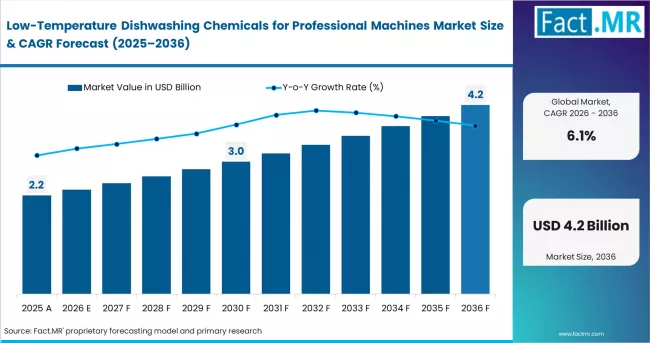
Low Temperature Dishwashing Chemicals For Professional Machines Market Market Value Analysis | Source: Fact.MR
| Metric | Value |
|---|---|
| Estimated Value in 2026 | USD 2.2 billion |
| Forecast Value in 2036 | USD 4.0 billion |
| Forecast CAGR (2026 to 2036) | 6.1% |
Source: Fact.MR analysis. Updated May 13, 2026
Summary of Low-Temperature Dishwashing Chemicals for Professional Machines Market
- Market Definition
- The market includes detergents, sanitizers, rinse aids, and support chemistries used in professional low-temperature dish machines that sanitize through chemical action rather than heat.
- Demand Drivers
- Low-temperature professional dishwashing depends on chemical sanitizing, which makes chemistry selection and dosing central to machine performance.
- Suppliers increasingly position warewashing around water and energy savings, supporting demand for chemistry that performs under lower-temperature wash conditions.
- Automatic dosing and closed-system chemical supply are common in professional warewashing, strengthening recurring demand for machine chemicals rather than ad hoc detergent buying.
- Key Segments Analyzed
- By Product Type: Low-temperature machine detergents are estimated to lead with approximately 34% share in 2026, supported by recurring base-cycle use across every wash program.
- By Machine Type: Undercounter machines are expected to hold approximately 31% share in 2026, driven by dense use across independent restaurants, cafés, and smaller kitchens.
- By End Use Setting: Restaurants are projected to account for approximately 33% share in 2026, supported by strong installed-base logic and high wash frequency.
- By Geography: India leads growth at 7.4% CAGR through 2036, supported by organized foodservice expansion.
- These share values are model-based estimates rather than figures directly published in the cited sources.
- Analyst Opinion at FACT.MR
- Shambhu Nath Jha, Senior Analyst at Fact.MR, opines, “CXOs should read this market as a performance-and-efficiency chemistry category rather than a basic detergent segment. Buyers are not only paying for wash chemistry. They are paying for sanitizing confidence, lower heat dependence, and repeatable machine results.”
- This is a modeled analyst view, not a quoted external statement.
- Strategic Implications
- Invest in chemistry systems that maintain sanitizing reliability and drying quality under reduced thermal dependence.
- Build technical sales capability around dosing precision, sanitizing efficacy, and energy-saving compatibility rather than detergent strength alone.
- Position integrated detergent-rinse aid-sanitizer programs where operators want predictable results with lower labor intervention.
- These implications are inferred from the cited warewashing and dosing materials.
The market is projected to generate USD 1.8 billion in absolute opportunity between 2026 and 2036. Growth is being supported by broader professional warewashing adoption across restaurants, hospitality, healthcare, and institutional kitchens, along with rising interest in lower-energy wash programs. Ecolab states that warewashing solutions are increasingly positioned around saving water and energy without sacrificing cleaning results, while MEIKO also highlights energy savings as a key commercial dishwashing priority. These market values are model-based estimates built from current professional warewashing usage patterns and recurring chemical dependence rather than from a published market-size source table. [2]
India is projected to lead with a CAGR of 7.4% through 2036, driven by organized foodservice expansion and rising machine-warewashing adoption. China follows at 6.9%, supported by broader hospitality and chain restaurant growth. The United States is expected to grow at 6.3%, underpinned by mature commercial warewashing penetration and strong service-chemistry contracts. Brazil records 5.9%, backed by foodservice formalization. Mexico grows at 5.6%, supported by restaurant and hotel kitchen standardization. Canada records 5.3%, shaped by institutional foodservice demand and mature jan-san distribution. These country rates are model-based estimates built from current professional dishwashing adoption, foodservice formalization, and chemical-program logic rather than from a published country-by-country source table. [3]
Segmental Analysis
Low-Temperature Dishwashing Chemicals for Professional Machines Market Analysis by Product Type
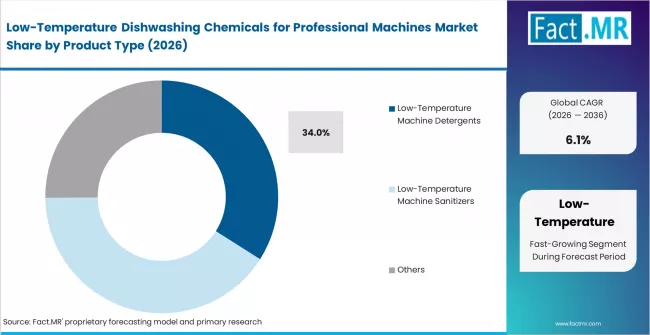
Low Temperature Dishwashing Chemicals For Professional Machines Market Analysis By Product Type | Source: Fact.MR
Low-temperature machine detergents are estimated to hold 34% share in 2026. They lead because every low-temp professional cycle still requires base wash chemistry, while sanitizer and rinse-aid demand layers on top of that detergent foundation. Low-temp machine sanitizers remain highly relevant because chemical-sanitizing systems depend on them for hygiene compliance, and sanitizer labels show that these products are specifically formulated for automatic dispensing in low-temperature dish machine solutions. Rinse aids also remain commercially important because professional warewashing relies on them for spotting control and drying quality, particularly where lower heat reduces thermal drying assistance [5].
- Detergent leadership comes from base-cycle use in every machine wash.
- Sanitizer demand remains essential because low-temp systems sanitize chemically, not thermally.
- Rinse aids stay important where lower-temperature cycles still need drying support and residue control.
Low-Temperature Dishwashing Chemicals for Professional Machines Market Analysis by Machine Type
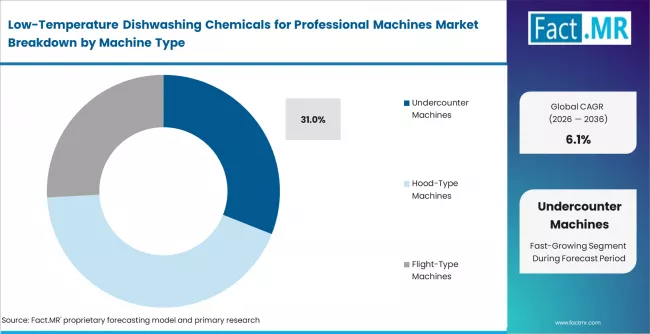
Low Temperature Dishwashing Chemicals For Professional Machines Market Analysis By Machine Type | Source: Fact.MR
Based on Fact.MR’s analysis, undercounter machines are expected to hold approximately 31% share in 2026. This segment leads because smaller professional kitchens, cafés, bars, and independent restaurants commonly rely on compact warewashing machines and still require low-temp chemistry programs with automatic dosing. Hood-type machines remain relevant in mid-sized foodservice settings, while conveyor and flight-type systems matter more in larger institutional or hospitality kitchens with heavier volume. These machine-type shares are model-based estimates built from professional kitchen format logic and warewashing usage patterns.
- Undercounter systems lead because outlet count is high in smaller commercial kitchens.
- Hood-type machines remain important where throughput is higher but footprint still matters.
- Conveyor and flight systems remain attractive in institutional and hotel kitchens where chemistry use per site is heavier.
Low-Temperature Dishwashing Chemicals for Professional Machines Market Analysis by End Use Setting
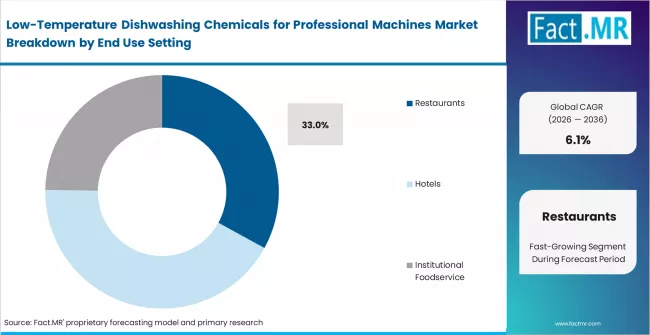
Low Temperature Dishwashing Chemicals For Professional Machines Market Analysis By End Use Setting | Source: Fact.MR
Restaurants are projected to account for approximately 33% share in 2026. They lead because the restaurant segment forms the largest visible end-user base in commercial warewashing demand, with stronger machine frequency and repeat chemical use than many other foodservice settings. Hotels, healthcare foodservice, and education kitchens remain highly relevant, though restaurant density and wash frequency create the broadest chemical demand base. These end-use shares are model-based estimates built from installed-machine logic rather than a published end-use table.
- Restaurants lead because they create the broadest recurring machine-chemical demand base.
- Hotels remain important where in-house foodservice and banquet operations increase wash intensity.
- Healthcare and education kitchens create steady demand where compliance and uptime matter as much as cleaning performance.
Drivers, Restraints, and Opportunities
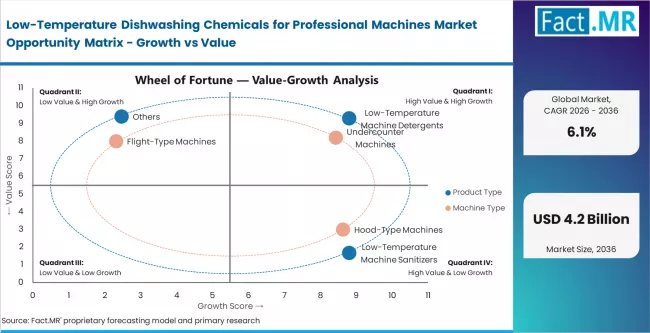
Low Temperature Dishwashing Chemicals For Professional Machines Market Opportunity Matrix Growth Vs Value | Source: Fact.MR
Fact.MR analysts observe that the market is being shaped by the need to maintain sanitizing and cleaning performance without depending on higher wash heat. Structural demand is anchored in the fact that low-temperature professional machines sanitize chemically, making chemistry quality and concentration mission-critical rather than optional. That gives low-temp chemical systems a strong recurring role in professional kitchens even when equipment replacement cycles slow.
The main restraint is performance sensitivity to dosing and operating conditions. The EU professional dishwasher study notes that insufficient detergent and rinse aid can produce unacceptable results and repeat washing, while incorrect dosing can leave residue. Because low-temp systems rely more heavily on chemistry than on thermal sanitizing force, inconsistent dosing, empty chemical containers, or untrained personnel can undermine performance faster than in heat-dominant systems.
- Energy-compatible chemistry remains the clearest opportunity where operators want lower-energy dishwashing without sacrificing hygiene.
- Products that combine reliable low-temp sanitizing with automatic dosing support offer stronger value than stand-alone detergents.
- Higher-value opportunity sits in programs sold with dosing setup, training, and machine support rather than in commodity chemical supply.
Regional Analysis
The market is assessed across North America, Europe, Asia Pacific, Latin America, and Middle East and Africa, covering 40+ countries with demand profiles shaped by organized foodservice growth, professional warewashing penetration, automatic-dosing adoption, and preference for lower-energy machine programs. The country growth rates below are model-based estimates.
.webp "Top Country Growth Comparison Low Temperature Dishwashing Chemicals For Professional Machines Market Cagr (2026 2036)")
Top Country Growth Comparison Low Temperature Dishwashing Chemicals For Professional Machines Market Cagr (2026 2036) | Source: Fact.MR
| Country | CAGR (2026 to 2036) |
|---|---|
| India | 7.4% |
| China | 6.9% |
| United States | 6.3% |
| Brazil | 5.9% |
| Mexico | 5.6% |
Source: Fact.MR analysis. Updated May 13, 2026
North America Low-Temperature Dishwashing Chemicals for Professional Machines Market Analysis
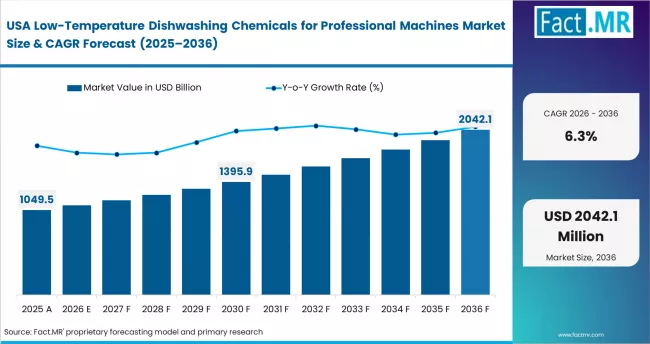
Low Temperature Dishwashing Chemicals For Professional Machines Market Country Value Analysis | Source: Fact.MR
North America remains an important commercial region because it combines strong commercial warewashing penetration, recurring foodservice hygiene demand, and mature supplier-led chemical programs. The region also benefits from established service-and-dosing relationships that reduce misdosing risk and support recurring chemical sales. Demand is strongest where operators already run professional machine warewashing as a managed chemical program instead of ad hoc detergent purchasing.
- United States: Mature professional warewashing use and strong service-chemistry contracts support U.S. demand. The market in the United States is projected to expand at a CAGR of 6.3% through 2036.
- Mexico: Restaurant and hotel-kitchen formalization create practical commercial fit. Sales in Mexico are likely to rise at 5.6% CAGR during the forecast period.
These country rates are model-based estimates.
Asia Pacific and Latin America Low-Temperature Dishwashing Chemicals for Professional Machines Market Analysis
Asia Pacific and Latin America offer the strongest long-term expansion potential because organized foodservice density, chain restaurant growth, and professional kitchen formalization are rising across major urban markets. Demand is likely to strengthen where operators move from manual warewashing and unmanaged chemistry use toward automatic-dosing machine programs that reduce labor and improve consistency. These regional growth views are model-based estimates built from foodservice formalization and professional warewashing expansion.
- India: Organized foodservice expansion and rising machine-adoption momentum continue to support demand across India. The market is projected to grow at a CAGR of 7.4% through 2036, driven by rapid growth of QSR chains, cloud kitchens, and centralized food preparation models. Operators are increasingly investing in equipment to improve efficiency, consistency, and hygiene in high-volume kitchen environments.
- Brazil: Foodservice formalization and higher levels of commercial kitchen standardization support growth in Brazil. Demand is expected to rise at a CAGR of 5.9% through 2036, as restaurant chains and institutional kitchens adopt more structured operations. Adoption is particularly visible in urban markets where consistency, compliance, and operational efficiency are becoming more important.
- China: Chain restaurant expansion and ongoing professional kitchen modernization continue to support demand across China. The market is projected to grow at a CAGR of 6.9% through 2036, driven by scaling foodservice networks and increasing focus on standardized kitchen processes. Adoption is rising across both domestic chains and institutional catering operations.
Competitive Aligners for Market Players
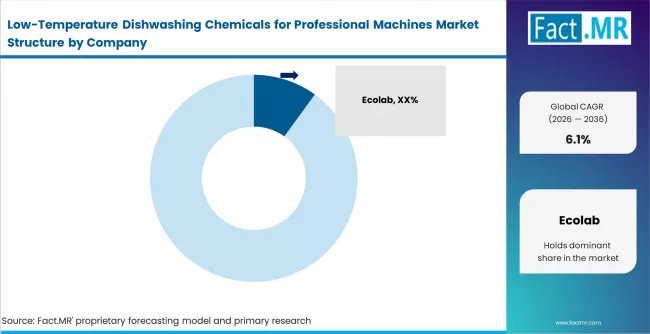
Low Temperature Dishwashing Chemicals For Professional Machines Market Analysis By Company | Source: Fact.MR
The market is moderately concentrated at the branded chemistry and service-program level, while local distribution remains fragmented. Competitive strength comes from the ability to connect chemistry with measurable machine performance, sanitizing confidence, and lower-energy operation. Suppliers need more than a detergent claim. They need a clear explanation of how their detergent, sanitizer, and rinse-aid system performs together under low-temp chemical-sanitizing conditions.
Competitive advantage is defined by dosing stability, chemical-system integration, sanitizing reliability, and fit with managed service models. Suppliers with visible machine-warewashing programs and rinse-aid offerings have an edge where operators want fewer performance failures and tighter usage control. This competitive framing is an analytical view derived from current supplier positioning rather than a published market-share table.
Key Players
- Ecolab
- Solenis
- Diversey
- Zep
- Spartan Chemical
- P&G Professional
- SC Johnson Professional
- Stepan
- Reckitt Professional
- Unilever Professional
Bibliography
- [1] Ecolab. Food Safety Best Practices: Warewashing.
- [2] Ecolab. Machine Warewashing.
- [3] MEIKO. Commercial Dishwashing and Energy Savings.
- [4] 10% Low Temp Dish Machine Sanitizer product label.
- [5] EU Preparatory Study and Impact Assessment support study on professional dishwashers, 2024.
Low-Temperature Dishwashing Chemicals for Professional Machines Market Definition
The market covers cleaning and sanitizing chemistries formulated for use in professional low-temperature dishwashing machines that sanitize through chemical action instead of high final-rinse heat. It includes machine detergents, rinse aids, sanitizers, and related support chemistries used in commercial warewashing systems across foodservice, hospitality, and institutional kitchens. [1]
Low-Temperature Dishwashing Chemicals for Professional Machines Market Inclusions
Covers global and regional forecasts from 2026 to 2036. Includes chlorine-based and other low-temperature machine sanitizers, low-temp detergents, rinse aids, delimers, and integrated chemical warewashing programs delivered through automatic dosing systems. Covers products positioned to maintain cleaning performance, sanitizing compliance, spotting control, and machine efficiency under lower wash temperatures.
Low-Temperature Dishwashing Chemicals for Professional Machines Market Exclusions
Excludes high-temperature machine detergents sold only for heat-sanitizing programs, hand dishwashing liquids, consumer dishwasher tablets, and manual three-compartment-sink sanitizers outside professional machine warewashing. It also excludes dishwashing equipment itself unless the chemical program remains the core commercial offer.
Low-Temperature Dishwashing Chemicals for Professional Machines Market Research Methodology
- Primary Research:Interviews with warewashing chemical distributors, commercial kitchen service partners, jan-san channel managers, hospitality procurement teams, and institutional foodservice operators.
- Desk Research:Uses current supplier guidance on machine warewashing, low-temperature sanitizing labels, professional dishwasher studies, and energy-efficiency materials tied to professional warewashing operations. [4]
- Market-Sizing and Forecasting:Hybrid model using professional machine installed-base logic, low-temp chemical dependence, organized foodservice growth, recurring dosing demand, and service-contract penetration.
- Data Validation and Update Cycle:Validated using professional warewashing guidance, low-temp sanitizer labels, and current studies on professional dishwasher operation, detergent dosing, and energy-saving machine use.
Segmentation
Scope of Report
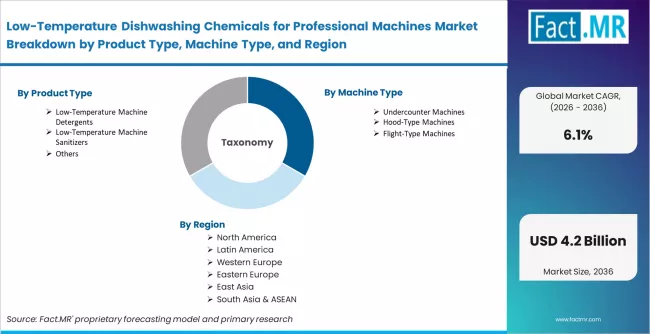
Low Temperature Dishwashing Chemicals For Professional Machines Market Breakdown By Product Type, Machine Type, And Region | Source: Fact.MR
| Attribute | Details |
|---|---|
| Quantitative Units | USD 2.2 billion (2026) to USD 4.0 billion (2036), at a CAGR of 6.1% |
| Market Definition | Cleaning and sanitizing chemistries formulated for professional low-temperature dishwashing machines that sanitize through chemical action rather than high-heat final rinses |
| Product Type Segmentation | Low-Temperature Machine Detergents, Low-Temperature Rinse Aids, Low-Temperature Machine Sanitizers, Delimers and Descalers for Low-Temp Programs, Multi-Component Warewashing Chemical Systems, Others |
| Machine Type Segmentation | Undercounter Machines, Hood-Type Machines, Rack Conveyor Machines, Flight-Type Machines, Others |
| End Use Segmentation | Restaurants, Hotels, Institutional Foodservice, Healthcare Foodservice, Education Foodservice, Others |
| Regions Covered | North America, Europe, Asia Pacific, Latin America, Middle East and Africa |
| Countries Covered | United States, Canada, Mexico, Germany, France, Spain, Italy, India, China, Brazil, and 40+ countries |
| Forecast Period | 2026 to 2036 |
| Approach | Hybrid top-down and bottom-up model using installed machine logic, chemical-sanitizing dependence, organized foodservice growth, and primary interviews with operators, distributors, and sanitation advisors |
Source: Fact.MR analysis. Updated May 13, 2026
Low-Temperature Dishwashing Chemicals for Professional Machines Market by Segments
-
By Product Type:
- Low-Temperature Machine Detergents
- Low-Temperature Rinse Aids
- Low-Temperature Machine Sanitizers
- Delimers and Descalers for Low-Temp Programs
- Multi-Component Warewashing Chemical Systems
- Others
-
By Machine Type:
- Undercounter Machines
- Hood-Type Machines
- Rack Conveyor Machines
- Flight-Type Machines
- Others
-
By End Use Setting:
- Restaurants
- Hotels
- Institutional Foodservice
- Healthcare Foodservice
- Education Foodservice
- Others
-
By Region:
- North America
- United States
- Canada
- Mexico
- Latin America
- Brazil
- Argentina
- Chile
- Rest of Latin America
- Western Europe
- Germany
- France
- United Kingdom
- Italy
- Spain
- Nordic Countries
- BENELUX
- Rest of Western Europe
- Eastern Europe
- Russia
- Poland
- Hungary
- Balkan and Baltic
- Rest of Eastern Europe
- East Asia
- China
- Japan
- South Korea
- South Asia and Pacific
- India
- ASEAN
- Australia and New Zealand
- Rest of South Asia and Pacific
- Middle East and Africa
- Kingdom of Saudi Arabia
- Other GCC Countries
- Turkey
- South Africa
- Rest of Middle East and Africa
- North America
Frequently Asked Questions
How large is the global low-temperature dishwashing chemicals for professional machines market in 2025?
What will the market size be in 2026?
What is the projected market size by 2036?
What is the expected CAGR from 2026 to 2036?
Which product type is poised to lead the market?
Which machine type holds the largest share?
Which end-use setting is expected to remain strongest?
Which country shows the fastest growth?
What is driving demand for low-temperature dishwashing chemicals?
What is the key challenge in this market?
Who worked on this report


Preview the report firsthand - request a free sample
Free SampleGet the brochure for pricing and purchase details
Download PDF