- Market Value (2025): USD 70.0 Mn
- Estimated Value (2026): USD 76.1 Mn
- Forecast Value (2036): USD 175.3 Mn
- CAGR (2026-2036): 8.7%
What is the magnetic field-responsive polymers market forecast to be worth by 2036?
USD 76.1 million in 2026 to USD 175.3 million by 2036, at 8.7% CAGR.
- The magnetic field-responsive polymers market crossed a valuation of USD 70.0 million in 2025, influenced by stimuli-responsive material research and magnetic particle workflows.
- Demand is projected to increase from USD 76.1 million in 2026 to USD 175.3 million by 2036.
- Industry is forecast to record 8.7% CAGR from 2026 to 2036 as life-science processors and electronics teams qualify field-controlled polymer systems.
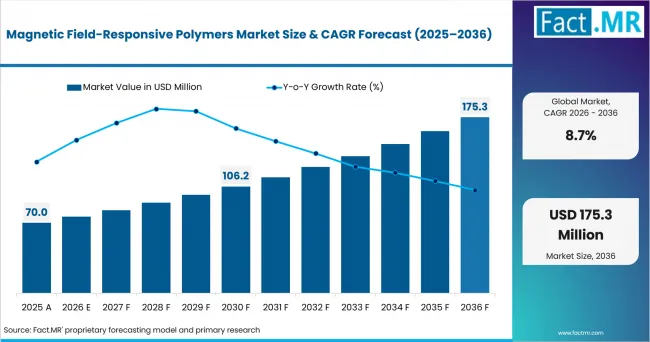
Magnetic Field Responsive Polymers Market Market Value Analysis | Source: Fact.MR
What are the defining numbers behind magnetic field-responsive polymers market growth?
USD 99.2 million absolute opportunity by 2036, led by magnetorheological elastomers, actuator applications, elastomer forms, and automotive end use.
- Demand drivers in the market
- Material developers depend on simulation-led formulation support as magnetic response changes after particle loading and polymer curing.
- Life-science processors use controlled bead handling for separation steps across closed sample and cell-processing workflows.
- Electronics engineers need compact response materials for vibration control and soft-motion functions.
- Manufacturing teams require workflow automation supported by repeatable field-response records and validation-ready data.
- Segments analyzed
- By Type: Magnetorheological elastomers are expected to account for 38% share in 2026, led by field-responsive stiffness and vibration-control uses.
- By Application: Actuators are projected to hold 31% share in 2026, driven by controlled motion and compact device response.
- By Form: Elastomer is anticipated to capture 47% share in 2026, owing to flexible polymer structures and field-responsive deformation.
- By End Use: Automotive is estimated to represent 29% share in 2026, shaped by vibration control, haptics, and compact actuation programs.
- Analyst opinion at Fact.MR
- Shambhu Nath Jha, Principal Consultant at Fact.MR, states, “Magnetic field-responsive polymer adoption is moving through a qualification bottleneck between laboratory response and production repeatability. Adoption is expected to favor providers able to connect particle chemistry and workflow evidence inside one validation record. Supplier advantage comes from bead uniformity and practical support for life-science and device teams.”
- Strategic implications
- Polymer formulators are likely to document iron oxide loading and actuation response before scale-up discussions.
- Software vendors are expected to connect material models to test records instead of offering stand-alone design dashboards.
- Life-science processors are anticipated to compare bead release timing and viability before changing magnetic handling workflows.
- Electronics teams are projected to test fatigue response and electromagnetic compatibility before moving polymer actuators into compact devices.
Thermo Fisher Scientific detailed CTS Detachable Dynabeads CD4 and CD8 beads in March 2025, describing 4.5 micron paramagnetic polystyrene beads for efficient human T-cell isolation or depletion. Product evidence reflects a wider shift toward magnetic polymer structures used inside controlled cell-processing workflows.
India is projected to record 10.5% CAGR through 2036, driven by patent filing depth and applied polymer commercialization. China is expected to post 9.8% CAGR by 2036, supported by high-tech manufacturing and equipment activity. Australia is anticipated to advance at 8.5% CAGR between 2026 and 2036 as innovation-active firms use applied research workflows. United Kingdom is estimated to hold 8.2% CAGR from 2026 to 2036 since SME depth supports science-led enterprise services. United States is forecast to record 8.0% CAGR during the study period, reinforced by polymer analytics funding and advanced manufacturing programs. Germany is projected to post 7.7% CAGR during the forecast period, owing to cloud-enabled industrial testing and material engineering depth. Japan is expected to register 7.4% CAGR by 2036, led by automation workflows and compact device programs.
How does the magnetic field-responsive polymers market break down by segment?
Elastomer is estimated to lead at 47%, and magnetorheological elastomers are expected to dominate at 38%.
What is likely to lead the type segment?
Magnetorheological elastomers are anticipated to hold 38% share in 2026.
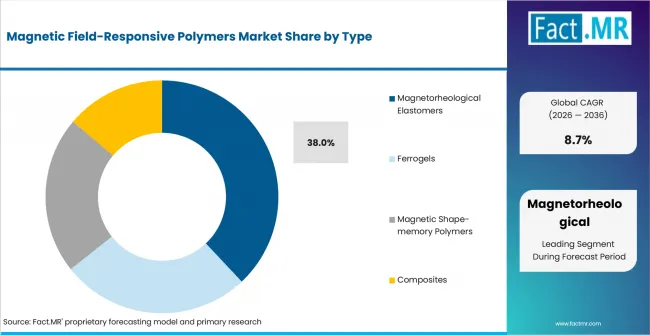
Magnetic Field Responsive Polymers Market Analysis By Type | Source: Fact.MR
Magnetorheological elastomers are expected to account for 38% share in 2026, backed by tunable stiffness and vibration-control behavior. Ferrogels follow through soft material response and biomedical research uses. Magnetic shape-memory polymers and composites influence controlled deformation and field-responsive material design. International Federation of Robotics reported in September 2025 noting 542,000 industrial robots were installed in 2024, reflecting automation settings using sensing and field-responsive components.
What is anticipated to dominate the application segment?
Actuators are expected to garner 31% share in 2026.
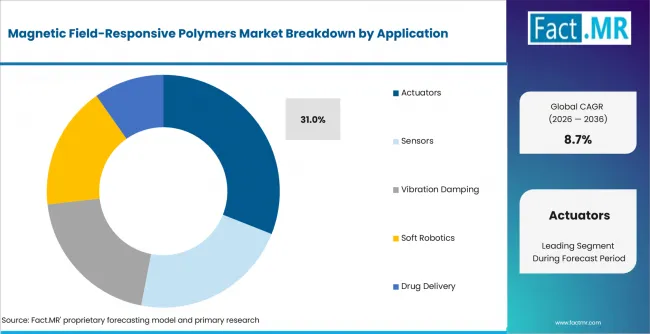
Magnetic Field Responsive Polymers Market Analysis By Application | Source: Fact.MR
Actuators are projected to hold 31% share in 2026, driven by controlled motion and compact device response. Sensors follow through field-linked detection and movement feedback. Vibration damping and drug delivery applications support use cases needing magnetic control and repeatable material movement. National Institute of Standards and Technology reported in August 2024 stating 17 Manufacturing USA institutes were included in its strategic plan, highlighting validation networks for complex manufacturing systems.
What is likely to support elastomer within form?
Elastomer is set to account for 47% share in 2026.
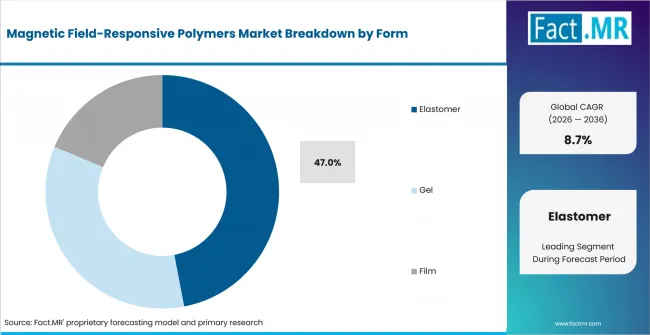
Magnetic Field Responsive Polymers Market Analysis By Form | Source: Fact.MR
Elastomer is anticipated to capture 47% share in 2026, owing to flexible polymer structures and field-responsive deformation. Gel follows through soft material and biomedical handling needs. Film supports compact response layers used in sensors, electronics, and device formats. U.S. National Science Foundation announced in May 2024 a USD 9.5 million sustainable polymer research funding opportunity focused partly on data analytics for polymer discovery and manufacture, showcasing institutional support for polymer design and validation.
How is end use predicted to shape demand?
Automotive is forecast to secure 29% share in 2026.
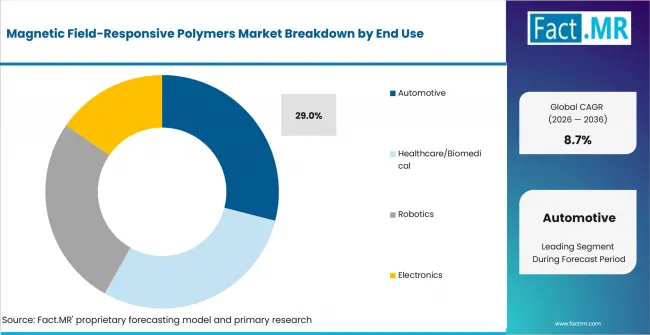
Magnetic Field Responsive Polymers Market Analysis By End Use | Source: Fact.MR
Automotive is estimated to represent 29% share in 2026, shaped by vibration control and compact actuation programs. Healthcare/biomedical follows through magnetic bead workflows and controlled material handling. Robotics and electronics support field-responsive motion and miniaturized device programs. International Energy Agency reported in 2026 stating electric car sales exceeded 20 million in 2025, reaching 25% share of global car sales, reflecting demand for sensor-rich vehicle platforms.
What is accelerating magnetic field-responsive polymers market adoption, and what is holding it back?
Validation-led material design drives it; scale-up proof burden restrains it.
Drivers impact analysis
| DRIVER | (~) % IMPACT ON CAGR | GEOGRAPHIC SCOPE | IMPACT TIMELINE |
|---|---|---|---|
| Software-led material validation | +1.0% | North America, Europe, East Asia | Medium term (2-4 years) |
| Magnetic bead workflows in life science | +0.8% | United States, Germany, Japan | Short term (<= 2 years) |
| Automation and soft robotics testing | +0.7% | China, Japan, Europe | Medium term (2-4 years) |
| Electronics miniaturization and sensing | +0.5% | China, United States, Japan | Long term (>= 4 years) |
| EV lightweighting and vibration control | +0.4% | China, India, Europe | Long term (>= 4 years) |
Source: Fact.MR analysis. Updated Jul 13, 2026
- Software-led material validation: Material teams are rebuilding test programs around field-response records and traceable trial data. Software is expected to gain share as qualification moves beyond single-sample demonstrations. In May 2024, the U.S. National Science Foundation announced USD 9.5 million for sustainable polymer research using polymer discovery and manufacturing inputs.
- Magnetic bead workflows in life science: Cell therapy and assay workflows use magnetic particles for activation and release. In March 2025, Thermo Fisher Scientific stated CTS Detachable Dynabeads CD4 and CD8 products use 4.5 micron paramagnetic polystyrene beads. Adoption is projected to rise as processors seek controlled bead removal and closed workflow compatibility.
- Automation and soft robotics testing: Manufacturing teams need materials able to respond to external fields without complex mechanical assemblies. In September 2025, the International Federation of Robotics reported 4,664,000 industrial robots in operational use worldwide during 2024. Demand is anticipated to expand across micro-positioning and vibration-control prototypes.
- Electronics miniaturization and sensing: Electronics firms need small materials able to combine motion and packaging functions. In February 2026, the Semiconductor Industry Association reported global semiconductor sales of USD 791.7 billion in 2025, up 25.6% from 2024. Magnetic polymer suppliers are expected to benefit from test demand around compact components.
- EV lightweighting and vibration control: Automotive engineers are testing lighter responsive polymer systems for haptic feedback and compact actuation. In 2026, the International Energy Agency reported electric car sales exceeded 20 million in 2025, reaching 25% share of global car sales. Material adoption is forecast to advance as vehicle programs add sensors and comfort features.
Opportunity impact analysis
| OPPORTUNITY | (~) % IMPACT ON CAGR | GEOGRAPHIC SCOPE | IMPACT TIMELINE |
|---|---|---|---|
| Magnetic separation materials for cell processing | +0.6% | United States, Europe, Japan | Short term (<= 2 years) |
| Cloud-based design records | +0.5% | Europe, Australia, United Kingdom | Medium term (2-4 years) |
| Paramagnetic particle customization | +0.4% | Germany, United States, China | Medium term (2-4 years) |
| Soft actuator modules for robotics | +0.3% | Japan, China, India | Long term (>= 4 years) |
Source: Fact.MR analysis. Updated Jul 13, 2026
- Magnetic separation materials: Life-science workflows offer a practical route for polymer-based magnetic particles. In 2025, Thermo Fisher Scientific evaluated CTS Detachable Dynabeads CD3/CD28 magnetic beads at 1:1, 3:1, and 5:1 bead-to-cell ratios. Suppliers are projected to gain account access through purity and release-timing evidence.
- Cloud-based design records: Cloud deployment supports shared modeling and enterprise approvals. In January 2026, Eurostat reported paid cloud use among European Union enterprises rose by 7.42 percentage points between 2023 and 2025. Software providers are expected to package magnetic polymer models with workflow records.
- Paramagnetic particle customization: Custom particle design helps material teams tune size and iron oxide loading. In 2026, microParticles GmbH listed paramagnetic spheres with a size range from 300 nm to 375 microns and iron oxide content adjustable up to 50 wt.-%. Supplier opportunity is anticipated around controlled separation and assay design.
- Soft actuator modules: Robotics teams need compact materials for motion without large motors or fluid lines. In September 2025, the International Federation of Robotics reported Asia accounted for 74% of new industrial robot deployments during 2024. Magnetic polymer developers are forecast to target microfluidic valves and adaptive device components.
Restraints impact analysis
| RESTRAINT | (~) % IMPACT ON CAGR | GEOGRAPHIC SCOPE | IMPACT TIMELINE |
|---|---|---|---|
| Scale-up proof burden | -0.7% | Global | Medium term (2-4 years) |
| Particle dispersion inconsistency | -0.5% | Global | Short term (<= 2 years) |
| Regulated workflow documentation | -0.4% | United States, Europe, Japan | Medium term (2-4 years) |
| Cost pressure in specialist SMEs | -0.3% | India, United Kingdom, Australia | Long term (>= 4 years) |
Source: Fact.MR analysis. Updated Jul 13, 2026
- Scale-up proof burden: Laboratory response often changes after magnetic particles move into thicker polymers or larger batches. Qualification is expected to slow unless suppliers provide repeatable field-response curves and processing records. In 2025, the National Nanotechnology Coordination Office reported over USD 900 million in annual NIH nanotechnology health investments for FY 2025, raising proof expectations in biomedical uses.
- Particle dispersion inconsistency: Magnetic fillers often aggregate, changing actuation strength and separation response. Material teams need tighter control over size distribution and surface chemistry before production approval. In 2026, micromod Partikeltechnologie described PLA-M particles containing magnetite at 40% w/w in a poly lactic acid matrix, underscoring composition control needs.
- Regulated workflow documentation: Cell therapy and diagnostic accounts need batch records, traceability, and controlled release evidence. In September 2025, Bangs Laboratories listed ISO 13485:2016 current registration for microsphere manufacture and distribution. Adoption is anticipated to remain selective for providers lacking documentation packages across instrument and process steps.
- Cost pressure in specialist SMEs: Small developers often carry testing cost before any large account approves material change. In June 2026, the Australian Bureau of Statistics reported 59% of businesses faced supply-chain disruptions in 2024-25. Qualification delays are estimated to keep some programs in pilot stage.
What countries are scaling magnetic field-responsive polymers market by CAGR?
India 10.5%, China 9.8%, Australia 8.5%, United Kingdom 8.2%, United States 8.0%.
Regional analysis covers North America, Latin America, Europe, East Asia, South Asia and Pacific, and Middle East and Africa.
.webp "Top Country Growth Comparison Magnetic Field Responsive Polymers Market Cagr (2026 2036)")
Top Country Growth Comparison Magnetic Field Responsive Polymers Market Cagr (2026 2036) | Source: Fact.MR
| COUNTRY | CAGR |
|---|---|
| India | 10.5% |
| China | 9.8% |
| Australia | 8.5% |
| United Kingdom | 8.2% |
| United States | 8.0% |
Source: Fact.MR analysis. Updated Jul 13, 2026
What is driving India’s growth through 2036?
10.5% CAGR by 2036, driven by IP filings and applied polymer research.
India’s innovation base is moving toward patent-led commercialization in materials and analytical tools. In July 2025, the Press Information Bureau reported IP filings rose 44% over five years to 6,89,991 in 2024-25. Market in India is projected to record 10.5% CAGR between 2026 and 2036 as domestic labs convert polymer and device research into protected product concepts.
How is China scaling magnetic field-responsive polymers demand?
9.8% CAGR through 2036, supported by high-tech manufacturing and equipment programs.
China offers demand pull from electronics, automation, and applied manufacturing programs. In February 2026, the National Bureau of Statistics reported high-tech manufacturing value added rose 9.4% in 2025 and accounted for 17.1% of industrial value added above designated size. Market demand is expected to post 9.8% CAGR by 2036 since device makers test responsive polymers for sensing and compact motion.
What supports the Australia outlook?
8.5% CAGR from 2026 to 2036, shaped by innovation-active businesses and applied research workflows.
Australia’s demand is supported by applied research users and smaller technology firms seeking testable material platforms. In June 2026, the Australian Bureau of Statistics reported 46% of businesses were innovation-active in 2024-25. Sector in Australia is anticipated to grow at 8.5% CAGR during the study period, led by polymer programs using software tools to shorten test cycles.
What underpins United Kingdom growth?
8.2% CAGR between 2026 and 2036, driven by SME depth and science-led enterprise services.
United Kingdom adoption is shaped by specialist SMEs, contract labs, and software-supported material validation teams. In June 2026, the UK Innovation Survey reported internal R&D used 48% of innovation expenditure in 2024. Demand in the United Kingdom is estimated to hold 8.2% CAGR during the forecast period, due to smaller service teams adopting validation tools for polymer and diagnostic workflows.
How is United States demand developing?
8.0% CAGR during the forecast period, reinforced by polymer analytics and manufacturing validation programs.
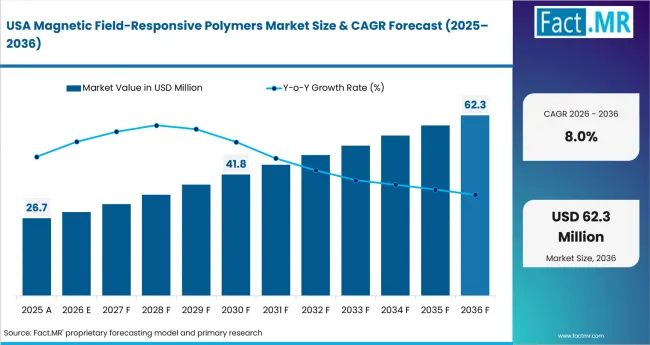
Magnetic Field Responsive Polymers Market Country Value Analysis | Source: Fact.MR
United States demand reflects advanced manufacturing, biomedical processing, and software-led material discovery. In May 2024, the U.S. National Science Foundation announced a USD 9.5 million SPEED funding opportunity with industry partners for polymer discovery and manufacture. Industry in the United States is forecast to record 8.0% CAGR by 2036, reflected by validation-heavy programs moving toward scale-up.
What shapes Germany’s position?
7.7% CAGR by 2036, supported by cloud-enabled industrial testing and material engineering depth.
Germany’s material base benefits from polymer engineering and enterprise cloud use. In 2026, the Federal Statistical Office of Germany reported 54% of enterprises used cloud computing services. Sales in Germany are projected to post 7.7% CAGR through 2036 as technical users connect simulation records and material qualification workflows.
How is Japan developing demand?
7.4% CAGR during the study period, driven by automation and compact device programs.
Japan’s demand is linked to automation, miniaturized devices, and high-control production systems. In August 2025, the Ministry of Economy, Trade and Industry reported Japan’s B-to-B e-commerce ratio reached 43.1% in FY 2024, up 3.1 percentage points year over year. Market in Japan is expected to register 7.4% CAGR by 2036, backed by connected ordering and engineering workflows influencing material trials.
Who leads the magnetic field-responsive polymers market?
Thermo Fisher Scientific and Merck KGaA lead direct magnetic bead coverage, and micromod strengthens specialist particle engineering.
Thermo Fisher Scientific serves cell isolation and closed cell therapy workflows through Dynabeads magnetic bead platforms. Merck KGaA, through Millipore and Sigma-Aldrich product lines, offers immunomagnetic beads with a 1.3 micron diameter along with a magnetic core and a thin polystyrene shell. In 2025, Merck KGaA product documentation identified immunomagnetic beads for immunoassay and protein purification.
micromod Partikeltechnologie strengthens specialist supply based on magnetic nano- and microparticles for life-science applications. Bangs Laboratories offers magnetic microspheres and related products under current ISO 13485:2016 registration dated September 2025. microParticles GmbH adds paramagnetic sphere customization across defined size ranges and iron oxide loading. Competitive positioning through 2036 is expected to be shaped by particle uniformity and application support.
What companies are the providers?
Thermo Fisher Scientific and Merck KGaA are providers. micromod and Bangs Laboratories are also profiled. microParticles GmbH completes the company set.
- Thermo Fisher Scientific
- Merck KGaA
- micromod Partikeltechnologie GmbH
- Bangs Laboratories, Inc.
- microParticles GmbH
Bibliography
- Australian Bureau of Statistics. (2026, June 25). Characteristics of Australian Business. Australian Bureau of Statistics.
- Bangs Laboratories, Inc. (2025, September 24). Quality. Bangs Laboratories, Inc.
- Department for Business and Trade. (2026, June 4). UK innovation survey 2025: Report. Department for Business and Trade.
- Department for Business and Trade. (2025, October 2). Business population estimates for the UK and regions 2025: Statistical release. Department for Business and Trade.
- Eurostat. (2026, January 13). Cloud computing - statistics on the use by enterprises. Eurostat.
- Federal Statistical Office of Germany. (2026). ICT in enterprises, ICT sector. Federal Statistical Office of Germany.
- International Energy Agency. (2026). Trends in electric cars: Global EV Outlook 2026. International Energy Agency.
- International Federation of Robotics. (2025, September 25). World Robotics 2025 report: Industrial robots. International Federation of Robotics.
- Merck KGaA. (2025). Immunomagnetic beads. Merck KGaA.
- microParticles GmbH. (2026). Paramagnetic spheres. microParticles GmbH.
- micromod Partikeltechnologie GmbH. (2026). PLA-M particles. micromod Partikeltechnologie GmbH.
- Ministry of Economy, Trade and Industry. (2025, August 26). Results of FY2024 e-commerce market survey compiled. Ministry of Economy, Trade and Industry.
- National Bureau of Statistics of China. (2026, February 28). Statistical communiqué of the People’s Republic of China on the 2025 national economic and social development. National Bureau of Statistics of China.
- National Institute of Standards and Technology. (2024, August 1). Strategic Plan for the Manufacturing USA Program. National Institute of Standards and Technology.
- National Nanotechnology Coordination Office. (2025). The National Nanotechnology Initiative supplement to the President’s 2025 budget. National Nanotechnology Coordination Office.
- Press Information Bureau. (2025, July 22). India witnesses 44% surge in IP filings over five years. Press Information Bureau.
- Semiconductor Industry Association. (2026, February 6). Global annual semiconductor sales increase 25.6% to USD 791.7 billion in 2025. Semiconductor Industry Association.
- Thermo Fisher Scientific. (2025, March 13). Optimizing cell isolation for flexible and scalable cell therapy manufacturing. Thermo Fisher Scientific.
- Thermo Fisher Scientific. (2025). Optimization of CTS Detachable Dynabeads CD3/CD28. Thermo Fisher Scientific.
- U.S. National Science Foundation. (2024, May 2). NSF and industry partners announce sustainable polymer research funding opportunity. U.S. National Science Foundation.
This Report Addresses
- Report provides strategic intelligence on magnetic field-responsive polymers across type and application choices shaping validation-led material programs.
- Segment analysis covers elastomer and magnetorheological elastomers within the 2026 market structure.
- Regional outlook evaluates India, China, Australia, United Kingdom, United States, Germany, and Japan.
- Competitive analysis profiles Thermo Fisher Scientific and Merck KGaA alongside micromod, Bangs Laboratories, and microParticles GmbH.
- Type assessment covers magnetorheological elastomers and ferrogels across material response behavior.
- Application assessment covers actuators and sensors alongside vibration damping and drug delivery use cases.
- Form assessment covers elastomer and film across market taxonomy.
- Forecast evidence uses official statistics and verified company sources to interpret across market values and segment shares.
What does the magnetic field-responsive polymers market cover?
Magnetorheological elastomers, ferrogels, magnetic shape-memory polymers, and composites used for magnetic-field-controlled material response.
Magnetic field-responsive polymers market covers polymer systems and magnetic particle-filled materials used to control movement, separation, deformation, damping, or sensing under external magnetic fields. Coverage includes magnetorheological elastomers, ferrogels, magnetic shape-memory polymers, and composites across actuators, sensors, vibration damping, soft robotics, and drug delivery applications.
Market scope differs from general stimuli-responsive polymers by focusing on magnetic-field response instead of temperature, pH, moisture, or light response alone. Conventional magnetic particles are excluded unless embedded in polymer matrices or sold with polymer-based response functionality.
What is included in the scope?
Magnetic field-responsive polymer systems used in validation, controlled material response, and field-guided workflows.
Scope includes magnetorheological elastomers, ferrogels, magnetic shape-memory polymers, and composites in elastomer, gel, and film forms. Application coverage includes actuators, sensors, vibration damping, soft robotics, and drug delivery. End-use coverage includes automotive, healthcare/biomedical, robotics, and electronics. Material coverage includes magnetic polymer particles, magnetite-loaded polymer matrices, paramagnetic beads, polymer-coated magnetic beads, and magnetically responsive soft materials.
What is excluded from the scope?
Standalone magnetic powders and non-polymer magnetic inspection consumables are outside the scope.
Scope excludes dry magnetic particle inspection powders, metal-only magnetic particles, and conventional magnetic field equipment sold without polymer response functionality. Generic polymer software without magnetic response modeling is excluded. Plain assay reagents are excluded unless magnetic polymer beads or polymer-coated magnetic particles provide the purchased function.
How was the analysis built?
120+ sources, 40+ company portfolios, 25+ countries, 20+ interviews.
- Primary research:
- Primary research includes interviews with polymer formulators, magnetic particle suppliers, life-science workflow specialists, laboratory automation teams, and device engineers. Input also includes material validation teams, application scientists, supplier sales teams, and technical service managers involved in field-responsive polymer qualification.
- Desk research:
- Desk research reviews official manufacturing statistics, cloud adoption data, polymer research funding announcements, robotics deployment data, semiconductor activity, and company product portfolios. Company pages are checked for active magnetic bead, polymer particle, paramagnetic particle, and custom bead modification offerings.
- Market-sizing and forecasting:
- Forecasting uses market values, segment shares, country CAGRs, application attachment rates, material qualification timelines, cloud workflow adoption, magnetic bead use cases, and expected adoption across software-supported polymer programs. Models also consider validation burden, response repeatability, supplier availability, and workflow automation intensity.
- Data validation and update cycle:
- Forecasts are validated through industry interviews testing assumptions on product demand and workflow readiness. Regional evidence review, official statistics, and supplier documentation checks help confirm market direction, and ongoing reviews of product launches and source updates support forecast revisions.
Segmentation
What is the report’s scope and coverage?
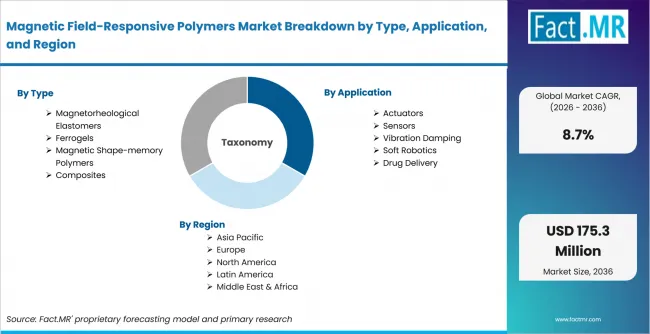
Magnetic Field Responsive Polymers Market Breakdown By Type, Application, And Region | Source: Fact.MR
| Attribute | Details |
|---|---|
| Quantitative Units | USD million in 2026 to USD million by 2036 at CAGR |
| Market Definition | Polymer systems and magnetic particle-loaded materials designed to respond to external magnetic fields for separation, sensing, actuation, and controlled material movement |
| Type | Magnetorheological elastomers; Ferrogels; Magnetic shape-memory polymers; Composites |
| Application | Actuators; Sensors; Vibration damping; Soft robotics; Drug delivery |
| Form | Elastomer; Gel; Film |
| End Use | Automotive; Healthcare/biomedical; Robotics; Electronics |
| Regions Covered | North America; Latin America; Europe; East Asia; South Asia and Pacific; Middle East and Africa |
| Countries Covered | India; China; Australia; United Kingdom; United States; Germany; Japan |
| Companies Profiled | Thermo Fisher Scientific; Merck KGaA; micromod Partikeltechnologie GmbH; Bangs Laboratories, Inc.; microParticles GmbH |
| Forecast Period | 2026 to 2036 |
| Approach | Hybrid top-down and bottom-up approach using market values, segment shares, magnetic bead workflows, polymer research funding, robotics activity, semiconductor and programs |
Source: Fact.MR analysis. Updated Jul 13, 2026
How is the market segmented?
-
By Type:
- Magnetorheological elastomers
- Ferrogels
- Magnetic shape-memory polymers
- Composites
-
By Application:
- Actuators
- Sensors
- Vibration damping
- Soft robotics
- Drug delivery
-
By Form:
- Elastomer
- Gel
- Film
-
By End Use:
- Automotive
- Healthcare/biomedical
- Robotics
- Electronics
-
By region:
- North America
- United States
- Canada
- Europe
- Germany
- United Kingdom
- France
- Italy
- Spain
- East Asia
- China
- Japan
- South Korea
- South Asia and Pacific
- India
- Australia
- Indonesia
- Thailand
- Latin America
- Brazil
- Mexico
- Argentina
- Chile
- Middle East and Africa
- UAE
- Saudi Arabia
- South Africa
- Egypt
- North America
Frequently Asked Questions
What type is expected to dominate the magnetic field-responsive polymers market?
What application is estimated to lead the magnetic field-responsive polymers market?
What form is predicted to hold the top share in the magnetic field-responsive polymers market?
Why are actuators anticipated to support market demand?
What country records the top CAGR in the magnetic field-responsive polymers market?
How does China perform in the magnetic field-responsive polymers market?
How does Australia perform in the magnetic field-responsive polymers market?
How does the United Kingdom perform in the magnetic field-responsive polymers market?
What is the primary driver in the magnetic field-responsive polymers market?
What is the main restraint in the magnetic field-responsive polymers market?
Why are magnetic bead workflows anticipated to support market demand?
What companies are active in the magnetic field-responsive polymers market?
Who worked on this report


Preview the report firsthand - request a free sample
Free SampleGet the brochure for pricing and purchase details
Download PDF