- Market Value (2025): USD 17.7 Bn
- Estimated Value (2026): USD 18.7 Bn
- Forecast Value (2036): USD 31.9 Bn
- CAGR (2026-2036): 5.5%
What is the Nickel Pig Iron Market forecast to be worth by 2036?
USD 18.7 billion in 2026 to USD 31.9 billion by 2036 at 5.5% CAGR.
- The nickel pig iron market reached USD 17.7 billion in 2025 as stainless steel producers kept laterite-based nickel units in their alloy plans.
- Demand is projected to increase from USD 18.7 billion in 2026 to USD 31.9 billion by 2036.
- The market is forecast to record 5.5% CAGR from 2026 to 2036. RKEF-based smelting routes remain relevant where product grade and delivery discipline are visible.
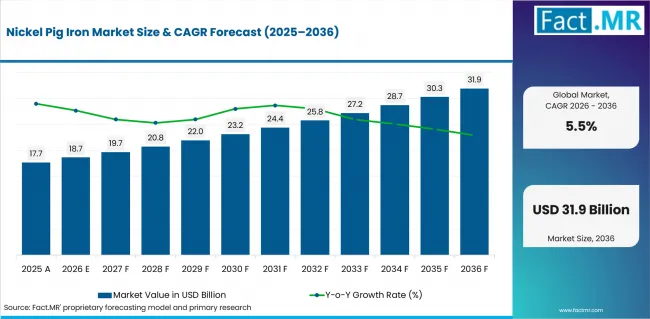
Nickel Pig Iron Market Value Analysis | Source: Fact.MR
What are the defining numbers behind Nickel Pig Iron Market growth?
USD 13.2 billion absolute opportunity is expected by 2036. Growth is led by Low-Grade Nickel Pig Iron and Stainless Steel Production alongside Stainless Steel Manufacturers.
- Demand Drivers in the Market
- Low-grade nickel pig iron remains important because stainless steel plants use it to secure nickel units at a workable input cost. Procurement groups are expected to compare grade consistency and melt-shop fit before recurring supply plans expand.
- Stainless steel production is expected to anchor demand as mills balance nickel content against ferroalloy and scrap inputs. This keeps nickel pig iron relevant where laterite ore access and integrated smelting reduce uncertainty in feedstock planning.
- Indonesia-centered smelting capacity is expected to support route-to-market depth for customers that need stable shipments. Producers with ore access and furnace reliability are better placed to serve stainless steel accounts under repeat contracts.
- Direct sales are expected to gain weight where large stainless steel producers want tighter control over specification and delivery windows. This favors producers that connect product grade with operating reliability and not spot availability alone.
- Key Segments Analyzed
- By Product Type: Low-Grade Nickel Pig Iron is projected to hold 37.5% share in 2026 because it gives stainless steel producers a clear entry point for cost-led nickel units.
- By Application: Stainless Steel Production is expected to account for 30.4% share in 2026 as nickel pig iron is primarily purchased for melt-shop feedstock use.
- By End User: Stainless Steel Manufacturers are anticipated to capture 32.1% share in 2026 since integrated mills have the strongest reason to control nickel-bearing inputs.
- By Distribution Channel: Direct Sales are estimated to represent 31.0% share in 2026 due to contract review needs around grade and shipment timing.
- By Production Process: Rotary Kiln-Electric Furnace (RKEF) is forecast to hold 44.1% share in 2026 because it is widely used for laterite ore smelting into nickel pig iron.
- Analyst Opinion at Fact.MR
- Shambhu Nath Jha, Sr. Consultant at Fact.MR, opines, "Nickel pig iron producers need to prove more than tonnage availability. Stainless steel customers are expected to favor feedstock routes that show grade consistency and furnace reliability through volatile nickel cycles."
- Strategic Implications
- Stainless steel producers should test nickel pig iron offers against melt-shop requirements before committing to annual volumes. This review should cover low-grade material behavior and blend planning.
- Producers can improve customer confidence by showing how RKEF furnace performance affects grade control. The same evidence helps customers compare nickel pig iron with high-purity pig iron when purchase teams review input stability.
- Investors should separate direct nickel pig iron exposure from wider nickel mining and base metal extraction activity. Demand becomes more defensible when laterite ore access and stainless steel offtake can be explained together.
Indonesia is projected to record a 7.1% CAGR from 2026 to 2036, supported by laterite ore access and integrated smelting. Japan is expected to post 6.6% CAGR as stainless steel quality requirements keep feedstock reliability important. The USA is forecast to register 6.1% CAGR through import-led alloy supply. Germany is anticipated to record 5.5% CAGR as specification review guides purchases. South Korea is estimated at 4.9% CAGR through stainless steel and manufacturing demand. Brazil is projected to reach 4.4% CAGR as distributor access shapes supply. Australia is expected to post 3.8% CAGR through selective resource-sector participation.
How does the Nickel Pig Iron Market break down by segment?
Low-Grade Nickel Pig Iron is expected to lead Product Type at 37.5% share in 2026. Stainless Steel Production is projected to lead Application at 30.4% share in 2026.
Which product type dominates?
Low-Grade Nickel Pig Iron is projected to account for 37.5% share in 2026.
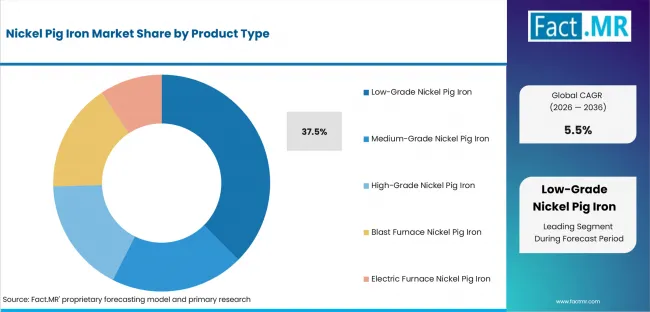
Nickel Pig Iron Market Analysis By Product Type | Source: Fact.MR
Low-grade material leads because it gives stainless steel producers a lower-cost nickel unit for routine alloy planning. The 4-8% Nickel Content and 8-10% Nickel Content groups remain important where plants require tighter grade bands. Medium-Grade Nickel Pig Iron supports accounts that need a higher nickel contribution without moving fully into premium feedstock.
What leads the Application segment?
Stainless Steel Production is expected to hold 30.4% share in 2026.
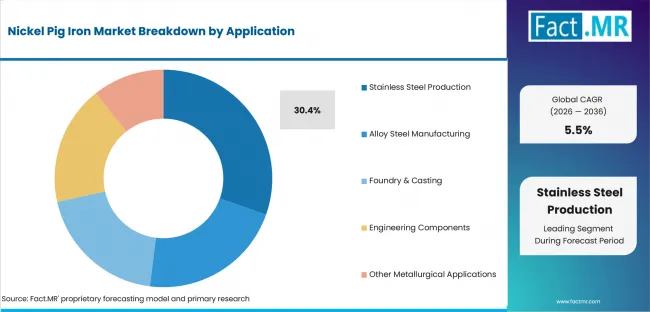
Nickel Pig Iron Market Analysis By Application | Source: Fact.MR
Stainless steel production leads because nickel pig iron is mainly used to support alloy chemistry in stainless melt shops. Austenitic Stainless Steel and Ferritic Stainless Steel continue to absorb demand where nickel content affects product selection. Alloy Steel Manufacturing remains smaller but relevant where feedstock cost and grade reliability matter.
How does End User shape demand?
Stainless Steel Manufacturers are anticipated to lead with 32.1% share in 2026.
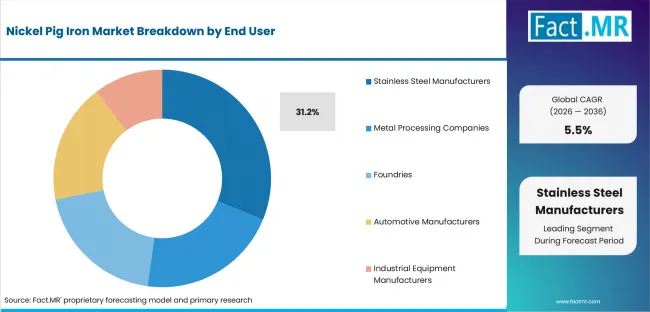
Nickel Pig Iron Market Analysis By End User | Source: Fact.MR
Stainless steel manufacturers lead because they have direct exposure to nickel cost and furnace scheduling. Integrated Steel Producers and Specialty Stainless Steel Mills retain demand when product grade and supply assurance justify contract review. Metal Processing Companies participate where downstream customers require stable stainless inputs.
What supports Direct Sales within Distribution Channel?
Direct Sales are estimated to represent 31.0% share in 2026.
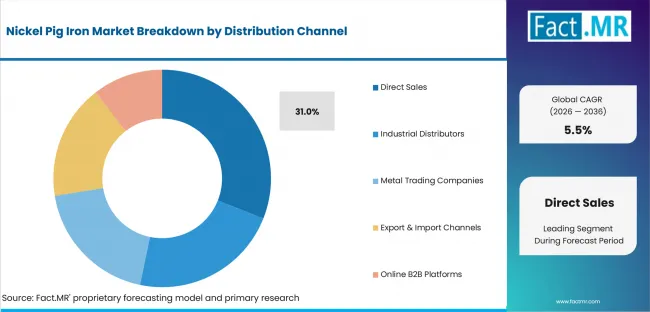
Nickel Pig Iron Market Analysis By Distribution Channel | Source: Fact.MR
Direct sales lead because large mills prefer direct negotiation on grade and delivery timing. Long-Term Supply Contracts and OEM Supply Agreements remain important for accounts that need volume protection. Industrial Distributors serve smaller customers that require access without long contract commitments.
Why does Rotary Kiln-Electric Furnace (RKEF) lead Production Process?
Rotary Kiln-Electric Furnace (RKEF) is forecast to account for 44.1% share in 2026.
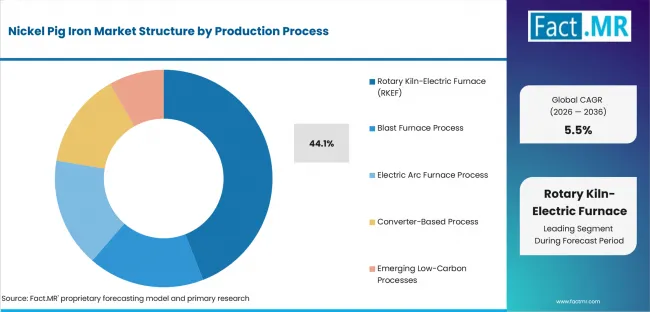
Nickel Pig Iron Market Analysis By Production Process | Source: Fact.MR
RKEF leads because the process is widely used to convert laterite ore into nickel pig iron for stainless steel production. Laterite Ore Processing and High-Grade NPI Production support demand where ore chemistry and furnace configuration match customer requirements. Blast Furnace Process remains relevant in selected plants with established equipment and local cost advantages.
What is accelerating Nickel Pig Iron Market adoption, and what is holding it back?
Demand is likely to grow through stainless steel production and laterite smelting. Changing nickel prices, high project costs and environmental concerns may slow adoption.
Drivers Impact Analysis
| DRIVER | QUALITATIVE RELEVANCE | GEOGRAPHIC RELEVANCE | IMPACT TIMELINE |
|---|---|---|---|
| Low-grade nickel pig iron specification pull | High | Indonesia; Japan | Short term (<= 2 years) |
| Stainless steel production feedstock demand | High | Japan; South Korea; Germany | Short term (<= 2 years) |
| Integrated laterite ore and smelting routes | Moderate | Indonesia and China-centered supply chains | Medium term (2-4 years) |
| Direct sales and contract control | Moderate | USA; Germany; Brazil | Medium term (2-4 years) |
| RKEF process scale | Selective | Indonesia and Australia-centered operators | Long term (>= 4 years) |
Source: Fact.MR analysis. Updated Jul 29, 2026
- Low-grade nickel pig iron specification pull: Customers are expected to approve volume faster when grade and melt-shop behavior are clearly documented. This makes low-grade material a practical route for cost control in stainless steel production.
- Stainless steel production feedstock demand: Stainless steel mills are projected to remain the main demand base because nickel pig iron supports alloy chemistry. Producers that explain grade behavior across batches are better placed for repeat orders.
- Integrated laterite ore and smelting routes: Ore access and nearby smelting are expected to reduce supply uncertainty for customers. This route matters most where logistics and furnace availability are reviewed before supply approval.
- Direct sales and contract control: Direct supply routes are anticipated to help large customers manage price review and delivery schedules. This channel is useful when purchasing groups need accountable service instead of broker-led spot sourcing.
- RKEF process scale: RKEF capacity is expected to support wider use of nickel pig iron where laterite ore chemistry fits furnace design. Scale improves commercial confidence only when output quality remains stable over repeated shipments.
Opportunity Impact Analysis
| OPPORTUNITY | QUALITATIVE RELEVANCE | GEOGRAPHIC RELEVANCE | IMPACT TIMELINE |
|---|---|---|---|
| Low-grade NPI supply packages | Moderate | Indonesia and Japan | Medium term (2-4 years) |
| Service and inspection contracts | Moderate | Japan and Germany | Medium term (2-4 years) |
| RKEF route optimization | Selective | Indonesia and Australia | Long term (>= 4 years) |
| Alloy feedstock portfolio bundling | Selective | USA; Brazil; South Korea | Long term (>= 4 years) |
Source: Fact.MR analysis. Updated Jul 29, 2026
- Low-grade NPI supply packages: Producers are expected to gain more account interest when low-grade material is sold with clear grade documentation and delivery discipline. This reduces approval friction for stainless steel customers that compare several nickel input routes.
- Service and inspection contracts: Inspection support is expected to create opportunity where customers need proof of consistency across shipments. Producers that provide testing records and clear dispute handling are better positioned for repeat volume.
- RKEF route optimization: Furnace-route optimization is anticipated to support producers that need lower operating variance. Customers value this when RKEF performance connects directly with melt-shop stability and lower rework risk.
- Alloy feedstock portfolio bundling: Nickel pig iron is expected to gain from bundled feedstock offers where customers compare NPI with ferronickel and scrap. Bundling improves purchasing convenience without changing the core specification test.
Restraints Impact Analysis
| RESTRAINT | QUALITATIVE RELEVANCE | GEOGRAPHIC RELEVANCE | IMPACT TIMELINE |
|---|---|---|---|
| Nickel price volatility | Moderate | Global | Short term (<= 2 years) |
| Capital approval and qualification delays | Moderate | Indonesia; Japan; Germany | Short term (<= 2 years) |
| Power use and environmental review | Selective | Indonesia and Australia | Medium term (2-4 years) |
| Competition from ferronickel and primary nickel | Selective | USA; South Korea; Brazil | Medium term (2-4 years) |
Source: Fact.MR analysis. Updated Jul 29, 2026
- Nickel price volatility: Price swings are expected to make customers delay commitments when the cost advantage over alternatives narrows. This restraint is sharper for accounts that do not have long-term stainless steel demand visibility.
- Capital approval and qualification delays: New supply routes require internal approval before procurement groups shift volume. Qualification work can slow adoption when grade records or delivery history are incomplete.
- Power use and environmental review: Energy-intensive smelting is expected to face more scrutiny where customers review emissions exposure. Producers need clearer operating controls to protect demand from sustainability-related purchasing limits.
- Competition from ferronickel and primary nickel: Alternative nickel inputs are expected to limit conversion when customers already have qualified supply routes. Nickel pig iron must show a clear cost and handling advantage to displace existing feedstock choices.
Which countries are scaling Nickel Pig Iron Market fastest?
The country comparison is defined by the difference between Indonesia and the remaining profiled markets. The total spread between Indonesia and Australia is 3.3 percentage points. Indonesia forms the clear upper position because laterite ore access and RKEF smelting give it a stronger production base. Japan follows as a quality-led stainless steel market. The USA and Germany remain close through industrial metal demand and import-led purchasing. South Korea and Brazil form a measured middle-to-lower cluster. Australia occupies the lowest listed position because the opportunity is more selective and tied to resource-sector participation.
- Indonesia shows the strongest listed CAGR because local ore access and smelting integration improve the case for recurring nickel pig iron supply.
- Japan remains above the global average because stainless steel producers place high value on reliable nickel-bearing feedstock and stable quality control.
- The USA records 6.1% CAGR, above the 5.5% global market CAGR, with demand shaped by imported nickel units and contract review by industrial metal users.
- Germany stays close to the USA because stainless steel processing and industrial quality requirements support selective nickel pig iron use.
- South Korea holds a measured position where stainless steel and manufacturing demand support purchases but qualification standards slow some switching.
- Brazil remains more selective because regional demand depends on distributor access and stainless steel customer readiness.
- Australia records the lowest listed CAGR as participation is tied more to mining-centered feedstock review than broad stainless steel consumption.
Comparable CAGRs can therefore create different market entry conditions across these countries. Commercial timing depends on ore access and stainless steel demand. Timing depends on contract structure and proof that nickel pig iron performs consistently in each local purchasing route.
The full report provides country-level CAGR analysis across North America; Latin America; Europe; East Asia; South Asia; Oceania and the Middle East and Africa.
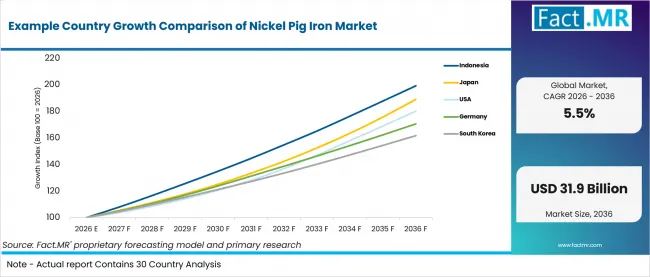
Example Country Growth Comparison Of Nickel Pig Iron Market | Source: Fact.MR
| Country | CAGR (2026-2036) |
|---|---|
| Indonesia | 7.1% |
| Japan | 6.6% |
| USA | 6.1% |
| Germany | 5.5% |
| South Korea | 4.9% |
| Brazil | 4.4% |
| Australia | 3.8% |
Source: Fact.MR analysis. Updated Jul 29, 2026
What supports Indonesia adoption?
7.1% CAGR, supported by laterite ore access and integrated smelting.
Indonesia's growth reflects a production-led market where ore availability and RKEF capacity shape supply depth. Stainless steel customers are expected to favor producers that connect low-grade nickel pig iron with reliable furnace output. Local integration gives the country a clearer route from laterite ore to stainless steel feedstock.
How is Japan scaling demand?
6.6% CAGR, driven by stainless steel quality requirements and feedstock reliability.
Japan's growth is tied to customers that place high value on predictable nickel units and consistent alloy behavior. Stainless steel producers are expected to evaluate nickel pig iron through quality control and shipment dependability. Demand remains selective because approval standards are stricter than in cost-led markets.
What is driving USA growth from 2026 to 2036?
6.1% CAGR, backed by import-led alloy supply and industrial metal demand.
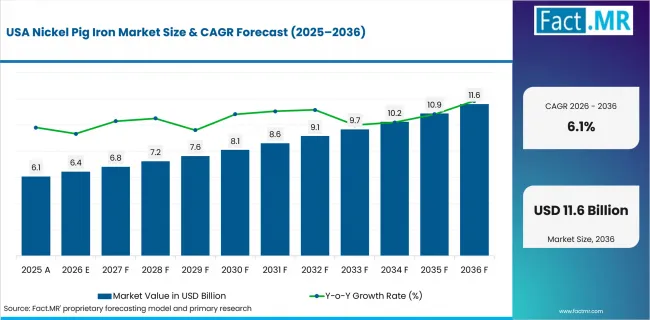
Nickel Pig Iron Market Country Value Analysis | Source: Fact.MR
The USA's growth reflects a market where customers need imported nickel-bearing feedstock to support stainless steel and alloy applications. Purchasing groups are expected to compare nickel pig iron with scrap and primary nickel. Contract clarity and delivery reliability are likely to decide producer preference.
How is Germany developing demand?
5.5% CAGR, led by stainless steel processing discipline and specification review.
Germany's growth is shaped by customers that require clear material evidence before shifting feedstock routes. Stainless steel processors are expected to review grade stability and handling performance before increasing nickel pig iron use. This creates steady but selective demand instead of rapid volume conversion.
How does South Korea perform?
4.9% CAGR, supported by stainless steel and manufacturing demand.
South Korea's demand reflects a manufacturing base that needs dependable nickel units for stainless steel and related industrial materials. Customers are expected to favor supply routes with consistent grade and reliable shipment performance. Qualification work is expected to slow adoption when alternative nickel inputs already have approved status.
What supports Brazil's growth?
4.4% CAGR, backed by selective industrial demand and distributor access.
Brazil's growth depends on regional availability and the ability of customers to justify nickel pig iron against other feedstock options. Distributors are expected to matter where smaller accounts need access without long contract exposure. Demand is likely to remain tied to industrial stainless steel use.
How does Australia perform?
3.8% CAGR, supported by mining-centered feedstock review and selective stainless steel demand.
Australia's growth is more selective because local demand is tied to resource-sector activity and specialized industrial accounts. Customers are expected to review nickel pig iron through supply dependability and import economics. Distance and service access are likely to shape adoption more than broad consumption volume.
Who leads the Nickel Pig Iron Market?
Tsingshan Holding Group and PT Virtue Dragon Nickel Industry stand out through large Indonesian smelting operations, while Nickel Industries Limited adds further strength through its expanding RKEF production base.
Tsingshan Holding Group holds a strong position through integrated mining, smelting and stainless steel activities. PT Virtue Dragon Nickel Industry contributes substantial furnace capacity and supports large-volume nickel pig iron supply. Nickel Industries Limited expands the supplier base through several Indonesian nickel projects linked with laterite ore processing. Eramet adds international mining and processing experience through its nickel operations. Jinchuan Group supports the market with broad expertise in nickel refining and alloy materials. Shandong Xinhai Technology and Lygend Resources & Technology also increase competition through smelting investment and regional supply development.
From 2026 to 2036, competitive advantage is likely to come from lower production costs, dependable furnace output and secure ore supply. Buyers may place greater weight on nickel grade, delivery schedules and long-term contract terms. Suppliers that combine consistent product quality with reliable shipment volumes are expected to attract more business from stainless steel mills and integrated producers.
Which companies are the key providers?
Key companies include Tsingshan Holding Group; Nickel Industries Limited; PT Virtue Dragon Nickel Industry; Jinchuan Group; Eramet; Shandong Xinhai Technology; and Lygend Resources & Technology.
- Tsingshan Holding Group
- Nickel Industries Limited
- PT Virtue Dragon Nickel Industry
- Jinchuan Group
- Eramet
- Shandong Xinhai Technology
- Lygend Resources & Technology
Bibliography
- U.S. Geological Survey. (2025, January 31). Mineral commodity summaries 2025.
- BPS-Statistics Indonesia. (2026, February 2). Exports and imports of Indonesia in December 2025 reached USD 26.35 billion and USD 23.83 billion, respectively.
Department of Industry, Science and Resources. (2025, December). Resources and energy quarterly: December 2025. Australian Government. - Eramet. (2025, July 30). Eramet: Increased focus on operational efficiency following a highly pressured H1 2025.
This Report Answers
- The report provides strategic intelligence on the Nickel Pig Iron Market across Product Type and Application choices that shape stainless steel feedstock decisions.
- Segment analysis covers Low-Grade Nickel Pig Iron and Stainless Steel Production as the share leaders within the 2026 market structure.
- Country outlook evaluates Indonesia and Japan alongside the USA and Germany. South Korea; Brazil and Australia complete the growth comparison across the profiled markets.
- Competitive analysis profiles Tsingshan Holding Group and Nickel Industries Limited alongside PT Virtue Dragon Nickel Industry. Jinchuan Group; Eramet; Shandong Xinhai Technology and Lygend Resources & Technology complete the provider set.
- Production-process assessment covers Rotary Kiln-Electric Furnace (RKEF) and laterite ore processing. High-grade NPI production and blast furnace routes complete the process view alongside electric furnace and converter-based routes.
What does the Nickel Pig Iron Market cover?
Nickel pig iron covers nickel-bearing feedstock produced mainly from laterite ore and used in stainless steel production. Cost and grade reliability affect purchasing decisions. Shipment discipline matters because stainless steel mills plan input availability before furnace schedules are finalized.
The Nickel Pig Iron Market covers low-grade; medium-grade and high-grade nickel pig iron sold through direct sales. Coverage extends to long-term supply contracts and OEM supply agreements. It includes RKEF and blast furnace routes where the material is used in stainless steel production and other metallurgical applications.
The market differs from general nickel mining because commercial value comes from smelting output that stainless steel customers can qualify as feedstock. Unprocessed ore remains outside the boundary. Battery chemicals are excluded unless they affect the comparison against stainless steel nickel inputs.
What is included in the scope?
Nickel pig iron products are used by stainless steel manufacturers and integrated steel producers. Specialty stainless steel mills and metal processing companies are included when they purchase nickel pig iron as a feedstock. Foundries and equipment manufacturers are covered where stainless alloy requirements create demand.
The scope includes Product Type and Application alongside End User; Distribution Channel; Production Process and Region. Coverage spans Low-Grade Nickel Pig Iron and Medium-Grade Nickel Pig Iron. High-Grade Nickel Pig Iron and Electric Furnace Nickel Pig Iron follow the same use-based boundary.
What is excluded from the scope?
Unprocessed nickel ore and unrelated steel products remain outside the scope of this market. Battery chemicals outside nickel pig iron feedstock competition are excluded. General mining revenue is not counted unless it has a clear nickel pig iron connection.
Standalone battery-grade nickel chemicals and unrelated ferronickel sales are excluded. General smelter services remain outside the scope unless they directly affect nickel pig iron purchasing or production-route qualification. Stainless steel product sales remain outside the scope after the feedstock is consumed.
How Was the Analysis Built?
The analysis draws on 120+ sources, 35+ company portfolios, 25+ countries, and more than 20 industry interviews.
- Primary Research: Primary research includes discussions with manufacturers, service providers, technology developers, distributors, end users, procurement teams, and subject-matter experts. These conversations examine purchasing priorities, product adoption, operational challenges, approval requirements, competitive positioning, and the factors that influence wider market acceptance.
- Desk Research: Desk research covers government statistics, regulatory publications, company filings, trade data, technical studies, industry associations, standards, public policy, and other authoritative sources. Every source used in the analysis is documented in the bibliography.
- Market Sizing and Forecasting: Market estimates combine historical performance, demand indicators, pricing and volume trends, segment shares, company participation, country-level growth, adoption patterns, investment activity, and barriers to market expansion.
- Data Validation and Update Cycle: Findings are validated by comparing primary interviews with public data, company activity, regulatory changes, trade patterns, and industry developments. Regular updates review new product launches, capacity changes, partnerships, approvals, procurement trends, and shifts in commercial adoption.
Segmentation
What is the report's scope and coverage?
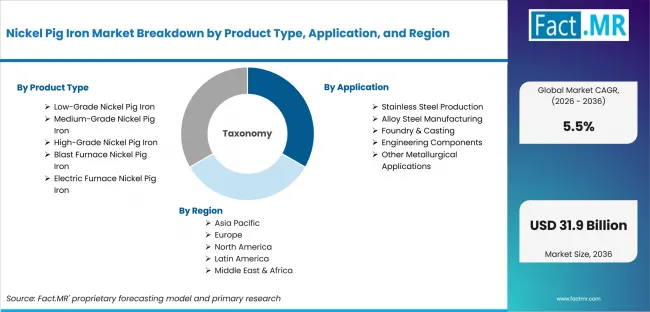
Nickel Pig Iron Market Breakdown By Product Type, Application, And Region | Source: Fact.MR
| Attribute | Details |
|---|---|
| Quantitative Units | USD billion in 2026 to USD billion by 2036 at CAGR |
| Market Definition | Commercial production and sale of nickel pig iron as a nickel-bearing feedstock for stainless steel production where grade consistency; furnace route; delivery reliability and input cost guide purchasing decisions |
| Product Type | Low-Grade Nickel Pig Iron; 4-8% Nickel Content; 8-10% Nickel Content; Medium-Grade Nickel Pig Iron; 10-13% Nickel Content; 13-15% Nickel Content; High-Grade Nickel Pig Iron; 15-20% Nickel Content; Above 20% Nickel Content; Blast Furnace Nickel Pig Iron; Electric Furnace Nickel Pig Iron |
| Application | Stainless Steel Production; Austenitic Stainless Steel; Ferritic Stainless Steel; Alloy Steel Manufacturing; Foundry and Casting; Other Metallurgical Applications |
| End User | Stainless Steel Manufacturers; Integrated Steel Producers; Specialty Stainless Steel Mills; Metal Processing Companies; Alloy Producers; Rolling Mills; Foundries; Automotive Manufacturers; Industrial Equipment Manufacturers |
| Distribution Channel | Direct Sales; Long-Term Supply Contracts; OEM Supply Agreements; Industrial Distributors; Metal Trading Companies; Export and Import Channels; Online B2B Platforms |
| Production Process | Rotary Kiln-Electric Furnace (RKEF); Laterite Ore Processing; High-Grade NPI Production; Blast Furnace Process; Electric Arc Furnace Process; Converter-Based Process; Emerging Low-Carbon Processes |
| Regions Covered | North America; Latin America; Europe; East Asia; South Asia and Pacific; Middle East and Africa; Oceania |
| Countries Covered | Indonesia; Japan; USA; Germany; South Korea; Brazil; Australia |
| Key Companies Profiled | Tsingshan Holding Group; Nickel Industries Limited; PT Virtue Dragon Nickel Industry; Jinchuan Group; Eramet; Shandong Xinhai Technology; Lygend Resources & Technology |
| Forecast Period | 2026 to 2036 |
| Approach | Hybrid top-down and bottom-up approach using nickel pig iron production routes; stainless steel feedstock demand; product-grade review; application demand; end-user purchasing behavior; distribution-channel preference; RKEF process role; country adoption patterns and company portfolio review |
Source: Fact.MR analysis. Updated Jul 29, 2026
How is the market segmented?
-
By Product Type:
- Low-Grade Nickel Pig Iron
- 4-8% Nickel Content
- 8-10% Nickel Content
- Medium-Grade Nickel Pig Iron
- 10-13% Nickel Content
- 13-15% Nickel Content
- High-Grade Nickel Pig Iron
- 15-20% Nickel Content
- Above 20% Nickel Content
- Blast Furnace Nickel Pig Iron
- Standard Blast Furnace Grade
- Modified Blast Furnace Grade
- Electric Furnace Nickel Pig Iron
- RKEF Grade
- Electric Arc Furnace Grade
-
By Application:
- Stainless Steel Production
- Austenitic Stainless Steel
- Ferritic Stainless Steel
- Alloy Steel Manufacturing
- Special Alloy Steel
- High Strength Steel
- Foundry & Casting
- Industrial Castings
- Automotive Castings
- Engineering Components
- Machinery Components
- Heavy Equipment Parts
- Other Metallurgical Applications
- Welding Materials
- Special Metal Products
-
By End User:
- Stainless Steel Manufacturers
- Integrated Steel Producers
- Specialty Stainless Steel Mills
- Metal Processing Companies
- Alloy Producers
- Rolling Mills
- Foundries
- Industrial Foundries
- Precision Casting Companies
- Automotive Manufacturers
- Commercial Vehicle Manufacturers
- Component Manufacturers
- Industrial Equipment Manufacturers
- Mining Equipment Manufacturers
- Construction Equipment Manufacturers
-
By Distribution Channel:
- Direct Sales
- Long-Term Supply Contracts
- OEM Supply Agreements
- Industrial Distributors
- National Distributors
- Regional Distributors
- Metal Trading Companies
- Commodity Traders
- Metal Service Centers
- Export & Import Channels
- Export Agents
- Import Distributors
- Online B2B Platforms
- Digital Metal Marketplaces
- E-Procurement Platforms
-
By Production Process:
- Rotary Kiln-Electric Furnace (RKEF)
- Laterite Ore Processing
- High-Grade NPI Production
- Blast Furnace Process
- Traditional Blast Furnace
- Modern Blast Furnace
- Electric Arc Furnace Process
- Primary Smelting
- Secondary Refining
- Converter-Based Process
- Basic Oxygen Converter
- Custom Alloy Conversion
- Emerging Low-Carbon Processes
- Hydrogen-Assisted Smelting
- Carbon Capture Integrated Smelting
-
By Region:
- East Asia
- North America
- Latin America
- South Asia and Pacific
- Middle East and Africa
Frequently Asked Questions
Which Product Type leads the Nickel Pig Iron Market?
Which Application leads the Nickel Pig Iron Market?
Which End User leads the Nickel Pig Iron Market?
Which Distribution Channel leads the Nickel Pig Iron Market?
Which Production Process leads the Nickel Pig Iron Market?
Which country records the highest listed CAGR?
What is the primary driver in this market?
What is the main restraint?
Why do stainless steel manufacturers lead demand?
Who worked on this report


Preview the report firsthand - request a free sample
Free SampleGet the brochure for pricing and purchase details
Download PDF