- Base Value(2026): 21.6 Bn
- Forecast Value (2036): 44.5 Bn
- CAGR (2036): 7.5%
Male Sex Toys Market Forecast and Outlook 2026 to 2036
In 2026, the male sex toys market was valued at USD 21.6 billion. Based on Fact.MR analysis, demand for male sex toys is projected to reach approximately USD 44.5 billion by 2036. Fact.MR projects a CAGR of 7.5% during the forecast period. Market expansion reflects rising acceptance of male-focused wellness products, growing online penetration, and repeat purchase behavior across both premium and mid-range price segments.
The market adds nearly USD 23.0 billion in value over the forecast window, representing sustained compounding rather than short-cycle consumer fads. Early period growth is supported by rapid adoption in Asia Pacific through mobile commerce platforms and influencer-led brand discovery. Mid period performance aligns with product innovation in materials, ergonomics, and app-enabled devices that support premium pricing. In later years, value growth is reinforced by replacement demand, subscription-based accessories, and broader female purchaser participation, supporting stable revenue even as category awareness matures.
India leads growth at 15.9% CAGR, supported by expanding e-commerce reach, younger demographics, and rising openness toward personal wellness products. China follows at 13.4% driven by domestic manufacturing scale and strong online sales ecosystems. Japan records 10.3% aligned with established adult product acceptance and innovation-led demand. Singapore grows at 9.8% reflecting high disposable income and premium product uptake. The United States remains comparatively mature at 4.8%, where growth is replacement-led and shaped by brand loyalty, regulatory clarity, and stable consumer awareness.
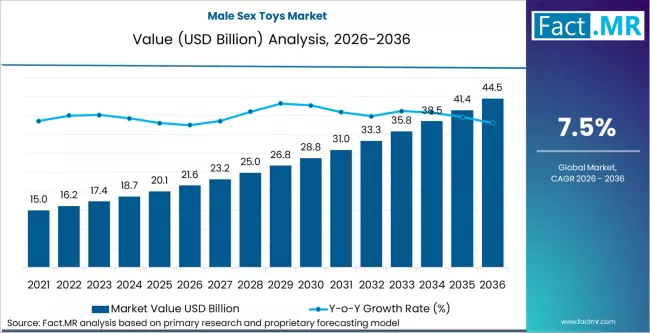
Male Sex Toys Market Market Value Analysis | Source: Fact.MR
Male Sex Toys Market Definition
The male sex toys market covers consumer products designed to support sexual stimulation and wellness for adult male users. These products include devices intended for external or internal use and are manufactured from materials suitable for repeated skin contact. Items are sold as finished consumer goods through retail and online channels. Product safety, material compliance, and labeling requirements in key markets are governed by consumer product safety and health regulations enforced by authorities such as the US Consumer Product Safety Commission and public health agencies [1]. Demand is driven by personal use, sexual health awareness, and relationship products.
Male Sex Toys Market Inclusions
The report covers global and regional market size estimates in volume and value terms with a forecast period from 2026 to 2036. Segmentation includes product type such as masturbators, vibrating devices, rings, and prostate stimulators, distribution channel including online and specialty retail, and end use focused on individual consumers. The scope also includes regional demand patterns, pricing benchmarks, and international trade flows for finished adult consumer products.
Male Sex Toys Market Exclusions
The scope excludes medical devices intended for clinical diagnosis or treatment of sexual dysfunction. Pornographic media, digital content, and subscription based adult services are not included. Raw materials, electronic components sold separately, and manufacturing equipment are excluded. Custom made artisanal products produced at noncommercial scale, prototype devices, laboratory testing tools, and therapeutic services or counseling are also outside the scope.
Male Sex Toys Market Research Methodology
- Primary Research: Primary research involved interviews with product manufacturers, brand owners, distributors, specialty retailers, and e commerce platform category managers.
- Desk Research: Desk research used consumer product safety guidance from the US Consumer Product Safety Commission and public health information from the Centers for Disease Control and Prevention, along with customs trade data, retail sales disclosures, and company annual reports.
- Market Sizing and Forecasting: Market sizing applied a hybrid top down and bottom up model using adult population data, per capita product consumption estimates, and reported sales volumes across retail channels.
- Data Validation and Update Cycle: Outputs were cross checked against trade statistics, retail sales disclosures, regulatory documentation, and company filings, with updates applied when verified public data sources issue revisions.
Summary of Male Sex Toys Market
-
Market definition
- The male sex toys market covers adult consumer products designed for sexual stimulation and wellness, including devices for external or internal use, sold as finished goods through online and offline retail channels under consumer product safety and labelling rules.
-
Demand drivers
- Rising normalization of sexual wellness consumption among adult men is supporting higher purchase frequency for private-use products such as masturbators and prostate toys across urban markets.
- Expansion of e-commerce and direct-to-consumer platforms enables discreet purchasing, wider assortment access, and cross-border availability, supporting volume growth. [2]
- Increasing participation of female purchasers for partner and relationship use is broadening the buyer base and sustaining repeat demand across mid-range and premium price tiers.
-
Key segments analyzed
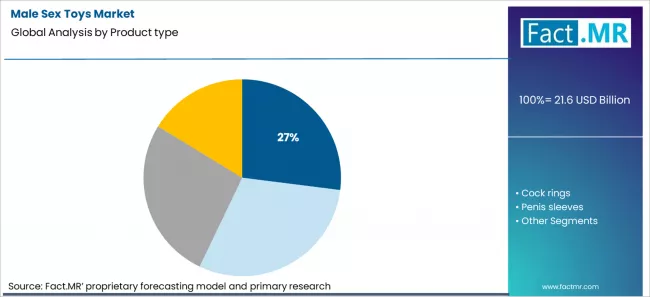
- Product type: Male masturbators lead with about 27% share due to private use, repeat replacement cycles, and compatibility with online fulfillment.
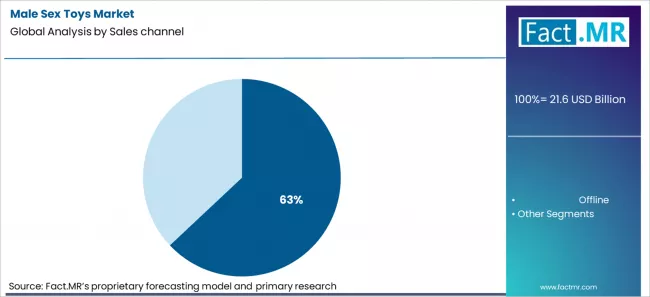
- Sales channel: Online channels account for roughly 63% share, driven by anonymity, home delivery, and lower dependence on specialty retail.
- Geography: India, China, Japan, and Singapore show faster growth linked to e-commerce penetration and shifting consumer attitudes, while the United States remains replacement-led.
-
Analyst opinion at Fact.MR
- Shambhu Nath Jha, Principal Consultant at Fact.MR, opines, ‘CXOs will find this report useful for understanding how private purchasing behavior, online channel dominance, and pricing tier segmentation are shaping long-term value creation in the male sex toys category.’
-
Strategic Implications / Executive Takeaways
- Prioritize online-first distribution with strong privacy, packaging, and logistics controls.
- Balance portfolios between high-volume mid-range products and premium designs to stabilize revenue mix.
- Align product safety, material disclosure, and labelling with consumer protection guidance [3] to reduce compliance risk.
-
Methodology
- Market sizing based on adult population data, per-capita consumption estimates, and reported retail sales volumes.
- Validation through trade statistics, regulatory documentation, and company disclosures.
- Forecasts developed using reproducible top-down and bottom-up models grounded in verified consumer benchmarks.
Segmental Analysis
Male Sex Toys Market Analysis by Product Type
Male Sex Toys Market Analysis By Product Type | Source: Fact.MR
Based on Fact.MR analysis, consumption of male masturbators is estimated to hold 27% share of the global male sex toys market in 2025. Fact.MR analysts note that this product type leads due to private use, discreet storage, and repeat purchase patterns across adult consumers. As per Fact.MR, male masturbators address user preferences for solo wellness products, varied textures, and compatibility with e commerce fulfillment, supporting steady demand through both premium and mass market offerings across urban markets worldwide during seasonal promotions and subscription models in key regions globally over time.
- Product safety context: Consumer product safety rules apply to personal wellness products sold to adults. [4]
- Usage pattern: Fact.MR analysts note repeat purchasing driven by product variety and replacement cycles.
- Portfolio breadth: Brands offer multiple designs and materials to address differing consumer preferences.
Male Sex Toys Market Analysis by Sales Channel
Male Sex Toys Market Analysis By Sales Channel | Source: Fact.MR
Based on Fact.MR analysis, consumption via online sales channels is estimated to hold 63% share of the global male sex toys market in 2025. Fact.MR analysts note that online channels lead due to anonymity, broader assortment, and home delivery options preferred by adult buyers. As per Fact.MR, online retail addresses pricing transparency, access to reviews, and cross border availability, enabling brands to scale demand efficiently while complying with age verification and consumer protection requirements across major e commerce markets including mobile apps and direct to consumer storefronts globally today now.
- Consumer protection: Online retail transactions are subject to federal consumer protection and advertising guidelines.
- Channel efficiency: Fact.MR analysts note lower overhead costs compared with physical retail formats.
- Market reach: Online platforms enable access to customers in regions lacking specialized retail stores.
Male Sex Toys Market Drivers, Restraints, And Opportunities
Fact.MR analysis indicates that the male sex toys market exists as a consumer wellness and personal lifestyle goods segment with applications spanning sexual health, pleasure, and intimate well-being among adult populations. As per Fact.MR assessment, products in this category include devices such as strokers, prostate stimulators, and wearable stimulation devices that interface with users’ anatomy, and in markets such as the United States these products fall under medical device and consumer product oversight frameworks that include guidance from the U.S. Food and Drug Administration (FDA) on classification and labelling of intimate devices and household consumer goods, which informs safety and labelling expectations for manufacturers and importers. Fact.MR analysts observe that current market size is shaped by rising consumer openness to sexual wellness products, digital commerce expansion, and differentiated product offerings that meet varied preference profiles among adult buyer segments.
Fact.MR is of the opinion that current market dynamics reflect a transition toward higher-functionality products with ergonomic designs, body-safe materials, and integrated digital control features. Based on Fact.MR assessment, basic manual products continue to account for a large share of unit volumes because of accessibility and lower cost, but demand growth is occurring in segments that emphasise premium materials, enhanced stimulation mechanisms, and app-connected or rechargeable features. Premium male sex toys typically carry higher per-unit pricing because of design complexity and material standards, meaning realised market value can grow even in periods where shipment volume growth remains measured. Fact.MR analysis suggests that this mix of evolving product expectations and value capture will influence near-term market progression.
- Consumer product safety frameworks: Fact.MR analysts note that regulatory guidance such as the U.S. FDA’s device classification and labelling requirements for intimate consumer goods influences design, safety testing, and market entry considerations for male sex toys.
- Shift to premium and ergonomic products: Based on Fact.MR assessment, increasing adoption of male sex toys with advanced features, body-safe materials, and digital controls supports value-oriented segments where users prioritise durability and experience differentiation.
- Asia Pacific e-commerce and awareness growth: Fact.MR opines that rising online retail penetration, growing consumer acceptance, and expanding sexual wellness awareness in China, India, and Southeast Asia support regional uptake of a broader range of male sex toy products across OEM and direct-to-consumer channels.
Regional Analysis
Based on regional assessment, the male sex toys sector is analyzed across North America, East Asia, South Asia, Southeast Asia, and other key consumer markets, spanning more than 40 countries. Regional performance varies according to changing consumer attitudes, penetration of e-commerce platforms, discretionary spending patterns, and regulatory acceptance of adult wellness products. The analysis also presents a comparative market attractiveness evaluation grounded in region-specific demand trends.
Male Sex Toys Market CAGR Analysis by Country (2026-2036)
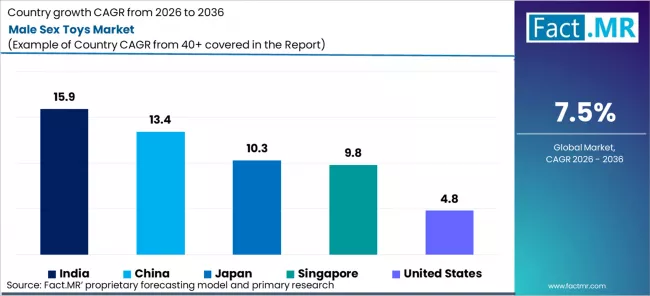
Male Sex Toys Market Cagr Analysis By Country | Source: Fact.MR
| Country | CAGR |
|---|---|
| India | 15.9% |
| China | 13.4% |
| Japan | 10.3% |
| Singapore | 9.8% |
| United States | 4.8% |
Source: Fact.MR analysis. Updated Feb 23, 2026
Source: Fact.MR analysis, based on proprietary forecasting models and primary research.
Asia Pacific Male Sex Toys Market Analysis
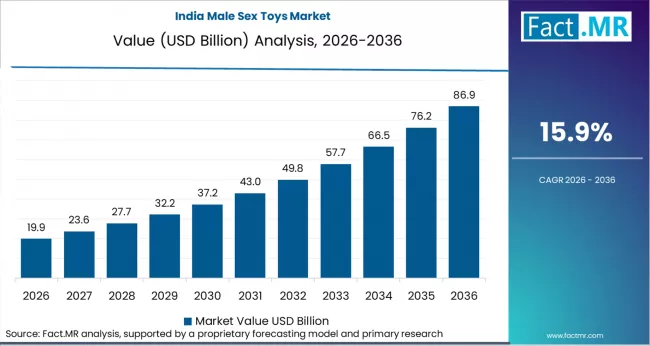
Male Sex Toys Market Country Value Analysis | Source: Fact.MR
Asia Pacific operates as a high growth consumption driven male sex toys region supported by rising disposable income expanding ecommerce access and gradual normalization of adult wellness products. Demand is shaped by urban demographics privacy focused online retail and growth of direct to consumer platforms. Distribution relies heavily on digital channels specialty adult stores and cross border ecommerce shipments. Consumption spans mass market and premium segments with demand concentrated in metropolitan areas across East South and Southeast Asia consumer markets.
- India: Demand for male sex toys in India is projected to rise at 15.9% CAGR through 2036. Consumption growth is supported by ecommerce penetration discreet delivery models and rising awareness of sexual wellness products, as per Fact.MR.
- China: Demand for male sex toys in China is projected to rise at 13.4% CAGR through 2036. Usage is driven by strong domestic manufacturing base online retail platforms and large urban consumer populations, according to Fact.MR.
- Japan: Demand for male sex toys in Japan is projected to rise at 10.3% CAGR through 2036. Consumption reflects established adult product retail culture and steady demand through specialty stores and ecommerce channels, as per Fact.MR.
- Singapore: Demand for male sex toys in Singapore is projected to rise at 9.8% CAGR through 2036. Adoption is supported by high income levels liberal consumer attitudes and strong online retail penetration, according to Fact.MR.
Fact.MR’s analysis of the Male Sex Toys Market in Asia Pacific consists of country-wise assessment that includes India, China, Japan, and Singapore. Readers can find retail channel trends, consumption behavior, and pricing segmentation insights.
North America Male Sex Toys Market Analysis
North America functions as a mature consumption oriented male sex toys region supported by established sexual wellness retail strong brand presence and high acceptance levels. Demand is shaped by replacement purchasing premium product adoption and omnichannel retail strategies. Distribution spans specialty adult stores pharmacies mass retailers and ecommerce platforms. Consumption emphasizes branded products material quality and product differentiation. Market activity reflects stable growth driven by lifestyle spending patterns and continued integration of sexual wellness into mainstream retail environments.
- United States: Demand for male sex toys in the United States is projected to rise at 4.8% CAGR through 2036. Consumption is supported by strong retail availability ecommerce penetration and normalization of sexual wellness products across mainstream channels, as per Fact.MR.
Fact.MR’s analysis of the Male Sex Toys Market in North America consists of country-wise assessment that includes the United States. Readers can find retail structure insights consumer purchasing patterns and demand segmentation references.
Competitive Landscape for Male Sex Toys Market
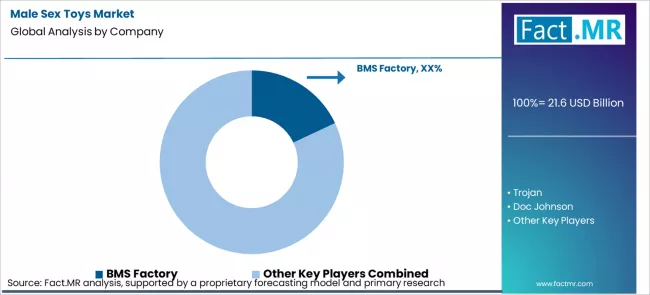
Male Sex Toys Market Analysis By Company | Source: Fact.MR
The male sex toy market in 2026 is defined by a strategic split between mass-market accessibility and high-tech "sextech" innovation. Mainstream leaders like Trojan, Durex, and LifeStyles dominate the entry-level segment, utilizing their vast pharmacy and grocery distribution networks to normalize products like vibrating rings for general consumers. In contrast, the mid-to-high-tier landscape is a battleground for engineering supremacy. TENGA continues to lead in design-led masturbators, while LELO and Fun Factory maintain their grip on the luxury market with medical-grade silicone and sophisticated aesthetics. This tier focuses on "pleasure as wellness," moving away from legacy novelty branding.
Specialty players and large-scale manufacturers like BMS Factory and Doc Johnson provide the backbone of the industry through massive SKU variety and private-label production. Doc Johnson leverages its North American manufacturing to dominate domestic retail, while BMS Factory has expanded its influence as a global OEM powerhouse for emerging digital brands. Simultaneously, niche leaders like Aneros and Bad Dragon command intense brand loyalty by serving specific anatomical or enthusiast subcultures. The fastest-growing subsegment teledildonics sees brands like Lovense and Jimmyjane integrating AI and app-connectivity, transforming the competitive landscape from a hardware-only race into a software-integrated ecosystem.
Recent Industry Developments
- Tenga Co. Ltd.: Redefining "Analog" and "Electronic" Pleasure: In 2025 and early 2026, the Japanese giant Tenga swept industry awards, including the 2026 'O' Award for the Spinner DX series. Their latest innovation is the Flip Zero EV, an electronic vibrating version of their flagship manual stroker. Tenga also expanded its "Geo" and "Arte" lines, which are designed to look like abstract sculptures (coral and drapes) to provide high-end, inconspicuous home decor that doubles as a medical-grade silicone masturbator. [5]
- FirmTech: The Rise of "Sex-Health" Wearables: A standout 2025-2026 development is the shift from pleasure to diagnostic health. FirmTech’s TechRing, a smart sensor ring for men, has gained mainstream clinical traction. It monitors "nocturnal tumescence" (nighttime erections) to provide a "Fidelity Score." This data is now being used by urologists to identify early signs of cardiovascular disease and vascular health issues, repositioning the male sex toy as a legitimate medical wearable. [6]
Key Players in Male Sex Toys Market
- BMS Factory
- Trojan
- Doc Johnson
- Fun Factory
- LELO
- Lifestyle
- LovHoney
- Luvu Brands
- Durex
- Tenga
- Adam & Eve
- Aneros
- Bad Dragon
- Crystal Delights
- Je Joue
- Jimmyjane
- Tantus
- Reliable
- Suction
Bibliography
- [1] U.S. Consumer Product Safety Commission. (2024). Regulations, laws, and standards applicable to consumer products. U.S. Consumer Product Safety Commission.
- [2] U.S. Consumer Product Safety Commission. (2024). Consumer product safety requirements for online and direct-to-consumer retail. U.S. Consumer Product Safety Commission.
- [3] Centers for Disease Control and Prevention. (2024). Sexual health and wellness: Public health information and guidance. U.S. Department of Health and Human Services.
- [4] U.S. Consumer Product Safety Commission. (2023). Safety education and general guidance for consumer wellness products. U.S. Consumer Product Safety Commission.
- [5] TENGA Co., Ltd. (2026). Product innovation updates and design awards announcements. TENGA Corporate Newsroom.
Segmentation
Scope of the Report
| Metric | Value |
|---|---|
| Quantitative Units | USD 21.6 billion (2026) to USD 44.5 billion (2036), CAGR 7.5% |
| Market Definition | The male sex toys market covers consumer products designed to support sexual stimulation and wellness for adult male users. Products include devices for external or internal use such as masturbators, rings, sleeves, prostate stimulators, sex dolls, and penis enhancements. Sales occur through online and offline retail. Product safety and labeling are regulated by authorities including the US CPSC and CDC. |
| Product Type Segmentation | Male Masturbators, Cock Rings, Penis Sleeves, Male Prostate Toys, Sex Doll Toys, Penis Enhancements, Other Product Types |
| Demographics | Male, Female |
| Price Range Segmentation | Premium or Luxury, Mid-Range or Economy |
| Sales Channel Segmentation | Online, Offline |
| Regions Covered | Asia Pacific, Europe, North America, Latin America, Middle East & Africa |
| Countries Covered | India, China, Japan, South Korea, Indonesia, Australia & New Zealand, ASEAN, Rest of Asia Pacific, Germany, Italy, France, United Kingdom, Spain, Benelux, Nordics, Central & Eastern Europe, Rest of Europe, United States, Canada, Mexico, Brazil, Argentina, Chile, Rest of Latin America, Kingdom of Saudi Arabia, United Arab Emirates, South Africa, Turkey, Rest of Middle East & Africa |
| Key Companies Profiled | BMS Factory, Trojan, Doc Johnson, Fun Factory, LELO, LifeStyles, LovHoney, Luvu Brands, Durex, Tenga, Adam & Eve, Aneros, Bad Dragon, Crystal Delights, Je Joue, Jimmyjane, Tantus, Reliable, Suction |
| Forecast Period | 2026 to 2036 |
| Approach | Hybrid top-down and bottom-up modeling validated through interviews with manufacturers, distributors, e-commerce managers, and regulatory data. Market sizing based on adult population data, per capita consumption, and sales channel penetration. |
Source: Fact.MR analysis. Updated Feb 23, 2026
Male Sex Toys Market Analysis by Segments
-
By Product Type :
- Male masturbators
- Cock rings
- Penis sleeves
- Male prostate toys
- Sex doll toys
- Penis enhancements
- Other product types
-
By Demographics :
- Male
- Female
-
By Price Range :
- Premium or luxury
- Mid-range or economy
-
By Sales Channel :
- Online
- Offline
-
Region :
- Asia Pacific
- India
- China
- Japan
- South Korea
- Indonesia
- Australia & New Zealand
- ASEAN
- Rest of Asia Pacific
- Europe
- Germany
- Italy
- France
- United Kingdom
- Spain
- Benelux
- Nordics
- Central & Eastern Europe
- Rest of Europe
- North America
- United States
- Canada
- Mexico
- Latin America
- Brazil
- Argentina
- Chile
- Rest of Latin America
- Middle East & Africa
- Kingdom of Saudi Arabia
- United Arab Emirates
- South Africa
- Turkey
- Rest of Middle East & Africa
- Asia Pacific
Frequently Asked Questions
How large is the male sex toys market in 2026?
What will the global market size be by 2036?
What is the expected CAGR for the male sex toys market during 2026–2036?
How much absolute value is the market expected to add over the forecast window?
What is driving long-term growth in the male sex toys market?
Which product type leads the male sex toys market by value?
Why do male masturbators account for the largest share?
How significant is the online sales channel in this market?
What factors are supporting dominance of online sales channels?
Which region is expected to see the fastest growth over the forecast period?
Which country records the highest CAGR globally?
What is driving rapid growth in India?
How fast is the male sex toys market expected to grow in China?
What is Japan’s growth outlook in this market?
How does Singapore compare in terms of growth rate?
What is the growth outlook for the United States market?
How important are premium or luxury products to market expansion?
What role do female purchasers play in market growth?
What supports market stability in the later years of the forecast?
What are the key strategic priorities for brands competing in this market?
Who worked on this report


Preview the report firsthand - request a free sample
Free SampleGet the brochure for pricing and purchase details
Download PDF