- Market Value (2025): USD 928.8 Mn
- Estimated Value (2026): USD 986.4 Mn
- Forecast Value (2036): USD 1800.1 Mn
- CAGR (2026-2036): 6.2%
What is the Mango Powder Market forecast to be worth by 2036?
USD 986.4 million in 2026 to USD 1800.1 million by 2036 at 6.2% CAGR.
- The mango powder market was valued at USD 928.8 million in 2025.
- Demand is projected to increase from USD 986.4 million in 2026 to USD 1800.1 million by 2036.
- The market is forecast to record 6.2% CAGR from 2026 to 2036.
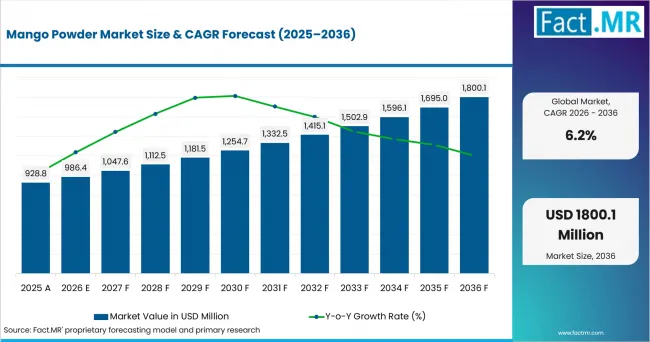
Mango Powder Market Value Analysis | Source: Fact.MR
What are the defining numbers behind Mango Powder Market growth?
USD 813.7 million absolute opportunity by 2036.
- Demand Drivers in the Market
- Amchur Powder is expected to remain central where buyers need tart mango flavor in a familiar dry spice format.
- Culinary and Seasoning use is likely to keep demand practical because curries and gravies need dry souring without extra liquid.
- Food and beverage manufacturers can use mango powder when seasoning bases or drink mixes need repeatable flavor during production.
- Spray-dried powder is expected to help suppliers serve B2B buyers that need flowability and consistent pack behavior.
- Key Segments Analyzed
- By Product Type: Amchur Powder is expected to hold 39.0% share in 2026 because pantry souring and spice-blend use keep it the main format.
- By Application: Culinary and Seasoning is projected to account for 33.0% share in 2026 as mango powder fits curries and gravies plus chutneys and pickles.
- By End Use: Food and Beverage Industry is anticipated to capture 49.0% share in 2026 since processors need dry ingredients with stable flavor.
- By Distribution Channel: B2B and Ingredient Suppliers are estimated to represent 57.0% share in 2026 where processors and spice distributors buy in larger volumes.
- By Drying Process: Spray-Dried is forecast to hold 56.0% share in 2026 due to its fit with powder handling and ingredient-scale supply.
- Analyst Opinion at Fact.MR
- Shambhu Nath Jha, Principal Consultant at Fact.MR, states, “Mango powder buying decisions depend on reliable tart flavor. Suppliers gain preference when powder stability and sourcing discipline are clear. Pack suitability must be explained in practical terms.”
- Strategic Implications
- Retail teams gain more from clear pack roles when mango powder is positioned for chutneys and snack mixes.
- Ingredient suppliers improve conversion when they document drying control before food manufacturers run application trials.
- Channel planners need separate routes for pantry spices and B2B ingredient packs since buying frequency differs across those accounts.
India leads the country set at 6.8% CAGR through 2036. China follows at 6.5% and the USA records 6.3%. Mexico advances at 6.1%. Thailand expands at 5.9% and UAE records 5.7%.
How does the Mango Powder Market break down by segment?
Amchur Powder is expected to lead Product Type at 39.0% share in 2026. Culinary and Seasoning is projected to lead Application at 33.0% share in 2026.
Which product type dominates?
Amchur Powder is projected to account for 39.0% share in 2026.
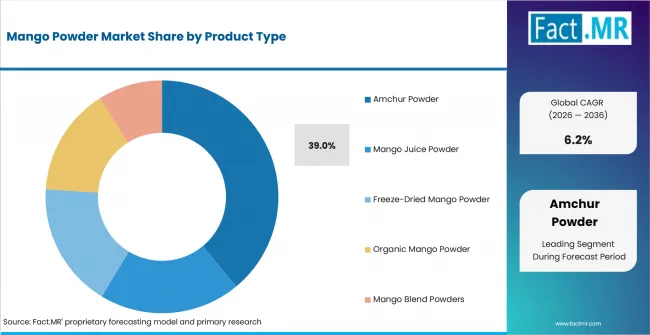
Mango Powder Market Analysis By Product Type | Source: Fact.MR
Its leadership reflects established use as a dry souring ingredient in household cooking and spice blends. Unripe Green Mango Powder and Sun-Dried Amchur support sharper traditional flavor profiles. Mango Juice Powder and Mango Blend Powders serve beverage and fruit-forward formulations, while freeze-dried and organic formats address premium applications.
What leads the Application segment?
Culinary and Seasoning is expected to hold 33.0% share in 2026.
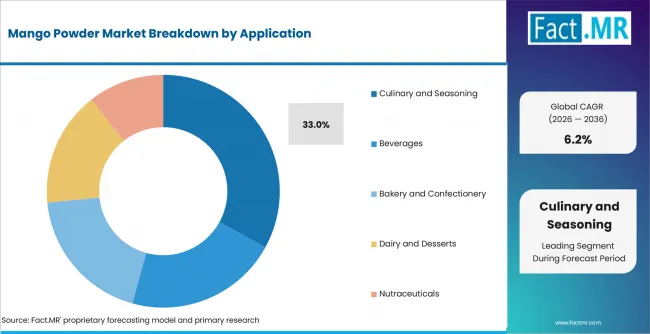
Mango Powder Market Analysis By Application | Source: Fact.MR
Dry tartness makes mango powder suitable for curries and gravies without adding moisture to the recipe. Chutneys and pickles create repeat use across familiar foods. Beverages and instant drink mixes widen application demand, while bakery, confectionery and dairy products provide smaller formulation routes.
How does End Use shape demand?
Food and Beverage Industry is anticipated to capture 49.0% share in 2026.
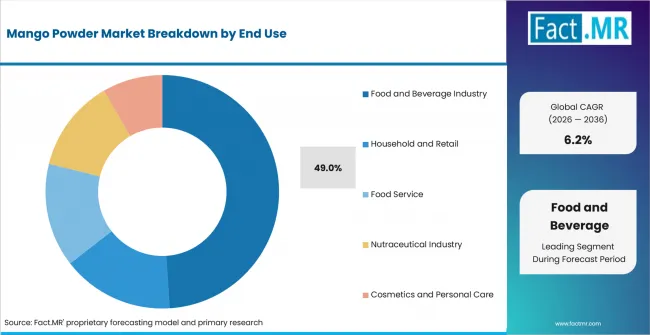
Mango Powder Market Analysis By End Use | Source: Fact.MR
Processors lead because seasoning bases, drink mixes and finished foods require stable flavor across production batches. Household and Retail demand remains important for home cooking. Food Service uses mango powder for controlled recipe preparation, while Nutraceutical and Personal Care applications represent more selective demand.
What supports B2B and Ingredient Suppliers within Distribution Channel?
B2B and Ingredient Suppliers are estimated to represent 57.0% share in 2026.
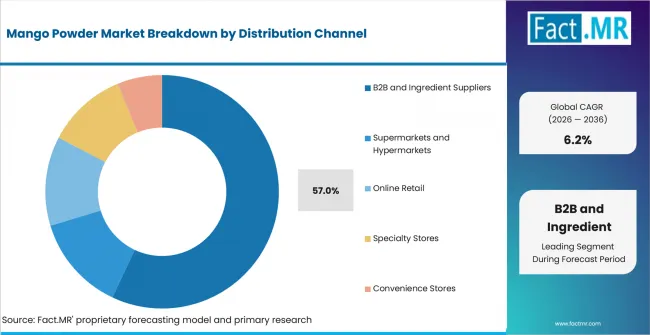
Mango Powder Market Analysis By Distribution Channel | Source: Fact.MR
Large-volume purchasing gives this channel the strongest position among processors and spice blenders. Ingredient distributors simplify specification review and repeat ordering. Contract manufacturers add demand through finished mixes, while supermarkets, online platforms and specialty stores mainly support household discovery and smaller pack purchases.
Which Drying Process leads?
Spray-Dried is forecast to hold 56.0% share in 2026.
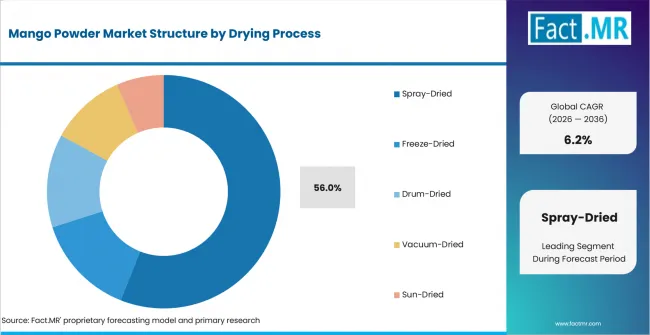
Mango Powder Market Analysis By Drying Process | Source: Fact.MR
Spray drying supports commercial-scale output with dependable flowability and storage performance. High- and low-temperature routes allow suppliers to balance cost and product quality. Freeze-Dried and Vacuum-Dried formats serve premium uses, while Sun-Dried powder retains relevance where traditional processing and stronger souring identity matter.
What is accelerating Mango Powder Market adoption, and what is holding it back?
Adoption is expected to rise through practical sour flavor and broader recipe use. B2B supplier reach helps the ingredient move into processed foods. Growth may be held back by raw mango availability and powder handling risk.
Drivers Impact Analysis
| DRIVER | (~) % IMPACT ON CAGR | GEOGRAPHIC RELEVANCE | IMPACT TIMELINE |
|---|---|---|---|
| Amchur Powder base | +1.6% | India, China, USA | Short term (<= 2 years) |
| Culinary and seasoning use | +1.4% | India, Mexico, UAE | Short term (<= 2 years) |
| Food and beverage industry demand | +1.1% | India, China, USA | Medium term (2-4 years) |
| B2B ingredient supplier reach | +0.9% | China, USA, Thailand | Medium term (2-4 years) |
| Spray-dried powder scale | +0.7% | Processing hubs | Long term (>= 4 years) |
Source: Fact.MR analysis. Updated Aug 5, 2026
- Amchur Powder base: Buyers are expected to approve mango powder faster when familiar souring use lowers trial hesitation.
- Culinary and seasoning use: Curries and gravies are likely to keep mango powder visible where dry tartness must stay controlled.
- Food and beverage industry demand: Processors can use mango powder where seasoning bases and drink mixes need consistent fruit flavor.
Opportunity Impact Analysis
| OPPORTUNITY | (~) % IMPACT ON CAGR | GEOGRAPHIC RELEVANCE | IMPACT TIMELINE |
|---|---|---|---|
| B2B pack optimization | +1.2% | India and China | Medium term (2-4 years) |
| Seasoning blend expansion | +1.0% | USA and Mexico | Medium term (2-4 years) |
| Online specialty retail | +0.8% | USA and UAE | Medium term (2-4 years) |
| Premium dried mango formats | +0.6% | Thailand and UAE | Long term (>= 4 years) |
Source: Fact.MR analysis. Updated Aug 5, 2026
- B2B pack optimization: Suppliers can expand use when larger packs match distributor buying and food processor handling needs.
- Seasoning blend expansion: Mango powder is expected to fit blends where sourness must be added without changing dry mix texture.
- Online specialty retail: Digital channels can introduce mango powder to shoppers who search by recipe need before choosing a brand.
Restraints Impact Analysis
| RESTRAINT | (~) % IMPACT ON CAGR | GEOGRAPHIC RELEVANCE | IMPACT TIMELINE |
|---|---|---|---|
| Raw mango supply variability | -1.1% | Global | Short term (<= 2 years) |
| Moisture and clumping control | -0.8% | Processing and storage sites | Short term (<= 2 years) |
| Channel price pressure | -0.6% | Retail and online sellers | Medium term (2-4 years) |
| Format switching limits | -0.4% | Foodservice and household buyers | Medium term (2-4 years) |
Source: Fact.MR analysis. Updated Aug 5, 2026
- Raw mango supply variability: Seasonal fruit availability is expected to affect powder cost when processors cannot secure consistent input quality.
- Moisture and clumping control: Poor storage conditions can weaken texture and reduce repeat orders from buyers that need free-flowing powder.
- Channel price pressure: Private-label packs may restrict premium pricing when shoppers compare mango powder with established souring ingredients.
Which countries are scaling Mango Powder Market fastest?
- The country comparison spans 1.1 percentage points and forms a compact growth range across the forecast period.
- The USA stays 0.2 percentage point above Mexico through online specialty access and food manufacturing scale.
- Mexico remains 0.2 percentage point above Thailand as seasoning and beverage applications support measured expansion.
- Thailand remains 0.2 percentage point above UAE through mango processing familiarity and regional ingredient trade.
Comparable CAGRs can create different entry conditions due to recipe familiarity and channel routes. Full report coverage includes North America and Latin America. East Asia, South Asia and Pacific plus Middle East and Africa complete the regional scope.
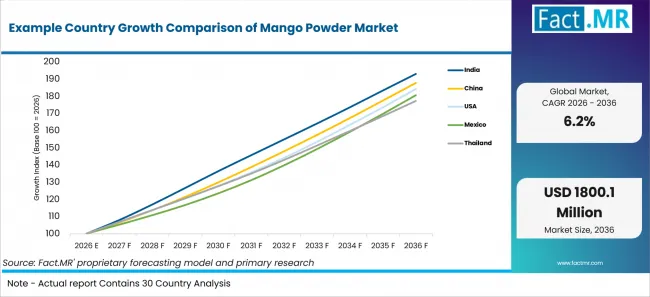
Example Country Growth Comparison Of Mango Powder Market | Source: Fact.MR
| Country | CAGR (2026-2036) |
|---|---|
| USA | 6.3% |
| Mexico | 6.1% |
| Thailand | 5.9% |
| UAE | 5.7% |
Source: Fact.MR analysis. Updated Aug 5, 2026
How is Mexico developing demand?
6.1% CAGR, led by seasoning applications and beverage experimentation.
Mexico demand is expected to build where tart fruit powder fits sauces and snack flavors. Ingredient suppliers can help processors reduce liquid handling.
How does Thailand perform?
5.9% CAGR, supported by mango processing familiarity and regional ingredient trade.
Thailand’s route is shaped by suppliers that understand dried mango formats. Freeze-dried and spray-dried products serve different price points. Storage quality decides conversion.
What supports UAE growth?
5.7% CAGR, backed by imported ingredient demand and specialty retail channels.
UAE growth is likely to reflect distributor-led availability for restaurants and grocery stores. Culinary and Seasoning use can support trial across foodservice accounts.
Who leads the Mango Powder Market?
Foods and Inns and Mevive International hold strong positions through mango powder and fruit-ingredient supply.
Vinayak Ingredients and Medikonda Nutrients add Indian sourcing and processing depth. Kanegrade and NutraDry broaden international ingredient coverage. Z Natural Foods supports retail access, while Paradise Fruits and Van Drunen Farms contribute dried-fruit expertise. Saipro Industries strengthens the supplier base across bulk and specialty applications.
Which companies are the key providers?
Key companies include Foods and Inns Limited; Mevive International; Vinayak Ingredients (India) Pvt. Ltd.; Medikonda Nutrients; Kanegrade Ltd.; NutraDry Pty Ltd.; Z Natural Foods, LLC; Paradise Fruits Solutions GmbH & Co. KG; Van Drunen Farms; Saipro Industries Private Limited
- Foods and Inns Limited
- Mevive International
- Vinayak Ingredients (India) Pvt. Ltd.
- Medikonda Nutrients
- Kanegrade Ltd.
- NutraDry Pty Ltd.
- Z Natural Foods, LLC
- Paradise Fruits Solutions GmbH & Co. KG
- Van Drunen Farms
- Saipro Industries Private Limited
Bibliography
- Ministry of Agriculture & Farmers Welfare. (2025, July 22). Support to mango farmers. Press Information Bureau, Government of India.
- U.S. Food and Drug Administration. (2025, January 6). FDA releases allergen, food safety, and plant-based alternative labeling guidances.
- Ministry of Agriculture & Farmers Welfare. (2026, March 17). Final estimates of 2024–25 and first advance estimates of 2025–26 of area and production of horticulture crops. Press Information Bureau, Government of India.
This Report Answers
- The report provides strategic intelligence on Product Type and Application choices that shape recipe use.
- Segment analysis covers Amchur Powder and Culinary and Seasoning as 2026 share leaders.
- End-use assessment explains why Food and Beverage Industry leads while B2B and Ingredient Suppliers dominate channel demand.
- Country outlook evaluates India and China alongside the USA. Mexico, Thailand and UAE complete the comparison.
- Drying-process assessment covers Spray-Dried formats and alternative drying routes.
What does the Mango Powder Market cover?
Mango powder products are dried fruit-based souring ingredients used where tart flavor must remain stable during storage and preparation.
The Mango Powder Market covers products sold for culinary and seasoning use. Curries and gravies form the core application base. Chutneys and pickles add repeat use. Beverage and instant drink mix applications are included when mango flavor is delivered in powder form. Coverage includes B2B supply and retail channels.
What is included in the scope?
The scope includes commercial mango powder sold through B2B supply, retail channels and online routes. Foodservice distribution is included where powder form improves recipe handling.
The scope includes Product Type and Application alongside End Use, Distribution Channel and Drying Process. Coverage spans Amchur Powder and Mango Juice Powder. Freeze-Dried Mango Powder and Organic Mango Powder are included when sold as mango powder formats. Food and Beverage Industry is included through seasoning and beverage users.
What is excluded from the scope?
Fresh mango products and unrelated fruit powders remain outside the scope unless they are directly sold as mango powder alternatives.
The scope excludes fresh mango and puree. Juice and pulp remain outside the coverage. Generic spice mixes are excluded when mango powder is not a stated ingredient. Finished restaurant dishes are excluded unless demand relates to mango powder procurement.
How Was the Analysis Built?
The analysis draws on 120+ sources, 35+ company portfolios, 25+ countries, and more than 20 industry interviews.
- Primary Research: Primary research includes discussions with manufacturers, service providers, technology developers, distributors, end users, procurement teams, and subject-matter experts. These conversations examine purchasing priorities, product adoption, operational challenges, approval requirements, competitive positioning, and the factors that influence wider market acceptance.
- Desk Research: Desk research covers government statistics, regulatory publications, company filings, trade data, technical studies, industry associations, standards, public policy, and other authoritative sources. Every source used in the analysis is documented in the bibliography.
- Market Sizing and Forecasting: Market estimates combine historical performance, demand indicators, pricing and volume trends, segment shares, company participation, country-level growth, adoption patterns, investment activity, and barriers to market expansion.
- Data Validation and Update Cycle: Findings are validated by comparing primary interviews with public data, company activity, regulatory changes, trade patterns, and industry developments. Regular updates review new product launches, capacity changes, partnerships, approvals, procurement trends, and shifts in commercial adoption.
Segmentation
What is the report’s scope and coverage?
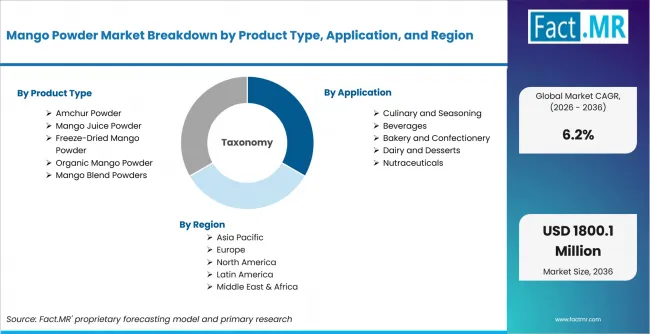
Mango Powder Market Breakdown By Product Type, Application, And Region | Source: Fact.MR
| Attribute | Details |
|---|---|
| Quantitative Units | USD million |
| Market Definition | Commercial mango powder products used as dried fruit-based souring ingredients where stability and application fit guide evaluation |
| Product Type | Amchur Powder; Unripe Green Mango Powder; Sun-Dried Amchur; Mango Juice Powder; Alphonso Mango Powder; Totapuri Mango Powder; Freeze-Dried Mango Powder; Organic Freeze-Dried Powder; Organic Mango Powder; Mango Blend Powders |
| Application | Culinary and Seasoning; Curries and Gravies; Chutneys and Pickles; Beverages; Juices and Smoothies; Instant Drink Mixes; Bakery and Confectionery; Candies and Toffees; Dairy and Desserts; Nutraceuticals |
| End Use | Food and Beverage Industry; Seasoning and Spice Blenders; Beverage Manufacturers; Household and Retail; Home Cooking Consumers; Ethnic Cuisine Households; Food Service; Restaurants and Caterers; Nutraceutical Industry; Cosmetics and Personal Care |
| Distribution Channel | B2B and Ingredient Suppliers; Spice and Ingredient Distributors; Contract Manufacturers; Supermarkets and Hypermarkets; Asian Grocery Chains; Modern Retail Outlets; Online Retail; E-commerce Marketplaces; Specialty Stores; Convenience Stores |
| Drying Process | Spray-Dried; High-Temperature Spray Drying; Low-Temperature Spray Drying; Freeze-Dried; Whole-Pulp Freeze Drying; Sliced Mango Freeze Drying; Drum-Dried; Drum-Dried Mango Flakes; Vacuum-Dried; Sun-Dried |
| Regions Covered | North America; Latin America; East Asia; South Asia and Pacific; Middle East and Africa |
| Countries Covered | India; China; USA; Mexico; Thailand; UAE |
| Key Companies Profiled | Foods and Inns Limited; Mevive International; Vinayak Ingredients (India) Pvt. Ltd.; Medikonda Nutrients; Kanegrade Ltd.; NutraDry Pty Ltd.; Z Natural Foods, LLC; Paradise Fruits Solutions GmbH & Co. KG; Van Drunen Farms; Saipro Industries Private Limited |
| Forecast Period | 2026 to 2036 |
| Approach | Hybrid top-down and bottom-up approach using mango powder demand; segment shares; country growth comparison; channel reach and drying control |
Source: Fact.MR analysis. Updated Aug 5, 2026
How is the market segmented?
-
By Product Type:
- Amchur Powder
- Unripe Green Mango Powder
- Sun-Dried Amchur
- Mango Juice Powder
- Alphonso Mango Powder
- Totapuri Mango Powder
- Freeze-Dried Mango Powder
- Organic Freeze-Dried Powder
- Organic Mango Powder
- Mango Blend Powders
- Amchur Powder
-
By Application:
- Culinary and Seasoning
- Curries and Gravies
- Chutneys and Pickles
- Beverages
- Juices and Smoothies
- Instant Drink Mixes
- Bakery and Confectionery
- Candies and Toffees
- Dairy and Desserts
- Nutraceuticals
- Culinary and Seasoning
-
By End Use:
- Food and Beverage Industry
- Seasoning and Spice Blenders
- Beverage Manufacturers
- Household and Retail
- Home Cooking Consumers
- Ethnic Cuisine Households
- Food Service
- Restaurants and Caterers
- Nutraceutical Industry
- Cosmetics and Personal Care
- Food and Beverage Industry
-
By Distribution Channel:
- B2B and Ingredient Suppliers
- Spice and Ingredient Distributors
- Contract Manufacturers
- Supermarkets and Hypermarkets
- Asian Grocery Chains
- Modern Retail Outlets
- Online Retail
- E-commerce Marketplaces
- Specialty Stores
- Convenience Stores
- B2B and Ingredient Suppliers
-
By Drying Process:
- Spray-Dried
- High-Temperature Spray Drying
- Low-Temperature Spray Drying
- Freeze-Dried
- Whole-Pulp Freeze Drying
- Sliced Mango Freeze Drying
- Drum-Dried
- Drum-Dried Mango Flakes
- Vacuum-Dried
- Sun-Dried
- Spray-Dried
-
By Region:
- North America
- Latin America
- Europe
- East Asia
- South Asia and Oceania
- Middle East and Africa
Frequently Asked Questions
How big is the mango powder market in 2026?
What is the CAGR of the mango powder market from 2026 to 2036?
Which product type leads the mango powder market?
Which end-use segment leads the mango powder market?
Who are the leading companies in the mango powder market?
Who worked on this report


Preview the report firsthand - request a free sample
Free SampleGet the brochure for pricing and purchase details
Download PDF