- Base Value(2025): 95 Mn
- Estimated Value(2026): 102 Mn
- Forecast Value (2036): 221 Mn
- CAGR (2026 - 2036): 8.1%
Mass Timber Fasteners Market Size, Share and Forecast and Outlook By Fact.MR
In 2025, the mass timber fasteners market was valued at USD 95 million. Fact MR analysis indicates demand for mass timber fasteners is expected to reach USD 102 million in 2026 and USD 221 million by 2036. FMR estimates the market will expand at a CAGR of 8.1% across the forecast period.
.webp "Image (14)")
Image (14) | Source: Fact.MR
Mass Timber Fasteners Market
| Metric | Details |
|---|---|
| Industry Size (2026E) | USD 102 million |
| Industry Value (2036F) | USD 221 million |
| CAGR (2026 to 2036) | 8.1% |
Source: Fact.MR analysis. Updated May 4, 2026
Summary of Mass Timber Fasteners Market
- Market Definition
- The mass timber fasteners market comprises engineered structural fastening components used to connect cross laminated timber, glued laminated timber, and laminated veneer lumber assemblies. These fasteners include structural screws, threaded rods, angle brackets, and connectors designed to transfer shear, tensile, and compressive loads across engineered wood construction systems. Demand is supported by expansion of prefabricated timber construction requiring precision-engineered mechanical joining systems compatible with high-load structural applications.
- Demand Drivers
- Increasing adoption of engineered wood construction systems supporting demand for high-strength fastening components designed for load-bearing timber assemblies.
- Expansion of prefabricated construction methods requiring precision fasteners enabling efficient on-site installation and structural consistency.
- Growing use of cross laminated timber and glued laminated timber in mid-rise buildings requiring certified structural connection systems.
- Rising preference for mechanical fastening systems compatible with modular construction approaches supporting standardized installation processes.
- Increasing structural engineering requirements for corrosion-resistant coatings supporting durability across exposed timber construction environments.
- Expansion of timber hybrid structural systems combining wood with steel connectors requiring compatible high-performance fastening solutions.
- Key Segments Analyzed
- Material Type: Carbon steel fasteners account for 46.3% share supported by strength characteristics and cost efficiency across structural timber applications.
- Product Type: Structural screws represent 42.7% share supported by high withdrawal resistance and compatibility with prefabricated timber assemblies.
- Application: Cross laminated timber and glued laminated timber structures drive demand for engineered fasteners supporting load transfer requirements.
- End Use: Commercial and residential construction segments demonstrate strongest adoption supported by expansion of mid-rise timber buildings.
- Geography: China shows fastest growth supported by engineered wood construction adoption, while Germany and Canada demonstrate mature timber engineering markets.
- Analyst Opinion at Fact MR
- Sudip Saha, Managing Director at Fact MR, states, "Mass timber fasteners represent a specification-driven structural hardware category aligned with expansion of engineered wood construction systems. Demand growth reflects increasing use of prefabricated timber assemblies requiring high-load fastening components designed to maintain structural integrity across multi-layer wood panels. Manufacturers are focusing on improving corrosion resistance, thread geometry performance, and structural certification compliance supporting compatibility with evolving timber construction standards through 2036."
- Strategic Implications
- Expand structural screw product development supporting high withdrawal resistance across dense laminated timber assemblies.
- Improve coating technologies supporting corrosion resistance in exposed timber structural environments.
- Strengthen engineering validation capability supporting compliance with building codes governing structural timber connection performance.
- Expand compatibility with prefabricated timber components supporting modular construction installation requirements.
- Improve material strength consistency supporting reliable load transfer across hybrid timber structural systems.
- Strengthen distribution networks supporting project-based procurement cycles across commercial timber construction projects.
- Methodology
- Developed using primary interviews with structural fastener manufacturers, engineered wood construction specialists, and procurement engineers.
- Supported through analysis of structural engineering standards, building code frameworks, and manufacturer product specifications.
- Market estimation applied hybrid modeling combining bottom-up supplier revenue analysis with top-down evaluation of engineered timber construction demand.
- Data validated through triangulation using technical literature, structural certification standards, and expert consultation inputs.
- Periodic updates incorporate developments in building codes, timber engineering practices, and adoption of prefabricated structural wood construction systems.
A CAGR of 8.1%, with value increasing from USD 102 million to USD 221 million, reflects moderate growth rate volatility tied to construction cycle sensitivity and project-based procurement patterns. Demand is supported by engineered wood adoption in mid-rise structures, while variability may arise from steel price fluctuations, building code evolution, and substitution from alternative structural joining systems.
China records the fastest growth at 9.4%, supported by increasing adoption of cross laminated timber in mid-rise structural construction. Germany follows at 8.8%, driven by expansion of engineered wood building systems in commercial and residential projects. The USA shows 8.5% growth, linked to rising use of structural screws and connectors in prefabricated timber assemblies. Canada at 8.4% and the United Kingdom at 8.2% represent mature markets where demand is largely replacement-driven due to established engineered wood construction practices. A structural constraint across mature markets is building code compliance complexity, which slows approval timelines for new timber structural connection systems.
Segmental Analysis
Mass Timber Fasteners Market Analysis by Material Type
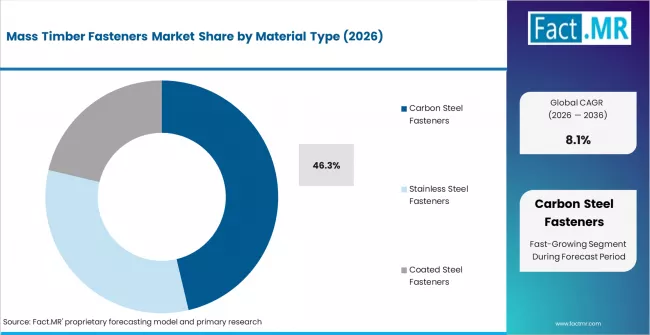
Mass Timber Fasteners Market Analysis By Material Type | Source: Fact.MR
- Market Overview: Carbon steel fasteners are projected to hold 46.3% share of the mass timber fasteners market in 2026. Adoption concentration reflects favorable strength-to-cost characteristics required for structural timber assemblies subjected to high load-bearing requirements. Carbon steel compositions provide mechanical stability across cross laminated timber, glued laminated timber, and hybrid structural systems used in engineered wood construction environments.
- Demand Drivers:
- Structural Load Capacity: Carbon steel fasteners demonstrate tensile strength and shear resistance required to maintain joint integrity across multi-layer engineered timber assemblies.
- Cost Performance Balance: Material availability and standardized manufacturing processes support cost-controlled production of fasteners used in large-scale timber construction applications.
- Design Compatibility: Structural engineering specifications frequently incorporate carbon steel fasteners designed to meet performance requirements across heavy timber framing systems.
Mass Timber Fasteners Market Analysis by Product Type
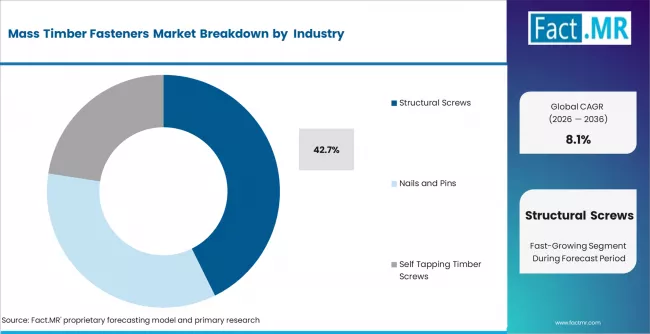
Mass Timber Fasteners Market Analysis By Product Type | Source: Fact.MR
- Market Overview: Structural screws are estimated to account for 42.7% share in 2026, supported by increasing use of engineered fasteners designed to deliver high withdrawal resistance and installation efficiency in mass timber construction. Structural screws enable secure joining of timber elements while reducing need for complex connector assemblies.
- Demand Drivers:
- Installation Efficiency: Structural screws support faster installation compared to traditional bolting systems, improving construction timelines across prefabricated timber building components.
- High Withdrawal Resistance: Engineered screw thread geometries provide strong anchoring performance within dense laminated timber layers used in modern wood construction.
- Compatibility with Prefabrication: Structural screws enable precision fastening in off-site manufactured timber components, supporting assembly efficiency across modular and panelized building systems.
Key Dynamics
Mass Timber Fasteners Market Drivers, Restraints, and Opportunities
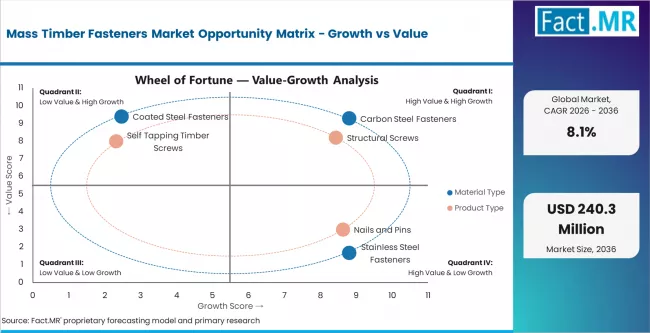
Mass Timber Fasteners Market Opportunity Matrix Growth Vs Value | Source: Fact.MR
Fact MR analysis indicates the market reflects a high-growth structural hardware segment emerging alongside engineered wood construction systems such as cross laminated timber (CLT), glued laminated timber (Glulam), and laminated veneer lumber (LVL). Market size exists because mass timber structural assemblies require specialized high-load fasteners capable of transferring shear, tensile, and moment forces across layered wood panels where conventional nails or bolts lack structural reliability. Historical adoption remained concentrated in Europe due to established timber engineering standards, while recent valuation reflects expansion of prefabricated building methods that require precision-engineered screws, brackets, and threaded rod systems designed for high torque installation and predictable structural performance.
Current dynamics show declining reliance on traditional light-frame fastening methods as construction firms transition toward long structural screws, self-tapping fasteners, and concealed connection systems optimized for high-rise timber construction. Advanced coated and stainless fasteners command higher per-unit pricing due to corrosion resistance and structural certification requirements, while volume growth is tied to expanding CLT adoption across mid-rise residential and commercial buildings. The market reflects a structural shift where engineered fasteners capture greater value per connection due to higher load-bearing requirements and modular construction tolerances.
- Building Code Acceptance: International Building Code (IBC) provisions allowing taller timber structures support adoption of structural fasteners designed for heavy timber load transfer and fire resistance compliance.
- Europe First-Mover Base: Germany, Austria, and Nordic countries maintain strong demand due to mature engineered timber ecosystems and established prefabrication supply chains supporting multi-story wood buildings.
- Structural Performance Upgrade: Shift toward self-tapping screws and steel connector systems increases value intensity per project as fasteners must deliver predictable load paths in CLT and hybrid timber assemblies.
Regional Analysis
The mass timber fasteners market is assessed across Asia Pacific, Europe, and North America, segmented by country-level demand for structural screws, bolts, connectors, and fastening systems used in cross laminated timber, glued laminated timber, and hybrid timber construction. Geographic variation reflects adoption of engineered wood structures, building code updates, and sustainable construction material demand. The full report offers market attractiveness analysis.
.webp "Top Country Growth Comparison Mass Timber Fasteners Market Cagr (2026 2036)")
Top Country Growth Comparison Mass Timber Fasteners Market Cagr (2026 2036) | Source: Fact.MR
CAGR Table
| Country | CAGR (2026–2036) |
|---|---|
| China | 9.4% |
| Germany | 8.8% |
| USA | 8.5% |
| Canada | 8.4% |
| UK | 8.2% |
Source: Fact.MR analysis. Updated May 4, 2026
Source: Fact MR analysis, based on proprietary forecasting model and primary research
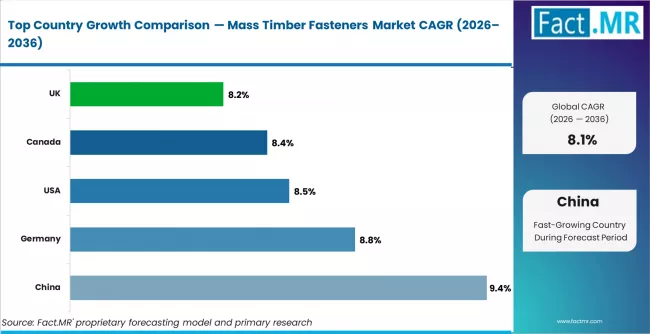
Mass Timber Fasteners Market Cagr Analysis By Country | Source: Fact.MR
Asia Pacific
Asia Pacific functions as the engineered wood construction expansion hub supported by increased adoption of cross laminated timber structures and prefabricated building components. Rothoblaas strengthens structural connector engineering capability. SFS Group expands timber fastener product portfolio depth. Pitzl Metallbau supports heavy-duty connection system innovation.
- China: China is projected to record 9.4% CAGR in mass timber fasteners through 2036. Green Building Action Plan update (Ministry of Housing and Urban-Rural Development, March 2023) supports timber structure adoption. Rothoblaas expanded structural fastener distribution network (June 2023).
Europe
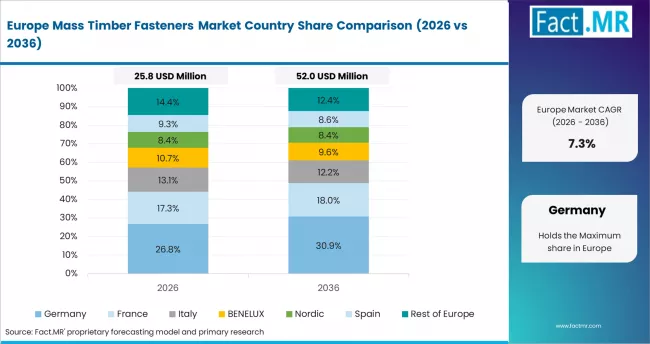
Mass Timber Fasteners Market Europe Country Market Share Analysis, 2026 & 2036 | Source: Fact.MR
Europe operates as the timber engineering regulatory laboratory supported by structured building code frameworks and strong adoption of sustainable construction materials. SFS Group strengthens high-load timber screw development capability. Eurotec GmbH expands structural connector portfolio depth. Würth Group supports engineered wood fastening system innovation.
- Germany: Germany is expected to observe 8.8% CAGR in mass timber fasteners through 2036. Federal timber construction promotion guideline update (Federal Ministry for Housing, January 2023) supports engineered wood building adoption. SFS Group expanded timber fastener production capability (April 2023).
- UK: The UK is anticipated to expand at 8.2% CAGR in mass timber fasteners through 2036. UK Timber in Construction Roadmap update (Department for Environment, Food and Rural Affairs, December 2023) supports cross laminated timber usage expansion. Würth Group expanded engineered wood fastening product availability (May 2023).
North America
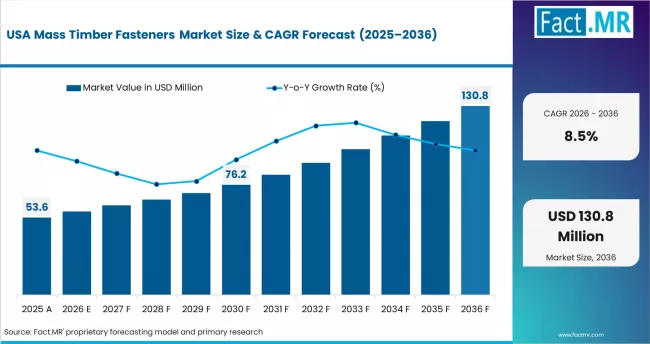
Mass Timber Fasteners Market Country Value Analysis | Source: Fact.MR
North America functions as the commercial timber construction adoption center supported by expansion of mid-rise timber buildings and prefabricated structural components. Simpson Strong-Tie strengthens structural connector engineering expertise. GRK Fasteners expands heavy-duty screw portfolio capability. ITW Construction Products supports timber fastening system innovation.
- USA: The USA is forecast to grow at 8.5% CAGR in mass timber fasteners through 2036. International Building Code update allowing taller mass timber structures (International Code Council, October 2023) supports structural fastener demand. Simpson Strong-Tie expanded structural screw product development capability (August 2023).
- Canada: Canada is projected to register 8.4% CAGR in mass timber fasteners through 2036. Canadian Wood Council tall wood building guideline update (February 2023) supports engineered timber construction growth. GRK Fasteners expanded structural screw production capability (July 2023).
Fact MR's analysis of mass timber fasteners market in global regions consists of country-wise assessment that includes China, Germany, USA, Canada, and UK. Readers can find engineered wood construction trends, fastening technology developments, regulatory positioning frameworks, and competitive structural hardware innovation insights.
Competitive Landscape
What is the Competitive Structure of the Mass Timber Fasteners Market?
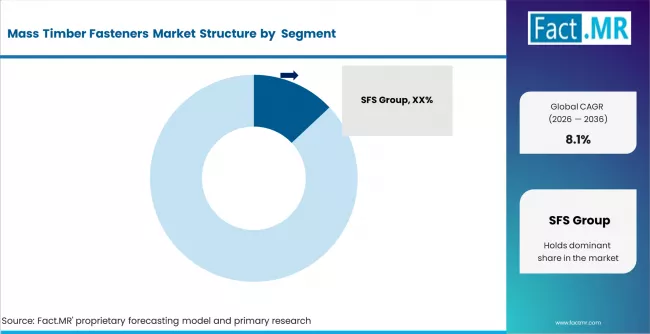
Mass Timber Fasteners Market Analysis By Company | Source: Fact.MR
The Mass Timber Fasteners Market demonstrates a moderately concentrated competitive structure, supported by specialized construction hardware manufacturers with engineering expertise in structural wood connection systems. Leading companies including SFS Group, Rothoblaas, Simpson Strong-Tie, Würth Group, SPAX, and ITW Construction Products collectively account for nearly 60–70% of global market share, particularly in fasteners designed for cross laminated timber and engineered wood construction. Competitive positioning is primarily determined by load-bearing capacity, corrosion resistance, installation efficiency, and compliance with structural certification standards required in commercial timber buildings. Technical differentiation is influenced by proprietary thread geometries, coating technologies, and design compatibility with modern engineered wood materials, creating moderate entry barriers for new participants.
Structural advantages are observed among companies possessing established distribution networks and engineering support capabilities aligned with construction specification requirements. Simpson Strong-Tie and Rothoblaas benefit from strong relationships with structural engineers and contractors involved in mass timber construction projects. Buyers typically manage supplier dependency through specification-based procurement and validation of equivalent fastener performance across approved vendors. Procurement decisions often consider structural certification compliance, installation efficiency, and long-term durability under varying load conditions. Pricing power remains relatively balanced, though suppliers retain moderate leverage where certified performance data and product reliability create switching constraints for construction projects requiring structural safety assurance.
Key Players of the Mass Timber Fasteners Market
- SFS Group
- Rothoblaas
- Simpson Strong-Tie
- SPAX
- GRK Fasteners
- ITW Construction Products
- Mass Timber Connections (MTC)
- Pitzl Metallbau
- Eurotec GmbH
- Würth Group
Bibliographies
- [1] Ministry of Housing and Urban-Rural Development (China). (2023, March). Green Building Action Plan update.
- [2] Federal Ministry for Housing, Urban Development and Building (Germany). (2023, January). Timber construction promotion guideline update.
- [3] International Code Council (USA). (2023, October). International Building Code mass timber provisions.
- [4] Canadian Wood Council. (2023, February). Tall wood building guideline update.
- [5] Department for Environment, Food & Rural Affairs (UK). (2023, December). Timber in Construction Roadmap update.
- [6] Rothoblaas GmbH. (2023, June). Structural fastener distribution network expansion.
- [7] SFS Group AG. (2023, April). Timber fastener production capability expansion.
- [8] Würth Group. (2023, May). Engineered wood fastening product availability expansion.
- [9] Simpson Strong-Tie Company Inc. (2023, August). Structural screw product development capability expansion.
- [10] GRK Canada. (2023, July). Structural screw production capability expansion.
This Report Addresses
- Market size estimation and revenue forecasts from 2026 to 2036, supported by validated construction activity benchmarks and engineered timber adoption indicators across structural building systems.
- Growth opportunity mapping across structural screws, threaded rod systems, self-tapping timber screws, angle brackets, and connector systems aligned with load-bearing timber connection requirements.
- Segment and regional revenue forecasts covering carbon steel, stainless steel, coated steel, and alloy fasteners used in cross laminated timber (CLT), glued laminated timber (Glulam), laminated veneer lumber (LVL), and hybrid timber construction structures.
- Competition strategy assessment including benchmarking of tensile strength performance, corrosion resistance characteristics, and compliance with structural certification standards applicable to engineered wood construction fasteners.
- Regulatory impact analysis covering International Building Code provisions, Eurocode timber engineering standards, and structural load compliance frameworks influencing adoption of engineered fastening systems in timber construction.
- Market report delivery in PDF, Excel, PPT, and structured data formats designed for structural engineers, construction contractors, prefabrication specialists, and fastener manufacturing companies.
- Supply chain vulnerability assessments identifying concentration risks in specialty steel production, coating technology availability, and precision fastener manufacturing capacity supporting engineered timber construction supply chains.
Mass Timber Fasteners Market Definition
The mass timber fasteners market refers to structural fastening components designed to connect engineered wood elements such as cross laminated timber, glued laminated timber, and laminated veneer lumber. These fasteners include screws, bolts, rods, plates, and connectors that provide load transfer, stability, and structural integrity in timber buildings and infrastructure applications.
Mass Timber Fasteners Market Inclusions
The report covers global and regional market size evaluation and forecast outlook across the defined study period. It includes segmentation by product type such as structural screws, bolts, threaded rods, and connectors, applications in CLT, glulam, and hybrid timber structures, and end users in residential, commercial, and institutional construction sectors. Pricing and supply chain assessment are included.
Mass Timber Fasteners Market Exclusions
The scope excludes standard construction fasteners not designed for structural timber loads and non-structural hardware such as nails used for light carpentry. Finished building components such as timber panels and prefabricated modules are not included. The analysis focuses strictly on engineered fasteners used for load-bearing timber connections and reinforcement systems.
Mass Timber Fasteners Market Research Methodology
- Primary Research: Interviews were conducted with fastener manufacturers, engineered wood suppliers, construction engineers, and procurement specialists involved in structural timber building projects.
- Desk Research: Technical standards, engineering publications, trade data, and manufacturer product documentation were reviewed to identify material specifications, connection design approaches, and application demand patterns.
- Market-Sizing and Forecasting: A hybrid model combining bottom-up supplier revenue analysis and top-down evaluation of engineered wood construction demand was applied to estimate market size and growth outlook.
- Data Validation and Update Cycle: Findings were validated through triangulation using engineering standards, supplier technical specifications, and expert consultation. Periodic updates reflect changes in construction codes, material standards, and adoption of mass timber structural systems.
Segmentation
Report Scope
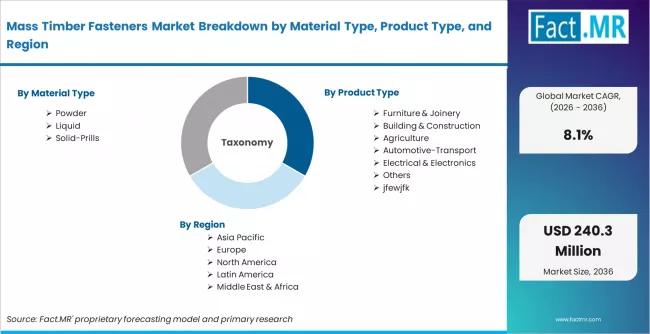
Mass Timber Fasteners Market Breakdown By Material Type, Product Type, And Region | Source: Fact.MR
| Metric | Value |
|---|---|
| Quantitative Units | USD 102 million (2026) to USD 221 million (2036), at a CAGR of 8.1% |
| Market Definition | The mass timber fasteners market includes structural fastening components designed to provide mechanical connectivity and load transfer in engineered wood construction systems. These fasteners are used to secure cross laminated timber, glued laminated timber, and laminated veneer lumber elements in structural frameworks requiring high strength, durability, and dimensional stability across modern timber construction applications. |
| Product Type Segmentation | Structural screws, Bolts & threaded rod systems, Nails & pins, Self-tapping timber screws, Angle brackets & connectors |
| Material Type Segmentation | Carbon steel fasteners, Stainless steel fasteners, Coated steel fasteners, Alloy fasteners |
| Application Segmentation | Cross laminated timber (CLT) structures, Glued laminated timber (Glulam) structures, Laminated veneer lumber (LVL) structures, Hybrid timber structures |
| End Use Segmentation | Residential construction, Commercial construction, Institutional buildings, Industrial buildings |
| Regions Covered | North America, Latin America, Europe, East Asia, South Asia, Oceania, Middle East and Africa |
| Countries Covered | United States, Canada, Mexico, Brazil, Argentina, Germany, France, United Kingdom, Italy, Spain, China, India, Japan, South Korea, Indonesia, Australia, and 40+ countries |
| Key Companies Profiled | SFS Group, Rothoblaas, Simpson Strong-Tie, SPAX, GRK Fasteners, ITW Construction Products, Mass Timber Connections (MTC), Pitzl Metallbau, Eurotec GmbH, Würth Group |
| Forecast Period | 2026 to 2036 |
| Approach | Hybrid top-down and bottom-up market estimation validated through primary interviews with structural fastener manufacturers, engineered wood construction specialists, building system integrators, and distribution channel participants, supported by construction activity benchmarking, trade flow analysis, and capacity assessment across engineered timber building component supply chains |
Source: Fact.MR analysis. Updated May 4, 2026
Mass Timber Fasteners Market Key Segments
-
Product Type:
- Structural Screws
- Bolts and Threaded Rod Systems
- Nails and Pins
- Self Tapping Timber Screws
- Angle Brackets and Connectors
-
Material Type:
- Carbon Steel Fasteners
- Stainless Steel Fasteners
- Coated Steel Fasteners
- Alloy Fasteners
-
Application:
- Cross Laminated Timber Structures
- Glued Laminated Timber Structures
- Laminated Veneer Lumber Structures
- Hybrid Timber Structures
-
End Use:
- Residential Construction
- Commercial Construction
- Institutional Buildings
- Industrial Buildings
-
Region:
-
North America
- USA
- Canada
- Mexico
- Europe
- Germany
- UK
- France
- Italy
- Spain
- Nordic Countries
- BENELUX
- Rest of Europe
- Asia Pacific
- China
- Japan
- South Korea
- India
- Australia
- Rest of Asia Pacific
- Latin America
- Brazil
- Argentina
- Rest of Latin America
- Middle East and Africa
- Kingdom of Saudi Arabia
- United Arab Emirates
- South Africa
- Rest of Middle East and Africa
- Other Regions
- Oceania
- Central Asia
- Other Markets
-
Frequently Asked Questions
How large is the demand for Mass Timber Fasteners in the global market in 2026?
What will be the market size of Mass Timber Fasteners in the global market by 2036?
What is the expected demand growth for Mass Timber Fasteners in the global market between 2026 and 2036?
Which Material Type is poised to lead global demand by 2026?
What is Driving Mass Timber Fastener Demand in China?
What is the China Growth Outlook in this Report?
What is Driving Mass Timber Fastener Demand in Germany?
What is the Germany Growth Outlook in this Report?
What is Driving Mass Timber Fastener Demand in the United States?
What is the United States Growth Outlook in this Report?
What is Driving Mass Timber Fastener Demand in Canada?
What is the Canada Growth Outlook in this Report?
What is Driving Mass Timber Fastener Demand in the United Kingdom?
What is the United Kingdom Growth Outlook in this Report?
Which Companies are Identified as Leading Participants in the Mass Timber Fasteners Market?
What are Mass Timber Fasteners and What are They Mainly Used For?
What does Mass Timber Fasteners Market Mean in this Report?
What is Included in the Scope of this Mass Timber Fasteners Market Report?
What is Excluded from the Scope of this Report?
What does Market Forecast Mean on this Page?
How is the Mass Timber Fasteners Market Forecast Developed in this Report?
What does Data Validation Approach Mean in this Report?
Who worked on this report


Preview the report firsthand - request a free sample
Free SampleGet the brochure for pricing and purchase details
Download PDF