Aluminum Body Panel Fasteners Market (2026 - 2036)
Aluminum Body Panel Fasteners Market Size and Share Forecast Outlook 2026 to 2036
Core Findings
Aluminum Body Panel Fasteners Market Forecast and Outlook 2026 to 2036
Market size for aluminum body panel fasteners is projected to expand from USD 1235.3 million in 2026 to USD 1936.8 million by 2036 at a compound annual growth rate of 4.6% across the forecast period.
Key Takeaways from Aluminum Body Panel Fasteners Market
- Aluminum Body Panel Fasteners Market Value 2026: USD 1235.3 million
- Aluminum Body Panel Fasteners Market Forecast Value 2036: USD 1936.8 millio
- Aluminum Body Panel Fasteners Market Forecast CAGR: 4.6%
- Leading Fastener Type in Aluminum Body Panel Fasteners Market: Self-piercing rivets SPR 35%
- Key Growth Regions in Aluminum Body Panel Fasteners Market: China, India, Mexico, South Korea, Germany, U.S., U.K., Japan
- Key Players in Aluminum Body Panel Fasteners Market: Böllhoff, Stanley Engineered Fastening, LISI Automotive, Würth Automotive, Bossard Group, SFS Group, Bulten, Fontana Gruppo
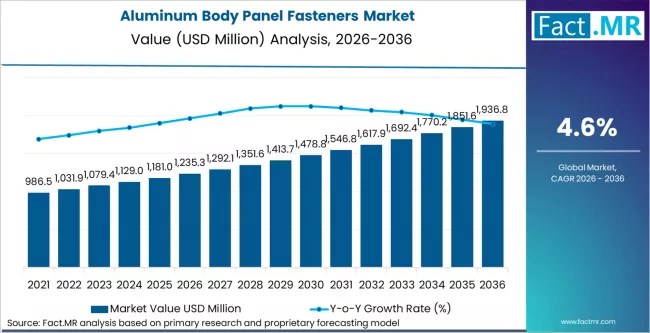
Demand is closely tied to vehicle production and the integration of lightweight aluminum body panels in passenger cars and light commercial vehicles. Fasteners are critical for joining panels while maintaining structural integrity, dimensional accuracy, and corrosion resistance.
Self-piercing rivets remain the most widely used type due to their suitability for joining aluminum sheets without pre-drilling. Aluminum continues to dominate material use, aligning with vehicle weight reduction objectives and performance requirements. Mass-market passenger cars represent the largest vehicle class, with premium passenger vehicles and light commercial vehicles contributing incremental volume.
OEM direct supply accounts for the majority of installations, reflecting factory integration during body assembly, while Tier-1 modules and aftermarket channels support secondary demand and replacement needs. Regional demand patterns mirror automotive production volumes and adoption of lightweight construction across Asia, Europe, and North America. Supplier competition emphasizes fastener durability, precise joint formation, and compatibility with high-speed assembly processes.
Aluminum Body Panel Fasteners Market
| Metric | Value |
|---|---|
| Estimated Value in (2026E) | USD 1,235.3 million |
| Forecast Value in (2036F) | USD 1,936.8 million |
| Forecast CAGR 2026 to 2036 | 4.6% |
Category
| Category | Segments |
|---|---|
| Fastener Type | Self-Piercing Rivets SPR; Flow-Drill Screws; Clinch Nuts and Studs; Other |
| Material | Aluminum; High-Strength Steel; Stainless Steel; Other |
| Vehicle Class | Mass-Market Passenger Cars; Premium Passenger Cars; Light Commercial Vehicles; Other |
| Sales Channel | OEM Direct; Tier-1 Modules; Aftermarket; Other |
| Region | North America; Europe; Asia Pacific; Latin America; Middle East & Africa |
Segmental Analysis
By Fastener Type, Which Segment Holds the Dominant Share in the Aluminum Body Panel Fasteners Market?
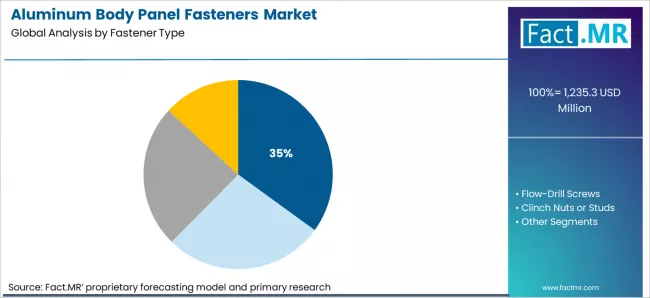
In terms of fastener type, self piercing rivets SPR lead the Aluminum Body Panel Fasteners Market with a 35% share. Aluminum body structures rely on SPR technology to join dissimilar aluminum grades without pre-drilling, supporting panel integrity during forming and crash events. These fasteners enable high-speed assembly while preserving surface quality across exterior closures and structural panels.
- Automotive body shops continue to integrate SPR systems to support mixed-material body architectures.
- With OEMs emphasizing lightweight body construction and repeatable joint strength, SPR remains the preferred fastening solution.
By Material, Which Segment Registers the Highest Share in the Aluminum Body Panel Fasteners Market?
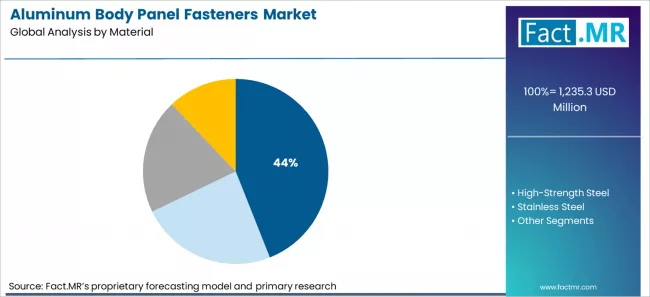
By material, aluminum-based fasteners account for a 44% share. Aluminum fasteners are selected to maintain material compatibility with aluminum panels while reducing galvanic corrosion risk. Their usage supports overall vehicle mass reduction targets while delivering sufficient joint performance for non-load-critical body applications.
- Material selection prioritizes corrosion resistance at exposed exterior interfaces.
- Adoption trends reflect alignment with aluminum-intensive body-in-white designs.
By Vehicle Class, Which Segment Holds the Dominant Share in the Aluminum Body Panel Fasteners Market?
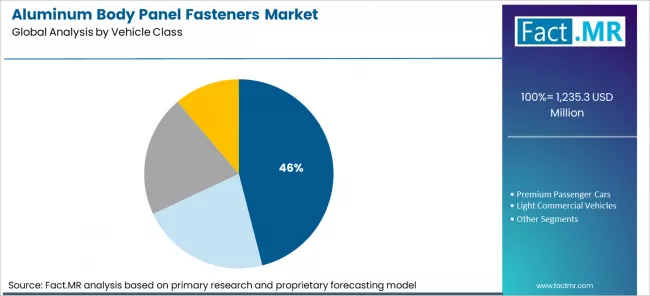
By vehicle class, mass-market passenger cars represent a 46% share. High production volumes and increasing aluminum usage in hoods, doors, and fenders drive sustained fastener demand in this segment. OEMs deploy standardized fastening solutions to support scalability across multiple vehicle platforms.
- Platform commonality supports consistent fastener specifications across large production runs.
- Body lightweighting initiatives continue to reinforce demand within this vehicle class.
By Sales Channel, Which Segment Registers the Highest Share in the Aluminum Body Panel Fasteners Market?
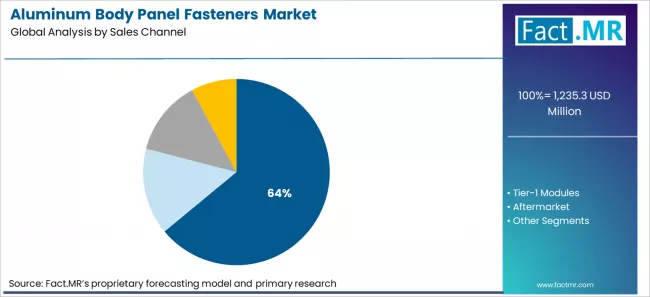
By sales channel, OEM direct supply leads with a 64% share. Aluminum body panel fasteners are integrated during vehicle assembly to ensure dimensional accuracy, surface alignment, and corrosion control. Direct sourcing enables tight coordination between fastener specifications and body panel manufacturing processes.
- Production-linked procurement supports quality consistency across body assembly lines.
- OEM-driven sourcing remains dominant due to validation requirements and warranty accountability.
What are the Drivers, Restraints, and Key Trends of the Aluminum Body Panel Fasteners Market?
- Drivers: Expanding use of aluminum body panels to reduce vehicle weight and improve efficiency drives demand for specialized fastening solutions that support dissimilar material joining, panel stiffness, and surface quality across mass market and premium vehicle platforms.
- Restraint: Higher material costs and complex joining requirements between aluminum and steel structures increase process sensitivity, limiting fastener interchangeability and raising qualification thresholds across OEM body in white operations.
- Trend 1: Rising adoption of self piercing rivets and flow drill screws engineered for aluminum substrates to deliver consistent joint strength, reduced heat input, and improved cosmetic finish in exterior body panel assemblies.
- Trend 2: Continued dominance of OEM direct and Tier 1 module supply channels supported by fasteners optimized for automated body shop integration, corrosion protection, and compatibility with mixed material vehicle architectures.
Analysis of the Aluminum Body Panel Fasteners Market by Key Country
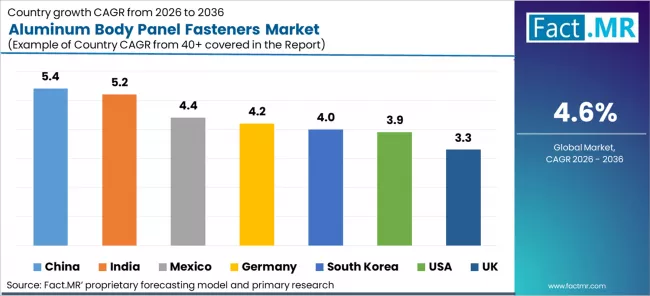
| Country | CAGR |
|---|---|
| China | 5.4% |
| India | 5.2% |
| Germany | 4.2% |
| Mexico | 4.4% |
| South Korea | 4.0% |
| U.S. | 3.9% |
| U.K. | 3.3% |
| Japan | 3.1% |
The report covers an in depth analysis of 8 countries; higher growth markets are highlighted below.
What Is Driving Expansion in the Aluminum Body Panel Fasteners Market in China?
China leads this market with a CAGR of 5.4%, shaped by broad adoption of aluminum intensive body structures across passenger vehicle platforms. Lightweighting targets are accelerating the use of self piercing rivets and flow drill screws in exterior panel assembly. High production volumes reinforce demand for repeatable and high speed fastening solutions. OEM controlled sourcing remains dominant due to tight dimensional and corrosion performance requirements. Demand concentration remains strongest within original equipment body shop operations.
- Expansion of aluminum intensive body architectures is supporting sustained demand for specialized fastening systems.
- High throughput body assembly lines are reinforcing consistent procurement of aluminum compatible fasteners.
How Is India Emerging as a Key Market for Aluminum Body Panel Fasteners?
India is projected to grow at a CAGR of 5.2%, supported by rising use of aluminum panels in mass market passenger vehicles. Body panel fastening requirements are evolving as manufacturers balance cost control with weight reduction targets. Self piercing rivets are increasingly adopted to address mixed material joining needs. Domestic sourcing strategies favor scalable fastening solutions aligned with high volume production. OEM direct channels account for most fastener demand.
- Growing penetration of aluminum body panels is increasing usage of rivet based fastening solutions.
- Expansion of domestic body shop capabilities is supporting stable original equipment demand.
What Factors Influence Aluminum Body Panel Fasteners Demand in Germany?
Germany is forecast to grow at a CAGR of 4.2%, reflecting strong presence of premium vehicle production with aluminum rich exterior designs. Body panel assembly emphasizes tight fit tolerances and surface quality. Fastener selection prioritizes compatibility with aluminum substrates and long term corrosion resistance. Supplier qualification standards remain stringent due to exterior finish requirements. Demand remains concentrated within premium OEM platforms.
- Premium aluminum body construction is driving demand for high precision fastening solutions.
- Emphasis on exterior surface quality is reinforcing use of advanced joining fasteners.
How Does Mexico Support Growth in the Aluminum Body Panel Fasteners Market?
Mexico is expected to expand at a CAGR of 4.4%, driven by export oriented vehicle production serving North American markets. Aluminum body panels are increasingly integrated into standardized global platforms. Fastener demand is shaped by uniform body assembly specifications. Production continuity across assembly plants supports predictable component offtake. OEM and tier one module sourcing dominate procurement.
- Export focused vehicle assembly is sustaining steady demand for aluminum body panel fasteners.
- Platform standardization is reinforcing consistent fastening specifications across body shops.
What Shapes the Aluminum Body Panel Fasteners Market in South Korea?
South Korea is projected to grow at a CAGR of 4.0%, influenced by increasing use of aluminum panels in mid range and premium vehicle models. Body panel joining requires solutions that support mixed material structures. Clinch nuts and studs are adopted selectively for localized reinforcement needs. Close coordination between OEMs and fastener suppliers supports stable sourcing cycles.
- Adoption of mixed material body designs is increasing demand for adaptable fastening solutions.
- Strong OEM supplier alignment is sustaining predictable procurement volumes.
What Demand Patterns Define the U.S. Aluminum Body Panel Fasteners Market?
The U.S. market is expected to expand at a CAGR of 3.9%, supported by steady production of light trucks and passenger vehicles using aluminum exterior panels. Body panel fastening systems must support durability under varied operating conditions. OEM sourcing dominates due to integration with automated body assembly processes. Aftermarket demand remains limited due to long service life of body fasteners.
- Continued use of aluminum panels in light trucks is supporting steady fastener demand.
- Automated body shop processes are reinforcing preference for high consistency fastening systems.
How Is the Aluminum Body Panel Fasteners Market Positioned in the U.K.?
The U.K. is forecast to grow at a CAGR of 3.3%, reflecting production of premium and niche vehicles with aluminum body structures. Body panel fastening requirements emphasize precision and surface integrity. Fastener volumes remain moderate due to lower overall vehicle output. OEM direct sourcing remains the primary demand channel.
- Premium vehicle production is sustaining demand for precision aluminum body fasteners.
- Lower production scale is moderating overall volume growth.
What Conditions Influence Aluminum Body Panel Fasteners Demand in Japan?
Japan is expected to register a CAGR of 3.1%, influenced by gradual adoption of aluminum panels and conservative body design transitions. Steel remains prevalent across many vehicle platforms, limiting aluminum fastener penetration. Where adopted, aluminum panels require proven joining technologies. Demand growth remains measured due to phased material substitution.
- Selective use of aluminum panels is supporting stable but moderate fastener demand.
- Conservative body material strategies are limiting rapid volume expansion.
Competitive Landscape of the Aluminum Body Panel Fasteners Market
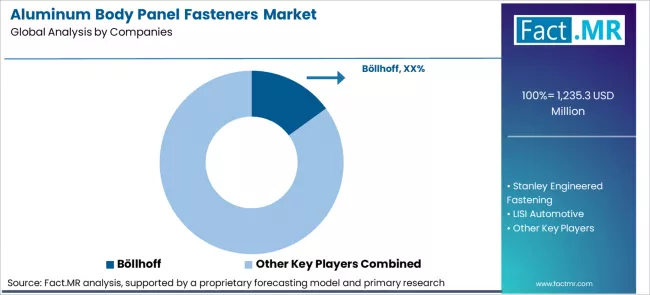
The aluminum body panel fasteners market is shaped by suppliers supporting lightweight vehicle construction, mixed-material joining, and exterior structural integrity. Competitive positioning is driven by fastening solutions that prevent galvanic corrosion, deliver consistent clamp force in thin aluminum panels, and maintain surface quality across visible body areas. Engineering efforts focus on self-piercing joining accuracy, flow-drill performance in aluminum stacks, and fastening systems compatible with high-speed body shop automation.
Market players include Böllhoff, Stanley Engineered Fastening, LISI Automotive, Würth Automotive, Bossard Group, SFS Group, Bulten, and Fontana Gruppo, supplying self-piercing rivets, flow-drill screws, clinch nuts, studs, and structural fasteners for aluminum-intensive body panels. Böllhoff and Stanley Engineered Fastening hold strong positions in SPR and flow-drill technologies for aluminum closures and exterior panels, while LISI Automotive support mixed aluminum and steel architectures across mass-market and premium vehicle programs through OEM-aligned fastening systems.
Key Players in the Aluminum Body Panel Fasteners Market
- Böllhoff
- Stanley Engineered Fastening
- LISI Automotive
- Würth Automotive
- Bossard Group
- SFS Group
- Bulten
- Fontana Gruppo
Scope of the Report
| Items | Values |
|---|---|
| Quantitative Units 2026 | USD 1235.3 Million |
| Fastener Type | Self-piercing rivets for aluminum body panels, Flow-drill screws for mixed-material joints, Clinch nuts and studs for sheet aluminum assemblies |
| Material | Aluminum fasteners, High-strength steel fasteners, Stainless steel fasteners |
| Vehicle Class | Mass-market passenger cars, Premium passenger cars, Light commercial vehicles |
| Sales Channel | OEM direct supply for aluminum body structures, Tier 1 module supply, Aftermarket replacement fasteners |
| Regions Covered | North America, Europe, Asia Pacific, Latin America, Middle East & Africa |
| Countries Covered | China, India, Mexico, South Korea, Germany, U.S., U.K., Japan |
| Key Companies Profiled | Böllhoff, Stanley Engineered Fastening, LISI Automotive, Würth Automotive, Bossard Group, SFS Group, Bulten, Fontana Gruppo |
| Additional Attributes | Dollar revenue by aluminum body panel fastener type, material, vehicle class, and sales channel; regional demand trends; mixed-material body-in-white joining practices; lightweight vehicle architecture adoption; galvanic corrosion mitigation requirements; premium aluminum body fastening strategies |
Aluminum Body Panel Fasteners Market by Segments
-
Fastener Type:
- Self-Piercing Rivets SPR
- Flow-Drill Screws
- Clinch Nuts or Studs
- Other
-
Material:
- Aluminum
- High-Strength Steel
- Stainless Steel
- Other
-
Vehicle Class:
- Mass-Market Passenger Cars
- Premium Passenger Cars
- Light Commercial Vehicles
- Other
-
Sales Channel:
- OEM Direct
- Tier-1 Modules
- Aftermarket
- Other
-
Region:
- North America
- U.S.
- Canada
- Mexico
- Europe
- Germany
- Italy
- UK
- France
- Spain
- Netherlands
- Switzerland
- Rest of Europe
- Asia Pacific
- Japan
- Australia
- South Korea
- China
- India
- Rest of Asia Pacific
- Latin America
- Brazil
- Argentina
- Rest of Latin America
- Middle East and Africa
- United Arab Emirates
- South Africa
- Rest of Middle East and Africa
- North America
Bibliography
- International Organization for Standardization. (2023). Mechanical fastening and joining systems for aluminum and mixed-material automotive body structures: Performance requirements, corrosion behavior, and assembly validation ISO Technical Report. ISO.
- European Committee for Standardization, CEN Technical Committee 301. (2023). Automotive body-in-white joining of aluminum structures: Self-piercing riveting, flow-drill fastening, and clinching performance evaluation EN Technical Report. CEN.
- United States Department of Energy, Vehicle Technologies Office. (2024). Lightweight automotive body technologies and aluminum joining methods for passenger vehicles and light commercial vehicles. U.S. Department of Energy.
- United Nations Economic Commission for Europe, World Forum for Harmonization of Vehicle Regulations. (2023). Structural integrity and fastening requirements for lightweight vehicle body panels under global vehicle safety regulations UN Technical Documentation. UNECE.
- International Aluminium Institute. (2024). Aluminum body panel applications in automotive manufacturing: Joining challenges, corrosion mitigation, and production scalability. International Aluminium Institute.
Table of Content
- Executive Summary
- Global Market Outlook
- Demand to side Trends
- Supply to side Trends
- Technology Roadmap Analysis
- Analysis and Recommendations
- Market Overview
- Market Coverage / Taxonomy
- Market Definition / Scope / Limitations
- Market Background
- Market Dynamics
- Drivers
- Restraints
- Opportunity
- Trends
- Scenario Forecast
- Demand in Optimistic Scenario
- Demand in Likely Scenario
- Demand in Conservative Scenario
- Opportunity Map Analysis
- Product Life Cycle Analysis
- Supply Chain Analysis
- Investment Feasibility Matrix
- Value Chain Analysis
- PESTLE and Porter’s Analysis
- Regulatory Landscape
- Regional Parent Market Outlook
- Production and Consumption Statistics
- Import and Export Statistics
- Market Dynamics
- Global Market Analysis 2021 to 2025 and Forecast, 2026 to 2036
- Historical Market Size Value (USD Million) Analysis, 2021 to 2025
- Current and Future Market Size Value (USD Million) Projections, 2026 to 2036
- Y to o to Y Growth Trend Analysis
- Absolute $ Opportunity Analysis
- Global Market Pricing Analysis 2021 to 2025 and Forecast 2026 to 2036
- Global Market Analysis 2021 to 2025 and Forecast 2026 to 2036, By Fastener Type
- Introduction / Key Findings
- Historical Market Size Value (USD Million) Analysis By Fastener Type, 2021 to 2025
- Current and Future Market Size Value (USD Million) Analysis and Forecast By Fastener Type, 2026 to 2036
- Self-Piercing Rivets SPR
- Flow-Drill Screws
- Clinch Nuts or Studs
- Other
- Self-Piercing Rivets SPR
- Y to o to Y Growth Trend Analysis By Fastener Type, 2021 to 2025
- Absolute $ Opportunity Analysis By Fastener Type, 2026 to 2036
- Global Market Analysis 2021 to 2025 and Forecast 2026 to 2036, By Material
- Introduction / Key Findings
- Historical Market Size Value (USD Million) Analysis By Material, 2021 to 2025
- Current and Future Market Size Value (USD Million) Analysis and Forecast By Material, 2026 to 2036
- Aluminum
- High-Strength Steel
- Stainless Steel
- Other
- Aluminum
- Y to o to Y Growth Trend Analysis By Material, 2021 to 2025
- Absolute $ Opportunity Analysis By Material, 2026 to 2036
- Global Market Analysis 2021 to 2025 and Forecast 2026 to 2036, By Vehicle Class
- Introduction / Key Findings
- Historical Market Size Value (USD Million) Analysis By Vehicle Class, 2021 to 2025
- Current and Future Market Size Value (USD Million) Analysis and Forecast By Vehicle Class, 2026 to 2036
- Mass-Market Passenger Cars
- Premium Passenger Cars
- Light Commercial Vehicles
- Other
- Mass-Market Passenger Cars
- Y to o to Y Growth Trend Analysis By Vehicle Class, 2021 to 2025
- Absolute $ Opportunity Analysis By Vehicle Class, 2026 to 2036
- Global Market Analysis 2021 to 2025 and Forecast 2026 to 2036, By Sales Channel
- Introduction / Key Findings
- Historical Market Size Value (USD Million) Analysis By Sales Channel, 2021 to 2025
- Current and Future Market Size Value (USD Million) Analysis and Forecast By Sales Channel, 2026 to 2036
- OEM Direct
- Tier-1 Modules
- Aftermarket
- Other
- OEM Direct
- Y to o to Y Growth Trend Analysis By Sales Channel, 2021 to 2025
- Absolute $ Opportunity Analysis By Sales Channel, 2026 to 2036
- Global Market Analysis 2021 to 2025 and Forecast 2026 to 2036, By Region
- Introduction
- Historical Market Size Value (USD Million) Analysis By Region, 2021 to 2025
- Current Market Size Value (USD Million) Analysis and Forecast By Region, 2026 to 2036
- North America
- Latin America
- Western Europe
- Eastern Europe
- East Asia
- South Asia and Pacific
- Middle East & Africa
- Market Attractiveness Analysis By Region
- North America Market Analysis 2021 to 2025 and Forecast 2026 to 2036, By Country
- Historical Market Size Value (USD Million) Trend Analysis By Market Taxonomy, 2021 to 2025
- Market Size Value (USD Million) Forecast By Market Taxonomy, 2026 to 2036
- By Country
- USA
- Canada
- Mexico
- By Fastener Type
- By Material
- By Vehicle Class
- By Sales Channel
- By Country
- Market Attractiveness Analysis
- By Country
- By Fastener Type
- By Material
- By Vehicle Class
- By Sales Channel
- Key Takeaways
- Latin America Market Analysis 2021 to 2025 and Forecast 2026 to 2036, By Country
- Historical Market Size Value (USD Million) Trend Analysis By Market Taxonomy, 2021 to 2025
- Market Size Value (USD Million) Forecast By Market Taxonomy, 2026 to 2036
- By Country
- Brazil
- Chile
- Rest of Latin America
- By Fastener Type
- By Material
- By Vehicle Class
- By Sales Channel
- By Country
- Market Attractiveness Analysis
- By Country
- By Fastener Type
- By Material
- By Vehicle Class
- By Sales Channel
- Key Takeaways
- Western Europe Market Analysis 2021 to 2025 and Forecast 2026 to 2036, By Country
- Historical Market Size Value (USD Million) Trend Analysis By Market Taxonomy, 2021 to 2025
- Market Size Value (USD Million) Forecast By Market Taxonomy, 2026 to 2036
- By Country
- Germany
- UK
- Italy
- Spain
- France
- Nordic
- BENELUX
- Rest of Western Europe
- By Fastener Type
- By Material
- By Vehicle Class
- By Sales Channel
- By Country
- Market Attractiveness Analysis
- By Country
- By Fastener Type
- By Material
- By Vehicle Class
- By Sales Channel
- Key Takeaways
- Eastern Europe Market Analysis 2021 to 2025 and Forecast 2026 to 2036, By Country
- Historical Market Size Value (USD Million) Trend Analysis By Market Taxonomy, 2021 to 2025
- Market Size Value (USD Million) Forecast By Market Taxonomy, 2026 to 2036
- By Country
- Russia
- Poland
- Hungary
- Balkan & Baltic
- Rest of Eastern Europe
- By Fastener Type
- By Material
- By Vehicle Class
- By Sales Channel
- By Country
- Market Attractiveness Analysis
- By Country
- By Fastener Type
- By Material
- By Vehicle Class
- By Sales Channel
- Key Takeaways
- East Asia Market Analysis 2021 to 2025 and Forecast 2026 to 2036, By Country
- Historical Market Size Value (USD Million) Trend Analysis By Market Taxonomy, 2021 to 2025
- Market Size Value (USD Million) Forecast By Market Taxonomy, 2026 to 2036
- By Country
- China
- Japan
- South Korea
- By Fastener Type
- By Material
- By Vehicle Class
- By Sales Channel
- By Country
- Market Attractiveness Analysis
- By Country
- By Fastener Type
- By Material
- By Vehicle Class
- By Sales Channel
- Key Takeaways
- South Asia and Pacific Market Analysis 2021 to 2025 and Forecast 2026 to 2036, By Country
- Historical Market Size Value (USD Million) Trend Analysis By Market Taxonomy, 2021 to 2025
- Market Size Value (USD Million) Forecast By Market Taxonomy, 2026 to 2036
- By Country
- India
- ASEAN
- Australia & New Zealand
- Rest of South Asia and Pacific
- By Fastener Type
- By Material
- By Vehicle Class
- By Sales Channel
- By Country
- Market Attractiveness Analysis
- By Country
- By Fastener Type
- By Material
- By Vehicle Class
- By Sales Channel
- Key Takeaways
- Middle East & Africa Market Analysis 2021 to 2025 and Forecast 2026 to 2036, By Country
- Historical Market Size Value (USD Million) Trend Analysis By Market Taxonomy, 2021 to 2025
- Market Size Value (USD Million) Forecast By Market Taxonomy, 2026 to 2036
- By Country
- Kingdom of Saudi Arabia
- Other GCC Countries
- Turkiye
- South Africa
- Other African Union
- Rest of Middle East & Africa
- By Fastener Type
- By Material
- By Vehicle Class
- By Sales Channel
- By Country
- Market Attractiveness Analysis
- By Country
- By Fastener Type
- By Material
- By Vehicle Class
- By Sales Channel
- Key Takeaways
- Key Countries Market Analysis
- USA
- Pricing Analysis
- Market Share Analysis, 2025
- By Fastener Type
- By Material
- By Vehicle Class
- By Sales Channel
- Canada
- Pricing Analysis
- Market Share Analysis, 2025
- By Fastener Type
- By Material
- By Vehicle Class
- By Sales Channel
- Mexico
- Pricing Analysis
- Market Share Analysis, 2025
- By Fastener Type
- By Material
- By Vehicle Class
- By Sales Channel
- Brazil
- Pricing Analysis
- Market Share Analysis, 2025
- By Fastener Type
- By Material
- By Vehicle Class
- By Sales Channel
- Chile
- Pricing Analysis
- Market Share Analysis, 2025
- By Fastener Type
- By Material
- By Vehicle Class
- By Sales Channel
- Germany
- Pricing Analysis
- Market Share Analysis, 2025
- By Fastener Type
- By Material
- By Vehicle Class
- By Sales Channel
- UK
- Pricing Analysis
- Market Share Analysis, 2025
- By Fastener Type
- By Material
- By Vehicle Class
- By Sales Channel
- Italy
- Pricing Analysis
- Market Share Analysis, 2025
- By Fastener Type
- By Material
- By Vehicle Class
- By Sales Channel
- Spain
- Pricing Analysis
- Market Share Analysis, 2025
- By Fastener Type
- By Material
- By Vehicle Class
- By Sales Channel
- France
- Pricing Analysis
- Market Share Analysis, 2025
- By Fastener Type
- By Material
- By Vehicle Class
- By Sales Channel
- India
- Pricing Analysis
- Market Share Analysis, 2025
- By Fastener Type
- By Material
- By Vehicle Class
- By Sales Channel
- ASEAN
- Pricing Analysis
- Market Share Analysis, 2025
- By Fastener Type
- By Material
- By Vehicle Class
- By Sales Channel
- Australia & New Zealand
- Pricing Analysis
- Market Share Analysis, 2025
- By Fastener Type
- By Material
- By Vehicle Class
- By Sales Channel
- China
- Pricing Analysis
- Market Share Analysis, 2025
- By Fastener Type
- By Material
- By Vehicle Class
- By Sales Channel
- Japan
- Pricing Analysis
- Market Share Analysis, 2025
- By Fastener Type
- By Material
- By Vehicle Class
- By Sales Channel
- South Korea
- Pricing Analysis
- Market Share Analysis, 2025
- By Fastener Type
- By Material
- By Vehicle Class
- By Sales Channel
- Russia
- Pricing Analysis
- Market Share Analysis, 2025
- By Fastener Type
- By Material
- By Vehicle Class
- By Sales Channel
- Poland
- Pricing Analysis
- Market Share Analysis, 2025
- By Fastener Type
- By Material
- By Vehicle Class
- By Sales Channel
- Hungary
- Pricing Analysis
- Market Share Analysis, 2025
- By Fastener Type
- By Material
- By Vehicle Class
- By Sales Channel
- Kingdom of Saudi Arabia
- Pricing Analysis
- Market Share Analysis, 2025
- By Fastener Type
- By Material
- By Vehicle Class
- By Sales Channel
- Turkiye
- Pricing Analysis
- Market Share Analysis, 2025
- By Fastener Type
- By Material
- By Vehicle Class
- By Sales Channel
- South Africa
- Pricing Analysis
- Market Share Analysis, 2025
- By Fastener Type
- By Material
- By Vehicle Class
- By Sales Channel
- USA
- Market Structure Analysis
- Competition Dashboard
- Competition Benchmarking
- Market Share Analysis of Top Players
- By Regional
- By Fastener Type
- By Material
- By Vehicle Class
- By Sales Channel
- Competition Analysis
- Competition Deep Dive
- Böllhoff
- Overview
- Product Portfolio
- Profitability by Market Segments (Product/Age /Sales Channel/Region)
- Sales Footprint
- Strategy Overview
- Marketing Strategy
- Product Strategy
- Channel Strategy
- Stanley Engineered Fastening
- LISI Automotive
- KAMAX
- Würth Automotive
- Bossard Group
- SFS Group
- PennEngineering
- Bulten
- Fontana Gruppo
- Böllhoff
- Competition Deep Dive
- Assumptions & Acronyms Used
- Research Methodology
List Of Table
- Table 1: Global Market Value (USD Million) Forecast by Region, 2021 to 2036
- Table 2: Global Market Value (USD Million) Forecast by Fastener Type, 2021 to 2036
- Table 3: Global Market Value (USD Million) Forecast by Material, 2021 to 2036
- Table 4: Global Market Value (USD Million) Forecast by Vehicle Class, 2021 to 2036
- Table 5: Global Market Value (USD Million) Forecast by Sales Channel, 2021 to 2036
- Table 6: North America Market Value (USD Million) Forecast by Country, 2021 to 2036
- Table 7: North America Market Value (USD Million) Forecast by Fastener Type, 2021 to 2036
- Table 8: North America Market Value (USD Million) Forecast by Material, 2021 to 2036
- Table 9: North America Market Value (USD Million) Forecast by Vehicle Class, 2021 to 2036
- Table 10: North America Market Value (USD Million) Forecast by Sales Channel, 2021 to 2036
- Table 11: Latin America Market Value (USD Million) Forecast by Country, 2021 to 2036
- Table 12: Latin America Market Value (USD Million) Forecast by Fastener Type, 2021 to 2036
- Table 13: Latin America Market Value (USD Million) Forecast by Material, 2021 to 2036
- Table 14: Latin America Market Value (USD Million) Forecast by Vehicle Class, 2021 to 2036
- Table 15: Latin America Market Value (USD Million) Forecast by Sales Channel, 2021 to 2036
- Table 16: Western Europe Market Value (USD Million) Forecast by Country, 2021 to 2036
- Table 17: Western Europe Market Value (USD Million) Forecast by Fastener Type, 2021 to 2036
- Table 18: Western Europe Market Value (USD Million) Forecast by Material, 2021 to 2036
- Table 19: Western Europe Market Value (USD Million) Forecast by Vehicle Class, 2021 to 2036
- Table 20: Western Europe Market Value (USD Million) Forecast by Sales Channel, 2021 to 2036
- Table 21: Eastern Europe Market Value (USD Million) Forecast by Country, 2021 to 2036
- Table 22: Eastern Europe Market Value (USD Million) Forecast by Fastener Type, 2021 to 2036
- Table 23: Eastern Europe Market Value (USD Million) Forecast by Material, 2021 to 2036
- Table 24: Eastern Europe Market Value (USD Million) Forecast by Vehicle Class, 2021 to 2036
- Table 25: Eastern Europe Market Value (USD Million) Forecast by Sales Channel, 2021 to 2036
- Table 26: East Asia Market Value (USD Million) Forecast by Country, 2021 to 2036
- Table 27: East Asia Market Value (USD Million) Forecast by Fastener Type, 2021 to 2036
- Table 28: East Asia Market Value (USD Million) Forecast by Material, 2021 to 2036
- Table 29: East Asia Market Value (USD Million) Forecast by Vehicle Class, 2021 to 2036
- Table 30: East Asia Market Value (USD Million) Forecast by Sales Channel, 2021 to 2036
- Table 31: South Asia and Pacific Market Value (USD Million) Forecast by Country, 2021 to 2036
- Table 32: South Asia and Pacific Market Value (USD Million) Forecast by Fastener Type, 2021 to 2036
- Table 33: South Asia and Pacific Market Value (USD Million) Forecast by Material, 2021 to 2036
- Table 34: South Asia and Pacific Market Value (USD Million) Forecast by Vehicle Class, 2021 to 2036
- Table 35: South Asia and Pacific Market Value (USD Million) Forecast by Sales Channel, 2021 to 2036
- Table 36: Middle East & Africa Market Value (USD Million) Forecast by Country, 2021 to 2036
- Table 37: Middle East & Africa Market Value (USD Million) Forecast by Fastener Type, 2021 to 2036
- Table 38: Middle East & Africa Market Value (USD Million) Forecast by Material, 2021 to 2036
- Table 39: Middle East & Africa Market Value (USD Million) Forecast by Vehicle Class, 2021 to 2036
- Table 40: Middle East & Africa Market Value (USD Million) Forecast by Sales Channel, 2021 to 2036
List Of Figures
- Figure 1: Global Market Pricing Analysis
- Figure 2: Global Market Value (USD Million) Forecast 2021 to 2036
- Figure 3: Global Market Value Share and BPS Analysis by Fastener Type, 2026 and 2036
- Figure 4: Global Market Y to o to Y Growth Comparison by Fastener Type, 2026 to 2036
- Figure 5: Global Market Attractiveness Analysis by Fastener Type
- Figure 6: Global Market Value Share and BPS Analysis by Material, 2026 and 2036
- Figure 7: Global Market Y to o to Y Growth Comparison by Material, 2026 to 2036
- Figure 8: Global Market Attractiveness Analysis by Material
- Figure 9: Global Market Value Share and BPS Analysis by Vehicle Class, 2026 and 2036
- Figure 10: Global Market Y to o to Y Growth Comparison by Vehicle Class, 2026 to 2036
- Figure 11: Global Market Attractiveness Analysis by Vehicle Class
- Figure 12: Global Market Value Share and BPS Analysis by Sales Channel, 2026 and 2036
- Figure 13: Global Market Y to o to Y Growth Comparison by Sales Channel, 2026 to 2036
- Figure 14: Global Market Attractiveness Analysis by Sales Channel
- Figure 15: Global Market Value (USD Million) Share and BPS Analysis by Region, 2026 and 2036
- Figure 16: Global Market Y to o to Y Growth Comparison by Region, 2026 to 2036
- Figure 17: Global Market Attractiveness Analysis by Region
- Figure 18: North America Market Incremental Dollar Opportunity, 2026 to 2036
- Figure 19: Latin America Market Incremental Dollar Opportunity, 2026 to 2036
- Figure 20: Western Europe Market Incremental Dollar Opportunity, 2026 to 2036
- Figure 21: Eastern Europe Market Incremental Dollar Opportunity, 2026 to 2036
- Figure 22: East Asia Market Incremental Dollar Opportunity, 2026 to 2036
- Figure 23: South Asia and Pacific Market Incremental Dollar Opportunity, 2026 to 2036
- Figure 24: Middle East & Africa Market Incremental Dollar Opportunity, 2026 to 2036
- Figure 25: North America Market Value Share and BPS Analysis by Country, 2026 and 2036
- Figure 26: North America Market Value Share and BPS Analysis by Fastener Type, 2026 and 2036
- Figure 27: North America Market Y to o to Y Growth Comparison by Fastener Type, 2026 to 2036
- Figure 28: North America Market Attractiveness Analysis by Fastener Type
- Figure 29: North America Market Value Share and BPS Analysis by Material, 2026 and 2036
- Figure 30: North America Market Y to o to Y Growth Comparison by Material, 2026 to 2036
- Figure 31: North America Market Attractiveness Analysis by Material
- Figure 32: North America Market Value Share and BPS Analysis by Vehicle Class, 2026 and 2036
- Figure 33: North America Market Y to o to Y Growth Comparison by Vehicle Class, 2026 to 2036
- Figure 34: North America Market Attractiveness Analysis by Vehicle Class
- Figure 35: North America Market Value Share and BPS Analysis by Sales Channel, 2026 and 2036
- Figure 36: North America Market Y to o to Y Growth Comparison by Sales Channel, 2026 to 2036
- Figure 37: North America Market Attractiveness Analysis by Sales Channel
- Figure 38: Latin America Market Value Share and BPS Analysis by Country, 2026 and 2036
- Figure 39: Latin America Market Value Share and BPS Analysis by Fastener Type, 2026 and 2036
- Figure 40: Latin America Market Y to o to Y Growth Comparison by Fastener Type, 2026 to 2036
- Figure 41: Latin America Market Attractiveness Analysis by Fastener Type
- Figure 42: Latin America Market Value Share and BPS Analysis by Material, 2026 and 2036
- Figure 43: Latin America Market Y to o to Y Growth Comparison by Material, 2026 to 2036
- Figure 44: Latin America Market Attractiveness Analysis by Material
- Figure 45: Latin America Market Value Share and BPS Analysis by Vehicle Class, 2026 and 2036
- Figure 46: Latin America Market Y to o to Y Growth Comparison by Vehicle Class, 2026 to 2036
- Figure 47: Latin America Market Attractiveness Analysis by Vehicle Class
- Figure 48: Latin America Market Value Share and BPS Analysis by Sales Channel, 2026 and 2036
- Figure 49: Latin America Market Y to o to Y Growth Comparison by Sales Channel, 2026 to 2036
- Figure 50: Latin America Market Attractiveness Analysis by Sales Channel
- Figure 51: Western Europe Market Value Share and BPS Analysis by Country, 2026 and 2036
- Figure 52: Western Europe Market Value Share and BPS Analysis by Fastener Type, 2026 and 2036
- Figure 53: Western Europe Market Y to o to Y Growth Comparison by Fastener Type, 2026 to 2036
- Figure 54: Western Europe Market Attractiveness Analysis by Fastener Type
- Figure 55: Western Europe Market Value Share and BPS Analysis by Material, 2026 and 2036
- Figure 56: Western Europe Market Y to o to Y Growth Comparison by Material, 2026 to 2036
- Figure 57: Western Europe Market Attractiveness Analysis by Material
- Figure 58: Western Europe Market Value Share and BPS Analysis by Vehicle Class, 2026 and 2036
- Figure 59: Western Europe Market Y to o to Y Growth Comparison by Vehicle Class, 2026 to 2036
- Figure 60: Western Europe Market Attractiveness Analysis by Vehicle Class
- Figure 61: Western Europe Market Value Share and BPS Analysis by Sales Channel, 2026 and 2036
- Figure 62: Western Europe Market Y to o to Y Growth Comparison by Sales Channel, 2026 to 2036
- Figure 63: Western Europe Market Attractiveness Analysis by Sales Channel
- Figure 64: Eastern Europe Market Value Share and BPS Analysis by Country, 2026 and 2036
- Figure 65: Eastern Europe Market Value Share and BPS Analysis by Fastener Type, 2026 and 2036
- Figure 66: Eastern Europe Market Y to o to Y Growth Comparison by Fastener Type, 2026 to 2036
- Figure 67: Eastern Europe Market Attractiveness Analysis by Fastener Type
- Figure 68: Eastern Europe Market Value Share and BPS Analysis by Material, 2026 and 2036
- Figure 69: Eastern Europe Market Y to o to Y Growth Comparison by Material, 2026 to 2036
- Figure 70: Eastern Europe Market Attractiveness Analysis by Material
- Figure 71: Eastern Europe Market Value Share and BPS Analysis by Vehicle Class, 2026 and 2036
- Figure 72: Eastern Europe Market Y to o to Y Growth Comparison by Vehicle Class, 2026 to 2036
- Figure 73: Eastern Europe Market Attractiveness Analysis by Vehicle Class
- Figure 74: Eastern Europe Market Value Share and BPS Analysis by Sales Channel, 2026 and 2036
- Figure 75: Eastern Europe Market Y to o to Y Growth Comparison by Sales Channel, 2026 to 2036
- Figure 76: Eastern Europe Market Attractiveness Analysis by Sales Channel
- Figure 77: East Asia Market Value Share and BPS Analysis by Country, 2026 and 2036
- Figure 78: East Asia Market Value Share and BPS Analysis by Fastener Type, 2026 and 2036
- Figure 79: East Asia Market Y to o to Y Growth Comparison by Fastener Type, 2026 to 2036
- Figure 80: East Asia Market Attractiveness Analysis by Fastener Type
- Figure 81: East Asia Market Value Share and BPS Analysis by Material, 2026 and 2036
- Figure 82: East Asia Market Y to o to Y Growth Comparison by Material, 2026 to 2036
- Figure 83: East Asia Market Attractiveness Analysis by Material
- Figure 84: East Asia Market Value Share and BPS Analysis by Vehicle Class, 2026 and 2036
- Figure 85: East Asia Market Y to o to Y Growth Comparison by Vehicle Class, 2026 to 2036
- Figure 86: East Asia Market Attractiveness Analysis by Vehicle Class
- Figure 87: East Asia Market Value Share and BPS Analysis by Sales Channel, 2026 and 2036
- Figure 88: East Asia Market Y to o to Y Growth Comparison by Sales Channel, 2026 to 2036
- Figure 89: East Asia Market Attractiveness Analysis by Sales Channel
- Figure 90: South Asia and Pacific Market Value Share and BPS Analysis by Country, 2026 and 2036
- Figure 91: South Asia and Pacific Market Value Share and BPS Analysis by Fastener Type, 2026 and 2036
- Figure 92: South Asia and Pacific Market Y to o to Y Growth Comparison by Fastener Type, 2026 to 2036
- Figure 93: South Asia and Pacific Market Attractiveness Analysis by Fastener Type
- Figure 94: South Asia and Pacific Market Value Share and BPS Analysis by Material, 2026 and 2036
- Figure 95: South Asia and Pacific Market Y to o to Y Growth Comparison by Material, 2026 to 2036
- Figure 96: South Asia and Pacific Market Attractiveness Analysis by Material
- Figure 97: South Asia and Pacific Market Value Share and BPS Analysis by Vehicle Class, 2026 and 2036
- Figure 98: South Asia and Pacific Market Y to o to Y Growth Comparison by Vehicle Class, 2026 to 2036
- Figure 99: South Asia and Pacific Market Attractiveness Analysis by Vehicle Class
- Figure 100: South Asia and Pacific Market Value Share and BPS Analysis by Sales Channel, 2026 and 2036
- Figure 101: South Asia and Pacific Market Y to o to Y Growth Comparison by Sales Channel, 2026 to 2036
- Figure 102: South Asia and Pacific Market Attractiveness Analysis by Sales Channel
- Figure 103: Middle East & Africa Market Value Share and BPS Analysis by Country, 2026 and 2036
- Figure 104: Middle East & Africa Market Value Share and BPS Analysis by Fastener Type, 2026 and 2036
- Figure 105: Middle East & Africa Market Y to o to Y Growth Comparison by Fastener Type, 2026 to 2036
- Figure 106: Middle East & Africa Market Attractiveness Analysis by Fastener Type
- Figure 107: Middle East & Africa Market Value Share and BPS Analysis by Material, 2026 and 2036
- Figure 108: Middle East & Africa Market Y to o to Y Growth Comparison by Material, 2026 to 2036
- Figure 109: Middle East & Africa Market Attractiveness Analysis by Material
- Figure 110: Middle East & Africa Market Value Share and BPS Analysis by Vehicle Class, 2026 and 2036
- Figure 111: Middle East & Africa Market Y to o to Y Growth Comparison by Vehicle Class, 2026 to 2036
- Figure 112: Middle East & Africa Market Attractiveness Analysis by Vehicle Class
- Figure 113: Middle East & Africa Market Value Share and BPS Analysis by Sales Channel, 2026 and 2036
- Figure 114: Middle East & Africa Market Y to o to Y Growth Comparison by Sales Channel, 2026 to 2036
- Figure 115: Middle East & Africa Market Attractiveness Analysis by Sales Channel
- Figure 116: Global Market - Tier Structure Analysis
- Figure 117: Global Market - Company Share Analysis
- FAQs -
How big is the aluminum body panel fasteners market in 2026?
The global aluminum body panel fasteners market is estimated to be valued at USD 1,235.3 million in 2026.
What will be the size of aluminum body panel fasteners market in 2036?
The market size for the aluminum body panel fasteners market is projected to reach USD 1,936.8 million by 2036.
How much will be the aluminum body panel fasteners market growth between 2026 and 2036?
The aluminum body panel fasteners market is expected to grow at a 4.6% CAGR between 2026 and 2036.
What are the key product types in the aluminum body panel fasteners market?
The key product types in aluminum body panel fasteners market are self-piercing rivets spr, flow-drill screws, clinch nuts or studs and other.
Which material segment to contribute significant share in the aluminum body panel fasteners market in 2026?
In terms of material, aluminum segment to command 44.0% share in the aluminum body panel fasteners market in 2026.