Crash Structure and Bumper Fasteners Market (2026 - 2036)
Crash Structure and Bumper Fasteners Market Size and Share Forecast Outlook 2026 to 2036
Core Findings
Crash Structure and Bumper Fasteners Market Forecast and Outlook 2026 to 2036
Revenue from crash structure and bumper fasteners market is expected to grow steadily from USD 1019.2 million in 2026 to USD 1523.2 million by 2036, reflecting a compound annual growth rate of 4.10%.
Key Takeaways from Crash Structure and Bumper Fasteners Market
- Crash Structure and Bumper Fasteners Market Value 2026: USD 1019.2 million
- Crash Structure and Bumper Fasteners Market Forecast Value 2036: USD 1523.2 million
- Crash Structure and Bumper Fasteners Market Forecast CAGR: 4.10%
- Leading Fastener Type: High-tensile bolts 41%
- Leading Component: Bumper beams 38%
- Key Growth Regions: India, China, Mexico, Brazil, U.S., South Korea, Germany, Japan
- Key Players: KAMAX, LISI Automotive, Stanley Engineered Fastening, Bulten, Fontana Gruppo, Würth Automotive, SFS Group, Meidoh, Bossard Group, ITW Automotive
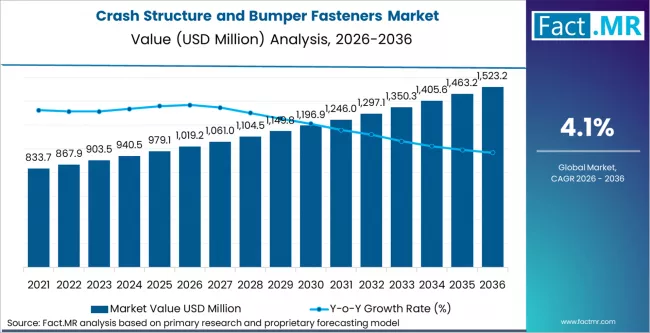
Growth is supported by vehicle manufacturers implementing stricter safety standards and adopting advanced front-end designs. These fasteners secure bumper beams, crash boxes, and other structural components that absorb collision energy, ensuring passenger protection during impacts.
High-tensile bolts lead usage because they can withstand extreme forces while maintaining joint integrity. Bumper beams account for the largest share of applications, reflecting their role as the primary energy-absorbing structures at the vehicle front. Material selection prioritizes mechanical strength and energy absorption, with high-strength steel dominating, while aluminum and stainless steel are used in weight-sensitive or corrosion-prone areas.
OEM direct supply channels handle most installations during vehicle assembly, whereas Tier-1 modules and aftermarket service support replacement and repair activities. Demand growth is strongest in India and China due to rising vehicle production, while mature regions such as the U.S., Germany, and Japan maintain consistent adoption. Suppliers focus on precise tolerances, load-bearing performance, and adherence to evolving safety regulations, highlighting the essential role these fasteners play in vehicle crashworthiness.
Crash Structure and Bumper Fasteners Market
| Metric | Value |
|---|---|
| Estimated Value in (2026E) | USD 1,019.2 million |
| Forecast Value in (2036F) | USD 1,523.2 million |
| Forecast CAGR 2026 to 2036 | 4.1% |
Category
| Category | Segments |
|---|---|
| Fastener Type | High-Tensile Bolts; Structural Rivets; Weld Studs; Other |
| Component | Bumper Beams; Crash Boxes; Front-End Attachments; Other |
| Material | High-Strength Steel; Aluminum; Stainless Steel; Other |
| Sales Channel | OEM Direct; Tier-1 Modules; Aftermarket; Other |
| Region | North America; Europe; Asia Pacific; Latin America; Middle East & Africa |
Segmental Analysis
By Fastener Type, Which Segment Holds the Dominant Share in the Crash Structure and Bumper Fasteners Market?
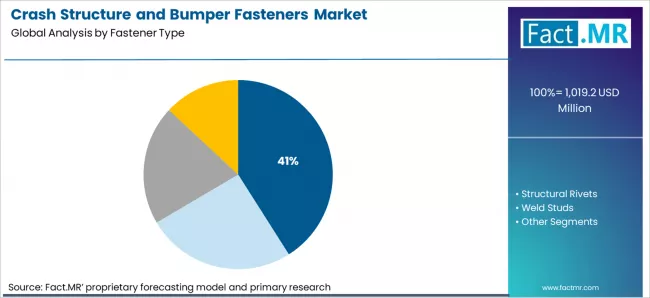
In terms of fastener type, high-tensile bolts lead the Crash Structure and Bumper Fasteners Market with a 41% share. Crash load paths within bumper systems rely on these bolts to secure bumper beams, crush cans, and mounting brackets to longitudinal members. Their role centers on maintaining joint integrity during low-speed impacts and controlled deformation during higher energy collisions.
- Vehicle front-end designs increasingly specify high-tensile bolts to manage load transfer during crash pulse progression.
- Rising bumper system complexity reinforces demand for fasteners capable of sustaining high shear and tensile forces.
By Component, Which Segment Registers the Highest Share in the Crash Structure and Bumper Fasteners Market?
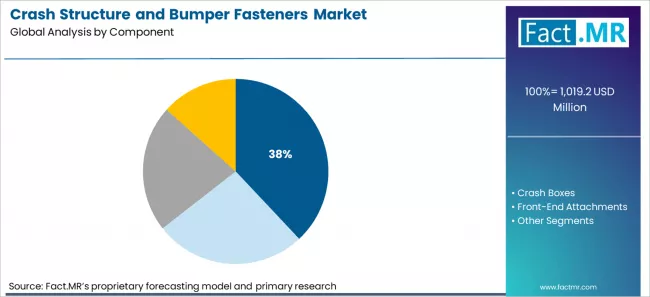
By component, bumper beams account for a 38% share. Bumper beams act as the primary energy absorption element during frontal and rear impacts, driving concentrated fastener usage at beam-to-body interfaces. Fasteners in this segment must ensure precise alignment to support predictable crash behavior across vehicle platforms.
- Standardized beam architectures support consistent fastener specifications across multiple models.
- Crash performance validation places strong emphasis on fastener placement and retention at beam mounting points.
By Material, Which Segment Holds the Dominant Share in the Crash Structure and Bumper Fasteners Market?
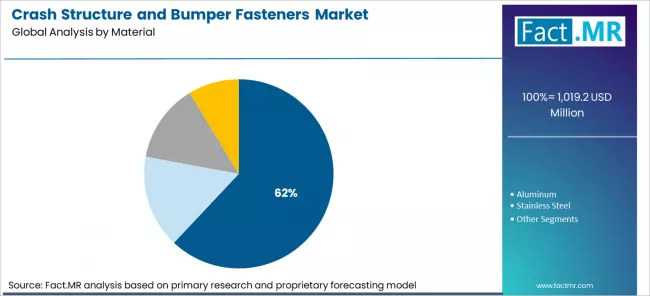
By material, high-strength steel dominates with a 62% share. Crash structure fastening applications favor high-strength steel to handle extreme impact loads without premature joint failure. This material supports stiffness requirements while maintaining controlled deformation characteristics in surrounding structures.
- Material selection prioritizes load-bearing capacity and fatigue resistance.
- Usage remains concentrated in structural zones exposed to direct crash forces.
By Sales Channel, Which Segment Registers the Highest Share in the Crash Structure and Bumper Fasteners Market?
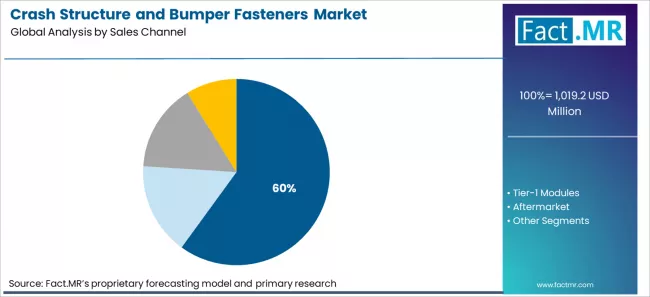
By sales channel, OEM direct supply leads with a 60% share. Crash structure and bumper fasteners are installed during vehicle assembly to meet crash certification, dimensional accuracy, and traceability requirements. Direct sourcing allows OEMs to align fastener performance with crash simulation models and regulatory testing outcomes.
- Assembly-line integration supports consistent torque application and joint validation.
- OEM-led procurement remains dominant due to responsibility for occupant safety compliance and warranty exposure.
What are the Drivers, Restraints, and Key Trends of the Crash Structure and Bumper Fasteners Market?
- Drivers: Automakers are placing greater emphasis on front and rear crash performance as bumper beams and crash boxes play a critical role in energy absorption, driving demand for fasteners that can reliably transfer impact loads and maintain structural alignment during collision events.
- Restraint: Crash structure fasteners must meet strict deformation and load path requirements while remaining compatible with mixed material assemblies, increasing validation complexity and limiting flexibility in fastener material and geometry selection.
- Trend 1: High tensile bolts and structural rivets are increasingly specified for bumper beams and crash boxes to ensure controlled deformation behavior and consistent load distribution under high impact conditions.
- Trend 2: OEM direct and Tier 1 module supply channels are prioritizing fastener systems developed alongside crash components, enabling tighter integration with bumper modules and improved consistency in vehicle safety performance across platforms.
Analysis of the Crash Structure and Bumper Fasteners Market by Key Country
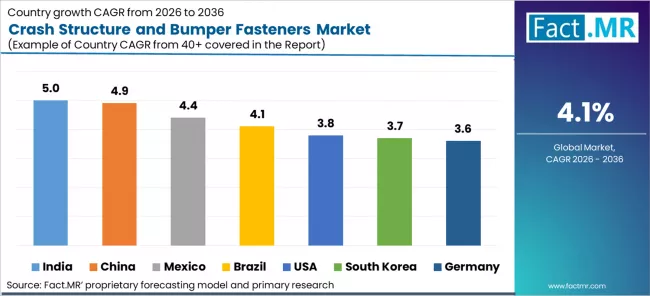
| Country | CAGR |
|---|---|
| India | 5.0% |
| China | 4.9% |
| Mexico | 4.4% |
| Brazil | 4.1% |
| U.S. | 3.8% |
| South Korea | 3.7% |
| Germany | 3.6% |
| Japan | 2.9% |
The report covers an in depth analysis of 8 countries; higher growth markets are highlighted below.
What Is Driving Demand for Crash Structure and Bumper Fasteners Market in India?
India leads growth with a CAGR of 5.0%, closely linked to rising vehicle production and tighter frontal impact safety requirements. Crash structures and bumper assemblies rely on fasteners that can manage high energy loads during collision events. Increasing use of reinforced bumper beams is raising demand for high tensile bolts with predictable deformation behavior. OEMs emphasize consistency and traceability due to regulatory scrutiny and homologation testing. Local sourcing of structural fasteners continues to expand alongside domestic vehicle manufacturing.
- Higher integration of reinforced bumper beams is increasing demand for high strength fastening solutions.
- Expansion of domestic crash structure production is supporting steady original equipment fastener consumption.
How Is China Shaping the Crash Structure and Bumper Fasteners Market?
China is projected to grow at a CAGR of 4.9%, supported by high vehicle output and widespread adoption of standardized front end crash architectures. Bumper beams and crash boxes are designed for controlled energy absorption, placing strict performance demands on fasteners. High strength steel remains the dominant material choice, influencing fastener design and coating selection. OEM led sourcing dominates due to safety validation requirements. Supplier alignment with tier one module manufacturers supports predictable demand cycles.
- High vehicle production volumes are sustaining consistent demand for structural bumper fasteners.
- Standardized crash module designs are reinforcing recurring fastener specifications.
What Role Does Mexico Play in Crash Structure and Bumper Fasteners Demand?
Mexico is expected to expand at a CAGR of 4.4%, reflecting its role as an export focused vehicle assembly base. Crash structures and bumper systems produced locally serve North American platforms with defined safety specifications. Structural rivets and bolts are widely used across modular front end assemblies. Production continuity supports steady component offtake. Procurement remains concentrated within OEM and tier one supply agreements.
- Export oriented bumper and crash module production is maintaining stable fastener demand.
- Platform consistency is reinforcing predictable structural fastener sourcing.
How Is Brazil Contributing to Market Growth?
Brazil is forecast to register a CAGR of 4.1%, driven by steady passenger vehicle production and increasing focus on occupant safety performance. Crash structure assemblies require fastening systems capable of sustaining deformation loads without premature failure. Use of weld studs and structural bolts remains common across locally produced platforms. OEM sourcing dominates due to safety compliance requirements.
- Expansion of safety focused vehicle designs is supporting demand for crash structure fasteners.
- Continued use of welded and bolted assemblies is sustaining stable fastener volumes.
What Defines the Crash Structure and Bumper Fasteners Market in the U.S.?
The U.S. market is expected to grow at a CAGR of 3.8%, supported by ongoing production of light trucks and sport utility vehicles with larger front end structures. Bumper and crash systems are engineered to manage higher vehicle mass, increasing fastener load requirements. OEM direct sourcing remains prevalent due to crash certification and warranty exposure. Aftermarket demand remains limited due to long component service life.
- Larger vehicle platforms are sustaining demand for high load crash fasteners.
- Emphasis on crash certification is reinforcing original equipment sourcing.
How Is South Korea Positioning Itself in This Market?
South Korea is projected to grow at a CAGR of 3.7%, influenced by advanced front end design and emphasis on compact yet effective crash management systems. Fasteners must support precise alignment of bumper beams and crash boxes. Material selection balances strength with weight reduction objectives. Close coordination between OEMs and tier one suppliers supports stable demand planning.
- Precision focused crash structure design is increasing demand for reliable fastening systems.
- Strong OEM supplier collaboration is sustaining consistent procurement volumes.
What Factors Shape Demand in Germany?
Germany is expected to grow at a CAGR of 3.6%, reflecting strict crash performance standards and focus on structural integrity. Crash structures are often integrated into modular front end systems, raising fastener accountability. Tight tolerances and corrosion resistance influence fastener specification. Supplier qualification processes remain rigorous due to safety critical application requirements.
- High crash performance standards are driving demand for tightly specified fasteners.
- Modular front end integration is reinforcing structural fastener usage.
How Is the Industry Evolving in Japan?
Japan is forecast to expand at a CAGR of 2.9%, influenced by compact vehicle dominance and conservative evolution of crash structure designs. Bumper and crash assemblies emphasize efficiency and controlled deformation. Fastener demand remains stable with limited growth momentum. Proven fastening solutions are favored to ensure long term reliability.
- Stable crash structure designs are sustaining consistent fastener consumption.
- Conservative design updates are moderating overall demand growth.
Competitive Landscape of the Crash Structure and Bumper Fasteners Market
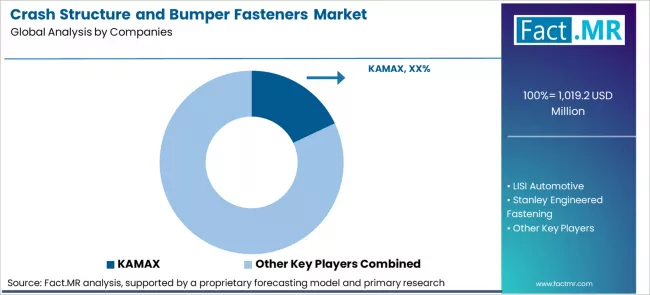
The crash structure and bumper fasteners market is shaped by suppliers working at the front line of vehicle safety, where fasteners play a direct role in energy absorption and load transfer during impact events. These components must hold bumper beams, crash boxes, and front-end structures together under extreme forces while still enabling controlled deformation. Competition centers on tensile strength consistency, shear performance, fatigue resistance, and predictable failure behavior aligned with global crash regulations.
Market participants focus on fasteners that support lightweight bumper systems without compromising crash performance. Engineering efforts emphasize high-tensile bolts with precise preload control, structural rivets capable of joining mixed materials, and weld studs designed for repeatable alignment of front-end modules. Suppliers with deep OEM collaboration gain advantage by tailoring fastener geometry and coatings to specific bumper beam designs, crash box layouts, and modular front-end assemblies.
Market players include KAMAX, LISI Automotive, Stanley Engineered Fastening, Bulten, Fontana Gruppo, Würth Automotive, SFS Group, Meidoh, Bossard Group, and ITW Automotive, supplying high-tensile bolts, structural rivets, weld studs, and crash-rated fastening systems used in bumper beams, crash boxes, and front-end attachment points. KAMAX and LISI Automotive maintain strong positions in OEM-direct programs where crash load paths are tightly engineered, while Stanley Engineered Fastening and Bulten support Tier 1 front-end modules with fastening systems validated for repeatable crash performance across steel and aluminum structures.
Key Players in the Crash Structure and Bumper Fasteners Market
- KAMAX
- LISI Automotive
- Stanley Engineered Fastening
- Bulten
- Fontana Gruppo
- Würth Automotive
- SFS Group
- Meidoh
- Bossard Group
- ITW Automotive
Scope of the Report
| Items | Values |
|---|---|
| Quantitative Units 2026 | USD 1019.2 Million |
| Fastener Type | High-tensile bolts for crash load paths, Structural rivets for energy absorption zones, Weld studs for bumper and crash structure attachment |
| Component | Bumper beams, Crash boxes, Front-end attachment structures |
| Material | High-strength steel fasteners, Aluminum fasteners, Stainless steel fasteners |
| Sales Channel | OEM direct supply for crash and bumper systems, Tier 1 module supply, Aftermarket replacement fasteners |
| Regions Covered | North America, Europe, Asia Pacific, Latin America, Middle East & Africa |
| Countries Covered | India, China, Mexico, Brazil, U.S., South Korea, Germany, Japan |
| Key Companies Profiled | KAMAX, LISI Automotive, Stanley Engineered Fastening, Bulten, Fontana Gruppo, Würth Automotive, SFS Group, Meidoh, Bossard Group, ITW Automotive |
| Additional Attributes | Dollar revenue by crash structure and bumper fastener type, component, material, and sales channel; regional demand trends; vehicle crashworthiness and energy management requirements; front-end module integration practices; lightweight bumper system adoption; regulatory safety compliance considerations |
Crash Structure and Bumper Fasteners Market by Segments
-
Fastener Type:
- High-Tensile Bolts
- Structural Rivets
- Weld Studs
- Other
-
Component:
- Bumper Beams
- Crash Boxes
- Front-End Attachments
- Other
-
Material:
- High-Strength Steel
- Aluminum
- Stainless Steel
- Other
-
Sales Channel:
- OEM Direct
- Tier-1 Modules
- Aftermarket
- Other
-
Region:
- North America
- U.S.
- Canada
- Mexico
- Europe
- Germany
- Italy
- UK
- France
- Spain
- Netherlands
- Switzerland
- Rest of Europe
- Asia Pacific
- Japan
- Australia
- South Korea
- China
- India
- Rest of Asia Pacific
- Latin America
- Brazil
- Argentina
- Rest of Latin America
- Middle East and Africa
- United Arab Emirates
- South Africa
- Rest of Middle East and Africa
- North America
Bibliography
- National Highway Traffic Safety Administration. 2024.Vehicle crashworthiness and structural fastening requirements for bumper systems and frontal impact protection. U.S. Department of Transportation.
- International Organization for Standardization. 2023.Road vehicles crash protection systems: Mechanical fasteners for bumper beams, crash boxes, and energy absorbing structures ISO Technical Report. ISO.
- United Nations Economic Commission for Europe World Forum for Harmonization of Vehicle Regulations. 2024.Frontal and rear impact safety regulations and structural attachment requirements for bumper and crash management systems. UNECE.
- Insurance Institute for Highway Safety Research Division. 2023.Crash energy management in modern vehicle front end structures and fastening system performance. Insurance Institute for Highway Safety.
- European New Car Assessment Programme Technical Committee. 2024.Assessment of bumper beam structures, crash boxes, and fastening performance in vehicle impact testing protocols. Euro NCAP.
Table of Content
- Executive Summary
- Global Market Outlook
- Demand to side Trends
- Supply to side Trends
- Technology Roadmap Analysis
- Analysis and Recommendations
- Market Overview
- Market Coverage / Taxonomy
- Market Definition / Scope / Limitations
- Market Background
- Market Dynamics
- Drivers
- Restraints
- Opportunity
- Trends
- Scenario Forecast
- Demand in Optimistic Scenario
- Demand in Likely Scenario
- Demand in Conservative Scenario
- Opportunity Map Analysis
- Product Life Cycle Analysis
- Supply Chain Analysis
- Investment Feasibility Matrix
- Value Chain Analysis
- PESTLE and Porter’s Analysis
- Regulatory Landscape
- Regional Parent Market Outlook
- Production and Consumption Statistics
- Import and Export Statistics
- Market Dynamics
- Global Market Analysis 2021 to 2025 and Forecast, 2026 to 2036
- Historical Market Size Value (USD Million) Analysis, 2021 to 2025
- Current and Future Market Size Value (USD Million) Projections, 2026 to 2036
- Y to o to Y Growth Trend Analysis
- Absolute $ Opportunity Analysis
- Global Market Pricing Analysis 2021 to 2025 and Forecast 2026 to 2036
- Global Market Analysis 2021 to 2025 and Forecast 2026 to 2036, By Fastener Type
- Introduction / Key Findings
- Historical Market Size Value (USD Million) Analysis By Fastener Type, 2021 to 2025
- Current and Future Market Size Value (USD Million) Analysis and Forecast By Fastener Type, 2026 to 2036
- High-Tensile Bolts
- Structural Rivets
- Weld Studs
- Other
- High-Tensile Bolts
- Y to o to Y Growth Trend Analysis By Fastener Type, 2021 to 2025
- Absolute $ Opportunity Analysis By Fastener Type, 2026 to 2036
- Global Market Analysis 2021 to 2025 and Forecast 2026 to 2036, By Component
- Introduction / Key Findings
- Historical Market Size Value (USD Million) Analysis By Component, 2021 to 2025
- Current and Future Market Size Value (USD Million) Analysis and Forecast By Component, 2026 to 2036
- Bumper Beams
- Crash Boxes
- Front-End Attachments
- Other
- Bumper Beams
- Y to o to Y Growth Trend Analysis By Component, 2021 to 2025
- Absolute $ Opportunity Analysis By Component, 2026 to 2036
- Global Market Analysis 2021 to 2025 and Forecast 2026 to 2036, By Material
- Introduction / Key Findings
- Historical Market Size Value (USD Million) Analysis By Material, 2021 to 2025
- Current and Future Market Size Value (USD Million) Analysis and Forecast By Material, 2026 to 2036
- High-Strength Steel
- Aluminum
- Stainless Steel
- Other
- High-Strength Steel
- Y to o to Y Growth Trend Analysis By Material, 2021 to 2025
- Absolute $ Opportunity Analysis By Material, 2026 to 2036
- Global Market Analysis 2021 to 2025 and Forecast 2026 to 2036, By Sales Channel
- Introduction / Key Findings
- Historical Market Size Value (USD Million) Analysis By Sales Channel, 2021 to 2025
- Current and Future Market Size Value (USD Million) Analysis and Forecast By Sales Channel, 2026 to 2036
- OEM Direct
- Tier-1 Modules
- Aftermarket
- Other
- OEM Direct
- Y to o to Y Growth Trend Analysis By Sales Channel, 2021 to 2025
- Absolute $ Opportunity Analysis By Sales Channel, 2026 to 2036
- Global Market Analysis 2021 to 2025 and Forecast 2026 to 2036, By Region
- Introduction
- Historical Market Size Value (USD Million) Analysis By Region, 2021 to 2025
- Current Market Size Value (USD Million) Analysis and Forecast By Region, 2026 to 2036
- North America
- Latin America
- Western Europe
- Eastern Europe
- East Asia
- South Asia and Pacific
- Middle East & Africa
- Market Attractiveness Analysis By Region
- North America Market Analysis 2021 to 2025 and Forecast 2026 to 2036, By Country
- Historical Market Size Value (USD Million) Trend Analysis By Market Taxonomy, 2021 to 2025
- Market Size Value (USD Million) Forecast By Market Taxonomy, 2026 to 2036
- By Country
- USA
- Canada
- Mexico
- By Fastener Type
- By Component
- By Material
- By Sales Channel
- By Country
- Market Attractiveness Analysis
- By Country
- By Fastener Type
- By Component
- By Material
- By Sales Channel
- Key Takeaways
- Latin America Market Analysis 2021 to 2025 and Forecast 2026 to 2036, By Country
- Historical Market Size Value (USD Million) Trend Analysis By Market Taxonomy, 2021 to 2025
- Market Size Value (USD Million) Forecast By Market Taxonomy, 2026 to 2036
- By Country
- Brazil
- Chile
- Rest of Latin America
- By Fastener Type
- By Component
- By Material
- By Sales Channel
- By Country
- Market Attractiveness Analysis
- By Country
- By Fastener Type
- By Component
- By Material
- By Sales Channel
- Key Takeaways
- Western Europe Market Analysis 2021 to 2025 and Forecast 2026 to 2036, By Country
- Historical Market Size Value (USD Million) Trend Analysis By Market Taxonomy, 2021 to 2025
- Market Size Value (USD Million) Forecast By Market Taxonomy, 2026 to 2036
- By Country
- Germany
- UK
- Italy
- Spain
- France
- Nordic
- BENELUX
- Rest of Western Europe
- By Fastener Type
- By Component
- By Material
- By Sales Channel
- By Country
- Market Attractiveness Analysis
- By Country
- By Fastener Type
- By Component
- By Material
- By Sales Channel
- Key Takeaways
- Eastern Europe Market Analysis 2021 to 2025 and Forecast 2026 to 2036, By Country
- Historical Market Size Value (USD Million) Trend Analysis By Market Taxonomy, 2021 to 2025
- Market Size Value (USD Million) Forecast By Market Taxonomy, 2026 to 2036
- By Country
- Russia
- Poland
- Hungary
- Balkan & Baltic
- Rest of Eastern Europe
- By Fastener Type
- By Component
- By Material
- By Sales Channel
- By Country
- Market Attractiveness Analysis
- By Country
- By Fastener Type
- By Component
- By Material
- By Sales Channel
- Key Takeaways
- East Asia Market Analysis 2021 to 2025 and Forecast 2026 to 2036, By Country
- Historical Market Size Value (USD Million) Trend Analysis By Market Taxonomy, 2021 to 2025
- Market Size Value (USD Million) Forecast By Market Taxonomy, 2026 to 2036
- By Country
- China
- Japan
- South Korea
- By Fastener Type
- By Component
- By Material
- By Sales Channel
- By Country
- Market Attractiveness Analysis
- By Country
- By Fastener Type
- By Component
- By Material
- By Sales Channel
- Key Takeaways
- South Asia and Pacific Market Analysis 2021 to 2025 and Forecast 2026 to 2036, By Country
- Historical Market Size Value (USD Million) Trend Analysis By Market Taxonomy, 2021 to 2025
- Market Size Value (USD Million) Forecast By Market Taxonomy, 2026 to 2036
- By Country
- India
- ASEAN
- Australia & New Zealand
- Rest of South Asia and Pacific
- By Fastener Type
- By Component
- By Material
- By Sales Channel
- By Country
- Market Attractiveness Analysis
- By Country
- By Fastener Type
- By Component
- By Material
- By Sales Channel
- Key Takeaways
- Middle East & Africa Market Analysis 2021 to 2025 and Forecast 2026 to 2036, By Country
- Historical Market Size Value (USD Million) Trend Analysis By Market Taxonomy, 2021 to 2025
- Market Size Value (USD Million) Forecast By Market Taxonomy, 2026 to 2036
- By Country
- Kingdom of Saudi Arabia
- Other GCC Countries
- Turkiye
- South Africa
- Other African Union
- Rest of Middle East & Africa
- By Fastener Type
- By Component
- By Material
- By Sales Channel
- By Country
- Market Attractiveness Analysis
- By Country
- By Fastener Type
- By Component
- By Material
- By Sales Channel
- Key Takeaways
- Key Countries Market Analysis
- USA
- Pricing Analysis
- Market Share Analysis, 2025
- By Fastener Type
- By Component
- By Material
- By Sales Channel
- Canada
- Pricing Analysis
- Market Share Analysis, 2025
- By Fastener Type
- By Component
- By Material
- By Sales Channel
- Mexico
- Pricing Analysis
- Market Share Analysis, 2025
- By Fastener Type
- By Component
- By Material
- By Sales Channel
- Brazil
- Pricing Analysis
- Market Share Analysis, 2025
- By Fastener Type
- By Component
- By Material
- By Sales Channel
- Chile
- Pricing Analysis
- Market Share Analysis, 2025
- By Fastener Type
- By Component
- By Material
- By Sales Channel
- Germany
- Pricing Analysis
- Market Share Analysis, 2025
- By Fastener Type
- By Component
- By Material
- By Sales Channel
- UK
- Pricing Analysis
- Market Share Analysis, 2025
- By Fastener Type
- By Component
- By Material
- By Sales Channel
- Italy
- Pricing Analysis
- Market Share Analysis, 2025
- By Fastener Type
- By Component
- By Material
- By Sales Channel
- Spain
- Pricing Analysis
- Market Share Analysis, 2025
- By Fastener Type
- By Component
- By Material
- By Sales Channel
- France
- Pricing Analysis
- Market Share Analysis, 2025
- By Fastener Type
- By Component
- By Material
- By Sales Channel
- India
- Pricing Analysis
- Market Share Analysis, 2025
- By Fastener Type
- By Component
- By Material
- By Sales Channel
- ASEAN
- Pricing Analysis
- Market Share Analysis, 2025
- By Fastener Type
- By Component
- By Material
- By Sales Channel
- Australia & New Zealand
- Pricing Analysis
- Market Share Analysis, 2025
- By Fastener Type
- By Component
- By Material
- By Sales Channel
- China
- Pricing Analysis
- Market Share Analysis, 2025
- By Fastener Type
- By Component
- By Material
- By Sales Channel
- Japan
- Pricing Analysis
- Market Share Analysis, 2025
- By Fastener Type
- By Component
- By Material
- By Sales Channel
- South Korea
- Pricing Analysis
- Market Share Analysis, 2025
- By Fastener Type
- By Component
- By Material
- By Sales Channel
- Russia
- Pricing Analysis
- Market Share Analysis, 2025
- By Fastener Type
- By Component
- By Material
- By Sales Channel
- Poland
- Pricing Analysis
- Market Share Analysis, 2025
- By Fastener Type
- By Component
- By Material
- By Sales Channel
- Hungary
- Pricing Analysis
- Market Share Analysis, 2025
- By Fastener Type
- By Component
- By Material
- By Sales Channel
- Kingdom of Saudi Arabia
- Pricing Analysis
- Market Share Analysis, 2025
- By Fastener Type
- By Component
- By Material
- By Sales Channel
- Turkiye
- Pricing Analysis
- Market Share Analysis, 2025
- By Fastener Type
- By Component
- By Material
- By Sales Channel
- South Africa
- Pricing Analysis
- Market Share Analysis, 2025
- By Fastener Type
- By Component
- By Material
- By Sales Channel
- USA
- Market Structure Analysis
- Competition Dashboard
- Competition Benchmarking
- Market Share Analysis of Top Players
- By Regional
- By Fastener Type
- By Component
- By Material
- By Sales Channel
- Competition Analysis
- Competition Deep Dive
- KAMAX
- Overview
- Product Portfolio
- Profitability by Market Segments (Product/Age /Sales Channel/Region)
- Sales Footprint
- Strategy Overview
- Marketing Strategy
- Product Strategy
- Channel Strategy
- LISI Automotive
- Stanley Engineered Fastening
- Bulten
- Fontana Gruppo
- Würth Automotive
- SFS Group
- Meidoh
- Bossard Group
- ITW Automotive
- KAMAX
- Competition Deep Dive
- Assumptions & Acronyms Used
- Research Methodology
List Of Table
- Table 1: Global Market Value (USD Million) Forecast by Region, 2021 to 2036
- Table 2: Global Market Value (USD Million) Forecast by Fastener Type, 2021 to 2036
- Table 3: Global Market Value (USD Million) Forecast by Component, 2021 to 2036
- Table 4: Global Market Value (USD Million) Forecast by Material, 2021 to 2036
- Table 5: Global Market Value (USD Million) Forecast by Sales Channel, 2021 to 2036
- Table 6: North America Market Value (USD Million) Forecast by Country, 2021 to 2036
- Table 7: North America Market Value (USD Million) Forecast by Fastener Type, 2021 to 2036
- Table 8: North America Market Value (USD Million) Forecast by Component, 2021 to 2036
- Table 9: North America Market Value (USD Million) Forecast by Material, 2021 to 2036
- Table 10: North America Market Value (USD Million) Forecast by Sales Channel, 2021 to 2036
- Table 11: Latin America Market Value (USD Million) Forecast by Country, 2021 to 2036
- Table 12: Latin America Market Value (USD Million) Forecast by Fastener Type, 2021 to 2036
- Table 13: Latin America Market Value (USD Million) Forecast by Component, 2021 to 2036
- Table 14: Latin America Market Value (USD Million) Forecast by Material, 2021 to 2036
- Table 15: Latin America Market Value (USD Million) Forecast by Sales Channel, 2021 to 2036
- Table 16: Western Europe Market Value (USD Million) Forecast by Country, 2021 to 2036
- Table 17: Western Europe Market Value (USD Million) Forecast by Fastener Type, 2021 to 2036
- Table 18: Western Europe Market Value (USD Million) Forecast by Component, 2021 to 2036
- Table 19: Western Europe Market Value (USD Million) Forecast by Material, 2021 to 2036
- Table 20: Western Europe Market Value (USD Million) Forecast by Sales Channel, 2021 to 2036
- Table 21: Eastern Europe Market Value (USD Million) Forecast by Country, 2021 to 2036
- Table 22: Eastern Europe Market Value (USD Million) Forecast by Fastener Type, 2021 to 2036
- Table 23: Eastern Europe Market Value (USD Million) Forecast by Component, 2021 to 2036
- Table 24: Eastern Europe Market Value (USD Million) Forecast by Material, 2021 to 2036
- Table 25: Eastern Europe Market Value (USD Million) Forecast by Sales Channel, 2021 to 2036
- Table 26: East Asia Market Value (USD Million) Forecast by Country, 2021 to 2036
- Table 27: East Asia Market Value (USD Million) Forecast by Fastener Type, 2021 to 2036
- Table 28: East Asia Market Value (USD Million) Forecast by Component, 2021 to 2036
- Table 29: East Asia Market Value (USD Million) Forecast by Material, 2021 to 2036
- Table 30: East Asia Market Value (USD Million) Forecast by Sales Channel, 2021 to 2036
- Table 31: South Asia and Pacific Market Value (USD Million) Forecast by Country, 2021 to 2036
- Table 32: South Asia and Pacific Market Value (USD Million) Forecast by Fastener Type, 2021 to 2036
- Table 33: South Asia and Pacific Market Value (USD Million) Forecast by Component, 2021 to 2036
- Table 34: South Asia and Pacific Market Value (USD Million) Forecast by Material, 2021 to 2036
- Table 35: South Asia and Pacific Market Value (USD Million) Forecast by Sales Channel, 2021 to 2036
- Table 36: Middle East & Africa Market Value (USD Million) Forecast by Country, 2021 to 2036
- Table 37: Middle East & Africa Market Value (USD Million) Forecast by Fastener Type, 2021 to 2036
- Table 38: Middle East & Africa Market Value (USD Million) Forecast by Component, 2021 to 2036
- Table 39: Middle East & Africa Market Value (USD Million) Forecast by Material, 2021 to 2036
- Table 40: Middle East & Africa Market Value (USD Million) Forecast by Sales Channel, 2021 to 2036
List Of Figures
- Figure 1: Global Market Pricing Analysis
- Figure 2: Global Market Value (USD Million) Forecast 2021 to 2036
- Figure 3: Global Market Value Share and BPS Analysis by Fastener Type, 2026 and 2036
- Figure 4: Global Market Y to o to Y Growth Comparison by Fastener Type, 2026 to 2036
- Figure 5: Global Market Attractiveness Analysis by Fastener Type
- Figure 6: Global Market Value Share and BPS Analysis by Component, 2026 and 2036
- Figure 7: Global Market Y to o to Y Growth Comparison by Component, 2026 to 2036
- Figure 8: Global Market Attractiveness Analysis by Component
- Figure 9: Global Market Value Share and BPS Analysis by Material, 2026 and 2036
- Figure 10: Global Market Y to o to Y Growth Comparison by Material, 2026 to 2036
- Figure 11: Global Market Attractiveness Analysis by Material
- Figure 12: Global Market Value Share and BPS Analysis by Sales Channel, 2026 and 2036
- Figure 13: Global Market Y to o to Y Growth Comparison by Sales Channel, 2026 to 2036
- Figure 14: Global Market Attractiveness Analysis by Sales Channel
- Figure 15: Global Market Value (USD Million) Share and BPS Analysis by Region, 2026 and 2036
- Figure 16: Global Market Y to o to Y Growth Comparison by Region, 2026 to 2036
- Figure 17: Global Market Attractiveness Analysis by Region
- Figure 18: North America Market Incremental Dollar Opportunity, 2026 to 2036
- Figure 19: Latin America Market Incremental Dollar Opportunity, 2026 to 2036
- Figure 20: Western Europe Market Incremental Dollar Opportunity, 2026 to 2036
- Figure 21: Eastern Europe Market Incremental Dollar Opportunity, 2026 to 2036
- Figure 22: East Asia Market Incremental Dollar Opportunity, 2026 to 2036
- Figure 23: South Asia and Pacific Market Incremental Dollar Opportunity, 2026 to 2036
- Figure 24: Middle East & Africa Market Incremental Dollar Opportunity, 2026 to 2036
- Figure 25: North America Market Value Share and BPS Analysis by Country, 2026 and 2036
- Figure 26: North America Market Value Share and BPS Analysis by Fastener Type, 2026 and 2036
- Figure 27: North America Market Y to o to Y Growth Comparison by Fastener Type, 2026 to 2036
- Figure 28: North America Market Attractiveness Analysis by Fastener Type
- Figure 29: North America Market Value Share and BPS Analysis by Component, 2026 and 2036
- Figure 30: North America Market Y to o to Y Growth Comparison by Component, 2026 to 2036
- Figure 31: North America Market Attractiveness Analysis by Component
- Figure 32: North America Market Value Share and BPS Analysis by Material, 2026 and 2036
- Figure 33: North America Market Y to o to Y Growth Comparison by Material, 2026 to 2036
- Figure 34: North America Market Attractiveness Analysis by Material
- Figure 35: North America Market Value Share and BPS Analysis by Sales Channel, 2026 and 2036
- Figure 36: North America Market Y to o to Y Growth Comparison by Sales Channel, 2026 to 2036
- Figure 37: North America Market Attractiveness Analysis by Sales Channel
- Figure 38: Latin America Market Value Share and BPS Analysis by Country, 2026 and 2036
- Figure 39: Latin America Market Value Share and BPS Analysis by Fastener Type, 2026 and 2036
- Figure 40: Latin America Market Y to o to Y Growth Comparison by Fastener Type, 2026 to 2036
- Figure 41: Latin America Market Attractiveness Analysis by Fastener Type
- Figure 42: Latin America Market Value Share and BPS Analysis by Component, 2026 and 2036
- Figure 43: Latin America Market Y to o to Y Growth Comparison by Component, 2026 to 2036
- Figure 44: Latin America Market Attractiveness Analysis by Component
- Figure 45: Latin America Market Value Share and BPS Analysis by Material, 2026 and 2036
- Figure 46: Latin America Market Y to o to Y Growth Comparison by Material, 2026 to 2036
- Figure 47: Latin America Market Attractiveness Analysis by Material
- Figure 48: Latin America Market Value Share and BPS Analysis by Sales Channel, 2026 and 2036
- Figure 49: Latin America Market Y to o to Y Growth Comparison by Sales Channel, 2026 to 2036
- Figure 50: Latin America Market Attractiveness Analysis by Sales Channel
- Figure 51: Western Europe Market Value Share and BPS Analysis by Country, 2026 and 2036
- Figure 52: Western Europe Market Value Share and BPS Analysis by Fastener Type, 2026 and 2036
- Figure 53: Western Europe Market Y to o to Y Growth Comparison by Fastener Type, 2026 to 2036
- Figure 54: Western Europe Market Attractiveness Analysis by Fastener Type
- Figure 55: Western Europe Market Value Share and BPS Analysis by Component, 2026 and 2036
- Figure 56: Western Europe Market Y to o to Y Growth Comparison by Component, 2026 to 2036
- Figure 57: Western Europe Market Attractiveness Analysis by Component
- Figure 58: Western Europe Market Value Share and BPS Analysis by Material, 2026 and 2036
- Figure 59: Western Europe Market Y to o to Y Growth Comparison by Material, 2026 to 2036
- Figure 60: Western Europe Market Attractiveness Analysis by Material
- Figure 61: Western Europe Market Value Share and BPS Analysis by Sales Channel, 2026 and 2036
- Figure 62: Western Europe Market Y to o to Y Growth Comparison by Sales Channel, 2026 to 2036
- Figure 63: Western Europe Market Attractiveness Analysis by Sales Channel
- Figure 64: Eastern Europe Market Value Share and BPS Analysis by Country, 2026 and 2036
- Figure 65: Eastern Europe Market Value Share and BPS Analysis by Fastener Type, 2026 and 2036
- Figure 66: Eastern Europe Market Y to o to Y Growth Comparison by Fastener Type, 2026 to 2036
- Figure 67: Eastern Europe Market Attractiveness Analysis by Fastener Type
- Figure 68: Eastern Europe Market Value Share and BPS Analysis by Component, 2026 and 2036
- Figure 69: Eastern Europe Market Y to o to Y Growth Comparison by Component, 2026 to 2036
- Figure 70: Eastern Europe Market Attractiveness Analysis by Component
- Figure 71: Eastern Europe Market Value Share and BPS Analysis by Material, 2026 and 2036
- Figure 72: Eastern Europe Market Y to o to Y Growth Comparison by Material, 2026 to 2036
- Figure 73: Eastern Europe Market Attractiveness Analysis by Material
- Figure 74: Eastern Europe Market Value Share and BPS Analysis by Sales Channel, 2026 and 2036
- Figure 75: Eastern Europe Market Y to o to Y Growth Comparison by Sales Channel, 2026 to 2036
- Figure 76: Eastern Europe Market Attractiveness Analysis by Sales Channel
- Figure 77: East Asia Market Value Share and BPS Analysis by Country, 2026 and 2036
- Figure 78: East Asia Market Value Share and BPS Analysis by Fastener Type, 2026 and 2036
- Figure 79: East Asia Market Y to o to Y Growth Comparison by Fastener Type, 2026 to 2036
- Figure 80: East Asia Market Attractiveness Analysis by Fastener Type
- Figure 81: East Asia Market Value Share and BPS Analysis by Component, 2026 and 2036
- Figure 82: East Asia Market Y to o to Y Growth Comparison by Component, 2026 to 2036
- Figure 83: East Asia Market Attractiveness Analysis by Component
- Figure 84: East Asia Market Value Share and BPS Analysis by Material, 2026 and 2036
- Figure 85: East Asia Market Y to o to Y Growth Comparison by Material, 2026 to 2036
- Figure 86: East Asia Market Attractiveness Analysis by Material
- Figure 87: East Asia Market Value Share and BPS Analysis by Sales Channel, 2026 and 2036
- Figure 88: East Asia Market Y to o to Y Growth Comparison by Sales Channel, 2026 to 2036
- Figure 89: East Asia Market Attractiveness Analysis by Sales Channel
- Figure 90: South Asia and Pacific Market Value Share and BPS Analysis by Country, 2026 and 2036
- Figure 91: South Asia and Pacific Market Value Share and BPS Analysis by Fastener Type, 2026 and 2036
- Figure 92: South Asia and Pacific Market Y to o to Y Growth Comparison by Fastener Type, 2026 to 2036
- Figure 93: South Asia and Pacific Market Attractiveness Analysis by Fastener Type
- Figure 94: South Asia and Pacific Market Value Share and BPS Analysis by Component, 2026 and 2036
- Figure 95: South Asia and Pacific Market Y to o to Y Growth Comparison by Component, 2026 to 2036
- Figure 96: South Asia and Pacific Market Attractiveness Analysis by Component
- Figure 97: South Asia and Pacific Market Value Share and BPS Analysis by Material, 2026 and 2036
- Figure 98: South Asia and Pacific Market Y to o to Y Growth Comparison by Material, 2026 to 2036
- Figure 99: South Asia and Pacific Market Attractiveness Analysis by Material
- Figure 100: South Asia and Pacific Market Value Share and BPS Analysis by Sales Channel, 2026 and 2036
- Figure 101: South Asia and Pacific Market Y to o to Y Growth Comparison by Sales Channel, 2026 to 2036
- Figure 102: South Asia and Pacific Market Attractiveness Analysis by Sales Channel
- Figure 103: Middle East & Africa Market Value Share and BPS Analysis by Country, 2026 and 2036
- Figure 104: Middle East & Africa Market Value Share and BPS Analysis by Fastener Type, 2026 and 2036
- Figure 105: Middle East & Africa Market Y to o to Y Growth Comparison by Fastener Type, 2026 to 2036
- Figure 106: Middle East & Africa Market Attractiveness Analysis by Fastener Type
- Figure 107: Middle East & Africa Market Value Share and BPS Analysis by Component, 2026 and 2036
- Figure 108: Middle East & Africa Market Y to o to Y Growth Comparison by Component, 2026 to 2036
- Figure 109: Middle East & Africa Market Attractiveness Analysis by Component
- Figure 110: Middle East & Africa Market Value Share and BPS Analysis by Material, 2026 and 2036
- Figure 111: Middle East & Africa Market Y to o to Y Growth Comparison by Material, 2026 to 2036
- Figure 112: Middle East & Africa Market Attractiveness Analysis by Material
- Figure 113: Middle East & Africa Market Value Share and BPS Analysis by Sales Channel, 2026 and 2036
- Figure 114: Middle East & Africa Market Y to o to Y Growth Comparison by Sales Channel, 2026 to 2036
- Figure 115: Middle East & Africa Market Attractiveness Analysis by Sales Channel
- Figure 116: Global Market - Tier Structure Analysis
- Figure 117: Global Market - Company Share Analysis
- FAQs -
How big is the crash structure and bumper fasteners market in 2026?
The global crash structure and bumper fasteners market is estimated to be valued at USD 1,019.2 million in 2026.
What will be the size of crash structure and bumper fasteners market in 2036?
The market size for the crash structure and bumper fasteners market is projected to reach USD 1,523.2 million by 2036.
How much will be the crash structure and bumper fasteners market growth between 2026 and 2036?
The crash structure and bumper fasteners market is expected to grow at a 4.1% CAGR between 2026 and 2036.
What are the key product types in the crash structure and bumper fasteners market?
The key product types in crash structure and bumper fasteners market are high-tensile bolts, structural rivets, weld studs and other.
Which component segment to contribute significant share in the crash structure and bumper fasteners market in 2026?
In terms of component, bumper beams segment to command 38.0% share in the crash structure and bumper fasteners market in 2026.