- Base Value(2026): 3 Bn
- Estimated Value(2026): 3.0 Bn
- Forecast Value (2036): 6.5 Bn
- CAGR (2026 - 2036): 8.1%
Multi-Material Body-in-White Fasteners Market Forecast and Outlook 2026 to 2036
Multi-material body-in-white fasteners market is likely to be valued at USD 3 billion in 2026 and is projected to reach USD 6.5 billion by 2036, reflecting an 8.1% CAGR, according to Fact.MR analysis.
Summary of Multi-Material Body in White Fasteners Market - Key Takeaways
- The multi-material body-in-white fasteners market includes fastening solutions used to join aluminum, steel, and composite structures in automotive body assemblies to support lightweighting and structural integrity.
- The global market is estimated at USD 3.0 billion in 2026 and is projected to reach USD 6.5 billion by 2036, expanding at an 8.1% CAGR based on Fact.MR bottom-up analysis aligned with vehicle production and mixed-material adoption trends.
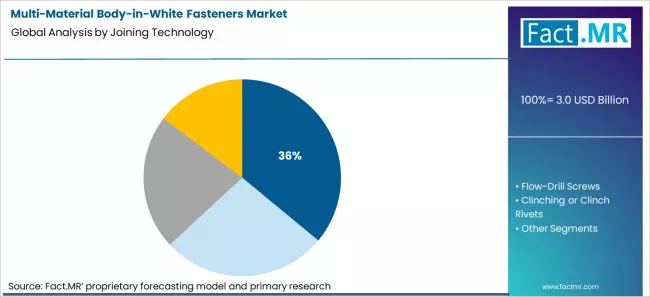
- By joining technology, self-piercing rivets lead with a 36% share, supported by standardized OEM specifications, repeatable high-volume procurement, and compatibility with automated assembly lines.
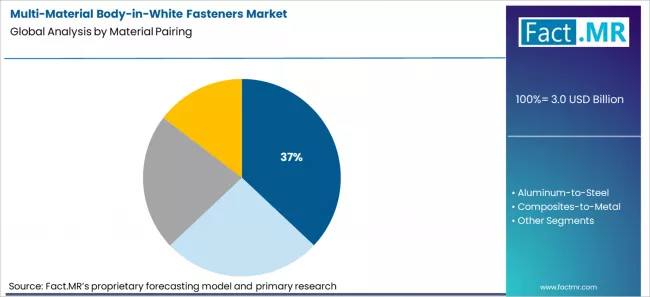
- By material pairing, aluminum-to-aluminum configurations account for a 37% share, reflecting high usage in lightweight vehicle platforms and predictable, scalable supply chain requirements.
- China and Brazil record the fastest growth at 10.2% and 10.0% CAGR respectively, driven by expanding automotive manufacturing and electric vehicle adoption, while the United States and Germany remain key value markets.
- Competition is led by suppliers such as Stanley Engineered Fastening, Illinois Tool Works, and LISI Automotive, with competitive strength anchored in material expertise, supply integration, and process reliability.
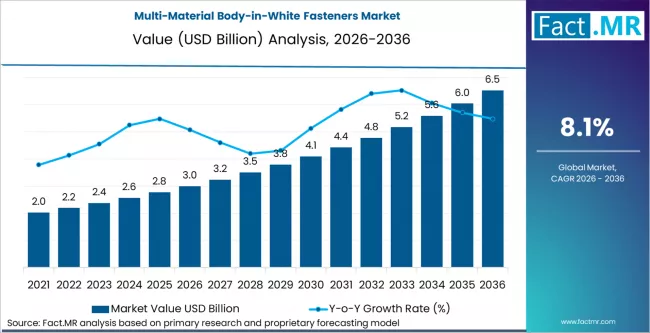
Multi Material Body In White Fasteners Market Market Value Analysis | Source: Fact.MR
Growth is being driven by automotive manufacturers’ shift toward lightweight, mixed-material vehicle bodies that require fasteners capable of maintaining structural integrity under diverse load and vibration conditions. Market adoption emphasizes standardized fastener specifications, material durability, and compatibility with automated assembly lines, enabling predictable throughput and operational efficiency across global production networks.
Procurement strategies prioritize suppliers with scalable production capabilities, consistent quality control, and multi-region distribution support. Regional OEMs leverage advanced alloys and composite fasteners to meet local regulatory standards and reduce vehicle weight. Adoption accelerates as manufacturers align design, logistics, and assembly processes to ensure predictable performance, reduce downtime, and optimize supply chain efficiency. The market trajectory reflects a long-term transition toward operationally reliable, scalable, and high-performance fastening solutions for modern automotive structures.
Multi-Material Body-in-White Fasteners Market
| Metric | Value |
|---|---|
| Market Value (2026) | USD 3.0 billion |
| Forecast Value (2036) | USD 6.5 billion |
| Forecast CAGR (2026-2036) | 8.1% |
Source: Fact.MR analysis. Updated Feb 13, 2026
Category
| Category | Segments |
|---|---|
| By Joining Technology | Self-piercing rivets (SPR); Flow-drill screws; Clinching or clinch rivets; Other |
| By Material Pairing | Aluminum-to-aluminum; Aluminum-to-steel; Composites-to-metal; Other |
| By Vehicle Segment | Premium and luxury; Mass-market passenger; LCV; Other |
| Region | North America; Europe; Asia Pacific; Latin America; Middle East & Africa |
Source: Fact.MR analysis. Updated Feb 13, 2026
Segmental Analysis
By Joining Technology, Why Do Self-Piercing Rivets Lead the Market?
Multi Material Body In White Fasteners Market Analysis By Joining Technology | Source: Fact.MR
Self-piercing rivets lead the market with 36% share, reflecting high adoption in automotive and industrial assembly operations where repeatable, large-scale procurement drives predictable demand. Market dynamics emphasize operational efficiency, scalable supply chains, and standardized distribution across assembly plants. Buyers prioritize technologies that reduce assembly time, minimize workflow disruption, and support multi-site deployment. Suppliers benefit from recurring orders, repeatable production, and streamlined logistics. Segment dominance arises from structural market drivers such as volume concentration, procurement consistency, and channel penetration rather than the mechanical characteristics of the joining method itself.
By Material Pairing, Why Does Aluminum-to-Aluminum Represent the Largest Segment?
Multi Material Body In White Fasteners Market Analysis By Material Pairing | Source: Fact.MR
Aluminum-to-aluminum pairings account for 37% share, reflecting the market’s focus on high-volume applications with predictable consumption and repeatable logistics. Procurement cycles prioritize reliable supply, multi-site distribution, and operational efficiency, enabling suppliers to maintain scalable production. Demand is reinforced by consistent adoption in automotive, transportation, and industrial sectors where workflow standardization is critical. Segment prominence is determined by structural market factors such as repeatable ordering, distribution efficiency, and high-volume adoption rather than the properties of the materials themselves. Aluminum-to-aluminum pairings dominate as the central driver of overall market activity.
Country/Region
| Country/Region | Driver | Restraint | Trend |
|---|---|---|---|
| USA | Demand for lightweight, multi-material automotive fasteners → drives premium body-in-white fastener adoption | OEM regulatory and safety compliance → increases CapEx and slows small supplier entry | Growth of high-strength, corrosion-resistant multi-material fasteners |
| Germany | Expansion of EV and premium vehicle production → fuels adoption of advanced fasteners | Strict EU automotive material regulations → increases testing and certification costs | Adoption of multi-material fasteners combining aluminum, steel, and composites |
| India | Rising automotive assembly and EV initiatives → accelerates market penetration | Limited advanced manufacturing infrastructure → slows rollout for smaller suppliers | Growth of localized, cost-effective multi-material fasteners for domestic vehicles |
| China | Large-scale automotive manufacturing → drives demand for lightweight, high-performance fasteners | Variable regional quality standards → delays approvals for new materials | Expansion of automated multi-material fastener production lines |
| Brazil | Automotive component localization policies → drive adoption of multi-material fasteners | Import restrictions and compliance requirements → increase production costs | Growth of sustainable, locally sourced high-strength fasteners |
Source: Fact.MR analysis. Updated Feb 13, 2026
Country
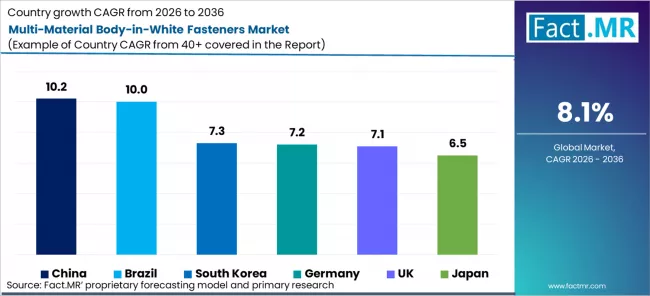
Multi Material Body In White Fasteners Market Cagr Analysis By Country | Source: Fact.MR
| Country | CAGR (2026-2036) |
|---|---|
| USA | 7.5% |
| Japan | 6.5% |
| South Korea | 7.3% |
| Germany | 7.2% |
| China | 10.2% |
| UK | 7.1% |
| Brazil | 10.0% |
Source: Fact.MR analysis. Updated Feb 13, 2026
The report covers an in-depth analysis of 40+ countries; top-performing countries are highlighted below.
How Is Demand for Multi-Material Body-in-White Fasteners Growing in the United States?
Demand for multi-material body-in-white fasteners in the United States grows at 7.5% CAGR through 2036. Automotive OEMs increasingly integrate aluminum, high-strength steel, and polymer fasteners to reduce vehicle weight while maintaining structural integrity. Manufacturers focus on precision manufacturing, material standardization, and quality assurance. Operational improvements emphasize supply chain reliability, inventory management, and regional distribution. Urban production hubs and assembly plants drive adoption. Market growth is supported by environmental regulations promoting lightweighting, consumer preference for fuel-efficient vehicles, and industrial modernization initiatives that integrate multi-material fasteners into new vehicle platforms.
What Is the Growth in Adoption of Multi-Material Body-in-White Fasteners in Japan?
Growth in adoption of multi-material body-in-white fasteners in Japan reaches 6.5% CAGR through 2036. Automotive manufacturers prioritize high-strength, lightweight fasteners to improve vehicle performance, efficiency, and safety. Operational improvements include precise tolerance control, quality verification, and supply chain optimization. OEMs integrate multi-material fasteners into assembly lines for electric and hybrid vehicles. Urban production facilities adopt automated handling and digital quality tracking. Market expansion reflects regulatory pressures to reduce vehicle emissions, consumer demand for lightweight vehicles, and the growing integration of high-performance fasteners in advanced automotive platforms.
How Is the Multi-Material Body-in-White Fasteners Market Shaping in South Korea?
Adoption of multi-material body-in-white fasteners in South Korea grows at 7.3% CAGR through 2036. Automotive OEMs integrate aluminum, high-strength steel, and polymer fasteners to achieve weight reduction and structural reliability. Manufacturers focus on precision production, material consistency, and compliance with industrial standards. Operational improvements emphasize inventory optimization, regional distribution, and automated assembly integration. Urban and industrial production hubs drive adoption. Market growth reflects government policies promoting fuel efficiency, consumer preference for lightweight vehicles, and investments in high-performance fastening technologies across passenger and commercial vehicles.
What Is the Outlook on Multi-Material Body-in-White Fasteners in Germany?
Outlook on multi-material body-in-white fasteners in Germany grows at 7.2% CAGR through 2036. Automotive manufacturers emphasize lightweighting and durability, integrating high-strength steel, aluminum, and polymer fasteners into vehicle chassis. Operational improvements focus on precision manufacturing, regulatory compliance, and digital quality assurance. Production facilities optimize assembly line integration, inventory, and supply chain efficiency. Urban and regional adoption is highest in major automotive clusters. Market expansion is driven by stringent EU fuel efficiency and safety regulations, growing demand for electric vehicles, and industrial investment in advanced multi-material fastening technologies for premium and mass-market models.
How Is the Multi-Material Body-in-White Fasteners Market Developing in China?
Growth in the multi-material body-in-white fasteners market in China reaches 10.2% CAGR through 2036. OEMs adopt high-strength steel, aluminum, and polymer fasteners to meet lightweighting targets and improve vehicle performance. Manufacturers invest in precision production, quality validation, and digital traceability. Operational improvements emphasize regional distribution, supply chain efficiency, and integration into automated assembly lines. Urban automotive production hubs drive adoption. Market expansion is fueled by government mandates for energy-efficient vehicles, rapid EV adoption, and industrial modernization programs encouraging high-performance multi-material fasteners across passenger and commercial vehicle platforms.
What Are the Growth Patterns in the Multi-Material Body-in-White Fasteners Market in the United Kingdom?
Growth patterns in the multi-material body-in-white fasteners market in the United Kingdom reach 7.1% CAGR through 2036. Automotive OEMs integrate aluminum, high-strength steel, and polymer fasteners to improve vehicle efficiency and safety. Operational improvements focus on precision manufacturing, quality verification, and supply chain resilience. Production facilities optimize assembly line integration and inventory management. Urban manufacturing hubs and industrial clusters lead adoption. Market expansion reflects consumer demand for lightweight vehicles, regulatory pressure for emission reduction, and growing use of advanced fastening technologies in both conventional and electric vehicle platforms. Premium and mass-market vehicles drive high adoption rates.
How Is the Multi-Material Body-in-White Fasteners Market Growing in Brazil?
Outlook on the multi-material body-in-white fasteners market in Brazil grows at 10% CAGR through 2036. OEMs adopt high-strength steel, aluminum, and polymer fasteners to meet lightweighting and safety requirements for passenger and commercial vehicles. Manufacturers invest in quality control, material standardization, and production precision. Operational improvements include supply chain optimization, inventory management, and integration with assembly line automation. Urban and industrial production hubs drive adoption. Market growth is supported by government incentives for fuel-efficient vehicles, rising consumer demand for performance and durability, and increasing incorporation of advanced multi-material fastening solutions across automotive platforms.
How Are Supply Integration, Multi Material Expertise, and Process Reliability Defining Competitive Moats in the Multi Material Body in White Fasteners Market?
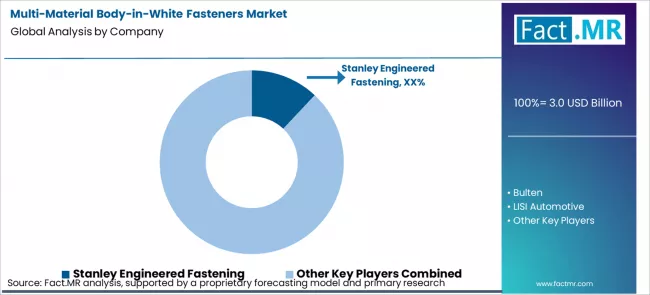
Multi Material Body In White Fasteners Market Analysis By Company | Source: Fact.MR
As per Fact.MR analysis, the multi material body in white fasteners market in 2026 is defined by a shift from basic fastening supply to integrated systems where material compatibility, production continuity, and compliance with automotive standards determine competitive advantage. Stanley Engineered Fastening and ITW leverage broad material expertise and validated installation systems, which strengthen adoption with global OEMs seeking consistent crash performance and lightweight assemblies. Bulten and LISI Automotive emphasise multi metal joining solutions with documented fatigue and corrosion resistance, which increases trust among Tier 1 chassis and closure subsystem integrators. Bossard and SFS Group provide inventory linked engineering support, which reduces supply variability and line stoppages. Nifco and KAMAX optimise polymer metal hybrid fastener programs, which improves weight reduction and assembly efficiency. Würth Industrie Service and Sundram Fasteners focus on regional responsiveness and quality control, which enhances on time delivery and compliance with multi region automotive norms. Together, material compatibility validation, supply integration, and process reliability form enduring competitive moats, reducing reliance on price or isolated part offerings.
Recent Industry Developments
- BASF & General Motors Win Innovation Award for Fastener Sleeves on 2024 EV BASF, General Motors, WITOL and ADAC won the 2024 SPE Automotive Innovation Award in the Body Exterior category for innovative fastener sleeves used on the 2024 Chevrolet Equinox EV a fastening component that automatically compensates tolerance and simplifies installation compared with traditional fasteners.
- LISI Automotive Launches New Fastening Systems in 2025 LISI Automotive’s official Innovation News section shows several new fastening solutions released in 2025
- Removable Bird’s Beak - a push-lock fastening system that eliminates traditional screws, nuts, and clips and significantly reduces assembly time.
- Sealing Screws - enhanced fastening components designed for robust panel sealing in electrified vehicle assemblies.
- Overmolding Screws - fasteners molded directly into plastic parts for secure, durable multi-material assemblies.
- LISI Automotive Finalizes Acquisition of Fastening Assets in Hungary (Oct 2025) LISI Automotive Hungary completed the acquisition of the assets of Polysemble Hungary in September 2025 - a strategic move to strengthen its fastener component production footprint in Central Europe for automotive body assembly and other vehicle applications.
Key Players in Multi-Material Body-in-White Fasteners Market
- Stanley Engineered Fastening
- Bulten
- LISI Automotive
- Bossard
- ITW
- SFS Group
- Nifco
- KAMAX
- Würth Industrie Service
- Sundram Fasteners
References
- European Parliament & Council of the European Union. (2023). Regulation (EU) 2018/858 on the approval and market surveillance of motor vehicles and their components (consolidated version). Official Journal of the European Union.
- European Commission. (2023). General Safety Regulation (EU) 2019/2144 - Consolidated text. Official Journal of the European Union.
- National Highway Traffic Safety Administration. (2024). Federal Motor Vehicle Safety Standards (FMVSS) - Body structure and crash protection requirements. U.S. Department of Transportation.
- Organisation for Economic Co-operation and Development. (2023). Vehicle lightweighting and material substitution in transport manufacturing. OECD Publishing.
- Ministry of Land, Infrastructure, Transport and Tourism. (2024). Road transport vehicle safety standards (structural strength and joining requirements). Government of Japan.
Segmentation
Scope of the Report
| Items | Values |
|---|---|
| Quantitative Units (2026) | USD 3.0 billion |
| By Joining Technology | Self-Piercing Rivets (SPR), Flow-Drill Screws, Clinching or Clinch Rivets, Other |
| By Material Pairing | Aluminum-to-Aluminum, Aluminum-to-Steel, Composites-to-Metal, Other |
| By Vehicle Segment | Premium and Luxury, Mass-Market Passenger, LCV, Other |
| By Sales Channel | OEM Direct, Tier-1 Body Modules, Aftermarket, Other |
| Region | Asia Pacific, Europe, North America, Latin America, Middle East & Africa |
| Countries Covered | China, Japan, South Korea, India, Australia & New Zealand, ASEAN, Rest of Asia Pacific, Germany, UK, France, Italy, Spain, Nordic, BENELUX, Rest of Europe, USA, Canada, Mexico, Brazil, Chile, Rest of Latin America, KSA, Other GCC, Turkey, South Africa, Other African Union, Rest of Middle East & Africa |
| Key Companies Profiled | Stanley Engineered Fastening, ITW, Bulten, LISI Automotive, Bossard, SFS Group, Nifco, KAMAX, Würth Industrie Service, Sundram Fasteners |
| Additional Attributes | Dollar by sales by joining technology, material pairing, and vehicle segment; high-strength and lightweight fasteners; compatibility with multi-material chassis; standardized tolerance and fatigue resistance; automated assembly line integration; quality validation; multi-region compliance; supply chain reliability; operational throughput; crash-tested performance; OEM adoption; repeatable procurement; localized production support; hybrid polymer-metal fasteners. |
Source: Fact.MR analysis. Updated Feb 13, 2026
Multi-Material Body-in-White Fasteners Market Segmentation
-
By Joining Technology :
- Self-Piercing Rivets (SPR)
- Flow-Drill Screws
- Clinching or Clinch Rivets
- Other
-
By Material Pairing :
- Aluminum-to-Aluminum
- Aluminum-to-Steel
- Composites-to-Metal
- Other
-
By Vehicle Segment :
- Premium and Luxury
- Mass-Market Passenger
- LCV
- Other
-
By Sales Channel :
- OEM Direct
- Tier-1 Body Modules
- Aftermarket
- Other
-
Region :
- Asia Pacific
- China
- Japan
- South Korea
- India
- Australia & New Zealand
- ASEAN
- Rest of Asia Pacific
- Europe
- Germany
- United Kingdom
- France
- Italy
- Spain
- Nordic
- BENELUX
- Rest of Europe
- North America
- United States
- Canada
- Mexico
- Latin America
- Brazil
- Chile
- Rest of Latin America
- Middle East & Africa
- Kingdom of Saudi Arabia
- Other GCC Countries
- Turkey
- South Africa
- Other African Union
- Rest of Middle East & Africa
- Asia Pacific
Frequently Asked Questions
How big is the multi-material body-in-white fasteners market in 2026?
What will be the size of multi-material body-in-white fasteners market in 2036?
How much will be the multi-material body-in-white fasteners market growth between 2026 and 2036?
What are the key product types in the multi-material body-in-white fasteners market?
Which material pairing segment to contribute significant share in the multi-material body-in-white fasteners market in 2026?
Who worked on this report


Preview the report firsthand - request a free sample
Free SampleGet the brochure for pricing and purchase details
Download PDF