- Base Value(2026): 900.0 Mn
- Estimated Value(2026): 900.0 Mn
- Forecast Value (2036): 3260.0 Mn
- CAGR (2026 - 2036): 13.7%
Material Passport Systems for Circular Plastics Market Forecast and Outlook 2026 to 2036
The material passport systems for circular plastics market is projected to reach a valuation of USD 900 million in 2026, expanding to USD 3,260 million by 2036, with a CAGR of 13.7%. Over the forecast period, cost structures in this market are influenced by technological investments in digital platforms and blockchain integration.
Key Takeaways from Material Passport Systems for Circular Plastics Market
- Material Passport Systems for Circular Plastics Market Value (2026): USD 900 million
- Material Passport Systems for Circular Plastics Market Forecast Value (2036): USD 3,260 million
- Material Passport Systems for Circular Plastics Market Forecast CAGR (2026-2036): 13.7%
- Leading Segment in Material Passport Systems for Circular Plastics Market: DPP-compliant platforms (55%)
- Key Growth Region in Material Passport Systems for Circular Plastics Market: India (16%)
- Key Players in Material Passport Systems for Circular Plastics Market: Circularise, SAP, AntChain, NEC, Sphera, IBM, VeChain
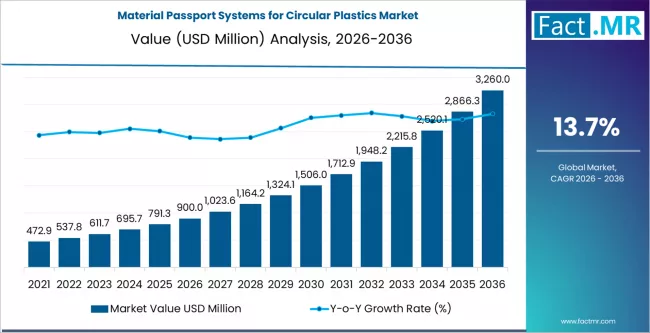
Material Passport Systems For Circular Plastics Market Market Value Analysis | Source: Fact.MR
These factors directly impact pricing strategies, with leading players leveraging intellectual property and data control to capture value rather than volume. Margin concentration is a key factor, as higher-value solutions focusing on compliance, traceability, and certification generate superior returns. Companies with a strong foothold in data management and secure platforms dominate value capture, capitalizing on their ability to offer a comprehensive range of services beyond mere product delivery. This enables them to create premium pricing opportunities while focusing on long-term contracts and strategic partnerships rather than short-term sales growth.
Material Passport Systems for Circular Plastics Market
| Metric | Value |
|---|---|
| Industry Sales Value (2026) | USD 900 million |
| Industry Forecast Value (2036) | USD 3,260 million |
| Industry Forecast CAGR (2026-2036) | 13.7% |
Source: Fact.MR analysis. Updated Jan 16, 2026
Category
| Category | Segments |
|---|---|
| End Use | Packaging & electronics; Brand compliance; Export traceability; Precision manufacturing; Emerging PCR flows |
| Passport Scope | Product & batch passports; Supplier-linked passports; Trade passports; Secure passports; Others |
| Data Elements | PCR %, additives, origin; Certifications & audits; Origin & transaction data; Material provenance; Others |
| Technology | DPP-compliant platforms; API-driven systems; Blockchain + QR; Trusted execution; Others |
| Region | North America; Europe; Asia Pacific; Latin America; Middle East & Africa |
Source: Fact.MR analysis. Updated Jan 16, 2026
Segmental Analysis
What Is the Impact of Passport Scope on the Material Passport Systems for Circular Plastics Market?
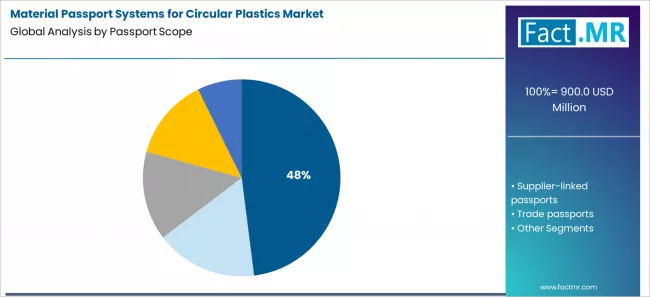
Material Passport Systems For Circular Plastics Market Analysis By Passport Scope | Source: Fact.MR
In the material passport systems for circular plastics market, passport scope plays a significant role in enhancing the traceability and transparency of recycled materials. Product and batch passports lead the market with a 48% share, as they offer detailed information about specific product batches and their material composition. This scope allows for better tracking of materials throughout their lifecycle, improving recycling efficiency and ensuring compliance with sustainability goals. As circular economy initiatives expand, the use of product and batch passports will remain a key factor in ensuring the proper management and recycling of plastics.
How Does Data Elements Influence the Material Passport Systems for Circular Plastics Market?
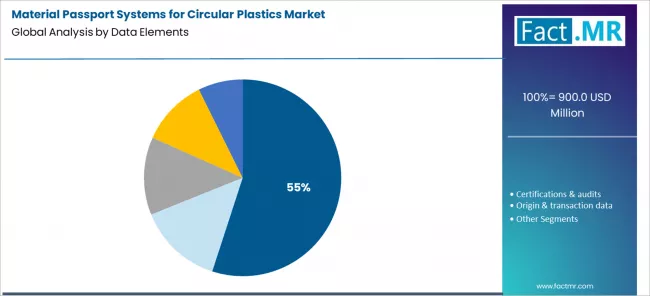
Material Passport Systems For Circular Plastics Market Analysis By Data Elements | Source: Fact.MR
Data elements are crucial in providing the necessary transparency and verification for material passport systems, with PCR %, additives, and origin leading this segment at a 55% share. These elements ensure that critical information about the material's recycled content, chemical additives, and sourcing is accurately recorded and accessible throughout the product's lifecycle. The integration of such data enhances supply chain visibility, enabling companies to make informed decisions regarding material use and recycling processes. As the market shifts toward more sustainable practices, the inclusion of these data elements will continue to drive the adoption of material passport systems, supporting the transition to a more circular plastic economy.
What are the Principal Drivers, Constraints, and Evolving Dynamics of the Material Passport Systems for Circular Plastics Market?
Growth in material passport systems for circular plastics has been influenced by requirements to track polymer attributes and history from collection through reuse and recycling. Manufacturers and brand owners use digital records that document resin type, additives, and processing data to support recyclers in sorting and reprocessing. Regulatory frameworks that require transparency in material composition and recycled content reporting have shaped specification of passport features.
Costs associated with digital infrastructure and data management have constrained adoption among smaller supply chain participants. Inconsistent data standards across organizations have affected interoperability of passport systems. Work to define common protocols and integrate passport data with existing enterprise systems is under way. Collaboration between standards bodies, resin producers, and converters aims to improve data quality and expand use cases.
Analysis of the Material Passport Systems for Circular Plastics Market by Key Country
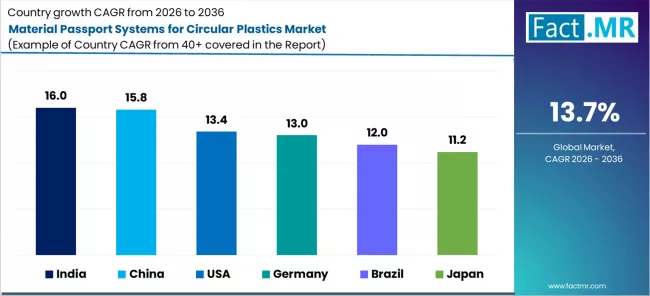
Material Passport Systems For Circular Plastics Market Cagr Analysis By Country | Source: Fact.MR
| Country | CAGR 2026 to 2036 |
|---|---|
| Germany | 13% |
| USA | 13.4% |
| China | 15.8% |
| Japan | 11.2% |
| India | 16% |
| Brazil | 12% |
Source: Fact.MR analysis. Updated Jan 16, 2026
The report covers an in-depth analysis of 40+ countries; top-performing countries are highlighted below.
What is the Growth Outlook for Material Passport Systems for Circular Plastics in Germany?
Germany’s material passport systems for circular plastics market is projected to grow at a CAGR of 13% from 2026 to 2036. As a global leader in sustainability and recycling, Germany’s push toward a circular economy is driving the demand for material passport systems in plastics. These systems offer traceability and transparency in the recycling process, which is essential for improving plastic reuse and reducing waste. Germany’s regulatory framework and commitment to sustainable manufacturing will continue to support the growth of this market.
How is the Material Passport Systems for Circular Plastics Market Performing in the USA?
The USA’s material passport systems for circular plastics market is expected to grow at a CAGR of 13.4% from 2026 to 2036. The country’s increasing focus on sustainability, coupled with the growing demand for recyclable and reusable materials, is fueling the adoption of material passport systems. These systems allow for better management and traceability of plastics throughout their lifecycle. As the USA faces growing pressure to reduce plastic waste and improve recycling efficiency, material passport systems will become a key tool in achieving circularity in plastic materials.
What is the Market Outlook for Material Passport Systems for Circular Plastics in China?
China is projected to experience significant growth in the material passport systems for circular plastics market, with a projected CAGR of 15.8% from 2026 to 2036. As China continues to expand its recycling infrastructure and adopt more sustainable practices in manufacturing, material passport systems are becoming increasingly important for improving the efficiency of plastic recycling. The country’s focus on environmental sustainability and reducing plastic waste aligns with the growing demand for technologies that facilitate better plastic traceability and circularity. With strong government support, the market for these systems in China is set to grow rapidly.
What is the Growth Potential for Material Passport Systems for Circular Plastics in Japan?
Japan’s material passport systems for circular plastics market is forecast to grow at a CAGR of 11.2% from 2026 to 2036. Japan has long been a leader in waste management and recycling, and its emphasis on sustainability continues to drive the adoption of circular plastic solutions. Material passport systems provide valuable data on plastic materials, enabling more effective recycling and reuse. As Japan seeks to improve the efficiency of its recycling systems and reduce plastic waste, the demand for these systems is expected to grow steadily, albeit at a slightly slower rate compared to other regions.
What is the Demand for Material Passport Systems for Circular Plastics in India?
India’s material passport systems for circular plastics market is set to grow at a robust CAGR of 16% from 2026 to 2036. With rapid urbanization and increasing environmental concerns, India is focusing on improving its plastic waste management and recycling systems. Material passport systems will play a critical role in providing transparency and traceability in the recycling process, facilitating the country’s transition to a circular plastics economy. Government initiatives and growing consumer awareness of sustainability are expected to accelerate the adoption of these systems, positioning India as a key growth market.
What is the Market Expansion Outlook for Material Passport Systems for Circular Plastics in Brazil?
Brazil’s material passport systems for circular plastics market is projected to grow at a CAGR of 12% from 2026 to 2036. Brazil’s growing focus on sustainability and improved waste management practices is driving the demand for circular solutions, particularly in the plastics sector. Material passport systems offer an efficient way to track and manage plastics throughout their lifecycle, which is crucial for improving recycling rates and reducing plastic waste. As the country strengthens its recycling infrastructure and regulatory frameworks, the market for these systems will expand steadily.
How is Competition Structured in the Material Passport Systems for Circular Plastics Market?
Competition in this market is defined by the ability to link material data with traceability, compliance, and lifecycle insights. Circularise and VeChain focus on decentralized architectures that record material attributes across supply chain tiers. Their systems aim to support verified material passports from feedstock to final product. SAP and IBM compete with enterprisescale platforms that embed material passport functionality into broader product and asset management suites.
AntChain and NEC emphasize blockchainenabled data integrity and secure sharing across partners. Sphera positions its offering through environmental, social, and governance data integration that aligns material passports with sustainability reporting. Competitive differentiation arises from ease of integration with existing enterprise systems, depth of analytics, and support for multi stakeholder visibility in plastic value chains. Buyers assess providers on technical interoperability, data governance, and documented use cases.
Key Players in the Material Passport Systems for Circular Plastics Market
- Circularise
- SAP
- AntChain
- NEC
- Sphera
- IBM
- VeChain
Bibliographies
- European Commission. (2023). Digital product passports for a circular economy: Requirements, architecture, and implementation pathways. Publications Office of the European Union.
- Organisation for Economic Co-operation and Development. (2023). Enhancing plastic circularity through digital tracking and material information systems. OECD Publishing.
- ISO. (2023). ISO 59020: Circular economy – Measuring and assessing circularity. International Organization for Standardization.
- World Economic Forum. (2023). Digital traceability systems for circular plastics value chains. World Economic Forum White Paper.
- Ellen MacArthur Foundation. (2024). The role of digital product passports in scaling circular plastics. Ellen MacArthur Foundation.
Segmentation
Scope of the Report
| Items | Values |
|---|---|
| Quantitative Units (2026) | USD Million |
| End Use | Packaging & electronics, Brand compliance, Export traceability, Precision manufacturing, Emerging PCR flows |
| Passport Scope | Product & batch passports, Supplier-linked passports, Trade passports, Secure passports, Others |
| Data Elements | PCR %, additives, origin, Certifications & audits, Origin & transaction data, Material provenance, Others |
| Technology | DPP-compliant platforms, API-driven systems, Blockchain + QR, Trusted execution, Others |
| Regions Covered | North America, Europe, Asia Pacific, Latin America, Middle East & Africa |
| Countries Covered | United States, Canada, Mexico, Brazil, Germany, United Kingdom, France, Italy, Spain, China, Japan, South Korea, India, Australia & New Zealand |
| Key Companies Profiled | Circularise, SAP, AntChain, NEC, Sphera, IBM, VeChain |
| Additional Attributes | Dollar revenue by end-use, passport scope, data elements, and technology; regional demand trends, competitive landscape, technological advancements in material passport systems, and innovations in circular plastics traceability |
Source: Fact.MR analysis. Updated Jan 16, 2026
Material Passport Systems for Circular Plastics Market Key Segments
-
End Use :
- Packaging & electronics
- Brand compliance
- Export traceability
- Precision manufacturing
- Emerging PCR flows
-
Passport Scope :
- Product & batch passports
- Supplier-linked passports
- Trade passports
- Secure passports
- Others
-
Data Elements :
- PCR %, additives, origin
- Certifications & audits
- Origin & transaction data
- Material provenance
- Others
-
Technology :
- DPP-compliant platforms
- API-driven systems
- Blockchain + QR
- Trusted execution
- Others
-
Region :
-
North America
- USA
- Canada
- Mexico
-
Europe
- Germany
- UK
- France
- Italy
- Spain
- Nordic Countries
- BENELUX
- Rest of Europe
-
Asia Pacific
- China
- Japan
- South Korea
- India
- Australia
- Rest of Asia Pacific
-
Latin America
- Brazil
- Argentina
- Rest of Latin America
-
Middle East and Africa
- Kingdom of Saudi Arabia
- United Arab Emirates
- South Africa
- Rest of Middle East and Africa
-
Other Regions
- Oceania
- Central Asia
- Other Markets
-
Frequently Asked Questions
How big is the material passport systems for circular plastics market in 2026?
What will be the size of material passport systems for circular plastics market in 2036?
How much will be the material passport systems for circular plastics market growth between 2026 and 2036?
What are the key product types in the material passport systems for circular plastics market?
Which passport scope segment to contribute significant share in the material passport systems for circular plastics market in 2026?
Who worked on this report


Preview the report firsthand - request a free sample
Free SampleGet the brochure for pricing and purchase details
Download PDF