- Market Value (2025): USD 147.2 Mn
- Estimated Value (2026): USD 160.0 Mn
- Forecast Value (2036): USD 368.5 Mn
- CAGR (2026-2036): 8.7%
Medical-Grade Barrier Systems Market Forecast and Outlook 2026 to 2036
According to the Fact.MR analysis, the medical-grade barrier systems market surpassed a value of USD 147.2 million in 2025 and is projected to grow from USD 160.0 million in 2026 to USD 368.5 million by 2036. Demand for medical-grade barrier systems is likely to grow at a CAGR of 8.7% over the forecast period.
Demand for medical-grade barrier systems is rising as caregivers protect skin from moisture, friction, adhesives and body fluids using silicone, acrylic, polyurethane and hydrogel barrier films, creams and coatings. These products prevent incontinence-associated dermatitis, diaper rash, pressure damage and skin stripping from tapes and dressings. For example, in April 2024, 3M spun off its health care business as Solventum, which sells the Cavilon line of no-sting barrier films and creams. Similar portfolio moves are projected to drive sales of medical-grade barrier systems through 2036.
Key Takeaways from the Medical-Grade Barrier Systems Market
- Medical-Grade Barrier Systems Market Value (2025): USD 147.2 million
- Medical-Grade Barrier Systems Market Value (2026): USD 160.0 million
- Medical-Grade Barrier Systems Market Forecast Value (2036): USD 368.5 million
- Medical-Grade Barrier Systems Market Forecast CAGR (2026-2036): 8.7%
- Leading Medical barrier material: Silicone (42.4%)
- Key Market Participants: DSM-Firmenich, Lonza, Balchem, Kerry Group, Glanbia Nutritionals, IFF
- Key Growth Regions: United States, Switzerland, Germany, Japan, France
Aging populations in Japan, Europe and the United States are increasing the number of people with incontinence and fragile skin in hospitals, nursing homes and home care. Demand for medical-grade barrier systems is growing as nursing guidelines recommend structured skin-care routines using barrier products. Suppliers of medical-grade silicones such as Dow, Wacker and Avantor's NuSil support barrier product makers. Similar demographics are projected to drive sales of medical-grade barrier systems worldwide.
Medical-Grade Barrier Systems Market
| Metric | Value |
|---|---|
| Estimated Value in (2026) | USD 160.0 million |
| Forecast Value in (2036) | USD 368.5 million |
| Forecast CAGR (2026 to 2036) | 8.7% |
Source: Fact.MR analysis. Updated Nov 18, 2026
Source: Fact.MR analysis.
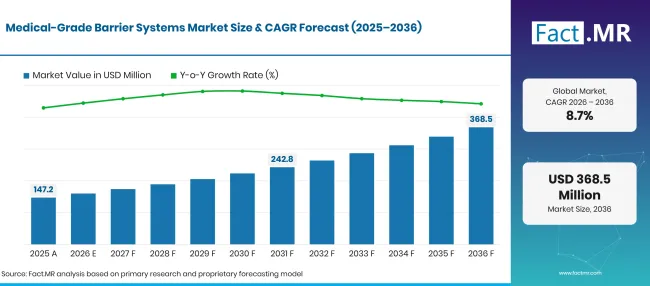
Medical Grade Barrier Systems Forecast Global 1 | Source: Fact.MR
Category
| Category | Segments |
|---|---|
| Medical barrier material | Silicone, Polyurethane, Hydrogel, Acrylic, Fluoropolymer |
| Commercial form | Powder, Capsule / tablet, Liquid, Microcapsule, Ready-to-use blend |
| End application | Clinical nutrition, Supplements, Functional foods, Infant / pediatric, Specialized medical |
| Sales channel | Ingredient OEM, Medical nutrition brand, Hospital procurement, Pharmacy, Direct consumer |
| Region | United States; Switzerland; Germany; Japan; France |
Source: Fact.MR analysis. Updated Nov 18, 2026
Source: Fact.MR analysis.
Segmental Analysis
What supports Silicone's leading position in the Medical-Grade Barrier Systems Market?
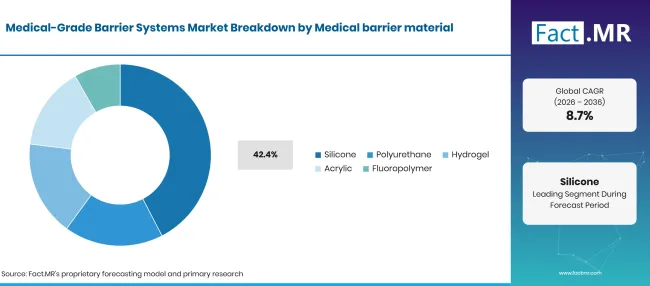
Medical Grade Barrier Systems Breakdown Medical Barrier Material | Source: Fact.MR
Demand for Silicone hold 42.4% of revenue in 2026, about USD 67.8 million, as silicone-based films, creams and sprays provide water resistance, breathability and skin protection for patients with fragile or compromised skin. Demand is supported by their use in wound care, incontinence management and protection against moisture-associated skin damage. Acrylic terpolymer films and hydrogels also serve specialized applications, while suppliers are expanding silicone-based sprays, wipes and leave-on formulations. The US FDA's recognition of skin protectants under its OTC drug framework supports the established use of topical protective products in healthcare. As hospitals and caregivers prioritize skin integrity and patient comfort, demand for silicone-based barrier solutions is expected to remain strong.
Which factors are supporting Liquid's commercial-form demand in the Medical-Grade Barrier Systems Market?
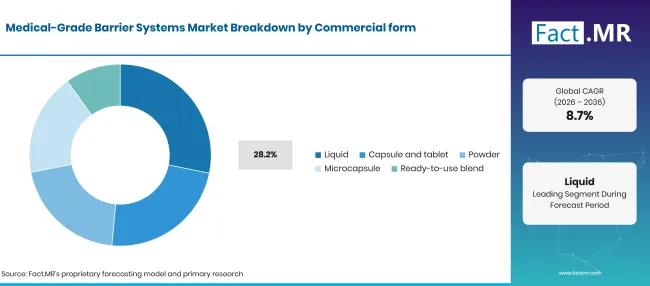
Medical Grade Barrier Systems Breakdown Commercial Form | Source: Fact.MR
Adoption of Liquid formats represent 28.2% of revenue in 2026, about USD 45.1 million, because sprays, lotions and liquid film-forming products can cover irregular skin surfaces and sensitive areas with minimal application friction. Their suitability for wound margins, peristomal skin and moisture-exposed areas supports purchasing by hospitals, long-term care facilities and home-care providers. Suppliers are offering no-sting formulations and spray applicators that simplify application and help create uniform protective layers. India's Ministry of Health and Family Welfare reported that institutional deliveries reached 90.6% under NFHS-6, released in May 2026, indicating the continued importance of hospital-based maternal and newborn care. This provides a relevant healthcare-setting indicator for demand for gentle topical protection, although it does not directly measure liquid barrier-product purchases.
How does Infant / pediatric care contribute to end-application demand in the Medical-Grade Barrier Systems Market?
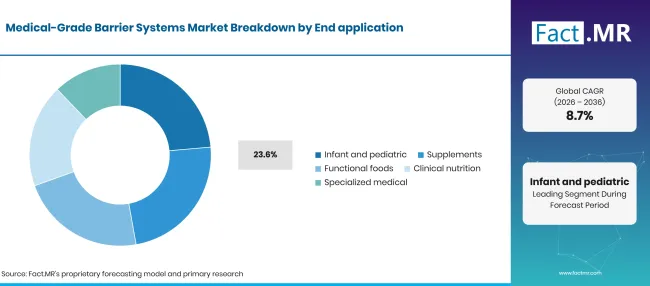
Medical Grade Barrier Systems Breakdown End Application | Source: Fact.MR
Infant and pediatric applications holds 23.6% of revenue in 2026, about USD 37.8 million, as newborns, premature infants and young children require gentle protection against diaper-related moisture exposure, friction and skin irritation. Demand is supported by the use of barrier creams and protective films in neonatal units, pediatric hospitals and household diaper-care routines. India's NFHS-6 data, released in 2026, showed that children below five years represented 8.0% of the population, while institutional deliveries reached 90.6%. These figures indicate a substantial base of young children and continued use of maternal and newborn healthcare services. Suppliers are responding with pediatric-oriented formulations designed to minimize irritation and support frequent application. Continued attention to infant skin protection is expected to sustain demand for specialized medical-grade barriers.
Which developments are strengthening Pharmacy's role in sales-channel demand in the Medical-Grade Barrier Systems Market?
Medical Grade Barrier Systems Breakdown Sales Channel | Source: Fact.MR
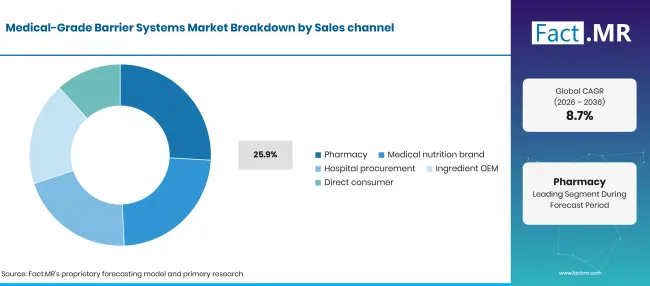
Sales through Pharmacies sales channel account for 25.9% of revenue in 2026, about USD 41.4 million, as parents, caregivers and patients purchase barrier creams, skin protectants and related wound-care products through retail pharmacies. Their accessibility supports repeat purchases for diaper rash prevention, moisture protection and routine skin care, while pharmacists help consumers select suitable products for different skin conditions. India's Department of Pharmaceuticals reported that 20,149 Jan Aushadhi Kendras had been established by June 30, 2026, providing a wider network for access to medicines and healthcare products. The scheme recorded medicine sales worth INR 2,252.19 crore during FY2025-26. Although these figures do not represent barrier-product sales specifically, they demonstrate the scale of India's organized pharmacy distribution network. Wider retail access and recurring demand for topical skin-care products are expected to support pharmacy-channel sales.
Medical-Grade Barrier Systems Market-Drivers, Restraints & Trends
Drivers: Medical-grade barrier systems
Demand for medical-grade barrier systems is supported by hospitals' focus on preventing pressure injuries and protecting skin integrity. AHRQ's 2026 Patient Safety Indicators benchmark recorded 34,703 pressure-ulcer cases across 46.53 million hospital discharges, representing an observed rate of 0.75 per 1,000 discharges. The 2026 benchmark treats pressure-ulcer rates as a hospital-level patient-safety indicator. This creates a measurable quality-improvement requirement for hospitals and supports demand for preventive skin-protection products with clinical evidence.
Restraints – Generic creams and reimbursement limitations
Price competition from generic skin protectants and reimbursement restrictions can limit sales of premium medical-grade barrier products, particularly in home-care settings. In its November 2026 preliminary HCPCS coding determination, CMS stated that skin sealants, protectants, moisturizers and ointments fall under existing code A6250. It also specified that products under this code are not covered under Medicare Part B and receive no Medicare payment. This provides direct evidence of a reimbursement constraint, although coverage decisions may differ across other healthcare programmes and insurers
Opportunities – Silicone spray films
Demand for no-touch silicone spray films has an opportunity to develop in care settings where frequent handling of vulnerable skin can be difficult. AHRQ's 2026 benchmark recorded 34,703 pressure-ulcer cases, highlighting the continuing need for preventive skin-care measures in hospitals. Spray-format barriers can offer an alternative application method for protecting exposed or sensitive skin. However, the AHRQ figures measure pressure-ulcer cases, not spray-film adoption or sales, so they should be used as evidence of the wider prevention need rather than proof of demand for a particular format.
Trend – Adhesive-related skin injury prevention
Hospitals are placing greater emphasis on monitoring pressure injuries and documenting patient-safety outcomes, strengthening the case for skin-protection measures around medical devices and adhesive dressings. AHRQ's 2026 Patient Safety Indicators include pressure-ulcer rates as a formal hospital-level measure, while its pressure-injury resources track preventive interventions and documented risk assessments. This focus supports interest in protective films applied before medical adhesives, although the AHRQ pressure-ulcer indicator does not specifically measure medical adhesive-related skin injuries.
Medical-Grade Barrier Systems Market by Analysis by Key Country
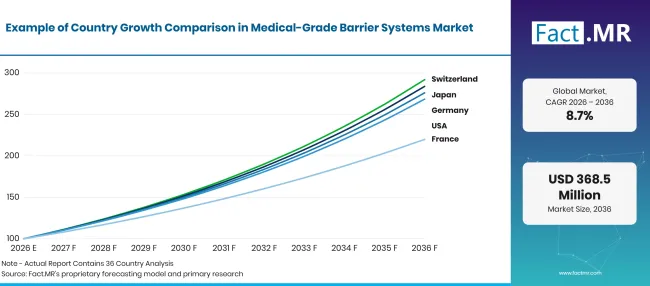
Medical Grade Barrier Systems Growth Index | Source: Fact.MR
| Country | CAGR (2026-2036) |
|---|---|
| United States | 12.8% |
| Switzerland | 12.1% |
| Germany | 11.9% |
| Japan | 11.4% |
| France | 8.2% |
Source: Fact.MR analysis. Updated Nov 18, 2026
Source: Fact.MR analysis.
Why is the United States the fastest-growing market for medical-grade barrier systems?
Demand for medical-grade barrier systems in the United States is projected to rise at a 12.8% CAGR through 2036, supported by hospital efforts to prevent pressure injuries and protect fragile skin among patients with limited mobility.
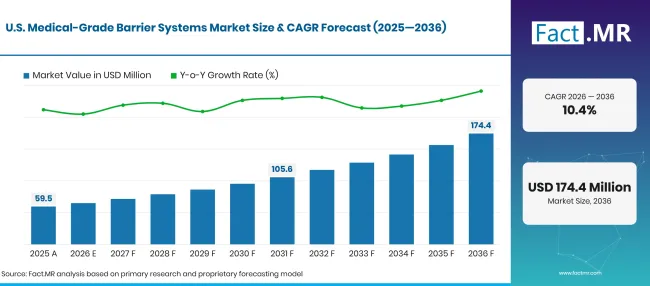
Medical Grade Barrier Systems Forecast Usa | Source: Fact.MR
The Agency for Healthcare Research and Quality’s 2026 patient-safety benchmark recorded a pressure-ulcer rate of 0.75 per 1,000 hospital discharges, based on more than 46.5 million discharges. This highlights the continuing need for prevention and skin-protection protocols in hospitals. Wider availability of silicone barrier films, creams and sprays through suppliers such as Solventum and Medline is also supporting sales.
What is driving medical-grade barrier system demand in Switzerland?
Swiss demand is estimated to expand at a 12.1% CAGR as hospitals, nursing facilities and home-care providers increase spending on products that protect vulnerable skin and support wound and incontinence care.
The Swiss Federal Statistical Office reported that healthcare costs reached CHF 97 billion in 2024, rising 4.1% year over year, in its April 2026 release. This provides evidence of a growing healthcare expenditure base, although it does not measure barrier-product purchases directly. Switzerland’s established medtech and dermatology industries, together with companies such as Galderma and medical textile supplier Flawa, provide a supportive commercial environment for premium barrier products.
What is shaping medical-grade barrier system demand in Germany?
Germany is projected to record an 11.9% CAGR, with demand supported by an expanding older population and the need to prevent moisture-associated skin damage, pressure injuries and irritation among people receiving long-term care.
Destatis reported in August 2026 that 19.3 million people were aged 65 or older in 2025, representing 23% of the population. This sizeable care population supports recurring purchases of barrier creams, protective films and skin-care products by nursing homes, hospitals and home-care providers. Wacker’s medical silicones and Hartmann’s incontinence-care portfolio also position established suppliers to serve related skin-protection needs.
What is shaping medical-grade barrier system demand in Japan?
Demand in Japan estimated to record a 11.4% CAGR as the world's oldest population needs incontinence and skin care, and Unicharm leads adult diapers. Japan's population aged 65 and over is about 29% of the total.
The Statistics Bureau of Japan’s June 2026 population estimates recorded 36.19 million people aged 65 and over, equal to 29.5% of the population; those aged 75 and over accounted for 21.37 million. These figures indicate a substantial population with potential need for regular skin-protection and moisture-barrier products. Unicharm’s adult incontinence-care products also support access to complementary hygiene and skin-care routines.
Why is medical-grade barrier system growth slower in France?
Sales in France is estimated to account 8.2% CAGR, the slowest among the five key countries, as pricing controls limit premium products, as the national health insurance sets prices for reimbursed wound care.
Makers such as Urgo, based in Chenôve, focus on high-volume products. Reimbursement and pricing requirements for listed medical devices can also make it harder for suppliers to secure higher prices for differentiated products. However, demand remains supported by the needs of older people receiving care at home and in residential facilities. A 2026 report from France’s Directorate for Research, Studies, Evaluation and Statistics (DREES) projected that 2.1 million older people with a need for assistance with daily living would live at home by 2050, around 698,000 more than in 2021. This longer-term care requirement supports sales opportunities for protective creams, barrier films and incontinence-related skin-care products, while suppliers such as Urgo continue to serve established wound-care channels.
Competitive Landscape for Medical-Grade Barrier Systems Market
Competition in the medical-grade barrier systems market involves medical skin-care brands, silicone suppliers and delivery-technology companies. The companies profiled, dsm-firmenich, Lonza, Balchem, Kerry Group, Glanbia Nutritionals and IFF, compete in adjacent formulation and delivery technologies, while dedicated barrier brands such as Solventum's Cavilon, Medline and Convatec lead finished products. Buyers select products on skin protection, comfort, evidence and price.
From 2024 onward, competition shifted toward silicone sprays and adhesive-injury prevention. Suppliers with clinical evidence are best placed to grow.
Recent Developments
- In April 2024, 3M completed the spin-off of its health care business as Solventum.
- In July 2026, dsm-firmenich announced a strategic partnership with Nous to accelerate the global commercialization of Koncentra, a botanical ingredient developed for energy, focus and mood support. The ingredient is intended for functional food and beverage applications.
- In March 2026, Lonza signed a definitive agreement to divest its Capsules & Health Ingredients (CHI) business to Lone Star Funds for an enterprise value of CHF 2.3 billion. Lonza planned to retain a 40% stake. This is a confirmed divestment agreement, not a new product launch or acquisition by Lonza.
- In April 2026, Kerry announced the opening of its expanded biotechnology manufacturing facility in Carrigaline, Ireland, increasing its industrial-scale lactase enzyme production capacity. The expansion supports dairy manufacturers developing lactose-free and reduced-sugar products.
Key Players in Medical-Grade Barrier Systems Market
Key companies operating in the market include DSM-Firmenich, Lonza, Balchem, Kerry Group, Glanbia Nutritionals, and IFF.
- DSM-Firmenich
- Lonza
- Balchem
- Kerry Group
- Glanbia Nutritionals
- IFF
Scope of Report
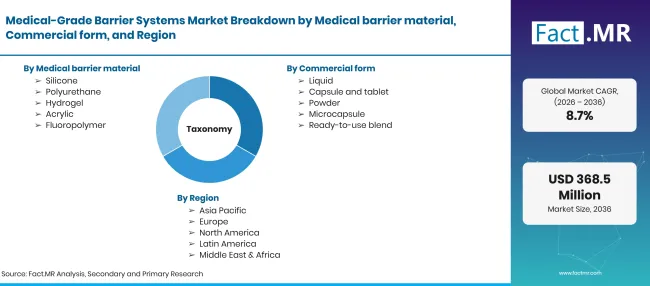
Medical Grade Barrier Systems Taxonomy | Source: Fact.MR
| Items | Values |
|---|---|
| Quantitative Units (2026) | USD 160.0 Million |
| Medical barrier material | Silicone, Polyurethane, Hydrogel, Acrylic, Fluoropolymer |
| Commercial form | Powder, Capsule / tablet, Liquid, Microcapsule, Ready-to-use blend |
| End application | Clinical nutrition, Supplements, Functional foods, Infant / pediatric, Specialized medical |
| Sales channel | Ingredient OEM, Medical nutrition brand, Hospital procurement, Pharmacy, Direct consumer |
| Regions Covered | North America, Latin America, Europe, East Asia, South Asia and Pacific, Middle East & Africa |
| Countries Covered | United States, Switzerland, Germany, Japan, France, and other countries |
| Key Companies Profiled | DSM-Firmenich, Lonza, Balchem, Kerry Group, Glanbia Nutritionals, IFF |
| Additional Attributes | Dollar revenue in the Medical-Grade Barrier Systems Market is segmented by medical barrier material (silicone, polyurethane, hydrogel, acrylic, fluoropolymer); commercial form (powder, capsule / tablet, liquid, microcapsule, ready-to-use blend); end application (clinical nutrition, supplements, functional foods, infant / pediatric, specialized medical); sales channel (ingredient oem, medical nutrition brand, hospital procurement, pharmacy, direct consumer) and region. |
Source: Fact.MR analysis. Updated Nov 18, 2026
Source: Fact.MR analysis.
Medical-Grade Barrier Systems Market by Segments
-
Medical barrier material
- Silicone
- Polyurethane
- Hydrogel
- Acrylic
- Fluoropolymer
-
Commercial form
- Powder
- Capsule / tablet
- Liquid
- Microcapsule
- Ready-to-use blend
-
End application
- Clinical nutrition
- Supplements
- Functional foods
- Infant / pediatric
- Specialized medical
-
Sales channel
- Ingredient OEM
- Medical nutrition brand
- Hospital procurement
- Pharmacy
- Direct consumer
-
Region:
- North America
- United States
- Canada
- Mexico
- Europe
- Germany
- United Kingdom
- France
- Italy
- Spain
- Rest of Europe
- Asia Pacific
- China
- India
- Japan
- South Korea
- Australia
- Rest of Asia Pacific
- Latin America
- Brazil
- Mexico
- Argentina
- Rest of Latin America
- Middle East & Africa
- GCC Countries
- South Africa
- Rest of Middle East & Africa
- North America
Bibliography
- Agency for Healthcare Research and Quality. (2026). 2026 patient safety indicators benchmark tables.
- Agency for Healthcare Research and Quality. (n.d.). Pressure injury dashboard.
- Agency for Healthcare Research and Quality. (n.d.). Quality indicators and patient safety measures.
- Centers for Medicare & Medicaid Services. (2026). B2 2026 HCPCS Level II public meeting agenda: November 2–3, 2026.
- Department of Pharmaceuticals, Government of India. (2026, July 28). Pradhan Mantri Bhartiya Janaushadhi Pariyojana. Press Information Bureau.
- Department of Pharmaceuticals, Government of India. (2026, August 7). Sale of medicines in Jan Aushadhi Kendras. Press Information Bureau.
- Directorate for Research, Studies, Evaluation and Statistics. (2026, February). Soutien à l’autonomie des personnes âgées : Entre 150 000 et 200 000 emplois supplémentaires seraient nécessaires en 2050 [Support for older people’s autonomy: Between 150,000 and 200,000 additional jobs would be needed by 2050]. Ministry of Health and Prevention, France.
- dsm-firmenich. (2026, July 15). dsm-firmenich and Nous partner to bring novel functional ingredient, Koncentra to market for energy, focus, and mood support.
- Kerry Group. (2026, April 20). Kerry opens expanded biotechnology manufacturing hub in Ireland to meet growing global demand for lactase enzymes.
- Lonza Group AG. (2026, March 6). Lonza completes its transformation to a pure-play CDMO with agreement to divest Capsules & Health Ingredients.
- Ministry of Health and Family Welfare, Government of India. (2026, May 29). Union Health Ministry releases National Family Health Survey–6. Press Information Bureau.
- Solventum Corporation. (2025). Annual report on Form 10-K for the fiscal year ended December 31, 2024.
- Swiss Federal Statistical Office. (2026, April 24). Health care costs and financing in 2024.
- Wacker Chemie AG. (2025). Annual report 2024.
Frequently Asked Questions
How big is the global Medical-Grade Barrier Systems Market in 2026?
What will be the size of the Medical-Grade Barrier Systems Market by 2036?
How fast will the Medical-Grade Barrier Systems Market grow during the forecast period?
Which medical barrier material segment holds the largest share of the Medical-Grade Barrier Systems Market?
Who worked on this report


Preview the report firsthand - request a free sample
Free SampleGet the brochure for pricing and purchase details
Download PDF