- Base Value(2026): 10.9 Bn
- Estimated Value(2026): 10.9 Bn
- Forecast Value (2036): 19.8 Bn
- CAGR (2026 - 2036): 6.1%
Medical Sharps Market Forecast and Outlook 2026 to 2036
The global medical sharps market is projected to total USD 10.95 billion in 2026, advancing to USD 19.79 billion by 2036, achieving a CAGR of 6.1%. This steady growth is underpinned by the indispensable role of disposable sharp instruments in virtually every facet of modern healthcare delivery, from routine vaccination and blood collection to complex surgical procedures and chronic disease management.
Key Takeaways from the Medical Sharps Market
- Market Value for 2026: USD 10.95 Billion
- Market Value for 2036: USD 19.79 Billion
- Forecast CAGR 2026 to 2036: 6.1%
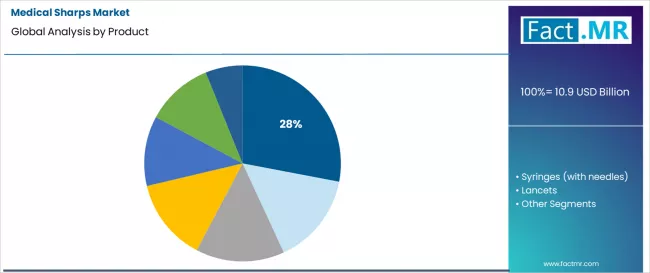
- Leading Product Segment (2026): Hypodermic needles (28.0%)
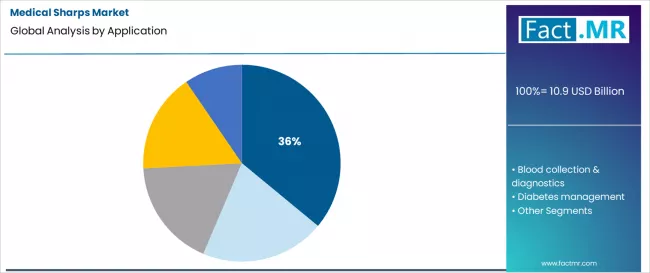
- Leading Application Segment (2026): Drug delivery & injections (36.0%)
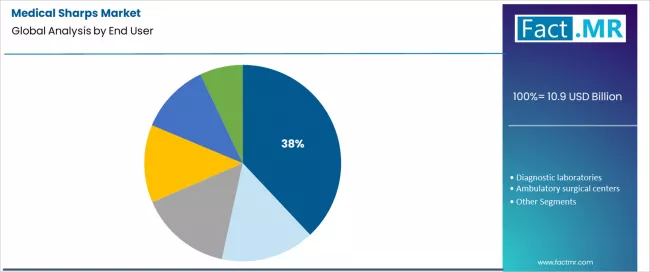
- Leading End User Segment (2026): Hospitals (38.0%)
- Key Growth Countries: India (8.5% CAGR), China (8.2% CAGR), USA (7.4% CAGR), Brazil (7.6% CAGR)
- Key Players in the Market: BD (Becton, Dickinson and Company), Terumo Corporation, B. Braun Melsungen, Nipro Corporation, Smiths Medical, Others
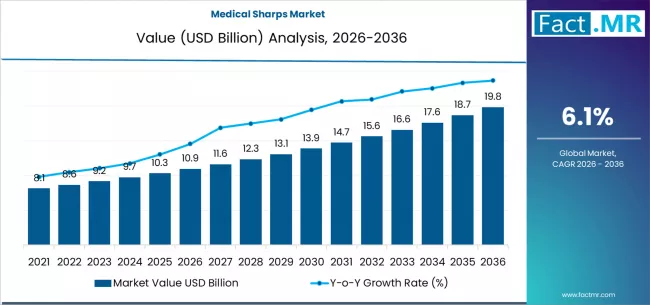
Medical Sharps Market Market Value Analysis | Source: Fact.MR
The consistent demand is fundamentally non-cyclical, driven by global patient volume, public health initiatives, and the non-reusable nature of these critical safety devices. The market's expansion is further supported by technological advancements focused on enhancing safety features to prevent needlestick injuries and by the rising prevalence of conditions like diabetes that require frequent subcutaneous access.
Dominance within the product segment is held by hypodermic needles, reflecting their universal application across therapeutic and diagnostic settings. The drug delivery and injections application constitutes the largest share, underscoring the central role of parenteral administration in treatment protocols. Hospitals remain the primary end-user, centralizing high-volume usage, though growth in home healthcare and retail channels is notable.
Expansion is robust across both mature and high-growth economies, propelled by aging populations, expanding immunization programs, and improving access to injectable therapies. The evolution of this essential market is characterized by a dual focus on meeting relentless procedural demand while continuously innovating to uphold the highest standards of clinician and patient safety.
Metric
| Metric | Value |
|---|---|
| Market Value (2026) | USD 10.95 Billion |
| Market Forecast Value (2036) | USD 19.79 Billion |
| Forecast CAGR 2026 to 2036 | 6.1% |
Source: Fact.MR analysis. Updated Jan 10, 2026
Category
| Category | Segments |
|---|---|
| Product | Hypodermic needles, Syringes (with needles), Lancets, Blood collection needles, Surgical blades & scalpels, Pen needles |
| Application | Drug delivery & injections, Blood collection & diagnostics, Diabetes management, Vaccination programs, Surgical procedures, Public health programs |
| End User | Hospitals, Diagnostic laboratories, Ambulatory surgical centers, Home healthcare, Retail & online pharmacies, Public health programs |
| Region | North America, Latin America, Western Europe, Eastern Europe, East Asia, South Asia & Pacific, MEA |
Source: Fact.MR analysis. Updated Jan 10, 2026
Segmental Analysis
By Product, Which Instrument is the Universal Conduit for Parenteral Access?
Medical Sharps Market Analysis By Product | Source: Fact.MR
Hypodermic needles command a leading 28.0% share. This dominance stems from their absolute necessity in administering a vast array of injectable drugs, vaccines, and fluids. Their use spans hospitals, clinics, and home care, making them the most fundamental and high-volume sharp device. Continuous innovation in gauge, length, and point geometry to reduce pain and tissue trauma sustains their central market position.
By Application, Which Clinical Activity Generates the Highest Procedural Volume?
Medical Sharps Market Analysis By Application | Source: Fact.MR
Drug delivery and injections constitute the dominant application with a 36.0% share. This encompasses the daily administration of medications across all therapeutic areas-from antibiotics and biologics to chemotherapy and anesthesia. The irreplaceable role of injection for rapid systemic drug delivery ensures this segment remains the primary driver of sharps consumption, closely tied to global pharmaceutical utilization trends.
By End User, Which Setting Centralizes the Most Diverse and Acute Usage?
Medical Sharps Market Analysis By End User | Source: Fact.MR
Hospitals are the primary end-user segment, holding a 38.0% share. As comprehensive care centers, hospitals utilize the full spectrum of sharps products across emergency, inpatient, surgical, and outpatient departments. Their high patient throughput and complex procedures create concentrated, consistent demand for bulk procurement.
What are the Principal Drivers, Constraints, and Evolving Dynamics of this Market?
| Attribute | Analysis |
|---|---|
| Rising Global Volume of Surgical & Injectable Procedures | Increasing surgical interventions, vaccination campaigns, and chronic disease management directly escalate the consumption of disposable sharps. |
| Stringent Safety Regulations and High Cost of Safety-Engineered Devices | Mandates for safety-engineered sharps increase unit costs, which can limit adoption in budget-constrained health systems despite reducing needlestick injuries. |
| Expansion of Home-based and Self-administered Care | Growth in diabetes management, auto-injector use, and home parenteral nutrition drives demand for user-friendly, safety-designed sharps for non-clinical settings. |
| Growing Emphasis on Circularity and Sharps Waste Management | The trend toward sustainable healthcare intensifies focus on the end-of-life environmental impact, prompting innovation in recyclable materials and waste processing. |
Source: Fact.MR analysis. Updated Jan 10, 2026
Analysis of the Medical Sharps Market by Key Countries
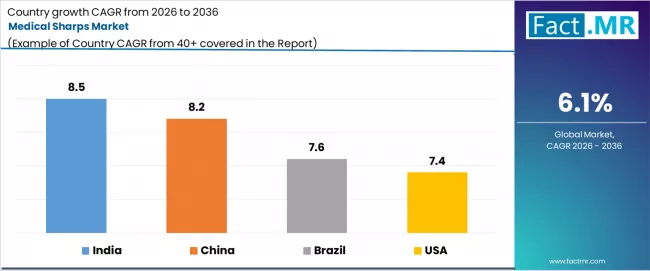
Medical Sharps Market Cagr Analysis By Country | Source: Fact.MR
| Country | CAGR 2026 to 2036 |
|---|---|
| India | 8.5% |
| China | 8.2% |
| USA | 7.4% |
| Brazil | 7.6% |
Source: Fact.MR analysis. Updated Jan 10, 2026
How do Regulatory Mandates and Group Purchasing Shape the USA's Advanced Market?
The USA's 7.4% CAGR is propelled by the enforcement of the Needlestick Safety and Prevention Act, mandating safety-engineered devices, and the influence of large group purchasing organizations (GPOs) that negotiate volume contracts.
Growth is characterized by a mature demand for high-safety products, a robust home healthcare segment, and steady volume from hospital and outpatient settings, with innovation focused on enhancing user ergonomics and connectivity.
What Public Health and Immunization Priorities Underpin Brazil's Steady Demand?
Brazil's 7.6% CAGR is closely tied to the scale of its national public health system (SUS), which conducts massive immunization campaigns and provides widespread access to injectable therapies.
Market growth is fueled by government procurement for public health programs and an expanding network of private hospitals and diagnostic centers, with demand spanning basic devices for primary care to safety devices for tertiary facilities.
How are China's Healthcare Expansion and Manufacturing Scale Intertwined?
China's 8.2% CAGR is driven by its dual role as a massive consumer and the world's leading manufacturer of medical devices. Domestic healthcare expansion increases procedural volume, while its manufacturing prowess supplies both local needs and global exports. The market is evolving from a focus on cost-effective volume products to increasing adoption of domestic and international branded safety devices in urban hospitals.
Why Does India's Epidemiological and Infrastructure Growth Present a High-Growth Scenario?
India's leading 8.5% CAGR is fueled by a high burden of diseases requiring injectable treatment such as diabetes, infectious diseases, an expanding hospital and diagnostic infrastructure, and large-scale government immunization and public health missions.
The market is highly tiered, with demand for ultra-low-cost conventional devices in public health coexisting with rapidly growing adoption of safety-engineered and specialty sharps in the private healthcare sector.
Competitive Landscape of the Medical Sharps Market
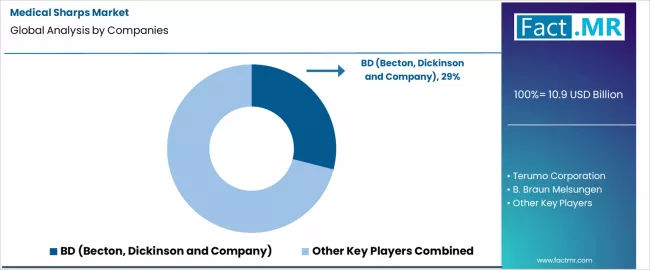
Medical Sharps Market Analysis By Company | Source: Fact.MR
Established global medtech giants dominate the competitive landscape with extensive portfolios spanning sharps, injection systems, and medication delivery. Competition is fierce and revolves around manufacturing scale, cost efficiency, and deep distribution networks that reach every level of the healthcare system.
Success is heavily dependent on securing long-term contracts with national tenders for public health programs and with large hospital GPOs. These companies invest significantly in automating production to maintain razor-thin margins on high-volume commodity items while also funding R&D for next-generation safety devices with features like passive shielding and needlestick prevention indicators.
Beyond scale, competition intensifies in the innovation arena for safety-engineered devices and specialized sharps for diabetes care, biologics, and wearable injectors. Companies compete on patent-protected designs that offer demonstrable reductions in needlestick injuries and improved patient comfort.
Competition from local manufacturers in high-growth regions, who can often compete aggressively on price for standard products, is a constant pressure. Strategic focus areas include vertical integration into syringe and drug container manufacturing, developing sustainable or recyclable products, and providing comprehensive sharps disposal solutions to create a full ecosystem around the device, thereby strengthening customer loyalty and creating additional revenue streams.
Key Players in the Medical Sharps Market
- BD (Becton, Dickinson and Company)
- Terumo Corporation
- B. Braun Melsungen
- Nipro Corporation
- Smiths Medical
- Others
References
- International Sharps Injury Prevention Society. (2025). Global guidelines for the selection and evaluation of safety-engineered sharp devices. ISIPS Publications.
- Jagger, J., & Perry, J. (2024). Epidemiology and prevention of needlestick injuries in health care settings. In Hospital Epidemiology and Infection Control. Lippincott Williams & Wilkins.
- Meyer, P., & DeJoy, D. (2025). Innovation in medical device design: The case of safety sharps. Journal of Medical Engineering & Technology.
- World Health Organization. (2024). WHO guideline on the use of safety-engineered syringes for intramuscular, intradermal and subcutaneous injections. WHO Guidelines.
- Xu, L., & Chen, Y. (2025). Market analysis and regulatory trends for injection devices. Drug Delivery and Translational Research.
Segmentation
Scope of Report
| Items | Values |
|---|---|
| Quantitative Units | USD Billion |
| Product | Hypodermic needles, Syringes (with needles), Lancets, Blood collection needles, Surgical blades & scalpels, Pen needles |
| Application | Drug delivery & injections, Blood collection & diagnostics, Diabetes management, Vaccination programs, Surgical procedures, Public health programs |
| End User | Hospitals, Diagnostic laboratories, Ambulatory surgical centers, Home healthcare, Retail & online pharmacies, Public health programs |
| Key Countries | India, China, USA, Brazil |
| Key Companies | BD (Becton, Dickinson and Company), Terumo Corporation, B. Braun Melsungen, Nipro Corporation, Smiths Medical, Others |
| Additional Analysis | Comparative analysis of safety device efficacy in reducing needlestick injuries; cost-benefit analysis of safety-engineered vs. conventional sharps; study of material innovations for recyclability; impact of biologics and high-viscosity drug delivery on needle design; evaluation of global sharps waste disposal regulations and their market impact. |
Source: Fact.MR analysis. Updated Jan 10, 2026
Market by Segments
-
Product :
- Hypodermic Needles
- Syringes (with Needles)
- Lancets
- Blood Collection Needles
- Surgical Blades & Scalpels
- Pen Needles
-
Application :
- Drug Delivery & Injections
- Blood Collection & Diagnostics
- Diabetes Management
- Vaccination Programs
- Surgical Procedures
- Public Health Programs
-
End User :
- Hospitals
- Diagnostic Laboratories
- Ambulatory Surgical Centers
- Home Healthcare
- Retail & Online Pharmacies
- Public Health Programs
-
Region :
- North America
- USA
- Canada
- Latin America
- Brazil
- Mexico
- Argentina
- Rest of Latin America
- Western Europe
- Germany
- France
- Italy
- Spain
- UK
- BENELUX
- Rest of Western Europe
- Eastern Europe
- Russia
- Poland
- Czech Republic
- Rest of Eastern Europe
- East Asia
- China
- Japan
- South Korea
- Rest of East Asia
- South Asia & Pacific
- India
- ASEAN
- Australia
- Rest of South Asia & Pacific
- MEA
- GCC Countries
- South Africa
- Turkiye
- Rest of MEA
- North America
Frequently Asked Questions
How big is the medical sharps market in 2026?
What will be the size of medical sharps market in 2036?
How much will be the medical sharps market growth between 2026 and 2036?
What are the key product types in the medical sharps market?
Which application segment to contribute significant share in the medical sharps market in 2026?
Who worked on this report


Preview the report firsthand - request a free sample
Free SampleGet the brochure for pricing and purchase details
Download PDF