Mediterranean Low-FODMAP Flavor Base Ingredients Market (2026 - 2036)

Mediterranean Low-FODMAP Flavor Base Ingredients Market Size and Share Forecast Outlook 2026 to 2036

Core Findings

    Mediterranean Low-FODMAP Flavor Base Ingredients Market Forecast and Outlook 2026 to 2036

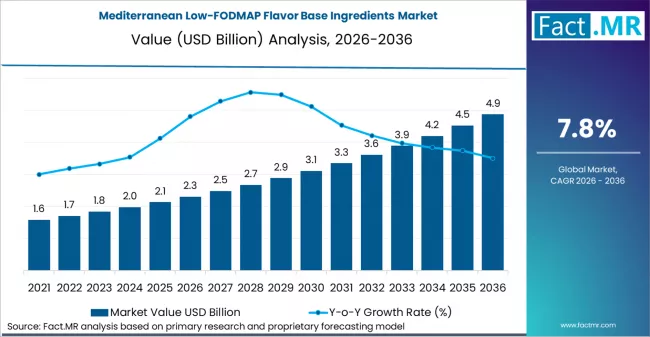
    The mediterranean low-FODMAP flavor base ingredients market shows USD 2.3 billion in 2026 and reaches USD 4.9 billion by 2036 at a 7.8% CAGR.

    Mediterranean Low-FODMAP Flavor Base Ingredients Market Key Takeaways

    • Mediterranean Low-FODMAP Flavor Base Ingredients Market Value (2026): USD 2.3 billion
    • Mediterranean Low-FODMAP Flavor Base Ingredients Market Forecast Value (2036): USD 4.9 billion
    • Mediterranean Low-FODMAP Flavor Base Ingredients Market Forecast CAGR (2026-2036): 7.8%
    • Leading Product Type in Mediterranean Low-FODMAP Flavor Base Ingredients Market: Low-FODMAP fruit and vegetable ingredient bases
    • Key Growth Regions in Mediterranean Low-FODMAP Flavor Base Ingredients Market: Asia Pacific, Europe, North America, Latin America, Middle East & Africa
    • Top Players in Mediterranean Low-FODMAP Flavor Base Ingredients Market: Kerry Group, Givaudan, Symrise, International Flavors & Fragrances, Firmenich, Döhler, Mane, Sensient
    Mediterranean Low Fodmap Flavor Base Ingredients Market Market Value Analysis

    The build-up toward this level follows a gradual pattern marked earlier by USD 1.6 billion, USD 1.7 billion, USD 1.8 billion, and USD 2.0 billion before crossing the current scale. In practice, these bases sit inside controlled recipe systems where every change triggers retesting, documentation updates, and customer approval steps.

    For that reason, product owners treat flavor bases as fixed infrastructure rather than flexible components. Selection focuses on how a base behaves under heating, freezing, and long storage, not on novelty. Once a base becomes part of a core recipe set, it often remains unchanged for many years. Management attention in this category centers on avoiding disruption. Procurement teams prefer continuity over short-term savings because a replacement can affect dozens of finished products at once.

    Technical departments limit the number of approved bases to keep validation work manageable. Manufacturing schedules favor long, repeatable runs with minimal changeovers. Supply agreements usually extend across several planning cycles. Capacity investments appear only after usage is proven across multiple product lines and customer programs.

    Mediterranean Low-FODMAP Flavor Base Ingredients Market

    Metric Value
    Market Value (2026) USD 2.3 billion
    Forecast Value (2036) USD 4.9 billion
    Forecast CAGR (2026–2036) 7.8%

    Category

    Category Segments
    Product Type Low-FODMAP fruit and vegetable ingredient bases; Low-FODMAP grain and flour bases; Low-FODMAP savory seasoning blends; Other low-FODMAP flavor concentrates
    End Use Food and beverage manufacturers; Foodservice and hospitality; Retail packaged food products; Specialty diet meal providers
    Region North America; Europe; Asia Pacific; Latin America; Middle East & Africa

    Segmental Analysis

    Why Do Fruit and Vegetable Bases Sit at The Center of Low-FODMAP Flavor Development Work?
    Mediterranean Low Fodmap Flavor Base Ingredients Market Analysis By Product Type

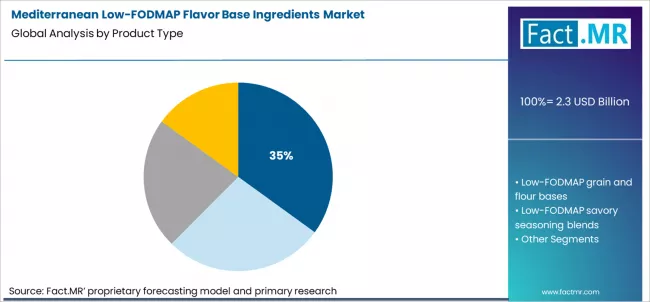
    Formulation programs in the mediterranean low-FODMAP flavor base ingredients market place low-FODMAP fruit and vegetable ingredient bases at the center, with a 35% share by product type. These bases offer familiar taste references while staying within defined digestive tolerance limits. Development teams use them to rebuild common profiles without introducing fermentable components that complicate validation work. Processing lines handle these inputs through concentration and blending steps already common in clean label production. Product families usually start from a small set of neutral profiles and expand into seasoned variants later. Grain bases, savory blends, and concentrates appear across portfolios as supporting elements. Planning discipline continues to treat fruit and vegetable systems as the reference point for most projects.

    Why Do Food and Beverage Manufacturers Control the Largest Share of Ingredient Demand?
    Mediterranean Low Fodmap Flavor Base Ingredients Market Analysis By End Use

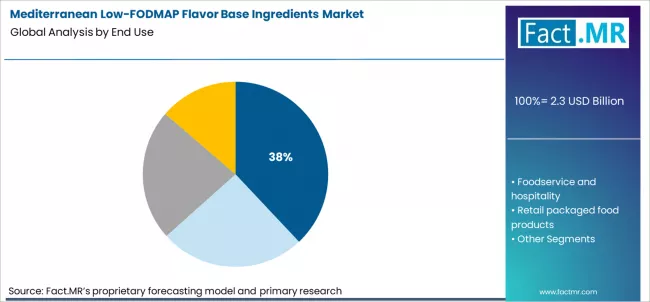
    End use demand in the mediterranean low-FODMAP flavor base ingredients market is led by food and beverage manufacturers, representing 38% of total consumption. This group directs recipe design, reformulation schedules, and scale up decisions across multiple categories. Low-FODMAP positioning requires controlled ingredient selection at the factory stage, not at service or retail. Production planners integrate these bases into ready meals, snacks, and beverages during primary formulation work. Contract manufacturing and private label programs follow the same path. Foodservice operators and specialty meal providers purchase finished products rather than base systems. Retail brands enter the chain as customers of manufacturers. Volume flow stays concentrated where product architecture decisions are made.

    What Factors Are Shaping Buyer Requirements and Product Strategies in the Mediterranean Low-FODMAP Flavor Base Ingredients Market?

    • Product Demand Logic: Demand is rising for flavor bases that allow chefs, food brands, and formulators to deliver Mediterranean taste profiles while meeting low-FODMAP tolerance standards for sensitive digestive systems.
    • Market Friction: Variability in ingredient FODMAP load and strict labeling requirements make reliable formulation challenging and slow adoption by mainstream food processors.
    • Formulation Trend 1: Increasing use of ingredient systems designed to deliver savory, herbaceous, and citrus notes that align with Mediterranean culinary expectations without triggering digestive discomfort.
    • Go-to-Market Trend 2: Growth in pre-blended solutions that reduce development time and support clear low-FODMAP positioning for packaged meals, sauces, and snacks.

    Analysis of the Mediterranean Low-FODMAP Flavor Base Ingredients Market by Key Country
    Mediterranean Low Fodmap Flavor Base Ingredients Market Cagr Analysis By Country

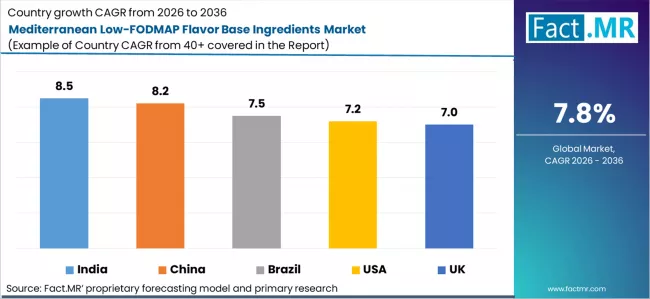
    Country CAGR (2026–2036)
    USA 7.2%
    UK 7.0%
    China 8.2%
    India 8.5%
    Brazil 7.5%

    The report covers an in-depth analysis of 40+ countries; top-performing countries are highlighted below.

    How Are Digestive Friendly Formulation Programs in USA Shaping Use of Mediterranean Low FODMAP Flavor Bases?

    Digestive positioning influences how these flavor bases enter finished product lines, with most use tied to sensitive nutrition and functional food ranges. Growth tracks near 7.2% per year through 2036. Product teams focus on taste masking and compatibility with restricted ingredient systems. Application work centers on beverages, powders, and medical style nutrition formats. Distribution remains concentrated among specialty food and nutrition channels. Import volumes follow confirmed formulation approvals rather than speculative trials. Procurement cycles depend on brand level platform reviews. Supplier selection favors groups offering stable sensory profiles across batches. Volume builds through incremental product additions. Trial usage appears during new formulation projects. Repeat demand depends on formulation success and consumer tolerance feedback. Category scale grows through portfolio breadth rather than through rapid conversion of mainstream products into low FODMAP compliant versions.

    Why Do Reformulation Cycles in UK Influence Use of Mediterranean Low FODMAP Flavor Bases?

    Reformulation programs define how these bases enter commercial recipes, with most demand linked to digestive friendly line extensions. Expansion runs close to 7.0% per year through 2036. Development teams concentrate on maintaining familiar taste while removing problematic components. Listing decisions inside retail and pharmacy channels shape most volume outcomes. Import volumes reflect confirmed recipe approvals rather than marketing driven launches. Supplier discussions emphasize batch consistency and sensory repeatability. Price plays a secondary role to performance in application tests. Inventory movement follows production scheduling rather than seasonal promotion. Volume growth depends on how many core products shift to compliant recipes. Demand remains concentrated among brands managing sensitive nutrition portfolios. Category progress remains tied to steady reformulation activity rather than to headline product launches or short cycle innovation programs.

    What Is Driving Broader Adoption of Low FODMAP Flavor Bases in China?

    Food intolerance awareness and platform driven product planning shape how these bases enter finished goods. The segment advances at a pace near 8.2% per year through 2036. Product formats favor ready to mix powders and functional beverages. Registration timing influences launch schedules more than development speed. Import volumes rise ahead of planned online campaigns. Supplier choice depends on documentation readiness and delivery reliability. Inventory builds occur in waves aligned with platform sales calendars. Brand owners focus on positioning inside digestive health categories. Pricing decisions follow campaign scale commitments. Baseline demand remains limited outside promotion windows. Repeat ordering depends on sell through results after major events. Category development stays linked to platform traffic management rather than to traditional retail shelf planning or menu based food service adoption.

    How Are Digestive Health Portfolio Expansions in India Changing Use of Low FODMAP Flavor Bases?

    Portfolio expansion inside digestive wellness and specialty nutrition lines explains most incremental demand. Growth holds near 8.5% per year through 2036. Product teams prioritize flavor balance and simple label positioning. Digital channels handle a large share of finished product sales. Import volumes increase when new ranges launch rather than during routine replenishment cycles. Supplier selection favors groups able to support small batch formulation work. Pricing sensitivity remains high in this segment. Volume planning follows brand strategy reviews rather than category level forecasts. Trial orders appear during new product development phases. Repeat demand depends on consumer acceptance and tolerance response. Distribution remains selective and focused on urban buyers. Category scale increases through brand participation rather than through rapid conversion of mainstream products into low FODMAP compliant alternatives.

    What Sets the Commercial Direction for Low FODMAP Flavor Bases in Brazil?

    Gradual reformulation of existing products defines how these bases enter the market, with limited use in entirely new categories. Growth stays near 7.5% per year through 2036. Shelf space and manufacturing constraints keep focus on targeted recipe changes. Sourcing decisions reflect logistics cost and supply reliability. Import volumes follow approved formulation changes. Trial usage appears during test production runs. Repeat orders depend on performance in finished products rather than on marketing support. Product teams treat low FODMAP positioning as a functional adjustment rather than a brand defining feature. Distribution remains concentrated among specialized food and wellness channels. Planning cycles follow production scheduling and portfolio review meetings. Category development remains incremental and tied to practical reformulation needs rather than to consumer led demand surges.

    How Do Compliance and Formulation Rules Shape Competition in the Mediterranean Low FODMAP Flavor Base Ingredients Market?
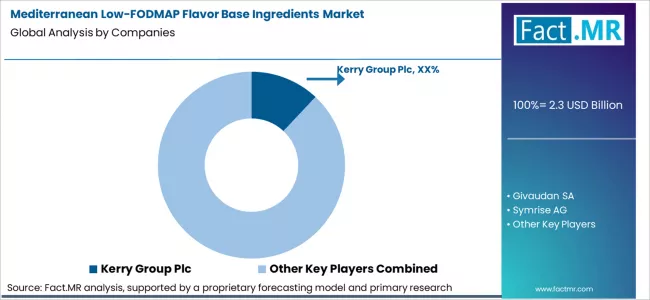
    Mediterranean Low Fodmap Flavor Base Ingredients Market Analysis By Company

    Access to approved low FODMAP flavor bases is controlled by dietary compliance protocols and internal nutrition review boards. In the Mediterranean low FODMAP flavor base ingredients market, product teams define tolerance thresholds, carrier systems, and labeling rules before any commercial discussion. Kerry, Givaudan, Symrise, International Flavors & Fragrances, and Firmenich usually engage at this stage, which secures placement across multiple platforms.

    Döhler and Mane compete through beverage and culinary system integration. Sensient participates where color and flavor co development is required. Buyers compare suppliers on analytical screening, documentation depth, and reproducibility. Once a base is qualified, volumes follow menu or line expansion. Replacements occur during reformulation or when standards change.

    Key Players in the Mediterranean Low-FODMAP Flavor Base Ingredients Market

    • Kerry Group Plc
    • Givaudan SA
    • Symrise AG
    • International Flavors & Fragrances Inc.
    • Firmenich SA
    • Döhler GmbH
    • Mane SA
    • Sensient Technologies Corporation

    References

    • European Food Safety Authority. (2024). Guidance on the characterization of carbohydrates and low-digestible ingredients for use in food products. European Food Safety Authority.
    • European Commission. (2024). Guidance document on the implementation of Regulation (EU) No 1169/2011 on the provision of food information to consumers. European Commission.
    • Codex Alimentarius Commission. (2023). General standard for food additives (CODEX STAN 192-1995, latest revision). FAO/WHO Codex Alimentarius.
    • European Food Safety Authority Panel on Nutrition, Novel Foods and Food Allergens (NDA). (2023). Scientific opinion on the safety of low-digestible carbohydrates and their role in food formulation. EFSA Journal, 21(5).

    Scope of the Report

    Items Values
    Quantitative Units (2026) USD billion
    Product Type Low-FODMAP fruit and vegetable ingredient bases, low-FODMAP grain and flour bases, low-FODMAP savory seasoning blends, other low-FODMAP flavor concentrates
    End Use Food and beverage manufacturers, foodservice and hospitality, retail packaged food products, specialty diet meal providers
    Regions Covered Asia Pacific, Europe, North America, Latin America, Middle East & Africa
    Countries Covered United States, Canada, Mexico, Germany, United Kingdom, France, Italy, Spain, Nordics, BENELUX, China, Japan, South Korea, India, Australia & New Zealand, ASEAN, Brazil, Chile, Saudi Arabia, Turkey, South Africa, and other regional markets
    Key Companies Profiled Kerry Group, Givaudan, Symrise, International Flavors & Fragrances, Firmenich, Döhler, Mane, Sensient
    Additional Attributes Dollar sales by product type and end use; FODMAP load control, thermal and storage stability, and sensory repeatability; compliance screening, documentation depth, and capacity planning tied to multi-recipe adoption

    Mediterranean Low-FODMAP Flavor Base Ingredients Market Segmentation

    • Product Type :

      • Low-FODMAP fruit and vegetable ingredient bases
      • Low-FODMAP grain and flour bases
      • Low-FODMAP savory seasoning blends
      • Other low-FODMAP flavor concentrates
    • End Use :

      • Food and beverage manufacturers
      • Foodservice and hospitality
      • Retail packaged food products
      • Specialty diet meal providers
    • Region :

      • Asia Pacific
        • China
        • Japan
        • South Korea
        • India
        • Australia & New Zealand
        • ASEAN
        • Rest of Asia Pacific
      • Europe
        • Germany
        • United Kingdom
        • France
        • Italy
        • Spain
        • Nordic
        • BENELUX
        • Rest of Europe
      • North America
        • United States
        • Canada
        • Mexico
      • Latin America
        • Brazil
        • Chile
        • Rest of Latin America
      • Middle East & Africa
        • Kingdom of Saudi Arabia
        • Other GCC Countries
        • Turkey
        • South Africa
        • Other African Union
        • Rest of Middle East & Africa

    Table of Content

    1. Executive Summary
      • Global Market Outlook
      • Demand to side Trends
      • Supply to side Trends
      • Technology Roadmap Analysis
      • Analysis and Recommendations
    2. Market Overview
      • Market Coverage / Taxonomy
      • Market Definition / Scope / Limitations
    3. Market Background
      • Market Dynamics
        • Drivers
        • Restraints
        • Opportunity
        • Trends
      • Scenario Forecast
        • Demand in Optimistic Scenario
        • Demand in Likely Scenario
        • Demand in Conservative Scenario
      • Opportunity Map Analysis
      • Product Life Cycle Analysis
      • Supply Chain Analysis
      • Investment Feasibility Matrix
      • Value Chain Analysis
      • PESTLE and Porter’s Analysis
      • Regulatory Landscape
      • Regional Parent Market Outlook
      • Production and Consumption Statistics
      • Import and Export Statistics
    4. Global Market Analysis 2021 to 2025 and Forecast, 2026 to 2036
      • Historical Market Size Value (USD Million) Analysis, 2021 to 2025
      • Current and Future Market Size Value (USD Million) Projections, 2026 to 2036
        • Y to o to Y Growth Trend Analysis
        • Absolute $ Opportunity Analysis
    5. Global Market Pricing Analysis 2021 to 2025 and Forecast 2026 to 2036
    6. Global Market Analysis 2021 to 2025 and Forecast 2026 to 2036, By Product Type
      • Introduction / Key Findings
      • Historical Market Size Value (USD Million) Analysis By Product Type, 2021 to 2025
      • Current and Future Market Size Value (USD Million) Analysis and Forecast By Product Type, 2026 to 2036
        • Low-FODMAP fruit and vegetable ingredient bases
        • Low-FODMAP grain and flour bases
        • Low-FODMAP savory seasoning blends
        • Other low-FODMAP flavor concentrates
      • Y to o to Y Growth Trend Analysis By Product Type, 2021 to 2025
      • Absolute $ Opportunity Analysis By Product Type, 2026 to 2036
    7. Global Market Analysis 2021 to 2025 and Forecast 2026 to 2036, By End Use
      • Introduction / Key Findings
      • Historical Market Size Value (USD Million) Analysis By End Use, 2021 to 2025
      • Current and Future Market Size Value (USD Million) Analysis and Forecast By End Use, 2026 to 2036
        • Food and beverage manufacturers
        • Foodservice and hospitality
        • Retail packaged food products
        • Specialty diet meal providers
      • Y to o to Y Growth Trend Analysis By End Use, 2021 to 2025
      • Absolute $ Opportunity Analysis By End Use, 2026 to 2036
    8. Global Market Analysis 2021 to 2025 and Forecast 2026 to 2036, By Region
      • Introduction
      • Historical Market Size Value (USD Million) Analysis By Region, 2021 to 2025
      • Current Market Size Value (USD Million) Analysis and Forecast By Region, 2026 to 2036
        • North America
        • Latin America
        • Western Europe
        • Eastern Europe
        • East Asia
        • South Asia and Pacific
        • Middle East & Africa
      • Market Attractiveness Analysis By Region
    9. North America Market Analysis 2021 to 2025 and Forecast 2026 to 2036, By Country
      • Historical Market Size Value (USD Million) Trend Analysis By Market Taxonomy, 2021 to 2025
      • Market Size Value (USD Million) Forecast By Market Taxonomy, 2026 to 2036
        • By Country
          • USA
          • Canada
          • Mexico
        • By Product Type
        • By End Use
      • Market Attractiveness Analysis
        • By Country
        • By Product Type
        • By End Use
      • Key Takeaways
    10. Latin America Market Analysis 2021 to 2025 and Forecast 2026 to 2036, By Country
      • Historical Market Size Value (USD Million) Trend Analysis By Market Taxonomy, 2021 to 2025
      • Market Size Value (USD Million) Forecast By Market Taxonomy, 2026 to 2036
        • By Country
          • Brazil
          • Chile
          • Rest of Latin America
        • By Product Type
        • By End Use
      • Market Attractiveness Analysis
        • By Country
        • By Product Type
        • By End Use
      • Key Takeaways
    11. Western Europe Market Analysis 2021 to 2025 and Forecast 2026 to 2036, By Country
      • Historical Market Size Value (USD Million) Trend Analysis By Market Taxonomy, 2021 to 2025
      • Market Size Value (USD Million) Forecast By Market Taxonomy, 2026 to 2036
        • By Country
          • Germany
          • UK
          • Italy
          • Spain
          • France
          • Nordic
          • BENELUX
          • Rest of Western Europe
        • By Product Type
        • By End Use
      • Market Attractiveness Analysis
        • By Country
        • By Product Type
        • By End Use
      • Key Takeaways
    12. Eastern Europe Market Analysis 2021 to 2025 and Forecast 2026 to 2036, By Country
      • Historical Market Size Value (USD Million) Trend Analysis By Market Taxonomy, 2021 to 2025
      • Market Size Value (USD Million) Forecast By Market Taxonomy, 2026 to 2036
        • By Country
          • Russia
          • Poland
          • Hungary
          • Balkan & Baltic
          • Rest of Eastern Europe
        • By Product Type
        • By End Use
      • Market Attractiveness Analysis
        • By Country
        • By Product Type
        • By End Use
      • Key Takeaways
    13. East Asia Market Analysis 2021 to 2025 and Forecast 2026 to 2036, By Country
      • Historical Market Size Value (USD Million) Trend Analysis By Market Taxonomy, 2021 to 2025
      • Market Size Value (USD Million) Forecast By Market Taxonomy, 2026 to 2036
        • By Country
          • China
          • Japan
          • South Korea
        • By Product Type
        • By End Use
      • Market Attractiveness Analysis
        • By Country
        • By Product Type
        • By End Use
      • Key Takeaways
    14. South Asia and Pacific Market Analysis 2021 to 2025 and Forecast 2026 to 2036, By Country
      • Historical Market Size Value (USD Million) Trend Analysis By Market Taxonomy, 2021 to 2025
      • Market Size Value (USD Million) Forecast By Market Taxonomy, 2026 to 2036
        • By Country
          • India
          • ASEAN
          • Australia & New Zealand
          • Rest of South Asia and Pacific
        • By Product Type
        • By End Use
      • Market Attractiveness Analysis
        • By Country
        • By Product Type
        • By End Use
      • Key Takeaways
    15. Middle East & Africa Market Analysis 2021 to 2025 and Forecast 2026 to 2036, By Country
      • Historical Market Size Value (USD Million) Trend Analysis By Market Taxonomy, 2021 to 2025
      • Market Size Value (USD Million) Forecast By Market Taxonomy, 2026 to 2036
        • By Country
          • Kingdom of Saudi Arabia
          • Other GCC Countries
          • Turkiye
          • South Africa
          • Other African Union
          • Rest of Middle East & Africa
        • By Product Type
        • By End Use
      • Market Attractiveness Analysis
        • By Country
        • By Product Type
        • By End Use
      • Key Takeaways
    16. Key Countries Market Analysis
      • USA
        • Pricing Analysis
        • Market Share Analysis, 2025
          • By Product Type
          • By End Use
      • Canada
        • Pricing Analysis
        • Market Share Analysis, 2025
          • By Product Type
          • By End Use
      • Mexico
        • Pricing Analysis
        • Market Share Analysis, 2025
          • By Product Type
          • By End Use
      • Brazil
        • Pricing Analysis
        • Market Share Analysis, 2025
          • By Product Type
          • By End Use
      • Chile
        • Pricing Analysis
        • Market Share Analysis, 2025
          • By Product Type
          • By End Use
      • Germany
        • Pricing Analysis
        • Market Share Analysis, 2025
          • By Product Type
          • By End Use
      • UK
        • Pricing Analysis
        • Market Share Analysis, 2025
          • By Product Type
          • By End Use
      • Italy
        • Pricing Analysis
        • Market Share Analysis, 2025
          • By Product Type
          • By End Use
      • Spain
        • Pricing Analysis
        • Market Share Analysis, 2025
          • By Product Type
          • By End Use
      • France
        • Pricing Analysis
        • Market Share Analysis, 2025
          • By Product Type
          • By End Use
      • India
        • Pricing Analysis
        • Market Share Analysis, 2025
          • By Product Type
          • By End Use
      • ASEAN
        • Pricing Analysis
        • Market Share Analysis, 2025
          • By Product Type
          • By End Use
      • Australia & New Zealand
        • Pricing Analysis
        • Market Share Analysis, 2025
          • By Product Type
          • By End Use
      • China
        • Pricing Analysis
        • Market Share Analysis, 2025
          • By Product Type
          • By End Use
      • Japan
        • Pricing Analysis
        • Market Share Analysis, 2025
          • By Product Type
          • By End Use
      • South Korea
        • Pricing Analysis
        • Market Share Analysis, 2025
          • By Product Type
          • By End Use
      • Russia
        • Pricing Analysis
        • Market Share Analysis, 2025
          • By Product Type
          • By End Use
      • Poland
        • Pricing Analysis
        • Market Share Analysis, 2025
          • By Product Type
          • By End Use
      • Hungary
        • Pricing Analysis
        • Market Share Analysis, 2025
          • By Product Type
          • By End Use
      • Kingdom of Saudi Arabia
        • Pricing Analysis
        • Market Share Analysis, 2025
          • By Product Type
          • By End Use
      • Turkiye
        • Pricing Analysis
        • Market Share Analysis, 2025
          • By Product Type
          • By End Use
      • South Africa
        • Pricing Analysis
        • Market Share Analysis, 2025
          • By Product Type
          • By End Use
    17. Market Structure Analysis
      • Competition Dashboard
      • Competition Benchmarking
      • Market Share Analysis of Top Players
        • By Regional
        • By Product Type
        • By End Use
    18. Competition Analysis
      • Competition Deep Dive
        • Kerry Group Plc
          • Overview
          • Product Portfolio
          • Profitability by Market Segments (Product/Age /Sales Channel/Region)
          • Sales Footprint
          • Strategy Overview
            • Marketing Strategy
            • Product Strategy
            • Channel Strategy
        • Givaudan SA
        • Symrise AG
        • International Flavors & Fragrances Inc.
        • Firmenich SA
        • Döhler GmbH
        • Mane SA
        • Sensient Technologies Corporation
    19. Assumptions & Acronyms Used
    20. Research Methodology

    List Of Table

    • Table 1: Global Market Value (USD Million) Forecast by Region, 2021 to 2036
    • Table 2: Global Market Value (USD Million) Forecast by Product Type, 2021 to 2036
    • Table 3: Global Market Value (USD Million) Forecast by End Use, 2021 to 2036
    • Table 4: North America Market Value (USD Million) Forecast by Country, 2021 to 2036
    • Table 5: North America Market Value (USD Million) Forecast by Product Type, 2021 to 2036
    • Table 6: North America Market Value (USD Million) Forecast by End Use, 2021 to 2036
    • Table 7: Latin America Market Value (USD Million) Forecast by Country, 2021 to 2036
    • Table 8: Latin America Market Value (USD Million) Forecast by Product Type, 2021 to 2036
    • Table 9: Latin America Market Value (USD Million) Forecast by End Use, 2021 to 2036
    • Table 10: Western Europe Market Value (USD Million) Forecast by Country, 2021 to 2036
    • Table 11: Western Europe Market Value (USD Million) Forecast by Product Type, 2021 to 2036
    • Table 12: Western Europe Market Value (USD Million) Forecast by End Use, 2021 to 2036
    • Table 13: Eastern Europe Market Value (USD Million) Forecast by Country, 2021 to 2036
    • Table 14: Eastern Europe Market Value (USD Million) Forecast by Product Type, 2021 to 2036
    • Table 15: Eastern Europe Market Value (USD Million) Forecast by End Use, 2021 to 2036
    • Table 16: East Asia Market Value (USD Million) Forecast by Country, 2021 to 2036
    • Table 17: East Asia Market Value (USD Million) Forecast by Product Type, 2021 to 2036
    • Table 18: East Asia Market Value (USD Million) Forecast by End Use, 2021 to 2036
    • Table 19: South Asia and Pacific Market Value (USD Million) Forecast by Country, 2021 to 2036
    • Table 20: South Asia and Pacific Market Value (USD Million) Forecast by Product Type, 2021 to 2036
    • Table 21: South Asia and Pacific Market Value (USD Million) Forecast by End Use, 2021 to 2036
    • Table 22: Middle East & Africa Market Value (USD Million) Forecast by Country, 2021 to 2036
    • Table 23: Middle East & Africa Market Value (USD Million) Forecast by Product Type, 2021 to 2036
    • Table 24: Middle East & Africa Market Value (USD Million) Forecast by End Use, 2021 to 2036

    List Of Figures

    • Figure 1: Global Market Pricing Analysis
    • Figure 2: Global Market Value (USD Million) Forecast 2021 to 2036
    • Figure 3: Global Market Value Share and BPS Analysis by Product Type, 2026 and 2036
    • Figure 4: Global Market Y to o to Y Growth Comparison by Product Type, 2026 to 2036
    • Figure 5: Global Market Attractiveness Analysis by Product Type
    • Figure 6: Global Market Value Share and BPS Analysis by End Use, 2026 and 2036
    • Figure 7: Global Market Y to o to Y Growth Comparison by End Use, 2026 to 2036
    • Figure 8: Global Market Attractiveness Analysis by End Use
    • Figure 9: Global Market Value (USD Million) Share and BPS Analysis by Region, 2026 and 2036
    • Figure 10: Global Market Y to o to Y Growth Comparison by Region, 2026 to 2036
    • Figure 11: Global Market Attractiveness Analysis by Region
    • Figure 12: North America Market Incremental Dollar Opportunity, 2026 to 2036
    • Figure 13: Latin America Market Incremental Dollar Opportunity, 2026 to 2036
    • Figure 14: Western Europe Market Incremental Dollar Opportunity, 2026 to 2036
    • Figure 15: Eastern Europe Market Incremental Dollar Opportunity, 2026 to 2036
    • Figure 16: East Asia Market Incremental Dollar Opportunity, 2026 to 2036
    • Figure 17: South Asia and Pacific Market Incremental Dollar Opportunity, 2026 to 2036
    • Figure 18: Middle East & Africa Market Incremental Dollar Opportunity, 2026 to 2036
    • Figure 19: North America Market Value Share and BPS Analysis by Country, 2026 and 2036
    • Figure 20: North America Market Value Share and BPS Analysis by Product Type, 2026 and 2036
    • Figure 21: North America Market Y to o to Y Growth Comparison by Product Type, 2026 to 2036
    • Figure 22: North America Market Attractiveness Analysis by Product Type
    • Figure 23: North America Market Value Share and BPS Analysis by End Use, 2026 and 2036
    • Figure 24: North America Market Y to o to Y Growth Comparison by End Use, 2026 to 2036
    • Figure 25: North America Market Attractiveness Analysis by End Use
    • Figure 26: Latin America Market Value Share and BPS Analysis by Country, 2026 and 2036
    • Figure 27: Latin America Market Value Share and BPS Analysis by Product Type, 2026 and 2036
    • Figure 28: Latin America Market Y to o to Y Growth Comparison by Product Type, 2026 to 2036
    • Figure 29: Latin America Market Attractiveness Analysis by Product Type
    • Figure 30: Latin America Market Value Share and BPS Analysis by End Use, 2026 and 2036
    • Figure 31: Latin America Market Y to o to Y Growth Comparison by End Use, 2026 to 2036
    • Figure 32: Latin America Market Attractiveness Analysis by End Use
    • Figure 33: Western Europe Market Value Share and BPS Analysis by Country, 2026 and 2036
    • Figure 34: Western Europe Market Value Share and BPS Analysis by Product Type, 2026 and 2036
    • Figure 35: Western Europe Market Y to o to Y Growth Comparison by Product Type, 2026 to 2036
    • Figure 36: Western Europe Market Attractiveness Analysis by Product Type
    • Figure 37: Western Europe Market Value Share and BPS Analysis by End Use, 2026 and 2036
    • Figure 38: Western Europe Market Y to o to Y Growth Comparison by End Use, 2026 to 2036
    • Figure 39: Western Europe Market Attractiveness Analysis by End Use
    • Figure 40: Eastern Europe Market Value Share and BPS Analysis by Country, 2026 and 2036
    • Figure 41: Eastern Europe Market Value Share and BPS Analysis by Product Type, 2026 and 2036
    • Figure 42: Eastern Europe Market Y to o to Y Growth Comparison by Product Type, 2026 to 2036
    • Figure 43: Eastern Europe Market Attractiveness Analysis by Product Type
    • Figure 44: Eastern Europe Market Value Share and BPS Analysis by End Use, 2026 and 2036
    • Figure 45: Eastern Europe Market Y to o to Y Growth Comparison by End Use, 2026 to 2036
    • Figure 46: Eastern Europe Market Attractiveness Analysis by End Use
    • Figure 47: East Asia Market Value Share and BPS Analysis by Country, 2026 and 2036
    • Figure 48: East Asia Market Value Share and BPS Analysis by Product Type, 2026 and 2036
    • Figure 49: East Asia Market Y to o to Y Growth Comparison by Product Type, 2026 to 2036
    • Figure 50: East Asia Market Attractiveness Analysis by Product Type
    • Figure 51: East Asia Market Value Share and BPS Analysis by End Use, 2026 and 2036
    • Figure 52: East Asia Market Y to o to Y Growth Comparison by End Use, 2026 to 2036
    • Figure 53: East Asia Market Attractiveness Analysis by End Use
    • Figure 54: South Asia and Pacific Market Value Share and BPS Analysis by Country, 2026 and 2036
    • Figure 55: South Asia and Pacific Market Value Share and BPS Analysis by Product Type, 2026 and 2036
    • Figure 56: South Asia and Pacific Market Y to o to Y Growth Comparison by Product Type, 2026 to 2036
    • Figure 57: South Asia and Pacific Market Attractiveness Analysis by Product Type
    • Figure 58: South Asia and Pacific Market Value Share and BPS Analysis by End Use, 2026 and 2036
    • Figure 59: South Asia and Pacific Market Y to o to Y Growth Comparison by End Use, 2026 to 2036
    • Figure 60: South Asia and Pacific Market Attractiveness Analysis by End Use
    • Figure 61: Middle East & Africa Market Value Share and BPS Analysis by Country, 2026 and 2036
    • Figure 62: Middle East & Africa Market Value Share and BPS Analysis by Product Type, 2026 and 2036
    • Figure 63: Middle East & Africa Market Y to o to Y Growth Comparison by Product Type, 2026 to 2036
    • Figure 64: Middle East & Africa Market Attractiveness Analysis by Product Type
    • Figure 65: Middle East & Africa Market Value Share and BPS Analysis by End Use, 2026 and 2036
    • Figure 66: Middle East & Africa Market Y to o to Y Growth Comparison by End Use, 2026 to 2036
    • Figure 67: Middle East & Africa Market Attractiveness Analysis by End Use
    • Figure 68: Global Market - Tier Structure Analysis
    • Figure 69: Global Market - Company Share Analysis

    - Frequently Asked Questions -

    How big is the mediterranean low-fodmap flavor base ingredients market in 2026?

    The global mediterranean low-fodmap flavor base ingredients market is estimated to be valued at USD 2.3 billion in 2026.

    What will be the size of mediterranean low-fodmap flavor base ingredients market in 2036?

    The market size for the mediterranean low-fodmap flavor base ingredients market is projected to reach USD 4.9 billion by 2036.

    How much will be the mediterranean low-fodmap flavor base ingredients market growth between 2026 and 2036?

    The mediterranean low-fodmap flavor base ingredients market is expected to grow at a 7.8% CAGR between 2026 and 2036.

    What are the key product types in the mediterranean low-fodmap flavor base ingredients market?

    The key product types in mediterranean low-fodmap flavor base ingredients market are low-fodmap fruit and vegetable ingredient bases, low-fodmap grain and flour bases, low-fodmap savory seasoning blends and other low-fodmap flavor concentrates.

    Which end use segment to contribute significant share in the mediterranean low-fodmap flavor base ingredients market in 2026?

    In terms of end use, food and beverage manufacturers segment to command 38.0% share in the mediterranean low-fodmap flavor base ingredients market in 2026.

    Mediterranean Low-FODMAP Flavor Base Ingredients Market