Mental Health Sleep Overlap Market (2026 - 2036)
Mental Health Sleep Overlap Market Size and Share Forecast Outlook 2026 to 2036
Core Findings
Mental Health Sleep Overlap Market Forecast and Outlook 2026 to 2036
Mental health sleep overlap market stands at USD 5.8 billion in 2026 and reaches USD 16.5 billion by 2036, reflecting an 11% CAGR.
Mental Health Sleep Overlap Market Key Takeaways
- Mental Health Sleep Overlap Market Value (2026): USD 5.8 billion
- Mental Health Sleep Overlap Market Forecast Value (2036): USD 16.5 billion
- Mental Health Sleep Overlap Market Forecast CAGR: 11.0%
- Leading Overlap Pathway in Mental Health Sleep Overlap Market: Depression plus insomnia management
- Key Growth Regions in Mental Health Sleep Overlap Market: North America, Europe, Asia Pacific, Latin America, Middle East & Africa
- Top Players in Mental Health Sleep Overlap Market: Otsuka Pharmaceutical, Johnson & Johnson, Pfizer, Teladoc Health, Big Health
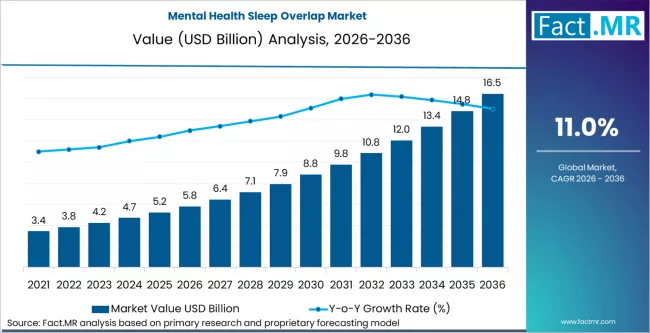
Demand forms around case management. Single prescriptions play a limited role. Providers organize care through episode budgets, visit cadence, and continuity targets. Clinics bundle assessment, therapy sessions, medication review, and digital follow up inside fixed service frames.
Payers purchase capacity blocks measured in visits and completion rates. Utilization growth comes from longer retention inside programs. Staffing models rely on licensed therapists, supervising physicians, and protocol libraries. Training time and supervision ratios define expansion speed. Platform vendors compete on scheduling density, documentation accuracy, and audit readiness. Inventory risk shows up in clinician hours. Pricing tracks contracted throughput and rework rates. Referral flows originate in primary care, psychiatry, and employer access points. Performance reporting centers on adherence, symptom scores, and return visits. Scale arrives through multi-site rollouts using shared playbooks.
Mental Health Sleep Overlap Market
| Metric | Value |
|---|---|
| Market Value (2026) | USD 5.8 billion |
| Forecast Value (2036) | USD 16.5 billion |
| Forecast CAGR (2026-2036) | 11.0% |
Category
| Category | Segments |
|---|---|
| Treatment and Service Mix | Psychiatric pharmacotherapy with sleep impact; CBT-I and CBT integrated programs; Tele-psychiatry or therapy services; Digital monitoring and relapse prevention tools; Adjunct devices (light therapy, wearables) |
| Overlap Pathways | Depression and insomnia management; Anxiety disorders and sleep disturbance; PTSD and nightmares or sleep disruption; Bipolar disorder sleep stabilization; Substance use recovery and sleep support |
| End User or Channel | Outpatient mental health clinics; Telehealth platforms; Hospitals or behavioral health centers; Employer or payer programs; Others |
| Region | North America; Europe; Asia Pacific; Latin America; Middle East & Africa |
Mental Health Sleep Overlap Market Segmental Analysis
By Treatment and Service Mix, Why Does Psychiatric Pharmacotherapy with Sleep Impact Lead the Mental Health-Sleep Overlap Market?
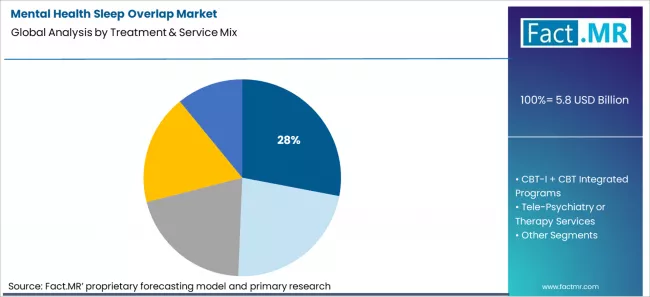
Fact.MR coverage shows that psychiatric pharmacotherapy with sleep impact holds 28% share because it fits existing treatment routines without changing how patients or clinicians organize care. The unmet need is immediate symptom control that addresses mood and sleep disruption in a single prescribing decision. For many patients, this approach becomes part of daily medication habits rather than a separate sleep intervention. The value is functional and centered on stabilization, not reassurance. Providers rely on it because it is measurable, scalable, and compatible with standard psychiatric follow up cycles. Its position reflects how combined mental health and sleep care often begins with medication management before layered services are added.
By Overlap Pathways, Why Does Depression Plus Insomnia Management Represent the Largest Use Case in the Mental Health-Sleep Overlap Market?
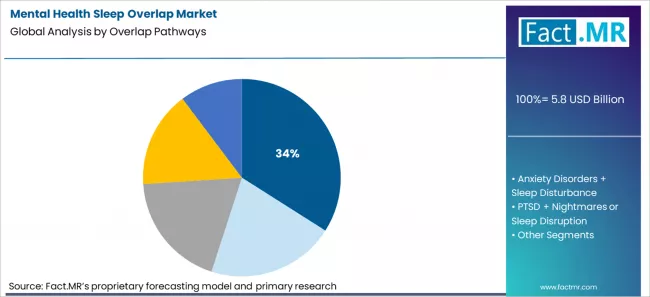
In Fact.MR compiled datasets, depression combined with insomnia management accounts for 34% share because this pairing describes a large, persistent patient group with recurring care needs. The unmet need is not episodic counseling but continuous management of symptoms that interfere with work, relationships, and daily function. Patients treat this pathway as necessary maintenance rather than optional support. The value remains practical and outcome focused. For health systems, this combination supports regular follow up, adjustment of therapy, and long duration engagement. Its scale reflects how intertwined mood disorders and sleep disruption have become in routine psychiatric care delivery.
Country
| Country | Driver | Restraint | Trend |
|---|---|---|---|
| USA | Strong evidence linking insomnia with depression/anxiety; integrated CBT-I adoption | Insurance reimbursement gaps hinder uniform access | Growth of hybrid tele-CBT and sleep programs |
| UK | NHS endorsement of digital CBTi reduces mental health burden | Regional commissioning variation limits spread | Expansion of sleep-mental health referrals |
| Germany | Research linking sleep disruption to mental disorders informs care | Complex outpatient reimbursement | Cross-discipline clinics in academic centers |
| China | High epidemiologic comorbidity of sleep and mental disorders | Scarce specialist workforce outside major cities | Increasing telepsychiatry with sleep screening |
| India | Rising youth anxiety and sleep complaints documented | Lack of structured mental-sleep care pathways | Broad interest in digital self-help interventions |
Analysis of the Mental Health-Sleep Overlap Market by Key Country
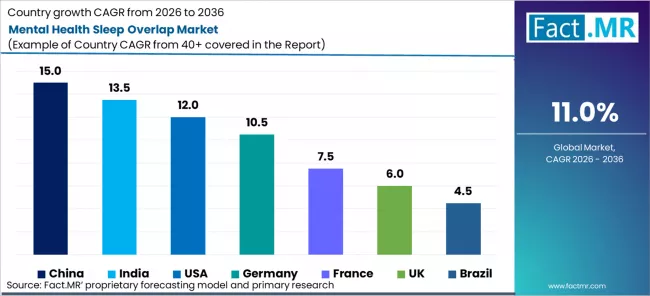
| Country | CAGR (2026-2036) |
|---|---|
| USA | 12.0% |
| China | 15.0% |
| India | 13.5% |
| Germany | 10.5% |
| France | 7.5% |
| UK | 6.0% |
| Brazil | 4.5% |
The report covers an in-depth analysis of 40+ countries; top-performing countries are highlighted below.
How Is the Mental Health Sleep Overlap Treatment Category Evolving in the United States?
A 12% annual expansion through 2036 reflects how behavioral health services and sleep medicine increasingly intersect inside large care systems. Patients treated for anxiety and depression already remain in therapy for long periods. Sleep assessment enters this process as a routine part of symptom management rather than as a separate referral. Digital screening tools and structured therapy programs support this integration. Insurers accept combined treatment models when relapse rates and medication escalation fall. Revenue growth comes from longer treatment duration and broader protocol coverage inside existing patient groups rather than from rapid growth in diagnosis volumes or population change.
What Explains the Rapid Scale of This Category in China?
A 15% growth trajectory matches the way mental health services expand inside urban hospital networks. Stress related disorders and sleep complaints appear together in outpatient psychiatry clinics. Once combined pathways enter hospital systems, patient volumes increase quickly due to centralized scheduling and follow up structures. Provincial platforms replicate these models across city networks. Care delivery relies on standardized digital workflows and clinic protocols. Volume rises through system replication rather than individual practitioner choice. The expansion rate follows the speed at which mental health services formalize sleep management inside routine outpatient psychiatric and neurological care programs.
Why Is India Showing Strong Uptake in This Segment?
A 13.5% annual growth path follows the rise of organized mental health platforms and teleconsultation networks. Many patients seek care for anxiety, stress, and mood disorders through private clinics and digital services. Sleep complaints appear in most initial assessments. Providers extend treatment plans to include structured sleep management to improve therapy adherence and patient retention. Diagnosis counts grow steadily, yet revenue increases faster through longer engagement cycles and subscription style care plans. The category expands because service providers bundle mental health and sleep management into single care journeys rather than treating them as separate clinical episodes.
How Is This Market Developing Inside the German Healthcare System?
Germany’s 10.5% growth profile aligns with a system that treats mental health through regulated outpatient and specialist pathways. Patients with depression and anxiety already receive structured follow up under defined schedules. Sleep assessment enters care plans only after guideline review and reimbursement positioning. Physicians rely on evidence based protocols rather than rapid service changes. Volume growth remains moderate due to demographic structure. Expansion appears through deeper treatment programs and gradual protocol inclusion across psychiatric practices. The category grows through clinical standardization and acceptance inside formal care structures rather than through commercial promotion or rapid service redesign.
What Sets the Pace for Growth in France?
A 7.5% yearly increase reflects how mental health services operate inside the public hospital and specialist network. Long waiting times shape treatment prioritization. Sleep management joins psychiatric care mainly for patients with complex or persistent symptoms. National funding rules and pathway definitions control how widely combined programs appear. Most activity stays inside hospital linked outpatient services. The focus remains on stabilizing existing patients and reducing relapse rates. Growth follows incremental changes in treatment protocols and staffing capacity, which keeps expansion steady and limited in scale across the national system.
Why Does the United Kingdom Show Measured Growth in This Area?
A 6% annual expansion matches the structure of mental health services inside the NHS. Talking therapies and psychiatric clinics already manage high caseloads with limited staff. Sleep interventions enter care mainly through specialist pilots and regional programs. Referral based access limits rapid scaling. Budget cycles and service planning reviews determine rollout speed. Patients benefit from combined treatment models, though system capacity constrains reach. The category grows through careful extension of existing services rather than through rapid national programs or large scale private sector deployment.
What Explains the Slower Progress in Brazil?
In Brazil, 4.5% growth path reflects uneven access to mental health and sleep specialists across regions. Private clinics in large cities offer combined programs, while public system coverage remains limited. Many patients receive separate treatment for mood disorders and sleep problems. Insurance coverage varies by employer and income group. Program development depends on private hospital networks and corporate health plans. The category expands through selected urban centers rather than through coordinated national strategy, which keeps growth gradual and confined to specific healthcare networks and patient segments.
Who controls treatment sequencing and patient flow in the mental health-sleep overlap market, and where does durable competitive leverage sit?
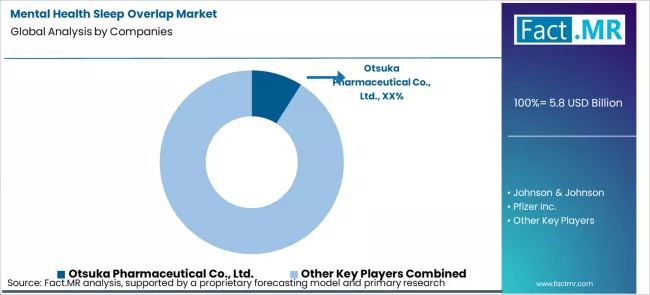
Care for patients with combined insomnia, depression, and anxiety is organized around prescribing authority and long term follow up rather than around isolated interventions. Otsuka Pharmaceutical and Pfizer participate through established psychiatric drug pathways, where maintenance therapy and periodic reassessment structure multi-year patient relationships. Johnson and Johnson operates across central nervous system and related therapeutic areas, which supports integration into hospital and specialist treatment protocols. Teladoc Health enters from the payer and employer channel, embedding sleep and mental health programs inside broader virtual care contracts that determine initial access. Big Health is positioned around evidence based digital insomnia programs that are often used alongside pharmacotherapy rather than as replacements. Clinical literature documents high comorbidity rates between insomnia and mood disorders, which keeps these pathways linked in routine practice. Competitive advantage follows control of referral entry points, reimbursement coverage, and continuity of care. Scale supports contracting reach and compliance operations. Process discipline in patient management now outweighs any single product advantage.
Key Players in Mental Health Sleep Overlap Market
- Otsuka Pharmaceutical Co., Ltd.
- Johnson & Johnson
- Pfizer Inc.
- Teladoc Health, Inc.
- Big Health Ltd.
- Others
Scope of the Report
| Items | Values |
|---|---|
| Quantitative Units (2026) | USD billion |
| Treatment and Service Mix | Psychiatric pharmacotherapy with sleep impact, CBT-I and CBT integrated programs, tele-psychiatry or therapy services, digital monitoring and relapse prevention tools, adjunct devices (light therapy, wearables) |
| Overlap Pathways | Depression and insomnia management, anxiety disorders and sleep disturbance, PTSD and nightmares or sleep disruption, bipolar disorder sleep stabilization, substance use recovery and sleep support |
| End User or Channel | Outpatient mental health clinics, telehealth platforms, hospitals or behavioral health centers, employer or payer programs, others |
| Regions Covered | Asia Pacific, Europe, North America, Latin America, Middle East & Africa |
| Countries Covered | United States, Canada, Mexico, Germany, United Kingdom, France, Italy, Spain, China, Japan, South Korea, India, Australia & New Zealand, ASEAN, Brazil, Chile, Saudi Arabia, Turkey, South Africa, and other regional markets |
| Key Companies Profiled | Otsuka Pharmaceutical Co., Ltd., Johnson & Johnson, Pfizer Inc., Teladoc Health, Inc., Big Health Ltd. |
| Additional Attributes | Dollar by sales by treatment mix, overlap pathway, and channel; focus on case-managed programs, protocol-driven care, and audit-ready documentation; demand driven by depression, anxiety, and insomnia comorbidity management across outpatient and virtual care settings |
Mental Health Sleep Overlap Market Segmentation
-
Treatment & Service Mix :
- Psychiatric Pharmacotherapy with Sleep Impact
- CBT-I + CBT Integrated Programs
- Tele-Psychiatry or Therapy Services
- Digital Monitoring & Relapse Prevention Tools
- Adjunct Devices (Light Therapy, Wearables)
-
Overlap Pathways :
- Depression + Insomnia Management
- Anxiety Disorders + Sleep Disturbance
- PTSD + Nightmares or Sleep Disruption
- Bipolar Disorder Sleep Stabilization
- Substance Use Recovery + Sleep Support
-
End User or Channel :
- Outpatient Mental Health Clinics
- Telehealth Platforms
- Hospitals or Behavioral Health Centers
- Employer or Payer Programs
- Others
-
Region :
- Asia Pacific
- China
- Japan
- South Korea
- India
- Australia & New Zealand
- ASEAN
- Rest of Asia Pacific
- Europe
- Germany
- United Kingdom
- France
- Italy
- Spain
- Nordic
- BENELUX
- Rest of Europe
- North America
- United States
- Canada
- Mexico
- Latin America
- Brazil
- Chile
- Rest of Latin America
- Middle East & Africa
- Kingdom of Saudi Arabia
- Other GCC Countries
- Turkey
- South Africa
- Other African Union
- Rest of Middle East & Africa
- Asia Pacific
References
- Centers for Disease Control and Prevention. (2024). Sleep Facts and Stats. CDC.
- Centers for Disease Control and Prevention. (2025). FastStats - Mental Health. CDC.
- National Center for Health Statistics. (2025). Depression Prevalence in Adolescents and Adults (NHANES). CDC.
- National Institute of Mental Health. (2025). Major Depression - Statistics. NIMH.
Table of Content
- Executive Summary
- Global Market Outlook
- Demand to side Trends
- Supply to side Trends
- Technology Roadmap Analysis
- Analysis and Recommendations
- Market Overview
- Market Coverage / Taxonomy
- Market Definition / Scope / Limitations
- Research Methodology
- Chapter Orientation
- Analytical Lens and Working Hypotheses
- Market Structure, Signals, and Trend Drivers
- Benchmarking and Cross-market Comparability
- Market Sizing, Forecasting, and Opportunity Mapping
- Research Design and Evidence Framework
- Desk Research Programme (Secondary Evidence)
- Company Annual and Sustainability Reports
- Peer-reviewed Journals and Academic Literature
- Corporate Websites, Product Literature, and Technical Notes
- Earnings Decks and Investor Briefings
- Statutory Filings and Regulatory Disclosures
- Technical White Papers and Standards Notes
- Trade Journals, Industry Magazines, and Analyst Briefs
- Conference Proceedings, Webinars, and Seminar Materials
- Government Statistics Portals and Public Data Releases
- Press Releases and Reputable Media Coverage
- Specialist Newsletters and Curated Briefings
- Sector Databases and Reference Repositories
- FMR Internal Proprietary Databases and Historical Market Datasets
- Subscription Datasets and Paid Sources
- Social Channels, Communities, and Digital Listening Inputs
- Additional Desk Sources
- Expert Input and Fieldwork (Primary Evidence)
- Primary Modes
- Qualitative Interviews and Expert Elicitation
- Quantitative Surveys and Structured Data Capture
- Blended Approach
- Why Primary Evidence is Used
- Field Techniques
- Interviews
- Surveys
- Focus Groups
- Observational and In-context Research
- Social and Community Interactions
- Stakeholder Universe Engaged
- C-suite Leaders
- Board Members
- Presidents and Vice Presidents
- R&D and Innovation Heads
- Technical Specialists
- Domain Subject-matter Experts
- Scientists
- Physicians and Other Healthcare Professionals
- Governance, Ethics, and Data Stewardship
- Research Ethics
- Data Integrity and Handling
- Primary Modes
- Tooling, Models, and Reference Databases
- Desk Research Programme (Secondary Evidence)
- Data Engineering and Model Build
- Data Acquisition and Ingestion
- Cleaning, Normalisation, and Verification
- Synthesis, Triangulation, and Analysis
- Quality Assurance and Audit Trail
- Market Background
- Market Dynamics
- Drivers
- Restraints
- Opportunity
- Trends
- Scenario Forecast
- Demand in Optimistic Scenario
- Demand in Likely Scenario
- Demand in Conservative Scenario
- Opportunity Map Analysis
- Product Life Cycle Analysis
- Supply Chain Analysis
- Investment Feasibility Matrix
- Value Chain Analysis
- PESTLE and Porter’s Analysis
- Regulatory Landscape
- Regional Parent Market Outlook
- Production and Consumption Statistics
- Import and Export Statistics
- Market Dynamics
- Global Market Analysis 2021 to 2025 and Forecast, 2026 to 2036
- Historical Market Size Value (USD Million) Analysis, 2021 to 2025
- Current and Future Market Size Value (USD Million) Projections, 2026 to 2036
- Y to o to Y Growth Trend Analysis
- Absolute $ Opportunity Analysis
- Global Market Pricing Analysis 2021 to 2025 and Forecast 2026 to 2036
- Global Market Analysis 2021 to 2025 and Forecast 2026 to 2036, By Treatment & Service Mix
- Introduction / Key Findings
- Historical Market Size Value (USD Million) Analysis By Treatment & Service Mix, 2021 to 2025
- Current and Future Market Size Value (USD Million) Analysis and Forecast By Treatment & Service Mix, 2026 to 2036
- Psychiatric Pharmacotherapy with Sleep Impact
- CBT-I + CBT Integrated Programs
- Tele-Psychiatry or Therapy Services
- Digital Monitoring & Relapse Prevention Tools
- Adjunct Devices (Light Therapy, Wearables)
- Psychiatric Pharmacotherapy with Sleep Impact
- Y to o to Y Growth Trend Analysis By Treatment & Service Mix, 2021 to 2025
- Absolute $ Opportunity Analysis By Treatment & Service Mix, 2026 to 2036
- Global Market Analysis 2021 to 2025 and Forecast 2026 to 2036, By Overlap Pathways
- Introduction / Key Findings
- Historical Market Size Value (USD Million) Analysis By Overlap Pathways, 2021 to 2025
- Current and Future Market Size Value (USD Million) Analysis and Forecast By Overlap Pathways, 2026 to 2036
- Depression + Insomnia Management
- Anxiety Disorders + Sleep Disturbance
- PTSD + Nightmares or Sleep Disruption
- Bipolar Disorder Sleep Stabilization
- Substance Use Recovery + Sleep Support
- Depression + Insomnia Management
- Y to o to Y Growth Trend Analysis By Overlap Pathways, 2021 to 2025
- Absolute $ Opportunity Analysis By Overlap Pathways, 2026 to 2036
- Global Market Analysis 2021 to 2025 and Forecast 2026 to 2036, By End User or Channel
- Introduction / Key Findings
- Historical Market Size Value (USD Million) Analysis By End User or Channel, 2021 to 2025
- Current and Future Market Size Value (USD Million) Analysis and Forecast By End User or Channel, 2026 to 2036
- Outpatient Mental Health Clinics
- Telehealth Platforms
- Hospitals or Behavioral Health Centers
- Employer or Payer Programs
- Others
- Outpatient Mental Health Clinics
- Y to o to Y Growth Trend Analysis By End User or Channel, 2021 to 2025
- Absolute $ Opportunity Analysis By End User or Channel, 2026 to 2036
- Global Market Analysis 2021 to 2025 and Forecast 2026 to 2036, By Region
- Introduction
- Historical Market Size Value (USD Million) Analysis By Region, 2021 to 2025
- Current Market Size Value (USD Million) Analysis and Forecast By Region, 2026 to 2036
- North America
- Latin America
- Western Europe
- Eastern Europe
- East Asia
- South Asia and Pacific
- Middle East & Africa
- Market Attractiveness Analysis By Region
- North America Market Analysis 2021 to 2025 and Forecast 2026 to 2036, By Country
- Historical Market Size Value (USD Million) Trend Analysis By Market Taxonomy, 2021 to 2025
- Market Size Value (USD Million) Forecast By Market Taxonomy, 2026 to 2036
- By Country
- USA
- Canada
- Mexico
- By Treatment & Service Mix
- By Overlap Pathways
- By End User or Channel
- By Country
- Market Attractiveness Analysis
- By Country
- By Treatment & Service Mix
- By Overlap Pathways
- By End User or Channel
- Key Takeaways
- Latin America Market Analysis 2021 to 2025 and Forecast 2026 to 2036, By Country
- Historical Market Size Value (USD Million) Trend Analysis By Market Taxonomy, 2021 to 2025
- Market Size Value (USD Million) Forecast By Market Taxonomy, 2026 to 2036
- By Country
- Brazil
- Chile
- Rest of Latin America
- By Treatment & Service Mix
- By Overlap Pathways
- By End User or Channel
- By Country
- Market Attractiveness Analysis
- By Country
- By Treatment & Service Mix
- By Overlap Pathways
- By End User or Channel
- Key Takeaways
- Western Europe Market Analysis 2021 to 2025 and Forecast 2026 to 2036, By Country
- Historical Market Size Value (USD Million) Trend Analysis By Market Taxonomy, 2021 to 2025
- Market Size Value (USD Million) Forecast By Market Taxonomy, 2026 to 2036
- By Country
- Germany
- UK
- Italy
- Spain
- France
- Nordic
- BENELUX
- Rest of Western Europe
- By Treatment & Service Mix
- By Overlap Pathways
- By End User or Channel
- By Country
- Market Attractiveness Analysis
- By Country
- By Treatment & Service Mix
- By Overlap Pathways
- By End User or Channel
- Key Takeaways
- Eastern Europe Market Analysis 2021 to 2025 and Forecast 2026 to 2036, By Country
- Historical Market Size Value (USD Million) Trend Analysis By Market Taxonomy, 2021 to 2025
- Market Size Value (USD Million) Forecast By Market Taxonomy, 2026 to 2036
- By Country
- Russia
- Poland
- Hungary
- Balkan & Baltic
- Rest of Eastern Europe
- By Treatment & Service Mix
- By Overlap Pathways
- By End User or Channel
- By Country
- Market Attractiveness Analysis
- By Country
- By Treatment & Service Mix
- By Overlap Pathways
- By End User or Channel
- Key Takeaways
- East Asia Market Analysis 2021 to 2025 and Forecast 2026 to 2036, By Country
- Historical Market Size Value (USD Million) Trend Analysis By Market Taxonomy, 2021 to 2025
- Market Size Value (USD Million) Forecast By Market Taxonomy, 2026 to 2036
- By Country
- China
- Japan
- South Korea
- By Treatment & Service Mix
- By Overlap Pathways
- By End User or Channel
- By Country
- Market Attractiveness Analysis
- By Country
- By Treatment & Service Mix
- By Overlap Pathways
- By End User or Channel
- Key Takeaways
- South Asia and Pacific Market Analysis 2021 to 2025 and Forecast 2026 to 2036, By Country
- Historical Market Size Value (USD Million) Trend Analysis By Market Taxonomy, 2021 to 2025
- Market Size Value (USD Million) Forecast By Market Taxonomy, 2026 to 2036
- By Country
- India
- ASEAN
- Australia & New Zealand
- Rest of South Asia and Pacific
- By Treatment & Service Mix
- By Overlap Pathways
- By End User or Channel
- By Country
- Market Attractiveness Analysis
- By Country
- By Treatment & Service Mix
- By Overlap Pathways
- By End User or Channel
- Key Takeaways
- Middle East & Africa Market Analysis 2021 to 2025 and Forecast 2026 to 2036, By Country
- Historical Market Size Value (USD Million) Trend Analysis By Market Taxonomy, 2021 to 2025
- Market Size Value (USD Million) Forecast By Market Taxonomy, 2026 to 2036
- By Country
- Kingdom of Saudi Arabia
- Other GCC Countries
- Turkiye
- South Africa
- Other African Union
- Rest of Middle East & Africa
- By Treatment & Service Mix
- By Overlap Pathways
- By End User or Channel
- By Country
- Market Attractiveness Analysis
- By Country
- By Treatment & Service Mix
- By Overlap Pathways
- By End User or Channel
- Key Takeaways
- Key Countries Market Analysis
- USA
- Pricing Analysis
- Market Share Analysis, 2025
- By Treatment & Service Mix
- By Overlap Pathways
- By End User or Channel
- Canada
- Pricing Analysis
- Market Share Analysis, 2025
- By Treatment & Service Mix
- By Overlap Pathways
- By End User or Channel
- Mexico
- Pricing Analysis
- Market Share Analysis, 2025
- By Treatment & Service Mix
- By Overlap Pathways
- By End User or Channel
- Brazil
- Pricing Analysis
- Market Share Analysis, 2025
- By Treatment & Service Mix
- By Overlap Pathways
- By End User or Channel
- Chile
- Pricing Analysis
- Market Share Analysis, 2025
- By Treatment & Service Mix
- By Overlap Pathways
- By End User or Channel
- Germany
- Pricing Analysis
- Market Share Analysis, 2025
- By Treatment & Service Mix
- By Overlap Pathways
- By End User or Channel
- UK
- Pricing Analysis
- Market Share Analysis, 2025
- By Treatment & Service Mix
- By Overlap Pathways
- By End User or Channel
- Italy
- Pricing Analysis
- Market Share Analysis, 2025
- By Treatment & Service Mix
- By Overlap Pathways
- By End User or Channel
- Spain
- Pricing Analysis
- Market Share Analysis, 2025
- By Treatment & Service Mix
- By Overlap Pathways
- By End User or Channel
- France
- Pricing Analysis
- Market Share Analysis, 2025
- By Treatment & Service Mix
- By Overlap Pathways
- By End User or Channel
- India
- Pricing Analysis
- Market Share Analysis, 2025
- By Treatment & Service Mix
- By Overlap Pathways
- By End User or Channel
- ASEAN
- Pricing Analysis
- Market Share Analysis, 2025
- By Treatment & Service Mix
- By Overlap Pathways
- By End User or Channel
- Australia & New Zealand
- Pricing Analysis
- Market Share Analysis, 2025
- By Treatment & Service Mix
- By Overlap Pathways
- By End User or Channel
- China
- Pricing Analysis
- Market Share Analysis, 2025
- By Treatment & Service Mix
- By Overlap Pathways
- By End User or Channel
- Japan
- Pricing Analysis
- Market Share Analysis, 2025
- By Treatment & Service Mix
- By Overlap Pathways
- By End User or Channel
- South Korea
- Pricing Analysis
- Market Share Analysis, 2025
- By Treatment & Service Mix
- By Overlap Pathways
- By End User or Channel
- Russia
- Pricing Analysis
- Market Share Analysis, 2025
- By Treatment & Service Mix
- By Overlap Pathways
- By End User or Channel
- Poland
- Pricing Analysis
- Market Share Analysis, 2025
- By Treatment & Service Mix
- By Overlap Pathways
- By End User or Channel
- Hungary
- Pricing Analysis
- Market Share Analysis, 2025
- By Treatment & Service Mix
- By Overlap Pathways
- By End User or Channel
- Kingdom of Saudi Arabia
- Pricing Analysis
- Market Share Analysis, 2025
- By Treatment & Service Mix
- By Overlap Pathways
- By End User or Channel
- Turkiye
- Pricing Analysis
- Market Share Analysis, 2025
- By Treatment & Service Mix
- By Overlap Pathways
- By End User or Channel
- South Africa
- Pricing Analysis
- Market Share Analysis, 2025
- By Treatment & Service Mix
- By Overlap Pathways
- By End User or Channel
- USA
- Market Structure Analysis
- Competition Dashboard
- Competition Benchmarking
- Market Share Analysis of Top Players
- By Regional
- By Treatment & Service Mix
- By Overlap Pathways
- By End User or Channel
- Competition Analysis
- Competition Deep Dive
- Otsuka Pharmaceutical Co., Ltd.
- Overview
- Product Portfolio
- Profitability by Market Segments (Product/Age /Sales Channel/Region)
- Sales Footprint
- Strategy Overview
- Marketing Strategy
- Product Strategy
- Channel Strategy
- Johnson & Johnson
- Pfizer Inc.
- Teladoc Health, Inc.
- Big Health Ltd.
- Others
- Otsuka Pharmaceutical Co., Ltd.
- Competition Deep Dive
- Assumptions & Acronyms Used
List Of Table
- Table 1: Global Market Value (USD Million) Forecast by Region, 2021 to 2036
- Table 2: Global Market Value (USD Million) Forecast by Treatment & Service Mix, 2021 to 2036
- Table 3: Global Market Value (USD Million) Forecast by Overlap Pathways, 2021 to 2036
- Table 4: Global Market Value (USD Million) Forecast by End User or Channel, 2021 to 2036
- Table 5: North America Market Value (USD Million) Forecast by Country, 2021 to 2036
- Table 6: North America Market Value (USD Million) Forecast by Treatment & Service Mix, 2021 to 2036
- Table 7: North America Market Value (USD Million) Forecast by Overlap Pathways, 2021 to 2036
- Table 8: North America Market Value (USD Million) Forecast by End User or Channel, 2021 to 2036
- Table 9: Latin America Market Value (USD Million) Forecast by Country, 2021 to 2036
- Table 10: Latin America Market Value (USD Million) Forecast by Treatment & Service Mix, 2021 to 2036
- Table 11: Latin America Market Value (USD Million) Forecast by Overlap Pathways, 2021 to 2036
- Table 12: Latin America Market Value (USD Million) Forecast by End User or Channel, 2021 to 2036
- Table 13: Western Europe Market Value (USD Million) Forecast by Country, 2021 to 2036
- Table 14: Western Europe Market Value (USD Million) Forecast by Treatment & Service Mix, 2021 to 2036
- Table 15: Western Europe Market Value (USD Million) Forecast by Overlap Pathways, 2021 to 2036
- Table 16: Western Europe Market Value (USD Million) Forecast by End User or Channel, 2021 to 2036
- Table 17: Eastern Europe Market Value (USD Million) Forecast by Country, 2021 to 2036
- Table 18: Eastern Europe Market Value (USD Million) Forecast by Treatment & Service Mix, 2021 to 2036
- Table 19: Eastern Europe Market Value (USD Million) Forecast by Overlap Pathways, 2021 to 2036
- Table 20: Eastern Europe Market Value (USD Million) Forecast by End User or Channel, 2021 to 2036
- Table 21: East Asia Market Value (USD Million) Forecast by Country, 2021 to 2036
- Table 22: East Asia Market Value (USD Million) Forecast by Treatment & Service Mix, 2021 to 2036
- Table 23: East Asia Market Value (USD Million) Forecast by Overlap Pathways, 2021 to 2036
- Table 24: East Asia Market Value (USD Million) Forecast by End User or Channel, 2021 to 2036
- Table 25: South Asia and Pacific Market Value (USD Million) Forecast by Country, 2021 to 2036
- Table 26: South Asia and Pacific Market Value (USD Million) Forecast by Treatment & Service Mix, 2021 to 2036
- Table 27: South Asia and Pacific Market Value (USD Million) Forecast by Overlap Pathways, 2021 to 2036
- Table 28: South Asia and Pacific Market Value (USD Million) Forecast by End User or Channel, 2021 to 2036
- Table 29: Middle East & Africa Market Value (USD Million) Forecast by Country, 2021 to 2036
- Table 30: Middle East & Africa Market Value (USD Million) Forecast by Treatment & Service Mix, 2021 to 2036
- Table 31: Middle East & Africa Market Value (USD Million) Forecast by Overlap Pathways, 2021 to 2036
- Table 32: Middle East & Africa Market Value (USD Million) Forecast by End User or Channel, 2021 to 2036
List Of Figures
- Figure 1: Global Market Pricing Analysis
- Figure 2: Global Market Value (USD Million) Forecast 2021 to 2036
- Figure 3: Global Market Value Share and BPS Analysis by Treatment & Service Mix, 2026 and 2036
- Figure 4: Global Market Y to o to Y Growth Comparison by Treatment & Service Mix, 2026 to 2036
- Figure 5: Global Market Attractiveness Analysis by Treatment & Service Mix
- Figure 6: Global Market Value Share and BPS Analysis by Overlap Pathways, 2026 and 2036
- Figure 7: Global Market Y to o to Y Growth Comparison by Overlap Pathways, 2026 to 2036
- Figure 8: Global Market Attractiveness Analysis by Overlap Pathways
- Figure 9: Global Market Value Share and BPS Analysis by End User or Channel, 2026 and 2036
- Figure 10: Global Market Y to o to Y Growth Comparison by End User or Channel, 2026 to 2036
- Figure 11: Global Market Attractiveness Analysis by End User or Channel
- Figure 12: Global Market Value (USD Million) Share and BPS Analysis by Region, 2026 and 2036
- Figure 13: Global Market Y to o to Y Growth Comparison by Region, 2026 to 2036
- Figure 14: Global Market Attractiveness Analysis by Region
- Figure 15: North America Market Incremental Dollar Opportunity, 2026 to 2036
- Figure 16: Latin America Market Incremental Dollar Opportunity, 2026 to 2036
- Figure 17: Western Europe Market Incremental Dollar Opportunity, 2026 to 2036
- Figure 18: Eastern Europe Market Incremental Dollar Opportunity, 2026 to 2036
- Figure 19: East Asia Market Incremental Dollar Opportunity, 2026 to 2036
- Figure 20: South Asia and Pacific Market Incremental Dollar Opportunity, 2026 to 2036
- Figure 21: Middle East & Africa Market Incremental Dollar Opportunity, 2026 to 2036
- Figure 22: North America Market Value Share and BPS Analysis by Country, 2026 and 2036
- Figure 23: North America Market Value Share and BPS Analysis by Treatment & Service Mix, 2026 and 2036
- Figure 24: North America Market Y to o to Y Growth Comparison by Treatment & Service Mix, 2026 to 2036
- Figure 25: North America Market Attractiveness Analysis by Treatment & Service Mix
- Figure 26: North America Market Value Share and BPS Analysis by Overlap Pathways, 2026 and 2036
- Figure 27: North America Market Y to o to Y Growth Comparison by Overlap Pathways, 2026 to 2036
- Figure 28: North America Market Attractiveness Analysis by Overlap Pathways
- Figure 29: North America Market Value Share and BPS Analysis by End User or Channel, 2026 and 2036
- Figure 30: North America Market Y to o to Y Growth Comparison by End User or Channel, 2026 to 2036
- Figure 31: North America Market Attractiveness Analysis by End User or Channel
- Figure 32: Latin America Market Value Share and BPS Analysis by Country, 2026 and 2036
- Figure 33: Latin America Market Value Share and BPS Analysis by Treatment & Service Mix, 2026 and 2036
- Figure 34: Latin America Market Y to o to Y Growth Comparison by Treatment & Service Mix, 2026 to 2036
- Figure 35: Latin America Market Attractiveness Analysis by Treatment & Service Mix
- Figure 36: Latin America Market Value Share and BPS Analysis by Overlap Pathways, 2026 and 2036
- Figure 37: Latin America Market Y to o to Y Growth Comparison by Overlap Pathways, 2026 to 2036
- Figure 38: Latin America Market Attractiveness Analysis by Overlap Pathways
- Figure 39: Latin America Market Value Share and BPS Analysis by End User or Channel, 2026 and 2036
- Figure 40: Latin America Market Y to o to Y Growth Comparison by End User or Channel, 2026 to 2036
- Figure 41: Latin America Market Attractiveness Analysis by End User or Channel
- Figure 42: Western Europe Market Value Share and BPS Analysis by Country, 2026 and 2036
- Figure 43: Western Europe Market Value Share and BPS Analysis by Treatment & Service Mix, 2026 and 2036
- Figure 44: Western Europe Market Y to o to Y Growth Comparison by Treatment & Service Mix, 2026 to 2036
- Figure 45: Western Europe Market Attractiveness Analysis by Treatment & Service Mix
- Figure 46: Western Europe Market Value Share and BPS Analysis by Overlap Pathways, 2026 and 2036
- Figure 47: Western Europe Market Y to o to Y Growth Comparison by Overlap Pathways, 2026 to 2036
- Figure 48: Western Europe Market Attractiveness Analysis by Overlap Pathways
- Figure 49: Western Europe Market Value Share and BPS Analysis by End User or Channel, 2026 and 2036
- Figure 50: Western Europe Market Y to o to Y Growth Comparison by End User or Channel, 2026 to 2036
- Figure 51: Western Europe Market Attractiveness Analysis by End User or Channel
- Figure 52: Eastern Europe Market Value Share and BPS Analysis by Country, 2026 and 2036
- Figure 53: Eastern Europe Market Value Share and BPS Analysis by Treatment & Service Mix, 2026 and 2036
- Figure 54: Eastern Europe Market Y to o to Y Growth Comparison by Treatment & Service Mix, 2026 to 2036
- Figure 55: Eastern Europe Market Attractiveness Analysis by Treatment & Service Mix
- Figure 56: Eastern Europe Market Value Share and BPS Analysis by Overlap Pathways, 2026 and 2036
- Figure 57: Eastern Europe Market Y to o to Y Growth Comparison by Overlap Pathways, 2026 to 2036
- Figure 58: Eastern Europe Market Attractiveness Analysis by Overlap Pathways
- Figure 59: Eastern Europe Market Value Share and BPS Analysis by End User or Channel, 2026 and 2036
- Figure 60: Eastern Europe Market Y to o to Y Growth Comparison by End User or Channel, 2026 to 2036
- Figure 61: Eastern Europe Market Attractiveness Analysis by End User or Channel
- Figure 62: East Asia Market Value Share and BPS Analysis by Country, 2026 and 2036
- Figure 63: East Asia Market Value Share and BPS Analysis by Treatment & Service Mix, 2026 and 2036
- Figure 64: East Asia Market Y to o to Y Growth Comparison by Treatment & Service Mix, 2026 to 2036
- Figure 65: East Asia Market Attractiveness Analysis by Treatment & Service Mix
- Figure 66: East Asia Market Value Share and BPS Analysis by Overlap Pathways, 2026 and 2036
- Figure 67: East Asia Market Y to o to Y Growth Comparison by Overlap Pathways, 2026 to 2036
- Figure 68: East Asia Market Attractiveness Analysis by Overlap Pathways
- Figure 69: East Asia Market Value Share and BPS Analysis by End User or Channel, 2026 and 2036
- Figure 70: East Asia Market Y to o to Y Growth Comparison by End User or Channel, 2026 to 2036
- Figure 71: East Asia Market Attractiveness Analysis by End User or Channel
- Figure 72: South Asia and Pacific Market Value Share and BPS Analysis by Country, 2026 and 2036
- Figure 73: South Asia and Pacific Market Value Share and BPS Analysis by Treatment & Service Mix, 2026 and 2036
- Figure 74: South Asia and Pacific Market Y to o to Y Growth Comparison by Treatment & Service Mix, 2026 to 2036
- Figure 75: South Asia and Pacific Market Attractiveness Analysis by Treatment & Service Mix
- Figure 76: South Asia and Pacific Market Value Share and BPS Analysis by Overlap Pathways, 2026 and 2036
- Figure 77: South Asia and Pacific Market Y to o to Y Growth Comparison by Overlap Pathways, 2026 to 2036
- Figure 78: South Asia and Pacific Market Attractiveness Analysis by Overlap Pathways
- Figure 79: South Asia and Pacific Market Value Share and BPS Analysis by End User or Channel, 2026 and 2036
- Figure 80: South Asia and Pacific Market Y to o to Y Growth Comparison by End User or Channel, 2026 to 2036
- Figure 81: South Asia and Pacific Market Attractiveness Analysis by End User or Channel
- Figure 82: Middle East & Africa Market Value Share and BPS Analysis by Country, 2026 and 2036
- Figure 83: Middle East & Africa Market Value Share and BPS Analysis by Treatment & Service Mix, 2026 and 2036
- Figure 84: Middle East & Africa Market Y to o to Y Growth Comparison by Treatment & Service Mix, 2026 to 2036
- Figure 85: Middle East & Africa Market Attractiveness Analysis by Treatment & Service Mix
- Figure 86: Middle East & Africa Market Value Share and BPS Analysis by Overlap Pathways, 2026 and 2036
- Figure 87: Middle East & Africa Market Y to o to Y Growth Comparison by Overlap Pathways, 2026 to 2036
- Figure 88: Middle East & Africa Market Attractiveness Analysis by Overlap Pathways
- Figure 89: Middle East & Africa Market Value Share and BPS Analysis by End User or Channel, 2026 and 2036
- Figure 90: Middle East & Africa Market Y to o to Y Growth Comparison by End User or Channel, 2026 to 2036
- Figure 91: Middle East & Africa Market Attractiveness Analysis by End User or Channel
- Figure 92: Global Market - Tier Structure Analysis
- Figure 93: Global Market - Company Share Analysis
- FAQs -
How big is the mental health sleep overlap market in 2026?
The global mental health sleep overlap market is estimated to be valued at USD 5.8 billion in 2026.
What will be the size of mental health sleep overlap market in 2036?
The market size for the mental health sleep overlap market is projected to reach USD 16.5 billion by 2036.
How much will be the mental health sleep overlap market growth between 2026 and 2036?
The mental health sleep overlap market is expected to grow at a 11.0% CAGR between 2026 and 2036.
What are the key product types in the mental health sleep overlap market?
The key product types in mental health sleep overlap market are psychiatric pharmacotherapy with sleep impact, cbt-i + cbt integrated programs, tele-psychiatry or therapy services, digital monitoring & relapse prevention tools and adjunct devices (light therapy, wearables).
Which overlap pathways segment to contribute significant share in the mental health sleep overlap market in 2026?
In terms of overlap pathways, depression + insomnia management segment to command 34.0% share in the mental health sleep overlap market in 2026.