- Market Value (2025): USD 11.2 Bn
- Estimated Value (2026): USD 12.6 Bn
- Forecast Value (2036): USD 42.7 Bn
- CAGR (2026-2036): 13.0%
What is the Messaging Security Market forecast to be worth by 2036?
USD 12.6 billion in 2026 to USD 42.7 billion by 2036, at 13.0% CAGR.
- The messaging security market crossed a valuation of USD 11.2 billion in 2025 across enterprise email and collaboration protection programs.
- Demand is projected to increase from USD 12.6 billion in 2026 to USD 42.7 billion by 2036.
- The market is forecast to record a 13.0% CAGR from 2026 to 2036 as security operations teams and managed service providers expand layered protection.
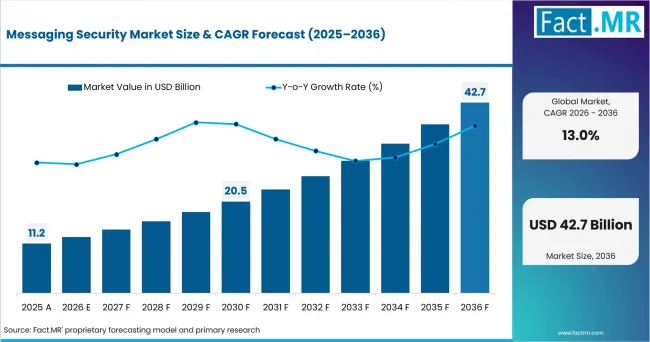
Messaging Security Market Market Value Analysis | Source: Fact.MR
What are the defining numbers behind Messaging Security Market growth?
USD 30.1 billion absolute opportunity by 2036 is led by Software and Cloud alongside BFSI demand.
- Demand Drivers in the Market
- Security operations teams need threat scoring that continues after delivery because account takeover activity often uses trusted mailboxes to bypass pre-delivery filters.
- Email administrators need policy controls across Microsoft 365 and Google Workspace so phishing investigations do not split across unrelated security consoles.
- Compliance teams need searchable message evidence owing to retention rules and internal investigations that span email alongside business collaboration tools.
- Managed service providers need multi-tenant response workflows supported by centralized quarantine review and repeatable policy deployment across customer environments.
- Key Segments Analyzed
- By Component: Software is expected to account for 37.7% share in 2026, driven by recurring platform licenses and integrated detection workflows.
- By Deployment: Cloud is projected to garner 50.6% share in 2026, supported by API access and post-delivery inspection for hosted email suites.
- By Organization Size: SMEs are anticipated to record 49.8% share in 2026, owing to managed services and simplified policy administration.
- By Application: Workflow Automation is estimated to hold 42.1% share in 2026, shaped by phishing triage and automated message removal.
- By End Use: BFSI is forecast to capture 27.3% share in 2026, attributable to impersonation risk and stricter communication governance.
- Analyst Opinion at Fact.MR
- Shambhu Nath Jha, Senior Analyst at Fact.MR states, “Messaging security is drawing attention because the control point now sits inside the mailbox and collaboration session after delivery. Adoption is expected to favor providers that connect detection signals to controlled remediation without forcing security teams into several consoles. Providers should combine sender authentication and behavioral detection with investigation workflows that preserve administrator control.”
- Strategic Implications
- Security leaders should map mail flow and API permissions before replacing gateways or layering post-delivery controls across production tenants.
- Email administrators should test quarantine release and message clawback behavior before extending automated remediation across business communication environments.
- Compliance teams should define retention and export rules separately from threat response so incident evidence remains available after message cleanup.
- Managed service providers should compare tenant isolation and delegated administration before standardizing one service stack across smaller customer accounts.
Security vendors are increasingly focusing on end-to-end email protection capabilities that reduce response complexity while improving threat containment across distributed environments. Barracuda launched Integrated Email Protection in June 2026 for continuous detection and remediation across Microsoft 365 and Google Workspace. The release combines post-delivery message clawback with cross-domain telemetry across both single-tenant and multi-tenant security environments. The move reflects enterprise pressure for one operational path from message verdict to response without rebuilding mail flow.
India is expected to record a 14.8% CAGR during the forecast period, driven by high incident volumes and wider enterprise cloud adoption. China is projected to post a 14.1% CAGR by 2036, supported by tighter network data governance and banking-sector security requirements. Australia is anticipated to record a 12.8% CAGR over the assessment period, shaped by proactive threat notification programs and managed service use. The United Kingdom is estimated to post a 12.5% CAGR between 2026 and 2036, reinforced by board-level cyber governance and incident response programs. The United States is forecast to record a 12.3% CAGR across the forecast horizon, attributable to persistent phishing and business email compromise exposure.
How does the Messaging Security Market break down by segment?
Cloud is projected to account for 50.6% share; SMEs are estimated to garner 49.8% share.
Which component dominates?
Software is anticipated to hold 37.7% share in 2026
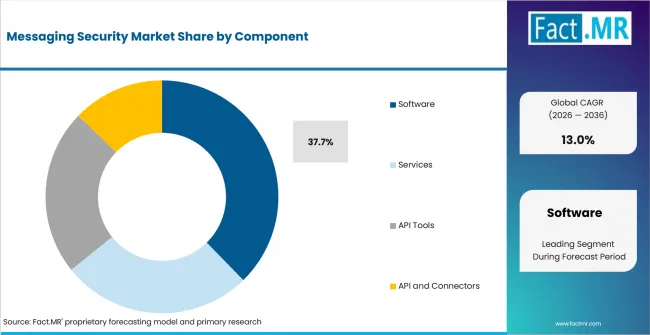
Messaging Security Market Analysis By Component | Source: Fact.MR
Software is expected to represent 37.7% share in 2026 because enterprise accounts increasingly want threat detection and remediation in one managed console. Services remain relevant where security teams need migration support and policy tuning during initial platform deployment projects. API Tools support case handling and response workflows while API Connectors extend controls into hosted communication suites. Regulated accounts also use email encryption software where outbound content control sits beside inbound threat screening. ENISA reported in October 2025 that it analyzed 4,875 incidents across Europe from July 2024 to June 2025. The volume keeps repeatable triage and coordinated investigation central to software-led security programs across enterprise accounts.
How does Deployment shape demand?
Cloud is estimated to garner 50.6% share in 2026
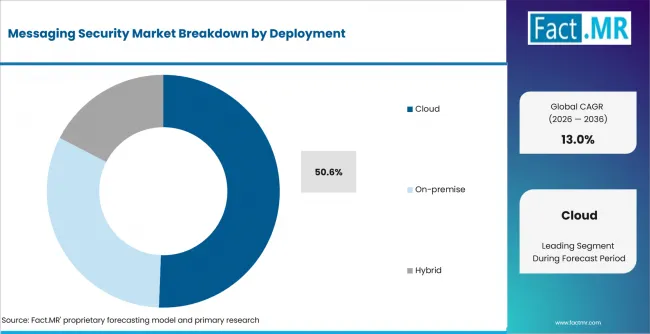
Messaging Security Market Analysis By Deployment | Source: Fact.MR
Cloud is anticipated to capture 50.6% share in 2026 owing to rapid API deployment and post-delivery inspection inside hosted mailboxes. On-premise systems remain relevant where regulated operators keep internal mail infrastructure and fixed routing controls. Hybrid deployment supports accounts that split legacy mail routing from cloud collaboration workloads during staged migration projects. In February 2026, Eurostat reported that 85.2% of EU enterprises using paid cloud services relied on them for email during 2025. Existing use gives security teams a direct route to add cloud-native controls around established business email platforms.
What supports SME demand within Organization Size?
SMEs are anticipated to record 49.8% share in 2026
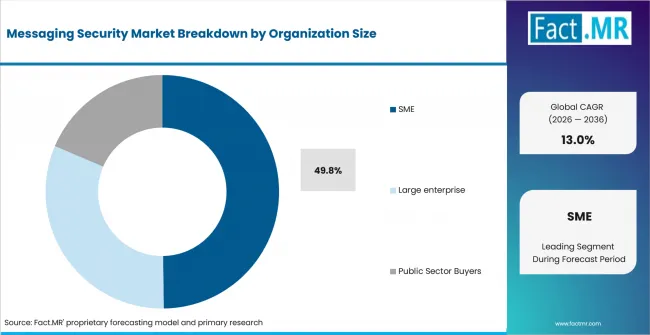
Messaging Security Market Analysis By Organization Size | Source: Fact.MR
SMEs are forecast to hold 49.8% share in 2026 supported by subscription pricing and outsourced administration. Large enterprises purchase deeper investigation layers and governance controls across multiple domains and complex organizational structures. Public Sector Buyers emphasize retention requirements and controlled data handling across communication systems that contain regulated records. Managed service providers also reduce the need for each smaller firm to maintain a separate investigation queue. In April 2026, DSIT reported that phishing affected 38% of businesses in the UK Cyber Security Breaches Survey 2025/2026. Persistent exposure keeps simplified deployment and managed response commercially relevant for organizations without dedicated email security teams.
What supports Workflow Automation within Application?
Workflow Automation is forecast to capture 42.1% share in 2026
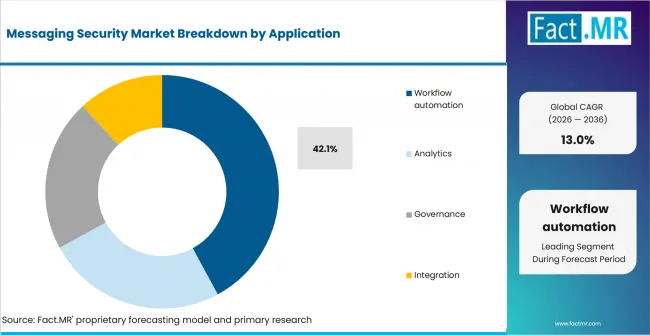
Messaging Security Market Analysis By Application | Source: Fact.MR
Workflow Automation is expected to represent 42.1% share in 2026 because phishing response depends on fast triage and consistent post-delivery action. Analytics follows as teams compare campaign patterns and user exposure over time across large communication estates. Governance supports evidence retention while Integration connects messaging controls with SIEM and case-management tools used by security operations teams. Integration also connects compromised-account evidence to zero trust architecture policies that restrict risky sessions after an email incident. In July 2025, APWG observed 1.004 million phishing attacks during the first quarter of 2025 across its international reporting network. Response teams therefore need workflows that move from detection to mailbox search and controlled message removal without repeated manual handoffs.
Why does BFSI carry weight within End Use?
BFSI is expected to account for 27.3% share in 2026
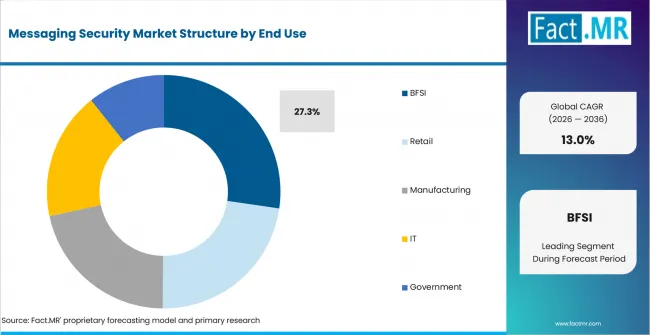
Messaging Security Market Analysis By End Use | Source: Fact.MR
BFSI is projected to garner 27.3% share in 2026 due to high exposure to payment fraud and executive impersonation. Retail organizations need brand protection and seasonal campaign screening across large customer communication and supplier networks. Manufacturers focus on supplier impersonation while IT providers protect privileged accounts and daily customer communication across service environments. Government agencies add procurement controls around retention and data handling across citizen communication and internal administrative systems. In July 2025, APWG reported that online payment and banking sectors represented 30.9% of phishing attacks during the first quarter of 2025. The concentration supports continued investment in message authentication and account takeover detection across financial institutions.
What is accelerating Messaging Security Market adoption, and what is holding it back?
Phishing and account compromise drive it; false positives and integration friction restrain it.
Drivers Impact Analysis
| Driver | (~) % Impact on CAGR | Geographic Relevance | Impact Timeline |
|---|---|---|---|
| Phishing and BEC pressure | +1.2% | North America and Europe | Short term (<= 2 years) |
| Compromised account activity | +0.9% | North America and Asia Pacific | Medium term (2-4 years) |
| Cloud email migration | +0.8% | Europe and Australia | Medium term (2-4 years) |
| Collaboration channel exposure | +0.6% | North America and Europe | Medium term (2-4 years) |
| Compliance and sender authentication | +0.5% | China and regulated markets | Long term (>= 4 years) |
Source: Fact.MR analysis. Updated Jul 10, 2026
- Phishing and BEC pressure: Attack volume keeps email and collaboration traffic at the center of security operations. APWG recorded 971,181 phishing attacks in the first quarter of 2026 in its May 2026 report. Providers are expected to gain preference where detection joins mailbox search and controlled response inside one analyst workflow.
- Compromised account activity: Compromised accounts send messages from trusted identities so attackers bypass reputation filters after initial access. Security teams need behavior signals that compare sending patterns and relationship context across long communication histories. Demand is projected to expand for controls that combine identity evidence with post-delivery remediation workflows across hosted mailboxes.
- Cloud email migration: Hosted email suites centralize message access while exposing APIs for search and remediation. API deployment lowers mail-flow disruption during trials and supports phased rollouts across complex enterprise communication environments. Cloud security adoption is anticipated to favor controls that prove permission boundaries and reversible automated actions.
- Collaboration channel exposure: Security incidents increasingly cross email and chat because users move files and links between channels during daily work. Separate controls create investigation gaps and duplicate analyst alerts across connected communication spaces during active incident response. Providers are estimated to win broader deployments where one policy layer covers email and collaboration messages.
- Compliance and sender authentication: Network data rules and sector controls are pushing administrators to document message handling and access decisions. DMARC and related authentication controls also create work around domain inventories and enforcement across extensive brand portfolios. Adoption is forecast to favor platforms that connect authentication evidence with impersonation investigations and auditable policy changes.
Opportunity Impact Analysis
| Opportunity | (~) % Impact on CAGR | Geographic Relevance | Impact Timeline |
|---|---|---|---|
| API-based layered detection | +0.7% | North America and Europe | Short term (<= 2 years) |
| Managed security for SMEs | +0.5% | India and United Kingdom | Medium term (2-4 years) |
| Cross-channel protection | +0.4% | Australia and United States | Medium term (2-4 years) |
| Authentication operations | +0.3% | Europe and Asia Pacific | Long term (>= 4 years) |
Source: Fact.MR analysis. Updated Jul 10, 2026
- API-based layered detection: API-based inspection gives enterprises a way to add post-delivery controls without replacing mail routes at project start. Security teams compare verdicts before enabling automated action across production mailboxes inside existing enterprise tenant environments. Opportunity is expected to expand for providers that pair API deployment with gateway-grade URL and attachment analysis.
- Managed security for SMEs: Smaller organizations often need email protection without staffing a dedicated investigation queue. In April 2026, DSIT found formal incident response plans at only 25% of businesses surveyed nationwide. Managed offerings are projected to gain where providers combine policy administration with incident handling under one service agreement.
- Cross-channel protection: Security teams need consistent inspection across email and collaboration spaces because attackers reuse links and trusted identities across both environments. A shared evidence layer reduces duplicate investigations and policy drift during incident response across connected communication channels. Providers are anticipated to expand account value where collaboration protection extends existing email deployments across customer environments globally.
- Authentication operations: Sender authentication programs create recurring operational work around domain discovery and enforcement across large enterprise brand portfolios. Large brands and managed service providers need workflows that surface spoofing attempts and misconfigured senders. Demand is estimated to rise for services that connect DMARC operations with broader impersonation defense.
Restraints Impact Analysis
| Restraint | (~) % Impact on CAGR | Geographic Relevance | Impact Timeline |
|---|---|---|---|
| False positives and mail-flow disruption | -0.6% | Worldwide enterprise accounts | Short term (<= 2 years) |
| Integration and tool overlap | -0.5% | North America and Europe | Medium term (2-4 years) |
| Tuning and skills requirements | -0.4% | India and Australia | Medium term (2-4 years) |
| Data residency and procurement fragmentation | -0.3% | China and Europe | Long term (>= 4 years) |
Source: Fact.MR analysis. Updated Jul 10, 2026
- False positives and mail-flow disruption: False positives disrupt mail flow and create user pressure when legitimate invoices are quarantined. Security teams therefore test release workflows and policy exceptions before broad automation across multiple business units and regions. Adoption is forecast to remain selective where vendors cannot explain verdicts or reverse automated actions quickly.
- Integration and tool overlap: Enterprises already run native security inside Microsoft 365 or Google Workspace alongside SIEM and identity tools. Overlapping alerts increase review effort when products do not share evidence cleanly during active incident investigations and response. New deployments are expected to face longer evaluations where security leaders cannot prove added detection coverage.
- Tuning and skills requirements: Behavioral detection and impersonation controls need local context about executives and trusted partners. Weak tuning creates noise that reduces analyst confidence during high-volume investigations and delays critical response decisions. Expansion is projected to favor providers that offer usable defaults and guided policy tuning without hiding investigation detail.
- Data residency and procurement fragmentation: Messaging evidence often contains personal data and regulated business records. Regional data residency rules complicate centralized service design for multinational enterprise accounts operating across several regulatory regions globally. Procurement is anticipated to slow where tenants lack clear processing locations and export controls inside cross-border communication programs.
Which countries are scaling Messaging Security Market fastest?
India 14.8%; China 14.1%; Australia 12.8%; United Kingdom 12.5%; United States 12.3%.
Messaging Security Market is segmented into North America, Europe, Asia Pacific, Latin America, and the Middle East & Africa.
.webp "Top Country Growth Comparison Messaging Security Market Cagr (2026 2036)")
Top Country Growth Comparison Messaging Security Market Cagr (2026 2036) | Source: Fact.MR
| Country | CAGR |
|---|---|
| India | 14.8% |
| China | 14.1% |
| Australia | 12.8% |
| United Kingdom | 12.5% |
| United States | 12.3% |
Source: Fact.MR analysis. Updated Jul 10, 2026
Why is incident pressure widening India’s Messaging Security market?
14.8% CAGR by 2036, driven by rising incident volumes and expanding cloud communication use across enterprise accounts.
Heavy incident volumes are increasing investigation workloads for Indian security teams protecting email and collaboration environments. In October 2025, the Press Information Bureau reported 22.68 lakh cybersecurity incidents during 2024. Demand is expected to record a 14.8% CAGR by 2036 as cloud adoption expands communication exposure across enterprise accounts. Managed-security providers gain stronger opportunities where messaging controls reduce alert queues and support organizations with limited internal response capacity.
How are network data rules reshaping China’s Messaging Security demand?
14.1% CAGR over the assessment period, supported by network data requirements and tighter control expectations across regulated organizations.
Regulatory change is making documented message handling more important across Chinese enterprises that operate large communication environments. In September 2024, the State Council issued the Regulations on Network Data Security Management for implementation from January 2025. The market is projected to post a 14.1% CAGR over the assessment period owing to compliance reviews and domestic security procurement. Providers improve their position when messaging controls strengthen access governance without interrupting established communication workflows.
Why are proactive threat alerts strengthening Australia’s outlook?
12.8% CAGR between 2026 and 2036, shaped by proactive cyber notifications and expanding managed response requirements.
Earlier threat notification gives Australian organizations more time to investigate malicious activity before wider operational disruption develops. In October 2025, ASD’s ACSC reported more than 1,700 notifications of potentially malicious cyber activity during FY2024–25. Demand is anticipated to record a 12.8% CAGR between 2026 and 2036 due to increased response requirements of cloud collaboration. Managed providers gain relevance when messaging telemetry connects directly with investigation workflows across mid-sized organizations.
What is bringing Messaging Security into United Kingdom boardroom discussions?
12.5% CAGR across the forecast horizon, reinforced by executive oversight and stronger requirements for documented response planning.
Board accountability is moving messaging protection beyond technical filtering and into wider enterprise risk management programs. In October 2025, the NCSC reported handling 204 nationally significant cyber attacks during the twelve months to August. Demand is estimated to post a 12.5% CAGR across the forecast as phishing exposure receives greater executive scrutiny. Vendors gain stronger positioning when reporting supports operational response teams while also providing evidence for senior governance reviews.
What keeps phishing protection central to United States demand?
12.3% CAGR during the forecast period, attributable to persistent phishing exposure and complex enterprise communication environments.
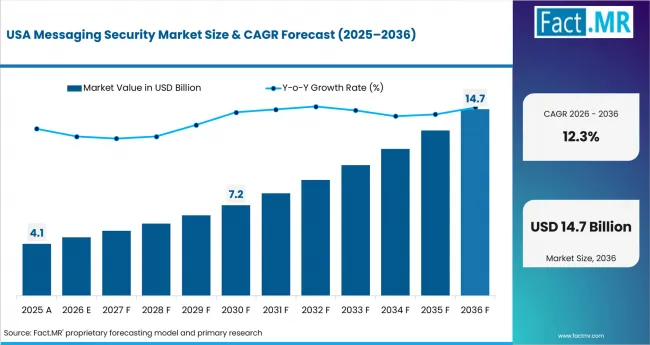
Messaging Security Market Country Value Analysis | Source: Fact.MR
Large hosted email estates give attackers repeated opportunities to target distributed workforces through impersonation and deceptive messaging campaigns. The FBI’s 2025 IC3 Annual Report recorded 191,561 phishing or spoofing complaints during the year. Demand is forecast to expand at a 12.3% CAGR during the forecast period as enterprises strengthen layered communication controls. Vendors improve account access when detection tools provide investigation context that helps security teams prioritize suspicious messages.
Who leads the Messaging Security Market?
Players such as Proofpoint and Broadcom (Symantec) are strengthening direct messaging security coverage.
Proofpoint competes across gateway protection and API-based detection for enterprise communication environments. Mimecast combines email defense with collaboration protection and incident response services for enterprise accounts and regulated organizations. Broadcom supports cloud email protection under the Symantec portfolio for organizations that retain different messaging architectures. Competition among these providers centers on detection depth and policy control while administrators also compare deployment flexibility and investigation speed.
Cisco Systems combines pre-delivery controls with investigation workflows for large enterprise email estates and complex messaging environments. Microsoft Defender for Office 365 links threat detection with automated investigation across Exchange Online and Teams environments. Trend Micro covers gateway email security and cloud collaboration protection while Barracuda Networks combines pre-delivery inspection with post-delivery remediation. During the forecast period competition is expected to be shaped by explainable automation and API permission design because agentic AI cybersecurity changes response expectations.
Which companies are the key providers?
Key providers profiled include Proofpoint, Mimecast, Broadcom (Symantec), Cisco Systems, Microsoft (Defender for Office 365), Trend Micro and Barracuda Networks.
- Proofpoint
- Mimecast
- Broadcom (Symantec)
- Cisco Systems
- Microsoft (Defender for Office 365)
- Trend Micro
- Barracuda Networks
Bibliography
- Anti-Phishing Working Group. (2025, July 2). Phishing Activity Trends Report, 1st Quarter 2025. Anti-Phishing Working Group.
- Anti-Phishing Working Group. (2026, May 21). Phishing Attack Trends Report - 1Q 2026. Anti-Phishing Working Group.
- Australian Signals Directorate. (2025, October 14). Annual Cyber Threat Report 2024-2025. Australian Cyber Security Centre.
- Barracuda Networks. (2026, June 17). Barracuda Unveils Integrated Email Protection, An Evolution in Email Security Delivering Cyber Resilience Made Easy for the Agentic AI Era. Barracuda Networks.
- Broadcom. (2025, June 30). Getting Started with Email Security.cloud. Broadcom.
- Cisco Systems. (2026, June). Cisco Secure Email Threat Defense Data Sheet. Cisco Systems.
- Department for Science, Innovation and Technology. (2026, April 30). Cyber Security Breaches Survey 2025/2026. GOV.UK.
- European Union Agency for Cybersecurity. (2025, October 1). ENISA Threat Landscape 2025. European Union Agency for Cybersecurity.
- Eurostat. (2026, February 3). 53% EU Enterprises Used Paid Cloud Services in 2025. European Commission.
- Federal Bureau of Investigation. (2026, April 6). 2025 Internet Crime Report. Internet Crime Complaint Center.
- Indian Computer Emergency Response Team. (2024, November 29). Annual Report 2024. Ministry of Electronics and Information Technology.
- Microsoft. (2026, May 21). Why Do I Need Microsoft Defender for Office 365? Microsoft Learn.
- Mimecast. (2026, March 10). Mimecast Eliminates the API Email Security Trade-Off with Complete Threat Detection. Mimecast.
- National Cyber Security Centre. (2025, October 14). NCSC Annual Review 2025. National Cyber Security Centre.
- Proofpoint. (2026, March 23). Proofpoint Redefines Email and Data Security for the Agentic Workspace. Proofpoint.
- State Council of the People’s Republic of China. (2024, September 30). Regulations on Network Data Security Management. The State Council of the People’s Republic of China.
- Trend Micro. (2026, March 19). TrendAI Vision One Cloud Email Gateway Protection and TrendAI Email Security February 2026 deployment. Trend Micro.
This Report Addresses
- The report provides strategic intelligence on the Messaging Security market across components, deployment modes, organization sizes, and industry verticals that influence secure business communications.
- Segment analysis covers Email Security and Messaging Security Platforms as the principal solution categories supporting threat detection, spam filtering, phishing prevention, and data protection.
- Regional outlook evaluates North America and Europe alongside Asia-Pacific. The analysis also covers Latin America and the Middle East & Africa, including key markets such as the United States, Canada, Germany, the United Kingdom, China, Japan, and India.
- Competitive analysis profiles Cisco Systems and Microsoft alongside Proofpoint. The provider landscape also covers Broadcom (Symantec), Mimecast, Barracuda Networks, Trend Micro, Fortinet, Sophos, and Forcepoint.
- Component assessment covers Solutions and Services. The analysis further evaluates managed services, professional services, and integrated threat protection offerings.
- Deployment assessment covers Cloud-Based and On-Premises solutions, examining adoption trends, security benefits, compliance requirements, and scalability considerations.
- Security Type assessment covers Email Security and Anti-Phishing solutions alongside Anti-Spam, Business Email Compromise (BEC) Protection, Data Loss Prevention (DLP), and Encryption technologies.
- Organization Size assessment covers Large Enterprises and Small & Medium-Sized Enterprises (SMEs), evaluating security investment priorities and implementation approaches.
- End Use assessment covers BFSI and Healthcare alongside Government, IT & Telecommunications, Retail & E-commerce, Manufacturing, Education, and other commercial sectors.
- Market dynamics analysis evaluates cyberattack trends, regulatory compliance requirements, cloud migration, remote workforce adoption, artificial intelligence integration, and evolving threat landscapes.
- The report examines emerging opportunities in AI-driven threat intelligence, zero-trust security frameworks, advanced email authentication technologies, cloud-native security platforms, and automated incident response solutions.
What does the Messaging Security Market cover?
Software and Services alongside API Tools and API Connectors protect business email and collaboration communications.
The Messaging Security Market covers products and services that inspect business messages for phishing and malware alongside impersonation and account takeover activity. Coverage spans gateway controls and API-based inspection alongside post-delivery search and controlled remediation inside enterprise communication accounts.
The market is narrower than the broader cybersecurity category because revenue must relate directly to email or collaboration message protection. General endpoint security and network security are excluded unless messaging-specific protection is separately packaged or measured. Standalone archiving remains outside the boundary unless it is sold as part of a security or governance workflow.
What is included in the scope?
Messaging security systems used across enterprise email and collaboration environments.
Scope includes Software and Services that support message inspection and policy control across enterprise communication environments. API Tools and API Connectors are included when they support investigation or remediation inside messaging security operations. Deployment coverage includes Cloud and On-premise architectures while Hybrid environments are also covered for business communication systems. Microsoft 365 and Google Workspace deployments sit inside the boundary when security controls are separately packaged and measured. Internal mail infrastructure is covered when a messaging security layer is separately measured for enterprise security use.
Organization coverage spans SMEs and Large Enterprises that purchase messaging controls directly or through managed service providers. Public Sector Buyers are included where communication security forms a defined procurement need for protected organizational communications. Application coverage includes Workflow Automation and Analytics alongside Governance and Integration across security operations and compliance processes. End-use analysis covers BFSI and Retail accounts that protect payment workflows and large customer communication programs. Manufacturing and IT are included alongside Government accounts that protect operational communication and regulated records. Managed administration is included when messaging protection is the primary service outcome for contracted customer security accounts.
What is excluded from the scope?
General network security and standalone endpoint security are outside the scope.
The report excludes firewalls and endpoint detection platforms that do not provide a messaging-specific protection layer. Broad identity systems are also excluded unless a separately measured messaging security module is part of the commercial package. Consumer spam filtering and standalone archiving remain outside the boundary unless they are sold inside a measured security or governance offering.
How was the analysis built?
120+ sources, 40+ company portfolios, 25+ countries, 20+ interviews.
- Primary Research:
- Primary research includes interviews with messaging security solution providers, email security specialists, enterprise IT security leaders and cybersecurity managers. It also includes input from managed security service providers, security architects, compliance officers and cloud security teams responsible for protecting enterprise communication environments.
- Desk Research:
- Desk research reviews cybersecurity industry statistics, email threat intelligence reports, messaging security product portfolios, regulatory guidance and company announcements. Industry publications, security research reports, provider documentation and enterprise communication security developments are also assessed to evaluate market trends and competitive positioning.
- Market-Sizing and Forecasting:
- Forecasting uses enterprise cybersecurity spending, cloud email adoption, phishing and business email compromise trends, secure messaging deployment activity and investment in threat protection technologies across major regions. Models consider demand for email security, anti-phishing solutions, data loss prevention, encryption technologies, security awareness programs and cloud-based messaging protection platforms.
- Data Validation and Update Cycle:
- Forecasts are validated through industry interviews that test assumptions on security adoption, threat mitigation priorities and enterprise spending patterns. End-user assessment and stakeholder feedback help confirm market direction, while ongoing reviews of threat developments, regulatory changes and product launches support forecast updates.
Segmentation
What is the report’s scope and coverage?
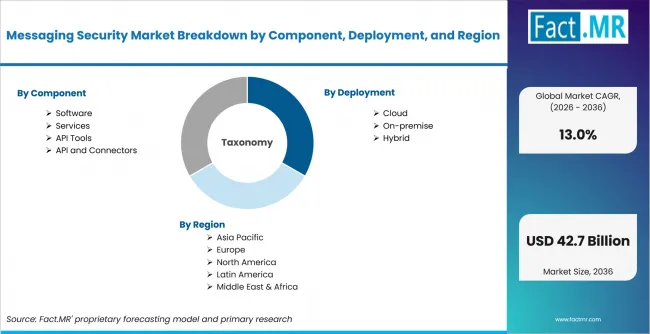
Messaging Security Market Breakdown By Component, Deployment, And Region | Source: Fact.MR
| Attribute | Details |
|---|---|
| Quantitative Units | USD Billion |
| Market Definition | Software and services that protect business email and collaboration communications from phishing; malware; impersonation; account takeover; related message-borne threats |
| Component | Software; Services; API Tools; API Connectors |
| Deployment | Cloud; On-premise; Hybrid |
| Organization Size | SMEs; Large Enterprises; Public Sector Buyers |
| Application | Workflow Automation; Analytics; Governance; Integration |
| End Use | BFSI; Retail; Manufacturing; IT; Government |
| Regions Covered | North America; Europe; Asia Pacific; Latin America; Middle East & Africa |
| Countries Covered | United States; Canada; Germany; United Kingdom; France; Italy; Spain; India; China; Japan; South Korea; Australia; Brazil; Argentina; Mexico; Chile; UAE; Saudi Arabia; South Africa |
| Key Companies Profiled | Proofpoint; Mimecast; Broadcom (Symantec); Cisco Systems; Microsoft (Defender for Office 365); Trend Micro; Barracuda Networks |
| Forecast Period | 2026 to 2036 |
| Approach | Hybrid top-down and bottom-up approach using enterprise email seats; cloud collaboration adoption; threat volumes; subscription attachment rates; deployment mix; incident response demand; |
Source: Fact.MR analysis. Updated Jul 10, 2026
How is the market segmented?
-
By Component:
- Software
- Services
- API Tools
- API Connectors
-
By Deployment:
- Cloud
- On-premise
- Hybrid
-
By Organization Size:
- SMEs
- Large Enterprises
- Public Sector Buyers
-
By Application:
- Workflow Automation
- Analytics
- Governance
- Integration
-
By End Use:
- BFSI
- Retail
- Manufacturing
- IT
- Government
-
By Region:
- North America
- United States
- Canada
- Europe
- Germany
- United Kingdom
- France
- Italy
- Spain
- Asia Pacific
- India
- China
- Japan
- South Korea
- Australia
- Latin America
- Brazil
- Argentina
- Mexico
- Chile
- Middle East & Africa
- UAE
- Saudi Arabia
- South Africa
- North America
Frequently Asked Questions
How is Software positioned within the Messaging Security Market?
What role does Cloud play in the Messaging Security Market?
How prominent are SMEs in the Messaging Security Market?
What contribution does Workflow Automation make to Messaging Security Market demand?
How are BFSI organizations represented in the Messaging Security Market?
Which country shows notable growth potential in the Messaging Security Market?
How is the Messaging Security Market expected to develop in China?
What outlook is anticipated for Australia in the Messaging Security Market?
How is demand projected to evolve in the United Kingdom?
What trend characterizes the United States Messaging Security Market?
What factor primarily supports market adoption?
Which challenge continues to influence purchasing decisions?
Why does Workflow Automation remain important in the Messaging Security Market?
What supports BFSI demand in the Messaging Security Market?
Who worked on this report


Preview the report firsthand - request a free sample
Free SampleGet the brochure for pricing and purchase details
Download PDF