- Base Value(2025): 1.9 Bn
- Estimated Value(2026): 2.1 Bn
- Forecast Value (2036): 6.0 Bn
- CAGR (2026 - 2036): 11%
Email Application Market Forecast and Outlook By Fact.MR
In 2025, the email application market was valued at USD 1.9 billion. Based on Fact.MR analysis, demand for email application services is estimated to grow to USD 2.1 billion in 2026 and USD 6.0 billion by 2036. FACT.MR projects a CAGR of 11% during the forecast period.
The market is expected to generate USD 3.9 billion in incremental revenue during the forecast period, reflecting transformational rather than incremental expansion. Growth is driven by enterprise migration from on-premise email infrastructure to cloud-native platforms with AI-embedded productivity features, rising per-seat pricing from Microsoft 365 Copilot and Google Workspace Gemini subscription tiers, and growing demand for privacy-focused encrypted email solutions. Constraints include high concentration risk among two dominant platforms, cloud migration hesitancy in highly regulated industries, and data sovereignty concerns limiting public cloud email adoption in government and financial services.
Country demand reflects enterprise cloud email migration maturity, AI productivity feature adoption, data privacy regulation, and digital workplace investment. The USA follows at 9.8% as the largest absolute revenue market, anchored by Microsoft 365 and Google Workspace enterprise seat expansion and premium AI copilot upsell. The European Union records 9.6% supported by GDPR-compliant cloud email migration and strong demand for privacy-certified business email platforms. The UK posts 9.4% through sustained enterprise Microsoft 365 deployment and National Cyber Security Centre cloud migration guidance. Japan records 8.7%, supported by large enterprise digital transformation mandates under the Digital Agency framework, with structural constraints from legacy on premise email architecture in banking and government sectors.
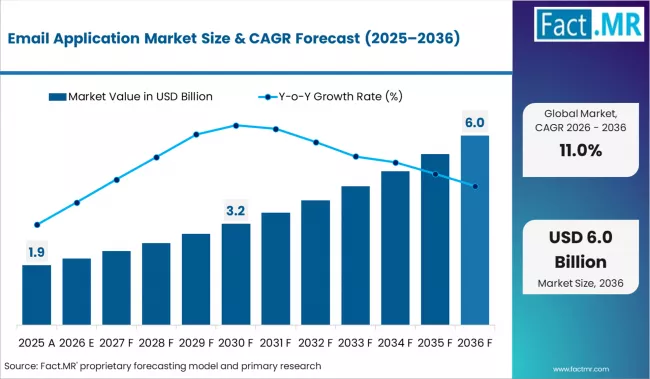
Email Application Market Market Value Analysis | Source: Fact.MR
| Metric | Value |
|---|---|
| Estimated Value in 2026 | USD 2.1 billion |
| Forecast Value in 2036 | USD 6.0 billion |
| Forecast CAGR (2026 to 2036) | 11% |
Source: Fact.MR analysis. Updated Mar 23, 2026
Email Application Market Definition
The email application market includes software used to send, receive, and manage email for businesses and consumers. It covers cloud business email platforms such as Microsoft 365 and Google Workspace. It also includes enterprise messaging platforms, consumer webmail services, and email client applications. Key uses include enterprise communication, collaboration, compliance archiving, and CRM support.
Email Application Market Inclusions
Revenue forecasts from 2026 to 2036 by product type and deployment model. Includes cloud business email, enterprise messaging platforms, consumer email, and email client software. Covers public cloud and on-premise deployments across North America, Europe, Asia Pacific, Latin America, and Middle East & Africa.
Email Application Market Exclusions
Excludes email marketing automation platforms. Excludes SMS and messaging apps without email integration and standalone email security tools. Also excludes email hardware infrastructure such as servers and networking equipment. Consumer device mail apps are excluded unless licensed separately.
Email Application MArket Research Methodology
- Primary Research: Interviews with enterprise IT managers, CIOs, cloud resellers, consultants, and compliance officers. Coverage across North America, Europe, and Asia Pacific.
- Desk Research: Sources include reports from Microsoft and Alphabet Inc. Data from European Commission GDPR records and government digital programmes in Japan and South Korea.
- Market Sizing and Forecasting: Hybrid top-down and bottom-up approach. Based on enterprise email seat counts, subscription pricing tiers, deployment splits, and vendor revenues.
- Data Validation and Update Cycle: Validated using revenue disclosures from Microsoft, Alphabet Inc., Zoho Corporation, and Proton AG. Supported by IT spending surveys and reseller interviews.
Summary of Email Application MArket
- Market Definition
- Market includes cloud business email, enterprise messaging platforms, consumer webmail, and email client software used for communication and collaboration.
- Demand Drivers
- Enterprise shift from on-premise email to Microsoft 365 and Google Workspace is driving subscription growth.
- Integration of Gemini AI in Workspace is increasing ARPU and retention.
- GDPR compliance demand is boosting adoption of platforms such as Proton Mail and Zoho Mail.
- Key Segments Analyzed
- By Product Type: Cloud business email holds 42% share in 2026 due to enterprise cloud migration.
- By Deployment: Public cloud holds 60% share in 2026 as SaaS email adoption rises.
- By Geography: South Korea leads CAGR at 10.2%, while mature markets show AI-driven revenue growth.
- Analyst Opinion at FACT.MR
- Shambhu Nath Jha notes that AI tiers like Microsoft 365 Copilot and Gemini are reshaping enterprise email pricing. GDPR rules and South Korea’s digital workplace investment create opportunities for regional and privacy-focused providers.
- Strategic Implications
- Vendors should integrate AI copilots for drafting, summarisation, and scheduling.
- Privacy-focused providers should invest in EU data residency and compliance infrastructure.
- Resellers should expand deployment services in South Korea and Japan to capture high-growth markets.
- Methodology
- Market sizing uses enterprise seat counts, subscription pricing, and vendor revenue disclosures.
- Regulatory and government datasets supported demand analysis.
- Forecasts incorporate cloud migration, AI upsell trends, and expert interviews.
Drivers, Restraints, and Opportunities
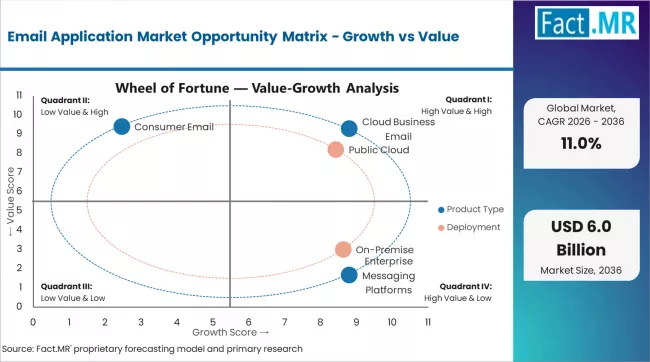
Email Application Market Opportunity Matrix Growth Vs Value | Source: Fact.MR
Email remains the primary formal communication channel for enterprises and institutions globally. Enterprise IT spending is concentrated in Microsoft 365 and Google Workspace, where email anchors subscription revenue. AI copilot integration is increasing revenue through premium tiers priced 30-50% higher than standard plans.
On-premise email deployments are declining as enterprises move to cloud platforms to reduce infrastructure costs and access AI features. Migration remains slower in banking, healthcare, and government due to data sovereignty regulations. Privacy-focused platforms such as Proton Mail and Zoho Mail are gaining traction in regulated sectors with encrypted and sovereign deployment options.
- Microsoft Copilot AI Integration: Microsoft’s June 2025 Outlook update introduced Copilot email coaching and AI suggestions for accounts connected to Outlook, including Gmail, Yahoo, and iCloud. Copilot Pro and Microsoft 365 subscribers can access the feature, encouraging upgrades to AI-enabled plans priced around USD 20-30 per user per month. [1]
- Google Workspace Gemini Expansion: From January 15, 2025, Google integrated Gemini AI across all Google Workspace Business and Enterprise plans. Features include AI drafting, summarisation, and Smart Compose without separate add-ons. The integration strengthens Google’s enterprise retention strategy. [2]
- EU GDPR Email Compliance Demand: Enforcement of General Data Protection Regulation is increasing demand for GDPR-compliant cloud email platforms. European enterprises are adopting Proton Mail Business for encrypted email and Swiss-jurisdiction storage. South Korea’s updated Personal Information Protection Act also tightened enterprise email data protection standards. [3]
Regional Analysis
The email application market is analysed across North America, Europe, Asia Pacific, Latin America, and Middle East and Africa, covering 40+ country-level demand shaped by enterprise cloud migration maturity, AI productivity platform adoption, data privacy regulatory frameworks, and government digital transformation investment programmes. The full report offers market attractiveness analysis based on enterprise seat growth, AI premium subscription adoption rates, and data sovereignty compliance benchmarks.
.webp "Top Country Growth Comparison Email Application Market Cagr (2026 2036)")
Top Country Growth Comparison Email Application Market Cagr (2026 2036) | Source: Fact.MR
| Country | CAGR (2026 to 2036) |
|---|---|
| USA | 9.8% |
| European Union | 9.6% |
| UK | 9.4% |
| Japan | 8.7% |
| South Korea | 8.2% |
Source: Fact.MR analysis. Updated Mar 23, 2026
Source: Fact.MR (FACT.MR) analysis, based on proprietary forecasting model and primary research
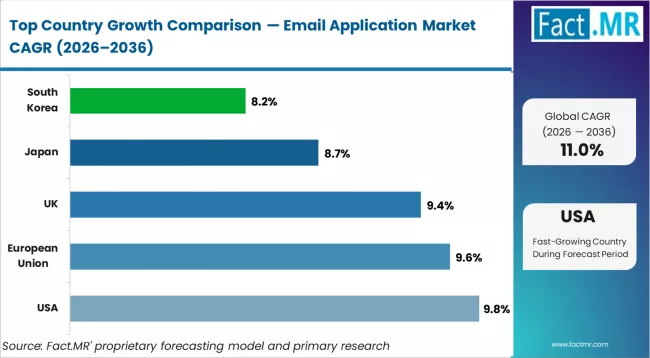
Email Application Market Cagr Analysis By Country | Source: Fact.MR
North America Email Application Market Analysis
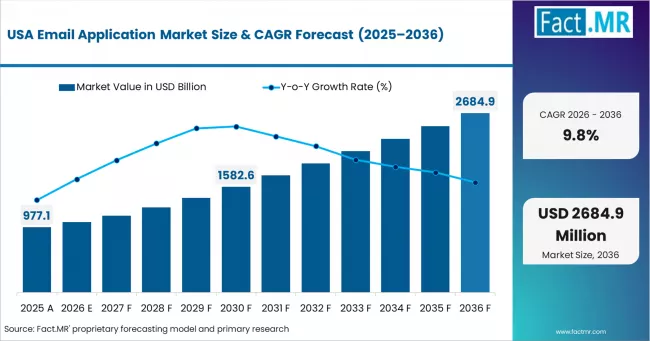
Email Application Market Country Value Analysis | Source: Fact.MR
North America represents the largest regional revenue market for email platforms. The region has the highest concentration of AI-enabled productivity feature adoption integrated into email workflows. Microsoft 365 and Google Workspace dominate deployments across organisations, while privacy-focused providers such as Proton Mail and Hushmail serve security-sensitive sectors.
- USA: Market expansion in the United States is projected at 9.8% CAGR through 2036. The country represents the world’s largest installed base of Microsoft 365 and Google Workspace deployments across Fortune 500 companies. Microsoft’s June 2025 Outlook update introduced Copilot AI email coaching and intelligent suggestions for Gmail and Yahoo accounts connected to Outlook. Google integrated Gemini AI features into all Workspace Business and Enterprise plans in January 2025.
FACT.MR analysis for North America covers the United States, Canada, and Mexico. The report provides Microsoft 365 and Google Workspace seat data, AI copilot adoption benchmarks, privacy-focused provider growth analysis, and country-level revenue forecasts by product type and deployment model.
Asia Pacific Email Application Market Analysis
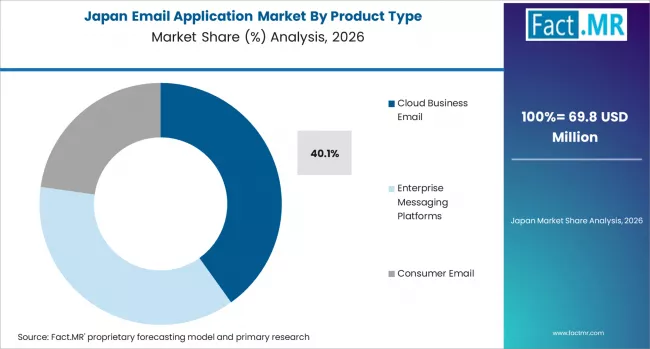
Email Application Market Japan Market Share Analysis By Product Type | Source: Fact.MR
Asia Pacific is the fastest-growing regional market, supported by South Korea’s digital workplace modernisation programmes and Japan’s large-scale corporate digital transformation initiatives. Microsoft 365 and Google Workspace lead platform adoption across organisations, while regional platforms such as Kakao for Business and Line Works serve domestic communication preferences alongside global providers.
- South Korea: Market expansion in South Korea is projected at 8.2% CAGR through 2036. The Ministry of Science and ICT expanded its cloud-first government procurement policy in 2024, requiring public agencies to adopt CC-certified digital services including email systems under the Digital Government Implementation Plan. The Korea Internet and Security Agency certified additional platforms through the Cloud Security Assurance Programme in 2024. Major conglomerates such as Samsung Electronics, SK Group, and LG Corporation accelerated deployment of Microsoft 365 Copilot in 2025 to integrate AI productivity tools across global operations.
- Japan: Market growth in Japan is forecast at 8.7% CAGR through 2036. The Digital Agency of Japan extended its cloud migration framework in 2024, requiring government ministries to transition email systems from on-premise infrastructure to certified platforms by FY2025. Government Cloud procurement selected Microsoft Azure and Google Cloud as authorised infrastructure providers. Toyota Motor Corporation and Hitachi Ltd. expanded Microsoft 365 Copilot deployments in 2025, with Hitachi targeting about 50,000 employee seats. Japan Post Holdings completed migration of roughly 50,000 employees to Google Workspace in FY2024.
FACT.MR analysis for Asia Pacific covers Japan, South Korea, China, India, ASEAN, Australia and New Zealand, and Rest of Asia Pacific. The report includes country CAGR forecasts, government email system mandate timelines, Microsoft 365 and Google Workspace seat benchmarks, and AI copilot adoption analysis by country.
Europe Email Application Market Analysis
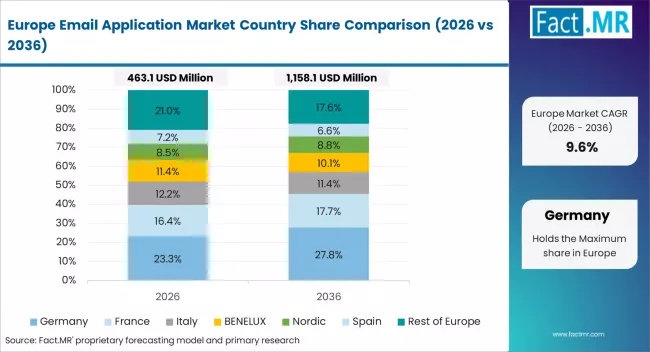
Email Application Market Europe Country Market Share Analysis, 2026 & 2036 | Source: Fact.MR
Europe acts as the global regulatory benchmark for privacy and data sovereignty in digital communication platforms. Enforcement of the General Data Protection Regulation and national data residency requirements strongly influence procurement decisions. Global providers compete with privacy-focused services such as Proton Mail and Zoho Mail that emphasise encryption and jurisdiction-controlled data storage.
- European Union: Regional market growth is projected at 9.6% CAGR through 2036. The European Data Protection Board issued updated guidance in 2024 reinforcing requirements for EU-jurisdiction data processing agreements and cross-border transfer safeguards. Microsoft implemented its EU Data Boundary initiative ensuring Microsoft 365 data for EU customers remains stored and processed within the European Union. The European Commission migrated around 32,000 staff to Microsoft 365 by 2024, creating a major reference deployment in the EU public sector. Proton AG reported strong Proton Mail Business adoption in Germany, France, and the Netherlands in 2024.
- United Kingdom: Regional growth in the UK is expected at 9.4% CAGR through 2036. The National Cyber Security Centre updated government cloud security guidance in 2024 endorsing Microsoft 365 and Google Workspace under the UK Government Cloud Security Principles framework. The HM Revenue and Customs migrated roughly 65,000 employees to Microsoft 365 Outlook and Teams in 2024. Fastmail expanded its UK customer base in 2025 with dedicated UK-region hosting. Hushmail continued expansion across UK healthcare and legal organisations.
FACT.MR analysis for Europe covers Germany, France, the United Kingdom, Italy, Spain, Nordic countries, BENELUX, Eastern Europe, and Russia. The report provides GDPR compliance benchmarks, EU Data Boundary adoption data, Proton Mail enterprise adoption metrics, and country-level forecasts by product type and deployment model.
Competitive Aligners for Market Players
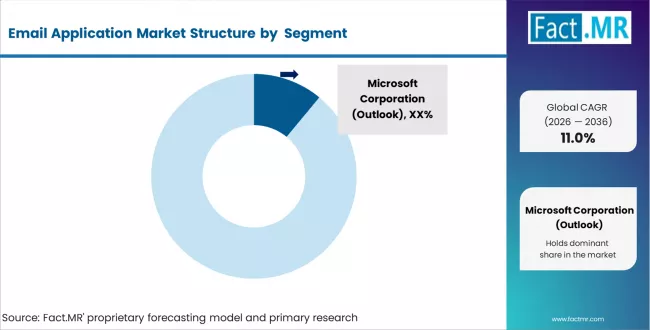
Email Application Market Analysis By Company | Source: Fact.MR
The global email application market is highly concentrated, with Microsoft and Google dominating the enterprise tier through platforms such as Microsoft 365, Outlook, Gmail, and Google Workspace. Together, these providers control roughly 70-80% of global enterprise email revenue.
Competition is no longer centered on basic email features, which are now largely commoditised. Instead, the key differentiator is AI-driven productivity tools that increase the value of subscription plans. Premium features such as Microsoft 365 Copilot and Gemini AI are priced around USD 30 and USD 22 per user per month respectively, creating major revenue growth opportunities.
Microsoft benefits from the strong integration of Outlook with applications such as Word, Excel, PowerPoint, Teams, and SharePoint, making it difficult for organisations to switch platforms. Google, however, competes through Gemini’s advanced AI capabilities and seamless collaboration across Drive, Docs, and Meet. At the same time, regulatory requirements for data privacy in regions such as Europe are encouraging some organisations to complement these platforms with privacy-focused services like Proton Mail.
Key Players
- Microsoft Corporation (Outlook)
- Google LLC (Gmail)
- Apple Inc. (Apple Mail)
- Yahoo Inc. (Yahoo Mail)
- Zoho Corporation Pvt. Ltd. (Zoho Mail)
- Proton AG (ProtonMail)
- FastMail Pty Ltd
- United Internet AG (GMX Mail, Mail.com)
- Hushmail Communications Ltd.
Bibliography
- [1] Microsoft Corporation. (2025). Microsoft Outlook June 2025 Update: Copilot AI Email Coaching and Intelligent Suggestions for Copilot Pro and Microsoft 365 Personal and Family Subscribers Including Third-Party Email Providers. June 2025.
- [2] Google LLC. (2025). Google Workspace Updates: Gemini AI Features Integration into All Business and Enterprise Plans from January 15 2025 Including Gmail AI Drafting Summarisation and Smart Compose for All Workspace Subscribers. January 2025.
- [3] Proton AG. (2024). Proton Company Update: Paying Subscriber Base Surpassing 100 Million Accounts Across Proton Mail Proton VPN and Proton Drive Growth in European Enterprise GDPR-Compliant Email Adoption. December 2024.
- [4] Microsoft Corporation / The Verge. (2025). Internal Memo: Gaurav Sareen Corporate Vice President Global Experiences and Platform Vision for Fundamental AI-Native Redesign of Microsoft Outlook from the Ground Up. October 2025.
- [5] Microsoft Corporation / Alphabet Inc. (2025). Microsoft 365 Copilot Pricing USD 30 Per User Per Month Enterprise Tier and Google Workspace Gemini Advanced Features at USD 22 Per User Per Month Business Plus Plan. 2025.
- [6] Microsoft Corporation. (2026). Windows Insider Blog: Microsoft Copilot Gmail Integration Rollout to Windows Insiders Enabling Cross-Platform AI Email and Calendar Search Across Gmail Google Calendar Outlook and OneDrive. January 2026.
- [7] Zoho Corporation. (2024). Product Update: Zoho Mail EU Data Residency Infrastructure Expansion GDPR-Compliant Data Processing Agreements and Dedicated EU-Region Cloud Email Deployment for European Enterprise Customers. 2024.
- [8] Ministry of Science and ICT, Republic of Korea. (2024). Digital Government Implementation Plan Update: Cloud-First Procurement Policy Expansion Requiring CC-Certified Cloud Services Including Email Platforms for Government Agencies. 2024.
This Report Addresses
- Regulatory insights covering General Data Protection Regulation, Microsoft EU Data Boundary, South Korea Cloud Security Assurance Programme, Japan Digital Agency policies, and National Cyber Security Centre guidance.
- Market forecast from USD 2.1 billion in 2026 to USD 6.0 billion by 2036 at 11% CAGR.
- Growth drivers including Microsoft 365 Copilot and Gemini AI AI subscription upsells and government cloud initiatives.
- Country CAGR outlook: South Korea 8.2%, United States 9.8%, European Union 9.6%, United Kingdom 9.4%, Japan 8.7%.
- Competitive analysis of Microsoft, Google, Proton AG, Zoho Corporation, Fastmail, Hushmail, and Yahoo.
- Technology tracking covering AI copilots, LLM summarisation, multimodal processing, DMARC authentication, and encrypted email.
- Regulatory coverage including GDPR, EU AI Act, South Korea PIPA, Japan cloud standards, US FTC review, and UK NCSC principles.
- Deliverables include PDF report, Excel datasets, PowerPoint summary, and dashboards.
Segmentation
Market Segmentation
Email Application Market Analysis by Product Type
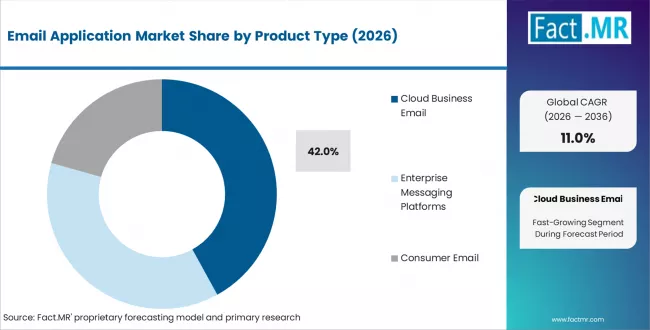
Email Application Market Analysis By Product Type | Source: Fact.MR
FACT.MR estimates cloud business email will hold about 42% market share in 2026.
Growth is driven by SaaS delivery, built-in security, compliance archiving, and AI productivity features. Cloud email eliminates infrastructure costs and scales with per-seat subscription pricing.
- Microsoft Outlook AI Redesign: In October 2025, Microsoft announced a redesign of Outlook under VP Gaurav Sareen. The update aims to rebuild Outlook as an AI-native email platform rather than upgrading legacy architecture. [4]
- Proton Mail Business Growth: Proton AG expanded Proton Mail for Business in 2024 with improved admin controls, custom domains, and higher storage tiers. Enterprise demand is rising for GDPR-compliant encrypted email alternatives to US hyperscalers. Proton surpassed 100 million paying users across its ecosystem. [3]
- Enterprise Email AI Pricing Trend: Microsoft 365 Copilot is priced at about USD 30 per user per month for enterprise plans. Advanced Gemini tiers in Google Workspace cost around USD 22 per user monthly. AI tiers increase pricing by roughly 30-50% compared with standard email plans. [5]
Email Application Market Analysis by Deployment
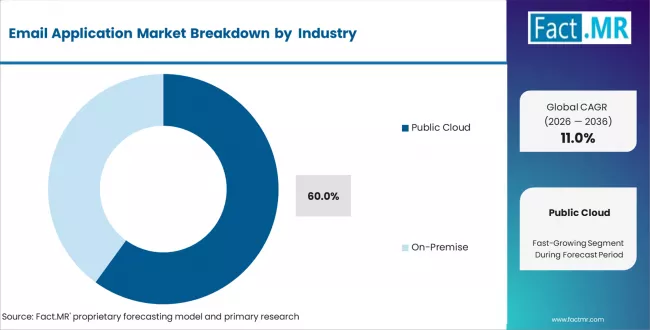
Email Application Market Analysis By Deployment | Source: Fact.MR
FACT.MR estimates public cloud will account for about 60% market share in 2026.
This reflects large-scale enterprise migration from on-premise Exchange or Notes systems to Microsoft 365 and Google Workspace over the past decade.
- Microsoft Copilot Gmail Connector: In January 2026, Microsoft began testing a Copilot Gmail connector for Windows Insiders. The feature allows Copilot to access Gmail, Outlook, and OneDrive data from a unified AI interface, supporting hybrid Microsoft-Google environments. [6]
- Zoho Mail Data Residency Deployment: Zoho Corporation expanded EU data residency infrastructure in 2024. The deployment offers GDPR-compliant regional hosting and private cloud options for regulated industries. [7]
- South Korea Cloud Email Mandate: South Korea’s Ministry of Science and ICT strengthened its cloud-first policy for public sector IT in 2024. Government agencies must adopt certified cloud services, including cloud email platforms, under the national digital transformation programme. [8]
Scope of Report
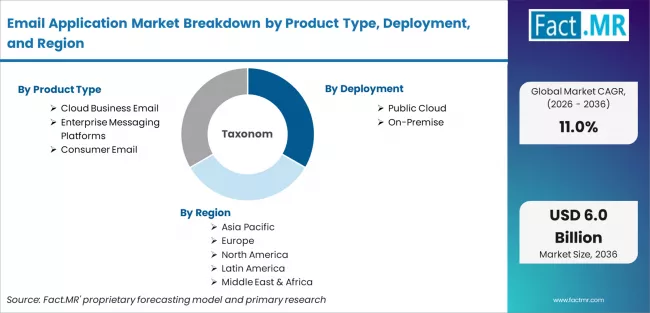
Email Application Market Breakdown By Product Type, Deployment, And Region | Source: Fact.MR
| Attribute | Details |
|---|---|
| Quantitative Units | USD 2.1 billion (2026) to USD 6.0 billion (2036), at a CAGR of 11% |
| Market Definition | Cloud and on-premise software platforms for sending, receiving, organising, and managing electronic mail for enterprise and consumer end-users, including AI-integrated email productivity services. |
| Product Type Segmentation | Cloud Business Email, Enterprise Messaging Platforms, Consumer Email, Email Clients |
| Deployment Segmentation | Public Cloud, On-Premise |
| Application Coverage | Enterprise internal communication, compliance archiving, AI-assisted email drafting and summarisation, encrypted business communication, government digital workplace, and marketing email management. |
| Regions Covered | North America, Europe, Asia Pacific, Latin America, Middle East and Africa |
| Countries Covered | USA, Canada, Mexico, UK, Germany, France, Italy, Spain, Nordic, BENELUX, Eastern Europe, Japan, South Korea, China, India, ASEAN, Australia and New Zealand, Brazil, Rest of Latin America, GCC, South Africa, Rest of MEA |
| Key Companies Profiled | Microsoft (Outlook), Google (Gmail), Apple Mail, Yahoo Mail, Zoho Mail, ProtonMail, FastMail, GMX Mail, Hushmail, Mail.com |
| Forecast Period | 2026 to 2036 |
| Approach | Hybrid top-down and bottom-up model using enterprise email seat counts, average subscription pricing by tier and AI feature inclusion, deployment model split analysis, and primary interviews with IT procurement managers. |
Source: Fact.MR analysis. Updated Mar 23, 2026
Email Application Market by Segments
-
By Product Type :
- Cloud Business Email
- Enterprise Messaging Platforms
- Consumer Email
- Email Clients
-
By Deployment :
- Public Cloud
- On-Premise
-
By Region :
- North America
- United States
- Canada
- Mexico
- Latin America
- Brazil
- Mexico
- Argentina
- Chile
- Rest of Latin America
- Western Europe
- Germany
- United Kingdom
- France
- Italy
- Spain
- Nordic Countries
- BENELUX
- Rest of Western Europe
- Eastern Europe
- Russia
- Poland
- Hungary
- Balkan and Baltic
- Rest of Eastern Europe
- East Asia
- China
- Japan
- South Korea
- South Asia and Pacific
- India
- ASEAN
- Australia and New Zealand
- Rest of South Asia and Pacific
- Middle East and Africa
- Kingdom of Saudi Arabia
- Other GCC Countries
- Turkey
- South Africa
- Rest of Middle East and Africa
- North America
Frequently Asked Questions
How large is the email application market in 2025?
What will the market size be in 2026?
What is the projected market size by 2036?
What is the expected CAGR?
Which product type leads the email application market?
Which deployment model dominates the market?
What is the primary market restraint?
What drives growth in the European Union?
Why is Japan growing at 8.7% CAGR?
Which companies dominate the market?
How is AI influencing the market?
Which sectors rely most on email platforms?
Who worked on this report


Preview the report firsthand - request a free sample
Free SampleGet the brochure for pricing and purchase details
Download PDF