- Market Value (2025): USD 9.8 Bn
- Estimated Value (2026): USD 11.3 Bn
- Forecast Value (2036): USD 46.1 Bn
- CAGR (2026-2036): 15.1%
What is the Messaging Application API Market forecast to be worth by 2036?
USD 11.3 billion in 2026 to USD 46.1 billion by 2036 at 15.1% CAGR.
- The messaging application API market reached USD 9.8 billion in 2025 as enterprises used more programmable alerts and authentication messages.
- Demand is projected to increase from USD 11.3 billion in 2026 to USD 46.1 billion by 2036.
- The market is forecast to record 15.1% CAGR from 2026 to 2036 owing to repeat transaction messages and richer verified channels.
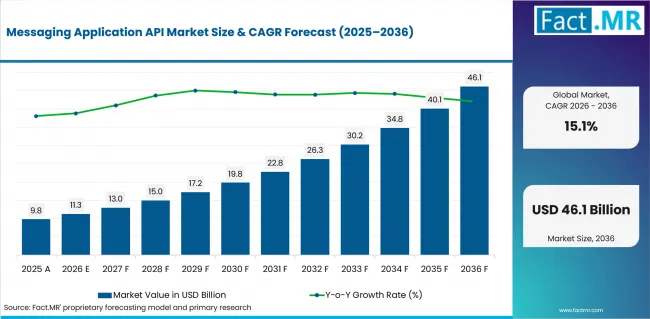
Messaging Application Api Market Value Analysis | Source: Fact.MR
What are the defining numbers behind Messaging Application API Market growth?
USD 34.8 billion absolute opportunity by 2036.
- Demand Drivers in the Market
- Enterprise teams favor programmable messaging because one interface helps control SMS; OTP; RCS; WhatsApp; email; and related channel rules.
- Telecom routing work is expected to keep provider support important as customers handle registration and local delivery rules.
- Fraud prevention needs are expected to lift demand for fallback routing and message-status reporting before high-risk actions are completed.
- Key Segments Analyzed
- By API Type: SMS API is projected to hold 36.0% share in 2026 because it reaches native mobile inboxes without an app dependency.
- By Deployment: Cloud-Based is projected to account for 72.0% share in 2026 due to lower routing and maintenance burden for enterprises.
- By Enterprise Size: Large Enterprises are forecast to hold 57.0% share in 2026 since higher message volume supports platform-wide contracts.
- Analyst Opinion at Fact.MR
- Shambhu Nath Jha, Sr. Consultant at Fact.MR, opines: “Messaging APIs become transaction infrastructure when customer actions trigger authentication, payment or service communication. Buyers test sender registration, delivery evidence and fallback routing before shifting high-value traffic to a provider.”
- Strategic Implications
- Product and engineering teams should treat messaging as transaction infrastructure. This makes telecommunications services relevant because API traffic needs reliable network reach.
- Providers should make sender registration easier to evaluate. Carrier infrastructure affects delivery quality across networks.
- Security teams should pair OTP and rich messaging with device and account-risk signals. Zero trust network access offers a useful comparison for identity checks inside protected workflows.
South Korea is projected to record a 16.2% CAGR from 2026 to 2036 through mobile-first services. The USA is expected to post a 15.9% CAGR as software teams use messaging inside customer operations. Canada is anticipated to reach a 15.6% CAGR through consent-led governance. The UK is estimated to grow at a 15.3% CAGR as A2P pricing remains part of provider review. Germany is forecast at a 15.0% CAGR through privacy review. Australia is projected to reach a 14.7% CAGR through sender-ID compliance work. Japan is expected to record a 14.2% CAGR through localized service channels.
How does the Messaging Application API Market break down by segment?
SMS API is expected to lead API Type at 36.0% share in 2026. Cloud-Based deployment is projected to lead Deployment at 72.0% share in 2026.
Which API Type dominates?
SMS API is projected to account for 36.0% share in 2026.
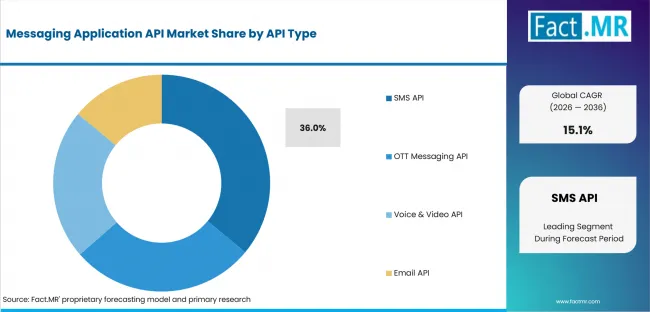
Messaging Application Api Market Analysis By Api Type | Source: Fact.MR
SMS API keeps its lead because it works on nearly every mobile phone and supports urgent alerts. Transactional SMS and OTP services remain useful for account checks.
What leads the Deployment segment?
Cloud-Based is expected to hold 72.0% share in 2026.
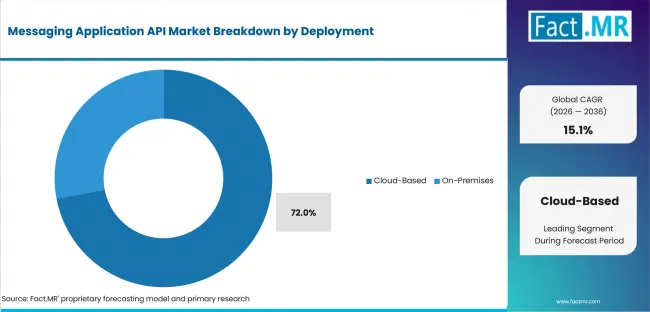
Messaging Application Api Market Analysis By Deployment | Source: Fact.MR
Cloud deployment gives enterprises flexible sending capacity without owning routing systems. Provider-managed updates help teams handle registration and onboarding.
How does Enterprise Size shape demand?
Large Enterprises are forecast to hold 57.0% share in 2026.
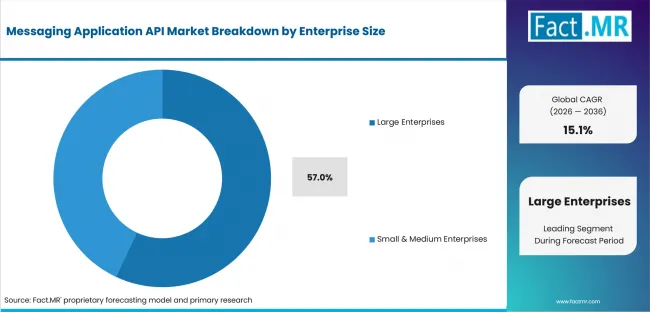
Messaging Application Api Market Analysis By Enterprise Size | Source: Fact.MR
Large enterprises generate steady traffic across countries and brands. Banks and marketplaces often manage several message types under one policy.
What is accelerating Messaging Application API Market adoption, and what is holding it back?
Demand is expected to rise through repeat digital transactions and controlled customer messaging. Growth may be limited by carrier rules and consent requirements.
Drivers Impact Analysis
| DRIVER | RELATIVE IMPACT | GEOGRAPHIC RELEVANCE | IMPACT TIMELINE |
|---|---|---|---|
| Recurring transaction messages | High | USA, UK, Canada | Short term (<= 2 years) |
| Authentication and fraud alerts | High | USA, South Korea, Japan | Short term (<= 2 years) |
| Cloud communication integration | Moderate | Global enterprise accounts | Medium term (2-4 years) |
| RCS and OTT channel expansion | Moderate | Japan, Germany, Australia | Medium term (2-4 years) |
| Delivery-status analytics | Low | Large enterprises | Long term (>= 4 years) |
Source: Fact.MR analysis. Updated Aug 3, 2026
- Recurring transaction messages: Customer actions are expected to create repeated volume across sign-in; payment; delivery; and service workflows.
- Authentication and fraud alerts: Enterprises are expected to favor APIs that combine OTP delivery with fallback routing and risk-aware notices.
- Cloud communication integration: Software teams are expected to choose cloud APIs when they need faster channel onboarding and less internal routing work.
Opportunity Impact Analysis
| OPPORTUNITY | RELATIVE IMPACT | GEOGRAPHIC RELEVANCE | IMPACT TIMELINE |
|---|---|---|---|
| Verified rich messaging | Moderate | USA, Germany, Japan | Medium term (2-4 years) |
| Network identity APIs | Moderate | Western and Eastern Europe and telecom-led markets | Medium term (2-4 years) |
| Customer journey orchestration | Moderate | Retail and BFSI accounts | Long term (>= 4 years) |
| AI-assisted routing support | Low | Large enterprise accounts | Long term (>= 4 years) |
Source: Fact.MR analysis. Updated Aug 3, 2026
- Verified rich messaging: RCS is expected to create opportunity where brands need proof that a message is authentic before a customer responds.
- Network identity APIs: SIM-swap and number-verification APIs are expected to add value when security teams need telecom signals before risky actions.
- Customer journey orchestration: Providers that move messaging events into CRM and service workflows are expected to improve customer experience BPO handoffs.
Restraints Impact Analysis
| RESTRAINT | RELATIVE IMPACT | GEOGRAPHIC RELEVANCE | IMPACT TIMELINE |
|---|---|---|---|
| Consent and revocation management | High | USA, Canada, Western Europe and Eastern Europe | Short term (<= 2 years) |
| Sender registration complexity | Moderate | Australia, Germany, UK | Short term (<= 2 years) |
| SMS fraud and spoofing exposure | Moderate | Global | Medium term (2-4 years) |
| Carrier pricing variation | Low | A2P-heavy markets | Long term (>= 4 years) |
Source: Fact.MR analysis. Updated Aug 3, 2026
- Consent and revocation management: Messaging programs are expected to need stronger opt-out handling as permission records become part of launch review.
- Sender registration complexity: Branded sender rules are expected to add operating work when enterprises use local sender IDs across several countries.
- SMS fraud and spoofing exposure: Fraud risk is expected to raise scrutiny around OTP-only flows and support demand for messaging security controls.
Which countries are scaling Messaging Application API Market fastest?
- South Korea leads through mobile services and digital payments, while the USA follows through large-scale OTP and customer messaging use.
- Canada and the UK grow through consent controls and A2P governance. Germany advances through privacy review and trusted-sender requirements.
- Australia benefits from sender ID registration rules. Japan remains relevant through local communication habits across LINE, SMS, RCS and service messaging.
- Comparable CAGRs create different entry conditions. Deployment timing depends on channel habits, compliance work and provider support.
The full report provides country-level CAGR analysis across North America; Latin America; Western Europe; Eastern Europe; East Asia; South Asia and Pacific; and Middle East & Africa.
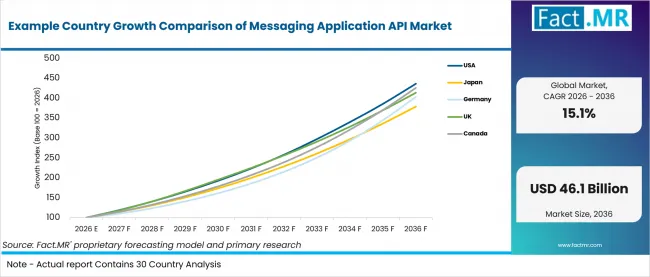
Example Country Growth Comparison Of Messaging Application Api Market | Source: Fact.MR
| Country | CAGR (2026-2036) |
|---|---|
| South Korea | 16.2% |
| USA | 15.9% |
| Canada | 15.6% |
| UK | 15.3% |
| Germany | 15.0% |
| Australia | 14.7% |
| Japan | 14.2% |
Source: Fact.MR analysis. Updated Aug 3, 2026
What supports USA adoption?
15.9% CAGR, supported by enterprise software depth and national carrier reach.
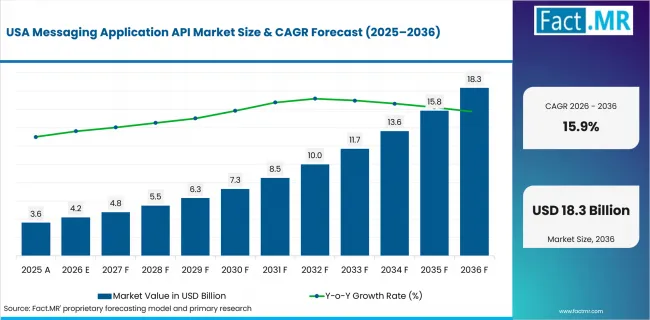
Messaging Application Api Market Country Value Analysis | Source: Fact.MR
The USA’s growth reflects messaging APIs used for account security and service operations. Enterprise teams need reliable routing before shifting more traffic into programmable channels.
How is Japan scaling demand?
14.2% CAGR, driven by localized messaging habits and app-led customer service.
Japan’s growth is shaped by consumer familiarity with app-based communication. Enterprise teams must coordinate LINE; SMS; RCS; and service notices around customer preference.
What is shaping Germany’s outlook through 2036?
15.0% CAGR, backed by data-protection review and trusted sender needs.
Germany’s growth reflects a market where privacy review and telecom reliability influence selection. Enterprises are expected to test verified sender identity and number-risk signals. Network function virtualization is relevant to service control.
How is the UK developing demand?
15.3% CAGR, driven by A2P message governance and customer channel choice.
The UK’s demand is shaped by organizations that use SMS; email; apps; and voice for different customer situations. Pricing review is expected to influence provider comparison before traffic scales.
What supports Canada’s growth?
15.6% CAGR, supported by consent-led messaging governance and enterprise compliance review.
Canada’s outlook reflects messaging programs where permission records carry operating weight. Enterprises are expected to value platforms that make consent evidence easy to review. Business email remains nearby.
How does Australia perform?
14.7% CAGR, led by sender-ID registration and branded text governance.
Australia’s growth reflects a launch environment where branded sender identity is easier to verify. Enterprises are expected to review registration before scaling SMS programs.
What supports South Korea’s growth?
16.2% CAGR, backed by mobile-first customer journeys and authentication intensity.
South Korea’s growth reflects mobile banking and commerce apps that keep messaging close to customer actions. API providers must support fast authentication without weakening trust.
Who leads the Messaging Application API Market?
Twilio, Sinch, Vonage, Infobip, Bird, Webex Connect, Kaleyra, CM.com, Bandwidth and Route Mobile offer messaging, authentication, routing or related programmable-communications capabilities relevant to this market.
Twilio and Sinch offer messaging APIs and RCS-related capabilities. Vonage, Infobip, Bird, Webex Connect, Kaleyra, CM.com, Bandwidth and Route Mobile extend coverage across omnichannel messaging, authentication and routing. Buyer comparison should examine channel coverage, sender-registration support, consent controls and delivery analytics for the relevant markets.
Which companies are the key providers?
Key companies include Twilio Inc.; Sinch AB; Ericsson, through Vonage; Infobip Ltd.; Bird; Cisco Systems, Inc., through Webex Connect; Tata Communications, through Kaleyra; CM.com; Bandwidth Inc.; and Proximus Global, through Route Mobile.
- Twilio Inc.
- Sinch AB
- Ericsson, through Vonage
- Infobip Ltd.
- Bird
- Cisco Systems, Inc., through Webex Connect
- Tata Communications, through Kaleyra
- CM.com
- Bandwidth Inc.
- Proximus Global, through Route Mobile
Bibliography
- Australian Communications and Media Authority. (2026, July 1). SMS Sender ID Register goes live to help protect Australians from scams.
- Proximus Group. (2024, May 8). Proximus Group completes the acquisition of a majority stake in Route Mobile.
- Sinch AB. (2025, August 18). Sinch Solidifies U.S. Market Leadership with Full RCS Coverage Across All Tier 1 Carriers.
- Twilio Inc. (2025, August 26). Twilio Announces General Availability of Rich Communication Services (RCS) to Transform Business Messaging with Branded, Interactive Experiences.
This Report Answers
- The report provides intelligence on API Type, Deployment, Enterprise Size, End User Industry and Communication Channel choices shaping messaging programs.
- Segment analysis covers SMS API, Cloud-Based deployment and Large Enterprises as the share leaders within the 2026 market.
- Country outlook evaluates South Korea, USA, Canada, UK, Germany, Australia and Japan.
- Competitive analysis compares the listed providers across messaging APIs, routing, RCS, authentication and enterprise channel coverage.
- Channel assessment covers SMS, A2P messaging, OTP verification, WhatsApp, RCS and other listed channels.
What does the Messaging Application API Market cover?
Programmable communication APIs enable enterprise software to send, verify and manage customer messages across customer-facing workflows.
The market covers API access, usage fees and platform subscriptions for enterprise messaging across SMS, transactional messaging, OTP and authentication, OTT messaging and related channels.
What is included in the scope?
Messaging application APIs are used across BFSI, retail, healthcare, travel, logistics, IT and telecommunications, and media workflows.
The scope includes API Type, Deployment, Enterprise Size, End User Industry, Communication Channel and Region. It includes SMS API, transactional SMS, OTP and authentication, OTT messaging APIs and other listed communication channels used in enterprise workflows.
What is excluded from the scope?
Underlying carrier connectivity and unrelated software applications remain outside the scope of this market.
The scope excludes separately sold carrier termination, telecom access plans and consumer messaging apps. It also excludes standalone contact-center seats, marketing automation, pure email-marketing platforms and unrelated identity tools.
How Was the Analysis Built?
The analysis integrates telecom regulatory materials, carrier and platform documentation, public company disclosures and messaging-adoption evidence.
- Evidence Review: The review considers telecom regulatory materials, platform documentation, public company disclosures and evidence relevant to channel coverage, consent, sender registration, routing and authentication.
- Market Sizing and Forecasting: Estimates combine provider revenue, API usage, channel mix, enterprise adoption, route economics and country requirements within the stated market boundary.
- Market Monitoring: The analysis is reviewed as carrier policy, sender-registration rules, platform capabilities and buyer requirements change.
Segmentation
What is the report’s scope and coverage?
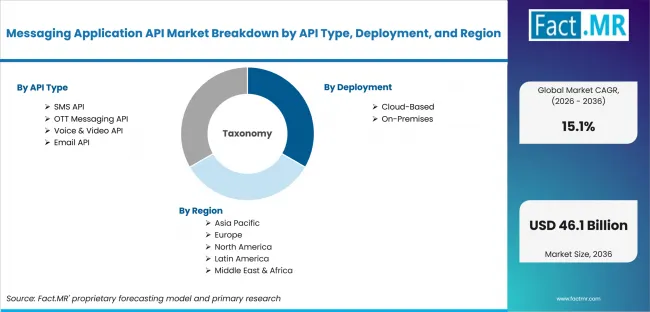
Messaging Application Api Market Breakdown By Api Type, Deployment, And Region | Source: Fact.MR
| Attribute | Details |
|---|---|
| Quantitative Units | USD 11.3 billion in 2026 to USD 46.1 billion by 2036 at 15.1% CAGR |
| Market Definition | Revenue from API access, usage charges, subscriptions and managed platform fees for programmable enterprise communication services |
| API Type | SMS API; Transactional SMS; OTP & Authentication; OTT Messaging API; WhatsApp Business API; RCS & Rich Messaging; Voice & Video API; VoIP API; Video Calling API; Email API; Transactional Email; Marketing Email |
| Deployment | Cloud-Based; Public Cloud; Private Cloud; On-Premises; Enterprise Infrastructure; Hybrid Deployment |
| Enterprise Size | Large Enterprises; Global Enterprises; Multinational Corporations; Small & Medium Enterprises; Small Businesses; Mid-Sized Enterprises |
| End User Industry | BFSI; Banking; Insurance; Retail & E-commerce; Online Retail; Digital Commerce; IT & Telecommunications; Cloud Services; Software Providers; Healthcare; Hospitals; Digital Health Platforms; Others; Travel & Hospitality; Education; Media & Entertainment |
| Communication Channel | SMS; A2P Messaging; OTP Verification; WhatsApp; Business Messaging; Customer Support; RCS; Rich Business Messaging; Interactive Messaging; Others; Email; Voice; Viber; Telegram; Facebook Messenger |
| Regions Covered | North America; Latin America; Western Europe; Eastern Europe; East Asia; South Asia and Pacific; Middle East & Africa |
| Key Countries Highlighted | South Korea; USA; Canada; UK; Germany; Australia; Japan |
| Key Companies Profiled | Twilio Inc.; Sinch AB; Ericsson, through Vonage; Infobip Ltd.; Bird; Cisco Systems, Inc., through Webex Connect; Tata Communications, through Kaleyra; CM.com; Bandwidth Inc.; Proximus Global, through Route Mobile |
| Forecast Period | 2026 to 2036 |
| Approach | Market sizing combines provider revenue, API usage, channel mix, enterprise adoption, route economics and country requirements within the stated market boundary. |
Source: Fact.MR analysis. Updated Aug 3, 2026
How is the market segmented?
-
By API Type
- SMS API
- Transactional SMS
- OTP & Authentication
- OTT Messaging API
- WhatsApp Business API
- RCS & Rich Messaging
- Voice & Video API
- VoIP API
- Video Calling API
- Email API
- Transactional Email
- Marketing Email
- SMS API
-
By Deployment
- Cloud-Based
- Public Cloud
- Private Cloud
- On-Premises
- Enterprise Infrastructure
- Hybrid Deployment
- Cloud-Based
-
By Enterprise Size
- Large Enterprises
- Global Enterprises
- Multinational Corporations
- Small & Medium Enterprises
- Small Businesses
- Mid-Sized Enterprises
- Large Enterprises
-
By End User Industry
- BFSI
- Banking
- Insurance
- Retail & E-commerce
- Online Retail
- Digital Commerce
- IT & Telecommunications
- Cloud Services
- Software Providers
- Healthcare
- Hospitals
- Digital Health Platforms
- Others
- Travel & Hospitality
- Education
- Media & Entertainment
- BFSI
-
By Communication Channel
- SMS
- A2P Messaging
- OTP Verification
- WhatsApp
- Business Messaging
- Customer Support
- RCS
- Rich Business Messaging
- Interactive Messaging
- Others
- Voice
- Viber
- Telegram
- Facebook Messenger
- SMS
-
By Region
- North America
- Latin America
- Western Europe
- Eastern Europe
- East Asia
- South Asia and Pacific
- Middle East & Africa
Frequently Asked Questions
Which API Type leads the market?
Which Deployment category leads the market?
Which Enterprise Size category leads the market?
Which country records the highest listed CAGR?
What is the primary driver in this market?
What is the main restraint?
Why do large enterprises lead demand?
Who worked on this report


Preview the report firsthand - request a free sample
Free SampleGet the brochure for pricing and purchase details
Download PDF