Heat-Resilient Flower Retention Agrochemical Market
Heat-Resilient Flower Retention Agrochemical Market Size and Share Forecast Outlook 2026 to 2036
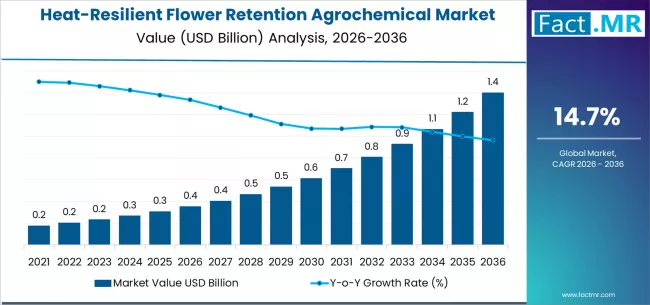
Heat-resilient flower retention agrochemical market is projected to grow from USD 0.4 billion in 2026 to USD 1.4 billion by 2036, at a CAGR of 14.7%. Anti-Abscission Plant Growth Regulators will dominate with a 37.0% market share, while fruits & vegetables will lead the crop type segment with a 41.0% share.
Heat-Resilient Flower Retention Agrochemical Market Forecast and Outlook 2026 to 2036
The global heat-resilient flower retention agrochemical market is projected to reach USD 1.40 billion by 2036. The market is valued at USD 0.36 billion in 2026 and is set to rise at a CAGR of 14.7% during the assessment period. By active chemistry type, anti-abscission plant growth regulators hold a leading 37% share. The fruits & vegetables crop type segment represents a dominant 41% share, while the flower drop & abscission control function accounts for 39% market share.
Key Takeaways from the Heat-Resilient Flower Retention Agrochemical Market
- Market Value for 2026: USD 0.36 Billion
- Market Value for 2036: USD 1.40 Billion
- Forecast CAGR (2026-2036): 14.7%
- Leading Active Chemistry Type Share (2026): Anti-Abscission Plant Growth Regulators (37%)
- Leading Crop Type Share (2026): Fruits & Vegetables (41%)
- Leading Stress-Mitigation Function Share (2026): Flower Drop & Abscission Control (39%)
- Key Players in the Market: Fine Americas Inc., De Sangosse, ICL Growing Solutions, Lallemand Plant Care, Bioiberica S.A.U.
Important trends involve the development of multi-mechanism formulations that combine hormonal control with nutrient and biostimulant support. Research is intensifying on products that protect pollen viability and tube growth under high-temperature stress. Integration of these agrochemicals with smart irrigation and shading systems is becoming a standard protocol for managing microclimates in high-value production during heat waves.
Regulatory frameworks are increasingly acknowledging the need for climate adaptation tools in agriculture. Policies supporting sustainable intensification and resilience create a favorable environment for these specialized products. Registration pathways for plant growth regulators and biostimulants, while rigorous, are well-defined, allowing for the commercialization of novel stress-mitigation chemistries.
Heat-Resilient Flower Retention Agrochemical Market
| Metric | Value |
|---|---|
| Market Value (2026) | USD 0.36 Billion |
| Market Forecast Value (2036) | USD 1.40 Billion |
| Forecast CAGR (2026-2036) | 14.7% |
Category
| Category | Segments |
|---|---|
| Active Chemistry Type | Anti-Abscission Plant Growth Regulators, Hormone-Balancing Biostimulant Blends, Heat-Stress Protective Metabolite Sprays, Micronutrient-Hormone Synergistic Systems, Others |
| Crop Type | Fruits & Vegetables, Oilseeds & Pulses, Plantation & Export Crops, Horticulture & Floriculture, Others |
| Stress-Mitigation Function | Flower Drop & Abscission Control, Pollen Viability & Fertility Protection, Canopy Cooling & Transpiration Regulation, Yield Stability During Heat Waves, Others |
| Region | North America, Latin America, Western Europe, Eastern Europe, East Asia, South Asia & Pacific, MEA |
Segmental Analysis
By Active Chemistry, Which Compounds Directly Intervene in the Abscission Process?
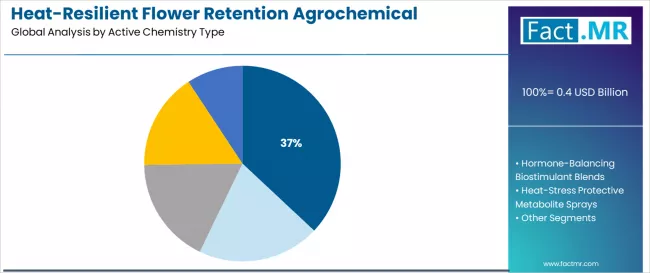
Anti-abscission plant growth regulators lead the segment with a 37% share. These compounds, often based on synthetic auxins or cytokinins, directly inhibit the formation of the abscission zone at the flower or fruitlet base. They provide a targeted hormonal signal to the plant to retain its reproductive structures despite environmental stress signals, offering the most direct and reliable method for preventing yield loss from flower drop.
By Crop Type, Where is the Economic Impact of Flower Loss Most Severe?
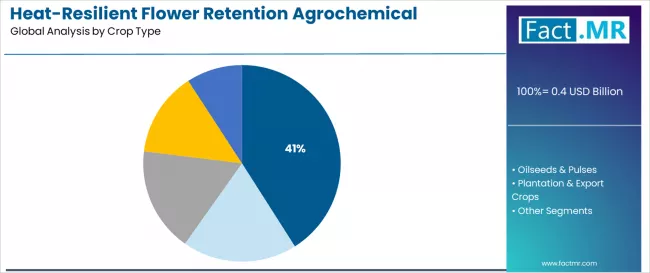
Fruits and vegetables command a 41% share. Each flower directly corresponds to a marketable fruit unit in crops like tomatoes, peppers, cucurbits, and tree fruits. Heat-induced flower abortion results in immediate, irreversible yield reduction. The high value per unit of these crops justifies significant investment in protective agrochemicals to secure pollination and fruit set, driving concentrated demand.
By Stress-Mitigation Function, What is the Most Visible and Immediate Grower Concern?
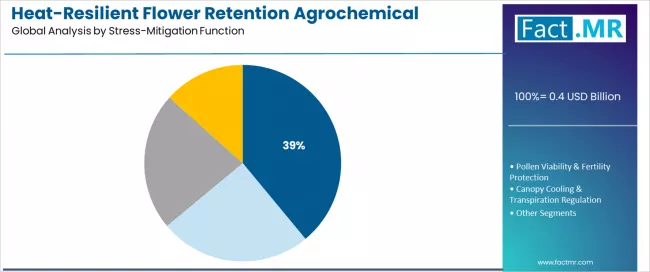
Flower drop and abscission control is the leading function at 39%. The visual sight of flowers falling prematurely is a clear indicator of impending economic loss. This function addresses the most direct consequence of heat stress, providing growers with a tangible result. Products that effectively reduce this visible drop offer immediate reassurance and demonstrable value, making this the primary target for intervention.
What are the Drivers, Restraints, and Key Trends of the Heat-Resilient Flower Retention Agrochemical Market?
Market growth is driven by the increasing frequency and intensity of heat waves globally, which directly threaten reproductive stages of crops. The rising economic value of high-quality, out-of-season horticultural produce increases the cost of crop failure. Advancements in plant physiology and hormone science are enabling more effective and targeted product development for specific crop stressors.
A significant restraint is the precise timing required for application, which must align with specific phenological stages before heat stress occurs. Performance can be influenced by interacting stresses like drought or humidity. The niche nature of these products can lead to higher costs and limited availability in some regions, and their use often requires advanced technical knowledge.
Key trends include the integration of these agrochemicals with predictive weather analytics for proactive application. Formulations are combining anti-abscission agents with osmoprotectants and antioxidants for comprehensive cell protection. There is growing research into microbial biostimulants that enhance inherent plant thermotolerance and improve flower retention.
Analysis of the Heat-Resilient Flower Retention Agrochemical Market by Key Countries
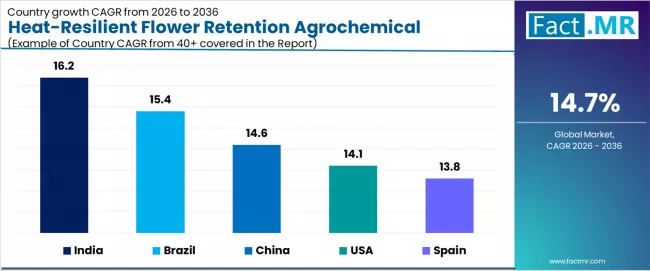
| Country | CAGR (2026-2036) |
|---|---|
| India | 16.20% |
| Brazil | 15.40% |
| China | 14.60% |
| USA | 14.10% |
| Spain | 13.80% |
Why does India's Climatic Extremity Drive the Highest Growth Rate?
India leads with a 16.20% CAGR, facing acute heat stress during critical flowering periods for major vegetable and fruit crops like mango, tomato, and cucurbits. The smallholder-driven, high-intensity production system is extremely vulnerable to temperature spikes. The adoption of flower retention products is becoming a critical risk-mitigation strategy to protect household incomes and ensure domestic food supply stability in increasingly volatile seasons.
How does Brazil's Tropical Fruit and Soybean Nexus Fuel Demand?
Brazil's 15.40% growth is propelled by dual needs: protecting high-value tropical fruit crops like mango and citrus from flower abortion, and safeguarding soybean flower fertility in central regions experiencing rising temperatures. Brazilian agriculture's scale and export orientation make securing yield during flowering a multi-billion-dollar priority, creating a strong market for effective hormonal and biostimulant solutions.
What drives China's Focus on Protected Horticulture and Field Crops?
China's 14.60% growth reflects challenges across both massive greenhouse vegetable operations and field crops like oilseed rape. In protected agriculture, managing microclimate is costly, making chemical flower retention a cost-effective supplement. For field crops, heat stress during flowering threatens national yield targets, spurring government and private sector investment in resilience technologies for key commodities.
How is the USA's High-Value Specialty Crop Sector a Key Market?
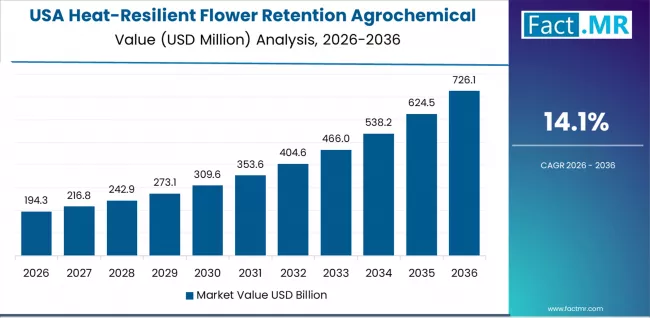
The USA's 14.10% growth is concentrated in states like California, Florida, and Washington, where heat waves threaten almond bloom, citrus fruit set, and vegetable seed production. The immense capital investment in these perennial and high-value annual crops justifies sophisticated protection strategies. American growers utilize these products as insurance within integrated crop management programs to guarantee contract fulfillment and quality.
What Factors Underpin Spain's Role in European Horticulture?
Spain's 13.80% growth is anchored in its position as Europe's leading producer of fresh fruits and vegetables. Regions like Almería and Murcia face intense summer heat during production cycles. Spanish growers, supplying rigorous EU supermarkets, must ensure continuous yield and quality. The use of flower retention agents, often integrated with precise irrigation, is standard practice to maintain delivery schedules and meet cosmetic standards.
Competitive Landscape of the Heat-Resilient Flower Retention Agrochemical Market
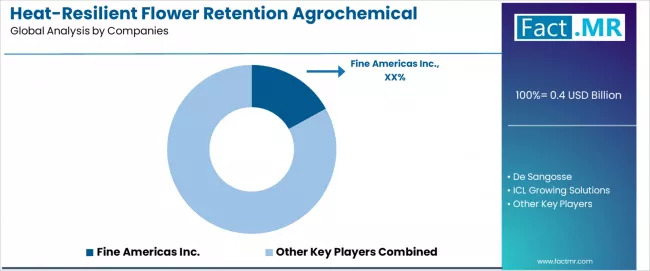
The market is specialized, featuring companies with deep expertise in plant physiology, hormones, and biostimulation. Established plant growth regulator specialists like Fine Americas Inc. compete with proprietary synthetic chemistry designed to precisely manipulate hormonal pathways involved in abscission and stress response.
Biostimulant and specialty nutrition companies such as ICL Growing Solutions, Lallemand Plant Care, and Bioiberica S.A.U. compete by offering biological or metabolite-based solutions that enhance the plant's natural resilience. Firms like De Sangosse often bridge both segments. Competition centers on robust field trial data demonstrating yield preservation under documented heat stress, technical support for optimal timing, and building trust with growers of sensitive high-value crops.
Key Players in the Heat-Resilient Flower Retention Agrochemical Market
- Fine Americas Inc.
- De Sangosse
- ICL Growing Solutions
- Lallemand Plant Care
- Bioiberica S.A.U.
Scope of Report
| Items | Values |
|---|---|
| Quantitative Units | USD Billion |
| Active Chemistry Type | Anti-Abscission Plant Growth Regulators, Hormone-Balancing Biostimulant Blends, Heat-Stress Protective Metabolite Sprays, Micronutrient-Hormone Synergistic Systems, Others |
| Crop Type | Fruits & Vegetables, Oilseeds & Pulses, Plantation & Export Crops, Horticulture & Floriculture, Others |
| Stress-Mitigation Function | Flower Drop & Abscission Control, Pollen Viability & Fertility Protection, Canopy Cooling & Transpiration Regulation, Yield Stability During Heat Waves, Others |
| Key Countries | India, Brazil, China, USA, Spain |
| Key Companies | Fine Americas Inc., De Sangosse, ICL Growing Solutions, Lallemand Plant Care, Bioiberica S.A.U. |
| Additional Analysis | Analysis of hormonal pathway modulation, interaction with pollinator activity under heat, application timing models based on growing degree hours, and economic threshold models for heat stress events. |
Heat-Resilient Flower Retention Agrochemical Market by Segments
-
Active Chemistry Type :
- Anti-Abscission Plant Growth Regulators
- Hormone-Balancing Biostimulant Blends
- Heat-Stress Protective Metabolite Sprays
- Micronutrient-Hormone Synergistic Systems
- Others
-
Crop Type :
- Fruits & Vegetables
- Oilseeds & Pulses
- Plantation & Export Crops
- Horticulture & Floriculture
- Others
-
Stress-Mitigation Function :
- Flower Drop & Abscission Control
- Pollen Viability & Fertility Protection
- Canopy Cooling & Transpiration Regulation
- Yield Stability During Heat Waves
- Others
-
Region :
-
North America
- USA
- Canada
-
Latin America
- Brazil
- Mexico
- Argentina
- Rest of Latin America
-
Western Europe
- Germany
- UK
- France
- Spain
- Italy
- BENELUX
- Rest of Western Europe
-
Eastern Europe
- Czech Republic
- Poland
- Russia
- Rest of Eastern Europe
-
East Asia
- China
- Japan
- South Korea
- Rest of East Asia
-
South Asia & Pacific
- India
- Indonesia
- Australia
- Rest of South Asia & Pacific
-
MEA
- GCC Countries
- Turkiye
- Saudi Arabia
- Rest of MEA
-
Table of Content
- Executive Summary
- Global Market Outlook
- Demand to side Trends
- Supply to side Trends
- Technology Roadmap Analysis
- Analysis and Recommendations
- Market Overview
- Market Coverage / Taxonomy
- Market Definition / Scope / Limitations
- Market Background
- Market Dynamics
- Drivers
- Restraints
- Opportunity
- Trends
- Scenario Forecast
- Demand in Optimistic Scenario
- Demand in Likely Scenario
- Demand in Conservative Scenario
- Opportunity Map Analysis
- Product Life Cycle Analysis
- Supply Chain Analysis
- Investment Feasibility Matrix
- Value Chain Analysis
- PESTLE and Porter’s Analysis
- Regulatory Landscape
- Regional Parent Market Outlook
- Production and Consumption Statistics
- Import and Export Statistics
- Market Dynamics
- Global Market Analysis 2021 to 2025 and Forecast, 2026 to 2036
- Historical Market Size Value (USD Million) Analysis, 2021 to 2025
- Current and Future Market Size Value (USD Million) Projections, 2026 to 2036
- Y to o to Y Growth Trend Analysis
- Absolute $ Opportunity Analysis
- Global Market Pricing Analysis 2021 to 2025 and Forecast 2026 to 2036
- Global Market Analysis 2021 to 2025 and Forecast 2026 to 2036, By Active Chemistry Type
- Introduction / Key Findings
- Historical Market Size Value (USD Million) Analysis By Active Chemistry Type, 2021 to 2025
- Current and Future Market Size Value (USD Million) Analysis and Forecast By Active Chemistry Type, 2026 to 2036
- Anti-Abscission Plant Growth Regulators
- Hormone-Balancing Biostimulant Blends
- Heat-Stress Protective Metabolite Sprays
- Micronutrient-Hormone Synergistic Systems
- Others
- Anti-Abscission Plant Growth Regulators
- Y to o to Y Growth Trend Analysis By Active Chemistry Type, 2021 to 2025
- Absolute $ Opportunity Analysis By Active Chemistry Type, 2026 to 2036
- Global Market Analysis 2021 to 2025 and Forecast 2026 to 2036, By Crop Type
- Introduction / Key Findings
- Historical Market Size Value (USD Million) Analysis By Crop Type, 2021 to 2025
- Current and Future Market Size Value (USD Million) Analysis and Forecast By Crop Type, 2026 to 2036
- Fruits & Vegetables
- Oilseeds & Pulses
- Plantation & Export Crops
- Horticulture & Floriculture
- Others
- Fruits & Vegetables
- Y to o to Y Growth Trend Analysis By Crop Type, 2021 to 2025
- Absolute $ Opportunity Analysis By Crop Type, 2026 to 2036
- Global Market Analysis 2021 to 2025 and Forecast 2026 to 2036, By Stress-Mitigation Function
- Introduction / Key Findings
- Historical Market Size Value (USD Million) Analysis By Stress-Mitigation Function, 2021 to 2025
- Current and Future Market Size Value (USD Million) Analysis and Forecast By Stress-Mitigation Function, 2026 to 2036
- Flower Drop & Abscission Control
- Pollen Viability & Fertility Protection
- Canopy Cooling & Transpiration Regulation
- Yield Stability During Heat Waves
- Flower Drop & Abscission Control
- Y to o to Y Growth Trend Analysis By Stress-Mitigation Function, 2021 to 2025
- Absolute $ Opportunity Analysis By Stress-Mitigation Function, 2026 to 2036
- Global Market Analysis 2021 to 2025 and Forecast 2026 to 2036, By Region
- Introduction
- Historical Market Size Value (USD Million) Analysis By Region, 2021 to 2025
- Current Market Size Value (USD Million) Analysis and Forecast By Region, 2026 to 2036
- North America
- Latin America
- Western Europe
- Eastern Europe
- East Asia
- South Asia and Pacific
- Middle East & Africa
- Market Attractiveness Analysis By Region
- North America Market Analysis 2021 to 2025 and Forecast 2026 to 2036, By Country
- Historical Market Size Value (USD Million) Trend Analysis By Market Taxonomy, 2021 to 2025
- Market Size Value (USD Million) Forecast By Market Taxonomy, 2026 to 2036
- By Country
- USA
- Canada
- Mexico
- By Active Chemistry Type
- By Crop Type
- By Stress-Mitigation Function
- By Country
- Market Attractiveness Analysis
- By Country
- By Active Chemistry Type
- By Crop Type
- By Stress-Mitigation Function
- Key Takeaways
- Latin America Market Analysis 2021 to 2025 and Forecast 2026 to 2036, By Country
- Historical Market Size Value (USD Million) Trend Analysis By Market Taxonomy, 2021 to 2025
- Market Size Value (USD Million) Forecast By Market Taxonomy, 2026 to 2036
- By Country
- Brazil
- Chile
- Rest of Latin America
- By Active Chemistry Type
- By Crop Type
- By Stress-Mitigation Function
- By Country
- Market Attractiveness Analysis
- By Country
- By Active Chemistry Type
- By Crop Type
- By Stress-Mitigation Function
- Key Takeaways
- Western Europe Market Analysis 2021 to 2025 and Forecast 2026 to 2036, By Country
- Historical Market Size Value (USD Million) Trend Analysis By Market Taxonomy, 2021 to 2025
- Market Size Value (USD Million) Forecast By Market Taxonomy, 2026 to 2036
- By Country
- Germany
- UK
- Italy
- Spain
- France
- Nordic
- BENELUX
- Rest of Western Europe
- By Active Chemistry Type
- By Crop Type
- By Stress-Mitigation Function
- By Country
- Market Attractiveness Analysis
- By Country
- By Active Chemistry Type
- By Crop Type
- By Stress-Mitigation Function
- Key Takeaways
- Eastern Europe Market Analysis 2021 to 2025 and Forecast 2026 to 2036, By Country
- Historical Market Size Value (USD Million) Trend Analysis By Market Taxonomy, 2021 to 2025
- Market Size Value (USD Million) Forecast By Market Taxonomy, 2026 to 2036
- By Country
- Russia
- Poland
- Hungary
- Balkan & Baltic
- Rest of Eastern Europe
- By Active Chemistry Type
- By Crop Type
- By Stress-Mitigation Function
- By Country
- Market Attractiveness Analysis
- By Country
- By Active Chemistry Type
- By Crop Type
- By Stress-Mitigation Function
- Key Takeaways
- East Asia Market Analysis 2021 to 2025 and Forecast 2026 to 2036, By Country
- Historical Market Size Value (USD Million) Trend Analysis By Market Taxonomy, 2021 to 2025
- Market Size Value (USD Million) Forecast By Market Taxonomy, 2026 to 2036
- By Country
- China
- Japan
- South Korea
- By Active Chemistry Type
- By Crop Type
- By Stress-Mitigation Function
- By Country
- Market Attractiveness Analysis
- By Country
- By Active Chemistry Type
- By Crop Type
- By Stress-Mitigation Function
- Key Takeaways
- South Asia and Pacific Market Analysis 2021 to 2025 and Forecast 2026 to 2036, By Country
- Historical Market Size Value (USD Million) Trend Analysis By Market Taxonomy, 2021 to 2025
- Market Size Value (USD Million) Forecast By Market Taxonomy, 2026 to 2036
- By Country
- India
- ASEAN
- Australia & New Zealand
- Rest of South Asia and Pacific
- By Active Chemistry Type
- By Crop Type
- By Stress-Mitigation Function
- By Country
- Market Attractiveness Analysis
- By Country
- By Active Chemistry Type
- By Crop Type
- By Stress-Mitigation Function
- Key Takeaways
- Middle East & Africa Market Analysis 2021 to 2025 and Forecast 2026 to 2036, By Country
- Historical Market Size Value (USD Million) Trend Analysis By Market Taxonomy, 2021 to 2025
- Market Size Value (USD Million) Forecast By Market Taxonomy, 2026 to 2036
- By Country
- Kingdom of Saudi Arabia
- Other GCC Countries
- Turkiye
- South Africa
- Other African Union
- Rest of Middle East & Africa
- By Active Chemistry Type
- By Crop Type
- By Stress-Mitigation Function
- By Country
- Market Attractiveness Analysis
- By Country
- By Active Chemistry Type
- By Crop Type
- By Stress-Mitigation Function
- Key Takeaways
- Key Countries Market Analysis
- USA
- Pricing Analysis
- Market Share Analysis, 2025
- By Active Chemistry Type
- By Crop Type
- By Stress-Mitigation Function
- Canada
- Pricing Analysis
- Market Share Analysis, 2025
- By Active Chemistry Type
- By Crop Type
- By Stress-Mitigation Function
- Mexico
- Pricing Analysis
- Market Share Analysis, 2025
- By Active Chemistry Type
- By Crop Type
- By Stress-Mitigation Function
- Brazil
- Pricing Analysis
- Market Share Analysis, 2025
- By Active Chemistry Type
- By Crop Type
- By Stress-Mitigation Function
- Chile
- Pricing Analysis
- Market Share Analysis, 2025
- By Active Chemistry Type
- By Crop Type
- By Stress-Mitigation Function
- Germany
- Pricing Analysis
- Market Share Analysis, 2025
- By Active Chemistry Type
- By Crop Type
- By Stress-Mitigation Function
- UK
- Pricing Analysis
- Market Share Analysis, 2025
- By Active Chemistry Type
- By Crop Type
- By Stress-Mitigation Function
- Italy
- Pricing Analysis
- Market Share Analysis, 2025
- By Active Chemistry Type
- By Crop Type
- By Stress-Mitigation Function
- Spain
- Pricing Analysis
- Market Share Analysis, 2025
- By Active Chemistry Type
- By Crop Type
- By Stress-Mitigation Function
- France
- Pricing Analysis
- Market Share Analysis, 2025
- By Active Chemistry Type
- By Crop Type
- By Stress-Mitigation Function
- India
- Pricing Analysis
- Market Share Analysis, 2025
- By Active Chemistry Type
- By Crop Type
- By Stress-Mitigation Function
- ASEAN
- Pricing Analysis
- Market Share Analysis, 2025
- By Active Chemistry Type
- By Crop Type
- By Stress-Mitigation Function
- Australia & New Zealand
- Pricing Analysis
- Market Share Analysis, 2025
- By Active Chemistry Type
- By Crop Type
- By Stress-Mitigation Function
- China
- Pricing Analysis
- Market Share Analysis, 2025
- By Active Chemistry Type
- By Crop Type
- By Stress-Mitigation Function
- Japan
- Pricing Analysis
- Market Share Analysis, 2025
- By Active Chemistry Type
- By Crop Type
- By Stress-Mitigation Function
- South Korea
- Pricing Analysis
- Market Share Analysis, 2025
- By Active Chemistry Type
- By Crop Type
- By Stress-Mitigation Function
- Russia
- Pricing Analysis
- Market Share Analysis, 2025
- By Active Chemistry Type
- By Crop Type
- By Stress-Mitigation Function
- Poland
- Pricing Analysis
- Market Share Analysis, 2025
- By Active Chemistry Type
- By Crop Type
- By Stress-Mitigation Function
- Hungary
- Pricing Analysis
- Market Share Analysis, 2025
- By Active Chemistry Type
- By Crop Type
- By Stress-Mitigation Function
- Kingdom of Saudi Arabia
- Pricing Analysis
- Market Share Analysis, 2025
- By Active Chemistry Type
- By Crop Type
- By Stress-Mitigation Function
- Turkiye
- Pricing Analysis
- Market Share Analysis, 2025
- By Active Chemistry Type
- By Crop Type
- By Stress-Mitigation Function
- South Africa
- Pricing Analysis
- Market Share Analysis, 2025
- By Active Chemistry Type
- By Crop Type
- By Stress-Mitigation Function
- USA
- Market Structure Analysis
- Competition Dashboard
- Competition Benchmarking
- Market Share Analysis of Top Players
- By Regional
- By Active Chemistry Type
- By Crop Type
- By Stress-Mitigation Function
- Competition Analysis
- Competition Deep Dive
- Fine Americas Inc.
- Overview
- Product Portfolio
- Profitability by Market Segments (Product/Age /Sales Channel/Region)
- Sales Footprint
- Strategy Overview
- Marketing Strategy
- Product Strategy
- Channel Strategy
- De Sangosse
- ICL Growing Solutions
- Lallemand Plant Care
- Bioiberica S.A.U.
- Others
- Fine Americas Inc.
- Competition Deep Dive
- Assumptions & Acronyms Used
- Research Methodology
List Of Table
- Table 1: Global Market Value (USD Million) Forecast by Region, 2021 to 2036
- Table 2: Global Market Value (USD Million) Forecast by Active Chemistry Type, 2021 to 2036
- Table 3: Global Market Value (USD Million) Forecast by Crop Type, 2021 to 2036
- Table 4: Global Market Value (USD Million) Forecast by Stress-Mitigation Function, 2021 to 2036
- Table 5: North America Market Value (USD Million) Forecast by Country, 2021 to 2036
- Table 6: North America Market Value (USD Million) Forecast by Active Chemistry Type, 2021 to 2036
- Table 7: North America Market Value (USD Million) Forecast by Crop Type, 2021 to 2036
- Table 8: North America Market Value (USD Million) Forecast by Stress-Mitigation Function, 2021 to 2036
- Table 9: Latin America Market Value (USD Million) Forecast by Country, 2021 to 2036
- Table 10: Latin America Market Value (USD Million) Forecast by Active Chemistry Type, 2021 to 2036
- Table 11: Latin America Market Value (USD Million) Forecast by Crop Type, 2021 to 2036
- Table 12: Latin America Market Value (USD Million) Forecast by Stress-Mitigation Function, 2021 to 2036
- Table 13: Western Europe Market Value (USD Million) Forecast by Country, 2021 to 2036
- Table 14: Western Europe Market Value (USD Million) Forecast by Active Chemistry Type, 2021 to 2036
- Table 15: Western Europe Market Value (USD Million) Forecast by Crop Type, 2021 to 2036
- Table 16: Western Europe Market Value (USD Million) Forecast by Stress-Mitigation Function, 2021 to 2036
- Table 17: Eastern Europe Market Value (USD Million) Forecast by Country, 2021 to 2036
- Table 18: Eastern Europe Market Value (USD Million) Forecast by Active Chemistry Type, 2021 to 2036
- Table 19: Eastern Europe Market Value (USD Million) Forecast by Crop Type, 2021 to 2036
- Table 20: Eastern Europe Market Value (USD Million) Forecast by Stress-Mitigation Function, 2021 to 2036
- Table 21: East Asia Market Value (USD Million) Forecast by Country, 2021 to 2036
- Table 22: East Asia Market Value (USD Million) Forecast by Active Chemistry Type, 2021 to 2036
- Table 23: East Asia Market Value (USD Million) Forecast by Crop Type, 2021 to 2036
- Table 24: East Asia Market Value (USD Million) Forecast by Stress-Mitigation Function, 2021 to 2036
- Table 25: South Asia and Pacific Market Value (USD Million) Forecast by Country, 2021 to 2036
- Table 26: South Asia and Pacific Market Value (USD Million) Forecast by Active Chemistry Type, 2021 to 2036
- Table 27: South Asia and Pacific Market Value (USD Million) Forecast by Crop Type, 2021 to 2036
- Table 28: South Asia and Pacific Market Value (USD Million) Forecast by Stress-Mitigation Function, 2021 to 2036
- Table 29: Middle East & Africa Market Value (USD Million) Forecast by Country, 2021 to 2036
- Table 30: Middle East & Africa Market Value (USD Million) Forecast by Active Chemistry Type, 2021 to 2036
- Table 31: Middle East & Africa Market Value (USD Million) Forecast by Crop Type, 2021 to 2036
- Table 32: Middle East & Africa Market Value (USD Million) Forecast by Stress-Mitigation Function, 2021 to 2036
List Of Figures
- Figure 1: Global Market Pricing Analysis
- Figure 2: Global Market Value (USD Million) Forecast 2021 to 2036
- Figure 3: Global Market Value Share and BPS Analysis by Active Chemistry Type, 2026 and 2036
- Figure 4: Global Market Y to o to Y Growth Comparison by Active Chemistry Type, 2026 to 2036
- Figure 5: Global Market Attractiveness Analysis by Active Chemistry Type
- Figure 6: Global Market Value Share and BPS Analysis by Crop Type, 2026 and 2036
- Figure 7: Global Market Y to o to Y Growth Comparison by Crop Type, 2026 to 2036
- Figure 8: Global Market Attractiveness Analysis by Crop Type
- Figure 9: Global Market Value Share and BPS Analysis by Stress-Mitigation Function, 2026 and 2036
- Figure 10: Global Market Y to o to Y Growth Comparison by Stress-Mitigation Function, 2026 to 2036
- Figure 11: Global Market Attractiveness Analysis by Stress-Mitigation Function
- Figure 12: Global Market Value (USD Million) Share and BPS Analysis by Region, 2026 and 2036
- Figure 13: Global Market Y to o to Y Growth Comparison by Region, 2026 to 2036
- Figure 14: Global Market Attractiveness Analysis by Region
- Figure 15: North America Market Incremental Dollar Opportunity, 2026 to 2036
- Figure 16: Latin America Market Incremental Dollar Opportunity, 2026 to 2036
- Figure 17: Western Europe Market Incremental Dollar Opportunity, 2026 to 2036
- Figure 18: Eastern Europe Market Incremental Dollar Opportunity, 2026 to 2036
- Figure 19: East Asia Market Incremental Dollar Opportunity, 2026 to 2036
- Figure 20: South Asia and Pacific Market Incremental Dollar Opportunity, 2026 to 2036
- Figure 21: Middle East & Africa Market Incremental Dollar Opportunity, 2026 to 2036
- Figure 22: North America Market Value Share and BPS Analysis by Country, 2026 and 2036
- Figure 23: North America Market Value Share and BPS Analysis by Active Chemistry Type, 2026 and 2036
- Figure 24: North America Market Y to o to Y Growth Comparison by Active Chemistry Type, 2026 to 2036
- Figure 25: North America Market Attractiveness Analysis by Active Chemistry Type
- Figure 26: North America Market Value Share and BPS Analysis by Crop Type, 2026 and 2036
- Figure 27: North America Market Y to o to Y Growth Comparison by Crop Type, 2026 to 2036
- Figure 28: North America Market Attractiveness Analysis by Crop Type
- Figure 29: North America Market Value Share and BPS Analysis by Stress-Mitigation Function, 2026 and 2036
- Figure 30: North America Market Y to o to Y Growth Comparison by Stress-Mitigation Function, 2026 to 2036
- Figure 31: North America Market Attractiveness Analysis by Stress-Mitigation Function
- Figure 32: Latin America Market Value Share and BPS Analysis by Country, 2026 and 2036
- Figure 33: Latin America Market Value Share and BPS Analysis by Active Chemistry Type, 2026 and 2036
- Figure 34: Latin America Market Y to o to Y Growth Comparison by Active Chemistry Type, 2026 to 2036
- Figure 35: Latin America Market Attractiveness Analysis by Active Chemistry Type
- Figure 36: Latin America Market Value Share and BPS Analysis by Crop Type, 2026 and 2036
- Figure 37: Latin America Market Y to o to Y Growth Comparison by Crop Type, 2026 to 2036
- Figure 38: Latin America Market Attractiveness Analysis by Crop Type
- Figure 39: Latin America Market Value Share and BPS Analysis by Stress-Mitigation Function, 2026 and 2036
- Figure 40: Latin America Market Y to o to Y Growth Comparison by Stress-Mitigation Function, 2026 to 2036
- Figure 41: Latin America Market Attractiveness Analysis by Stress-Mitigation Function
- Figure 42: Western Europe Market Value Share and BPS Analysis by Country, 2026 and 2036
- Figure 43: Western Europe Market Value Share and BPS Analysis by Active Chemistry Type, 2026 and 2036
- Figure 44: Western Europe Market Y to o to Y Growth Comparison by Active Chemistry Type, 2026 to 2036
- Figure 45: Western Europe Market Attractiveness Analysis by Active Chemistry Type
- Figure 46: Western Europe Market Value Share and BPS Analysis by Crop Type, 2026 and 2036
- Figure 47: Western Europe Market Y to o to Y Growth Comparison by Crop Type, 2026 to 2036
- Figure 48: Western Europe Market Attractiveness Analysis by Crop Type
- Figure 49: Western Europe Market Value Share and BPS Analysis by Stress-Mitigation Function, 2026 and 2036
- Figure 50: Western Europe Market Y to o to Y Growth Comparison by Stress-Mitigation Function, 2026 to 2036
- Figure 51: Western Europe Market Attractiveness Analysis by Stress-Mitigation Function
- Figure 52: Eastern Europe Market Value Share and BPS Analysis by Country, 2026 and 2036
- Figure 53: Eastern Europe Market Value Share and BPS Analysis by Active Chemistry Type, 2026 and 2036
- Figure 54: Eastern Europe Market Y to o to Y Growth Comparison by Active Chemistry Type, 2026 to 2036
- Figure 55: Eastern Europe Market Attractiveness Analysis by Active Chemistry Type
- Figure 56: Eastern Europe Market Value Share and BPS Analysis by Crop Type, 2026 and 2036
- Figure 57: Eastern Europe Market Y to o to Y Growth Comparison by Crop Type, 2026 to 2036
- Figure 58: Eastern Europe Market Attractiveness Analysis by Crop Type
- Figure 59: Eastern Europe Market Value Share and BPS Analysis by Stress-Mitigation Function, 2026 and 2036
- Figure 60: Eastern Europe Market Y to o to Y Growth Comparison by Stress-Mitigation Function, 2026 to 2036
- Figure 61: Eastern Europe Market Attractiveness Analysis by Stress-Mitigation Function
- Figure 62: East Asia Market Value Share and BPS Analysis by Country, 2026 and 2036
- Figure 63: East Asia Market Value Share and BPS Analysis by Active Chemistry Type, 2026 and 2036
- Figure 64: East Asia Market Y to o to Y Growth Comparison by Active Chemistry Type, 2026 to 2036
- Figure 65: East Asia Market Attractiveness Analysis by Active Chemistry Type
- Figure 66: East Asia Market Value Share and BPS Analysis by Crop Type, 2026 and 2036
- Figure 67: East Asia Market Y to o to Y Growth Comparison by Crop Type, 2026 to 2036
- Figure 68: East Asia Market Attractiveness Analysis by Crop Type
- Figure 69: East Asia Market Value Share and BPS Analysis by Stress-Mitigation Function, 2026 and 2036
- Figure 70: East Asia Market Y to o to Y Growth Comparison by Stress-Mitigation Function, 2026 to 2036
- Figure 71: East Asia Market Attractiveness Analysis by Stress-Mitigation Function
- Figure 72: South Asia and Pacific Market Value Share and BPS Analysis by Country, 2026 and 2036
- Figure 73: South Asia and Pacific Market Value Share and BPS Analysis by Active Chemistry Type, 2026 and 2036
- Figure 74: South Asia and Pacific Market Y to o to Y Growth Comparison by Active Chemistry Type, 2026 to 2036
- Figure 75: South Asia and Pacific Market Attractiveness Analysis by Active Chemistry Type
- Figure 76: South Asia and Pacific Market Value Share and BPS Analysis by Crop Type, 2026 and 2036
- Figure 77: South Asia and Pacific Market Y to o to Y Growth Comparison by Crop Type, 2026 to 2036
- Figure 78: South Asia and Pacific Market Attractiveness Analysis by Crop Type
- Figure 79: South Asia and Pacific Market Value Share and BPS Analysis by Stress-Mitigation Function, 2026 and 2036
- Figure 80: South Asia and Pacific Market Y to o to Y Growth Comparison by Stress-Mitigation Function, 2026 to 2036
- Figure 81: South Asia and Pacific Market Attractiveness Analysis by Stress-Mitigation Function
- Figure 82: Middle East & Africa Market Value Share and BPS Analysis by Country, 2026 and 2036
- Figure 83: Middle East & Africa Market Value Share and BPS Analysis by Active Chemistry Type, 2026 and 2036
- Figure 84: Middle East & Africa Market Y to o to Y Growth Comparison by Active Chemistry Type, 2026 to 2036
- Figure 85: Middle East & Africa Market Attractiveness Analysis by Active Chemistry Type
- Figure 86: Middle East & Africa Market Value Share and BPS Analysis by Crop Type, 2026 and 2036
- Figure 87: Middle East & Africa Market Y to o to Y Growth Comparison by Crop Type, 2026 to 2036
- Figure 88: Middle East & Africa Market Attractiveness Analysis by Crop Type
- Figure 89: Middle East & Africa Market Value Share and BPS Analysis by Stress-Mitigation Function, 2026 and 2036
- Figure 90: Middle East & Africa Market Y to o to Y Growth Comparison by Stress-Mitigation Function, 2026 to 2036
- Figure 91: Middle East & Africa Market Attractiveness Analysis by Stress-Mitigation Function
- Figure 92: Global Market - Tier Structure Analysis
- Figure 93: Global Market - Company Share Analysis
- FAQs -
How big is the heat-resilient flower retention agrochemical market in 2026?
The global heat-resilient flower retention agrochemical market is estimated to be valued at USD 0.4 billion in 2026.
What will be the size of heat-resilient flower retention agrochemical market in 2036?
The market size for the heat-resilient flower retention agrochemical market is projected to reach USD 1.4 billion by 2036.
How much will be the heat-resilient flower retention agrochemical market growth between 2026 and 2036?
The heat-resilient flower retention agrochemical market is expected to grow at a 14.7% CAGR between 2026 and 2036.
What are the key product types in the heat-resilient flower retention agrochemical market?
The key product types in heat-resilient flower retention agrochemical market are anti-abscission plant growth regulators, hormone-balancing biostimulant blends, heat-stress protective metabolite sprays, micronutrient-hormone synergistic systems and others.
Which crop type segment to contribute significant share in the heat-resilient flower retention agrochemical market in 2026?
In terms of crop type, fruits & vegetables segment to command 41.0% share in the heat-resilient flower retention agrochemical market in 2026.