Drone-Optimized Ultra-Low Volume Agrochemical Formulation Market
Drone-Optimized Ultra-Low Volume Agrochemical Formulation Market Size and Share Forecast Outlook 2026 to 2036
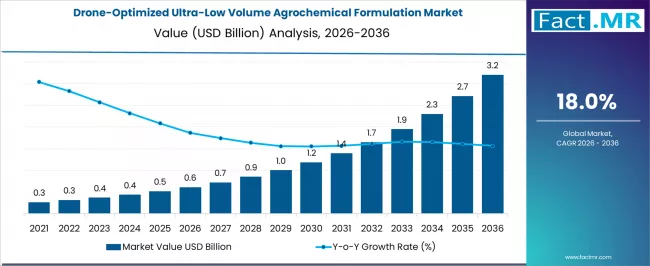
Drone-optimized ultra-low volume agrochemical formulation market is projected to grow from USD 0.6 billion in 2026 to USD 3.2 billion by 2036, at a CAGR of 18.0%. Ultra-Concentrated SC & OD Formulations will dominate with a 38.0% market share, while fungicides will lead the agrochemical type segment with a 34.0% share.
Drone-Optimized Ultra-Low-Volume Agrochemical Formulation Market Forecast and Outlook 2026 to 2036
The global drone-optimized ultra-low-volume agrochemical formulation market is projected to reach USD 3.20 billion by 2036. The market is valued at USD 0.61 billion in 2026 and is set to rise at a CAGR of 18.0% during the assessment period. By formulation technology, ultra-concentrated SC & OD formulations hold a leading 38% share. Fungicides represent the dominant agrochemical type at 34%, while precision spot spraying is the primary drone use-case, accounting for 41% market share.
Key Takeaways from the Drone-Optimized Ultra-Low-Volume Agrochemical Formulation Market
- Market Value for 2026: USD 0.61 Billion
- Market Value for 2036: USD 3.20 Billion
- Forecast CAGR (2026-2036): 18.0%
- Leading Formulation Technology Share (2026): Ultra-Concentrated SC & OD Formulations (38%)
- Leading Agrochemical Type Share (2026): Fungicides (34%)
- Leading Drone Use-Case Share (2026): Precision Spot Spraying (41%)
- Key Players in the Market: XAG Co. Ltd. (Ag Formulations), Hylio Agrotechnology, Guardian Agriculture, Rantizo Formulation Labs, SkyX Precision
Defining trends involve the creation of purpose-built chemistries that maximize efficacy at droplet sizes between 100-300 microns, a range optimized for aerial dispersal and canopy penetration. Innovation is rapidly advancing in adjuvants that manage evaporation and drift for these minute droplets. Integration of these formulations with drone flight control software is becoming critical, allowing for dynamic application rate adjustment based on real-time biomass sensor data and wind conditions.
Regulatory frameworks are evolving to create distinct pathways for ULV aerial applications, often with relaxed buffer zone requirements compared to traditional spraying due to superior precision and reduced drift. Policies promoting precision agriculture and reducing overall chemical load per hectare act as significant market catalysts, with drone-specific formulations seen as a key tool for achieving these policy goals.
Drone-Optimized Ultra-Low-Volume Agrochemical Formulation Market
| Metric | Value |
|---|---|
| Market Value (2026) | USD 0.61 Billion |
| Market Forecast Value (2036) | USD 3.20 Billion |
| Forecast CAGR (2026-2036) | 18.0% |
Category
| Category | Segments |
|---|---|
| Formulation Technology | Ultra-Concentrated SC & OD Formulations, Nano-Emulsion ULV Systems, Electrostatic-Optimized Droplet Chemistries, Micro-Encapsulated Drone-Safe Actives, Others |
| Agrochemical Type | Fungicides, Insecticides, Herbicides, Biostimulants & Nutritionals, Others |
| Drone Use-Case | Precision Spot Spraying, Terrain-Inaccessible Fields, Time-Critical Pest & Disease Control, Plantation & Orchard Canopies, Others |
| Region | North America, Latin America, Western Europe, Eastern Europe, East Asia, South Asia & Pacific, MEA |
Segmental Analysis
By Formulation Technology, Which System Maximizes Payload and Field Efficiency?
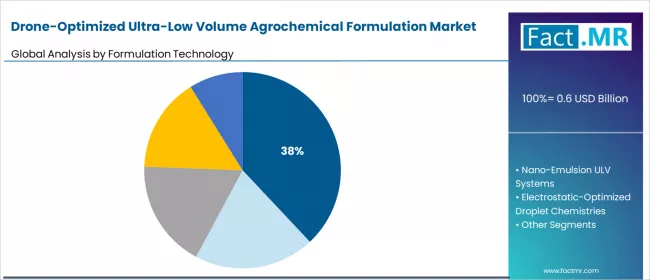
Ultra-concentrated suspension concentrate (SC) and oil dispersion (OD) formulations lead the segment with a 38% share. This dominance is due to their ability to deliver a high mass of active ingredient in a minimal volume of water, perfectly matching the limited payload capacity of agricultural drones. These formulations are engineered to remain stable in high concentrations, resist crystallization in nozzles, and provide excellent coverage and rainfastness when applied in ultra-low volumes.
By Agrochemical Type, Which Chemistry Benefits Most from Rapid, Targeted Application?
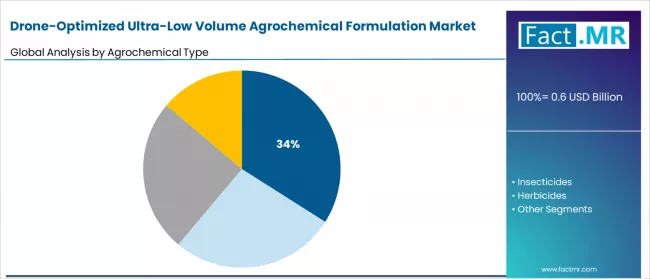
Fungicides command the largest type share at 34%. Fungal diseases often start in localized foci and spread rapidly. Drones enable swift, targeted intervention at the first sign of infection, preventing wider outbreaks. Fungicide formulations for ULV application are designed to ensure thorough canopy penetration and adhesion, providing protective and curative action with minimal product, making them ideal for managing diseases in rice, vines, and horticultural crops.
By Drone Use-Case, What Application Maximizes the Economic Value of the Technology?
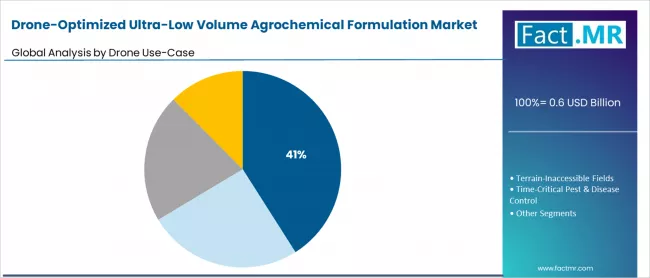
Precision spot spraying represents the leading use-case at 41%. This application leverages drone-mounted computer vision to identify and spray only weeds or infected plants, achieving chemical savings of 70-90% compared to broadcast methods. The economic return from input reduction is immediate and substantial, providing the clearest justification for investment in both drone hardware and the specialized ULV formulations required to execute this task effectively.
What are the Drivers, Restraints, and Key Trends of the Drone-Optimized Ultra-Low-Volume Agrochemical Formulation Market?
Market expansion is driven by the explosive global adoption of agricultural drones and the parallel need for chemistries that unlock their full potential. Labor shortages and the need for rapid response to pest outbreaks make drone application invaluable. Regulatory pressure to reduce chemical runoff and drift favors precise, low-volume application. The shrinking size of farm holdings in many regions also makes drone-based service models more economically viable than traditional ground equipment.
A significant restraint is the lack of standardized tank-mix compatibility data for ULV applications, as interactions can differ from high-volume spraying. The high relative cost per liter of ultra-concentrated formulations can be a perceptual barrier, despite lower per-hectare costs. Limited payload capacity restricts treatment area per flight, and regulatory approval for new ULV application methods can be slow, lagging behind technological adoption.
Key trends include the co-development of formulations by drone manufacturers and chemical companies to ensure system optimization. The rise of service-specific formulations for drone application service providers is notable. There is growing research into ULV formulations for biologicals, and the integration of formulation data into flight planning software to auto-calculate coverage and rate is becoming standard.
Analysis of the Drone-Optimized Ultra-Low-Volume Agrochemical Formulation Market by Key Countries
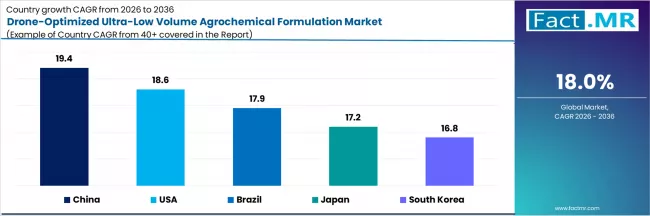
| Country | CAGR (2026-2036) |
|---|---|
| China | 19.40% |
| USA | 18.60% |
| Brazil | 17.90% |
| Japan | 17.20% |
| South Korea | 16.80% |
How does China's Dominance in Drone Manufacturing and Smallholder Farms Drive the Market?
China leads with a 19.40% CAGR, leveraging its position as the world's primary manufacturer of agricultural drones and home to millions of small plots. Government subsidies for smart farming equipment and a strong domestic supply chain for both drones and agrochemicals create a powerful synergy. Chinese formulation scientists are at the forefront of developing ULV chemistries for rice, wheat, and fruit trees, enabling widespread adoption across its diverse agricultural landscape.
Why is the USA's High-Tech, Large-Scale Farming Sector a Major Growth Area?
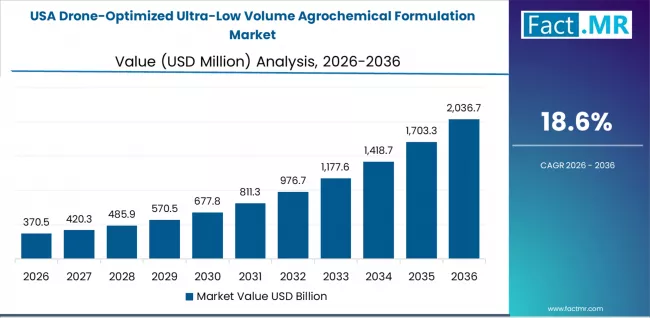
The USA's 18.60% growth is driven by the adoption of drone technology for scouting and spot-spraying in massive row crop operations, particularly for early weed control and mid-season disease patches. American farmers and custom applicators demand formulations that integrate seamlessly with advanced drone systems from both domestic and international manufacturers. The focus is on achieving operational efficiency and meeting sustainability benchmarks in corn, soybean, and specialty crop production.
What Role does Brazil's Challenging Terrain and Large Farms Play?
Brazil's 17.90% growth is fueled by the application of drones on its vast, often difficult-to-access farms. Drones are used for spraying fungicides on steeply sloped coffee plantations, treating remote pasture areas, and applying pesticides in wet fields where ground equipment cannot travel. The market demands robust, drift-resistant ULV formulations that can perform effectively in the variable tropical climates and large-scale contexts of Brazilian agriculture.
How do Japan's Precision Agriculture and Aging Farmer Demographics Influence Adoption?
Japan's 17.20% growth is closely tied to its need for ultra-precision in its high-value fruit and vegetable sector and its shrinking agricultural workforce. Drones are used for meticulous application in greenhouses, terraced rice fields, and orchards. Japanese formulations emphasize safety, low odor, and compatibility with sensitive crops, reflecting the extreme quality standards and regulatory environment of the domestic market.
What Factors Underpin South Korea's Advanced Agro-Tech Ecosystem?
South Korea's 16.80% growth is supported by strong government investment in smart farm villages and digital agriculture. The country's advanced electronics and chemical industries facilitate the development of sophisticated drone systems and tailored formulations. Korean ULV products are often designed for integrated pest management programs in protected horticulture and for use in the complex topography of its agricultural lands.
Competitive Landscape of the Drone-Optimized Ultra-Low-Volume Agrochemical Formulation Market
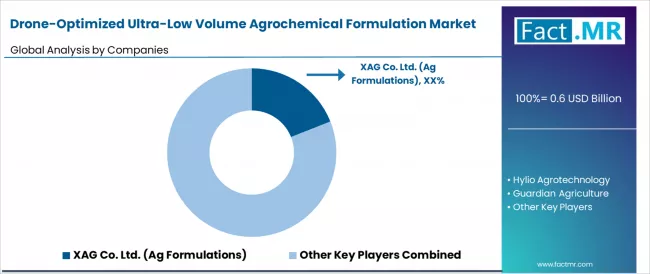
The competitive landscape is uniquely shaped by the convergence of drone hardware manufacturers and specialized formulation developers. Leading drone companies like XAG Co. Ltd. are vertically integrating by developing proprietary formulation lines optimized specifically for their aircraft's spray systems, creating a locked-in ecosystem of hardware and consumables.
Specialized ag-tech firms like Rantizo Formulation Labs and SkyX Precision compete as independent formulation experts, creating drone-optimized chemistries that are compatible with multiple drone platforms. Their value proposition is agronomic expertise and neutrality. Companies like Guardian Agriculture and Hylio Agrotechnology often bridge both segments, developing application systems alongside compatible chemistry. Competition intensifies around droplet spectrum control, tank-mix flexibility, and demonstrable field efficacy data from drone applications.
Key Players in the Drone-Optimized Ultra-Low-Volume Agrochemical Formulation Market
- XAG Co. Ltd. (Ag Formulations)
- Hylio Agrotechnology
- Guardian Agriculture
- Rantizo Formulation Labs
- SkyX Precision
Scope of Report
| Items | Values |
|---|---|
| Quantitative Units | USD Billion |
| Formulation Technology | Ultra-Concentrated SC & OD Formulations, Nano-Emulsion ULV Systems, Electrostatic-Optimized Droplet Chemistries, Micro-Encapsulated Drone-Safe Actives, Others |
| Agrochemical Type | Fungicides, Insecticides, Herbicides, Biostimulants & Nutritionals, Others |
| Drone Use-Case | Precision Spot Spraying, Terrain-Inaccessible Fields, Time-Critical Pest & Disease Control, Plantation & Orchard Canopies, Others |
| Key Countries | China, USA, Brazil, Japan, South Korea |
| Key Companies | XAG Co. Ltd. (Ag Formulations), Hylio Agrotechnology, Guardian Agriculture, Rantizo Formulation Labs, SkyX Precision |
| Additional Analysis | Analysis of droplet spectrum efficacy, payload efficiency metrics, compatibility with anti-drift adjuvants, regulatory data requirements for aerial ULV claims, and ROI models for drone-based application services. |
Drone-Optimized Ultra-Low-Volume Agrochemical Formulation Market by Segments
-
Formulation Technology :
- Ultra-Concentrated SC & OD Formulations
- Nano-Emulsion ULV Systems
- Electrostatic-Optimized Droplet Chemistries
- Micro-Encapsulated Drone-Safe Actives
- Others
-
Agrochemical Type :
- Fungicides
- Insecticides
- Herbicides
- Biostimulants & Nutritionals
- Others
-
Drone Use-Case :
- Precision Spot Spraying
- Terrain-Inaccessible Fields
- Time-Critical Pest & Disease Control
- Plantation & Orchard Canopies
- Others
-
Region :
-
North America
- USA
- Canada
-
Latin America
- Brazil
- Mexico
- Argentina
- Rest of Latin America
-
Western Europe
- Germany
- UK
- France
- Spain
- Italy
- BENELUX
- Rest of Western Europe
-
Eastern Europe
- Czech Republic
- Poland
- Russia
- Rest of Eastern Europe
-
East Asia
- China
- Japan
- South Korea
- Rest of East Asia
-
South Asia & Pacific
- India
- Indonesia
- Australia
- Rest of South Asia & Pacific
-
MEA
- GCC Countries
- Turkiye
- Saudi Arabia
- Rest of MEA
-
Table of Content
- Executive Summary
- Global Market Outlook
- Demand to side Trends
- Supply to side Trends
- Technology Roadmap Analysis
- Analysis and Recommendations
- Market Overview
- Market Coverage / Taxonomy
- Market Definition / Scope / Limitations
- Market Background
- Market Dynamics
- Drivers
- Restraints
- Opportunity
- Trends
- Scenario Forecast
- Demand in Optimistic Scenario
- Demand in Likely Scenario
- Demand in Conservative Scenario
- Opportunity Map Analysis
- Product Life Cycle Analysis
- Supply Chain Analysis
- Investment Feasibility Matrix
- Value Chain Analysis
- PESTLE and Porter’s Analysis
- Regulatory Landscape
- Regional Parent Market Outlook
- Production and Consumption Statistics
- Import and Export Statistics
- Market Dynamics
- Global Market Analysis 2021 to 2025 and Forecast, 2026 to 2036
- Historical Market Size Value (USD Million) Analysis, 2021 to 2025
- Current and Future Market Size Value (USD Million) Projections, 2026 to 2036
- Y to o to Y Growth Trend Analysis
- Absolute $ Opportunity Analysis
- Global Market Pricing Analysis 2021 to 2025 and Forecast 2026 to 2036
- Global Market Analysis 2021 to 2025 and Forecast 2026 to 2036, By Formulation Technology
- Introduction / Key Findings
- Historical Market Size Value (USD Million) Analysis By Formulation Technology, 2021 to 2025
- Current and Future Market Size Value (USD Million) Analysis and Forecast By Formulation Technology, 2026 to 2036
- Ultra-Concentrated SC & OD Formulations
- Nano-Emulsion ULV Systems
- Electrostatic-Optimized Droplet Chemistries
- Micro-Encapsulated Drone-Safe Actives
- Others
- Ultra-Concentrated SC & OD Formulations
- Y to o to Y Growth Trend Analysis By Formulation Technology, 2021 to 2025
- Absolute $ Opportunity Analysis By Formulation Technology, 2026 to 2036
- Global Market Analysis 2021 to 2025 and Forecast 2026 to 2036, By Agrochemical Type
- Introduction / Key Findings
- Historical Market Size Value (USD Million) Analysis By Agrochemical Type, 2021 to 2025
- Current and Future Market Size Value (USD Million) Analysis and Forecast By Agrochemical Type, 2026 to 2036
- Fungicides
- Insecticides
- Herbicides
- Biostimulants & Nutritionals
- Fungicides
- Y to o to Y Growth Trend Analysis By Agrochemical Type, 2021 to 2025
- Absolute $ Opportunity Analysis By Agrochemical Type, 2026 to 2036
- Global Market Analysis 2021 to 2025 and Forecast 2026 to 2036, By Drone Use-Case
- Introduction / Key Findings
- Historical Market Size Value (USD Million) Analysis By Drone Use-Case, 2021 to 2025
- Current and Future Market Size Value (USD Million) Analysis and Forecast By Drone Use-Case, 2026 to 2036
- Precision Spot Spraying
- Terrain-Inaccessible Fields
- Time-Critical Pest & Disease Control
- Plantation & Orchard Canopies
- Precision Spot Spraying
- Y to o to Y Growth Trend Analysis By Drone Use-Case, 2021 to 2025
- Absolute $ Opportunity Analysis By Drone Use-Case, 2026 to 2036
- Global Market Analysis 2021 to 2025 and Forecast 2026 to 2036, By Region
- Introduction
- Historical Market Size Value (USD Million) Analysis By Region, 2021 to 2025
- Current Market Size Value (USD Million) Analysis and Forecast By Region, 2026 to 2036
- North America
- Latin America
- Western Europe
- Eastern Europe
- East Asia
- South Asia and Pacific
- Middle East & Africa
- Market Attractiveness Analysis By Region
- North America Market Analysis 2021 to 2025 and Forecast 2026 to 2036, By Country
- Historical Market Size Value (USD Million) Trend Analysis By Market Taxonomy, 2021 to 2025
- Market Size Value (USD Million) Forecast By Market Taxonomy, 2026 to 2036
- By Country
- USA
- Canada
- Mexico
- By Formulation Technology
- By Agrochemical Type
- By Drone Use-Case
- By Country
- Market Attractiveness Analysis
- By Country
- By Formulation Technology
- By Agrochemical Type
- By Drone Use-Case
- Key Takeaways
- Latin America Market Analysis 2021 to 2025 and Forecast 2026 to 2036, By Country
- Historical Market Size Value (USD Million) Trend Analysis By Market Taxonomy, 2021 to 2025
- Market Size Value (USD Million) Forecast By Market Taxonomy, 2026 to 2036
- By Country
- Brazil
- Chile
- Rest of Latin America
- By Formulation Technology
- By Agrochemical Type
- By Drone Use-Case
- By Country
- Market Attractiveness Analysis
- By Country
- By Formulation Technology
- By Agrochemical Type
- By Drone Use-Case
- Key Takeaways
- Western Europe Market Analysis 2021 to 2025 and Forecast 2026 to 2036, By Country
- Historical Market Size Value (USD Million) Trend Analysis By Market Taxonomy, 2021 to 2025
- Market Size Value (USD Million) Forecast By Market Taxonomy, 2026 to 2036
- By Country
- Germany
- UK
- Italy
- Spain
- France
- Nordic
- BENELUX
- Rest of Western Europe
- By Formulation Technology
- By Agrochemical Type
- By Drone Use-Case
- By Country
- Market Attractiveness Analysis
- By Country
- By Formulation Technology
- By Agrochemical Type
- By Drone Use-Case
- Key Takeaways
- Eastern Europe Market Analysis 2021 to 2025 and Forecast 2026 to 2036, By Country
- Historical Market Size Value (USD Million) Trend Analysis By Market Taxonomy, 2021 to 2025
- Market Size Value (USD Million) Forecast By Market Taxonomy, 2026 to 2036
- By Country
- Russia
- Poland
- Hungary
- Balkan & Baltic
- Rest of Eastern Europe
- By Formulation Technology
- By Agrochemical Type
- By Drone Use-Case
- By Country
- Market Attractiveness Analysis
- By Country
- By Formulation Technology
- By Agrochemical Type
- By Drone Use-Case
- Key Takeaways
- East Asia Market Analysis 2021 to 2025 and Forecast 2026 to 2036, By Country
- Historical Market Size Value (USD Million) Trend Analysis By Market Taxonomy, 2021 to 2025
- Market Size Value (USD Million) Forecast By Market Taxonomy, 2026 to 2036
- By Country
- China
- Japan
- South Korea
- By Formulation Technology
- By Agrochemical Type
- By Drone Use-Case
- By Country
- Market Attractiveness Analysis
- By Country
- By Formulation Technology
- By Agrochemical Type
- By Drone Use-Case
- Key Takeaways
- South Asia and Pacific Market Analysis 2021 to 2025 and Forecast 2026 to 2036, By Country
- Historical Market Size Value (USD Million) Trend Analysis By Market Taxonomy, 2021 to 2025
- Market Size Value (USD Million) Forecast By Market Taxonomy, 2026 to 2036
- By Country
- India
- ASEAN
- Australia & New Zealand
- Rest of South Asia and Pacific
- By Formulation Technology
- By Agrochemical Type
- By Drone Use-Case
- By Country
- Market Attractiveness Analysis
- By Country
- By Formulation Technology
- By Agrochemical Type
- By Drone Use-Case
- Key Takeaways
- Middle East & Africa Market Analysis 2021 to 2025 and Forecast 2026 to 2036, By Country
- Historical Market Size Value (USD Million) Trend Analysis By Market Taxonomy, 2021 to 2025
- Market Size Value (USD Million) Forecast By Market Taxonomy, 2026 to 2036
- By Country
- Kingdom of Saudi Arabia
- Other GCC Countries
- Turkiye
- South Africa
- Other African Union
- Rest of Middle East & Africa
- By Formulation Technology
- By Agrochemical Type
- By Drone Use-Case
- By Country
- Market Attractiveness Analysis
- By Country
- By Formulation Technology
- By Agrochemical Type
- By Drone Use-Case
- Key Takeaways
- Key Countries Market Analysis
- USA
- Pricing Analysis
- Market Share Analysis, 2025
- By Formulation Technology
- By Agrochemical Type
- By Drone Use-Case
- Canada
- Pricing Analysis
- Market Share Analysis, 2025
- By Formulation Technology
- By Agrochemical Type
- By Drone Use-Case
- Mexico
- Pricing Analysis
- Market Share Analysis, 2025
- By Formulation Technology
- By Agrochemical Type
- By Drone Use-Case
- Brazil
- Pricing Analysis
- Market Share Analysis, 2025
- By Formulation Technology
- By Agrochemical Type
- By Drone Use-Case
- Chile
- Pricing Analysis
- Market Share Analysis, 2025
- By Formulation Technology
- By Agrochemical Type
- By Drone Use-Case
- Germany
- Pricing Analysis
- Market Share Analysis, 2025
- By Formulation Technology
- By Agrochemical Type
- By Drone Use-Case
- UK
- Pricing Analysis
- Market Share Analysis, 2025
- By Formulation Technology
- By Agrochemical Type
- By Drone Use-Case
- Italy
- Pricing Analysis
- Market Share Analysis, 2025
- By Formulation Technology
- By Agrochemical Type
- By Drone Use-Case
- Spain
- Pricing Analysis
- Market Share Analysis, 2025
- By Formulation Technology
- By Agrochemical Type
- By Drone Use-Case
- France
- Pricing Analysis
- Market Share Analysis, 2025
- By Formulation Technology
- By Agrochemical Type
- By Drone Use-Case
- India
- Pricing Analysis
- Market Share Analysis, 2025
- By Formulation Technology
- By Agrochemical Type
- By Drone Use-Case
- ASEAN
- Pricing Analysis
- Market Share Analysis, 2025
- By Formulation Technology
- By Agrochemical Type
- By Drone Use-Case
- Australia & New Zealand
- Pricing Analysis
- Market Share Analysis, 2025
- By Formulation Technology
- By Agrochemical Type
- By Drone Use-Case
- China
- Pricing Analysis
- Market Share Analysis, 2025
- By Formulation Technology
- By Agrochemical Type
- By Drone Use-Case
- Japan
- Pricing Analysis
- Market Share Analysis, 2025
- By Formulation Technology
- By Agrochemical Type
- By Drone Use-Case
- South Korea
- Pricing Analysis
- Market Share Analysis, 2025
- By Formulation Technology
- By Agrochemical Type
- By Drone Use-Case
- Russia
- Pricing Analysis
- Market Share Analysis, 2025
- By Formulation Technology
- By Agrochemical Type
- By Drone Use-Case
- Poland
- Pricing Analysis
- Market Share Analysis, 2025
- By Formulation Technology
- By Agrochemical Type
- By Drone Use-Case
- Hungary
- Pricing Analysis
- Market Share Analysis, 2025
- By Formulation Technology
- By Agrochemical Type
- By Drone Use-Case
- Kingdom of Saudi Arabia
- Pricing Analysis
- Market Share Analysis, 2025
- By Formulation Technology
- By Agrochemical Type
- By Drone Use-Case
- Turkiye
- Pricing Analysis
- Market Share Analysis, 2025
- By Formulation Technology
- By Agrochemical Type
- By Drone Use-Case
- South Africa
- Pricing Analysis
- Market Share Analysis, 2025
- By Formulation Technology
- By Agrochemical Type
- By Drone Use-Case
- USA
- Market Structure Analysis
- Competition Dashboard
- Competition Benchmarking
- Market Share Analysis of Top Players
- By Regional
- By Formulation Technology
- By Agrochemical Type
- By Drone Use-Case
- Competition Analysis
- Competition Deep Dive
- XAG Co. Ltd. (Ag Formulations)
- Overview
- Product Portfolio
- Profitability by Market Segments (Product/Age /Sales Channel/Region)
- Sales Footprint
- Strategy Overview
- Marketing Strategy
- Product Strategy
- Channel Strategy
- Hylio Agrotechnology
- Guardian Agriculture
- Rantizo Formulation Labs
- SkyX Precision
- Others
- XAG Co. Ltd. (Ag Formulations)
- Competition Deep Dive
- Assumptions & Acronyms Used
- Research Methodology
List Of Table
- Table 1: Global Market Value (USD Million) Forecast by Region, 2021 to 2036
- Table 2: Global Market Value (USD Million) Forecast by Formulation Technology, 2021 to 2036
- Table 3: Global Market Value (USD Million) Forecast by Agrochemical Type, 2021 to 2036
- Table 4: Global Market Value (USD Million) Forecast by Drone Use-Case, 2021 to 2036
- Table 5: North America Market Value (USD Million) Forecast by Country, 2021 to 2036
- Table 6: North America Market Value (USD Million) Forecast by Formulation Technology, 2021 to 2036
- Table 7: North America Market Value (USD Million) Forecast by Agrochemical Type, 2021 to 2036
- Table 8: North America Market Value (USD Million) Forecast by Drone Use-Case, 2021 to 2036
- Table 9: Latin America Market Value (USD Million) Forecast by Country, 2021 to 2036
- Table 10: Latin America Market Value (USD Million) Forecast by Formulation Technology, 2021 to 2036
- Table 11: Latin America Market Value (USD Million) Forecast by Agrochemical Type, 2021 to 2036
- Table 12: Latin America Market Value (USD Million) Forecast by Drone Use-Case, 2021 to 2036
- Table 13: Western Europe Market Value (USD Million) Forecast by Country, 2021 to 2036
- Table 14: Western Europe Market Value (USD Million) Forecast by Formulation Technology, 2021 to 2036
- Table 15: Western Europe Market Value (USD Million) Forecast by Agrochemical Type, 2021 to 2036
- Table 16: Western Europe Market Value (USD Million) Forecast by Drone Use-Case, 2021 to 2036
- Table 17: Eastern Europe Market Value (USD Million) Forecast by Country, 2021 to 2036
- Table 18: Eastern Europe Market Value (USD Million) Forecast by Formulation Technology, 2021 to 2036
- Table 19: Eastern Europe Market Value (USD Million) Forecast by Agrochemical Type, 2021 to 2036
- Table 20: Eastern Europe Market Value (USD Million) Forecast by Drone Use-Case, 2021 to 2036
- Table 21: East Asia Market Value (USD Million) Forecast by Country, 2021 to 2036
- Table 22: East Asia Market Value (USD Million) Forecast by Formulation Technology, 2021 to 2036
- Table 23: East Asia Market Value (USD Million) Forecast by Agrochemical Type, 2021 to 2036
- Table 24: East Asia Market Value (USD Million) Forecast by Drone Use-Case, 2021 to 2036
- Table 25: South Asia and Pacific Market Value (USD Million) Forecast by Country, 2021 to 2036
- Table 26: South Asia and Pacific Market Value (USD Million) Forecast by Formulation Technology, 2021 to 2036
- Table 27: South Asia and Pacific Market Value (USD Million) Forecast by Agrochemical Type, 2021 to 2036
- Table 28: South Asia and Pacific Market Value (USD Million) Forecast by Drone Use-Case, 2021 to 2036
- Table 29: Middle East & Africa Market Value (USD Million) Forecast by Country, 2021 to 2036
- Table 30: Middle East & Africa Market Value (USD Million) Forecast by Formulation Technology, 2021 to 2036
- Table 31: Middle East & Africa Market Value (USD Million) Forecast by Agrochemical Type, 2021 to 2036
- Table 32: Middle East & Africa Market Value (USD Million) Forecast by Drone Use-Case, 2021 to 2036
List Of Figures
- Figure 1: Global Market Pricing Analysis
- Figure 2: Global Market Value (USD Million) Forecast 2021 to 2036
- Figure 3: Global Market Value Share and BPS Analysis by Formulation Technology, 2026 and 2036
- Figure 4: Global Market Y to o to Y Growth Comparison by Formulation Technology, 2026 to 2036
- Figure 5: Global Market Attractiveness Analysis by Formulation Technology
- Figure 6: Global Market Value Share and BPS Analysis by Agrochemical Type, 2026 and 2036
- Figure 7: Global Market Y to o to Y Growth Comparison by Agrochemical Type, 2026 to 2036
- Figure 8: Global Market Attractiveness Analysis by Agrochemical Type
- Figure 9: Global Market Value Share and BPS Analysis by Drone Use-Case, 2026 and 2036
- Figure 10: Global Market Y to o to Y Growth Comparison by Drone Use-Case, 2026 to 2036
- Figure 11: Global Market Attractiveness Analysis by Drone Use-Case
- Figure 12: Global Market Value (USD Million) Share and BPS Analysis by Region, 2026 and 2036
- Figure 13: Global Market Y to o to Y Growth Comparison by Region, 2026 to 2036
- Figure 14: Global Market Attractiveness Analysis by Region
- Figure 15: North America Market Incremental Dollar Opportunity, 2026 to 2036
- Figure 16: Latin America Market Incremental Dollar Opportunity, 2026 to 2036
- Figure 17: Western Europe Market Incremental Dollar Opportunity, 2026 to 2036
- Figure 18: Eastern Europe Market Incremental Dollar Opportunity, 2026 to 2036
- Figure 19: East Asia Market Incremental Dollar Opportunity, 2026 to 2036
- Figure 20: South Asia and Pacific Market Incremental Dollar Opportunity, 2026 to 2036
- Figure 21: Middle East & Africa Market Incremental Dollar Opportunity, 2026 to 2036
- Figure 22: North America Market Value Share and BPS Analysis by Country, 2026 and 2036
- Figure 23: North America Market Value Share and BPS Analysis by Formulation Technology, 2026 and 2036
- Figure 24: North America Market Y to o to Y Growth Comparison by Formulation Technology, 2026 to 2036
- Figure 25: North America Market Attractiveness Analysis by Formulation Technology
- Figure 26: North America Market Value Share and BPS Analysis by Agrochemical Type, 2026 and 2036
- Figure 27: North America Market Y to o to Y Growth Comparison by Agrochemical Type, 2026 to 2036
- Figure 28: North America Market Attractiveness Analysis by Agrochemical Type
- Figure 29: North America Market Value Share and BPS Analysis by Drone Use-Case, 2026 and 2036
- Figure 30: North America Market Y to o to Y Growth Comparison by Drone Use-Case, 2026 to 2036
- Figure 31: North America Market Attractiveness Analysis by Drone Use-Case
- Figure 32: Latin America Market Value Share and BPS Analysis by Country, 2026 and 2036
- Figure 33: Latin America Market Value Share and BPS Analysis by Formulation Technology, 2026 and 2036
- Figure 34: Latin America Market Y to o to Y Growth Comparison by Formulation Technology, 2026 to 2036
- Figure 35: Latin America Market Attractiveness Analysis by Formulation Technology
- Figure 36: Latin America Market Value Share and BPS Analysis by Agrochemical Type, 2026 and 2036
- Figure 37: Latin America Market Y to o to Y Growth Comparison by Agrochemical Type, 2026 to 2036
- Figure 38: Latin America Market Attractiveness Analysis by Agrochemical Type
- Figure 39: Latin America Market Value Share and BPS Analysis by Drone Use-Case, 2026 and 2036
- Figure 40: Latin America Market Y to o to Y Growth Comparison by Drone Use-Case, 2026 to 2036
- Figure 41: Latin America Market Attractiveness Analysis by Drone Use-Case
- Figure 42: Western Europe Market Value Share and BPS Analysis by Country, 2026 and 2036
- Figure 43: Western Europe Market Value Share and BPS Analysis by Formulation Technology, 2026 and 2036
- Figure 44: Western Europe Market Y to o to Y Growth Comparison by Formulation Technology, 2026 to 2036
- Figure 45: Western Europe Market Attractiveness Analysis by Formulation Technology
- Figure 46: Western Europe Market Value Share and BPS Analysis by Agrochemical Type, 2026 and 2036
- Figure 47: Western Europe Market Y to o to Y Growth Comparison by Agrochemical Type, 2026 to 2036
- Figure 48: Western Europe Market Attractiveness Analysis by Agrochemical Type
- Figure 49: Western Europe Market Value Share and BPS Analysis by Drone Use-Case, 2026 and 2036
- Figure 50: Western Europe Market Y to o to Y Growth Comparison by Drone Use-Case, 2026 to 2036
- Figure 51: Western Europe Market Attractiveness Analysis by Drone Use-Case
- Figure 52: Eastern Europe Market Value Share and BPS Analysis by Country, 2026 and 2036
- Figure 53: Eastern Europe Market Value Share and BPS Analysis by Formulation Technology, 2026 and 2036
- Figure 54: Eastern Europe Market Y to o to Y Growth Comparison by Formulation Technology, 2026 to 2036
- Figure 55: Eastern Europe Market Attractiveness Analysis by Formulation Technology
- Figure 56: Eastern Europe Market Value Share and BPS Analysis by Agrochemical Type, 2026 and 2036
- Figure 57: Eastern Europe Market Y to o to Y Growth Comparison by Agrochemical Type, 2026 to 2036
- Figure 58: Eastern Europe Market Attractiveness Analysis by Agrochemical Type
- Figure 59: Eastern Europe Market Value Share and BPS Analysis by Drone Use-Case, 2026 and 2036
- Figure 60: Eastern Europe Market Y to o to Y Growth Comparison by Drone Use-Case, 2026 to 2036
- Figure 61: Eastern Europe Market Attractiveness Analysis by Drone Use-Case
- Figure 62: East Asia Market Value Share and BPS Analysis by Country, 2026 and 2036
- Figure 63: East Asia Market Value Share and BPS Analysis by Formulation Technology, 2026 and 2036
- Figure 64: East Asia Market Y to o to Y Growth Comparison by Formulation Technology, 2026 to 2036
- Figure 65: East Asia Market Attractiveness Analysis by Formulation Technology
- Figure 66: East Asia Market Value Share and BPS Analysis by Agrochemical Type, 2026 and 2036
- Figure 67: East Asia Market Y to o to Y Growth Comparison by Agrochemical Type, 2026 to 2036
- Figure 68: East Asia Market Attractiveness Analysis by Agrochemical Type
- Figure 69: East Asia Market Value Share and BPS Analysis by Drone Use-Case, 2026 and 2036
- Figure 70: East Asia Market Y to o to Y Growth Comparison by Drone Use-Case, 2026 to 2036
- Figure 71: East Asia Market Attractiveness Analysis by Drone Use-Case
- Figure 72: South Asia and Pacific Market Value Share and BPS Analysis by Country, 2026 and 2036
- Figure 73: South Asia and Pacific Market Value Share and BPS Analysis by Formulation Technology, 2026 and 2036
- Figure 74: South Asia and Pacific Market Y to o to Y Growth Comparison by Formulation Technology, 2026 to 2036
- Figure 75: South Asia and Pacific Market Attractiveness Analysis by Formulation Technology
- Figure 76: South Asia and Pacific Market Value Share and BPS Analysis by Agrochemical Type, 2026 and 2036
- Figure 77: South Asia and Pacific Market Y to o to Y Growth Comparison by Agrochemical Type, 2026 to 2036
- Figure 78: South Asia and Pacific Market Attractiveness Analysis by Agrochemical Type
- Figure 79: South Asia and Pacific Market Value Share and BPS Analysis by Drone Use-Case, 2026 and 2036
- Figure 80: South Asia and Pacific Market Y to o to Y Growth Comparison by Drone Use-Case, 2026 to 2036
- Figure 81: South Asia and Pacific Market Attractiveness Analysis by Drone Use-Case
- Figure 82: Middle East & Africa Market Value Share and BPS Analysis by Country, 2026 and 2036
- Figure 83: Middle East & Africa Market Value Share and BPS Analysis by Formulation Technology, 2026 and 2036
- Figure 84: Middle East & Africa Market Y to o to Y Growth Comparison by Formulation Technology, 2026 to 2036
- Figure 85: Middle East & Africa Market Attractiveness Analysis by Formulation Technology
- Figure 86: Middle East & Africa Market Value Share and BPS Analysis by Agrochemical Type, 2026 and 2036
- Figure 87: Middle East & Africa Market Y to o to Y Growth Comparison by Agrochemical Type, 2026 to 2036
- Figure 88: Middle East & Africa Market Attractiveness Analysis by Agrochemical Type
- Figure 89: Middle East & Africa Market Value Share and BPS Analysis by Drone Use-Case, 2026 and 2036
- Figure 90: Middle East & Africa Market Y to o to Y Growth Comparison by Drone Use-Case, 2026 to 2036
- Figure 91: Middle East & Africa Market Attractiveness Analysis by Drone Use-Case
- Figure 92: Global Market - Tier Structure Analysis
- Figure 93: Global Market - Company Share Analysis
- FAQs -
How big is the drone-optimized ultra-low volume agrochemical formulation market in 2026?
The global drone-optimized ultra-low volume agrochemical formulation market is estimated to be valued at USD 0.6 billion in 2026.
What will be the size of drone-optimized ultra-low volume agrochemical formulation market in 2036?
The market size for the drone-optimized ultra-low volume agrochemical formulation market is projected to reach USD 3.2 billion by 2036.
How much will be the drone-optimized ultra-low volume agrochemical formulation market growth between 2026 and 2036?
The drone-optimized ultra-low volume agrochemical formulation market is expected to grow at a 18.0% CAGR between 2026 and 2036.
What are the key product types in the drone-optimized ultra-low volume agrochemical formulation market?
The key product types in drone-optimized ultra-low volume agrochemical formulation market are ultra-concentrated sc & od formulations, nano-emulsion ulv systems, electrostatic-optimized droplet chemistries, micro-encapsulated drone-safe actives and others.
Which agrochemical type segment to contribute significant share in the drone-optimized ultra-low volume agrochemical formulation market in 2026?
In terms of agrochemical type, fungicides segment to command 34.0% share in the drone-optimized ultra-low volume agrochemical formulation market in 2026.