- Market Value (2025): USD 40.3 Mn
- Estimated Value (2026): USD 45.0 Mn
- Forecast Value (2036): USD 136.1 Mn
- CAGR (2026-2036): 11.7%
Sweet Protein Co-Sweeteners Market Forecast and Outlook 2026 to 2036
The sweet protein co-sweeteners market is projected to grow from USD 45.0 million in 2026 to USD 136.1 million by 2036. Demand for sweet protein co-sweeteners is likely to grow at a CAGR of 11.7% over the forecast period.
Buyers of sweet protein co-sweeteners respond to beverage and food makers look for natural, low-calorie sweetness to pair with reduced sugar or stevia. Proteins such as thaumatin, brazzein and monellin are hundreds to thousands of times sweeter than sugar and, unlike many sweeteners, are digested as protein. For example, thaumatin is used as a high-intensity sweetener and flavor modifier. The US FDA has issued no-questions responses to GRAS notices for specified thaumatin uses. Such notices do not amount to a general FDA approval of every potential application. Regulatory acceptance may expand the commercial opportunity for sweet protein co-sweeteners during the forecast period.
Market Snapshot: Sweet Protein Co-Sweeteners Market
- Sales of sweet protein co-sweeteners stood at USD 40.3 million in 2025
- Sweet Protein Co-Sweeteners Market Value (2026): USD 45.0 million
- Sweet Protein Co-Sweeteners Market Forecast Value (2036): USD 136.1 million
- Sweet Protein Co-Sweeteners Market Forecast CAGR (2026-2036): 11.7%
- Leading Sweet protein: Thaumatin (32.0%)
- Key Market Participants: Oobli, Sweegen, Amai Proteins, Givaudan, Conagen, Ingredion
- Key Growth Regions: Israel, United States, China, Germany, Japan
Start-ups such as Oobli in the United States and Amai Proteins in Israel are producing sweet proteins by precision fermentation, and Ingredion announced a partnership with Oobli in February 2025 to bring sweet proteins to food makers. Interest in sweet protein co-sweeteners is strengthening as large ingredient groups help scale and formulate these proteins. Suppliers are pairing sweet proteins with stevia and other sweeteners. Food developers will examine sweetness onset, lingering taste and permitted uses before selecting a protein blend.
Sweet Protein Co-Sweeteners Market
| Metric | Value |
|---|---|
| Estimated Value in (2026) | USD 45.0 million |
| Forecast Value in (2036) | USD 136.1 million |
| Forecast CAGR (2026 to 2036) | 11.7% |
Source: Fact.MR analysis. Updated Nov 20, 2026
Source: Fact.MR analysis.
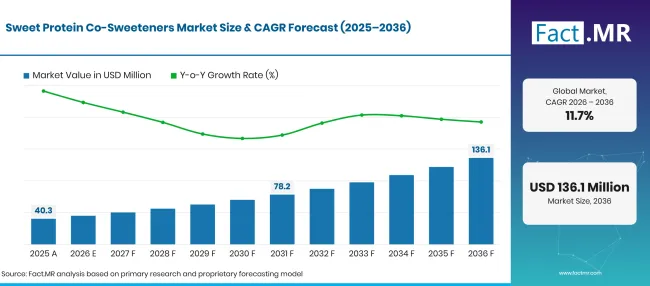
Sweet Protein Co Sweeteners Forecast Global | Source: Fact.MR
Category
| Category | Segments |
|---|---|
| Sweet protein | Brazzein, Thaumatin, Monellin, Mabinlin, Other sweet proteins |
| Commercial form | Powder, Liquid concentrate, Granulate, Encapsulated bead, Ready-to-use premix |
| Food application | Bakery, Dairy / alternatives, Beverage, Meat / savory, Confectionery / snacks |
| Primary function | Shelf-life, Texture / rheology, Taste / color, Nutritional functionality, Processing stability |
| Region | Israel; United States; China; Germany; Japan |
Source: Fact.MR analysis. Updated Nov 20, 2026
Source: Fact.MR analysis.
Segmental Analysis
Why does thaumatin lead sweet-protein demand in the Sweet Protein Co-Sweeteners Market?
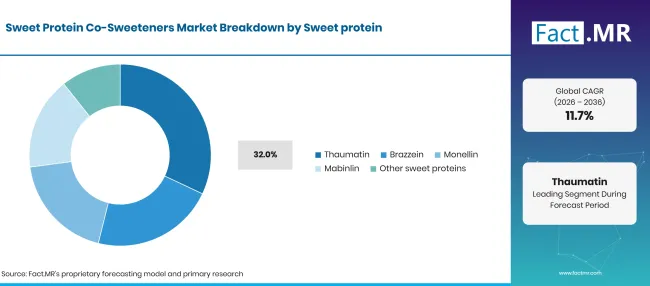
Sweet Protein Co Sweeteners Breakdown Sweet Protein | Source: Fact.MR
Thaumatin accounts for 32.0% of revenue in 2026, approximately USD 14.4 million, supported by its established regulatory acceptance and use as a flavor modifier and co-sweetener. Food manufacturers incorporate thaumatin to improve sweetness profiles while reducing conventional sugar content. Monellin and brazzein are gaining attention as fermentation production develops. Suppliers are refining thaumatin blends for beverage, confectionery and nutritional applications.
Why do ready-to-use premixes lead commercial-form demand in the Sweet Protein Co-Sweeteners Market?
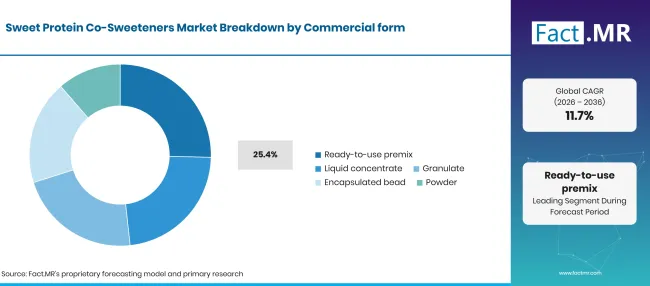
Sweet Protein Co Sweeteners Breakdown Commercial Form | Source: Fact.MR
Ready-to-use premixes represent 25.4% of revenue in 2026, valued at approximately USD 11.4 million, as sweet proteins require precise dosing in food formulations. Pre-blended ingredients simplify handling and improve sweetness consistency across production batches. Powder formulations serve manufacturers seeking greater flexibility in ingredient combinations. Suppliers are developing premixes with compatible carriers and sweeteners to support easier integration into commercial food processing.
Why does beverage lead application demand in the Sweet Protein Co-Sweeteners Market?
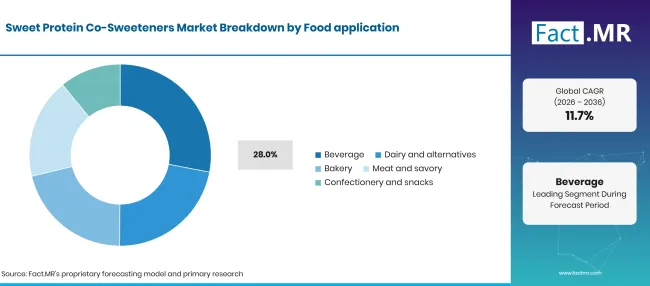
Sweet Protein Co Sweeteners Breakdown Food Application | Source: Fact.MR
Beverage applications hold 28.0% of revenue in 2026, equivalent to approximately USD 12.6 million, as soft drink and flavored water manufacturers seek alternatives to conventional sugar. Sugar reduction targets and taxation policies are encouraging reformulation across beverage categories. Sweet proteins can help improve sweetness perception in reduced-sugar formulations. Suppliers are testing ingredient combinations for taste quality, solubility and compatibility with beverage processing conditions.
Why does nutritional functionality lead function demand in the Sweet Protein Co-Sweeteners Market?
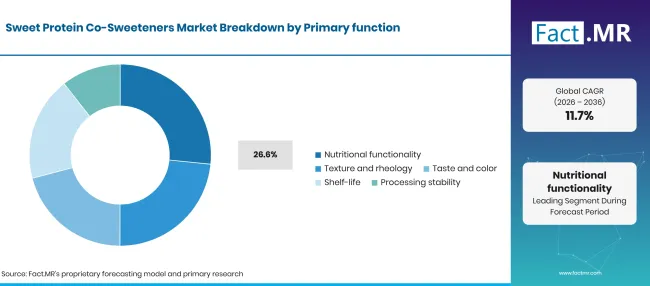
Sweet Protein Co Sweeteners Breakdown Primary Function | Source: Fact.MR
Nutritional functionality accounts for 26.6% of revenue in 2026, approximately USD 12.0 million, reflecting interest in sweetening ingredients that contribute minimal calories at typical use levels. Food manufacturers are evaluating sweet proteins for reduced-sugar products and specialized nutritional formulations. Taste and shelf-life performance remain additional considerations. Suppliers are developing ingredient combinations that maintain sweetness quality while supporting sugar reduction and nutritional positioning.
Sweet Protein Co-Sweeteners Market-Drivers, Restraints & Trends
Drivers:
Demand for sweet protein co-sweeteners is increasing as sugar reduction policies encourage beverage manufacturers to reformulate products. The UK's Soft Drinks Industry Levy supports reduced-sugar beverage development. Ingredient suppliers are refining protein-based sweeteners to improve taste, sweetness intensity and formulation compatibility.
Restraints:
Commercial use of sweet protein co-sweeteners faces production costs, formulation stability challenges and ingredient-specific regulatory requirements. The WHO's guidance on non-sugar sweeteners requires careful interpretation. Food manufacturers must assess permitted applications, sweetness profiles, processing stability and supporting nutritional evidence before selecting ingredients.
Trend: Fermentation-Made Sweet Proteins:
Fermentation-based production is attracting interest as manufacturers develop alternative methods for producing brazzein and monellin. Suppliers are refining microbial production processes to improve ingredient consistency and manufacturing efficiency. Commercial expansion will depend on production economics, regulatory approvals and compatibility with food formulations.
Trend: Stevia-Sweet Protein Blends:
Food and beverage manufacturers are exploring combinations of stevia and sweet proteins to improve sweetness quality in reduced-sugar products. These blends can help balance sweetness onset and lingering taste. Ingredient suppliers are testing formulation ratios, processing stability and sensory performance across beverage applications.
Sweet Protein Co-Sweeteners Market by Analysis by Key Country
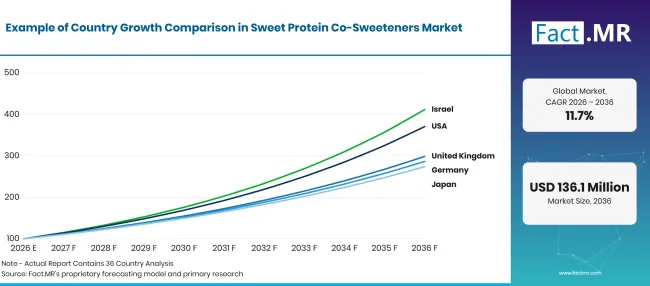
Sweet Protein Co Sweeteners Growth Index | Source: Fact.MR
| Country | CAGR (2026-2036) |
|---|---|
| Israel | 15.2% |
| United States | 14.0% |
| China | 13.3% |
| Germany | 11.1% |
| Japan | 10.6% |
Source: Fact.MR analysis. Updated Nov 20, 2026
Source: Fact.MR analysis.
Why is Israel the fastest-growing market for sweet protein co-sweeteners?
Demand for sweet protein co-sweeteners in Israel is forecast to increase at a 15.2% CAGR through 2036, the fastest among the five countries.
Domestic biotechnology companies are developing protein-based sweeteners as alternatives to conventional sugar and artificial sweetening ingredients. Amai Proteins is working on sweet protein technologies designed for food and beverage applications. Public research institutions and biotechnology partnerships support ingredient development. Israeli manufacturers are exploring fermentation-based production and formulation improvements. Commercial opportunities will depend on manufacturing efficiency, regulatory acceptance, sweetness quality and partnerships with international food producers.
What is shaping sweet protein co-sweetener sales in the United States?
Sales of sweet protein co-sweeteners in the United States are set to rise at a 14.0% CAGR through 2036, supported by regulatory progress and partnerships between ingredient developers and food manufacturers.
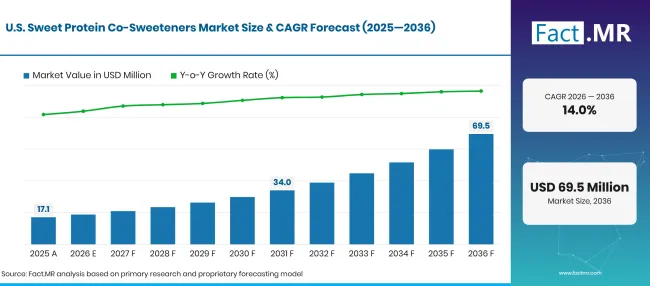
Sweet Protein Co Sweeteners Forecast Usa | Source: Fact.MR
Oobli has received FDA no-questions letters following GRAS assessments for its sweet proteins, supporting their commercial development for specified uses. Its collaboration with Ingredion is also intended to expand market access. Beverage and confectionery manufacturers are examining protein-based sweetness solutions. Further adoption will reflect ingredient availability, formulation stability, sensory performance and compliance with applicable food safety requirements.
What is driving sweet protein co-sweetener demand in China?
Sales of sweet protein co-sweeteners in China are forecast to expand at a 13.3% CAGR through 2036 as beverage manufacturers develop reduced-sugar products for health-conscious consumers.
Brands such as Genki Forest and Nongfu Spring have established positions in the sugar-free beverage category, creating opportunities for alternative sweetening ingredients. Sweet proteins offer potential applications in flavored waters, teas and functional drinks. Ingredient developers are examining combinations that improve sweetness profiles alongside existing sweeteners. Commercial adoption will depend on regulatory clearance, production costs, ingredient stability and consumer taste preferences.
What is shaping sweet protein co-sweetener demand in Germany?
Demand for sweet protein co-sweeteners in Germany is likely to advance at an 11.1% CAGR through 2036 as beverage and food manufacturers pursue sugar reduction targets.
Germany's national reduction strategy encourages reformulation, while retailers continue to emphasize nutritional improvements in packaged products. New sweet proteins must meet applicable EU novel food requirements before entering relevant commercial applications. Ingredient suppliers are developing formulations that complement established sweeteners and improve taste quality. Manufacturers will consider regulatory authorization, sweetness consistency, processing stability and commercial ingredient availability when evaluating new protein-based alternatives.
Why is sweet protein co-sweetener growth slower in Japan?
Demand for sweet protein co-sweeteners in Japan is expected to increase at a 10.6% CAGR through 2036, the slowest among the five countries.
Established sweetening ingredients, including stevia and sucralose, maintain strong positions in beverage and processed food formulations. Regulatory evaluation of newer sweet proteins also influences commercialization schedules. Japanese beverage manufacturers, including Suntory, have experience developing reduced-sugar products and assessing alternative sweetening technologies. New protein-based ingredients will need to demonstrate suitable taste, processing stability and manufacturing consistency before gaining wider acceptance among domestic food producers.
Competitive Market for Sweet Protein Co-Sweeteners Market
Competition in the sweet protein co-sweeteners market includes biotechnology companies developing fermentation-derived proteins and established ingredient manufacturers offering sugar reduction solutions. Oobli, Amai Proteins and Conagen focus on sweet protein development and production technologies, while Ingredion, Sweegen and Givaudan compete through sweetener formulation expertise, ingredient portfolios and application support. Suppliers are developing combinations of thaumatin, brazzein, monellin and stevia to improve sweetness quality in reduced-sugar foods. Buyers assess sweetness intensity, taste characteristics, formulation stability, regulatory acceptance and manufacturing consistency when selecting ingredients.
From 2025 onward, partnerships between biotechnology developers and established ingredient suppliers have become more important for commercial expansion. In February 2025, Oobli and Ingredion announced a partnership to develop sweetening systems combining fermentation-derived sweet proteins with stevia. Ingredion subsequently highlighted its reduced-sugar formulation capabilities and broader ingredient solutions for food manufacturers. Companies are refining production methods, ready-to-use premixes and applications for beverages and confectionery. Suppliers with reliable fermentation processes, regulatory expertise and established food industry relationships are better positioned to expand commercial adoption.
Recent Developments
- In February 2025, Oobli partnered with Ingredion to develop sweetener systems combining fermentation-derived sweet proteins with stevia, supporting sugar reduction and improved taste in food and beverage products across commercial applications.
Key Players in Sweet Protein Co-Sweeteners Market
Key companies operating in the market include Oobli, Sweegen, Amai Proteins, Givaudan, Conagen, and Ingredion.
- Oobli
- Sweegen
- Amai Proteins
- Givaudan
- Conagen
- Ingredion
Bibliography
- European Food Safety Authority. (2025, April 30). Re-evaluation of acesulfame K (E 950) as food additive.
- European Food Safety Authority. (2026, February 16). Re-evaluation of sucralose (E 955) as a food additive.
- European Food Safety Authority. (2026, September 10). EFSA concludes the salt of aspartame-acesulfame (E 962) is safe at current exposure levels.
- HM Revenue & Customs. (2026, January 30). Soft Drinks Industry Levy statistics commentary 2026. GOV.UK.
- HM Revenue & Customs. (2026, July 13). Changes to the Soft Drinks Industry Levy. GOV.UK.
- Ingredion Incorporated. (2025, February 28). Ingredion y Oobli anuncian alianza ante la creciente demanda de proteínas dulces [Ingredion and Oobli announce partnership amid growing demand for sweet proteins].
- Ingredion Incorporated. (2025, November 14). Solutions for reduced-sugar products: Meeting consumer trends at scale.
- Ingredion Incorporated. (2026, July 6). Ingredion to spotlight next-generation solutions for texture, clean labels and positive nutrition at IFT FIRST 2026.
- Oobli. (2025, February 13). Oobli and Ingredion announce partnership as demand for sweet proteins accelerates. Official announcement
- World Health Organization. (2026, January 13). Global report on the use of sugar-sweetened beverage taxes, 2025.
- World Health Organization. (2026, January 26). Healthy diet.
Segmentation
Scope of Report
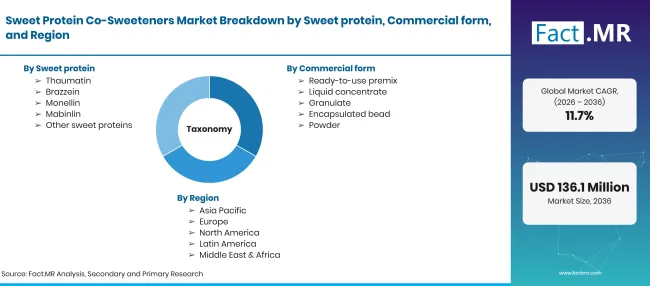
Sweet Protein Co Sweeteners Taxonomy | Source: Fact.MR
| Items | Values |
|---|---|
| Quantitative Units (2026) | USD 45.0 Million |
| Sweet protein | Brazzein, Thaumatin, Monellin, Mabinlin, Other sweet proteins |
| Commercial form | Powder, Liquid concentrate, Granulate, Encapsulated bead, Ready-to-use premix |
| Food application | Bakery, Dairy / alternatives, Beverage, Meat / savory, Confectionery / snacks |
| Primary function | Shelf-life, Texture / rheology, Taste / color, Nutritional functionality, Processing stability |
| Regions Covered | North America, Latin America, Europe, East Asia, South Asia and Pacific, Middle East & Africa |
| Countries Covered | Israel, United States, China, Germany, Japan, and other countries |
| Key Companies Profiled | Oobli, Sweegen, Amai Proteins, Givaudan, Conagen, Ingredion |
| Additional Attributes | Dollar revenue in the Sweet Protein Co-Sweeteners Market is segmented by sweet protein (brazzein, thaumatin, monellin, mabinlin, other sweet proteins); commercial form (powder, liquid concentrate, granulate, encapsulated bead, ready-to-use premix); food application (bakery, dairy / alternatives, beverage, meat / savory, confectionery / snacks); primary function (shelf-life, texture / rheology, taste / color, nutritional functionality, processing stability) and region. |
Source: Fact.MR analysis. Updated Nov 20, 2026
Source: Fact.MR analysis.
Sweet Protein Co-Sweeteners Market by Segments
-
Sweet protein
- Brazzein
- Thaumatin
- Monellin
- Mabinlin
- Other sweet proteins
-
Commercial form
- Powder
- Liquid concentrate
- Granulate
- Encapsulated bead
- Ready-to-use premix
-
Food application
- Bakery
- Dairy / alternatives
- Beverage
- Meat / savory
- Confectionery / snacks
-
Primary function
- Shelf-life
- Texture / rheology
- Taste / color
- Nutritional functionality
- Processing stability
-
Region:
- North America
- United States
- Canada
- Mexico
- Europe
- Germany
- United Kingdom
- France
- Italy
- Spain
- Rest of Europe
- Asia Pacific
- China
- India
- Japan
- South Korea
- Australia
- Rest of Asia Pacific
- Latin America
- Brazil
- Mexico
- Argentina
- Rest of Latin America
- Middle East & Africa
- GCC Countries
- South Africa
- Rest of Middle East & Africa
- North America
Frequently Asked Questions
How big is the global Sweet Protein Co-Sweeteners Market in 2026?
What will be the size of the Sweet Protein Co-Sweeteners Market by 2036?
How fast will the Sweet Protein Co-Sweeteners Market grow during the forecast period?
Which sweet protein segment holds the largest share of the Sweet Protein Co-Sweeteners Market?
Who worked on this report


Preview the report firsthand - request a free sample
Free SampleGet the brochure for pricing and purchase details
Download PDF