- Market Value (2025): USD 129.9 Mn
- Estimated Value (2026): USD 142.0 Mn
- Forecast Value (2036): USD 345.5 Mn
- CAGR (2026-2036): 9.3%
Natural Color Retention Systems Market Forecast and Outlook 2026 to 2036
Global natural color retention systems revenue is estimated at USD 142.0 million in 2026, reaching USD 345.5 million in 2036. Across the decade, this corresponds to a 9.3% compound annual growth rate for natural color retention systems.
Demand for natural color retention systems is growing as food makers replace synthetic dyes with plant colors that fade or shift with heat, light, pH and oxygen. Retention systems use antioxidants, chelators, encapsulation and pH control to keep anthocyanins, carotenoids and chlorophylls bright through processing and shelf life. For example, in April 2025, the US FDA announced plans to phase out petroleum-based synthetic dyes from the food supply, after revoking authorization for Red No. 3 in January 2025. Formulators will evaluate color changes during heating, exposure to light and storage before approving a stabilizer.
Market Snapshot: Natural Color Retention Systems Market
- Sales of natural color retention systems stood at USD 129.9 million in 2025
- Natural Color Retention Systems Market Value (2026): USD 142.0 million
- Natural Color Retention Systems Market Forecast Value (2036): USD 345.5 million
- Natural Color Retention Systems Market Forecast CAGR (2026-2036): 9.3%
- Leading Color protected: Anthocyanins (26.6%)
- Key Market Participants: Corbion, Jungbunzlauer, Balchem, Kerry Group, Kemin Industries, Inc., Cargill
- Key Growth Regions: China, Netherlands, United States, France, Germany
In June 2025, Kraft Heinz said it would remove FD&C colors from its US products by the end of 2027, joining other large food makers moving to natural colors. Orders for natural color retention systems are associated with these reformulations reveal stability problems with natural pigments. Suppliers also offer color-protecting antioxidant and encapsulation systems. Formulators will evaluate color changes during heating, exposure to light and storage before approving a stabilizer.
Natural Color Retention Systems Market
| Metric | Value |
|---|---|
| Estimated Value in (2026) | USD 142.0 million |
| Forecast Value in (2036) | USD 345.5 million |
| Forecast CAGR (2026 to 2036) | 9.3% |
Source: Fact.MR analysis. Updated Nov 19, 2026
Source: Fact.MR analysis.
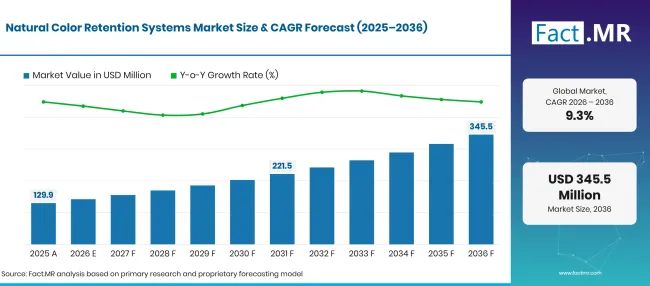
Natural Color Retention Systems Forecast Global | Source: Fact.MR
Category
| Category | Segments |
|---|---|
| Color protected | Anthocyanins, Carotenoids, Chlorophylls, Betalains, Curcuminoids |
| Commercial form | Powder, Liquid concentrate, Granulate, Encapsulated bead, Ready-to-use premix |
| Food application | Bakery, Dairy / alternatives, Beverage, Meat / savory, Confectionery / snacks |
| Primary function | Shelf-life, Texture / rheology, Taste / color, Nutritional functionality, Processing stability |
| Region | China; Netherlands; United States; France; Germany |
Source: Fact.MR analysis. Updated Nov 19, 2026
Source: Fact.MR analysis.
Segmental Analysis
Why do anthocyanins lead protected-color demand in the Natural Color Retention Systems Market?
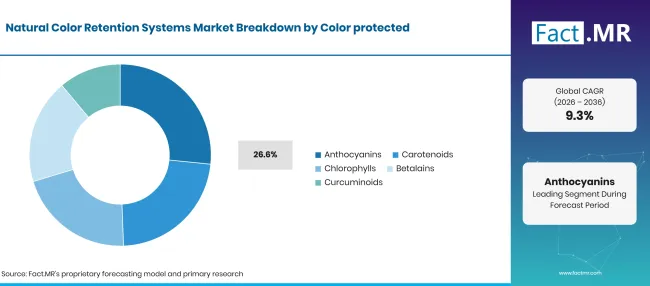
Natural Color Retention Systems Breakdown Color Protected | Source: Fact.MR
Anthocyanins account for 26.6% of revenue in 2026, approximately USD 37.8 million, as food manufacturers use pigments from berries, purple carrots and red cabbage to replace synthetic colorants. Their sensitivity to heat and pH creates demand for protective formulations. Carotenoids and chlorophylls serve additional applications. Suppliers are developing stabilization systems that preserve pigment intensity during processing and storage.
Why does powder lead commercial-form demand in the Natural Color Retention Systems Market?
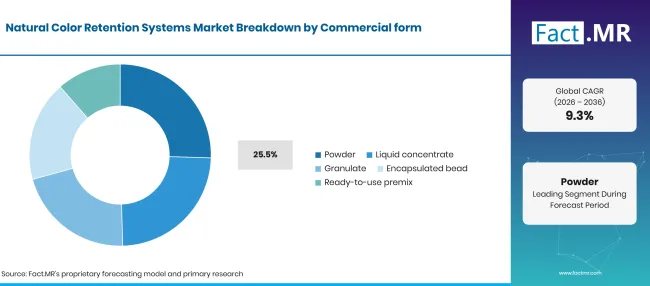
Natural Color Retention Systems Breakdown Commercial Form | Source: Fact.MR
Powder formulations represent 25.5% of revenue in 2026, valued at approximately USD 36.2 million, supported by their compatibility with dry food ingredients and manufacturing processes. Stabilizer blends can be incorporated into flour mixes, sugar coatings and seasoning formulations. Encapsulated beads and premixes serve specialized applications. Suppliers are improving powder dispersibility, storage stability and ingredient compatibility to support consistent color retention.
Why does bakery lead application demand in the Natural Color Retention Systems Market?
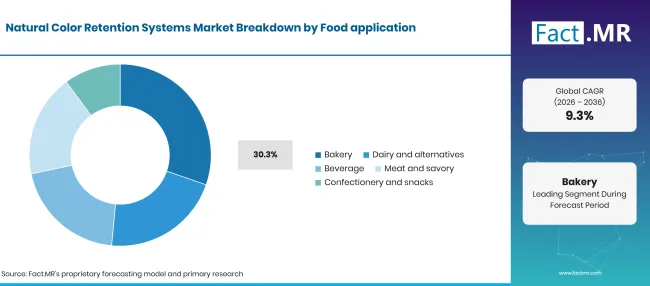
Natural Color Retention Systems Breakdown Food Application | Source: Fact.MR
Bakery applications hold 30.3% of revenue in 2026, equivalent to approximately USD 43.0 million, as manufacturers seek natural pigments that withstand baking temperatures and varying formulation conditions. Heat exposure and alkaline leavening can affect color stability in cakes, cookies and icings. Meat and savory applications contribute additional demand. Ingredient suppliers are developing bake-stable systems that maintain color appearance throughout processing.
Why does shelf-life lead function demand in the Natural Color Retention Systems Market?
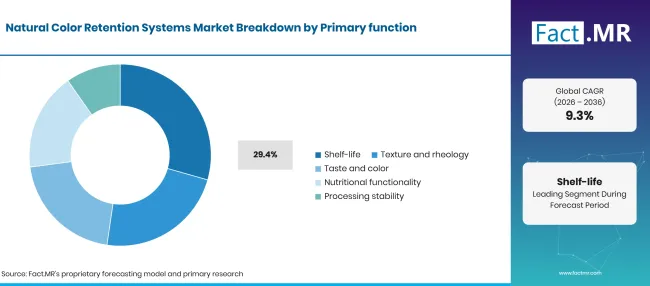
Natural Color Retention Systems Breakdown Primary Function | Source: Fact.MR
Shelf-life accounts for 29.4% of revenue in 2026, approximately USD 41.7 million, reflecting manufacturers' need to preserve natural pigment appearance during storage and distribution. Exposure to oxygen, light and temperature changes can reduce color intensity before products reach consumers. Texture and nutrition remain additional formulation considerations. Suppliers are developing protective systems that maintain visual consistency and support longer product storage periods.
Natural Color Retention Systems Market-Drivers, Restraints & Trends
Drivers:
Demand for natural color retention systems is increasing as US manufacturers reformulate products in response to regulatory action and voluntary commitments. The FDA revoked authorization for Red No. 3, while its wider effort encourages the removal of other petroleum-based dyes by the end of 2027. Suppliers also offer stabilization services.
Restraints:
Demand for natural color retention systems is limited by the higher cost of natural colors plus stabilizers and by limits on achieving some shades naturally. Formulators will evaluate color changes during heating, exposure to light and storage before approving a stabilizer. Suppliers will need to expand stable shade ranges.
Trend:
Synthetic Dye Phase-Out. Demand for stable natural colors is increasing because US companies remove FD&C dyes. Suppliers also offer full color solutions. Demand for stable blues is rising after the FDA approved galdieria extract blue in 2025. Suppliers are developing stabilization for new pigments.
Natural Color Retention Systems Market by Analysis by Key Country
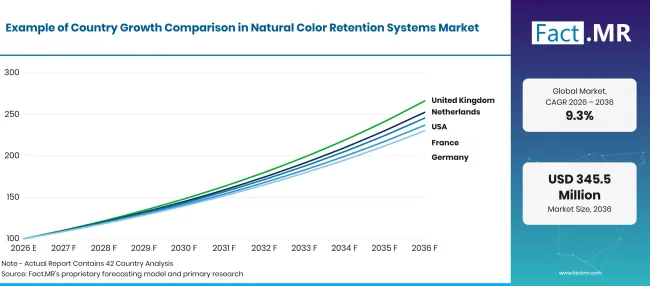
Natural Color Retention Systems Growth Index | Source: Fact.MR
| Country | CAGR (2026-2036) |
|---|---|
| China | 10.9% |
| Netherlands | 9.5% |
| United States | 9.4% |
| France | 8.8% |
| Germany | 8.7% |
Source: Fact.MR analysis. Updated Nov 19, 2026
Source: Fact.MR analysis.
Why is China the fastest-growing market for natural color retention systems?
Demand for natural color retention systems in China is forecast to increase at a 10.9% CAGR through 2036, the fastest among the five countries.
Domestic natural color producers are expanding their product ranges as food manufacturers improve ingredient labels for international markets. Export-oriented processors require stable natural pigments for beverages, confectionery and packaged foods. Chinese ingredient suppliers are developing formulations that protect color intensity during heating and storage. Purchasing decisions will reflect pigment stability, ingredient compatibility, processing performance and the requirements of international food manufacturers.
What is driving natural color retention demand in the Netherlands?
Demand for natural color retention systems in the Netherlands is set to rise at a 9.5% CAGR through 2036, supported by established food ingredient manufacturers and natural coloring expertise.
GNT Group, headquartered in Mierlo, develops EXBERRY coloring foods using fruits, vegetables and other edible plant materials. Its international customer base creates opportunities for formulations that maintain color consistency across different food applications. Dutch suppliers are improving pigment protection during processing and storage. Food manufacturers will prioritize heat resistance, light stability, formulation compatibility and consistent appearance throughout product shelf life.
How is the dye phase-out shaping natural color retention sales in the United States?
Sales of natural color retention systems in the United States are forecast to expand at a 9.4% CAGR through 2036 as food manufacturers reformulate products containing synthetic colorants.
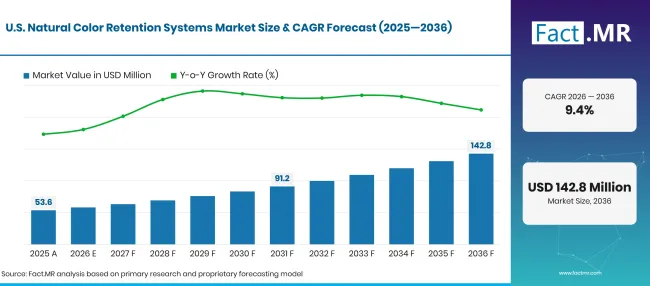
Natural Color Retention Systems Forecast Usa | Source: Fact.MR
In April 2025, the FDA announced plans to phase out petroleum-based food dyes. Companies including Kraft Heinz and General Mills have also announced commitments to remove synthetic colors from selected product portfolios. These changes are creating opportunities for natural pigment stabilization technologies. Suppliers are developing systems that improve heat resistance, color consistency and storage stability across packaged food applications.
What is shaping natural color retention demand in France?
Demand for natural color retention systems in France is likely to advance at an 8.8% CAGR through 2036, reflecting established preferences for natural ingredients in bakery, confectionery and packaged foods.
France introduced restrictions on titanium dioxide in food before the wider EU prohibition, encouraging manufacturers to review ingredient formulations. Natural pigments require protection from heat, light and changes in acidity during processing. French food producers are seeking stable color solutions that maintain product appearance. Suppliers will compete through formulation expertise, pigment compatibility and reliable performance during storage.
Why is natural color retention growth slower in Germany?
Demand for natural color retention systems in Germany is forecast to increase at an 8.7% CAGR through 2036, the slowest among the five countries.
Natural colorants already have an established presence in packaged foods, following earlier reformulation efforts by major retailers and manufacturers. Further opportunities are emerging in plant-based alternatives, bakery products and processed foods requiring improved pigment stability. German ingredient suppliers are developing protective formulations suited to different processing conditions. Buyers will assess heat resistance, color consistency, shelf-life performance and compatibility with existing product recipes.
Competitive Market for Natural Color Retention Systems Market
Competition in the natural color retention systems market is divided between acid and antioxidant producers and broad ingredient groups. Corbion, Jungbunzlauer, Kemin Industries, Inc. and Balchem compete on stabilizers and encapsulation, while Kerry Group and Cargill compete on broader color and ingredient portfolios. Buyers select systems on stability, shade, label and cost.
From 2025 onward, competition shifted toward helping US food makers replace synthetic dyes. An advantage may accrue to suppliers with proven stabilization as they seek to grow.
Recent Developments
- In June 2026, Corbion launched LUMI Set, a titanium dioxide-free icing stabilizer designed to maintain the appearance, texture and stability of water-based bakery icings while supporting manufacturers seeking alternative food formulations.
- In September 2025, Kemin launched OLESSENCE G Liquid, a plant-derived ingredient blend designed to help maintain food quality, delay enzymatic browning and protect color in sauces, dips and other food applications.
- In July 2025, Jungbunzlauer launched TayaGel LA, a low-acyl gellan gum designed to improve suspension, gel formation and visual clarity in food and beverage formulations requiring stable texture and consistent appearance.
Key Players in Natural Color Retention Systems Market
Key companies operating in the market include Corbion, Jungbunzlauer, Balchem, Kerry Group, Kemin Industries, Inc., and Cargill.
- Corbion
- Jungbunzlauer
- Balchem
- Kerry Group
- Kemin Industries, Inc.
- Cargill
Bibliography
- Corbion. (2026, June 15). Corbion launches LUMI Set to help bakers reformulate away from titanium dioxide without sacrificing visual appeal.
- Conagra Brands, Inc. (2025, June 25). Conagra Brands to achieve multi-year modernization milestone in frozen portfolio by end of 2025.
- Consumer Brands Association. (2025, July 11). Consumer Brands Association announces voluntary initiative to remove certified artificial colors in food and beverage products from schools.
- General Mills, Inc. (2025, June 17). General Mills announces plans to remove certified colors from all U.S. cereals and all foods served in K–12 schools by summer 2026.
- Jungbunzlauer. (2025, July 14). Jungbunzlauer launches new TayaGel LA at IFT FIRST 2025. Official product announcement
- Kemin Industries. (2025, September 10). Kemin Food Technologies – EMEA launches next generation of OLESSENCE natural solutions to deliver freshness and enhance flavour. Official press release
- Nestlé USA. (2026, June 15). Nestlé USA completes removal of FD&C colors across U.S. portfolio.
- PepsiCo, Inc. (2026, April 16). 150 million Americans feel dehydrated: Gatorade aims to change how people think about hydration.
- Sensient Technologies Corporation. (2026). Sustainability report 2025.
- The Kraft Heinz Company. (2025, June 17). Kraft Heinz commits to remove FD&C colors from its U.S. portfolio before the end of 2027 and will not launch new products in the U.S. with FD&C colors, effective immediately.
- U.S. Department of Health and Human Services. (2025, April 22). HHS, FDA to phase out petroleum-based synthetic dyes in nation’s food supply.
- U.S. Food and Drug Administration. (2025, May 9). FDA approves three food colors from natural sources.
Segmentation
Scope of Report
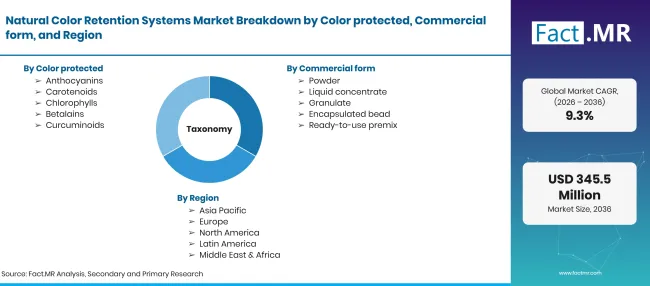
Natural Color Retention Systems Taxonomy | Source: Fact.MR
| Items | Values |
|---|---|
| Quantitative Units (2026) | USD 142.0 Million |
| Color protected | Anthocyanins, Carotenoids, Chlorophylls, Betalains, Curcuminoids |
| Commercial form | Powder, Liquid concentrate, Granulate, Encapsulated bead, Ready-to-use premix |
| Food application | Bakery, Dairy / alternatives, Beverage, Meat / savory, Confectionery / snacks |
| Primary function | Shelf-life, Texture / rheology, Taste / color, Nutritional functionality, Processing stability |
| Regions Covered | North America, Latin America, Europe, East Asia, South Asia and Pacific, Middle East & Africa |
| Countries Covered | China, Netherlands, United States, France, Germany, and other countries |
| Key Companies Profiled | Corbion, Jungbunzlauer, Balchem, Kerry Group, Kemin Industries, Inc., Cargill |
| Additional Attributes | Dollar revenue in the Natural Color Retention Systems Market is segmented by color protected (anthocyanins, carotenoids, chlorophylls, betalains, curcuminoids); commercial form (powder, liquid concentrate, granulate, encapsulated bead, ready-to-use premix); food application (bakery, dairy / alternatives, beverage, meat / savory, confectionery / snacks); primary function (shelf-life, texture / rheology, taste / color, nutritional functionality, processing stability) and region. |
Source: Fact.MR analysis. Updated Nov 19, 2026
Source: Fact.MR analysis.
Natural Color Retention Systems Market by Segments
-
Color protected
- Anthocyanins
- Carotenoids
- Chlorophylls
- Betalains
- Curcuminoids
-
Commercial form
- Powder
- Liquid concentrate
- Granulate
- Encapsulated bead
- Ready-to-use premix
-
Food application
- Bakery
- Dairy / alternatives
- Beverage
- Meat / savory
- Confectionery / snacks
-
Primary function
- Shelf-life
- Texture / rheology
- Taste / color
- Nutritional functionality
- Processing stability
-
Region:
- North America
- United States
- Canada
- Mexico
- Europe
- Germany
- United Kingdom
- France
- Italy
- Spain
- Rest of Europe
- Asia Pacific
- China
- India
- Japan
- South Korea
- Australia
- Rest of Asia Pacific
- Latin America
- Brazil
- Mexico
- Argentina
- Rest of Latin America
- Middle East & Africa
- GCC Countries
- South Africa
- Rest of Middle East & Africa
- North America
Frequently Asked Questions
How big is the global Natural Color Retention Systems Market in 2026?
What will be the size of the Natural Color Retention Systems Market by 2036?
How fast will the Natural Color Retention Systems Market grow during the forecast period?
Which color protected segment holds the largest share of the Natural Color Retention Systems Market?
Who worked on this report


Preview the report firsthand - request a free sample
Free SampleGet the brochure for pricing and purchase details
Download PDF