- Base Value(2025): 1.7 Bn
- Estimated Value(2026): 1.9 Bn
- Forecast Value (2036): 5 Bn
- CAGR (2026 - 2036): 10.2%
Middle East Digestive Health Products Market Size, Share and Forecast and Outlook By Fact.MR
In 2025, the Middle East digestive health products market was valued at USD 1.7 billion. Fact MR analysis indicates demand for digestive health products is expected to reach USD 1.9 billion in 2026 and USD 5 billion by 2036. FMR estimates the market will expand at a CAGR of 10.2% across the forecast period.
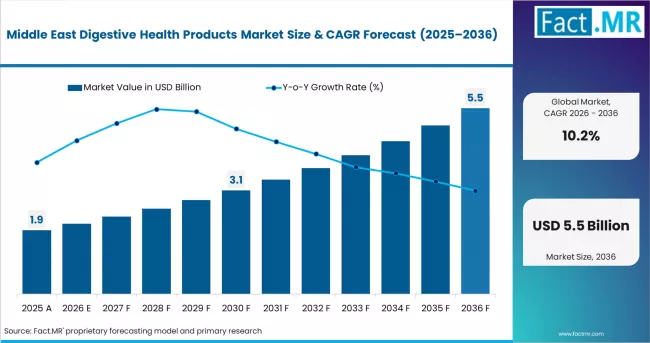
Middle East Digestive Health Products Market Value Analysis | Source: Fact.MR
Middle East Digestive Health Products Market
| Metric | Details |
|---|---|
| Industry Size (2026E) | USD 1.9 billion |
| Industry Value (2036F) | USD 5 billion |
| CAGR (2026 to 2036) | 10.2% |
Source: Fact.MR analysis. Updated May 4, 2026
- Market Definition
- The Middle East digestive health products market refers to nutraceutical formulations, functional foods, and dietary supplements designed to support gastrointestinal balance, microbiome stability, and digestive efficiency. These products include probiotics, prebiotics, digestive enzymes, fiber-based supplements, and herbal digestive formulations used to improve gut microbiota composition, nutrient absorption efficiency, and gastrointestinal comfort across preventive nutrition applications.
- Demand Drivers
- Increasing consumer awareness regarding gut microbiome balance and digestive wellness as part of preventive healthcare routines.
- Expansion of probiotic-based supplement consumption supporting gastrointestinal comfort and microbiota stability.
- Growth of pharmacy-led retail distribution networks improving accessibility of clinically positioned digestive formulations.
- Increasing incorporation of digestive health ingredients within functional foods and beverages targeting daily wellness consumption.
- Rising prevalence of lifestyle-related digestive discomfort supporting demand for fiber supplements and enzyme-based formulations.
- Expansion of online retail channels supporting wider availability of nutraceutical digestive health product portfolios.
- Key Segments Analyzed
- Product Type: Probiotics account for 36.8% share supported by increased use of microbiome-support formulations across dietary supplements and functional foods.
- Distribution Channel: Pharmacies represent 44.2% share supported by consumer preference for regulated retail environments offering clinically positioned digestive formulations.
- Form: Capsules and powders demonstrate strong adoption supported by dosing precision and formulation stability across varying climatic storage conditions.
- Application: Functional foods and beverages demonstrate expanding penetration supported by integration of digestive ingredients in daily nutrition formats.
- Geography: UAE and Saudi Arabia demonstrate strongest demand growth supported by pharmacy retail expansion and preventive nutrition awareness, while Israel and Turkey reflect established nutraceutical consumption environments.
- Analyst Opinion at Fact MR
- Rohit Kumar Singh, Senior Industry Analyst at Fact MR, states, "Digestive health products in the Middle East are transitioning from traditional fermented food consumption toward clinically positioned microbiome-support supplements. Market expansion reflects increased consumer awareness regarding gut health as part of preventive nutrition strategies. Probiotic strain validation, formulation stability under regional climatic conditions, and pharmacy-led distribution networks remain critical competitive factors shaping product adoption through 2036."
- Strategic Implications
- Strengthen probiotic strain stabilization capability supporting product viability under high temperature distribution environments.
- Expand pharmacy distribution partnerships supporting regulated retail availability of digestive health nutraceutical products.
- Improve product formulation diversity supporting integration of probiotics, enzymes, and fiber ingredients across functional food formats.
- Strengthen clinical validation capability supporting credibility of microbiome-support product positioning.
- Expand online retail channel presence supporting accessibility across urban and semi-urban consumer populations.
- Improve dosage format versatility supporting capsules, powders, and gummies aligned with consumer consumption preferences.
- Methodology
- Developed using primary interviews with nutraceutical manufacturers, functional food producers, gastroenterology specialists, and regional distribution partners.
- Supported through review of scientific publications, regulatory frameworks, and technical product literature addressing microbiome-support ingredients.
- Market estimation applied hybrid modeling combining supplement revenue benchmarking with evaluation of digestive health awareness trends.
- Data validated through triangulation using ingredient supplier data, expert consultation inputs, and regional nutraceutical consumption patterns.
- Periodic updates incorporate developments in probiotic strain research, regulatory classification frameworks, and innovation in digestive enzyme and fiber-based formulations.
A CAGR of 10.2%, with value rising from USD 1.9 billion to USD 5 billion, indicates an inflection point as preventive nutrition shifts from niche supplements to mainstream digestive health formulations. Growth is supported by probiotic adoption and retail expansion, while moderated by regulatory classification differences, pricing sensitivity, and formulation stability requirements in regional climates.
The UAE records the fastest growth at 11.4%, supported by increasing consumption of probiotic supplements and functional nutrition products. Saudi Arabia follows at 10.8%, driven by rising demand for digestive wellness formulations across pharmacy retail channels. Israel shows 10.6% growth, linked to expansion of clinically positioned microbiome-support products. Turkey at 10.3% and South Africa at 9.8% represent relatively mature markets where demand is largely replacement-driven due to established presence of digestive health supplement categories. A structural constraint across mature markets is regulatory oversight on health claims, which limits rapid introduction of new functional ingredient combinations.
Segmental Analysis
Middle East Digestive Health Products Market Analysis by Distribution Channel
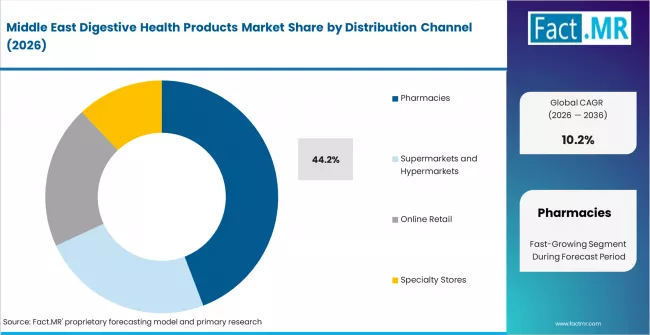
Middle East Digestive Health Products Market Analysis By Distribution Channel | Source: Fact.MR
- Market Overview: Pharmacies are projected to hold 44.2% share of the Middle East digestive health products market in 2026. Demand concentration reflects consumer preference for clinically positioned digestive health formulations distributed through regulated retail channels providing pharmacist guidance and product authenticity assurance. Retail pharmacy networks support availability of probiotic supplements, digestive enzymes, and gastrointestinal support formulations aligned with therapeutic product positioning.
- Demand Drivers:
- Professional Recommendation Influence: Consumers rely on pharmacist consultation when selecting digestive health formulations requiring dosage guidance and product suitability verification.
- Regulated Product Access: Pharmacies maintain compliance with regional health product distribution requirements, ensuring availability of certified digestive health supplements across controlled retail environments.
- Retail Network Expansion: Growth of organized pharmacy chains supports broader geographic accessibility of digestive health products across urban and semi-urban markets.
Middle East Digestive Health Products Market Analysis by Product Type
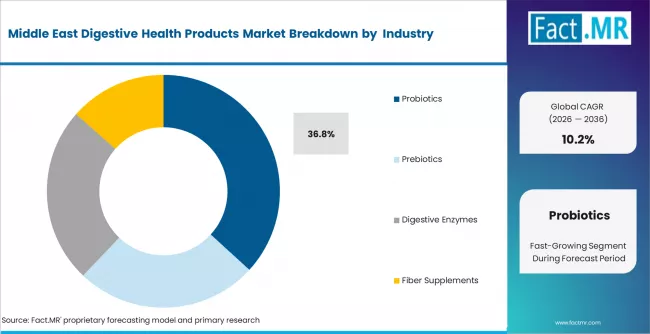
Middle East Digestive Health Products Market Analysis By Product Type | Source: Fact.MR
-
Market Overview: Probiotics are estimated to account for 36.8% share in 2026, supported by increased incorporation of beneficial microbial strains in dietary supplements and functional foods designed to support gastrointestinal microbiota balance. Product formulation strategies emphasize strain stability and controlled viability across storage and consumption conditions.
- Demand Drivers:
- Microbiota Balance Requirements: Probiotic formulations are utilized to support digestive system stability through introduction of beneficial bacterial strains associated with gastrointestinal health maintenance.
- Preventive Healthcare Adoption: Consumers increasingly utilize probiotic supplements as part of routine dietary intake supporting digestive function management.
- Product Format Versatility: Probiotic ingredients are incorporated across capsules, sachets, dairy-based formulations, and functional beverages designed for convenient daily consumption.
Key Dynamics
Middle East Digestive Health Products Market Drivers, Restraints, and Opportunities
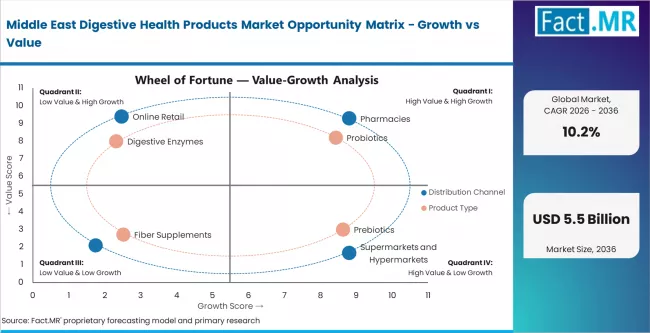
Middle East Digestive Health Products Market Opportunity Matrix Growth Vs Value | Source: Fact.MR
Fact MR analysis indicates the market reflects a transitioning nutraceutical and functional food segment shaped by increasing preventive healthcare orientation across Gulf Cooperation Council countries. Market size exists because digestive health disorders including IBS, lactose intolerance, and metabolic syndrome are increasingly addressed through over-the-counter probiotic supplements, fortified dairy products, and fiber-enriched formulations. Historical demand was concentrated in yogurt and fermented dairy formats, while the current valuation reflects expansion into capsules, powders, and functional beverages aligned with rising health awareness and pharmacy-led supplement retail growth across the region.
Current dynamics show declining reliance on traditional fermented dairy as standalone digestive solutions, while targeted probiotic strains, synbiotic blends, and enzyme-based digestive aids command higher per-unit pricing due to strain stabilization and clinical validation requirements. Premium formulations increase ingredient value intensity even as overall consumption volumes expand gradually across Saudi Arabia, UAE, and Egypt. Market expansion reflects a structural shift toward microbiome-positioned functional products integrated into daily preventive health routines rather than episodic treatment formats.
- Preventive Healthcare Shift: Rising prevalence of lifestyle disorders and increasing consumer awareness of gut health are supporting steady uptake of probiotic and prebiotic supplements across pharmacy and online retail channels.
- GSO Supplement Regulation: GCC Technical Regulation for Health Supplements (GSO 2538/2021) standardizes registration, labeling, and safety requirements, improving consumer trust and enabling structured market expansion for digestive health formulations.
- GCC Demand Concentration: Saudi Arabia and UAE dominate regional consumption due to higher disposable income, expanding modern retail infrastructure, and strong adoption of functional foods targeting digestive wellness.
Regional Analysis
The Middle East digestive health products market is assessed across Middle East & Africa, segmented by country-level demand for probiotic supplements, prebiotic fortified foods, digestive enzyme formulations, and gut health functional beverages. Geographic variation reflects preventive healthcare awareness, functional nutrition adoption, and regulatory positioning for nutraceutical products. The full report offers market attractiveness analysis.
.webp "Top Country Growth Comparison Middle East Digestive Health Products Market Cagr (2026 2036)")
Top Country Growth Comparison Middle East Digestive Health Products Market Cagr (2026 2036) | Source: Fact.MR
CAGR Table
| Country | CAGR (2026–2036) |
|---|---|
| UAE | 11.4% |
| Saudi Arabia | 10.8% |
| Israel | 10.6% |
| Turkey | 10.3% |
| South Africa | 9.8% |
Source: Fact.MR analysis. Updated May 4, 2026
Source: Fact MR analysis, based on proprietary forecasting model and primary research
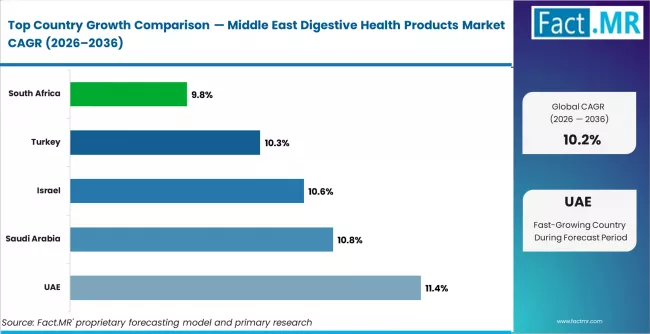
Middle East Digestive Health Products Market Cagr Analysis By Country | Source: Fact.MR
Middle East & Africa
Middle East & Africa functions as the functional nutrition adoption corridor supported by increasing preventive healthcare awareness and expansion of probiotic product distribution networks. Nestlé Health Science strengthens digestive wellness product formulation capability. Danone S.A. expands probiotic dairy portfolio depth. Yakult Honsha Co., Ltd. supports probiotic beverage supply capability.
- UAE: UAE is projected to record 11.4% CAGR in digestive health products through 2036. National Nutrition Strategy framework update (Ministry of Health and Prevention, March 2023) supports preventive health supplement adoption. Nestlé Health Science expanded probiotic product distribution capability (June 2023).
- Saudi Arabia: Saudi Arabia is expected to observe 10.8% CAGR in digestive health products through 2036. Saudi Vision 2030 healthcare transformation program update (Ministry of Health, January 2023) supports preventive nutrition product demand growth. Danone S.A. expanded probiotic dairy distribution agreements (April 2023).
- Israel: Israel is anticipated to expand at 10.6% CAGR in digestive health products through 2036. National preventive healthcare strategy update (Ministry of Health, February 2023) supports functional nutrition product adoption. Yakult Honsha Co., Ltd. expanded probiotic beverage market presence (May 2023).
- Turkey: Turkey is forecast to grow at 10.3% CAGR in digestive health products through 2036. Healthy Nutrition and Active Life Programme update (Ministry of Health, March 2023) supports digestive wellness product consumption. Nestlé Health Science expanded functional nutrition product availability (July 2023).
- South Africa: South Africa is projected to register 9.8% CAGR in digestive health products through 2036. National Food and Nutrition Security Plan update (Department of Health, January 2023) supports functional food adoption. Danone S.A. expanded probiotic yogurt product distribution capability (August 2023).
Fact MR's analysis of digestive health products market in Middle East & Africa consists of country-wise assessment that includes UAE, Saudi Arabia, Israel, Turkey, and South Africa. Readers can find probiotic product demand trends, functional nutrition developments, regulatory positioning frameworks, and competitive nutraceutical innovation insights.
Competitive Landscape
What is the Competitive Structure of the Middle East Digestive Health Products Market?
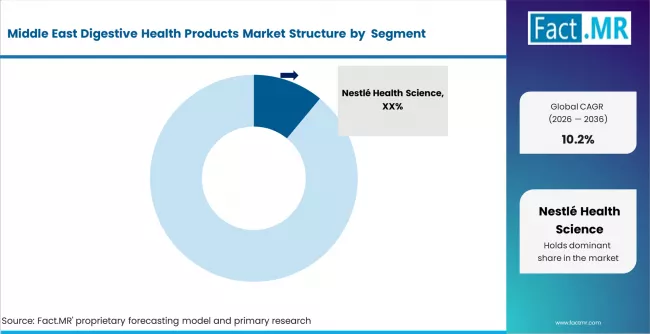
Middle East Digestive Health Products Market Analysis By Company | Source: Fact.MR
The Middle East Digestive Health Products Market reflects a moderately fragmented competitive structure, supported by multinational nutrition companies and consumer health product manufacturers with established regional distribution networks. Leading companies including Nestlé Health Science, Danone, Abbott, Bayer, Reckitt, DSM-Firmenich, Glanbia, Yakult, Herbalife, and Amway collectively account for approximately 55–65% of market share across probiotic supplements, digestive enzymes, functional dairy products, and gut health nutrition formulations. Competitive positioning is primarily determined by clinical validation of probiotic strains, brand credibility, formulation stability, and regulatory compliance across regional health authorities. Product differentiation is influenced by strain specificity, delivery format, and compatibility with dietary preferences observed across Middle Eastern consumer groups.
Structural advantages are observed among companies possessing established supply chains, strong brand portfolios, and long-term relationships with pharmacies, hospitals, and retail distributors. Nestlé Health Science and Danone benefit from extensive research capabilities supporting clinically studied probiotic strains and specialized nutritional formulations. Buyers typically manage supplier dependency through product comparison across multiple brands and evaluation of ingredient transparency, dosage consistency, and formulation efficacy. Distribution partnerships with regional retailers and healthcare providers influence procurement stability and product availability. Pricing power remains relatively balanced, though suppliers retain moderate leverage where clinically supported formulations and strong brand recognition create switching constraints among consumers seeking consistent digestive health product performance.
Key Players of the Middle East Digestive Health Products Market
- Nestlé Health Science
- Danone
- Abbott
- Yakult
- Herbalife
- Amway
- Bayer
- Reckitt
- DSM-Firmenich
- Glanbia
Bibliographies
- [1] Ministry of Health and Prevention (UAE). (2023, March). National Nutrition Strategy framework update.
- [2] Ministry of Health (Saudi Arabia). (2023, January). Saudi Vision 2030 healthcare transformation program update.
- [3] Ministry of Health (Israel). (2023, February). National preventive healthcare strategy update.
- [4] Ministry of Health (Turkey). (2023, March). Healthy Nutrition and Active Life Programme update.
- [5] Department of Health (South Africa). (2023, January). National Food and Nutrition Security Plan update.
- [6] Nestlé Health Science. (2023, June). Probiotic product distribution capability expansion UAE.
- [7] Danone S.A. (2023, April). Probiotic dairy distribution agreements expansion Saudi Arabia.
- [8] Yakult Honsha Co., Ltd. (2023, May). Probiotic beverage market presence expansion Israel.
- [9] Nestlé Health Science. (2023, July). Functional nutrition product availability expansion Turkey.
- [10] Danone S.A. (2023, August). Probiotic yogurt distribution capability expansion South Africa.
This Report Addresses
- Market size estimation and revenue forecasts from 2026 to 2036, supported by validated nutraceutical consumption benchmarks and preventive nutrition adoption indicators across digestive wellness product categories.
- Growth opportunity mapping across probiotics, prebiotics, digestive enzymes, fiber supplements, herbal digestive formulations, and functional foods and beverages aligned with microbiome balance and gastrointestinal support applications.
- Segment and regional revenue forecasts covering capsules, tablets, powders, liquids, and gummies distributed through pharmacies, supermarkets and hypermarkets, online retail platforms, and specialty nutrition stores across Middle East markets.
- Competition strategy assessment including benchmarking of probiotic strain stability, formulation efficacy validation, ingredient standardization capability, and brand positioning across digestive wellness product portfolios.
- Regulatory impact analysis covering GCC supplement registration frameworks, labeling requirements, and health claim compliance standards influencing commercialization of digestive health nutraceutical products.
- Market report delivery in PDF, Excel, PPT, and structured data formats designed for nutraceutical manufacturers, functional food producers, pharmacy chains, distributors, and preventive healthcare product strategists.
- Supply chain vulnerability assessments identifying concentration risks in probiotic culture production capacity, botanical extract sourcing, encapsulation manufacturing infrastructure, and regional distribution networks supporting digestive health product availability.
Middle East Digestive Health Products Market Definition
The Middle East digestive health products market refers to functional foods, supplements, and ingredients formulated to support digestive function and gut microbiota balance. These products include probiotics, prebiotics, digestive enzymes, and fiber-based formulations used to improve nutrient absorption, intestinal health, and gastrointestinal comfort across preventive nutrition and therapeutic dietary applications.
Middle East Digestive Health Products Market Inclusions
The report covers Middle East regional market size, historical performance, and forecast outlook across the study period. It includes segmentation by ingredient type such as probiotics, prebiotics, enzymes, and fiber, product formats including supplements and functional foods, and end users such as adults, pediatric populations, and clinical nutrition consumers. Pricing and trade flow analysis are included.
Middle East Digestive Health Products Market Exclusions
The scope excludes general nutritional supplements without digestive health functionality, conventional foods lacking functional digestive ingredients, and pharmaceutical drugs intended solely for treatment of gastrointestinal diseases. It does not cover unrelated wellness products such as vitamins or protein supplements unless formulated specifically to support digestive balance or microbiome health.
Middle East Digestive Health Products Market Research Methodology
- Primary Research: Interviews were conducted with nutraceutical manufacturers, functional food producers, gastroenterology specialists, and regional distributors involved in digestive health product supply chains.
- Desk Research: Scientific journals, nutrition research publications, regulatory guidance documents, and company product literature were reviewed to assess ingredient functionality and demand patterns in digestive health formulations.
- Market-Sizing and Forecasting: A hybrid model combining bottom-up analysis of supplement and functional food revenues and top-down evaluation of digestive health awareness trends was applied to estimate market size and growth outlook.
- Data Validation and Update Cycle: Findings were verified using multiple independent data sources, technical publications, and expert consultations. Periodic updates incorporate changes in dietary trends, regulatory frameworks, and innovation in probiotic and enzyme-based formulations.
Segmentation
Report Scope
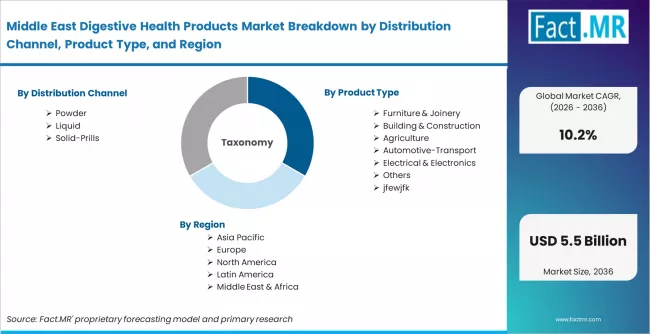
Middle East Digestive Health Products Market Breakdown By Distribution Channel, Product Type, And Region | Source: Fact.MR
| Metric | Value |
|---|---|
| Quantitative Units | USD 1.9 billion (2026) to USD 5 billion (2036), at a CAGR of 10.2% |
| Market Definition | The Middle East digestive health products market includes dietary supplements, functional foods, and nutraceutical formulations designed to support gastrointestinal balance, microbiome stability, and digestive enzyme activity. These products are consumed to address digestive discomfort, nutrient absorption efficiency, and gut microbiota modulation across preventive healthcare and wellness nutrition applications. |
| Product Type Segmentation | Probiotics, Prebiotics, Digestive enzymes, Fiber supplements, Herbal digestive products, Functional foods & beverages |
| Form Segmentation | Capsules, Tablets, Powder, Liquid, Gummies |
| Distribution Channel Segmentation | Pharmacies, Supermarkets & hypermarkets, Online retail, Specialty stores |
| Regions Covered | Middle East |
| Countries Covered | Kingdom of Saudi Arabia, United Arab Emirates, Israel, Turkey, Iran, Qatar, Kuwait, Oman, Bahrain, and 10+ countries |
| Key Companies Profiled | Nestlé Health Science, Danone, Abbott, Yakult, Herbalife, Amway, Bayer, Reckitt, DSM-Firmenich, Glanbia |
| Forecast Period | 2026 to 2036 |
| Approach | Hybrid top-down and bottom-up market estimation validated through primary interviews with nutraceutical manufacturers, dietary supplement distributors, retail pharmacy chains, and functional food producers, supported by consumption trend benchmarking, regulatory framework evaluation, and assessment of product penetration across digestive wellness product categories in Middle East markets |
Source: Fact.MR analysis. Updated May 4, 2026
Middle East Digestive Health Products Market Key Segments
-
Product Type:
- Probiotics
- Prebiotics
- Digestive Enzymes
- Fiber Supplements
- Herbal Digestive Products
- Functional Foods and Beverages
-
Form:
- Capsules
- Tablets
- Powder
- Liquid
- Gummies
-
Distribution Channel:
- Pharmacies
- Supermarkets and Hypermarkets
- Online Retail
- Specialty Stores
-
Region:
- Middle East
- Kingdom of Saudi Arabia
- United Arab Emirates
- Israel
- Turkey
- Rest of Middle East
- Middle East
Frequently Asked Questions
How large is the demand for Digestive Health Products in the Middle East market in 2026?
What will be the market size of Digestive Health Products in the Middle East market by 2036?
What is the expected demand growth for Digestive Health Products in the Middle East market between 2026 and 2036?
Which Distribution Channel is poised to lead demand in the Middle East by 2026?
What is Driving Digestive Health Product Demand in the United Arab Emirates?
What is the United Arab Emirates Growth Outlook in this Report?
What is Driving Digestive Health Product Demand in Saudi Arabia?
What is the Saudi Arabia Growth Outlook in this Report?
What is Driving Digestive Health Product Demand in Israel?
What is the Israel Growth Outlook in this Report?
What is Driving Digestive Health Product Demand in Turkey?
What is the Turkey Growth Outlook in this Report?
What is Driving Digestive Health Product Demand in South Africa?
What is the South Africa Growth Outlook in this Report?
Which Companies are Identified as Leading Participants in the Middle East Digestive Health Products Market?
What are Digestive Health Products and What are They Mainly Used For?
What does Digestive Health Products Market Mean in this Report?
What is Included in the Scope of this Digestive Health Products Market Report?
What is Excluded from the Scope of this Report?
What does Market Forecast Mean on this Page?
How is the Digestive Health Products Market Forecast Developed in this Report?
What does Data Validation Approach Mean in this Report?
Who worked on this report


Preview the report firsthand - request a free sample
Free SampleGet the brochure for pricing and purchase details
Download PDF