Mixed-Plastic Waste Stream Reactive Compatibilizers Market (2026 - 2036)
Mixed-Plastic Waste Stream Reactive Compatibilizers Market Size and Share Forecast Outlook 2026 to 2036
Core Findings
Mixed-Plastic Waste Stream Reactive Compatibilizers Market Forecast Outlook 2026 to 2036
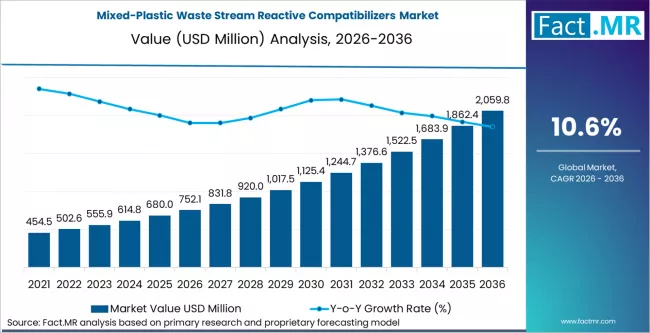
The mixed-plastic waste stream reactive compatibilizers market is projected to reach USD 752.1 million in 2026 and grow to USD 2,059.8 million by 2036, reflecting a CAGR of 10.6%.
Key Takeaways from Mixed-Plastic Waste Stream Reactive Compatibilizers Market
- Mixed-Plastic Waste Stream Reactive Compatibilizers Market Value (2026): USD 752.1 million
- Mixed-Plastic Waste Stream Reactive Compatibilizers Market Forecast Value (2036): USD 2,059.8 million
- Mixed-Plastic Waste Stream Reactive Compatibilizers Market Forecast CAGR 2026 to 2036: 10.6%
- Leading Segment in Mixed-Plastic Waste Stream Reactive Compatibilizers Market: Pellets (63%)
- Key Growth Region in Mixed-Plastic Waste Stream Reactive Compatibilizers Market: China (12.1% CAGR)
- Key Players in Mixed-Plastic Waste Stream Reactive Compatibilizers Market: Dow Inc., BASF SE, Arkema S.A., LyondellBasell Industries N.V., SABIC (Saudi Basic Industries Corporation), Exxon Mobil Corporation (ExxonMobil Chemical), Borealis AG, DuPont de Nemours, Inc., Clariant AG, Avient Corporation
Regional concentration will significantly shape market dynamics, with demand skewed toward regions with advanced recycling infrastructure, such as North America and Europe. These areas, driven by stringent environmental regulations, will experience higher adoption rates. However, uneven adoption patterns will persist, particularly in developing markets, where recycling systems and technological adoption are less mature.
Geographic cost advantages will also influence growth, with lower production costs in certain regions allowing manufacturers to offer competitive pricing in price-sensitive markets. The uneven pace of adoption across regions means that vendors will need to adapt their strategies based on local market conditions, balancing innovation with the practical realities of varying levels of infrastructure and regulatory frameworks. This will be crucial for capturing opportunities in both established and emerging markets.
Mixed-Plastic Waste Stream Reactive Compatibilizers Market
| Metric | Value |
|---|---|
| Estimated Value in (2026E) | USD 752.1 million |
| Forecast Value in (2036F) | USD 2,059.8 million |
| Forecast CAGR 2026 to 2036 | 10.6% |
Category
| Category | Sub-Segment |
|---|---|
| By Compatibilizer Type | MAH-grafted polyolefins; Epoxy-functional compatibilizers; Reactive elastomers; Block copolymer systems; Others |
| By Waste Stream | Mixed PE/PP packaging; PP/PET blends; PE/PA blends; Multilayer flexible packaging; WEEE & other streams |
| By End Use Product | Injection molded parts; Film/sheet products; Profiles & building products; Automotive parts; Others |
| By Supply Form | Pellets; Masterbatch; Powder; Liquid |
| Region | North America; Europe; Asia Pacific; Latin America; Middle East & Africa |
Segmental Analysis
What is Driving the Dominance of Pellets in the Mixed-Plastic Waste Stream Reactive Compatibilizers Market?
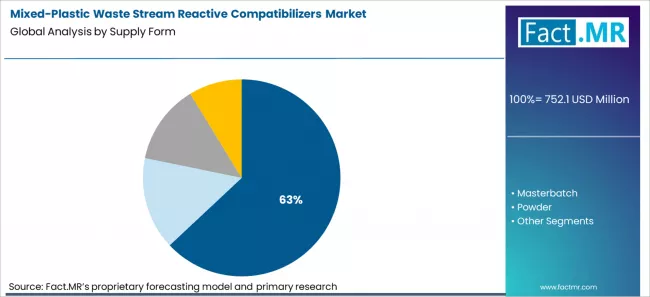
Pellets hold 63% of the market share in 2026 for the mixed-plastic waste stream reactive compatibilizers market. Pellets are favored due to their ease of handling, consistent quality, and compatibility with existing extrusion and injection molding processes. The pellet form ensures uniform dispersion of compatibilizers during the recycling process, improving the processing efficiency of mixed-plastic waste. Their ability to integrate seamlessly into the recycling streams and improve the properties of recycled materials makes them the most widely used format in the industry.
What is the Role of Mixed PE/PP Packaging in the Mixed-Plastic Waste Stream Reactive Compatibilizers Market?
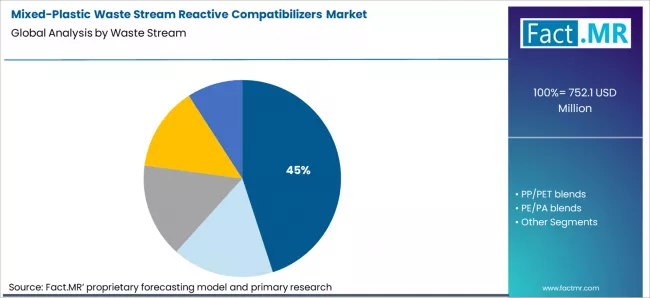
Mixed PE/PP packaging accounts for 45% of the market share in 2026. PE (Polyethylene) and PP (Polypropylene) are common polymers found in mixed-plastic waste streams, particularly in packaging materials. These materials often require compatibilizers to improve the bonding between different polymers during the recycling process, enhancing the quality of recycled products. The demand for reactive compatibilizers in mixed PE/PP streams is driven by the increasing need to process and recycle plastic waste from packaging applications, which constitutes a significant portion of global plastic waste.
What are the Drivers, Restraints, and Key Trends in the MixedPlastic Waste Stream Reactive Compatibilizers Market?
Demand for reactive compatibilizers for mixed plastic waste streams is shaped by requirements to improve interfacial adhesion, mechanical performance, and processability in recycled blends containing PE, PP, PS, and other polymers. Recyclers and compounders specify these chemistries to stabilize heterogeneous feedstocks, reduce phase separation, and enable higher yields of usable recycled resins for packaging, automotive, and consumer goods. Procurement teams prioritize compatibilizers that deliver consistent performance at low loadings and integrate with existing extrusion and reactive processing equipment. Higher additive costs and the need for precise feedstock characterization constrain adoption where budgets are limited, and variability in waste composition affects compatibilization efficacy. Key trends include development of tailored reactive agents designed for specific polymer mixes and expansion of technical support to optimize reactive blending in high throughput recycling lines.
Analysis of the Mixed-Plastic Waste Stream Reactive Compatibilizers Market by Key Country
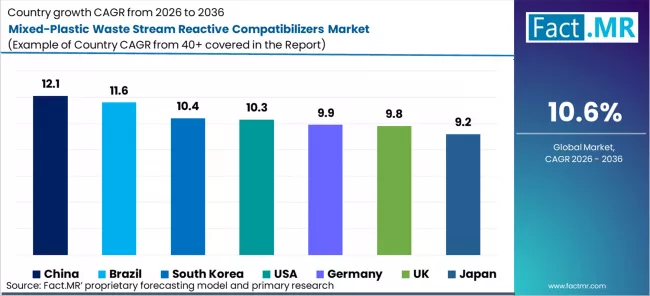
| Country | CAGR 2026 to 2036 |
|---|---|
| USA | 10.3% |
| Japan | 9.2% |
| South Korea | 10.4% |
| Germany | 9.9% |
| China | 12.1% |
| UK | 9.8% |
| Brazil | 11.6% |
The report covers an in-depth analysis of 40+ countries; top-performing countries are highlighted below.
What is Driving the Growth of the Mixed-Plastic Waste Stream Reactive Compatibilizers Market in the USA?
The USA’s Mixed-Plastic Waste Stream Reactive Compatibilizers market is projected to grow at 10.3%, driven by the need to improve recycling rates and reduce plastic waste. As the U.S. increasingly focuses on sustainability, the demand for technologies that enhance the recyclability of mixed plastics is rising. Reactive compatibilizers are critical in improving the compatibility of different plastic types in recycled products, helping to boost material quality and reduce waste. Government policies promoting circular economy practices, combined with an increasing push for recycled content in packaging and consumer goods, are driving the growth of this market in the U.S.
How is the Mixed-Plastic Waste Stream Reactive Compatibilizers Market Expanding in Japan?
Japan’s Mixed-Plastic Waste Stream Reactive Compatibilizers market is growing at 9.2%, supported by the country’s focus on advanced recycling technologies and waste management. With Japan’s stringent recycling regulations and commitment to reducing landfill waste, reactive compatibilizers are increasingly being used to improve the quality of recycled mixed plastics. These additives help manufacturers process diverse waste streams into high-quality recycled materials. Japan’s ongoing efforts to promote sustainability in manufacturing and packaging further contribute to the growth of the market, ensuring that plastic waste is effectively reused and integrated into new products.
What Factors Are Fueling the Growth of the Mixed-Plastic Waste Stream Reactive Compatibilizers Market in South Korea?
South Korea’s Mixed-Plastic Waste Stream Reactive Compatibilizers market is projected to grow at 10.4%, driven by the country's strong commitment to sustainability and recycling. South Korea has a well-established waste management and recycling infrastructure, and the need for reactive compatibilizers is increasing as industries seek to improve the quality and performance of recycled plastic materials. These compatibilizers enable the effective processing of mixed plastics, making them suitable for high-value applications such as automotive parts, packaging, and construction materials. South Korea’s regulatory framework and focus on waste reduction drive the adoption of these compatibilizers across various sectors.
How is the Mixed-Plastic Waste Stream Reactive Compatibilizers Market Evolving in Germany?
Germany’s Mixed-Plastic Waste Stream Reactive Compatibilizers market is growing at 9.9%, fueled by the country’s leadership in sustainable manufacturing and recycling technologies. As Germany focuses on increasing the circularity of its plastic economy, the need for reactive compatibilizers to improve the recyclability and quality of mixed plastics is growing. These additives are essential in enabling the effective recycling of plastics that would otherwise be discarded, helping to meet the EU’s stringent recycling targets. Germany’s ongoing investment in green technologies and commitment to sustainable production further supports the market’s growth in the country.
What is Driving the Growth of the Mixed-Plastic Waste Stream Reactive Compatibilizers Market in China?
China’s Mixed-Plastic Waste Stream Reactive Compatibilizers market is expanding at 12.1%, the fastest growth rate among the key countries. As China continues to scale its recycling efforts and reduce plastic waste, there is a growing demand for technologies that enable the recycling of mixed plastics. Reactive compatibilizers play a key role in enhancing the quality and functionality of recycled plastics, making them suitable for new applications. China’s shift towards sustainability in its manufacturing and packaging industries, combined with government incentives to improve recycling systems, is driving the widespread adoption of reactive compatibilizers in the plastic recycling sector.
What is Contributing to the Growth of the Mixed-Plastic Waste Stream Reactive Compatibilizers Market in the UK?
The UK’s Mixed-Plastic Waste Stream Reactive Compatibilizers market is growing at 9.8%, driven by the country’s focus on achieving high recycling rates and reducing plastic waste. The UK’s regulatory environment and the increasing push for circular economy practices are fueling demand for technologies that make it possible to recycle mixed plastics more effectively. Reactive compatibilizers help improve the performance and quality of recycled plastics, enabling them to be used in high-end applications. With growing consumer and industry demand for sustainable products, the market for reactive compatibilizers is expanding as the UK moves towards a more sustainable, closed-loop plastic system.
What is Driving the Growth of the Mixed-Plastic Waste Stream Reactive Compatibilizers Market in Brazil?
Brazil’s Mixed-Plastic Waste Stream Reactive Compatibilizers market is expanding at 11.6%, driven by the country’s increasing efforts to improve its recycling infrastructure and reduce plastic waste. As Brazil faces challenges related to plastic waste management, the demand for reactive compatibilizers is rising, particularly in the packaging, automotive, and construction sectors. These additives help in the efficient recycling of mixed plastics, enhancing their quality and usability. Government initiatives supporting recycling technologies, along with rising environmental awareness among consumers and industries, are propelling the adoption of reactive compatibilizers in Brazil, ensuring continued market growth.
How Are Key Players Competing in the Mixed-Plastic Waste Stream Reactive Compatibilizers Market?
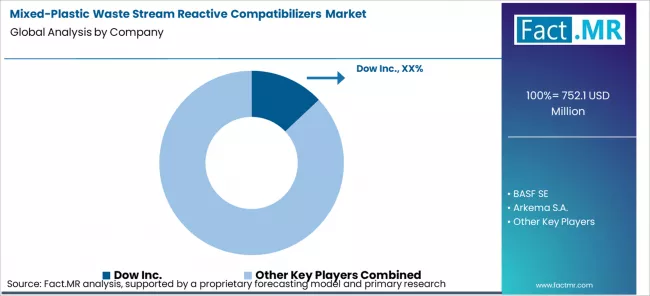
In the mixed-plastic waste stream reactive compatibilizers market, key players are focused on enhancing the recyclability of mixed plastic waste, optimizing polymer blends, and addressing sustainability concerns. Dow Inc. and BASF SE are driving innovation in polymer modification technologies, using compatibilizers to improve the mechanical properties of recycled plastics. Arkema S.A. and LyondellBasell Industries N.V. are focusing on advancing compatibilization techniques that enhance the performance and quality of recycled plastics. SABIC, Exxon Mobil Corporation, and Borealis AG emphasize product compatibility and process scalability for high-throughput recycling operations. Meanwhile, DuPont de Nemours, Inc., Clariant AG, and Avient Corporation leverage their expertise in materials science to optimize mixed polymer waste streams, focusing on sustainable solutions and improving the environmental impact of plastic recycling.
Recent Industry Developments
- Patent - Upgraded Recycled Polyethylene-Polypropylene Blend Using Block-Copolymer Compatibilizers (Published Sep 7, 2023) This patent publication describes upgrading recycled PE/PP blends by using polypropylene-based olefin block copolymers engineered as compatibilizers to improve interfacial bonding and mechanical performance in mixed polyolefin recyclate streams. (Google Patents)
- Patent - Compatibilization and Impact Modification of Post-Consumer Resins (Published Sep 12, 2024) This patent publication covers formulations that blend virgin and post-consumer recycled (PCR) polyolefins with a compatibilizer (and an impact modifier) to reduce performance loss from mixed/variable recyclate feedstocks and broaden end-use suitability. (Google Patents)
- Patent - Novel Compatibilizer Composition Using Reactive + Non-Reactive Components (Published Jun 27, 2024) This patent publication discloses a compatibilizer system combining reactive and non-reactive components (including MAH/GMA-type reactive chemistries in described embodiments) to improve miscibility and mechanical properties in thermoplastic blends, including blends incorporating post-consumer resin. (Google Patents)
Key Players of the Mixed-Plastic Waste Stream Reactive Compatibilizers Market
- Dow Inc.
- BASF SE
- Arkema S.A.
- LyondellBasell Industries N.V.
- SABIC (Saudi Basic Industries Corporation)
- Exxon Mobil Corporation
- Borealis AG
- DuPont de Nemours, Inc.
- Clariant AG
- Avient Corporation
Scope of the Report
| Items | Values |
|---|---|
| Quantitative Units (2026) | USD 752.1 Million |
| By Compatibilizer Type | MAH-grafted Polyolefins, Epoxy-functional Compatibilizers, Reactive Elastomers, Block Copolymer Systems, Others |
| By Waste Stream | Mixed PE/PP Packaging, PP/PET Blends, PE/PA Blends, Multilayer Flexible Packaging, WEEE & Other Streams |
| By End Use Product | Injection Molded Parts, Film/Sheet Products, Profiles & Building Products, Automotive Parts, Others |
| By Supply Form | Pellets, Masterbatch, Powder, Liquid |
| Regions Covered | North America, Europe, Asia Pacific, Latin America, Middle East & Africa |
| Countries Covered | United States, Canada, Mexico, Germany, United Kingdom, France, Japan, South Korea, China, India, Brazil, and other countries |
| Key Companies Profiled | Dow Inc., BASF SE, Arkema S.A., LyondellBasell Industries N.V., SABIC (Saudi Basic Industries Corporation), Exxon Mobil Corporation, Borealis AG, DuPont de Nemours, Inc., Clariant AG, Avient Corporation |
| Additional Attributes | Dollar revenue by compatibilizer type, waste stream, end use product, supply form, and region; regional demand trends, competitive landscape, technological advancements in mixed-plastic waste stream reactive compatibilizers, operational performance optimization initiatives, and product development strategies |
Mixed-Plastic Waste Stream Reactive Compatibilizers Market Key Segments
-
By Compatibilizer Type :
- MAH-grafted polyolefins
- Epoxy-functional compatibilizers
- Reactive elastomers
- Block copolymer systems
- Others
-
By Waste Stream :
- Mixed PE/PP packaging
- PP/PET blends
- PE/PA blends
- Multilayer flexible packaging
- WEEE & other streams
-
By End Use Product :
- Injection molded parts
- Film/sheet products
- Profiles & building products
- Automotive parts
- Others
-
By Supply Form :
- Pellets
- Masterbatch
- Powder
- Liquid
-
Region :
- North America
- USA
- Canada
- Mexico
- Europe
- Germany
- UK
- France
- Italy
- Spain
- Nordic Countries
- BENELUX
- Rest of Europe
- Asia Pacific
- China
- Japan
- South Korea
- India
- Australia
- Rest of Asia Pacific
- Latin America
- Brazil
- Argentina
- Rest of Latin America
- Middle East and Africa
- Kingdom of Saudi Arabia
- United Arab Emirates
- South Africa
- Rest of Middle East and Africa
- Other Regions
- Oceania
- Central Asia
- Other Markets
- North America
Bibliographies
- European Commission Joint Research Centre (JRC). (2024). Compatibilization strategies for mixed polyolefin and polyester waste in mechanical recycling. European Commission.
- Organisation for Economic Co-operation and Development (OECD). (2023). Polymer compatibilizers and their role in mixed plastic waste valorisation. OECD Environment Directorate.
- U.S. Environmental Protection Agency (EPA). (2024). Improving plastics circularity: Additives and compatibilization in recycling streams. EPA.
- Association of Plastic Recyclers (APR). (2024). Design guidance on additives impacting mixed-plastic recyclability. APR.
- Plastics Europe. (2024). Mechanical recycling of mixed plastic streams: Technical and material performance aspects. Plastics Europe.
Table of Content
- Executive Summary
- Global Market Outlook
- Demand to side Trends
- Supply to side Trends
- Technology Roadmap Analysis
- Analysis and Recommendations
- Market Overview
- Market Coverage / Taxonomy
- Market Definition / Scope / Limitations
- Research Methodology
- Chapter Orientation
- Analytical Lens and Working Hypotheses
- Market Structure, Signals, and Trend Drivers
- Benchmarking and Cross-market Comparability
- Market Sizing, Forecasting, and Opportunity Mapping
- Research Design and Evidence Framework
- Desk Research Programme (Secondary Evidence)
- Company Annual and Sustainability Reports
- Peer-reviewed Journals and Academic Literature
- Corporate Websites, Product Literature, and Technical Notes
- Earnings Decks and Investor Briefings
- Statutory Filings and Regulatory Disclosures
- Technical White Papers and Standards Notes
- Trade Journals, Industry Magazines, and Analyst Briefs
- Conference Proceedings, Webinars, and Seminar Materials
- Government Statistics Portals and Public Data Releases
- Press Releases and Reputable Media Coverage
- Specialist Newsletters and Curated Briefings
- Sector Databases and Reference Repositories
- FMR Internal Proprietary Databases and Historical Market Datasets
- Subscription Datasets and Paid Sources
- Social Channels, Communities, and Digital Listening Inputs
- Additional Desk Sources
- Expert Input and Fieldwork (Primary Evidence)
- Primary Modes
- Qualitative Interviews and Expert Elicitation
- Quantitative Surveys and Structured Data Capture
- Blended Approach
- Why Primary Evidence is Used
- Field Techniques
- Interviews
- Surveys
- Focus Groups
- Observational and In-context Research
- Social and Community Interactions
- Stakeholder Universe Engaged
- C-suite Leaders
- Board Members
- Presidents and Vice Presidents
- R&D and Innovation Heads
- Technical Specialists
- Domain Subject-matter Experts
- Scientists
- Physicians and Other Healthcare Professionals
- Governance, Ethics, and Data Stewardship
- Research Ethics
- Data Integrity and Handling
- Primary Modes
- Tooling, Models, and Reference Databases
- Desk Research Programme (Secondary Evidence)
- Data Engineering and Model Build
- Data Acquisition and Ingestion
- Cleaning, Normalisation, and Verification
- Synthesis, Triangulation, and Analysis
- Quality Assurance and Audit Trail
- Market Background
- Market Dynamics
- Drivers
- Restraints
- Opportunity
- Trends
- Scenario Forecast
- Demand in Optimistic Scenario
- Demand in Likely Scenario
- Demand in Conservative Scenario
- Opportunity Map Analysis
- Product Life Cycle Analysis
- Supply Chain Analysis
- Investment Feasibility Matrix
- Value Chain Analysis
- PESTLE and Porter’s Analysis
- Regulatory Landscape
- Regional Parent Market Outlook
- Production and Consumption Statistics
- Import and Export Statistics
- Market Dynamics
- Global Market Analysis 2021 to 2025 and Forecast, 2026 to 2036
- Historical Market Size Value (USD Million) Analysis, 2021 to 2025
- Current and Future Market Size Value (USD Million) Projections, 2026 to 2036
- Y to o to Y Growth Trend Analysis
- Absolute $ Opportunity Analysis
- Global Market Pricing Analysis 2021 to 2025 and Forecast 2026 to 2036
- Global Market Analysis 2021 to 2025 and Forecast 2026 to 2036, By Waste Stream
- Introduction / Key Findings
- Historical Market Size Value (USD Million) Analysis By Waste Stream, 2021 to 2025
- Current and Future Market Size Value (USD Million) Analysis and Forecast By Waste Stream, 2026 to 2036
- Mixed PE/PP packaging
- PP/PET blends
- PE/PA blends
- Multilayer flexible packaging
- WEEE & other streams
- Mixed PE/PP packaging
- Y to o to Y Growth Trend Analysis By Waste Stream, 2021 to 2025
- Absolute $ Opportunity Analysis By Waste Stream, 2026 to 2036
- Global Market Analysis 2021 to 2025 and Forecast 2026 to 2036, By Supply Form
- Introduction / Key Findings
- Historical Market Size Value (USD Million) Analysis By Supply Form, 2021 to 2025
- Current and Future Market Size Value (USD Million) Analysis and Forecast By Supply Form, 2026 to 2036
- Pellets
- Masterbatch
- Powder
- Liquid
- Pellets
- Y to o to Y Growth Trend Analysis By Supply Form, 2021 to 2025
- Absolute $ Opportunity Analysis By Supply Form, 2026 to 2036
- Global Market Analysis 2021 to 2025 and Forecast 2026 to 2036, By Region
- Introduction
- Historical Market Size Value (USD Million) Analysis By Region, 2021 to 2025
- Current Market Size Value (USD Million) Analysis and Forecast By Region, 2026 to 2036
- North America
- Latin America
- Western Europe
- Eastern Europe
- East Asia
- South Asia and Pacific
- Middle East & Africa
- Market Attractiveness Analysis By Region
- North America Market Analysis 2021 to 2025 and Forecast 2026 to 2036, By Country
- Historical Market Size Value (USD Million) Trend Analysis By Market Taxonomy, 2021 to 2025
- Market Size Value (USD Million) Forecast By Market Taxonomy, 2026 to 2036
- By Country
- USA
- Canada
- Mexico
- By Waste Stream
- By Supply Form
- By Country
- Market Attractiveness Analysis
- By Country
- By Waste Stream
- By Supply Form
- Key Takeaways
- Latin America Market Analysis 2021 to 2025 and Forecast 2026 to 2036, By Country
- Historical Market Size Value (USD Million) Trend Analysis By Market Taxonomy, 2021 to 2025
- Market Size Value (USD Million) Forecast By Market Taxonomy, 2026 to 2036
- By Country
- Brazil
- Chile
- Rest of Latin America
- By Waste Stream
- By Supply Form
- By Country
- Market Attractiveness Analysis
- By Country
- By Waste Stream
- By Supply Form
- Key Takeaways
- Western Europe Market Analysis 2021 to 2025 and Forecast 2026 to 2036, By Country
- Historical Market Size Value (USD Million) Trend Analysis By Market Taxonomy, 2021 to 2025
- Market Size Value (USD Million) Forecast By Market Taxonomy, 2026 to 2036
- By Country
- Germany
- UK
- Italy
- Spain
- France
- Nordic
- BENELUX
- Rest of Western Europe
- By Waste Stream
- By Supply Form
- By Country
- Market Attractiveness Analysis
- By Country
- By Waste Stream
- By Supply Form
- Key Takeaways
- Eastern Europe Market Analysis 2021 to 2025 and Forecast 2026 to 2036, By Country
- Historical Market Size Value (USD Million) Trend Analysis By Market Taxonomy, 2021 to 2025
- Market Size Value (USD Million) Forecast By Market Taxonomy, 2026 to 2036
- By Country
- Russia
- Poland
- Hungary
- Balkan & Baltic
- Rest of Eastern Europe
- By Waste Stream
- By Supply Form
- By Country
- Market Attractiveness Analysis
- By Country
- By Waste Stream
- By Supply Form
- Key Takeaways
- East Asia Market Analysis 2021 to 2025 and Forecast 2026 to 2036, By Country
- Historical Market Size Value (USD Million) Trend Analysis By Market Taxonomy, 2021 to 2025
- Market Size Value (USD Million) Forecast By Market Taxonomy, 2026 to 2036
- By Country
- China
- Japan
- South Korea
- By Waste Stream
- By Supply Form
- By Country
- Market Attractiveness Analysis
- By Country
- By Waste Stream
- By Supply Form
- Key Takeaways
- South Asia and Pacific Market Analysis 2021 to 2025 and Forecast 2026 to 2036, By Country
- Historical Market Size Value (USD Million) Trend Analysis By Market Taxonomy, 2021 to 2025
- Market Size Value (USD Million) Forecast By Market Taxonomy, 2026 to 2036
- By Country
- India
- ASEAN
- Australia & New Zealand
- Rest of South Asia and Pacific
- By Waste Stream
- By Supply Form
- By Country
- Market Attractiveness Analysis
- By Country
- By Waste Stream
- By Supply Form
- Key Takeaways
- Middle East & Africa Market Analysis 2021 to 2025 and Forecast 2026 to 2036, By Country
- Historical Market Size Value (USD Million) Trend Analysis By Market Taxonomy, 2021 to 2025
- Market Size Value (USD Million) Forecast By Market Taxonomy, 2026 to 2036
- By Country
- Kingdom of Saudi Arabia
- Other GCC Countries
- Turkiye
- South Africa
- Other African Union
- Rest of Middle East & Africa
- By Waste Stream
- By Supply Form
- By Country
- Market Attractiveness Analysis
- By Country
- By Waste Stream
- By Supply Form
- Key Takeaways
- Key Countries Market Analysis
- USA
- Pricing Analysis
- Market Share Analysis, 2025
- By Waste Stream
- By Supply Form
- Canada
- Pricing Analysis
- Market Share Analysis, 2025
- By Waste Stream
- By Supply Form
- Mexico
- Pricing Analysis
- Market Share Analysis, 2025
- By Waste Stream
- By Supply Form
- Brazil
- Pricing Analysis
- Market Share Analysis, 2025
- By Waste Stream
- By Supply Form
- Chile
- Pricing Analysis
- Market Share Analysis, 2025
- By Waste Stream
- By Supply Form
- Germany
- Pricing Analysis
- Market Share Analysis, 2025
- By Waste Stream
- By Supply Form
- UK
- Pricing Analysis
- Market Share Analysis, 2025
- By Waste Stream
- By Supply Form
- Italy
- Pricing Analysis
- Market Share Analysis, 2025
- By Waste Stream
- By Supply Form
- Spain
- Pricing Analysis
- Market Share Analysis, 2025
- By Waste Stream
- By Supply Form
- France
- Pricing Analysis
- Market Share Analysis, 2025
- By Waste Stream
- By Supply Form
- India
- Pricing Analysis
- Market Share Analysis, 2025
- By Waste Stream
- By Supply Form
- ASEAN
- Pricing Analysis
- Market Share Analysis, 2025
- By Waste Stream
- By Supply Form
- Australia & New Zealand
- Pricing Analysis
- Market Share Analysis, 2025
- By Waste Stream
- By Supply Form
- China
- Pricing Analysis
- Market Share Analysis, 2025
- By Waste Stream
- By Supply Form
- Japan
- Pricing Analysis
- Market Share Analysis, 2025
- By Waste Stream
- By Supply Form
- South Korea
- Pricing Analysis
- Market Share Analysis, 2025
- By Waste Stream
- By Supply Form
- Russia
- Pricing Analysis
- Market Share Analysis, 2025
- By Waste Stream
- By Supply Form
- Poland
- Pricing Analysis
- Market Share Analysis, 2025
- By Waste Stream
- By Supply Form
- Hungary
- Pricing Analysis
- Market Share Analysis, 2025
- By Waste Stream
- By Supply Form
- Kingdom of Saudi Arabia
- Pricing Analysis
- Market Share Analysis, 2025
- By Waste Stream
- By Supply Form
- Turkiye
- Pricing Analysis
- Market Share Analysis, 2025
- By Waste Stream
- By Supply Form
- South Africa
- Pricing Analysis
- Market Share Analysis, 2025
- By Waste Stream
- By Supply Form
- USA
- Market Structure Analysis
- Competition Dashboard
- Competition Benchmarking
- Market Share Analysis of Top Players
- By Regional
- By Waste Stream
- By Supply Form
- Competition Analysis
- Competition Deep Dive
- Dow Inc.
- Overview
- Product Portfolio
- Profitability by Market Segments (Product/Age /Sales Channel/Region)
- Sales Footprint
- Strategy Overview
- Marketing Strategy
- Product Strategy
- Channel Strategy
- BASF SE
- Arkema S.A.
- LyondellBasell Industries N.V.
- SABIC (Saudi Basic Industries Corporation)
- Exxon Mobil Corporation
- Borealis AG
- DuPont de Nemours, Inc.
- Clariant AG
- Avient Corporation
- Dow Inc.
- Competition Deep Dive
- Assumptions & Acronyms Used
List Of Table
- Table 1: Global Market Value (USD Million) Forecast by Region, 2021 to 2036
- Table 2: Global Market Value (USD Million) Forecast by Waste Stream, 2021 to 2036
- Table 3: Global Market Value (USD Million) Forecast by Supply Form, 2021 to 2036
- Table 4: North America Market Value (USD Million) Forecast by Country, 2021 to 2036
- Table 5: North America Market Value (USD Million) Forecast by Waste Stream, 2021 to 2036
- Table 6: North America Market Value (USD Million) Forecast by Supply Form, 2021 to 2036
- Table 7: Latin America Market Value (USD Million) Forecast by Country, 2021 to 2036
- Table 8: Latin America Market Value (USD Million) Forecast by Waste Stream, 2021 to 2036
- Table 9: Latin America Market Value (USD Million) Forecast by Supply Form, 2021 to 2036
- Table 10: Western Europe Market Value (USD Million) Forecast by Country, 2021 to 2036
- Table 11: Western Europe Market Value (USD Million) Forecast by Waste Stream, 2021 to 2036
- Table 12: Western Europe Market Value (USD Million) Forecast by Supply Form, 2021 to 2036
- Table 13: Eastern Europe Market Value (USD Million) Forecast by Country, 2021 to 2036
- Table 14: Eastern Europe Market Value (USD Million) Forecast by Waste Stream, 2021 to 2036
- Table 15: Eastern Europe Market Value (USD Million) Forecast by Supply Form, 2021 to 2036
- Table 16: East Asia Market Value (USD Million) Forecast by Country, 2021 to 2036
- Table 17: East Asia Market Value (USD Million) Forecast by Waste Stream, 2021 to 2036
- Table 18: East Asia Market Value (USD Million) Forecast by Supply Form, 2021 to 2036
- Table 19: South Asia and Pacific Market Value (USD Million) Forecast by Country, 2021 to 2036
- Table 20: South Asia and Pacific Market Value (USD Million) Forecast by Waste Stream, 2021 to 2036
- Table 21: South Asia and Pacific Market Value (USD Million) Forecast by Supply Form, 2021 to 2036
- Table 22: Middle East & Africa Market Value (USD Million) Forecast by Country, 2021 to 2036
- Table 23: Middle East & Africa Market Value (USD Million) Forecast by Waste Stream, 2021 to 2036
- Table 24: Middle East & Africa Market Value (USD Million) Forecast by Supply Form, 2021 to 2036
List Of Figures
- Figure 1: Global Market Pricing Analysis
- Figure 2: Global Market Value (USD Million) Forecast 2021 to 2036
- Figure 3: Global Market Value Share and BPS Analysis by Waste Stream, 2026 and 2036
- Figure 4: Global Market Y to o to Y Growth Comparison by Waste Stream, 2026 to 2036
- Figure 5: Global Market Attractiveness Analysis by Waste Stream
- Figure 6: Global Market Value Share and BPS Analysis by Supply Form, 2026 and 2036
- Figure 7: Global Market Y to o to Y Growth Comparison by Supply Form, 2026 to 2036
- Figure 8: Global Market Attractiveness Analysis by Supply Form
- Figure 9: Global Market Value (USD Million) Share and BPS Analysis by Region, 2026 and 2036
- Figure 10: Global Market Y to o to Y Growth Comparison by Region, 2026 to 2036
- Figure 11: Global Market Attractiveness Analysis by Region
- Figure 12: North America Market Incremental Dollar Opportunity, 2026 to 2036
- Figure 13: Latin America Market Incremental Dollar Opportunity, 2026 to 2036
- Figure 14: Western Europe Market Incremental Dollar Opportunity, 2026 to 2036
- Figure 15: Eastern Europe Market Incremental Dollar Opportunity, 2026 to 2036
- Figure 16: East Asia Market Incremental Dollar Opportunity, 2026 to 2036
- Figure 17: South Asia and Pacific Market Incremental Dollar Opportunity, 2026 to 2036
- Figure 18: Middle East & Africa Market Incremental Dollar Opportunity, 2026 to 2036
- Figure 19: North America Market Value Share and BPS Analysis by Country, 2026 and 2036
- Figure 20: North America Market Value Share and BPS Analysis by Waste Stream, 2026 and 2036
- Figure 21: North America Market Y to o to Y Growth Comparison by Waste Stream, 2026 to 2036
- Figure 22: North America Market Attractiveness Analysis by Waste Stream
- Figure 23: North America Market Value Share and BPS Analysis by Supply Form, 2026 and 2036
- Figure 24: North America Market Y to o to Y Growth Comparison by Supply Form, 2026 to 2036
- Figure 25: North America Market Attractiveness Analysis by Supply Form
- Figure 26: Latin America Market Value Share and BPS Analysis by Country, 2026 and 2036
- Figure 27: Latin America Market Value Share and BPS Analysis by Waste Stream, 2026 and 2036
- Figure 28: Latin America Market Y to o to Y Growth Comparison by Waste Stream, 2026 to 2036
- Figure 29: Latin America Market Attractiveness Analysis by Waste Stream
- Figure 30: Latin America Market Value Share and BPS Analysis by Supply Form, 2026 and 2036
- Figure 31: Latin America Market Y to o to Y Growth Comparison by Supply Form, 2026 to 2036
- Figure 32: Latin America Market Attractiveness Analysis by Supply Form
- Figure 33: Western Europe Market Value Share and BPS Analysis by Country, 2026 and 2036
- Figure 34: Western Europe Market Value Share and BPS Analysis by Waste Stream, 2026 and 2036
- Figure 35: Western Europe Market Y to o to Y Growth Comparison by Waste Stream, 2026 to 2036
- Figure 36: Western Europe Market Attractiveness Analysis by Waste Stream
- Figure 37: Western Europe Market Value Share and BPS Analysis by Supply Form, 2026 and 2036
- Figure 38: Western Europe Market Y to o to Y Growth Comparison by Supply Form, 2026 to 2036
- Figure 39: Western Europe Market Attractiveness Analysis by Supply Form
- Figure 40: Eastern Europe Market Value Share and BPS Analysis by Country, 2026 and 2036
- Figure 41: Eastern Europe Market Value Share and BPS Analysis by Waste Stream, 2026 and 2036
- Figure 42: Eastern Europe Market Y to o to Y Growth Comparison by Waste Stream, 2026 to 2036
- Figure 43: Eastern Europe Market Attractiveness Analysis by Waste Stream
- Figure 44: Eastern Europe Market Value Share and BPS Analysis by Supply Form, 2026 and 2036
- Figure 45: Eastern Europe Market Y to o to Y Growth Comparison by Supply Form, 2026 to 2036
- Figure 46: Eastern Europe Market Attractiveness Analysis by Supply Form
- Figure 47: East Asia Market Value Share and BPS Analysis by Country, 2026 and 2036
- Figure 48: East Asia Market Value Share and BPS Analysis by Waste Stream, 2026 and 2036
- Figure 49: East Asia Market Y to o to Y Growth Comparison by Waste Stream, 2026 to 2036
- Figure 50: East Asia Market Attractiveness Analysis by Waste Stream
- Figure 51: East Asia Market Value Share and BPS Analysis by Supply Form, 2026 and 2036
- Figure 52: East Asia Market Y to o to Y Growth Comparison by Supply Form, 2026 to 2036
- Figure 53: East Asia Market Attractiveness Analysis by Supply Form
- Figure 54: South Asia and Pacific Market Value Share and BPS Analysis by Country, 2026 and 2036
- Figure 55: South Asia and Pacific Market Value Share and BPS Analysis by Waste Stream, 2026 and 2036
- Figure 56: South Asia and Pacific Market Y to o to Y Growth Comparison by Waste Stream, 2026 to 2036
- Figure 57: South Asia and Pacific Market Attractiveness Analysis by Waste Stream
- Figure 58: South Asia and Pacific Market Value Share and BPS Analysis by Supply Form, 2026 and 2036
- Figure 59: South Asia and Pacific Market Y to o to Y Growth Comparison by Supply Form, 2026 to 2036
- Figure 60: South Asia and Pacific Market Attractiveness Analysis by Supply Form
- Figure 61: Middle East & Africa Market Value Share and BPS Analysis by Country, 2026 and 2036
- Figure 62: Middle East & Africa Market Value Share and BPS Analysis by Waste Stream, 2026 and 2036
- Figure 63: Middle East & Africa Market Y to o to Y Growth Comparison by Waste Stream, 2026 to 2036
- Figure 64: Middle East & Africa Market Attractiveness Analysis by Waste Stream
- Figure 65: Middle East & Africa Market Value Share and BPS Analysis by Supply Form, 2026 and 2036
- Figure 66: Middle East & Africa Market Y to o to Y Growth Comparison by Supply Form, 2026 to 2036
- Figure 67: Middle East & Africa Market Attractiveness Analysis by Supply Form
- Figure 68: Global Market - Tier Structure Analysis
- Figure 69: Global Market - Company Share Analysis
- FAQs -
How big is the mixed-plastic waste stream reactive compatibilizers market in 2026?
The global mixed-plastic waste stream reactive compatibilizers market is estimated to be valued at USD 752.1 million in 2026.
What will be the size of mixed-plastic waste stream reactive compatibilizers market in 2036?
The market size for the mixed-plastic waste stream reactive compatibilizers market is projected to reach USD 2,059.8 million by 2036.
How much will be the mixed-plastic waste stream reactive compatibilizers market growth between 2026 and 2036?
The mixed-plastic waste stream reactive compatibilizers market is expected to grow at a 10.6% CAGR between 2026 and 2036.
What are the key product types in the mixed-plastic waste stream reactive compatibilizers market?
The key product types in mixed-plastic waste stream reactive compatibilizers market are mixed pe/pp packaging, pp/pet blends, pe/pa blends, multilayer flexible packaging and weee & other streams.
Which supply form segment to contribute significant share in the mixed-plastic waste stream reactive compatibilizers market in 2026?
In terms of supply form, pellets segment to command 63.0% share in the mixed-plastic waste stream reactive compatibilizers market in 2026.