- Market Value (2025): USD 314.8 Mn
- Estimated Value (2026): USD 160.0 Mn
- Forecast Value (2036): USD 977.6 Mn
- CAGR (2026-2036): 9.5%
Plant-Matrix Produce Coatings Market Forecast and Outlook 2026 to 2036
The plant-matrix produce coatings market stood at USD 314.8 million in 2025 and will reach USD 160.0 million in 2026. At a CAGR of 9.5%, the market is set to reach USD 977.6 million by 2036.
Plant-matrix produce coatings are gaining attention as fruit and vegetable businesses look for ways to keep fresh produce in good condition for longer. Ingredients such as pectin, alginate, cellulose and plant proteins form a thin edible layer that helps limit moisture loss and slow ripening. This gives packers and retailers another way to reduce spoilage without relying on plastic packaging. Wider efforts to cut food waste and improve fresh-food handling are also creating room for these coatings across the produce supply chain.
A notable commercial step came in October 2025, when Saveggy launched its plant-based edible produce coating in Sweden through a retail trial with ICA and Odlarna.se.
Key Takeaways from the Plant-Matrix Produce Coatings Market
- Sales of plant-matrix produce coatings stood at USD 314.8 million in 2025
- Plant-Matrix Produce Coatings Market Value (2026): USD 160.0 million
- Plant-Matrix Produce Coatings Market Forecast Value (2036): USD 977.6 million
- Plant-Matrix Produce Coatings Market Forecast CAGR (2026-2036): 9.5%
- Leading Plant-matrix coating base: Plant-protein composite (25.8%)
- Key Market Participants: Apeel Sciences, Mori, Sufresca; Xampla; Mantrose-Haeuser; Akorn Technology
- Key Growth Regions: India, Spain, Netherlands; United States; China
Companies such as Apeel Sciences, Akorn Technology and Sufresca have taken edible coatings into commercial trials involving avocados, citrus fruits; mangoes and cucumbers. Their work shows how coating formulas are being adapted to suit different produce types and storage conditions. Retailers are also examining these solutions as a way to reduce damaged stock and limit plastic packaging. As more packers explore practical uses for crop-specific coatings, these products are finding a place in fresh produce handling.
Plant-Matrix Produce Coatings Market
| Metric | Value |
|---|---|
| Estimated Value in (2025) | USD 314.8 million |
| Estimated Value in (2026) | USD 160.0 million |
| Forecast Value in (2036) | USD 977.6 million |
| Forecast CAGR (2026 to 2036) | 9.5% |
Source: Fact.MR analysis. Updated Nov 19, 2026
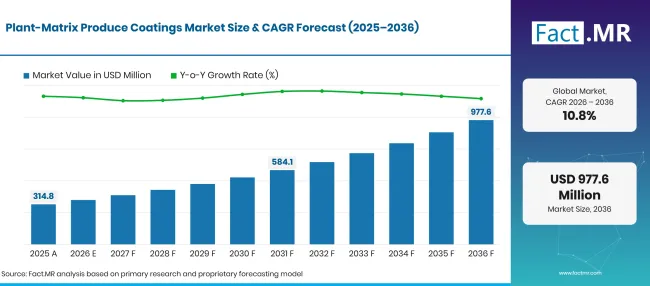
Plant Matrix Produce Coatings Forecast Global | Source: Fact.MR
Category
| Category | Segments |
|---|---|
| Plant-matrix coating base | Cellulose, Pectin, Alginate; Starch; Plant-protein composite |
| Commercial form | Powder, Liquid concentrate, Granulate; Encapsulated bead; Ready-to-use premix |
| Food application | Bakery, Dairy / alternatives, Beverage; Meat / savory; Confectionery / snacks |
| Primary function | Shelf-life, Texture / rheology, Taste / color; Nutritional functionality; Processing stability |
| Region | India; Spain; Netherlands; United States; China |
Source: Fact.MR analysis. Updated Nov 19, 2026
Segmental Analysis
Why do Plant-protein composite bases lead coating demand in the Plant-Matrix Produce Coatings Market?
Blending plant proteins with polysaccharides helps create edible films that balance flexibility, strength and moisture resistance. This makes plant-protein composite bases the leading category, with a 25.8% revenue contribution, valued at USD 41.3 million in 2026. Alginate and pectin formulations follow closely. A 2025 review published in Food Packaging and Shelf Life examined plant-protein coatings for perishable food preservation, highlighting their potential to improve barrier performance and maintain product quality.
Why does Powder lead commercial-form demand in the Plant-Matrix Produce Coatings Market?
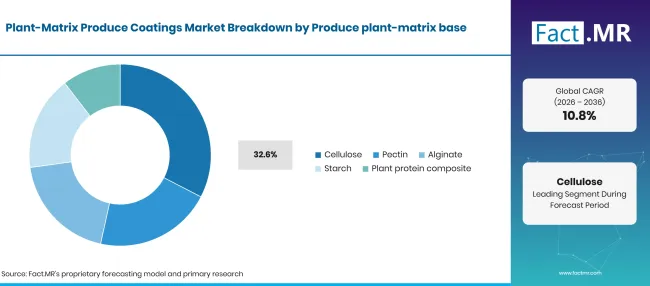
Plant Matrix Produce Coatings Breakdown Produce Plant Matrix Base | Source: Fact.MR
Packhouses can store powdered coating concentrates and prepare the required mixture by adding water before application. This simplifies transportation, storage and handling, particularly for businesses processing large volumes of fresh produce. Powder represents 32.6% of the market, valued at USD 46.4 million in 2026, ahead of liquid concentrates. A 2025 study in the Journal of Food Measurement and Characterization examined a plant-based coating powder made with potato peel starch, gum arabic and Kinnow peel extract for preserving litchi.
Why does Meat / savory lead application demand in the Plant-Matrix Produce Coatings Market?
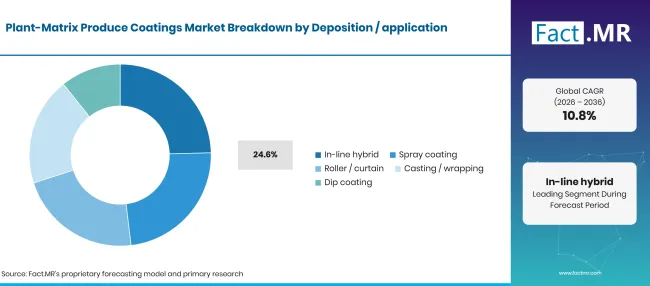
Plant Matrix Produce Coatings Breakdown Deposition Application | Source: Fact.MR
The use of edible films beyond fresh produce is creating additional application opportunities in meat, savory snacks and prepared foods. These coatings help control moisture movement and maintain product quality during storage. Meat / savory contributes 24.6% of market revenue in 2026, equivalent to USD 44.8 million, with dairy alternatives following. In 2025, research published in the International Journal of Biological Macromolecules examined whey-protein and chitosan edible coatings for chilled beef, including their effects on quality during storage.
Why does Texture / rheology lead function demand in the Plant-Matrix Produce Coatings Market?
Firmness and crispness play an important role in how consumers judge fresh produce, making texture control a key coating application. This function contributes 24.9% of market revenue in 2026, valued at USD 39.8 million. Coatings help limit moisture loss that can cause fruits and vegetables to soften during storage. An ICAR-NISA Annual Report 2025 documented sodium alginate and lemongrass oil coating trials on strawberries. After 16 days of refrigerated storage, coated fruit recorded a 5.8% decline in firmness, compared with 69.4% for uncoated fruit.
Plant-Matrix Produce Coatings Market - Drivers, Restraints & Trends
Driver: Efforts to Reduce Produce Waste and Plastic Packaging
Fresh produce retailers are looking for ways to extend the selling period of fruits and vegetables without adding more plastic packaging. Edible coatings address both concerns by slowing deterioration while leaving produce suitable for direct sale. The European Commission's CRISP project, launched in June 2025, tested plant-based produce protection on cucumbers at industrial scale. Such initiatives are creating commercial opportunities for coating technologies across fresh produce supply chains.
Restraint: Inconsistent Performance Across Produce Categories
A coating that works well on one fruit may not deliver the same results on another because surface texture, moisture content and respiration rates differ. Formulation changes, application trials and food-contact compliance also add to development costs. Smaller coating companies may struggle to finance repeated testing and large-scale validation. These uncertainties can delay retailer approvals and make wider adoption difficult.
Trend: Crop-Specific Coating Formulations
Coating research is moving towards formulations suited to individual fruits and vegetables rather than one solution for every crop. The European Commission's CRISP project reported a tailored zucchini formulation in 2026 that extended shelf life threefold, while testing also covered bananas and bell peppers. Further opportunities lie in adapting coatings to different storage conditions and handling practices, opening new avenues across fresh produce categories.
Trend: Plastic-Free Produce Retailing
Retailers are exploring ways to display loose fruits and vegetables without conventional plastic films. Plant-based edible coatings offer an alternative that can help preserve freshness within existing distribution systems. The CRISP project reported initial full-scale machine trials and commercialisation work in 2026, indicating progress beyond laboratory research. Wider retailer participation could create opportunities for coating adoption across supermarkets, wholesalers and export-oriented produce businesses.
Plant-Matrix Produce Coatings Market by Analysis by Key Country
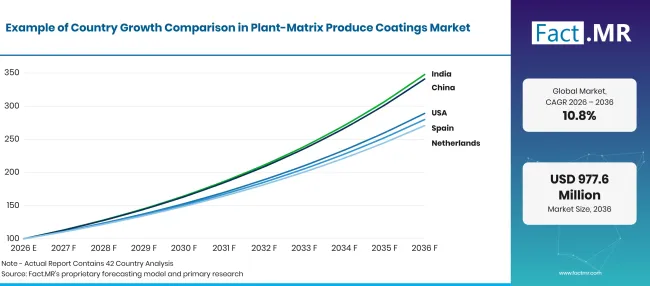
Plant Matrix Produce Coatings Growth Index | Source: Fact.MR
| Country | CAGR (2026-2036) |
|---|---|
| India | 11.8% |
| Spain | 11.6% |
| Netherlands | 11.5% |
| United States | 11.4% |
| China | 11.1% |
Source: Fact.MR analysis. Updated Nov 19, 2026
Why is India the fastest-growing market for plant-matrix produce coatings?
India's large fruit and vegetable production base creates considerable room for post-harvest preservation technologies.
The Ministry of Food Processing Industries reported in December 2025 that post-harvest losses included 7.36 million tonnes of fruits and 11.97 million tonnes of vegetables, based on the NABCONS study. This makes shelf-life improvement an important priority for growers, exporters and food processors. Expansion of cold-chain facilities, rising horticultural exports and efforts to reduce spoilage are creating opportunities for plant-based produce coatings.
What is driving plant-matrix produce coating demand in Spain?
Spain's position as a major European fruit and vegetable exporter creates a strong commercial case for coatings that help produce withstand longer distribution journeys.
In April 2025, Spain introduced Law 1/2025 on food loss and waste prevention, strengthening the focus on reducing avoidable food waste. The Ministry of Agriculture reported that fruit exports reached EUR 11.918 billion in 2025. Export-oriented packing operations, supermarket quality standards and waste-reduction efforts are key factors creating opportunities for edible coatings.
What is shaping plant-matrix produce coating demand in the Netherlands?
High-value horticulture exports and advanced greenhouse production make the Netherlands an important market for fresh-produce preservation technologies.
Statistics Netherlands reported in January 2026 that fruit exports reached EUR 9.6 billion and vegetable exports EUR 9.4 billion in 2025. The country also recorded increased vegetable production, including 3.83 million tonnes of open-field vegetables. Export quality requirements, efficient post-harvest handling and efforts to reduce losses are creating opportunities for plant-matrix coatings in commercial distribution.
What is shaping plant-matrix produce coating sales in the United States?
The scale of fresh-produce trade in the United States makes storage quality and retail shelf life important considerations for the industry.
\USDA data published in 2026 put the country's fruit and vegetable exports at USD 12.92 billion for 2025, covering 7.27 million metric tonnes. Longer distribution routes, supermarket inventory management and efforts to limit produce shrinkage are supporting interest in edible preservation methods. These factors create room for plant-based coatings across domestic packing, retail and export operations.
Why is plant-matrix produce coating growth slower in China?
China's extensive fruit and vegetable supply chain creates opportunities for technologies that help preserve produce between harvesting, storage and retail sale.
In August 2025, China's national standards authority initiated a standard for cold-chain logistics services covering fruits and vegetables. Another standard, GH/T 1506-2025, was published in December 2025 and came into effect in March 2026; addressing carbon-emission accounting across fruit and vegetable cold-chain distribution. Greater attention to storage efficiency, product quality and supply-chain sustainability is creating opportunities for edible coating applications.
Competitive Landscape for Plant-Matrix Produce Coatings Market
The plant-matrix produce coatings market is seeing a shift from basic shelf-life extension towards formulations that deliver measurable results for individual crops. Apeel Sciences, Akorn Technology and Sufresca focus on edible produce protection, while Mori; Xampla and Mantrose-Haeuser bring alternative coating and material technologies to the field. In June 2025, Akorn introduced Natural Advantage for English cucumbers and bell peppers, offering an edible alternative to plastic wrapping. In January 2026, Akorn also won the UAE FoodTech Challenge, securing support to expand its post-harvest technology. These moves show how crop-specific performance, affordable application and retailer acceptance are shaping commercial success.
Recent Developments
- On June 18, 2025, AgroFresh Solutions entered into an exclusive distribution agreement with Nabaco to expand the availability of NatuWrap fruit protection technology across global produce markets.
- On May 20, 2025, AgroFresh and Biotalys announced a partnership to develop biological solutions for protecting fresh produce and reducing food waste.
- On January 20, 2026, Akorn Technology was named one of four winners of the UAE FoodTech Challenge for its edible coating technology designed to extend fresh produce shelf life.
- On May 28, 2026, TransFRESH Corporation acquired Hazel Technologies to add its Breatheway freshness-preservation technology to its post-harvest solutions portfolio.
- On September 23, 2025, DECCO announced the expansion of its global operations through a new plant in Valencia; Spain; to strengthen its post-harvest fruit and vegetable protection business.
Key Players in Plant-Matrix Produce Coatings Market
Key companies profiled include Apeel Sciences; Sufresca; Akorn Technology; Mantrose-Haeuser; AgroFresh Solutions; Hazel Technologies; Citrosol Group; NatureSeal; Decco Post-Harvest; and Liquidseal.
- Apeel Sciences
- Sufresca
- Akorn Technology
- Mantrose-Haeuser
- AgroFresh Solutions
- Hazel Technologies
- Citrosol Group
- NatureSeal
- Decco Post-Harvest
- Liquidseal
Bibliography
- Agencia Estatal Boletín Oficial del Estado. (2025). Ley 1/2025, de 1 de abril, de prevención de las pérdidas y el desperdicio alimentario. Boletín Oficial del Estado.
- European Commission. (2025). Coating fruit and vegetables: Reducing plastic waste and increasing shelf life of produce (CRISP). CORDIS.
- European Commission. (2026). Periodic reporting for period 1: CRISP (Coating fruit and vegetables: Reducing plastic waste and increasing shelf life of produce). CORDIS.
- Ministry of Agriculture, Fisheries and Food. (2026). Informe anual de comercio exterior 2025. Government of Spain
- Ministry of Food Processing Industries. (2025, December 12). India strengthens cold-chain infrastructure to reduce post-harvest food losses. Press Information Bureau, Government of India.
- Statistics Netherlands. (2026). Value of agricultural exports up by over 8 percent in 2025
- U.S. Department of Agriculture, Foreign Agricultural Service. (2026). Fruits and vegetables: U.S. fruits and vegetables exports in 2025
- (2025)(GH/T 1506-2025) [Technical specification for carbon emission accounting for fruit and vegetable cold-chain distribution]. National Public Service Platform for Standards Information.
Segmentation
Scope of Report
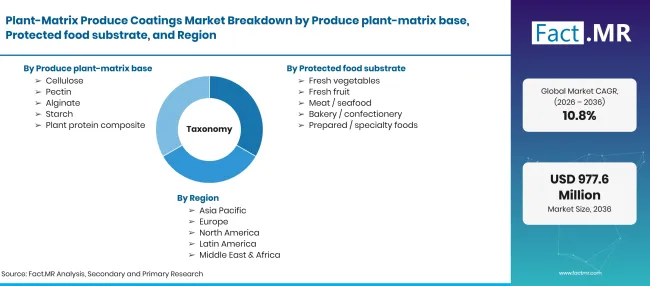
Plant Matrix Produce Coatings Taxonomy | Source: Fact.MR
| Items | Values |
|---|---|
| Quantitative Units (2026) | USD 160.0 Million |
| Plant-matrix coating base | Cellulose, Pectin, Alginate; Starch; Plant-protein composite |
| Commercial form | Powder, Liquid concentrate, Granulate; Encapsulated bead; Ready-to-use premix |
| Food application | Bakery, Dairy / alternatives, Beverage; Meat / savory; Confectionery / snacks |
| Primary function | Shelf-life, Texture / rheology, Taste / color; Nutritional functionality; Processing stability |
| Regions Covered | North America, Latin America, Europe; East Asia; South Asia and Pacific; Middle East & Africa |
| Countries Covered | India, Spain, Netherlands; United States; China; and other countries |
| Key Companies Profiled | Apeel Sciences, Mori, Sufresca; Xampla; Mantrose-Haeuser; Akorn Technology |
| Additional Attributes | Dollar revenue in the Plant-Matrix Produce Coatings Market is segmented by plant-matrix coating base (cellulose, pectin, alginate; starch; plant-protein composite); commercial form (powder; liquid concentrate; granulate; encapsulated bead; ready-to-use premix); food application (bakery; dairy / alternatives; beverage; meat / savory; confectionery / snacks); primary function (shelf-life; texture / rheology; taste / color; nutritional functionality; processing stability) and region. |
Source: Fact.MR analysis. Updated Nov 19, 2026
Plant-Matrix Produce Coatings Market by Segments
-
Plant-matrix coating base
- Cellulose
- Pectin
- Alginate
- Starch
- Plant-protein composite
-
Commercial form
- Powder
- Liquid concentrate
- Granulate
- Encapsulated bead
- Ready-to-use premix
-
Food application
- Bakery
- Dairy / alternatives
- Beverage
- Meat / savory
- Confectionery / snacks
-
Primary function
- Shelf-life
- Texture / rheology
- Taste / color
- Nutritional functionality
- Processing stability
-
Region:
- North America
- United States
- Canada
- Mexico
- Europe
- Germany
- United Kingdom
- France
- Italy
- Spain
- Rest of Europe
- Asia Pacific
- China
- India
- Japan
- South Korea
- Australia
- Rest of Asia Pacific
- Latin America
- Brazil
- Mexico
- Argentina
- Rest of Latin America
- Middle East & Africa
- GCC Countries
- South Africa
- Rest of Middle East & Africa
- North America
Frequently Asked Questions
How big is the global Plant-Matrix Produce Coatings Market in 2026?
What will be the size of the Plant-Matrix Produce Coatings Market by 2036?
How fast will the Plant-Matrix Produce Coatings Market grow during the forecast period?
Which plant-matrix coating base segment holds the largest share of the Plant-Matrix Produce Coatings Market?
Who worked on this report


Preview the report firsthand - request a free sample
Free SampleGet the brochure for pricing and purchase details
Download PDF