- Forecast Value (2036): 2.0 Bn
- CAGR (2036): 12.8%
What is the mono-material barrier bottles market forecast to be worth by 2036?
USD 0.6 billion in 2026 to USD 2.0 billion by 2036, at 12.8% CAGR.
- The mono-material barrier bottles market crossed a valuation of USD 0.5 billion in 2025.
- Demand is estimated at USD 0.6 billion in 2026 and is projected to reach USD 2.0 billion by 2036.
- The market is forecast to record 12.8% CAGR from 2026 to 2036 due to packaging redesign rules and brand pressure to replace hard-to-recycle barrier bottles.
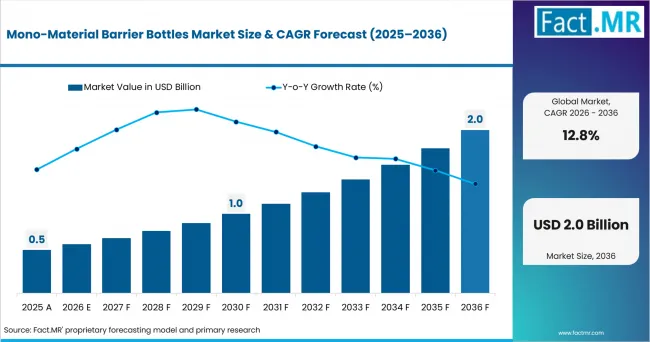
Mono Material Barrier Bottles Market Market Value Analysis | Source: Fact.MR
What are the defining numbers behind mono-material barrier bottle growth?
USD 1.4 billion absolute opportunity by 2036, led by India and China.
- Demand Drivers in the Market
- Brand owners need recyclable bottle formats before product launches enter retail review.
- Food and beverage processors need oxygen protection while keeping the main bottle material sortable.
- Converters need coating and scavenger options that fit existing blow-molding assets.
- Regulators are pushing packaging teams toward designs that can be documented under recycling rules.
- Key Segments Analyzed
- By Material Platform: Mono-PET is projected to hold 34.0% share in 2026 due to beverage-line fit and clear sorting routes.
- By Barrier Method: Recyclable coating is anticipated to account for 31.0% share in 2026 owing to lower filling-line disruption.
- By End Use: Dairy is forecast to capture 26.0% share in 2026 due to oxygen sensitivity in chilled products.
- By Bottle Format: High-barrier containers are expected to hold 29.0% share in 2026 supported by shelf-life requirements.
- By Sales Channel: Direct contracts are estimated to hold 48.0% share in 2026 due to converter qualification needs.
- By Geography: India is projected to record 14.5% CAGR through 2036 owing to EPR registration and brand compliance pressure.
- Analyst Opinion at Fact.MR
- Shambhu Nath Jha, Senior Analyst at Fact.MR, states, “Mono-material barrier bottles are becoming a qualification issue before they become a volume issue. Brand owners are asking whether a bottle protects the product and still passes recycling review. Suppliers that connect barrier data with converter trials should gain earlier access to food, beverage and personal care programs.”
- Strategic Implications
- Bottle converters should build trial evidence for coated PET and HDPE formats before large brand bids.
- Brand owners need pack-level recycling evidence before moving oxygen-sensitive products into mono-material bottles.
- Barrier material suppliers should support recyclability testing instead of selling only additive performance.
- Equipment suppliers need filling-line support that proves mono-material bottle conversion does not slow throughput.
Rigid bottles made mainly from one polymer family form the core of this market. European Commission guidance states that the Packaging and Packaging Waste Regulation entered into force on 11 February 2025 and generally applies from 12 August 2026. This supports buyer review of plastic bottles and containers before new product launches.
India is projected to record 14.5% CAGR through 2036 due to EPR registration pressure and faster packaged beverage conversion. China is expected to expand at 13.8% CAGR through 2036 owing to domestic packaging redesign and large beverage output. France is forecast to grow at 12.9% CAGR through 2036 due to EU packaging rules and brand recycling targets. Germany is expected to advance at 12.6% CAGR through 2036 due to strict sorting systems and converter readiness. The United Kingdom is projected to rise at 12.2% CAGR through 2036 due to plastic packaging tax pressure.
How does the mono-material barrier bottles market break down by segment?
Mono-PET leads at 34.0%; recyclable coating leads at 31.0%.
Which material platform dominates?
Mono-PET holds 34.0% share in 2026.
Mono-PET is projected to hold 34.0% share in 2026 due to existing bottle collection routes and beverage-line familiarity. PET keeps clear-bottle economics attractive for juices and functional drinks. Fact.MR comparison with PET containers shows why buyers can convert faster when recycling infrastructure already recognizes the base polymer.
Which barrier method dominates?
Recyclable coating accounts for 31.0% share in 2026.
Recyclable coating is anticipated to account for 31.0% share in 2026 owing to lower disruption during bottle conversion. The Association of Plastic Recyclers says its design guide supports assessment of every component of a package design. This makes design-for-recycling packaging a direct specification point for coated bottle projects.
Which end use dominates?
Dairy holds 26.0% share in 2026.
Dairy is forecast to capture 26.0% share in 2026 due to oxygen sensitivity and short shelf-life risk. Buyers need bottles that protect taste and product quality during chilled distribution. Adjacent food packaging needs show the same trade-off between product protection and recyclability, but keep the dairy section focused on oxygen-sensitive bottles.
Which bottle format dominates?
High-barrier containers lead with 29.0% share in 2026.
High-barrier containers are expected to hold 29.0% share in 2026 due to shelf-life requirements in dairy, juice and sauce packs. This format gains attention where plain PET or HDPE cannot meet oxygen or aroma protection needs. Suppliers need test data that proves barrier performance and recycling compatibility in the same bottle.
Which sales channel dominates?
Direct contracts hold 48.0% share in 2026.
Direct contracts are estimated to hold 48.0% share in 2026 due to converter qualification and brand approval needs. High-volume accounts often require bottle trials, recycling evidence and filling-line confirmation before launch.
What is accelerating mono-material barrier bottle demand, and what is holding it back?
Packaging rules and shelf-life needs drive demand; validation cost restrains adoption.
The main driver is regulatory pressure on recyclable packaging. Eurostat reported 79.7 million tonnes of EU packaging waste in 2023. This supports redesign work in bottled water packaging and other rigid bottle categories.
The second driver is the need to protect oxygen-sensitive products without keeping mixed-material structures. Recyclable coatings and scavengers let suppliers keep a main polymer stream while adding barrier protection. The buyer benefit is simpler recycling evidence during retail and compliance reviews.
The main restraint is validation cost. Food and beverage brands must prove shelf life, migration safety and recycling fit before moving large volumes. Rigid plastic packaging suppliers can shorten qualification when they already serve brand accounts and converter networks.
Where do the biggest mono-material barrier bottle opportunities sit?
Dairy bottles, juice packs and personal care refills.
- Dairy Bottles: Suppliers can target chilled products that need oxygen protection and clearer recycling claims. Closure compatibility also matters because caps can affect the recycling result of the full pack.
- Juice Packs: Coated PET and oxygen scavenger systems can support shelf-life protection for clear and hot-fill bottles. This route is helped by brand interest in recyclable plastic packaging that can be documented during launch approval.
- Personal Care Refills: Mono-HDPE and mono-PP refill bottles can support shampoo, household liquid and cleaning product programs. Brands working toward zero waste packaging need pack designs that reduce sorting complexity.
Which countries are scaling mono-material barrier bottles fastest?
India 14.5%, China 13.8%, France 12.9%, Germany 12.6%, UK 12.2%, USA 11.8%, Japan 10.8%.
Based on regional analysis, the mono-material barrier bottles market is segmented into North America, Europe, East Asia, South Asia and Pacific, Latin America, and Middle East and Africa complete the regional scope.
| Country | CAGR |
|---|---|
| India | 14.5% |
| China | 13.8% |
| France | 12.9% |
| Germany | 12.6% |
| United Kingdom | 12.2% |
| United States | 11.8% |
| Japan | 10.8% |
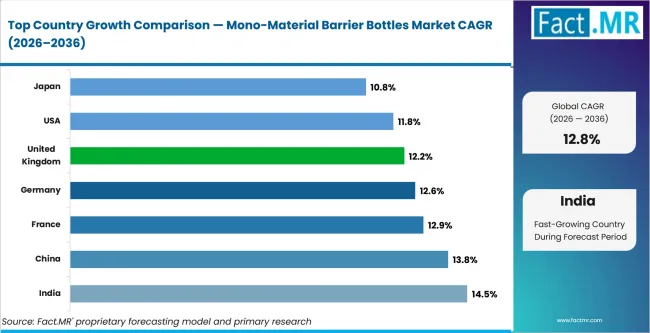
Mono Material Barrier Bottles Market Cagr Analysis By Country | Source: Fact.MR
What is powering India’s lead?
14.5% CAGR, supported by EPR registration and fast packaged beverage conversion.
India is projected to record 14.5% CAGR through 2036 due to EPR registration pressure and rising packaged beverage conversion. The Press Information Bureau stated in March 2026 that 60,128 Producers, Importers and Brand Owners were registered on the plastic packaging EPR portal. Brand owners therefore need bottle designs that can be documented for compliance and recycling. Suppliers with local converter access should gain better trial access.
Why is China an important bottle conversion market?
13.8% CAGR, driven by large beverage output and packaging redesign.
China is expected to expand at 13.8% CAGR through 2036 owing to domestic beverage scale and local packaging redesign. Public recycling programs and brand supply chains are pushing converters to simplify plastic formats. Domestic bottle makers can move faster when barrier systems fit existing PET and HDPE platforms. Demand should favor suppliers that support local testing and plant-level qualification.
What underpins France’s growth?
12.9% CAGR, backed by EU packaging rules and retail recycling scrutiny.
France is forecast to grow at 12.9% CAGR through 2036 due to EU packaging rules and brand recycling commitments. The EU regulation creates a stronger reason for French beverage and personal care companies to review hard-to-recycle packs before 2026 implementation. Converters need proof that coatings and scavengers do not disrupt recycling. Suppliers with RecyClass and APR alignment evidence should be better placed.
Why does Germany remain a core market?
12.6% CAGR, supported by sorting discipline and converter readiness.
Germany is expected to advance at 12.6% CAGR through 2036 due to strict sorting systems and a deep packaging converter base. German packaging customers tend to request recyclability evidence before wider account approval. Bottle redesign therefore moves through testing, documentation and line validation. Faster growth is limited by the time needed to approve food-contact and shelf-life performance together.
What supports the United Kingdom outlook?
12.2% CAGR, due to plastic packaging tax pressure.
The United Kingdom is projected to rise at 12.2% CAGR through 2036 due to tax pressure on plastic packaging with low recycled content. HM Revenue and Customs reported a Plastic Packaging Tax rate of GBP 217.85 per tonne for 2024 to 2025. Brands and converters are expected to keep reviewing recyclable bottle structures while tax and EPR costs affect pack economics. Suppliers need evidence that bottles can meet both cost and recycling requirements.
How is the United States scaling demand?
11.8% CAGR, supported by brand coalitions and state packaging rules.
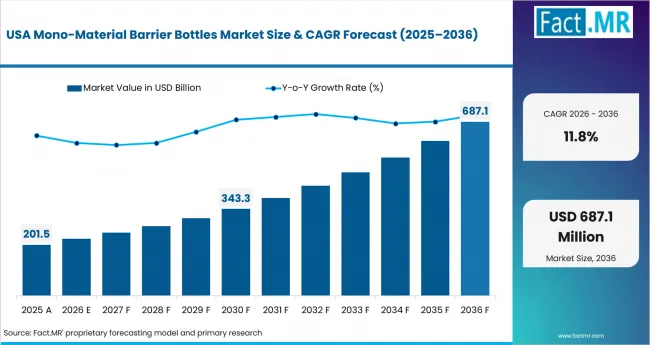
Mono Material Barrier Bottles Market Country Value Analysis | Source: Fact.MR
The United States is forecast to grow at 11.8% CAGR through 2036 due to retailer pressure and state-level packaging rules. The U.S. Plastics Pact reported in its 2023 to 2024 impact report that 50% of plastic packaging placed on the market by activators was reusable, recyclable or compostable. Brand owners are expected to test mono-material bottles where recycling claims must be clearer. Regional conversion is uneven because collection systems differ by state and municipality.
Why is Japan a measured conversion market?
10.8% CAGR, backed by local recycling systems and careful pack qualification.
Japan is expected to post 10.8% CAGR through 2036 due to disciplined pack testing and a cautious retail approval process. The Japan Containers and Packaging Recycling Association states that certified local governments began recycling plastic without sorting by type in April 2024. This supports simpler polymer design but does not remove the need for performance testing. Suppliers with clear shelf-life evidence should gain stronger buyer confidence.
Who leads the mono-material barrier bottles landscape?
Amcor, ALPLA and Plastipak lead through converter scale and barrier bottle proof.
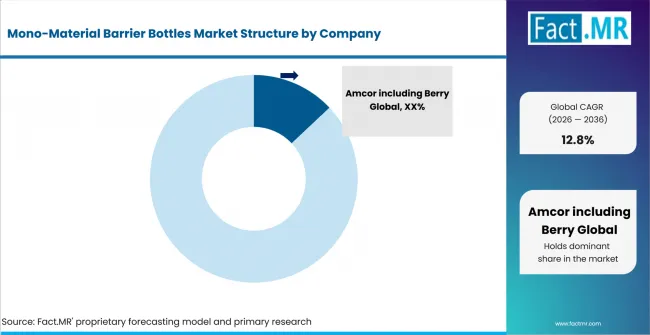
Mono Material Barrier Bottles Market Analysis By Company | Source: Fact.MR
Mono-material barrier bottle supply is shaped by converters, barrier material suppliers and filling-line system providers. Amcor now includes Berry Global after completing the combination in April 2025. [11] ALPLA supports recyclable plastic bottle programs and has active mono-material HDPE development in its published sustainability disclosures. Plastipak has direct barrier technology proof through O2Blox.
Plastipak stated in June 2026 that O2Blox is a nylon-free PET oxygen barrier recognized by the Association of Plastic Recyclers and RecyClass. This gives the company better access in accounts requiring barrier protection and recycling evidence together.
Competition through 2036 should depend on proof of barrier performance, recycling compatibility and converter account access. Suppliers that can combine test data with brand-ready bottle trials should be better placed than firms selling only resins or coating inputs.
Which companies are the key players?
Amcor / Berry Global, ALPLA, Plastipak, Graham Packaging, Kuraray and Mitsubishi Gas Chemical.
- Amcor / Berry Global
- ALPLA
- Plastipak
- Graham Packaging
- Kuraray
- Mitsubishi Gas Chemical
Bibliography
- European Commission. (2025). Packaging waste. European Commission.
- Eurostat. (2025, October 10). Packaging waste statistics. European Commission.
- Association of Plastic Recyclers. (2026). APR Design® Guide overview. Association of Plastic Recyclers.
- Association of Plastic Recyclers. (2025, April 16). 2025 APR-RecyClass Cooperation Report. Association of Plastic Recyclers.
- Ellen MacArthur Foundation. (2024, November 18). The Global Commitment 2024 Progress Report. Ellen MacArthur Foundation.
- U.S. Plastics Pact. (2024). U.S. Pact 2023–24 Impact Report. U.S. Plastics Pact.
- HM Revenue & Customs. (2025, August 28). Plastic Packaging Tax statistics commentary. GOV.UK.
- Press Information Bureau. (2026, March 23). Parliament question: Plastic waste management. Government of India.
- ALPLA Group. (2024). Circular economy at ALPLA. In Sustainability Report 2023–2024.
- Japan Containers and Packaging Recycling Association. (2024). Profile. JCPRA.
- Amcor plc. (2025, April 30). Amcor completes combination with Berry Global. Amcor.
- Plastipak Packaging. (2026, June 1). O2Blox™: Recyclable PET barrier packaging. Plastipak.
This Report Addresses
- Strategic intelligence on mono-material barrier bottles across material platform, barrier method and end use.
- Segment analysis covering Mono-PET and Recyclable Coating. Dairy, High-Barrier Containers, and Direct Contracts are also covered.
- Regional outlook covering India and China. France, Germany, the United Kingdom, the United States, and Japan are also covered.
- Competitive analysis of Amcor / Berry Global and ALPLA. Plastipak, Graham Packaging, Kuraray and Mitsubishi Gas Chemical are also covered.
- Product assessment covering recyclable coatings and oxygen scavengers. Plasma coating and SiOx or AlOx barrier methods are also covered.
- Packaging regulation assessment covering PPWR, Plastic Packaging Tax, and India EPR portal signals.
- Primary interviews and company checks support the forecast. Official source review and converter validation were also used.
What does the mono-material barrier bottles market cover?
Rigid barrier bottles made mainly from one polymer family.
The mono-material barrier bottles market covers rigid bottles designed around one main polymer family. It includes mono-PET and mono-HDPE bottles. Mono-PP bottles are included when coatings or scavengers protect food and personal care products.
What is included in the scope?
Barrier bottles, recyclable coatings and converter-ready bottle formats.
The scope includes mono-material bottles for dairy and juice. Sauces, edible oil and personal care are also included. It includes recyclable coating and oxygen scavenger approaches. Plasma, SiOx and AlOx coatings are covered. Converter qualification and brand contract supply are included for bottles designed for mechanical recycling.
What is excluded from the scope?
Flexible packs and cartons. Glass bottles and non-barrier rigid bottles.
The scope excludes flexible pouches and paper cartons. Glass bottles and metal cans are also excluded. It excludes multilayer bottles that cannot be sorted into a main polymer stream. Standard rigid bottles without barrier performance are also outside the scope.
How was the analysis built?
120+ sources and 45+ company portfolios. 30+ countries and 25+ interviews.
- Primary Research:
- Primary research includes interviews with brand packaging teams and rigid packaging converters. It includes input from resin suppliers, coating providers and filling-line system providers.
- Desk Research:
- Desk research reviews packaging rules, design-for-recycling guidance and official waste statistics. Company sources were used to verify current product activity and corporate status.
- Market-Sizing and Forecasting:
- Forecasting uses the supplied 2026 value anchor and checks it against rigid bottle demand. Segment shares were built from converter portfolios, end-use fit and barrier method suitability.
- Data Validation and Update Cycle:
- Forecasts were validated through source checks and company portfolio review. Current M&A status was updated after Amcor completed its combination with Berry Global in April 2025.
Segmentation
What is the report’s scope and coverage?
| Attribute | Details |
|---|---|
| Quantitative Units | USD Billion in 2026 to USD Billion by 2036 at CAGR |
| Market Definition | Rigid barrier bottles made mainly from one polymer family and designed for recyclable packaging programs |
| Material Platform | Mono-PET, Mono-HDPE, Mono-PP, Recyclable Coated PET, Recyclable Coated HDPE, Additive-Enhanced Mono-Material |
| Barrier Method | Recyclable Coating, Oxygen Scavenger, Plasma Coating, SiOx Coating, AlOx Coating, Nanocomposite |
| End Use | Dairy, Juice, Sauces, Edible Oil, Pharma, Personal Care, Household Chemicals |
| Bottle Format | Small Bottles, Refill Bottles, Hot-Fill Bottles, Cold-Fill Bottles, High-Barrier Containers, Lightweight Bottles |
| Performance Need | Oxygen Barrier, Aroma Barrier, Light Protection, Hot-Fill Resistance, Recyclability Compliance |
| Sales Channel | Direct Contracts, Converter Supply, Resin Supplier Partnerships, Equipment Partnerships, Distributor Support |
| Regions Covered | North America, Europe, East Asia, South Asia and Pacific, Latin America, Middle East and Africa |
| Countries Covered | India, China, France, Germany, United Kingdom, United States, Japan |
| Key Companies Profiled | Amcor / Berry Global, ALPLA, Plastipak, Graham Packaging, Kuraray, Mitsubishi Gas Chemical |
| Forecast Period | 2026 to 2036 |
| Approach | Hybrid top-down and bottom-up approach using market value anchors, converter portfolios, packaging regulation checks, and company validation |
How is the market segmented?
-
By Material Platform:
- Mono-PET
- Mono-HDPE
- Mono-PP
- Recyclable Coated PET
- Recyclable Coated HDPE
- Additive-Enhanced Mono-Material
-
By Barrier Method:
- Recyclable Coating
- Oxygen Scavenger
- Plasma Coating
- SiOx Coating
- AlOx Coating
- Nanocomposite
-
By End Use:
- Dairy
- Juice
- Sauces
- Edible Oil
- Pharma
- Personal Care
- Household Chemicals
-
By Bottle Format:
- Small Bottles
- Refill Bottles
- Hot-Fill Bottles
- Cold-Fill Bottles
- High-Barrier Containers
- Lightweight Bottles
-
By Performance Need:
- Oxygen Barrier
- Aroma Barrier
- Light Protection
- Hot-Fill Resistance
- Recyclability Compliance
-
By Sales Channel:
- Direct Contracts
- Converter Supply
- Resin Supplier Partnerships
- Equipment Partnerships
- Distributor Support
-
By Region:
- North America
- United States
- Canada
- Mexico
- Latin America
- Brazil
- Argentina
- Rest of Latin America
- Europe
- Germany
- United Kingdom
- France
- Italy
- Spain
- Rest of Europe
- Asia Pacific
- China
- India
- Japan
- South Korea
- ASEAN
- Middle East and Africa
- GCC Countries
- South Africa
- UAE
- Rest of Middle East and Africa
- North America
Frequently Asked Questions
Which material platform leads the Mono-Material Barrier Bottles Market?
Which country expands fastest in the Mono-Material Barrier Bottles Market?
How does China perform in the Mono-Material Barrier Bottles Market?
How does France perform in the Mono-Material Barrier Bottles Market?
How does Germany perform in the Mono-Material Barrier Bottles Market?
How does the United Kingdom perform in the Mono-Material Barrier Bottles Market?
What is the primary driver in the Mono-Material Barrier Bottles Market?
What is the main restraint in the Mono-Material Barrier Bottles Market?
Why are recyclable coatings important in this market?
Who worked on this report


Preview the report firsthand - request a free sample
Free SampleGet the brochure for pricing and purchase details
Download PDF