Multi-axis Truss Robot Market (2026 - 2036)

Multi-axis Truss Robot Market is segmented by Axis Configuration (Two-Axis, Three-Axis, Four-Axis, Five-Axis, Six-Axis, Other Configurations) and Application (Automobile Manufacturing, Metallurgy Casting, Electronic Communications, Aerospace, Military Research, and Other). Forecast for 2026 to 2036.

Core Findings

    Multi-axis Truss Robot Market Forecast 2026 to 2036

    In 2025, the multi-axis truss robot market was valued at USD 1.6 billion. Based on FMR's analysis, demand for multi-axis truss robots is estimated to grow to USD 1.7 billion in 2026 and USD 3.5 billion by 2036. FMR projects a CAGR of 8.1% during the forecast period.

    The absolute dollar growth from 2026 to 2036 is USD 1.8 billion. This growth is driven by the increasing demand for automation and precision in various industries such as automotive, aerospace, and electronics manufacturing. Multi-axis truss robots are becoming essential for tasks that require high flexibility, accuracy, and speed. Additionally, the adoption of Industry 4.0 and smart factory solutions is further boosting market expansion. However, challenges such as high capital investment and integration complexities may affect market growth in certain regions.

    As Philippe Beaulieu, Chief Executive Officer of Mecademic Industrial Robotics, noted regarding the automation robotics industry’s growth and its impact on automation solutions, ‘We are entering a period of rapid growth for automation. This funding allows us to expand our product line, strengthen our global presence, and continue leading in micro‑automation.’

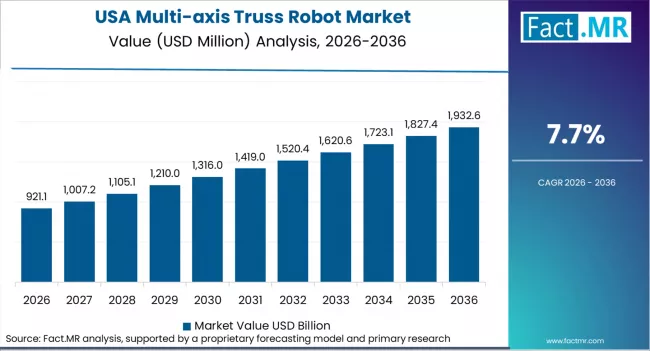
    China leads with a CAGR of 10.9%, driven by its manufacturing strength and growing automation in various industrial sectors. India follows with 10.1%, fueled by rapid industrialization and the increasing demand for automated solutions in the manufacturing sector. Germany grows at 9.3%, benefiting from its strong automotive and industrial sectors. Brazil shows growth at 8.5%, supported by increasing demand for automation in Latin America. The USA grows at 7.7%, reflecting steady adoption of advanced robotics in industrial applications.
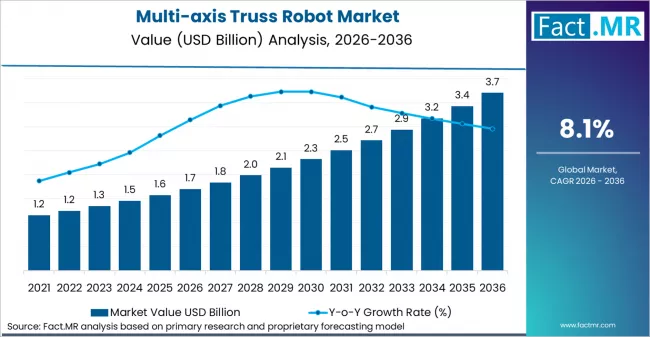
    Multi Axis Truss Robot Market Market Value Analysis

    Multi-axis Truss Robot Market

    Metric Value
    Estimated Value in (2026E) USD 1.7 billion
    Forecast Value in (2036F). USD 3.5 billion
    Forecast CAGR (2026 to 2036) 8.1%

    Multi‑axis Truss Robot Market Definition

    The multi‑axis truss robot market involves the development, manufacture, and sale of robotic systems mounted on truss or gantry structures with multiple axes of movement, used to automate material handling, assembly, welding, painting, inspection, and other industrial tasks with high reach, precision, and speed.

    Market Inclusions

    This report covers global and regional market sizes for multi‑axis truss robots over a defined forecast period, including system types (3‑axis, 5‑axis, 6‑axis and above), end‑use industries (automotive, aerospace, electronics, logistics and warehousing), and deployment models (OEM integrated, aftermarket installations).

    Market Exclusions

    The scope excludes standalone articulated or collaborative robots not mounted on truss structures, unrelated fixed automation systems, and general industrial equipment not specific to multi‑axis truss robot applications.

    Research Methodology

    • Primary Research: Interviews were conducted with robotics engineers, system integrators, OEM automation specialists, and industrial end users.
    • Desk Research: Data was sourced from industry reports, automation publications, and trade association statistics.
    • Market‑Sizing and Forecasting: A hybrid model combining top‑down industrial automation adoption forecasts with bottom‑up shipment and revenue data was used.
    • Data Validation and Update Cycle: Findings were validated through expert review and aligned with recent production, deployment, and trade figures.

    Summary of the Multi-axis Truss Robot Market

    • Market Definition
      • The multi-axis truss robot market involves the development, manufacture, and sale of robotic systems mounted on truss or gantry structures with multiple axes of movement. These robots are used to automate various industrial tasks such as material handling, assembly, welding, painting, and inspection, offering high reach, precision, and speed.
    • Demand Drivers
      • Rising Demand for Automation: The need for improved precision, speed, and flexibility in industries such as automotive, aerospace, and electronics is driving the demand for multi-axis truss robots. These robots provide solutions that reduce labor costs, enhance productivity, and improve production quality.
      • Adoption of Industry 4.0: The shift toward smart factories and the increasing adoption of Industry 4.0 technologies are accelerating the use of robotics for more complex tasks in manufacturing environments.
      • Precision and Flexibility: The ability of multi-axis truss robots to perform complex tasks with precision and flexibility is essential for industries that require high levels of automation.
    • Key Segments Analyzed
      • Axis Configuration: Four-axis robots are expected to hold 40% of the market share by 2026. These robots are commonly used in applications that require a balance of cost, complexity, and functionality, particularly in manufacturing and assembly lines.
      • Application: Automobile manufacturing is projected to account for 45% of the market share by 2026, driven by the increasing use of robots in assembly, welding, and other tasks to enhance production efficiency and reduce labor costs.
      • Geography: China leads with a 10.9% CAGR, driven by rapid industrialization, a growing demand for automation, and advancements in robotics across sectors.
    • Analyst Opinion at Fact MR
      • Shambhu Nath Jha, Principal Consultant at Fact MR, stated, "The growing demand for high precision and flexibility in manufacturing processes, coupled with the adoption of Industry 4.0, is expected to continue driving the growth of the multi-axis truss robot market."
    • Strategic Implications/Executive Takeaways
      • Focus on Automation and Precision: Companies should focus on developing solutions that offer flexibility, precision, and faster cycle times to meet the increasing demand for advanced automation across various industries.
      • Industry-Specific Solutions: Tailoring robotic solutions to specific industries, such as automobile manufacturing and electronics, will be crucial in expanding market reach and ensuring competitive advantages.
      • Sustainability and Smart Manufacturing: Integrating robotics with other smart factory solutions, including IoT and AI, will be key to improving operational efficiency, reducing costs, and enhancing overall manufacturing capabilities.
    • Methodology
      • Primary Research: Interviews with robotics engineers, system integrators, and OEM automation specialists.
      • Desk Research: Data sourced from industry reports, automation publications, and trade association statistics.
      • Market Sizing & Forecasting: A hybrid model combining top-down industrial automation adoption forecasts with bottom-up product sales and shipment data was used for forecasting market growth.

    Segmental Analysis

    Multi-axis Truss Robot Market Analysis by Axis Configuration
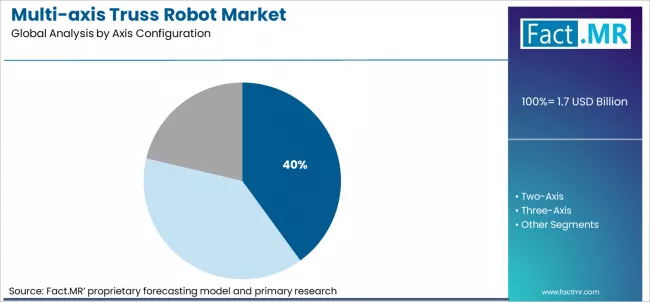
    Multi Axis Truss Robot Market Analysis By Axis Configuration

    • Market Overview: Four-axis configurations are projected to capture 40% of the market share by 2026. Four-axis robots are commonly used in applications that require a high level of precision and flexibility in movement. They are particularly popular in manufacturing and assembly lines due to their balance of complexity, cost, and functionality.
    • Demand Drivers:
      • Precision and Flexibility in Manufacturing: Four-axis robots provide a combination of rotational and translational movements, allowing for precise and flexible handling of materials, making them ideal for applications like assembly, packaging, and material handling in manufacturing environments.
      • Cost-Effectiveness: Four-axis robots strike a balance between cost and complexity compared to more advanced configurations, such as six-axis robots. This makes them an attractive option for companies looking to automate processes without incurring the higher costs associated with more complex systems.
      • Broad Adoption in Key Industries: Four-axis robots are increasingly being adopted in industries such as automotive manufacturing, electronics assembly, and packaging, where precise and repeatable movements are essential.

    Multi-axis Truss Robot Market Analysis by Application
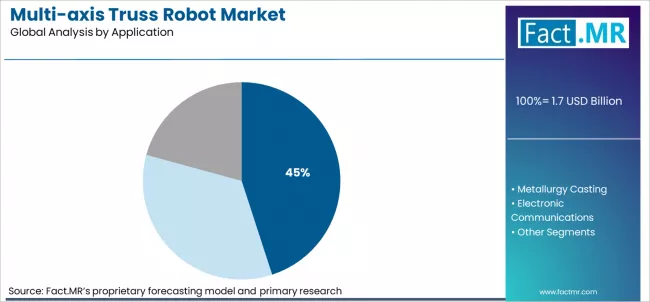
    Multi Axis Truss Robot Market Analysis By Application

    • Market Overview: Automobile manufacturing is expected to capture 45% of the market share by 2026. Multi-axis truss robots are extensively used in automobile manufacturing due to their ability to handle complex tasks, such as assembly, welding, painting, and inspection, with high precision and efficiency.
    • Demand Drivers:
      • Automation in Automotive Production: The automotive industry is increasingly adopting robotics to automate labor-intensive processes, improve production speed, and maintain quality. Multi-axis truss robots offer the precision and flexibility needed to streamline production lines and reduce costs.
      • Increasing Demand for High-Quality Standards: As automotive manufacturers focus on improving product quality and meeting stringent regulatory standards, the use of advanced robotics to achieve higher precision and consistency in production is becoming more prevalent.
      • Versatility in Handling Multiple Tasks: Multi-axis truss robots are highly versatile, capable of performing a range of tasks such as welding, assembling, and quality control in the automotive manufacturing process, driving their widespread use in the sector.

    Multi axis Truss Robot Market Drivers, Restraints, and Opportunities

    FMR analysts observe that the multi‑axis truss robot market is a growth‑aligned automation segment driven by rising demand for flexible, high‑precision material handling and assembly in industries such as automotive, aerospace, electronics and general manufacturing. Historically, traditional fixed‑axis robots and gantries dominated structured production lines; as manufacturers pursue increased throughput, dynamic pathing, and 3D motion capability, structural demand has emerged for multi‑axis truss robots that combine reach, speed, and precision across complex tasks. The 2026 valuation reflects this shift, with adoption tied to broader Industry 4.0 investments and the need to automate increasingly intricate workflows.

    While traditional 6‑axis or cartesian robots remain strong in simple pick‑and‑place and linear applications, multi‑axis truss robots are gaining share because they deliver extended workspace, coordinated motion, and reduced cycle times. These advanced systems typically carry higher average selling prices, contributing to net market value growth even as overall unit volumes grow moderately with capital equipment replacement cycles.

    • Automation & Productivity Demand: Manufacturers adopt multi‑axis truss robots to handle complex motion, larger work envelopes, and synchronized paths that basic robots cannot deliver.
    • Standards & Integration Trends: Industrial automation and quality standards push adoption of certified, interoperable robotic systems that meet defined precision and safety requirements.
    • Regional Industrial Dynamics: In Asia‑Pacific and North America, strong manufacturing bases and investment in automation drive higher uptake of multi‑axis truss systems compared with regions with slower capital automation deployment.

    Regional Analysis

    The market analysis covers key global regions, including East Asia, South Asia, Western Europe, North America, and Latin America. It is segmented geographically, with specific market dynamics for each region. The full report provides a detailed market attractiveness analysis.
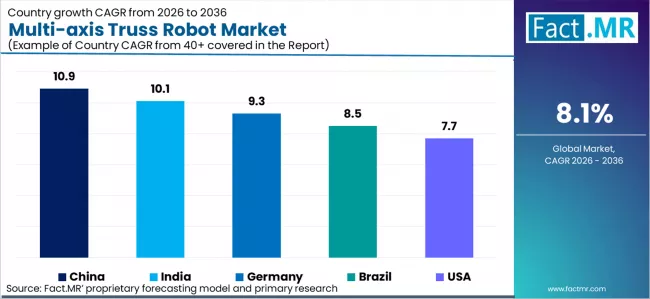
    Multi Axis Truss Robot Market Cagr Analysis By Country

    Country CAGR (2026-2036)
    China 10.9%
    India 10.1%
    Germany 9.3%
    Brazil 8.5%
    USA 7.7%

    Source: Fact MR (FMR) analysis, based on proprietary forecasting model and primary research.

    East Asia:

    In East Asia, China is the leading market for multi-axis truss robots, supported by rapid industrialization, increasing automation in manufacturing processes, and growing demand for robotics across sectors like automotive, electronics, and logistics.

    • China: Demand for multi-axis truss robots in China is projected to rise at 10.9% CAGR through 2036. China’s booming industrial sector, expansion of manufacturing automation, and increasing adoption of robotics in various industries continue to drive market growth.

    South Asia:

    In South Asia, India is a significant market for multi-axis truss robots, driven by the country’s growing industrial base, rising demand for automation, and increasing focus on advanced manufacturing technologies.

    • India: Demand for multi-axis truss robots in India is projected to rise at 10.1% CAGR through 2036. India’s growing industrial output, increased focus on automation in manufacturing, and government initiatives to promote robotics in industry continue to boost market demand.

    Western Europe:

    In Western Europe, Germany is a key market for multi-axis truss robots, supported by the country’s advanced manufacturing capabilities, increasing adoption of automation, and strong presence in automotive, electronics, and logistics sectors.

    • Germany: Demand for multi-axis truss robots in Germany is projected to rise at 9.3% CAGR through 2036. Germany’s focus on advanced manufacturing, high demand for automation solutions in various industries, and growing investments in robotics technology continue to fuel market growth.

    North America:
    Multi Axis Truss Robot Market Country Value Analysis

    In North America, the USA is a prominent market for multi-axis truss robots, driven by technological advancements in robotics, the increasing need for automation in manufacturing, and rising demand for flexible and efficient robotic systems.

    • USA: Demand for multi-axis truss robots in the U.S. is projected to rise at 7.7% CAGR through 2036. The USA’s strong industrial base, growing adoption of automation solutions, and high demand for robotics in sectors like automotive and logistics continue to support steady market growth.

    Latin America:

    In Latin America, Brazil is the leading market for multi-axis truss robots, driven by the country’s industrial growth, rising automation demand, and increasing interest in robotic technologies for improving manufacturing efficiency.

    • Brazil: Demand for multi-axis truss robots in Brazil is projected to rise at 8.5% CAGR through 2036. Brazil’s growing industrial sector, rising demand for automation in manufacturing, and increasing interest in robotics for operational efficiency continue to contribute to market expansion.

    Fact MR's analysis of the Multi-axis Truss Robot Market in East Asia, South Asia, Western Europe, North America, and Latin America consists of country-wise assessments that include China, India, Germany, Brazil, and the USA. Readers can find detailed trends, regulatory updates, and company-specific investments shaping the market’s growth in these countries.

    What is the Competitive Structure and Buyer Behavior in the Multi axis Truss Robot Market?
    Multi Axis Truss Robot Market Analysis By Company

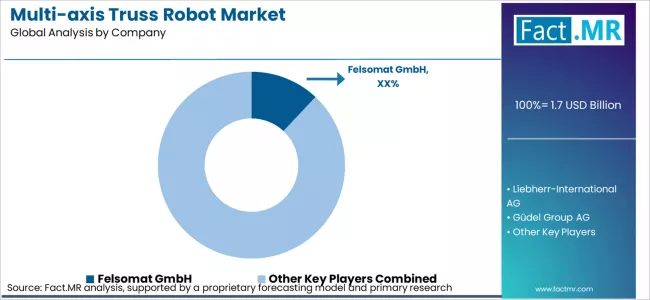
    The multi‑axis truss robot market is moderately concentrated, with a mix of established industrial robotics leaders such as Felsomat GmbH, Liebherr‑International AG, Güdel Group AG, FLT Automation GmbH, FANUC Corporation, SIASUN Robot & Automation Co., Ltd., Qingdao Kingerobot Co., Ltd., LECN, Anhui Hengtong Group Co., Ltd., and STON Robot capturing a substantial share of revenue while smaller regional specialists compete in niche segments. Technological capability and system integration are the primary competitive variables, with performance, precision, and compatibility with automation systems driving buyer preference. Firms with deep engineering expertise, broad automation portfolios, and global service networks hold structural advantages, as they can offer end‑to‑end solutions, shorten deployment cycles, and support long‑term maintenance. Large industrial buyers, including automotive OEMs and major manufacturers, exert considerable leverage by negotiating terms and qualifying multiple suppliers based on standards, cost, and after‑sales support. To manage supplier dependency, these buyers often standardize components and maintain a roster of approved vendors, which limits individual suppliers’ pricing power and shifts competition toward value, reliability, and integrated service offerings rather than price alone.

    Recent Industry Developments

    • AI-Driven "Predictive Pathing" Integration: By February 2026, major manufacturers like FANUC and Yaskawa have integrated "Agentic AI" into truss control systems. Unlike traditional rule-based movements, these robots now use analytical AI to anticipate machine tool failures and autonomously re-route material handling paths across multiple workstations to avoid production bottlenecks.
    • Commercial Scaling of Level 5 Automation: The European market has entered a decisive phase for Digital Automatic systems in heavy industry. New 2026 "PioDAC" projects are testing truss robots equipped with Level 5 automation, enabling fully autonomous coupling and uncoupling of heavy payloads in marshalling yards and metallurgy casting environments without human intervention.
    • The "Simulate-then-Procure" Shift: In 2026, the era of "CapEx Guessing" for large-scale truss installations has ended. Manufacturers are moving toward a Digital Twin-first model, where the entire multi-axis gantry system is built, stress-tested, and optimized in a high-fidelity virtual environment (using platforms like NVIDIA Isaac Sim) before the physical hardware is even ordered

    Key Players of the Multi-axis Truss Robot Market

    • Felsomat GmbH
    • Liebherr-International AG
    • Güdel Group AG
    • FLT Automation GmbH
    • FANUC Corporation
    • SIASUN Robot & Automation Co., Ltd.
    • Qingdao Kingerobot Co., Ltd.
    • LECN
    • Anhui Hengtong Group Co., Ltd.
    • STON Robot

    Report Scope

    Metric Value
    Quantitative Units USD 1.7 billion (2026) to USD 3.5 billion (2036), at a CAGR of 8.1%
    Market Definition The Multi-axis Truss Robot Market includes robots used for various industrial applications with multiple axis configurations for tasks such as manufacturing, casting, and research.
    By Axis Configuration Two-Axis, Three-Axis, Four-Axis, Five-Axis, Six-Axis, Other Configurations
    By Application Automobile Manufacturing, Metallurgy Casting, Electronic Communications, Aerospace, Military Research, Other
    Regions Covered North America, Latin America, Europe, East Asia, South Asia, Oceania, Middle East and Africa
    Countries Covered United States, Canada, Mexico, Brazil, Argentina, Germany, France, United Kingdom, Italy, Spain, China, India, Japan, South Korea, Indonesia, Australia, and 40+ countries
    Key Companies Profiled Felsomat GmbH, Liebherr-International AG, Güdel Group AG, FLT Automation GmbH, FANUC Corporation, SIASUN Robot & Automation Co., Ltd., Qingdao Kingerobot Co., Ltd., LECN, Anhui Hengtong Group Co., Ltd., STON Robot
    Forecast Period 2026 to 2036
    Approach Hybrid top-down and bottom-up market modeling validated through primary interviews with manufacturers and supported by trade data benchmarking and market research.

    Multi-axis Truss Robot Market Key Segments

    • Axis Configuration :

      • Two-Axis
      • Three-Axis
      • Four-Axis
      • Five-Axis
      • Six-Axis
      • Other Configurations
    • Application :

      • Automobile Manufacturing
      • Metallurgy Casting
      • Electronic Communications
      • Aerospace
      • Military Research
      • Other
    • Region :

      • North America
        • USA
        • Canada
        • Mexico
      • Europe
        • Germany
        • UK
        • France
        • Italy
        • Spain
        • Nordic Countries
        • BENELUX
        • Rest of Europe
      • Asia Pacific
        • China
        • Japan
        • South Korea
        • India
        • Australia
        • Rest of Asia Pacific
      • Latin America
        • Brazil
        • Argentina
        • Rest of Latin America
      • Middle East and Africa
        • Kingdom of Saudi Arabia
        • United Arab Emirates
        • South Africa
        • Rest of Middle East and Africa
      • Other Regions
        • Oceania
        • Central Asia
        • Other Markets

    Bibliographies

    • FANUC Corporation. (2023). Industry 4.0 and the rise of multi-axis robotics in manufacturing. FANUC Corporation.
    • Felsomat GmbH. (2023). Advancements in multi-axis truss robots for automotive manufacturing. Felsomat GmbH.
    • Güdel Group AG. (2023). Innovative multi-axis truss robots for precision manufacturing. Güdel Group AG.
    • Liebherr-International AG. (2023). Robotic automation solutions in industrial manufacturing. Liebherr-International AG.
    • SIASUN Robot & Automation Co., Ltd. (2023). The future of multi-axis truss robots in global manufacturing sectors. SIASUN Robot & Automation Co., Ltd.
    • DBR77. (2025/2026). Industrial robotics trends 2026: Physical AI and the simulate-then-procure shift [Industry insights]. DBR77.
    • Machinery & Manufacturing. (2026, January). FANUC sets out top three trends in robotics for 2026 [Market report]. Machinery & Manufacturing.
    • UIC. (2026, March). Moving towards real DAC operations: Where do we stand and what’s next? [Industry update]. UIC.

    This report addresses:

    • Market intelligence enabling comprehensive assessment of leading countries and product segments across the Multi-axis Truss Robot Market globally.
    • Market volume (sales units) estimates and 10-year revenue forecasts from 2026 to 2036, validated through manufacturer shipment data, channel partner surveys, and country-level demand modeling.
    • Growth opportunity mapping across axis configurations (Two-Axis, Three-Axis, Four-Axis, Five-Axis, Six-Axis), application types (Automobile Manufacturing, Metallurgy Casting, Electronic Communications, Aerospace, Military Research, and Other), and end-use industries.
    • Segment and regional revenue forecasts by axis configuration, application, end-user industry, and geography across 40+ countries.
    • Competition strategy analysis covering dealer network structure, recent developments, product portfolio, USPs, and market share analysis.
    • Product and regulatory compliance tracking aligned with robotics safety standards, automation system certifications, and manufacturing regulations.
    • Regulatory impact analysis addressing automation standards, industrial robotics integration, and manufacturing certifications across key markets.
    • Report delivery in PDF, Excel, PowerPoint, and interactive dashboard formats for executive, procurement, and operational planning use.

    Table of Content

    1. Executive Summary
      • Global Market Outlook
      • Demand to side Trends
      • Supply to side Trends
      • Technology Roadmap Analysis
      • Analysis and Recommendations
    2. Market Overview
      • Market Coverage / Taxonomy
      • Market Definition / Scope / Limitations
    3. Research Methodology
      • Chapter Orientation
      • Analytical Lens and Working Hypotheses
        • Market Structure, Signals, and Trend Drivers
        • Benchmarking and Cross-market Comparability
        • Market Sizing, Forecasting, and Opportunity Mapping
      • Research Design and Evidence Framework
        • Desk Research Programme (Secondary Evidence)
          • Company Annual and Sustainability Reports
          • Peer-reviewed Journals and Academic Literature
          • Corporate Websites, Product Literature, and Technical Notes
          • Earnings Decks and Investor Briefings
          • Statutory Filings and Regulatory Disclosures
          • Technical White Papers and Standards Notes
          • Trade Journals, Industry Magazines, and Analyst Briefs
          • Conference Proceedings, Webinars, and Seminar Materials
          • Government Statistics Portals and Public Data Releases
          • Press Releases and Reputable Media Coverage
          • Specialist Newsletters and Curated Briefings
          • Sector Databases and Reference Repositories
          • FMR Internal Proprietary Databases and Historical Market Datasets
          • Subscription Datasets and Paid Sources
          • Social Channels, Communities, and Digital Listening Inputs
          • Additional Desk Sources
        • Expert Input and Fieldwork (Primary Evidence)
          • Primary Modes
            • Qualitative Interviews and Expert Elicitation
            • Quantitative Surveys and Structured Data Capture
            • Blended Approach
          • Why Primary Evidence is Used
          • Field Techniques
            • Interviews
            • Surveys
            • Focus Groups
            • Observational and In-context Research
            • Social and Community Interactions
          • Stakeholder Universe Engaged
            • C-suite Leaders
            • Board Members
            • Presidents and Vice Presidents
            • R&D and Innovation Heads
            • Technical Specialists
            • Domain Subject-matter Experts
            • Scientists
            • Physicians and Other Healthcare Professionals
          • Governance, Ethics, and Data Stewardship
            • Research Ethics
            • Data Integrity and Handling
        • Tooling, Models, and Reference Databases
      • Data Engineering and Model Build
        • Data Acquisition and Ingestion
        • Cleaning, Normalisation, and Verification
        • Synthesis, Triangulation, and Analysis
      • Quality Assurance and Audit Trail
    4. Market Background
      • Market Dynamics
        • Drivers
        • Restraints
        • Opportunity
        • Trends
      • Scenario Forecast
        • Demand in Optimistic Scenario
        • Demand in Likely Scenario
        • Demand in Conservative Scenario
      • Opportunity Map Analysis
      • Product Life Cycle Analysis
      • Supply Chain Analysis
      • Investment Feasibility Matrix
      • Value Chain Analysis
      • PESTLE and Porter’s Analysis
      • Regulatory Landscape
      • Regional Parent Market Outlook
      • Production and Consumption Statistics
      • Import and Export Statistics
    5. Global Market Analysis 2021 to 2025 and Forecast, 2026 to 2036
      • Historical Market Size Value (USD Million) Analysis, 2021 to 2025
      • Current and Future Market Size Value (USD Million) Projections, 2026 to 2036
        • Y to o to Y Growth Trend Analysis
        • Absolute $ Opportunity Analysis
    6. Global Market Pricing Analysis 2021 to 2025 and Forecast 2026 to 2036
    7. Global Market Analysis 2021 to 2025 and Forecast 2026 to 2036, By Axis Configuration
      • Introduction / Key Findings
      • Historical Market Size Value (USD Million) Analysis By Axis Configuration , 2021 to 2025
      • Current and Future Market Size Value (USD Million) Analysis and Forecast By Axis Configuration , 2026 to 2036
        • Four-Axis
        • Two-Axis
        • Three-Axis
      • Y to o to Y Growth Trend Analysis By Axis Configuration , 2021 to 2025
      • Absolute $ Opportunity Analysis By Axis Configuration , 2026 to 2036
    8. Global Market Analysis 2021 to 2025 and Forecast 2026 to 2036, By Application
      • Introduction / Key Findings
      • Historical Market Size Value (USD Million) Analysis By Application, 2021 to 2025
      • Current and Future Market Size Value (USD Million) Analysis and Forecast By Application, 2026 to 2036
        • Automobile Manufacturing
        • Metallurgy Casting
        • Electronic Communications
      • Y to o to Y Growth Trend Analysis By Application, 2021 to 2025
      • Absolute $ Opportunity Analysis By Application, 2026 to 2036
    9. Global Market Analysis 2021 to 2025 and Forecast 2026 to 2036, By Region
      • Introduction
      • Historical Market Size Value (USD Million) Analysis By Region, 2021 to 2025
      • Current Market Size Value (USD Million) Analysis and Forecast By Region, 2026 to 2036
        • North America
        • Latin America
        • Western Europe
        • Eastern Europe
        • East Asia
        • South Asia and Pacific
        • Middle East & Africa
      • Market Attractiveness Analysis By Region
    10. North America Market Analysis 2021 to 2025 and Forecast 2026 to 2036, By Country
      • Historical Market Size Value (USD Million) Trend Analysis By Market Taxonomy, 2021 to 2025
      • Market Size Value (USD Million) Forecast By Market Taxonomy, 2026 to 2036
        • By Country
          • USA
          • Canada
          • Mexico
        • By Axis Configuration
        • By Application
      • Market Attractiveness Analysis
        • By Country
        • By Axis Configuration
        • By Application
      • Key Takeaways
    11. Latin America Market Analysis 2021 to 2025 and Forecast 2026 to 2036, By Country
      • Historical Market Size Value (USD Million) Trend Analysis By Market Taxonomy, 2021 to 2025
      • Market Size Value (USD Million) Forecast By Market Taxonomy, 2026 to 2036
        • By Country
          • Brazil
          • Chile
          • Rest of Latin America
        • By Axis Configuration
        • By Application
      • Market Attractiveness Analysis
        • By Country
        • By Axis Configuration
        • By Application
      • Key Takeaways
    12. Western Europe Market Analysis 2021 to 2025 and Forecast 2026 to 2036, By Country
      • Historical Market Size Value (USD Million) Trend Analysis By Market Taxonomy, 2021 to 2025
      • Market Size Value (USD Million) Forecast By Market Taxonomy, 2026 to 2036
        • By Country
          • Germany
          • UK
          • Italy
          • Spain
          • France
          • Nordic
          • BENELUX
          • Rest of Western Europe
        • By Axis Configuration
        • By Application
      • Market Attractiveness Analysis
        • By Country
        • By Axis Configuration
        • By Application
      • Key Takeaways
    13. Eastern Europe Market Analysis 2021 to 2025 and Forecast 2026 to 2036, By Country
      • Historical Market Size Value (USD Million) Trend Analysis By Market Taxonomy, 2021 to 2025
      • Market Size Value (USD Million) Forecast By Market Taxonomy, 2026 to 2036
        • By Country
          • Russia
          • Poland
          • Hungary
          • Balkan & Baltic
          • Rest of Eastern Europe
        • By Axis Configuration
        • By Application
      • Market Attractiveness Analysis
        • By Country
        • By Axis Configuration
        • By Application
      • Key Takeaways
    14. East Asia Market Analysis 2021 to 2025 and Forecast 2026 to 2036, By Country
      • Historical Market Size Value (USD Million) Trend Analysis By Market Taxonomy, 2021 to 2025
      • Market Size Value (USD Million) Forecast By Market Taxonomy, 2026 to 2036
        • By Country
          • China
          • Japan
          • South Korea
        • By Axis Configuration
        • By Application
      • Market Attractiveness Analysis
        • By Country
        • By Axis Configuration
        • By Application
      • Key Takeaways
    15. South Asia and Pacific Market Analysis 2021 to 2025 and Forecast 2026 to 2036, By Country
      • Historical Market Size Value (USD Million) Trend Analysis By Market Taxonomy, 2021 to 2025
      • Market Size Value (USD Million) Forecast By Market Taxonomy, 2026 to 2036
        • By Country
          • India
          • ASEAN
          • Australia & New Zealand
          • Rest of South Asia and Pacific
        • By Axis Configuration
        • By Application
      • Market Attractiveness Analysis
        • By Country
        • By Axis Configuration
        • By Application
      • Key Takeaways
    16. Middle East & Africa Market Analysis 2021 to 2025 and Forecast 2026 to 2036, By Country
      • Historical Market Size Value (USD Million) Trend Analysis By Market Taxonomy, 2021 to 2025
      • Market Size Value (USD Million) Forecast By Market Taxonomy, 2026 to 2036
        • By Country
          • Kingdom of Saudi Arabia
          • Other GCC Countries
          • Turkiye
          • South Africa
          • Other African Union
          • Rest of Middle East & Africa
        • By Axis Configuration
        • By Application
      • Market Attractiveness Analysis
        • By Country
        • By Axis Configuration
        • By Application
      • Key Takeaways
    17. Key Countries Market Analysis
      • USA
        • Pricing Analysis
        • Market Share Analysis, 2025
          • By Axis Configuration
          • By Application
      • Canada
        • Pricing Analysis
        • Market Share Analysis, 2025
          • By Axis Configuration
          • By Application
      • Mexico
        • Pricing Analysis
        • Market Share Analysis, 2025
          • By Axis Configuration
          • By Application
      • Brazil
        • Pricing Analysis
        • Market Share Analysis, 2025
          • By Axis Configuration
          • By Application
      • Chile
        • Pricing Analysis
        • Market Share Analysis, 2025
          • By Axis Configuration
          • By Application
      • Germany
        • Pricing Analysis
        • Market Share Analysis, 2025
          • By Axis Configuration
          • By Application
      • UK
        • Pricing Analysis
        • Market Share Analysis, 2025
          • By Axis Configuration
          • By Application
      • Italy
        • Pricing Analysis
        • Market Share Analysis, 2025
          • By Axis Configuration
          • By Application
      • Spain
        • Pricing Analysis
        • Market Share Analysis, 2025
          • By Axis Configuration
          • By Application
      • France
        • Pricing Analysis
        • Market Share Analysis, 2025
          • By Axis Configuration
          • By Application
      • India
        • Pricing Analysis
        • Market Share Analysis, 2025
          • By Axis Configuration
          • By Application
      • ASEAN
        • Pricing Analysis
        • Market Share Analysis, 2025
          • By Axis Configuration
          • By Application
      • Australia & New Zealand
        • Pricing Analysis
        • Market Share Analysis, 2025
          • By Axis Configuration
          • By Application
      • China
        • Pricing Analysis
        • Market Share Analysis, 2025
          • By Axis Configuration
          • By Application
      • Japan
        • Pricing Analysis
        • Market Share Analysis, 2025
          • By Axis Configuration
          • By Application
      • South Korea
        • Pricing Analysis
        • Market Share Analysis, 2025
          • By Axis Configuration
          • By Application
      • Russia
        • Pricing Analysis
        • Market Share Analysis, 2025
          • By Axis Configuration
          • By Application
      • Poland
        • Pricing Analysis
        • Market Share Analysis, 2025
          • By Axis Configuration
          • By Application
      • Hungary
        • Pricing Analysis
        • Market Share Analysis, 2025
          • By Axis Configuration
          • By Application
      • Kingdom of Saudi Arabia
        • Pricing Analysis
        • Market Share Analysis, 2025
          • By Axis Configuration
          • By Application
      • Turkiye
        • Pricing Analysis
        • Market Share Analysis, 2025
          • By Axis Configuration
          • By Application
      • South Africa
        • Pricing Analysis
        • Market Share Analysis, 2025
          • By Axis Configuration
          • By Application
    18. Market Structure Analysis
      • Competition Dashboard
      • Competition Benchmarking
      • Market Share Analysis of Top Players
        • By Regional
        • By Axis Configuration
        • By Application
    19. Competition Analysis
      • Competition Deep Dive
        • Felsomat GmbH
          • Overview
          • Product Portfolio
          • Profitability by Market Segments (Product/Age /Sales Channel/Region)
          • Sales Footprint
          • Strategy Overview
            • Marketing Strategy
            • Product Strategy
            • Channel Strategy
        • Liebherr-International AG
        • Güdel Group AG
        • FLT Automation GmbH
        • FANUC Corporation
        • SIASUN Robot & Automation Co., Ltd.
    20. Assumptions & Acronyms Used

    List Of Table

    • Table 1: Global Market Value (USD Million) Forecast by Region, 2021 to 2036
    • Table 2: Global Market Value (USD Million) Forecast by Axis Configuration , 2021 to 2036
    • Table 3: Global Market Value (USD Million) Forecast by Application, 2021 to 2036
    • Table 4: North America Market Value (USD Million) Forecast by Country, 2021 to 2036
    • Table 5: North America Market Value (USD Million) Forecast by Axis Configuration , 2021 to 2036
    • Table 6: North America Market Value (USD Million) Forecast by Application, 2021 to 2036
    • Table 7: Latin America Market Value (USD Million) Forecast by Country, 2021 to 2036
    • Table 8: Latin America Market Value (USD Million) Forecast by Axis Configuration , 2021 to 2036
    • Table 9: Latin America Market Value (USD Million) Forecast by Application, 2021 to 2036
    • Table 10: Western Europe Market Value (USD Million) Forecast by Country, 2021 to 2036
    • Table 11: Western Europe Market Value (USD Million) Forecast by Axis Configuration , 2021 to 2036
    • Table 12: Western Europe Market Value (USD Million) Forecast by Application, 2021 to 2036
    • Table 13: Eastern Europe Market Value (USD Million) Forecast by Country, 2021 to 2036
    • Table 14: Eastern Europe Market Value (USD Million) Forecast by Axis Configuration , 2021 to 2036
    • Table 15: Eastern Europe Market Value (USD Million) Forecast by Application, 2021 to 2036
    • Table 16: East Asia Market Value (USD Million) Forecast by Country, 2021 to 2036
    • Table 17: East Asia Market Value (USD Million) Forecast by Axis Configuration , 2021 to 2036
    • Table 18: East Asia Market Value (USD Million) Forecast by Application, 2021 to 2036
    • Table 19: South Asia and Pacific Market Value (USD Million) Forecast by Country, 2021 to 2036
    • Table 20: South Asia and Pacific Market Value (USD Million) Forecast by Axis Configuration , 2021 to 2036
    • Table 21: South Asia and Pacific Market Value (USD Million) Forecast by Application, 2021 to 2036
    • Table 22: Middle East & Africa Market Value (USD Million) Forecast by Country, 2021 to 2036
    • Table 23: Middle East & Africa Market Value (USD Million) Forecast by Axis Configuration , 2021 to 2036
    • Table 24: Middle East & Africa Market Value (USD Million) Forecast by Application, 2021 to 2036

    List Of Figures

    • Figure 1: Global Market Pricing Analysis
    • Figure 2: Global Market Value (USD Million) Forecast 2021 to 2036
    • Figure 3: Global Market Value Share and BPS Analysis by Axis Configuration , 2026 and 2036
    • Figure 4: Global Market Y to o to Y Growth Comparison by Axis Configuration , 2026 to 2036
    • Figure 5: Global Market Attractiveness Analysis by Axis Configuration
    • Figure 6: Global Market Value Share and BPS Analysis by Application, 2026 and 2036
    • Figure 7: Global Market Y to o to Y Growth Comparison by Application, 2026 to 2036
    • Figure 8: Global Market Attractiveness Analysis by Application
    • Figure 9: Global Market Value (USD Million) Share and BPS Analysis by Region, 2026 and 2036
    • Figure 10: Global Market Y to o to Y Growth Comparison by Region, 2026 to 2036
    • Figure 11: Global Market Attractiveness Analysis by Region
    • Figure 12: North America Market Incremental Dollar Opportunity, 2026 to 2036
    • Figure 13: Latin America Market Incremental Dollar Opportunity, 2026 to 2036
    • Figure 14: Western Europe Market Incremental Dollar Opportunity, 2026 to 2036
    • Figure 15: Eastern Europe Market Incremental Dollar Opportunity, 2026 to 2036
    • Figure 16: East Asia Market Incremental Dollar Opportunity, 2026 to 2036
    • Figure 17: South Asia and Pacific Market Incremental Dollar Opportunity, 2026 to 2036
    • Figure 18: Middle East & Africa Market Incremental Dollar Opportunity, 2026 to 2036
    • Figure 19: North America Market Value Share and BPS Analysis by Country, 2026 and 2036
    • Figure 20: North America Market Value Share and BPS Analysis by Axis Configuration , 2026 and 2036
    • Figure 21: North America Market Y to o to Y Growth Comparison by Axis Configuration , 2026 to 2036
    • Figure 22: North America Market Attractiveness Analysis by Axis Configuration
    • Figure 23: North America Market Value Share and BPS Analysis by Application, 2026 and 2036
    • Figure 24: North America Market Y to o to Y Growth Comparison by Application, 2026 to 2036
    • Figure 25: North America Market Attractiveness Analysis by Application
    • Figure 26: Latin America Market Value Share and BPS Analysis by Country, 2026 and 2036
    • Figure 27: Latin America Market Value Share and BPS Analysis by Axis Configuration , 2026 and 2036
    • Figure 28: Latin America Market Y to o to Y Growth Comparison by Axis Configuration , 2026 to 2036
    • Figure 29: Latin America Market Attractiveness Analysis by Axis Configuration
    • Figure 30: Latin America Market Value Share and BPS Analysis by Application, 2026 and 2036
    • Figure 31: Latin America Market Y to o to Y Growth Comparison by Application, 2026 to 2036
    • Figure 32: Latin America Market Attractiveness Analysis by Application
    • Figure 33: Western Europe Market Value Share and BPS Analysis by Country, 2026 and 2036
    • Figure 34: Western Europe Market Value Share and BPS Analysis by Axis Configuration , 2026 and 2036
    • Figure 35: Western Europe Market Y to o to Y Growth Comparison by Axis Configuration , 2026 to 2036
    • Figure 36: Western Europe Market Attractiveness Analysis by Axis Configuration
    • Figure 37: Western Europe Market Value Share and BPS Analysis by Application, 2026 and 2036
    • Figure 38: Western Europe Market Y to o to Y Growth Comparison by Application, 2026 to 2036
    • Figure 39: Western Europe Market Attractiveness Analysis by Application
    • Figure 40: Eastern Europe Market Value Share and BPS Analysis by Country, 2026 and 2036
    • Figure 41: Eastern Europe Market Value Share and BPS Analysis by Axis Configuration , 2026 and 2036
    • Figure 42: Eastern Europe Market Y to o to Y Growth Comparison by Axis Configuration , 2026 to 2036
    • Figure 43: Eastern Europe Market Attractiveness Analysis by Axis Configuration
    • Figure 44: Eastern Europe Market Value Share and BPS Analysis by Application, 2026 and 2036
    • Figure 45: Eastern Europe Market Y to o to Y Growth Comparison by Application, 2026 to 2036
    • Figure 46: Eastern Europe Market Attractiveness Analysis by Application
    • Figure 47: East Asia Market Value Share and BPS Analysis by Country, 2026 and 2036
    • Figure 48: East Asia Market Value Share and BPS Analysis by Axis Configuration , 2026 and 2036
    • Figure 49: East Asia Market Y to o to Y Growth Comparison by Axis Configuration , 2026 to 2036
    • Figure 50: East Asia Market Attractiveness Analysis by Axis Configuration
    • Figure 51: East Asia Market Value Share and BPS Analysis by Application, 2026 and 2036
    • Figure 52: East Asia Market Y to o to Y Growth Comparison by Application, 2026 to 2036
    • Figure 53: East Asia Market Attractiveness Analysis by Application
    • Figure 54: South Asia and Pacific Market Value Share and BPS Analysis by Country, 2026 and 2036
    • Figure 55: South Asia and Pacific Market Value Share and BPS Analysis by Axis Configuration , 2026 and 2036
    • Figure 56: South Asia and Pacific Market Y to o to Y Growth Comparison by Axis Configuration , 2026 to 2036
    • Figure 57: South Asia and Pacific Market Attractiveness Analysis by Axis Configuration
    • Figure 58: South Asia and Pacific Market Value Share and BPS Analysis by Application, 2026 and 2036
    • Figure 59: South Asia and Pacific Market Y to o to Y Growth Comparison by Application, 2026 to 2036
    • Figure 60: South Asia and Pacific Market Attractiveness Analysis by Application
    • Figure 61: Middle East & Africa Market Value Share and BPS Analysis by Country, 2026 and 2036
    • Figure 62: Middle East & Africa Market Value Share and BPS Analysis by Axis Configuration , 2026 and 2036
    • Figure 63: Middle East & Africa Market Y to o to Y Growth Comparison by Axis Configuration , 2026 to 2036
    • Figure 64: Middle East & Africa Market Attractiveness Analysis by Axis Configuration
    • Figure 65: Middle East & Africa Market Value Share and BPS Analysis by Application, 2026 and 2036
    • Figure 66: Middle East & Africa Market Y to o to Y Growth Comparison by Application, 2026 to 2036
    • Figure 67: Middle East & Africa Market Attractiveness Analysis by Application
    • Figure 68: Global Market - Tier Structure Analysis
    • Figure 69: Global Market - Company Share Analysis

    - FAQs -

    How large is the demand for Multi-axis Truss Robots in the global market in 2026?

    Demand for Multi-axis Truss Robots in the global market is estimated to be valued at USD 1.7 billion in 2026.

    What will be the market size of Multi-axis Truss Robots in the global market by 2036?

    The market size for Multi-axis Truss Robots is projected to reach USD 3.5 billion by 2036.

    What is the expected demand growth for Multi-axis Truss Robots in the global market between 2026 and 2036?

    Demand for Multi-axis Truss Robots in the global market is expected to grow at a CAGR of 8.1% between 2026 and 2036.

    Which application is expected to dominate the market?

    Automobile Manufacturing is expected to dominate the market, accounting for 45% of the market share in 2026, driven by the increasing use of automation in automobile production processes to improve efficiency and precision.

    Which region is expected to show the highest growth rate for Multi-axis Truss Robots?

    China is projected to show the highest regional CAGR at 10.9% during the forecast period, supported by rapid industrial automation, large-scale manufacturing facilities, and growing demand for robotics in various industries, including automobile manufacturing.

    How significant is the growth outlook for India in this market?

    India is expected to grow at a CAGR of 10.1%, driven by the country’s expanding manufacturing sector, increasing adoption of automation technologies, and the rise in demand for robots in industries like automotive and electronics.

    What is the growth outlook for Germany in the Multi-axis Truss Robot market?

    Germany is expected to grow at a CAGR of 9.3%, driven by its well-established automotive industry, growing demand for precision manufacturing, and increasing investments in automation and robotic technologies.

    What is the growth forecast for Brazil in the Multi-axis Truss Robot market?

    Brazil is expected to grow at a CAGR of 8.5%, supported by increasing adoption of robotics in manufacturing, a growing automotive industry, and government initiatives to improve industrial automation.

    What is the growth forecast for the United States in the Multi-axis Truss Robot market?

    The United States is projected to grow at a CAGR of 7.7% from 2026 to 2036, driven by advancements in industrial automation, rising demand for robots in manufacturing, and a focus on improving productivity in the automotive sector.

    Which company is identified as a leading player in the Multi-axis Truss Robot market?

    Felsomat GmbH is recognized as a leading player in this market, offering advanced multi-axis truss robot solutions for a range of manufacturing applications, particularly in the automotive sector.

    What are Multi-axis Truss Robots used for?

    Multi-axis Truss Robots are used in various manufacturing applications, primarily in automobile manufacturing, to automate tasks such as assembly, welding, painting, and material handling, improving efficiency, precision, and safety in production processes.

    What does the Multi-axis Truss Robot market include in this report?

    The market scope includes multi-axis truss robots used in industries like automobile manufacturing, which require flexible, precise, and efficient robotic systems to handle various tasks in production lines.

    How is the market forecast developed in this report?

    The forecast is developed using historical data on industrial automation trends, growing demand for robotics in manufacturing, particularly in the automotive sector, and insights from key industry players involved in the development and deployment of multi-axis truss robots.

    What is meant by the Multi-axis Truss Robot market in this report?

    The market refers to the global production, trade, and consumption of multi-axis truss robots, which are increasingly used in manufacturing applications to automate processes, reduce labor costs, and enhance production efficiency in industries such as automotive manufacturing.

    Multi-axis Truss Robot Market