- Base Value(2026): 720.0 Mn
- Estimated Value(2026): 720.0 Mn
- Forecast Value (2036): 2540.0 Mn
- CAGR (2026 - 2036): 13.4%
Multi-Layer PCR Film Deinking Systems Market Forecast and Outlook 2026 to 2036
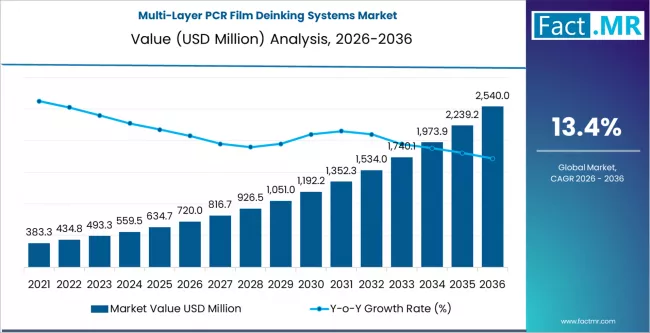
The multi-layer PCR film deinking systems market is projected to reach USD 720 million in 2026 and grow to USD 2.54 billion by 2036, expanding at a CAGR of 13.4%. Commercial realities in this market will be shaped by the ongoing need for pricing discipline and careful cost management.
Multi Layer Pcr Film Deinking Systems Market Market Value Analysis | Source: Fact.MR
Summary of Multi-LayerPCRFilm Deinking Systems Market
- Market Snapshot
- Global multi-layerPCRfilm deinking systems market revenue stood at USD 720 million in 2026 and is forecast to reach USD 2.54 billion by 2036.
- At a 13.4%CAGRfrom 2026 to 2036, this market is set to expand ~3.5x in value, adding USD 1.82 billion in absolute opportunity.
- This marketrepresentsa critical enabling layer in plastic recycling infrastructure, focused on improving the recyclability of complex multi-layer films.
- Deinking systems are evolving into high-efficiency polymer purification platforms, enabling removal of inks, adhesives, and contaminants to produce high-quality post-consumer recycled (PCR) materials.
- Demand and Growth Drivers
- Increasing regulatory pressure on plastic recycling and circular economy adoption is the primary growth driver.
- Rising demand for high-quality recycled polymers from multi-layer packaging waste is accelerating adoption.
- Growth in flexible packaging usage (food, personal care, consumer goods) is driving demand for advanced deinking solutions.
- Brand-owner commitments toward recycled content targets and sustainability goals are reinforcing market expansion.
- Increasing need to upgrade low-grade film waste into usablePCRfeedstock is shaping technology development.
- Product and Segment View
- Printed PE or PP multilayers hold 55% of segment share in 2026,emergingas the dominant segment due to high prevalence in packaging waste streams.
- Key system categories include:
- Wet and chemical deinking lines
- Integrated washing and separation systems
- Ink removal and contaminant extraction units
- Core functionalities include:
- Ink and pigment removal from films
- Separation of adhesives and coatings
- Improvement of polymer purity and recyclability
- Geography and Competitive Outlook
- Asia Pacific is the leading growth region, driven by rapid industrialization and strengthening recycling regulations.
- Key growth markets include:
- India (15.6%CAGR)
- China (14.8%)
- United States (12.8%)
- Germany (12.4%)
- Brazil (11.4%)
- Japan (10.6%)
- Market expansion is closely tied to:
- Recycling infrastructure development
- Circular economy policies
- Packaging waste management regulations
- Key companies active in this market include Cadel Deinking,Sorema, HerboldMeckesheim, Ebara,ACERETECH,B+BAnlagenbau, Mitsubishi Heavy Industries, andPolystar.
Multi-LayerPCRFilm Deinking Systems Market — At a Glance
| Attribute | Details |
| Market Value 2026 | USD 720 million |
| Market Value 2036 | USD 2.54 billion |
| Absolute Dollar Opportunity 2026-2036 | USD 1.82 billion |
| Total Growth 2026-2036 | 252.8% |
| CAGR2026-2036 | 13.4% |
| Growth Multiple | ~3.5x |
| Key Demand Theme | Increasing need for advanced recycling systems to process complex multi-layer plastic films |
| Leading Segment (2026) | Printed PE/PP Multilayers |
| Segment Share (2026) | 55% |
| Key Growth Region | Asia Pacific |
| CountryCAGRs | India 15.6%, China 14.8%, USA 12.8%, Germany 12.4%, Brazil 11.4%, Japan 10.6% |
| Top Companies | Cadel Deinking,Sorema, HerboldMeckesheim, Ebara,ACERETECH,B+BAnlagenbau, Mitsubishi Heavy Industries,Polystar |
| Segmentation by Residue/Input Type | Printed PE/PP Multilayers, Laminated Films, Others |
| Segmentation by System Type | Wet/Chemical Deinking, Integrated Washing Systems |
| Segmentation by End Use | Flexible Packaging Recycling, Industrial Film Recycling |
| Segmentation by Region | North America, Latin America, Western Europe, Eastern Europe, East Asia, South Asia & Pacific, Middle East & Africa |
Source: Fact.MR analysis. Updated May 4, 2026
As demand for deinking systems rises, buyers will wield increased leverage, pressuring suppliers to offer competitive pricing without compromising performance. Volume predictability remains a challenge, as the market is heavily influenced by fluctuations in raw material availability and evolving regulatory pressures. Companies in this space will face the need to balance innovation with practical production capabilities, ensuring that new technologies can be scaled without significant price escalation. The overall market trajectory will hinge on the ability to navigate these dynamics, making careful attention to cost control, pricing strategy, and customer relationships vital for sustained success.
Category
| Category | Segments |
|---|---|
| End-Use | Flexible packaging recycling; Food and non-food films; High-purity film recovery; Large-scale film recycling; Emerging film recycling; Regional recyclers |
| System Type | Wet and chemical deinking lines; Modular deinking units; Precision separation systems; Integrated wash lines; Others |
| Film Structure | Printed PE or PP multilayers; PE or PP films; Printed laminates; Mixed multilayers; Others |
| Deinking or Separation Technology | Solvent or alkaline wash + flotation; Friction wash + surfactants; Low-residue chemical systems; Cost-optimized deinking; Others |
| Region | North America; Europe; Asia Pacific; Latin America; Middle East & Africa |
Source: Fact.MR analysis. Updated May 4, 2026
Segmental Analysis
What Is the Impact of Film Structure on the Multi-Layer PCR Film Deinking Systems Market?
Multi Layer Pcr Film Deinking Systems Market Analysis By Deinking Or Separation Technology | Source: Fact.MR
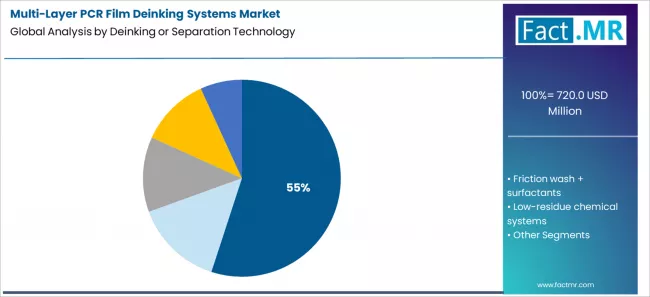
In the multi-layer PCR film deinking systems market, the film structure plays a key role in determining the ease and efficiency of the deinking process. Printed PE or PP multilayers lead the market with a 55% share, as they are commonly used in various packaging applications. These films are often challenging to recycle due to their multi-layered nature, but they are also the most prevalent in the industry, driving the need for advanced deinking systems. As the demand for sustainable packaging increases, the ability to efficiently remove ink and contaminants from printed PE and PP films will continue to be a significant factor in the development of recycling technologies.
How Does End-Use Influence the Multi-Layer PCR Film Deinking Systems Market?
Multi Layer Pcr Film Deinking Systems Market Analysis By End Use | Source: Fact.MR
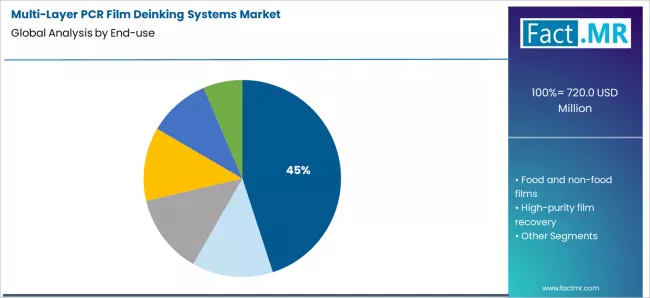
End-use plays a critical role in shaping the market for multi-layer PCR film deinking systems, with flexible packaging recycling holding a 45% share. Flexible packaging, which includes films used for food and consumer products, generates a large volume of waste and requires specialized recycling processes to reclaim the material. The need for high-purity film recovery and large-scale film recycling systems is growing as more industries seek to recycle flexible packaging materials efficiently. As the market shifts toward more sustainable packaging, the demand for advanced deinking systems capable of processing these complex materials will continue to rise.
What are the Principal Drivers, Constraints, and Evolving Dynamics of the Multilayer PCR Film Deinking Systems Market?
Demand for multilayer postconsumer recycled (PCR) film deinking systems has been influenced by pressure on packaging supply chains to recover highvalue polymers from complex film waste. Processors and recyclers seek deinking technologies that can separate inks and contaminants from multilayer films without degrading polymer quality. Regulatory frameworks that require recycled content in packaging have reinforced interest in systems capable of producing cleaner PCR streams.
High capital requirements for advanced deinking equipment have limited adoption among smaller recycling operations. Variability in feedstock composition affects process stability and final resin properties. Efforts to standardize deinking protocols and improve solvent and mechanical separation techniques are underway. Collaboration between equipment manufacturers and recycling firms is shaping performance benchmarks and driving incremental improvements in throughput and resin purity.
Analysis of the Multi-Layer PCR Film Deinking Systems Market by Key Country
| Country | CAGR (2026–2036) |
|---|---|
| Germany | 12.4% |
| USA | 12.8% |
| Japan | 10.6% |
| China | 14.8% |
| India | 15.6% |
| Brazil | 11.4% |
Source: Fact.MR analysis. Updated May 4, 2026
The report covers an in-depth analysis of 40+ countries; top-performing countries are highlighted below.
What is the Growth Outlook for Multi-Layer PCR Film Deinking Systems in Germany?
Germany’s multi-layer PCR film deinking systems market is expected to grow at a CAGR of 12.4% from 2026 to 2036. As Germany continues to lead in environmental sustainability and circular economy initiatives, the demand for advanced deinking systems for PCR films is rising. Stricter regulations on waste management and recycling, combined with the increasing need for high-quality recycled materials, are driving the adoption of multi-layer PCR film deinking systems. Germany’s strong recycling infrastructure and commitment to innovation will support continued market growth in this sector.
How is the Multi-Layer PCR Film Deinking Systems Market Performing in the USA?
The USA’s multi-layer PCR film deinking systems market is projected to grow at a CAGR of 12.8% from 2026 to 2036. The growing focus on improving the quality and efficiency of recycling processes is driving the adoption of deinking systems in the country’s packaging and recycling industries. As consumer demand for eco-friendly packaging solutions increases and regulatory requirements for waste reduction become more stringent, multi-layer PCR film deinking systems will play a crucial role in improving the quality of recycled materials. This trend will drive substantial growth in the market over the forecast period.
What is the Market Outlook for Multi-Layer PCR Film Deinking Systems in Japan?
Japan’s multi-layer PCR film deinking systems market is expected to grow at a CAGR of 10.6% from 2026 to 2036. Japan’s commitment to sustainability and its robust recycling infrastructure support the adoption of advanced deinking systems for multi-layer PCR films. As the country focuses on improving the quality of recycled plastics for various applications, particularly in packaging, the demand for efficient deinking technologies will rise. While the growth rate may be slower compared to other regions, Japan’s continued investment in recycling innovation and sustainability initiatives will support steady market growth.
What is the Growth Potential for Multi-Layer PCR Film Deinking Systems in China?
China is projected to see significant growth in the multi-layer PCR film deinking systems market, with a projected CAGR of 14.8% from 2026 to 2036. The country’s rapid industrial growth, combined with increasing focus on waste management and sustainability, is driving demand for improved deinking technologies in PCR film recycling. As China’s government implements stricter environmental regulations and promotes the adoption of circular economy practices, the need for advanced deinking systems will continue to rise. China’s large-scale manufacturing and recycling efforts will position it as a key market for multi-layer PCR film deinking systems.
What is the Demand for Multi-Layer PCR Film Deinking Systems in India?
India’s multi-layer PCR film deinking systems market is set to grow at a robust CAGR of 15.6% from 2026 to 2036. With rapid industrialization, urbanization, and a growing focus on sustainability, India’s demand for efficient recycling technologies is on the rise. The adoption of multi-layer PCR film deinking systems is being driven by the need to improve recycling processes and meet growing consumer demand for eco-friendly products. As the government strengthens its recycling infrastructure and regulatory framework, India’s market for deinking systems will expand rapidly, particularly in the packaging and waste management sectors.
What is the Market Expansion Outlook for Multi-Layer PCR Film Deinking Systems in Brazil?
Brazil’s multi-layer PCR film deinking systems market is projected to grow at a CAGR of 11.4% from 2026 to 2036. Brazil is increasingly focusing on sustainable waste management and packaging solutions, which is driving the demand for multi-layer PCR film deinking systems. As the country’s recycling infrastructure improves and consumer awareness of environmental issues grows, the adoption of these deinking systems will rise. Government support for recycling and waste reduction initiatives will further contribute to market growth, positioning Brazil as a growing player in the multi-layer PCR film deinking systems market.
How is Competition Structured in the MultiLayer PCR Film Deinking Systems Market?
Competition in the multi layer PCR film deinking systems market is shaped by system efficiency, deinking quality, and throughput capacity. Cadel Deinking and Sorema offer specialized deinking lines optimized for producing cleaner recycled polymers from printed multi layer films. Herbold Meckesheim and Polystar focus on integrated solutions that combine shredding, washing, and flotation to separate inks and contaminants.
Ebara and Mitsubishi Heavy Industries emphasize engineering reliability and ease of maintenance for high volume operations. ACERETECH and B+B Anlagenbau position their systems with modular designs that adapt to varying film types and waste streams. Differentiation is defined by the effectiveness of ink removal, energy use, and ability to deliver feedstock that meets downstream processing specifications. Buyers assess providers based on validated performance data, service support, and the ability to scale operations for commercial recycling facilities.
Key Players in the MultiLayer PCR Film Deinking Systems Market?
- Cadel Deinking
- Sorema
- Herbold Meckesheim
- Ebara
- ACERETECH
- B+B Anlagenbau
- Mitsubishi Heavy Industries
- Polystar
Bibliographies
- European Commission. (2023).Mechanical recycling of plastic packaging waste: Technical barriers related to inks, adhesives, and multilayer structures. Publications Office of the European Union.
- European Commission, Joint Research Centre. (2024).Recycling of flexible plastic packaging: Deinking efficiency, contaminant removal, and quality impacts. JRC Technical Reports.
- European Food Safety Authority. (2023).Challenges in recycling printed plastic materials for food-contact applications. EFSA Journal.
- Packaging Technology and Science. (2023).Impact of printing inks and coatings on the recyclability of multilayer polymer films.
- International Organization for Standardization. (2023).ISO 15270: Plastics – Guidelines for the recovery and recycling of plastics waste. ISO.
Segmentation
Scope of the Report
| Items | Values |
|---|---|
| Quantitative Units (2026) | USD Million |
| End-use | Flexible packaging recycling, Food and non-food films, High-purity film recovery, Large-scale film recycling, Emerging film recycling |
| System Type | Wet and chemical deinking lines, Modular deinking units, Precision separation systems, Integrated wash lines, Others |
| Film Structure | Printed PE or PP multilayers, PE or PP films, Printed laminates, Mixed multilayers, Others |
| Deinking or Separation Technology | Solvent or alkaline wash + flotation, Friction wash + surfactants, Low-residue chemical systems, Cost-optimised deinking, Others |
| Regions Covered | North America, Europe, Asia Pacific, Latin America, Middle East & Africa |
| Countries Covered | United States, Canada, Mexico, Brazil, Germany, United Kingdom, France, Italy, Spain, China, Japan, South Korea, India, Australia & New Zealand |
| Key Companies Profiled | Cadel Deinking, Sorema, Herbold Meckesheim, Ebara, ACERETECH, B+B Anlagenbau, Mitsubishi Heavy Industries, Polystar |
| Additional Attributes | Dollar revenue by end-use, system type, film structure, and deinking or separation technology; regional demand trends, competitive landscape, technological advancements in multi-layer PCR film deinking systems, and innovations in film recycling technologies |
Source: Fact.MR analysis. Updated May 4, 2026
Multi-Layer PCR Film Deinking Systems Market Key Segments
-
End-use :
- Flexible packaging recycling
- Food and non-food films
- High-purity film recovery
- Large-scale film recycling
- Emerging film recycling
- Regional recyclers
-
System Type :
- Wet and chemical deinking lines
- Modular deinking units
- Precision separation systems
- Integrated wash lines
- Others
-
Film Structure :
- Printed PE or PP multilayers
- PE or PP films
- Printed laminates
- Mixed multilayers
- Others
-
Deinking or Separation Technology :
- Solvent or alkaline wash + flotation
- Friction wash + surfactants
- Low-residue chemical systems
- Cost-optimised deinking
- Others
-
Region :
-
North America
- U.S.
- Canada
- Mexico
-
Europe
- Germany
- UK
- France
- Italy
- Spain
- Nordic Countries
- BENELUX
- Rest of Europe
-
Asia Pacific
- China
- Japan
- South Korea
- India
- Australia
- Rest of Asia Pacific
-
Latin America
- Brazil
- Argentina
- Rest of Latin America
-
Middle East and Africa
- Kingdom of Saudi Arabia
- United Arab Emirates
- South Africa
- Rest of Middle East and Africa
-
Other Regions
- Oceania
- Central Asia
- Other Markets
-
Frequently Asked Questions
How big is the multi-layer pcr film deinking systems market in 2026?
What will be the size of multi-layer pcr film deinking systems market in 2036?
How much will be the multi-layer pcr film deinking systems market growth between 2026 and 2036?
What are the key product types in the multi-layer pcr film deinking systems market?
Which system type segment to contribute significant share in the multi-layer pcr film deinking systems market in 2026?
Who worked on this report


Preview the report firsthand - request a free sample
Free SampleGet the brochure for pricing and purchase details
Download PDF