- Base Value(2025): 245 Mn
- Estimated Value(2026): 260 Mn
- Forecast Value (2036): 480 Mn
- CAGR (2026 - 2036): 6.3%
Multi-Residue Detoxifying Field Wash Aid Market Forecast and Outlook by Fact.MR
In 2025, the multi-residue detoxifying field wash aid market was valued at USD 245 million. Based on Fact.MR analysis, demand for field wash aids is estimated to grow to USD 260 million in 2026 and USD 480 million by 2036. FACT.MR projects a CAGR of 6.3% during the forecast period.
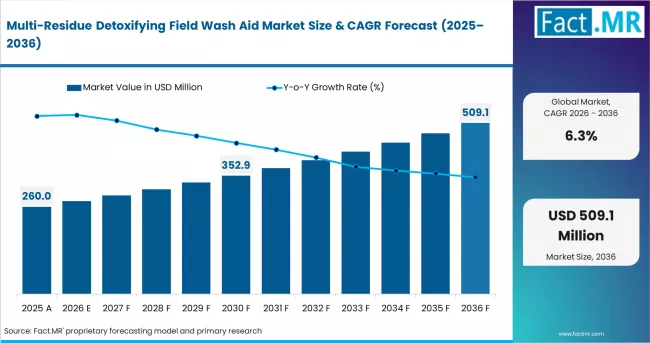
Multi Residue Detoxifying Field Wash Aid Market Value Analysis | Source: Fact.MR
Summary of Multi-Residue Detoxifying Field Wash Aid Market
- Market Definition
- The market covers enzymatic, chemical, and bio-based wash aids used to detoxify multi-pesticide residue loads on fresh produce and field crops at pre-harvest, field, and post-harvest processing stages globally.
- Demand Drivers
- EU MRL Rejections: Rising produce rejection rates at EU border inspection posts are compelling Indian and Chinese exporters to certify field wash aid use in export supply chains.
- FDA Residue Norms: U.S. Food and Drug Administration pesticide tolerance enforcement under FSMA is increasing demand for documented wash aid application at U.S. fresh produce pack houses.
- Organic Sector Growth: EU and Japan organic certification requirements are driving food processors and retailers to adopt bio-based enzymatic wash aids as part of clean-label supply chain validation.
- Key Segments Analyzed
- By Product Type: Bio-based/organic wash aids lead with 42% share in 2026, driven by export compliance and organic certification demand from pack houses targeting EU and US markets.
- By Application: Fruits and vegetables cleaning leads with 50% share in 2026, reflecting high residue sensitivity and strict MRL compliance requirements from importers.
- By End User: Export-oriented pack houses lead with 40% share in 2026, due to mandatory MRL compliance documentation required by international retail and import buyers.
- By Geography: India leads at 7.8% CAGR through 2036, driven by EU export rejection pressure and government residue management programmes for agricultural exporters.
- Analyst Opinion at FACT.MR
- Shambhu Nath Jha, Principal Consultant at Fact.MR, opines, CXOs will see bio-based enzymatic certification as a key procurement factor. MRL documentation trails will also drive decisions. Vendors lacking regulatory-grade efficacy data will lose competitiveness. Such vendors risk losing export pack house contracts through 2036.
- Strategic Implications
- Prioritise bio-based enzymatic wash aid formulations with third-party residue efficacy certification to meet export pack house qualification requirements in EU and US supply chains.
- Develop MRL compliance documentation packages and field-use protocols to support export market access for smallholder aggregators and large-scale food processor customers.
- Build distribution partnerships with agri-input dealers in India and China to capture pre-harvest and field-level wash aid demand in fast-growing export-oriented farming clusters.
- Methodology
- Market sizing based on wash aid sales volumes by product type and end-user channel. Validated with 2024–2025 export rejection data and MRL compliance audit records.
- Uses EU RASFF food safety notifications, Codex Alimentarius MRL standards, USDA AMS pesticide monitoring data, and FSSAI guidelines for demand and regulatory analysis.
- Forecasts consider EU MRL enforcement timelines, organic certification adoption curves, and bio-based formulation penetration across export-oriented agri supply chains.
| Metric | Value |
|---|---|
| Estimated Value in 2026 | USD 260 million |
| Forecast Value in 2036 | USD 480 million |
| Forecast CAGR (2026 to 2036) | 6.3% |
Source: Fact.MR analysis. Updated Apr 30, 2026
The market is projected to generate USD 220 million in absolute opportunity between 2026 and 2036. Growth is steady and structurally driven. Rising pesticide residue rejection rates at EU, US, and Japanese import ports are compelling exporters and pack houses to adopt certified wash aid protocols. Growth is moderated by fragmented adoption in smallholder farming economies and inconsistent regulatory enforcement at field level.
India leads with a projected CAGR of 7.8% through 2036, driven by surging agri-export rejections in EU markets and a national push to meet Codex Alimentarius MRL standards. The United States follows at 7.5%, anchored by strict FDA residue tolerance enforcement and high-value fresh produce export volumes. China records 7.2%, reflecting large-scale agricultural output tied to export compliance requirements. Germany grows at 6.8%, supported by strong organic food demand and clean-label purchasing trends. Japan records 6.5%, anchored by stringent domestic food safety standards. Mature markets in Germany and Japan generate compliance-driven replacement demand rather than volume-led expansion.
Segmental Analysis
Multi-Residue Detoxifying Field Wash Aid Market Analysis by Product Type
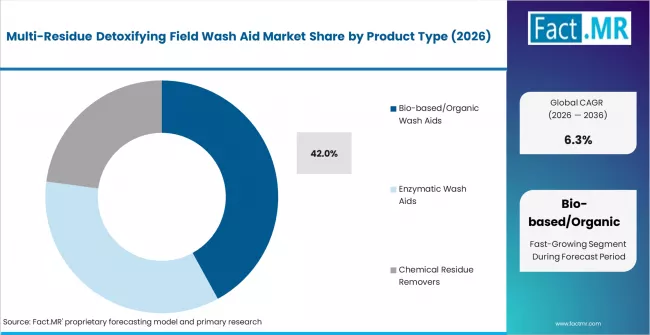
Multi Residue Detoxifying Field Wash Aid Market Analysis By Product Type | Source: Fact.MR
Based on FACT.MR, bio-based or organic wash aids hold 42% share in 2026. Growth is driven by certification and export compliance needs. Enzymatic formulations offer proven residue breakdown. Exporters to EU and Japan require certified solutions in audits.
- Bayer AG Investment: Bayer AG expanded its sustainability portfolio in 2024. It added residue management solutions for export markets. FieldView integrated wash aid tracking for supply chains. This was done with Indian exporters in Q3 2024. [4]
- Novozymes Technology Development: Novozymes launched an enzymatic bio-wash in Q1 2025. It targets multi-residue detoxification for export produce. The formula uses protease and lipase blends. It is effective against key pesticide residues. [5]
- Bio-Based Certification Trend: ECOCERT certified 12 new bio-based wash aids in 2024. This reflects rising investment in organic solutions. Certification is becoming mandatory for European retail supply. [6]
Multi-Residue Detoxifying Field Wash Aid Market Analysis by Application
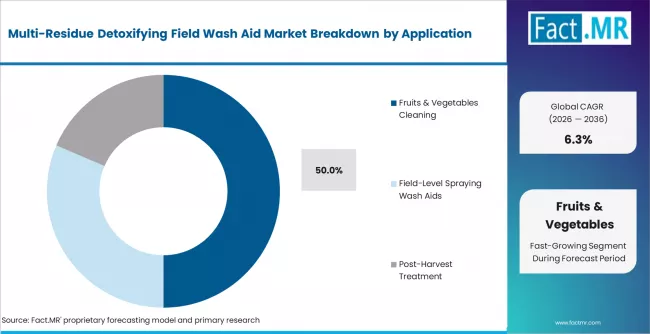
Multi Residue Detoxifying Field Wash Aid Market Analysis By Application | Source: Fact.MR
Based on FACT.MR, fruits and vegetables cleaning holds 50% share in 2026. High residue load and strict MRL limits drive demand. Grapes, citrus, berries, and leafy vegetables show high detection rates. This supports demand for certified wash aids.
- UPL Limited Development: UPL launched a post-harvest wash aid line in Q2 2024. It targets grape and citrus export chains in India. The launch responds to EU rejection data.
- Syngenta Programme: Syngenta partnered with pack houses in Maharashtra in 2024. It piloted wash aid protocols for grape exporters. The programme covered over 1,200 hectares. It aims to reduce EU rejection risk.
- Post-Harvest Channel Growth: APEDA data shows adoption grew in 2024–2025. Growth is estimated at 18% year-on-year. Rising EU rejection penalties are the key driver. This is expanding wash aid use in pack houses. [3]
Drivers, Restraints, and Opportunities
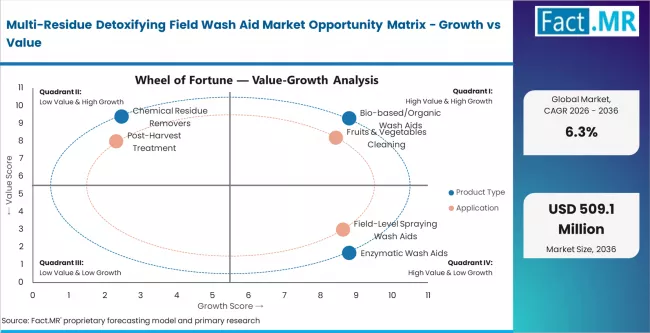
Multi Residue Detoxifying Field Wash Aid Market Opportunity Matrix Growth Vs Value | Source: Fact.MR
FACT.MR analysts observe that the market is shaped more by compliance pressure than agronomic need. Demand is rising due to export rejection risk. RASFF data shows pesticide residue violations from Asia-origin produce increased in 2024. This is pushing exporters to formalise wash aid use in supply chains.
The market is shifting toward certified formulations. Generic chemical wash products are losing relevance in organic supply chains. Bio-based enzymatic aids are gaining share at premium prices. Pack houses are absorbing higher costs. Certification failure carries greater financial risk than product cost.
- Export Rejection Pressure: EU border controls flagged 178 pesticide residue violations in 2024. This increase is reported in RASFF data. Exporters in India and China are adopting certified wash aid protocols. This is boosting usage in pack house operations. [1]
- U.S. FSMA Compliance Demand: The U.S. FDA updated FSMA Produce Safety Rule guidance in early 2024. The update tightened wash and water standards. Importers now require compliance documentation from suppliers. This is driving procurement across export regions. [2]
- India Agri-Export Infrastructure: APEDA launched residue management programmes in 2024–2025. These target mango and grape exporters. Support includes technical and financial assistance. This is accelerating adoption of MRL-compliant wash protocols.
Regional Analysis
The multi-residue detoxifying field wash aid market is assessed across Asia Pacific, North America, Europe, Latin America, and Middle East and Africa, covering 40+ countries with distinct compliance, export, and agricultural demand profiles. The full report provides market attractiveness analysis by region and country.
.webp "Top Country Growth Comparison Multi Residue Detoxifying Field Wash Aid Market Cagr (2026 2036)")
Top Country Growth Comparison Multi Residue Detoxifying Field Wash Aid Market Cagr (2026 2036) | Source: Fact.MR
| Country | CAGR (2026 to 2036) |
|---|---|
| India | 7.8% |
| United States | 7.5% |
| China | 7.2% |
| Germany | 6.8% |
| Japan | 6.5% |
Source: Fact.MR analysis. Updated Apr 30, 2026
Source: Fact.MR (FACT.MR) analysis, based on proprietary forecasting model and primary research
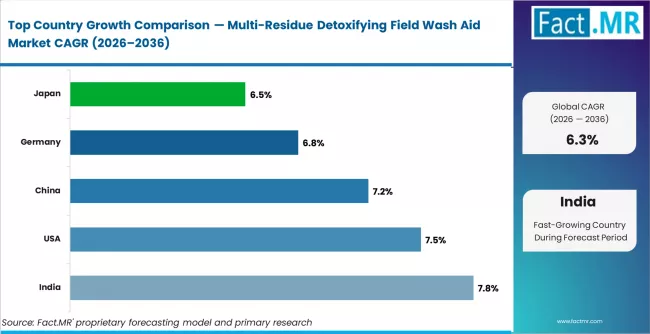
Multi Residue Detoxifying Field Wash Aid Market Cagr Analysis By Country | Source: Fact.MR
Asia Pacific Multi-Residue Detoxifying Field Wash Aid Market Analysis
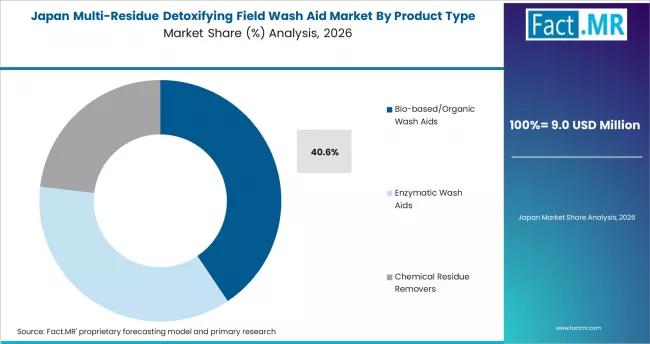
Multi Residue Detoxifying Field Wash Aid Market Japan Market Share Analysis By Product Type | Source: Fact.MR
Asia Pacific leads both in scale and growth. The region is driven by export-focused agriculture facing strict MRL compliance from EU, U.S., and Japan. India drives growth momentum. China contributes the largest volume base. Syngenta and UPL Limited maintain strong pack house channel presence.
- India: India shows the strongest growth trajectory in the region. Demand is projected to rise at 7.8% CAGR through 2036. EU border rejections increased in 2024, especially for grapes and pomegranates. RASFF flagged multiple violations. APEDA launched residue management support in 2024–2025. It funds training and certification for exporters. Adoption is rising across Maharashtra, Andhra Pradesh, and Karnataka clusters.
- China: China’s growth is volume-driven but policy-aligned. Demand is projected to rise at 7.2% CAGR through 2036. The Ministry of Agriculture updated residue standards in 2024. These align more closely with Codex MRL thresholds. Pack houses are upgrading treatment protocols. Yangtze River Delta zones are prioritising certified export supply chains. This is creating structured demand for wash aids.
- Japan: Japan reflects a precision-driven compliance market. Demand is projected to rise at 6.5% CAGR through 2036. The Positive List System enforces strict residue limits. The 0.01 ppm default MRL remains unchanged. Importers require high-efficacy enzymatic wash aids. Retail chains mandate supplier compliance documentation.
Fact.MR’s analysis covers India, China, Japan, ASEAN, Australia and New Zealand, and Rest of Asia Pacific. It includes export rejection trends, MRL compliance impact, and bio-based adoption across key clusters.
North America Multi-Residue Detoxifying Field Wash Aid Market Analysis
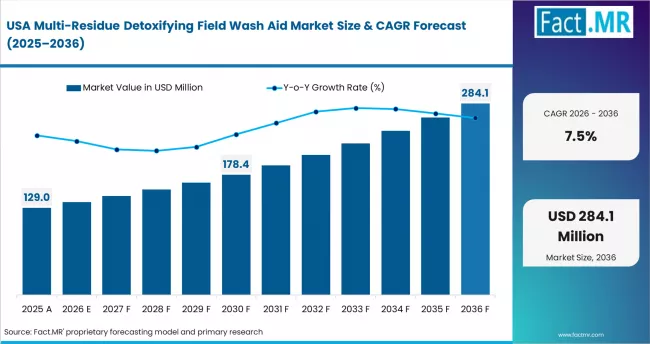
Multi Residue Detoxifying Field Wash Aid Market Country Value Analysis | Source: Fact.MR
North America is a high-value compliance-driven market. Procurement is shaped by FSMA enforcement. Pack houses and processors prioritise certified inputs. UPL Limited and BASF SE operate through strong agri-retail networks.
- United States: The U.S. market is regulation-led and audit-intensive. Demand is projected to rise at 7.5% CAGR through 2036. FDA FSMA rules define wash aid requirements. Updated 2024 guidance tightened water and post-harvest standards. California and Florida pack houses dominate usage. Procurement is linked to GlobalG.A.P. and USDA organic audits.
Fact.MR’s analysis covers the United States, Canada, and Mexico. It includes FSMA timelines, organic adoption, and procurement trends.
Europe Multi-Residue Detoxifying Field Wash Aid Market Analysis
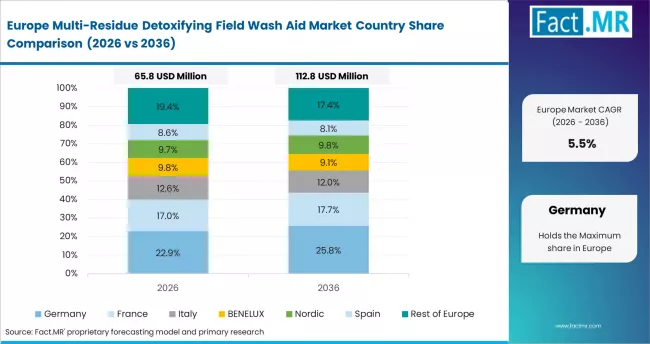
Multi Residue Detoxifying Field Wash Aid Market Europe Country Market Share Analysis, 2026 & 2036 | Source: Fact.MR
Europe acts as the global regulatory benchmark. EU MRL rules define compliance standards worldwide. Demand is driven by certified bio-based wash aids. Bayer AG and Evonik Industries lead formulation supply.
- Germany: Germany reflects a retail-driven compliance ecosystem. Demand is projected to rise at 6.8% CAGR through 2036. Organic food demand is strong. Retailers like REWE and EDEKA expanded clean-label produce lines in 2024–2025. Supplier certification requirements are increasing. BVL monitoring data highlights ongoing residue gaps. This is accelerating enzymatic wash aid adoption.
Fact.MR’s analysis covers Germany, France, the United Kingdom, Italy, Spain, and Rest of Europe. It includes EU enforcement trends, retail demand, and certification patterns.
Competitive Aligners for Market Players
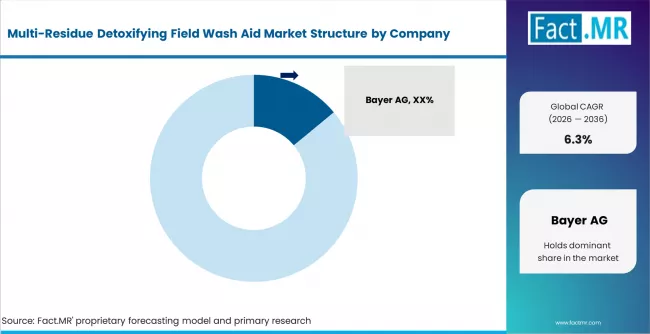
Multi Residue Detoxifying Field Wash Aid Market Analysis By Company | Source: Fact.MR
The competitive landscape of the multi-residue detoxifying field wash aid market is moderately consolidated, with a mix of global agrochemical leaders and emerging bio-based solution providers shaping competition. Large players such as Bayer AG, BASF SE, and Syngenta leverage strong distribution networks and established relationships with export-oriented growers and pack houses. Their advantage lies in integrated crop solutions, digital farm platforms, and the ability to bundle wash aids with broader crop protection portfolios.
Companies like UPL Limited are gaining ground by focusing on post-harvest solutions tailored to export compliance needs, particularly in Asia. These players compete aggressively on regional adaptability, pricing, and direct engagement with agri-export clusters.
A key shift in the competitive environment is the rise of bio-based and enzymatic formulation specialists. Firms such as Novozymes are differentiating through scientifically validated residue breakdown capabilities and alignment with organic certification standards. This is increasingly important as buyers prioritise compliance documentation over generic efficacy claims.
Competition is no longer driven purely by product performance. It is now shaped by regulatory alignment, certification credibility, and traceability support. Vendors that can provide documented efficacy, MRL compliance assurance, and audit-ready data are gaining preference in procurement decisions. Thus, the market is moving toward value-based competition. Suppliers that combine regulatory trust, bio-based innovation, and strong supply chain integration are expected to capture long-term contracts with export pack houses and global fresh produce buyers.
Key Players
- Bayer AG
- Syngenta
- BASF SE
- UPL Limited
- Nufarm
- Evonik Industries
- Novozymes
Bibliography
- [1] European Commission. (2024). RASFF Annual Report 2024: Pesticide Residue Violations in Fresh Produce from Asia-Origin Shipments at EU Border Inspection Posts. 2024. ec.europa.eu/food/safety/rasff
- [2] U.S. Food and Drug Administration. (2024). FSMA Produce Safety Rule: Updated Water Quality and Post-Harvest Treatment Guidance for Domestic and Imported Fresh Produce Compliance. January 2024. fda.gov/food/food-safety-modernization-act-fsma
- [3] Agricultural and Processed Food Products Export Development Authority. (2024–2025). Residue Management Support Programme for Indian Mango and Grape Exporters: Technical Assistance and MRL Compliance Protocol Adoption. 2024–2025. apeda.gov.in
- [4] Bayer AG. (Q3 2024). Corporate Sustainability Disclosure: FieldView Digital Farming Platform Integration with Residue Management Tracking for Export-Certified Indian Agri-Supply Chains. Q3 2024. bayer.com/en/sustainability
- [5] Novozymes A/S. (Q1 2025). Product Launch: Multi-Residue Enzymatic Bio-Wash Formulation with Protease-Lipase Blend Targeting EU and US Export Pack House Compliance Documentation Requirements. January 2025. novozymes.com/en/news
- [6] ECOCERT Group. (2024). Certification Update: 12 New Bio-Based Agricultural Wash Aid Formulations Certified for Organic-Grade Residue Removal in Fresh Produce Export Pack House Environments. 2024. ecocert.com/en/certification
This Report Addresses
- Strategic intelligence on field wash aid demand across enzymatic, chemical, and bio-based product types for farmer, food processor, and export pack house end users globally.
- Market forecast from USD 260 million in 2026 to USD 480 million by 2036 at a CAGR of 6.3%.
- Growth opportunity mapping across India's agri-export compliance push, U.S. FSMA enforcement, China's MRL standard alignment, Germany's organic retail demand, and Japan's Positive List System.
- Segment analysis by product type (enzymatic, chemical, bio-based), application (fruits and vegetables, field spraying, post-harvest), and end user (farmers, processors, pack houses) across global and regional markets.
- Regional outlook covering Asia Pacific export compliance dynamics, North America FSMA-driven procurement, and Europe EU MRL and organic certification requirements.
- Competitive analysis of Bayer AG, Syngenta, BASF SE, UPL Limited, Nufarm, Evonik Industries, and Novozymes covering formulation certification depth, pack house distribution reach, and bio-based product pipeline.
- Regulatory impact analysis covering EU MRL Regulation (EC) No 396/2005 enforcement, FSMA Produce Safety Rule compliance, Codex Alimentarius standards, APEDA residue management programmes, and GlobalG.A.P. certification requirements.
- Report delivered in PDF, Excel datasets, and presentation formats. Supported by primary interviews, EU RASFF notifications, USDA AMS residue data, APEDA export statistics, and manufacturer product disclosures.
Multi-Residue Detoxifying Field Wash Aid Market Definition
The market covers enzymatic, chemical, and bio-based wash aids applied pre- and post-harvest to neutralise multi-residue pesticide contamination on fresh produce, field crops, and fruits and vegetables intended for domestic consumption or export.
Multi-Residue Detoxifying Field Wash Aid Market Inclusions
Covers global and regional forecasts from 2026 to 2036. Includes product type, application, and end-user segments. Covers enzymatic, chemical residue remover, and bio-based wash aid formulations across fruits, vegetables, and field crops. Includes farmer, food processor, and export pack house end users.
Multi-Residue Detoxifying Field Wash Aid Market Exclusions
Market Exclusions Excludes general-purpose agricultural detergents not formulated for residue detoxification. Omits irrigation water treatment products and fumigation-based residue control methods. Excludes finished ready-to-eat produce unless wash aid application is documented in processing.
Multi-Residue Detoxifying Field Wash Aid Market Research Methodology
- Primary Research
- Interviews with agrochemical buyers, export pack house managers, food safety auditors, and regulatory affairs officers across India, United States, China, Germany, and Japan.
- Desk Research
- Uses Codex Alimentarius MRL updates, EU pesticide residue surveillance data, USDA AMS residue reports, and company disclosures from Bayer AG, UPL Limited, and Novozymes (2024–2025).
- Market-Sizing and Forecasting
- Hybrid model based on wash aid volume by product type and end user. Uses export rejection rate data and compliance-driven procurement timelines. Covers key regions and end-use channels.
- Data Validation and Update Cycle
- Validated using EU RASFF food safety alerts, USDA pesticide data, and importer MRL audit records. Cross-checked with supply chain inputs. Updated annually.
Segmentation
Scope of Report
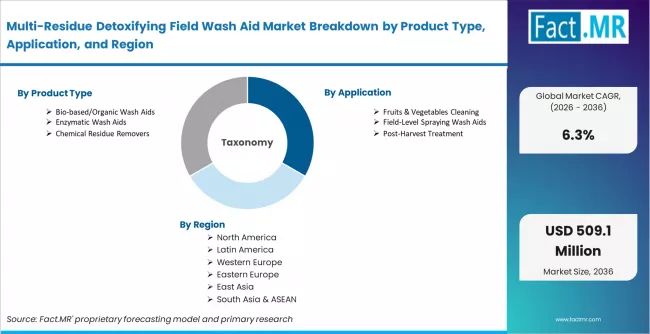
Multi Residue Detoxifying Field Wash Aid Market Breakdown By Product Type Application And Region | Source: Fact.MR
| Attribute | Details |
|---|---|
| Quantitative Units | USD 260 million (2026) to USD 480 million (2036), at a CAGR of 6.3% |
| Market Definition | Enzymatic, chemical, and bio-based wash aids applied pre- and post-harvest to neutralise multi-residue pesticide contamination on fresh produce and field crops for domestic and export markets. |
| Product Type Segmentation | Enzymatic Wash Aids, Chemical Residue Removers, Bio-based/Organic Wash Aids |
| Application Segmentation | Fruits & Vegetables Cleaning, Field-Level Spraying Wash Aids, Post-Harvest Treatment |
| End-User Segmentation | Farmers (Pre-harvest), Food Processors, Exporters/Pack Houses |
| Application Coverage | Pre-harvest residue management, field-level spraying protocols, post-harvest pack house treatment, MRL compliance documentation for export supply chains. |
| Regions Covered | North America, Europe, Asia Pacific, Latin America, Middle East and Africa |
| Countries Covered | USA, Canada, Mexico, Germany, UK, France, Italy, Spain, Nordic, BENELUX, China, Japan, South Korea, India, ASEAN, Australia and New Zealand, Brazil, Argentina, Chile, Saudi Arabia, GCC, Turkey, South Africa, Rest of MEA |
| Key Companies Profiled | Bayer AG, Syngenta, BASF SE, UPL Limited, Nufarm, Evonik Industries, Novozymes |
| Forecast Period | 2026 to 2036 |
| Approach | Hybrid top-down and bottom-up model using wash aid volume by product type and end-user channel, export rejection rate data, MRL compliance procurement timelines, and primary interviews with pack house managers and food safety auditors. |
Source: Fact.MR analysis. Updated Apr 30, 2026
Multi-Residue Detoxifying Field Wash Aid Market by Segments
-
By Product Type:
- Enzymatic Wash Aids
- Chemical Residue Removers
- Bio-based/Organic Wash Aids
-
By Application:
- Fruits & Vegetables Cleaning
- Field-Level Spraying Wash Aids
- Post-Harvest Treatment
-
By End User:
- Farmers (Pre-harvest Use)
- Food Processors
- Exporters/Pack Houses
-
By Region:
- North America
- United States
- Canada
- Mexico
- Latin America
- Brazil
- Mexico
- Argentina
- Chile
- Rest of Latin America
- Western Europe
- Germany
- United Kingdom
- France
- Italy
- Spain
- Nordic Countries
- BENELUX
- Rest of Western Europe
- Eastern Europe
- Russia
- Poland
- Hungary
- Balkan and Baltic
- Rest of Eastern Europe
- East Asia
- China
- Japan
- South Korea
- South Asia and Pacific
- India
- ASEAN
- Australia and New Zealand
- Rest of South Asia and Pacific
- Middle East and Africa
- Kingdom of Saudi Arabia
- Other GCC Countries
- Turkey
- South Africa
- Rest of Middle East and Africa
- North America
Frequently Asked Questions
How large is the global multi-residue detoxifying field wash aid market in 2025?
What will the market size be in 2026?
What is the projected market size by 2036?
What is the expected CAGR from 2026 to 2036?
Which product type segment is poised to lead the market?
Which application segment holds the largest share?
Which end-user segment dominates the market?
Which country shows the fastest growth?
What is driving demand for multi-residue detoxifying field wash aids?
What are the major restraints?
Who worked on this report


Preview the report firsthand - request a free sample
Free SampleGet the brochure for pricing and purchase details
Download PDF