Green Chelating Agents for Brownfield Redevelopment Market
Green Chelating Agents for Brownfield Redevelopment Market Size and Share Forecast Outlook 2026 to 2036
Green chelating agents for brownfield redevelopment market is projected to grow from USD 300.0 million in 2026 to USD 764.1 million by 2036, at a CAGR of 9.8%. GLDA & MGDA (Biodegradable Aminopolycarboxylates) will dominate with a 32.0% market share, while heavy metals (pb, cr, as, hg, cd) will lead the contaminant type segment with a 38.0% share.
Green Chelating Agents for Brownfield Redevelopment Market Forecast and Outlook 2026 to 2036
The global market for green chelating agents in brownfield redevelopment is entering a phase of significant growth, propelled by the shift toward sustainable and non-toxic remediation chemistry. Valued at USD 300.00 million in 2026, the market is projected to expand to USD 764.09 million by 2036, achieving a CAGR of 9.8% during the forecast period.
Key Takeaways from the Green Chelating Agents for Brownfield Redevelopment Market
- Market Value for 2026: USD 300.00 Million
- Market Value for 2036: USD 764.09 Million
- Forecast CAGR (2026-2036): 9.8%
- Leading Chelating Agent Type Share (2026): GLDA & MGDA (Biodegradable Aminopolycarboxylates) (32%)
- Leading Contaminant Type Share (2026): Heavy Metals (Pb, Cr, As, Hg, Cd) (38%)
- Leading End-Use Sector Share (2026): Environmental Remediation Firms (36%)
- Key Players in the Market: BASF SE, Nouryon, Solvay S.A., Evonik Industries AG, REGENESIS
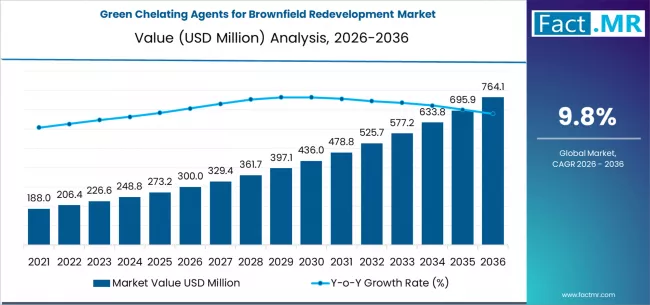
Biodegradable aminopolycarboxylates such as GLDA and MGDA represent the dominant product type, securing a 32% market share. The remediation of heavy metal contamination drives the most demand, accounting for 38% of the market. Environmental remediation firms constitute the leading end-use sector, with a 36% share, acting as the primary specifiers and appliers of these advanced agents.
This expansion is directly linked to stricter global regulations limiting the use of persistent synthetic chelators like EDTA and a growing emphasis on sustainable land regeneration. Green chelating agents offer an effective solution for mobilizing and extracting toxic metals from soil without leaving behind harmful residues. Their high biodegradability and lower ecotoxicity make them essential for projects where future land use and long-term environmental safety are paramount, enabling developers to meet both regulatory and social responsibility goals.
These agents facilitate soil washing, phytoremediation enhancement, and in-situ soil flushing processes. Their development focuses on achieving high binding efficiency for target metals, maintaining performance across varying soil pH levels, and ensuring rapid degradation post-application. The market’s progression addresses the core challenge of detoxifying contaminated land in a way that supports circular economy principles and safe urban redevelopment.
Metric
| Metric | Value |
|---|---|
| Market Value (2026) | USD 300.00 Million |
| Market Forecast Value (2036) | USD 764.09 Million |
| Forecast CAGR (2026-2036) | 9.8% |
Category
| Category | Segments |
|---|---|
| Chelating Agent Type | GLDA & MGDA (Biodegradable Aminopolycarboxylates), IDS & EDDS (Readily Biodegradable Chelators), Plant-Based & Bio-Sourced Chelating Agents, Polymer-Assisted Chelation Systems, Other Green/Eco-Friendly Chelators |
| Contaminant Type | Heavy Metals (Pb, Cr, As, Hg, Cd), Industrial Chemicals & Solvents, Petroleum Hydrocarbons & Organics, Mixed Metal-Organic Pollutants, Other Emerging Contaminants |
| End-Use Sector | Environmental Remediation Firms, Brownfield Redevelopment & Real Estate, Industrial & Manufacturing Sites, Government & Municipal Cleanup Projects, Mining & Metallurgical Land Reclamation |
| Region | North America, Latin America, Western Europe, Eastern Europe, East Asia, South Asia & Pacific, MEA |
Segmental Analysis
By Chelating Agent Type, Which Segment Commands the Largest Market Share?
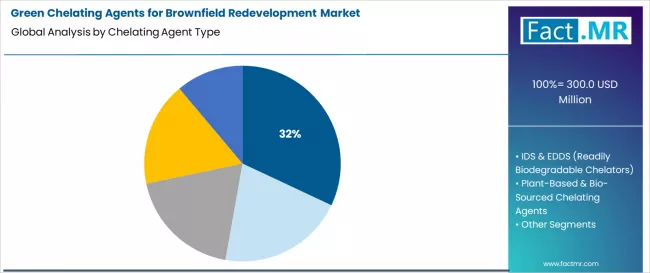
Biodegradable aminopolycarboxylates, specifically GLDA and MGDA, lead the segment with a 32% share. Their dominance is based on an optimal balance of technical performance and environmental profile. These agents exhibit strong chelating strength comparable to traditional options but undergo rapid and complete biodegradation in standard conditions.
This combination of high efficacy for a broad range of heavy metals and a clear regulatory safety profile makes them the preferred choice for sustainable remediation projects, establishing them as the industry benchmark.
By Contaminant Type, Which Class is the Primary Driver of Demand?
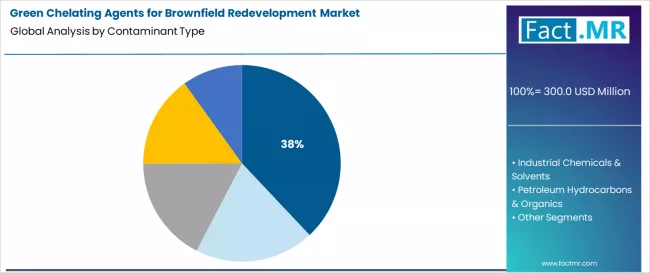
Heavy metal contamination represents the largest contaminant segment, holding a 38% share. The widespread legacy of lead, chromium, arsenic, and cadmium pollution from industrial activities, mining, and historical land use creates a vast addressable market.
Green chelating agents are particularly critical for these sites because they can selectively bind and mobilize metals for removal without the ecological persistence of older chemistries, directly addressing regulatory bans on persistent synthetic chelators in many regions.
By End-Use Sector, Which Group is the Key Specifier and Applier?
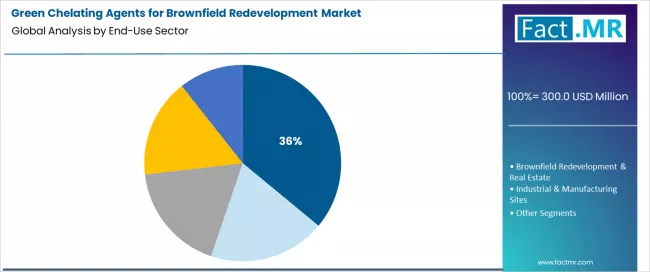
Environmental remediation firms constitute the leading end-use sector with a 36% share. These specialized engineering firms are the primary intermediaries who select and apply remediation chemicals based on project specifications, regulatory compliance, and technical effectiveness.
Their consistent demand stems from a continuous pipeline of assessment and cleanup projects. They require green chelating agents that are not only effective but also simplify regulatory approvals and align with environmental, social, and governance (ESG) reporting for their clients.
What are the Drivers, Restraints, and Key Trends of the Green Chelating Agents for Brownfield Redevelopment Market?
The primary market driver is the increasing regulatory restriction or outright ban on the use of persistent synthetic chelating agents like EDTA in many countries, mandating a shift to biodegradable alternatives. Simultaneously, the global acceleration of urban brownfield redevelopment demands sustainable cleanup technologies that assure long-term land safety and community acceptance. Stricter soil quality standards for residential and commercial reuse further necessitate highly effective metal extraction methods, which green chelants provide.
A significant market restraint is the higher unit cost of advanced green chelating agents compared to conventional, non-biodegradable alternatives. This can impact project economics, especially for large-scale, cost-sensitive cleanups. Performance variability in complex, mixed-contaminant soils with high clay or organic matter content can also pose a technical challenge, sometimes requiring customized blends or sequential treatment approaches. A lack of standardized testing protocols for certifying biodegradability under site-specific conditions can create uncertainty for some specifiers.
Key trends include the rapid development of plant-based and bio-sourced chelating agents derived from agricultural waste or microbial processes, aiming for a fully circular and renewable feedstock. There is growing innovation in smart polymer-assisted systems that enhance metal selectivity and recovery rates, improving process economics. The market is also moving toward integrated treatment protocols where green chelants are used in combination with phytoremediation or electrokinetic methods to reduce chemical usage and leverage synergistic effects for complex contaminant matrices.
Analysis of the Green Chelating Agents for Brownfield Redevelopment Market by Key Countries
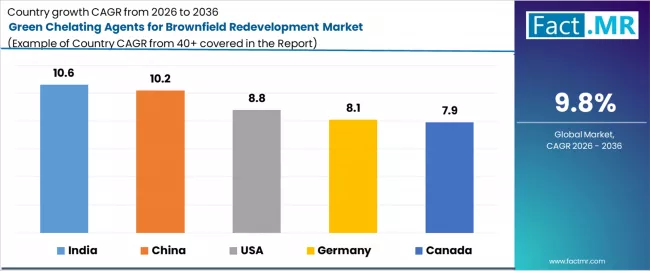
| Country | CAGR (2026-2036) |
|---|---|
| India | 10.60% |
| China | 10.20% |
| USA | 8.80% |
| Germany | 8.10% |
| Canada | 7.90% |
How is India’s Rapid Urbanization and Industrial Land Reuse Fueling Market Growth?
India’s leading CAGR of 10.60% is driven by massive urban redevelopment initiatives and government programs to clean up legacy industrial sites. The need to remediate land for new housing, commercial spaces, and public infrastructure in expanding cities creates unprecedented demand.
Green chelating agents are increasingly specified to treat ubiquitous heavy metal contamination from informal industries, aligning with national sustainability goals and offering a viable path for safe redevelopment in densely populated areas.
What Role does China’s ‘Beautiful China’ and Soil Pollution Law Play in Adoption?
China’s 10.20% growth is anchored in the stringent enforcement of its Soil Pollution Prevention and Control Law and the ecological objectives of the Beautiful China initiative. As the country systematically remediates contaminated land from its industrial past, there is a strong policy push for green and sustainable remediation technologies. The scale of state-led redevelopment projects provides a substantial market for high-volume, effective, and environmentally sound chelating agents to treat heavy metal pollution.
How does the USA’s Mature Regulatory and Real Estate Market Influence Demand?
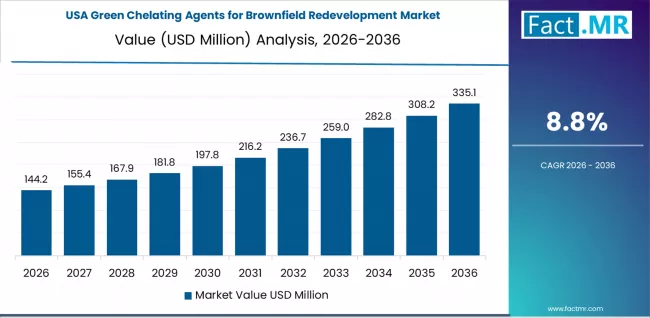
A well-established framework for brownfield redevelopment, including liability protections and grants, which incentivizes cleanup, supports the USA’s 8.80% CAGR. The strong presence of environmental consulting firms and a real estate market that values sustainable development practices drives the adoption of green chemistries. The phase-out of EDTA in many state guidelines creates a direct replacement market for biodegradable chelating agents in metal extraction projects.
Why is Germany a Key Market for High-Standard, Sustainable Remediation Solutions?
Germany’s 8.10% growth reflects its rigorous implementation of EU circular economy and soil protection directives. German engineering standards for remediation prioritize long-term environmental safety and resource efficiency.
This creates a sophisticated demand for high-performance green chelants that are backed by comprehensive biodegradability data and life-cycle assessments, making it a key market for advanced, next-generation formulations.
What is Driving Adoption in Canada’s Mining and Industrial Heartlands?
Canada’s 7.90% growth is linked to the ongoing reclamation of land associated with its extensive mining and historical industrial sectors. Provincial regulations increasingly encourage the use of less harmful remediation substances.
Green chelating agents offer a responsible solution for treating metal-laden soils at these sites, facilitating the return of land to safe and productive use while minimizing the long-term ecological footprint of cleanup operations.
Competitive Landscape of the Green Chelating Agents for Brownfield Redevelopment Market
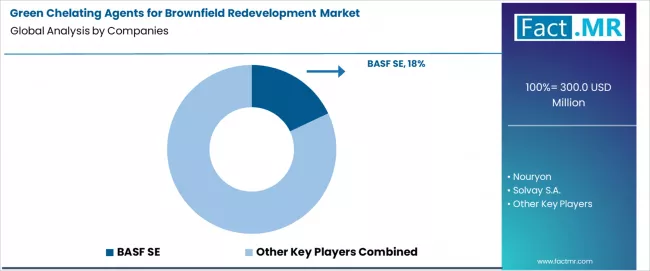
The competitive landscape features global specialty chemical companies leveraging their expertise in chelation chemistry and sustainability. Leaders like BASF and Nouryon compete through robust portfolios of biodegradable chelants, such as GLDA and EDDS, supported by extensive application research.
Competition centers on demonstrating superior metal-binding efficacy, providing verified biodegradability data, and offering technical support for complex site conditions. A key differentiator is the ability to supply tailored blends for specific soil matrices and contaminant mixes, along with providing comprehensive environmental fate studies to streamline regulatory approval for clients.
Key Players in the Green Chelating Agents for Brownfield Redevelopment Market
- BASF SE
- Nouryon
- Solvay S.A.
- Evonik Industries AG
- REGENESIS
Scope of Report
| Items | Values |
|---|---|
| Quantitative Units | USD Million |
| Chelating Agent Type | Biodegradable Aminopolycarboxylates (GLDA, MGDA), Readily Biodegradable Chelators (IDS, EDDS), Plant-Based Agents, Polymer-Assisted Systems, Other Green Chelators |
| Contaminant Type | Heavy Metals, Industrial Chemicals/Solvents, Petroleum Hydrocarbons, Mixed Pollutants, Emerging Contaminants |
| End-Use Sector | Remediation Firms, Real Estate/Redevelopment, Industrial Sites, Government Projects, Mining Land Reclamation |
| Key Countries | India, China, USA, Germany, Canada |
| Key Companies | BASF SE, Nouryon, Solvay, Evonik, REGENESIS |
| Additional Analysis | Analysis of chelant-metal complex stability constants; biodegradation pathways and half-life studies; soil geochemical compatibility; effect on soil microbiota; comparative analysis with synthetic chelators (EDTA, DTPA); regulatory landscapes governing chelant use and residues. |
Market by Segments
-
Chelating Agent Type :
- GLDA & MGDA (Biodegradable Aminopolycarboxylates)
- IDS & EDDS (Readily Biodegradable Chelators)
- Plant-Based & Bio-Sourced Chelating Agents
- Polymer-Assisted Chelation Systems
- Other Green/Eco-Friendly Chelators
-
Contaminant Type :
- Heavy Metals (Pb, Cr, As, Hg, Cd)
- Industrial Chemicals & Solvents
- Petroleum Hydrocarbons & Organics
- Mixed Metal-Organic Pollutants
- Other Emerging Contaminants
-
End-Use Sector :
- Environmental Remediation Firms
- Brownfield Redevelopment & Real Estate
- Industrial & Manufacturing Sites
- Government & Municipal Cleanup Projects
- Mining & Metallurgical Land Reclamation
-
Region :
-
North America
- USA
- Canada
-
Latin America
- Brazil
- Mexico
- Argentina
- Rest of Latin America
-
Western Europe
- Germany
- UK
- France
- Spain
- Italy
- BENELUX
- Rest of Western Europe
-
Eastern Europe
- Russia
- Poland
- Czech Republic
- Rest of Eastern Europe
-
East Asia
- China
- Japan
- South Korea
- Rest of East Asia
-
South Asia & Pacific
- India
- ASEAN
- Australia
- Rest of South Asia & Pacific
-
MEA
- Saudi Arabia
- UAE
- Turkiye
- Rest of MEA
-
Table of Content
- Executive Summary
- Global Market Outlook
- Demand to side Trends
- Supply to side Trends
- Technology Roadmap Analysis
- Analysis and Recommendations
- Market Overview
- Market Coverage / Taxonomy
- Market Definition / Scope / Limitations
- Market Background
- Market Dynamics
- Drivers
- Restraints
- Opportunity
- Trends
- Scenario Forecast
- Demand in Optimistic Scenario
- Demand in Likely Scenario
- Demand in Conservative Scenario
- Opportunity Map Analysis
- Product Life Cycle Analysis
- Supply Chain Analysis
- Investment Feasibility Matrix
- Value Chain Analysis
- PESTLE and Porter’s Analysis
- Regulatory Landscape
- Regional Parent Market Outlook
- Production and Consumption Statistics
- Import and Export Statistics
- Market Dynamics
- Global Market Analysis 2021 to 2025 and Forecast, 2026 to 2036
- Historical Market Size Value (USD Million) Analysis, 2021 to 2025
- Current and Future Market Size Value (USD Million) Projections, 2026 to 2036
- Y to o to Y Growth Trend Analysis
- Absolute $ Opportunity Analysis
- Global Market Pricing Analysis 2021 to 2025 and Forecast 2026 to 2036
- Global Market Analysis 2021 to 2025 and Forecast 2026 to 2036, By Chelating Agent Type
- Introduction / Key Findings
- Historical Market Size Value (USD Million) Analysis By Chelating Agent Type, 2021 to 2025
- Current and Future Market Size Value (USD Million) Analysis and Forecast By Chelating Agent Type, 2026 to 2036
- GLDA & MGDA (Biodegradable Aminopolycarboxylates)
- IDS & EDDS (Readily Biodegradable Chelators)
- Plant-Based & Bio-Sourced Chelating Agents
- Polymer-Assisted Chelation Systems
- Other Green/Eco-Friendly Chelators
- GLDA & MGDA (Biodegradable Aminopolycarboxylates)
- Y to o to Y Growth Trend Analysis By Chelating Agent Type, 2021 to 2025
- Absolute $ Opportunity Analysis By Chelating Agent Type, 2026 to 2036
- Global Market Analysis 2021 to 2025 and Forecast 2026 to 2036, By Contaminant Type
- Introduction / Key Findings
- Historical Market Size Value (USD Million) Analysis By Contaminant Type, 2021 to 2025
- Current and Future Market Size Value (USD Million) Analysis and Forecast By Contaminant Type, 2026 to 2036
- Heavy Metals (Pb, Cr, As, Hg, Cd)
- Industrial Chemicals & Solvents
- Petroleum Hydrocarbons & Organics
- Mixed Metal-Organic Pollutants
- Other Emerging Contaminants
- Heavy Metals (Pb, Cr, As, Hg, Cd)
- Y to o to Y Growth Trend Analysis By Contaminant Type, 2021 to 2025
- Absolute $ Opportunity Analysis By Contaminant Type, 2026 to 2036
- Global Market Analysis 2021 to 2025 and Forecast 2026 to 2036, By End-Use Sector
- Introduction / Key Findings
- Historical Market Size Value (USD Million) Analysis By End-Use Sector, 2021 to 2025
- Current and Future Market Size Value (USD Million) Analysis and Forecast By End-Use Sector, 2026 to 2036
- Environmental Remediation Firms
- Brownfield Redevelopment & Real Estate
- Industrial & Manufacturing Sites
- Government & Municipal Cleanup Projects
- Mining & Metallurgical Land Reclamation
- Environmental Remediation Firms
- Y to o to Y Growth Trend Analysis By End-Use Sector, 2021 to 2025
- Absolute $ Opportunity Analysis By End-Use Sector, 2026 to 2036
- Global Market Analysis 2021 to 2025 and Forecast 2026 to 2036, By Region
- Introduction
- Historical Market Size Value (USD Million) Analysis By Region, 2021 to 2025
- Current Market Size Value (USD Million) Analysis and Forecast By Region, 2026 to 2036
- North America
- Latin America
- Western Europe
- Eastern Europe
- East Asia
- South Asia and Pacific
- Middle East & Africa
- Market Attractiveness Analysis By Region
- North America Market Analysis 2021 to 2025 and Forecast 2026 to 2036, By Country
- Historical Market Size Value (USD Million) Trend Analysis By Market Taxonomy, 2021 to 2025
- Market Size Value (USD Million) Forecast By Market Taxonomy, 2026 to 2036
- By Country
- USA
- Canada
- Mexico
- By Chelating Agent Type
- By Contaminant Type
- By End-Use Sector
- By Country
- Market Attractiveness Analysis
- By Country
- By Chelating Agent Type
- By Contaminant Type
- By End-Use Sector
- Key Takeaways
- Latin America Market Analysis 2021 to 2025 and Forecast 2026 to 2036, By Country
- Historical Market Size Value (USD Million) Trend Analysis By Market Taxonomy, 2021 to 2025
- Market Size Value (USD Million) Forecast By Market Taxonomy, 2026 to 2036
- By Country
- Brazil
- Chile
- Rest of Latin America
- By Chelating Agent Type
- By Contaminant Type
- By End-Use Sector
- By Country
- Market Attractiveness Analysis
- By Country
- By Chelating Agent Type
- By Contaminant Type
- By End-Use Sector
- Key Takeaways
- Western Europe Market Analysis 2021 to 2025 and Forecast 2026 to 2036, By Country
- Historical Market Size Value (USD Million) Trend Analysis By Market Taxonomy, 2021 to 2025
- Market Size Value (USD Million) Forecast By Market Taxonomy, 2026 to 2036
- By Country
- Germany
- UK
- Italy
- Spain
- France
- Nordic
- BENELUX
- Rest of Western Europe
- By Chelating Agent Type
- By Contaminant Type
- By End-Use Sector
- By Country
- Market Attractiveness Analysis
- By Country
- By Chelating Agent Type
- By Contaminant Type
- By End-Use Sector
- Key Takeaways
- Eastern Europe Market Analysis 2021 to 2025 and Forecast 2026 to 2036, By Country
- Historical Market Size Value (USD Million) Trend Analysis By Market Taxonomy, 2021 to 2025
- Market Size Value (USD Million) Forecast By Market Taxonomy, 2026 to 2036
- By Country
- Russia
- Poland
- Hungary
- Balkan & Baltic
- Rest of Eastern Europe
- By Chelating Agent Type
- By Contaminant Type
- By End-Use Sector
- By Country
- Market Attractiveness Analysis
- By Country
- By Chelating Agent Type
- By Contaminant Type
- By End-Use Sector
- Key Takeaways
- East Asia Market Analysis 2021 to 2025 and Forecast 2026 to 2036, By Country
- Historical Market Size Value (USD Million) Trend Analysis By Market Taxonomy, 2021 to 2025
- Market Size Value (USD Million) Forecast By Market Taxonomy, 2026 to 2036
- By Country
- China
- Japan
- South Korea
- By Chelating Agent Type
- By Contaminant Type
- By End-Use Sector
- By Country
- Market Attractiveness Analysis
- By Country
- By Chelating Agent Type
- By Contaminant Type
- By End-Use Sector
- Key Takeaways
- South Asia and Pacific Market Analysis 2021 to 2025 and Forecast 2026 to 2036, By Country
- Historical Market Size Value (USD Million) Trend Analysis By Market Taxonomy, 2021 to 2025
- Market Size Value (USD Million) Forecast By Market Taxonomy, 2026 to 2036
- By Country
- India
- ASEAN
- Australia & New Zealand
- Rest of South Asia and Pacific
- By Chelating Agent Type
- By Contaminant Type
- By End-Use Sector
- By Country
- Market Attractiveness Analysis
- By Country
- By Chelating Agent Type
- By Contaminant Type
- By End-Use Sector
- Key Takeaways
- Middle East & Africa Market Analysis 2021 to 2025 and Forecast 2026 to 2036, By Country
- Historical Market Size Value (USD Million) Trend Analysis By Market Taxonomy, 2021 to 2025
- Market Size Value (USD Million) Forecast By Market Taxonomy, 2026 to 2036
- By Country
- Kingdom of Saudi Arabia
- Other GCC Countries
- Turkiye
- South Africa
- Other African Union
- Rest of Middle East & Africa
- By Chelating Agent Type
- By Contaminant Type
- By End-Use Sector
- By Country
- Market Attractiveness Analysis
- By Country
- By Chelating Agent Type
- By Contaminant Type
- By End-Use Sector
- Key Takeaways
- Key Countries Market Analysis
- USA
- Pricing Analysis
- Market Share Analysis, 2025
- By Chelating Agent Type
- By Contaminant Type
- By End-Use Sector
- Canada
- Pricing Analysis
- Market Share Analysis, 2025
- By Chelating Agent Type
- By Contaminant Type
- By End-Use Sector
- Mexico
- Pricing Analysis
- Market Share Analysis, 2025
- By Chelating Agent Type
- By Contaminant Type
- By End-Use Sector
- Brazil
- Pricing Analysis
- Market Share Analysis, 2025
- By Chelating Agent Type
- By Contaminant Type
- By End-Use Sector
- Chile
- Pricing Analysis
- Market Share Analysis, 2025
- By Chelating Agent Type
- By Contaminant Type
- By End-Use Sector
- Germany
- Pricing Analysis
- Market Share Analysis, 2025
- By Chelating Agent Type
- By Contaminant Type
- By End-Use Sector
- UK
- Pricing Analysis
- Market Share Analysis, 2025
- By Chelating Agent Type
- By Contaminant Type
- By End-Use Sector
- Italy
- Pricing Analysis
- Market Share Analysis, 2025
- By Chelating Agent Type
- By Contaminant Type
- By End-Use Sector
- Spain
- Pricing Analysis
- Market Share Analysis, 2025
- By Chelating Agent Type
- By Contaminant Type
- By End-Use Sector
- France
- Pricing Analysis
- Market Share Analysis, 2025
- By Chelating Agent Type
- By Contaminant Type
- By End-Use Sector
- India
- Pricing Analysis
- Market Share Analysis, 2025
- By Chelating Agent Type
- By Contaminant Type
- By End-Use Sector
- ASEAN
- Pricing Analysis
- Market Share Analysis, 2025
- By Chelating Agent Type
- By Contaminant Type
- By End-Use Sector
- Australia & New Zealand
- Pricing Analysis
- Market Share Analysis, 2025
- By Chelating Agent Type
- By Contaminant Type
- By End-Use Sector
- China
- Pricing Analysis
- Market Share Analysis, 2025
- By Chelating Agent Type
- By Contaminant Type
- By End-Use Sector
- Japan
- Pricing Analysis
- Market Share Analysis, 2025
- By Chelating Agent Type
- By Contaminant Type
- By End-Use Sector
- South Korea
- Pricing Analysis
- Market Share Analysis, 2025
- By Chelating Agent Type
- By Contaminant Type
- By End-Use Sector
- Russia
- Pricing Analysis
- Market Share Analysis, 2025
- By Chelating Agent Type
- By Contaminant Type
- By End-Use Sector
- Poland
- Pricing Analysis
- Market Share Analysis, 2025
- By Chelating Agent Type
- By Contaminant Type
- By End-Use Sector
- Hungary
- Pricing Analysis
- Market Share Analysis, 2025
- By Chelating Agent Type
- By Contaminant Type
- By End-Use Sector
- Kingdom of Saudi Arabia
- Pricing Analysis
- Market Share Analysis, 2025
- By Chelating Agent Type
- By Contaminant Type
- By End-Use Sector
- Turkiye
- Pricing Analysis
- Market Share Analysis, 2025
- By Chelating Agent Type
- By Contaminant Type
- By End-Use Sector
- South Africa
- Pricing Analysis
- Market Share Analysis, 2025
- By Chelating Agent Type
- By Contaminant Type
- By End-Use Sector
- USA
- Market Structure Analysis
- Competition Dashboard
- Competition Benchmarking
- Market Share Analysis of Top Players
- By Regional
- By Chelating Agent Type
- By Contaminant Type
- By End-Use Sector
- Competition Analysis
- Competition Deep Dive
- BASF SE
- Overview
- Product Portfolio
- Profitability by Market Segments (Product/Age /Sales Channel/Region)
- Sales Footprint
- Strategy Overview
- Marketing Strategy
- Product Strategy
- Channel Strategy
- Nouryon
- Solvay S.A.
- Evonik Industries AG
- REGENESIS
- BASF SE
- Competition Deep Dive
- Assumptions & Acronyms Used
- Research Methodology
List Of Table
- Table 1: Global Market Value (USD Million) Forecast by Region, 2021 to 2036
- Table 2: Global Market Value (USD Million) Forecast by Chelating Agent Type, 2021 to 2036
- Table 3: Global Market Value (USD Million) Forecast by Contaminant Type, 2021 to 2036
- Table 4: Global Market Value (USD Million) Forecast by End-Use Sector, 2021 to 2036
- Table 5: North America Market Value (USD Million) Forecast by Country, 2021 to 2036
- Table 6: North America Market Value (USD Million) Forecast by Chelating Agent Type, 2021 to 2036
- Table 7: North America Market Value (USD Million) Forecast by Contaminant Type, 2021 to 2036
- Table 8: North America Market Value (USD Million) Forecast by End-Use Sector, 2021 to 2036
- Table 9: Latin America Market Value (USD Million) Forecast by Country, 2021 to 2036
- Table 10: Latin America Market Value (USD Million) Forecast by Chelating Agent Type, 2021 to 2036
- Table 11: Latin America Market Value (USD Million) Forecast by Contaminant Type, 2021 to 2036
- Table 12: Latin America Market Value (USD Million) Forecast by End-Use Sector, 2021 to 2036
- Table 13: Western Europe Market Value (USD Million) Forecast by Country, 2021 to 2036
- Table 14: Western Europe Market Value (USD Million) Forecast by Chelating Agent Type, 2021 to 2036
- Table 15: Western Europe Market Value (USD Million) Forecast by Contaminant Type, 2021 to 2036
- Table 16: Western Europe Market Value (USD Million) Forecast by End-Use Sector, 2021 to 2036
- Table 17: Eastern Europe Market Value (USD Million) Forecast by Country, 2021 to 2036
- Table 18: Eastern Europe Market Value (USD Million) Forecast by Chelating Agent Type, 2021 to 2036
- Table 19: Eastern Europe Market Value (USD Million) Forecast by Contaminant Type, 2021 to 2036
- Table 20: Eastern Europe Market Value (USD Million) Forecast by End-Use Sector, 2021 to 2036
- Table 21: East Asia Market Value (USD Million) Forecast by Country, 2021 to 2036
- Table 22: East Asia Market Value (USD Million) Forecast by Chelating Agent Type, 2021 to 2036
- Table 23: East Asia Market Value (USD Million) Forecast by Contaminant Type, 2021 to 2036
- Table 24: East Asia Market Value (USD Million) Forecast by End-Use Sector, 2021 to 2036
- Table 25: South Asia and Pacific Market Value (USD Million) Forecast by Country, 2021 to 2036
- Table 26: South Asia and Pacific Market Value (USD Million) Forecast by Chelating Agent Type, 2021 to 2036
- Table 27: South Asia and Pacific Market Value (USD Million) Forecast by Contaminant Type, 2021 to 2036
- Table 28: South Asia and Pacific Market Value (USD Million) Forecast by End-Use Sector, 2021 to 2036
- Table 29: Middle East & Africa Market Value (USD Million) Forecast by Country, 2021 to 2036
- Table 30: Middle East & Africa Market Value (USD Million) Forecast by Chelating Agent Type, 2021 to 2036
- Table 31: Middle East & Africa Market Value (USD Million) Forecast by Contaminant Type, 2021 to 2036
- Table 32: Middle East & Africa Market Value (USD Million) Forecast by End-Use Sector, 2021 to 2036
List Of Figures
- Figure 1: Global Market Pricing Analysis
- Figure 2: Global Market Value (USD Million) Forecast 2021 to 2036
- Figure 3: Global Market Value Share and BPS Analysis by Chelating Agent Type, 2026 and 2036
- Figure 4: Global Market Y to o to Y Growth Comparison by Chelating Agent Type, 2026 to 2036
- Figure 5: Global Market Attractiveness Analysis by Chelating Agent Type
- Figure 6: Global Market Value Share and BPS Analysis by Contaminant Type, 2026 and 2036
- Figure 7: Global Market Y to o to Y Growth Comparison by Contaminant Type, 2026 to 2036
- Figure 8: Global Market Attractiveness Analysis by Contaminant Type
- Figure 9: Global Market Value Share and BPS Analysis by End-Use Sector, 2026 and 2036
- Figure 10: Global Market Y to o to Y Growth Comparison by End-Use Sector, 2026 to 2036
- Figure 11: Global Market Attractiveness Analysis by End-Use Sector
- Figure 12: Global Market Value (USD Million) Share and BPS Analysis by Region, 2026 and 2036
- Figure 13: Global Market Y to o to Y Growth Comparison by Region, 2026 to 2036
- Figure 14: Global Market Attractiveness Analysis by Region
- Figure 15: North America Market Incremental Dollar Opportunity, 2026 to 2036
- Figure 16: Latin America Market Incremental Dollar Opportunity, 2026 to 2036
- Figure 17: Western Europe Market Incremental Dollar Opportunity, 2026 to 2036
- Figure 18: Eastern Europe Market Incremental Dollar Opportunity, 2026 to 2036
- Figure 19: East Asia Market Incremental Dollar Opportunity, 2026 to 2036
- Figure 20: South Asia and Pacific Market Incremental Dollar Opportunity, 2026 to 2036
- Figure 21: Middle East & Africa Market Incremental Dollar Opportunity, 2026 to 2036
- Figure 22: North America Market Value Share and BPS Analysis by Country, 2026 and 2036
- Figure 23: North America Market Value Share and BPS Analysis by Chelating Agent Type, 2026 and 2036
- Figure 24: North America Market Y to o to Y Growth Comparison by Chelating Agent Type, 2026 to 2036
- Figure 25: North America Market Attractiveness Analysis by Chelating Agent Type
- Figure 26: North America Market Value Share and BPS Analysis by Contaminant Type, 2026 and 2036
- Figure 27: North America Market Y to o to Y Growth Comparison by Contaminant Type, 2026 to 2036
- Figure 28: North America Market Attractiveness Analysis by Contaminant Type
- Figure 29: North America Market Value Share and BPS Analysis by End-Use Sector, 2026 and 2036
- Figure 30: North America Market Y to o to Y Growth Comparison by End-Use Sector, 2026 to 2036
- Figure 31: North America Market Attractiveness Analysis by End-Use Sector
- Figure 32: Latin America Market Value Share and BPS Analysis by Country, 2026 and 2036
- Figure 33: Latin America Market Value Share and BPS Analysis by Chelating Agent Type, 2026 and 2036
- Figure 34: Latin America Market Y to o to Y Growth Comparison by Chelating Agent Type, 2026 to 2036
- Figure 35: Latin America Market Attractiveness Analysis by Chelating Agent Type
- Figure 36: Latin America Market Value Share and BPS Analysis by Contaminant Type, 2026 and 2036
- Figure 37: Latin America Market Y to o to Y Growth Comparison by Contaminant Type, 2026 to 2036
- Figure 38: Latin America Market Attractiveness Analysis by Contaminant Type
- Figure 39: Latin America Market Value Share and BPS Analysis by End-Use Sector, 2026 and 2036
- Figure 40: Latin America Market Y to o to Y Growth Comparison by End-Use Sector, 2026 to 2036
- Figure 41: Latin America Market Attractiveness Analysis by End-Use Sector
- Figure 42: Western Europe Market Value Share and BPS Analysis by Country, 2026 and 2036
- Figure 43: Western Europe Market Value Share and BPS Analysis by Chelating Agent Type, 2026 and 2036
- Figure 44: Western Europe Market Y to o to Y Growth Comparison by Chelating Agent Type, 2026 to 2036
- Figure 45: Western Europe Market Attractiveness Analysis by Chelating Agent Type
- Figure 46: Western Europe Market Value Share and BPS Analysis by Contaminant Type, 2026 and 2036
- Figure 47: Western Europe Market Y to o to Y Growth Comparison by Contaminant Type, 2026 to 2036
- Figure 48: Western Europe Market Attractiveness Analysis by Contaminant Type
- Figure 49: Western Europe Market Value Share and BPS Analysis by End-Use Sector, 2026 and 2036
- Figure 50: Western Europe Market Y to o to Y Growth Comparison by End-Use Sector, 2026 to 2036
- Figure 51: Western Europe Market Attractiveness Analysis by End-Use Sector
- Figure 52: Eastern Europe Market Value Share and BPS Analysis by Country, 2026 and 2036
- Figure 53: Eastern Europe Market Value Share and BPS Analysis by Chelating Agent Type, 2026 and 2036
- Figure 54: Eastern Europe Market Y to o to Y Growth Comparison by Chelating Agent Type, 2026 to 2036
- Figure 55: Eastern Europe Market Attractiveness Analysis by Chelating Agent Type
- Figure 56: Eastern Europe Market Value Share and BPS Analysis by Contaminant Type, 2026 and 2036
- Figure 57: Eastern Europe Market Y to o to Y Growth Comparison by Contaminant Type, 2026 to 2036
- Figure 58: Eastern Europe Market Attractiveness Analysis by Contaminant Type
- Figure 59: Eastern Europe Market Value Share and BPS Analysis by End-Use Sector, 2026 and 2036
- Figure 60: Eastern Europe Market Y to o to Y Growth Comparison by End-Use Sector, 2026 to 2036
- Figure 61: Eastern Europe Market Attractiveness Analysis by End-Use Sector
- Figure 62: East Asia Market Value Share and BPS Analysis by Country, 2026 and 2036
- Figure 63: East Asia Market Value Share and BPS Analysis by Chelating Agent Type, 2026 and 2036
- Figure 64: East Asia Market Y to o to Y Growth Comparison by Chelating Agent Type, 2026 to 2036
- Figure 65: East Asia Market Attractiveness Analysis by Chelating Agent Type
- Figure 66: East Asia Market Value Share and BPS Analysis by Contaminant Type, 2026 and 2036
- Figure 67: East Asia Market Y to o to Y Growth Comparison by Contaminant Type, 2026 to 2036
- Figure 68: East Asia Market Attractiveness Analysis by Contaminant Type
- Figure 69: East Asia Market Value Share and BPS Analysis by End-Use Sector, 2026 and 2036
- Figure 70: East Asia Market Y to o to Y Growth Comparison by End-Use Sector, 2026 to 2036
- Figure 71: East Asia Market Attractiveness Analysis by End-Use Sector
- Figure 72: South Asia and Pacific Market Value Share and BPS Analysis by Country, 2026 and 2036
- Figure 73: South Asia and Pacific Market Value Share and BPS Analysis by Chelating Agent Type, 2026 and 2036
- Figure 74: South Asia and Pacific Market Y to o to Y Growth Comparison by Chelating Agent Type, 2026 to 2036
- Figure 75: South Asia and Pacific Market Attractiveness Analysis by Chelating Agent Type
- Figure 76: South Asia and Pacific Market Value Share and BPS Analysis by Contaminant Type, 2026 and 2036
- Figure 77: South Asia and Pacific Market Y to o to Y Growth Comparison by Contaminant Type, 2026 to 2036
- Figure 78: South Asia and Pacific Market Attractiveness Analysis by Contaminant Type
- Figure 79: South Asia and Pacific Market Value Share and BPS Analysis by End-Use Sector, 2026 and 2036
- Figure 80: South Asia and Pacific Market Y to o to Y Growth Comparison by End-Use Sector, 2026 to 2036
- Figure 81: South Asia and Pacific Market Attractiveness Analysis by End-Use Sector
- Figure 82: Middle East & Africa Market Value Share and BPS Analysis by Country, 2026 and 2036
- Figure 83: Middle East & Africa Market Value Share and BPS Analysis by Chelating Agent Type, 2026 and 2036
- Figure 84: Middle East & Africa Market Y to o to Y Growth Comparison by Chelating Agent Type, 2026 to 2036
- Figure 85: Middle East & Africa Market Attractiveness Analysis by Chelating Agent Type
- Figure 86: Middle East & Africa Market Value Share and BPS Analysis by Contaminant Type, 2026 and 2036
- Figure 87: Middle East & Africa Market Y to o to Y Growth Comparison by Contaminant Type, 2026 to 2036
- Figure 88: Middle East & Africa Market Attractiveness Analysis by Contaminant Type
- Figure 89: Middle East & Africa Market Value Share and BPS Analysis by End-Use Sector, 2026 and 2036
- Figure 90: Middle East & Africa Market Y to o to Y Growth Comparison by End-Use Sector, 2026 to 2036
- Figure 91: Middle East & Africa Market Attractiveness Analysis by End-Use Sector
- Figure 92: Global Market - Tier Structure Analysis
- Figure 93: Global Market - Company Share Analysis
- FAQs -
How big is the green chelating agents for brownfield redevelopment market in 2026?
The global green chelating agents for brownfield redevelopment market is estimated to be valued at USD 300.0 million in 2026.
What will be the size of green chelating agents for brownfield redevelopment market in 2036?
The market size for the green chelating agents for brownfield redevelopment market is projected to reach USD 764.1 million by 2036.
How much will be the green chelating agents for brownfield redevelopment market growth between 2026 and 2036?
The green chelating agents for brownfield redevelopment market is expected to grow at a 9.8% CAGR between 2026 and 2036.
What are the key product types in the green chelating agents for brownfield redevelopment market?
The key product types in green chelating agents for brownfield redevelopment market are glda & mgda (biodegradable aminopolycarboxylates), ids & edds (readily biodegradable chelators), plant-based & bio-sourced chelating agents, polymer-assisted chelation systems and other green/eco-friendly chelators.
Which contaminant type segment to contribute significant share in the green chelating agents for brownfield redevelopment market in 2026?
In terms of contaminant type, heavy metals (pb, cr, as, hg, cd) segment to command 38.0% share in the green chelating agents for brownfield redevelopment market in 2026.