- Forecast Value (2036): 1.4 Bn
- CAGR (2036): 13.3%
What is the nasal powder dispensers market forecast to be worth by 2036?
USD 0.4 billion in 2026 to USD 1.4 billion by 2036, at 13.3% CAGR.
- The nasal powder dispensers market crossed a valuation of USD 0.3 billion in 2025.
- Demand is expected to increase from USD 0.4 billion in 2026 to USD 1.4 billion by 2036.
- The market is forecast to record 13.3% CAGR from 2026 to 2036 as powder-based intranasal medicines move through clinical and combination-product development.
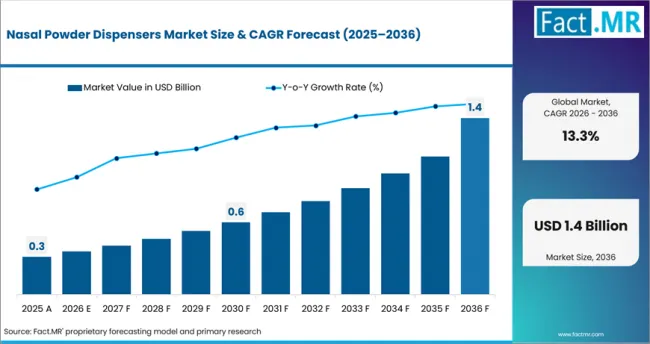
Nasal Powder Dispensers Market Value Analysis | Source: Fact.MR
What are the defining numbers behind nasal powder dispensers market growth?
USD 1.0 billion absolute opportunity by 2036, led by the United States and the United Kingdom.
- Demand Drivers in the Market
- Pharma companies need stable dry formats for sensitive intranasal drug products.
- Rescue therapy developers need simple devices for non-clinician administration.
- Formulation teams need powder dispensers that support higher dose loading.
- CDMOs need device platforms that fit capsule or cartridge filling workflows.
- Key Segments Analyzed
- By Device Format: Single-Use Unit-Dose Powder Dispensers are expected to hold 49.0% share in 2026 because rescue and acute medicines need ready-to-use delivery.
- By Actuation Mechanism: User-Independent Mechanical Actuation leads because dose delivery must be consistent across caregivers and patients. The share is projected at 38.0% in 2026.
- By Dose Format: Pre-Filled Powder Reservoirs are likely to account for 36.0% share in 2026 because sealed systems protect dry formulations.
- By Drug Use: Rescue and Acute Care Medicines lead with 34.0% share in 2026 because non-invasive administration matters during urgent use.
- By Customer Type: Pharma Combination Product Programs are expected to hold 51.0% share in 2026 because sponsors define device and formulation requirements together.
- By Geography: The United States is projected to record 15.6% CAGR through 2036 as intranasal powder programs expand.
- Analyst Opinion at Fact.MR
- Shambhu Nath Jha, Senior Analyst at Fact.MR, states, “Nasal powder dispensers are becoming a bridge between formulation stability and patient-friendly drug delivery. We see sponsors evaluating powder devices for rescue medicines, peptides and respiratory protection programs. Suppliers that combine deposition control with strong usability evidence will gain stronger access to nasal combination-product programs.”
- Strategic Implications
- Device suppliers should align actuation force with emergency-use requirements.
- CDMOs should pair powder engineering with device selection earlier.
- Pharma sponsors should test deposition and reconstitution-free usability before pivotal studies.
- Platform owners should build data packages around fill weight and emitted dose consistency.
Nasal powder dispensers are devices that deliver dry powder formulations into the nasal cavity for local, systemic or nose-to-brain applications. The category connects with drug delivery systems because device performance affects deposition, usability and dose confidence. Nemera and Therakind announced a 2026 partnership to advance DriDose dry powder intranasal technology.
Hovione advanced a single-use capsule-based nasal dry powder device in 2026. Hovione states that the platform supports systemic and nose-to-brain deposition and flexible dosing up to 30 mg. This shows how capsule-compatible powder devices can simplify early drug product development.
The United States is projected to record 15.6% CAGR through 2036 as respiratory and rescue therapy programs use intranasal powder delivery. The United Kingdom is expected to post 14.7% CAGR through 2036 as Therakind and device development partners support dry powder programs. France is likely to record 14.1% CAGR as Nemera expands dry powder intranasal capability. Portugal is forecast to advance at 13.5% CAGR as Hovione links particle engineering with device development. Germany is set to record 13.0% CAGR as pharma-device programs evaluate nasal powder delivery for specialty medicines.
How does the nasal powder dispensers market break down by segment?
Single-Use Unit-Dose Powder Dispensers lead at 49.0%; Pharma Combination Product Programs lead at 51.0%.
Which device format dominates?
Single-Use Unit-Dose Powder Dispensers hold 49.0% share in 2026.
Single-Use Unit-Dose Powder Dispensers are expected to hold 49.0% share in 2026 because acute therapies need simple device handling. The format is ready to use and avoids patient dose preparation. Aptar’s UDS Powder system supports this pathway through single-dose dry powder delivery. The segment connects with combination products because the medicine and device are developed as one system.
Which actuation mechanism dominates?
User-Independent Mechanical Actuation accounts for 38.0% share in 2026.
User-Independent Mechanical Actuation leads because nasal powder delivery must perform across different users. The mechanism is projected to capture 38.0% share in 2026. Devices with controlled actuation reduce variability from hand force or device angle.
Which dose format dominates?
Pre-Filled Powder Reservoirs hold 36.0% share in 2026.
Pre-Filled Powder Reservoirs lead because sealed dose chambers protect dry powder until administration. The dose format is likely to account for 36.0% share in 2026. The format supports compact unit-dose systems and tamper-evident packaging. Capsule-based formats are growing where developers want standard filling equipment and flexible dose loading. Powder handling lessons from dry powder inhalers can transfer into nasal device design.
Which drug use dominates?
Rescue and Acute Care Medicines lead with 34.0% share in 2026.
Rescue and Acute Care Medicines lead because nasal powder delivery can support fast, needle-free administration. The drug use category is expected to hold 34.0% share in 2026. Caregivers need a device that works quickly during stressful moments. Powder formats can also help with drug stability in portable products. The segment connects with emergency medical services because rescue therapy usability affects real-world treatment.
Which customer type dominates?
Pharma Combination Product Programs hold 51.0% share in 2026.
Pharma Combination Product Programs lead because nasal powder devices must match the formulation early. The customer type is expected to hold 51.0% share in 2026. Sponsors need device evidence, deposition testing and human factors support. CDMOs follow because they help connect powder engineering with device filling. Pharmaceutical contract packaging is relevant where device assembly and kit packaging support commercialization.
What is accelerating nasal powder dispenser demand, and what is holding it back?
Stable dry intranasal delivery drives demand, while deposition variability restrains adoption.
Stable dry intranasal delivery is the main driver. Powders can support molecules that face stability issues in liquid formats. They can also support higher dose loading and portable emergency-use devices.
Aptar states that nasal powder formulations can offer improved product stability, enhanced bioavailability and higher dosing levels. This supports sponsor interest in powder dispenser platforms.
Therakind states that DriDose includes single-use and reusable versions that can be modified for different powder-loading capacities. This supports device flexibility across drug candidates.
The main restraint is deposition variability. Powder flow, nasal anatomy and user handling can influence dose placement. Suppliers need nasal cast testing and human factors work before sponsors can trust a device platform.
Where do the biggest nasal powder dispenser opportunities sit?
Rescue medicines, peptide delivery and respiratory protection programs.
- Rescue Medicines: Sponsors can use powder devices to reduce dependence on needles.
- Peptide Delivery: Developers can test nasal powder formats for systemic delivery programs.
- Respiratory Protection: Dry intranasal devices can support antiviral and barrier therapy development.
Which countries are scaling nasal powder dispensers fastest?
United States 15.6%, United Kingdom 14.7%, France 14.1%, Portugal 13.5%, Germany 13.0%.
Based on regional analysis, the nasal powder dispensers market covers North America, Western Europe, Asia Pacific, Latin America, and Middle East and Africa complete the regional scope.
| Country | CAGR |
|---|---|
| United States | 15.6% |
| United Kingdom | 14.7% |
| France | 14.1% |
| Portugal | 13.5% |
| Germany | 13.0% |
What is powering the United States lead?
15.6% CAGR, driven by Aptar Pharma and respiratory clinical programs.
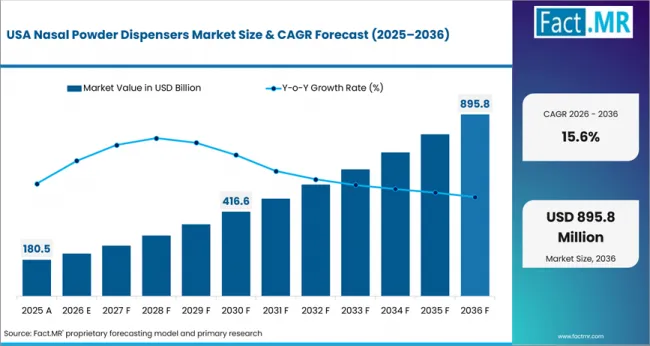
Nasal Powder Dispensers Market Country Value Analysis | Source: Fact.MR
The United States is projected to record 15.6% CAGR by 2036 as nasal powder systems move through respiratory and rescue therapy pipelines. Aptar Pharma supports UDS Powder nasal delivery and clinical-stage intranasal development. Sponsors need devices that can support simple administration and dry formulation stability. Growth will favor platforms with strong regulatory and device files.
How is the United Kingdom scaling nasal powder dispenser demand?
14.7% CAGR, supported by Therakind nasal device capability.
The United Kingdom is expected to post 14.7% CAGR through 2036 as dry powder intranasal technology and nasal device development expand. Therakind supports DriDose dry powder nasal delivery. Growth will favor device partners that can support early feasibility and clinical supply.
What supports France’s outlook?
14.1% CAGR, driven by Nemera and dry powder intranasal industrialization.
France is likely to record 14.1% CAGR by 2036 as Nemera expands into DriDose dry powder intranasal technology. The company brings device development and industrialization support to the partnership with Therakind. French pharma-device programs need nasal platforms that support systemic and local therapies. Growth will favor suppliers with human factors and manufacturing scale-up capability.
How is Portugal scaling nasal powder dispenser adoption?
13.5% CAGR, backed by Hovione and capsule-based nasal powder platforms.
Portugal is forecast to advance at 13.5% CAGR through 2036 as Hovione links particle engineering with single-use nasal dry powder devices. The Hovione platform supports a capsule-based device approach. This can help developers use established powder filling paths. Growth will favor CDMO-led models that combine formulation and device services.
What underpins Germany’s growth?
13.0% CAGR, driven by specialty pharma programs and combination-product engineering.
Germany is set to record 13.0% CAGR through 2036 as specialty drug developers evaluate dry intranasal formats. Device engineering teams need consistent dose delivery and robust powder protection. German pharma programs are likely to test nasal powder devices for peptides and rescue therapies. Growth will favor validated dispenser platforms and strong quality documentation.
Who leads the nasal powder dispensers market?
Aptar Pharma and Nemera lead through nasal powder platform development and device industrialization.
Nasal powder dispensers are supplied by drug delivery device firms, CDMOs and specialist design partners. Aptar Pharma leads through its Unidose Powder Nasal Spray System. Nemera expands through its partnership with Therakind on DriDose dry powder intranasal technology.
Therakind competes through DriDose single-use and reusable dry powder nasal device concepts. Hovione supports nasal powder delivery through a capsule-based intranasal platform developed with IDC.
Competition through 2036 will depend on deposition control and device usability. Suppliers need powder protection, clear actuation feedback and repeatable emitted dose performance. The medical polymers layer matters because dispenser components must protect powder and perform under storage stress. The biologics layer is relevant because some peptide and biologic candidates may need non-invasive delivery routes.
Which companies are the key providers?
Aptar Pharma and Nemera are key providers. Therakind and Hovione are also profiled.
- Aptar Pharma
- Nemera
- Therakind
- Hovione
Bibliography
- Aptar Pharma. (2026, March 19). Aptar’s Unidose Powder Nasal Delivery System Used in ENA Respiratory Phase II Clinical Study of Investigational INNA-051 Nasal Spray. Aptar Pharma.
- Nemera. (2026, April 7). Nemera and Therakind announce strategic partnership to advance DriDose® dry powder intranasal technology. Nemera.
- Hovione. (2026, May 7). Hovione and IDC Intranasal Drug Delivery Platform Available for Commercial Partnerships. Hovione.
- Hovione. (2026). Nasal Device DPI. Hovione.
- Bespak. (2026). Inhalation CDMO: pMDI, DPI & nasal drug delivery. Bespak.
- Industrial Design Consultancy. (2026). Nasal dry powder delivery. IDC.
This Report Addresses
- Strategic intelligence on nasal powder dispensers across device format and actuation mechanism.
- Segment analysis covering Single-Use Unit-Dose Powder Dispensers and User-Independent Mechanical Actuation.
- Regional outlook covering the United States, the United Kingdom, France, Portugal, and Germany.
- Competitive analysis of Aptar Pharma, Nemera, Therakind, Hovione.
- Technology assessment covering capsule devices, unit-dose systems, reusable cartridges, and air-assisted powder emission.
- Use case assessment covering rescue medicines, respiratory protection and peptide delivery programs.
- Primary interviews, supplier checks and official source review support the forecast.
What does the nasal powder dispensers market cover?
Devices that deliver dry powder formulations through the nasal route.
The nasal powder dispensers market covers single-dose and multidose devices that administer dry powder medicines into the nasal cavity. It includes unit-dose powder spray systems, capsule-based nasal devices, multidose systems, and reusable dispensers. The scope connects with nasal spray systems because several device suppliers serve both liquid and powder delivery routes.
The market differs from liquid nasal sprays because the drug product is stored and emitted as powder. This can improve formulation stability and support compounds that are difficult to deliver in aqueous form. Device design must control powder emptying, plume behavior and user activation.
What is included in the scope?
Unit-dose, capsule-based and reusable nasal powder dispenser systems.
The scope includes devices used for local nasal therapy and systemic delivery. It covers dispenser platforms used with peptides, vaccines, rescue medicines, and respiratory antivirals. The scope also includes pharmaceutical packaging components when they protect powder dose integrity inside the device.
The scope includes commercial, clinical, and co-development devices.It covers dispenser assembly, device industrialization and combination-product support. It also includes formulation-device matching when suppliers provide particle engineering or nasal deposition services.
What is excluded from the scope?
Liquid nasal pumps and ordinary dry powder inhalers.
The scope excludes liquid nasal spray pumps unless the same platform is adapted for dry powder delivery. It excludes pulmonary dry powder inhalers designed mainly for lung delivery. It excludes formulation excipients sold without a nasal dispenser. It also excludes general nasal irrigation devices and saline delivery systems.
How was the analysis built?
100+ sources, 40+ company portfolios, 25+ countries, 20+ interviews.
- Primary Research:
- Primary research includes interviews with intranasal device engineers and combination-product managers. It includes input from formulation developers and CDMO technical teams.
- Desk Research:
- Desk research reviews official device sources, nasal formulation updates and regulatory guidance. It covers nasal powder platforms, human factors testing and medical device technologies used in drug-device systems.
- Market-Sizing and Forecasting:
- Forecasting uses nasal device program activity and powder formulation adoption. Clinical pipeline movement and device co-development demand support the market assessment.
- Data Validation and Update Cycle:
- Forecasts are validated through supplier checks and official product references. Device partnerships and clinical-use updates help confirm market direction.
What is the report’s scope and coverage?
| Attribute | Details |
|---|---|
| Quantitative Units | USD Billion in 2026 to USD Billion by 2036 at CAGR |
| Market Definition | Devices that deliver dry powder formulations through the nasal route |
| Device Format | Single-Use Unit-Dose Powder Dispensers; Bidose Powder Dispensers; Multidose Powder Dispensers; Capsule-Based Nasal Devices; Reusable Cartridge Devices |
| Actuation Mechanism | User-Independent Mechanical Actuation; Manual Push Actuation; Air-Assisted Powder Emission; Capsule-Piercing Actuation; Breath-Independent Discharge |
| Dose Format | Pre-Filled Powder Reservoirs; Capsule-Based Powder Doses; Cartridge-Based Powder Doses; Blister-Based Powder Doses; Custom Powder Chambers |
| Drug Use | Rescue and Acute Care Medicines; Respiratory Protection Products; Peptide and Hormone Delivery; Nose-to-Brain Programs; Local Nasal Therapies |
| Customer Type | Pharma Combination Product Programs; CDMOs; Device Platform Developers; Biotech Developers; Clinical Trial Supply Teams |
| Regions Covered | North America; Western Europe; Asia Pacific; Latin America; Middle East and Africa |
| Countries Covered | United States; United Kingdom; France; Portugal; Germany |
| Key Companies Profiled | Aptar Pharma; Nemera; Therakind; Hovione |
| Period Period | 2026 to 2036 |
| Approach | Hybrid top-down and bottom-up approach using nasal powder device programs, clinical-stage adoption, CDMO development activity and provider validation |
How is the market segmented?
-
By Device Format:
- Single-Use Unit-Dose Powder Dispensers
- Bidose Powder Dispensers
- Multidose Powder Dispensers
- Capsule-Based Nasal Devices
- Reusable Cartridge Devices
-
By Actuation Mechanism:
- User-Independent Mechanical Actuation
- Manual Push Actuation
- Air-Assisted Powder Emission
- Capsule-Piercing Actuation
- Breath-Independent Discharge
-
By Dose Format:
- Pre-Filled Powder Reservoirs
- Capsule-Based Powder Doses
- Cartridge-Based Powder Doses
- Blister-Based Powder Doses
- Custom Powder Chambers
-
By Drug Use:
- Rescue and Acute Care Medicines
- Respiratory Protection Products
- Peptide and Hormone Delivery
- Nose-to-Brain Programs
- Local Nasal Therapies
-
By Customer Type:
- Pharma Combination Product Programs
- CDMOs
- Device Platform Developers
- Biotech Developers
- Clinical Trial Supply Teams
-
Region:
- North America
- United States
- Canada
- Europe
- United Kingdom
- France
- Portugal
- Germany
- Switzerland
- Asia Pacific
- Japan
- China
- South Korea
- Singapore
- India
- Latin America
- Brazil
- Mexico
- Argentina
- Middle East & Africa
- UAE
- Saudi Arabia
- South Africa
- Israel
- North America