- Base Value(2025): 2.0 Bn
- Estimated Value(2026): 2.1 Bn
- Forecast Value (2036): 4.7 Bn
- CAGR (2026 - 2036): 8.0%
Transnasal Endoscopy Guidance Devices Market Forecast and Outlook By FACT.MR
In 2025, the transnasal endoscopy guidance devices market was valued at USD 2.0 billion. Based on Fact.MR analysis, demand for transnasal endoscopy guidance devices is estimated to grow to USD 2.1 billion in 2026 and USD 4.7 billion by 2036. FACT.MR projects a CAGR of 8.0% during the forecast period.
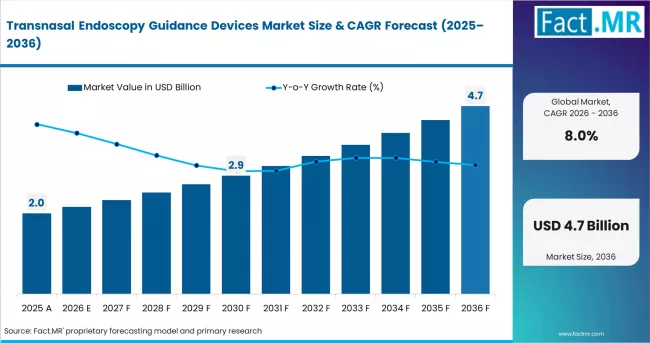
Transnasal Endoscopy Guidance Devices Market Value Analysis | Source: Fact.MR
Summary of Transnasal Endoscopy Guidance Devices Market
- Market Definition
- The market includes guidance-enabled transnasal endoscopic devices used for minimally invasive GI, ENT, and airway diagnostics across hospital, ambulatory, and office-based settings globally.
- Demand Drivers
- Rising demand for unsedated office-based GI screening is driving adoption of guidance-enabled flexible transnasal endoscopes among gastroenterologists and primary care settings.
- Hospital ENT departments are increasing transnasal diagnostic procedure volumes, creating structured procurement demand for imaging-assisted guidance modules.
- National colorectal and upper GI screening programmes in Asia and Europe are expanding eligible patient populations and driving device procurement through public health budgets.
- Key Segments Analyzed
- By Product Type: Guidance-enabled flexible transnasal endoscopes lead with 52% share in 2026 due to established clinical adoption and multi-indication utility.
- By Application: Gastrointestinal diagnostics leads with 50% share in 2026, driven by the highest procedure frequency across hospital and office-based settings.
- By End Use: Hospitals account for 60% share in 2026, supported by high procedure volumes and structured device procurement through group purchasing organisations.
- By Geography: India leads at 9.1% CAGR through 2036 driven by outpatient diagnostics expansion and private hospital infrastructure growth.
- Analyst Opinion at FACT.MR
- Shambhu Nath Jha, Principal Consultant at Fact.MR, opines, ‘CXOs will find the transnasal endoscopy guidance devices market pivoting toward disposable guidance systems and office-based protocols where site-of-care economics and reimbursement alignment define long-term commercial positioning.’
- Strategic Implications
- Invest in guidance-enabled disposable transnasal system development to capture the high-growth office-based and ambulatory surgical center segments.
- Build reimbursement and clinical evidence strategies targeting CMS and national payer coding updates for unsedated transnasal GI procedures.
- Establish distributor and procurement partnerships in high-growth India and China markets to capture private hospital and outpatient diagnostics expansion.
- Methodology
- Market sizing uses procedure volume data, device penetration rates, and average selling price benchmarks by product type and end-use setting.
- Analysis incorporates FDA 510(k), NMPA approvals, CMS reimbursement data, and ESGE and ASG clinical guideline inputs.
- Forecasts consider office-based procedure adoption rates, hospital capital procurement cycles, and national screening programme timelines.
| Metric | Value |
|---|---|
| Estimated Value in 2026 | USD 2.1 billion |
| Forecast Value in 2036 | USD 4.7 billion |
| Forecast CAGR (2026 to 2036) | 8.0% |
Source: Fact.MR analysis. Updated Apr 22, 2026
The market is projected to generate USD 2.5 billion in absolute opportunity between 2026 and 2036. Growth is transformational in nature. Expansion is driven by the shift to unsedated, office-based GI screening. Minimally invasive ENT diagnostics are also supporting demand. Reimbursement gaps in emerging markets remain a constraint. High device qualification cycles continue to slow adoption in cost-sensitive hospital procurement.
At the country level, India leads with 9.1% CAGR through 2036. Growth is driven by outpatient diagnostics expansion and private hospital investment. China follows at 8.6%, supported by hospital construction and rising ENT procedure volumes. The United States records 7.8%, driven by adoption of office-based minimally invasive diagnostics. Germany grows at 7.5%, supported by advanced ENT uptake and ageing population screening demand. Japan records 7.2%, driven by high technology adoption and strong diagnostic utilisation rates.
Segmental Analysis
Transnasal Endoscopy Guidance Devices Market Analysis by Product Type
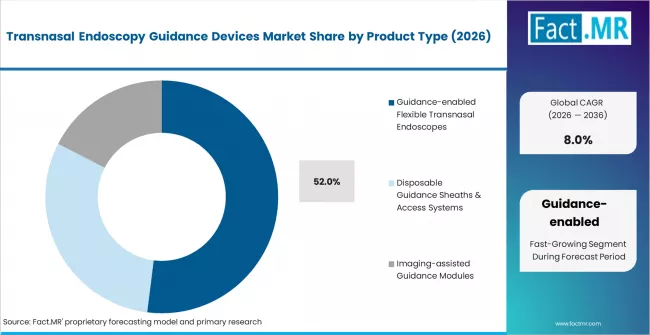
Transnasal Endoscopy Guidance Devices Market Analysis By Product Type | Source: Fact.MR
Guidance-enabled flexible transnasal endoscopes hold 52% share in 2026. The segment leads due to strong integration into GI and ENT workflows. It supports multi-indication use in unsedated outpatient procedures. Adoption is high across hospital and ambulatory settings.
- Olympus Investment: Olympus Corporation launched the TN-1000 system in 2024. The platform targets hospital and ambulatory use. It offers improved guidance integration and HD imaging. Focus is on unsedated upper GI procedures. [1]
- FUJIFILM Development: FUJIFILM expanded the Eluxeo platform in 2025. AI-assisted lesion detection modules were introduced. Systems are used in GI screening and ENT diagnostics. [2]
- Disposable Growth Trend: Single-use adoption is rising in outpatient settings. Office-based procedures increased disposable usage by 22% in 2024. Transnasal disposable guidance systems are among the fastest-growing segments. [3]
Transnasal Endoscopy Guidance Devices Market Analysis by Application
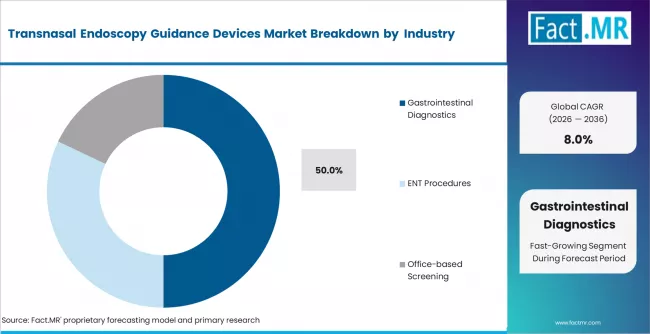
Transnasal Endoscopy Guidance Devices Market Analysis By Application | Source: Fact.MR
Gastrointestinal diagnostics hold 50% share in 2026. The segment leads due to high procedure frequency. Demand spans hospital and office-based settings. Unsedated transnasal endoscopy is gaining acceptance as a primary diagnostic option.
- Boston Scientific Investment: Boston Scientific expanded its access portfolio in 2024. Investment focuses on transnasal systems. Target is rising demand in ambulatory GI diagnostics. [4]
- Karl Storz Innovation: Karl Storz launched a hybrid guidance system in 2025. It integrates 4K imaging and real-time navigation. Applications include ENT and sinonasal diagnostics. [5]
- Screening Expansion Trend: Guideline updates are expanding procedure settings. Unsedated transnasal endoscopy is now a first-line option in primary care. Adoption is increasing beyond hospitals. [6]
Drivers, Restraints, and Opportunities
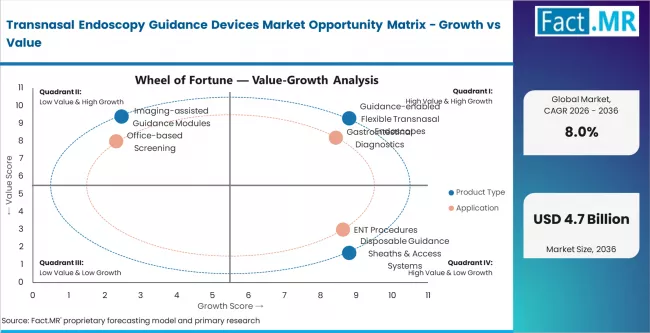
Transnasal Endoscopy Guidance Devices Market Opportunity Matrix Growth Vs Value | Source: Fact.MR
Fact.MR analysis indicates the market has shifted beyond hospital-only use. Adoption is expanding across clinics and ambulatory centers. Reimbursement and guideline support are driving growth.
Sedated hospital procedures are stabilising. Demand is shifting to unsedated outpatient protocols. Disposable guidance systems carry 15–25% price premiums. Lower sedation and facility costs offset device pricing. Overall procedure economics are improving.
- Office-based Reimbursement Expansion: Reimbursement support is accelerating adoption. Updated CPT codes in 2024 recognised unsedated procedures. Payments now include office-based GI diagnostics. This supports outpatient system adoption.
- Asia Pacific Diagnostic Capacity Investment: Healthcare infrastructure expansion is increasing demand. India and China are investing in outpatient diagnostics. Flexible transnasal systems are being adopted in tier-2 and tier-3 cities. Demand is linked to rising patient volumes.
- ESGE Guideline Adoption: Updated guidelines support wider adoption. Unsedated transnasal endoscopy is endorsed as first-line screening. Pentax Medical and FUJIFILM are aligning products with guidelines. Procurement is expanding across outpatient settings.
Regional Analysis
The transnasal endoscopy guidance devices market is assessed across Asia Pacific, North America, Europe, Latin America, and Middle East and Africa, covering 40+ countries with demand shaped by endoscopy procedure volumes, reimbursement structures, national screening programmes, and outpatient diagnostic capacity investment. The full report provides market attractiveness analysis by region and country.
.webp "Top Country Growth Comparison Transnasal Endoscopy Guidance Devices Market Cagr (2026 2036)")
Top Country Growth Comparison Transnasal Endoscopy Guidance Devices Market Cagr (2026 2036) | Source: Fact.MR
| Country | CAGR (2026–2036) |
|---|---|
| India | 9.1% |
| China | 8.6% |
| United States | 7.8% |
| Germany | 7.5% |
| Japan | 7.2% |
Source: Fact.MR analysis. Updated Apr 22, 2026
Source: Fact.MR (FACT.MR) analysis, based on proprietary forecasting model and primary research
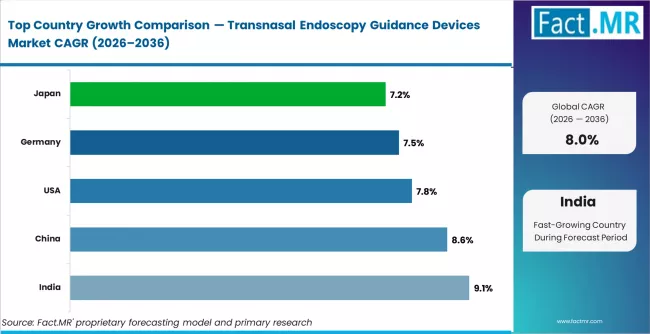
Transnasal Endoscopy Guidance Devices Market Cagr Analysis By Country | Source: Fact.MR
Asia Pacific Transnasal Endoscopy Guidance Devices Market Analysis
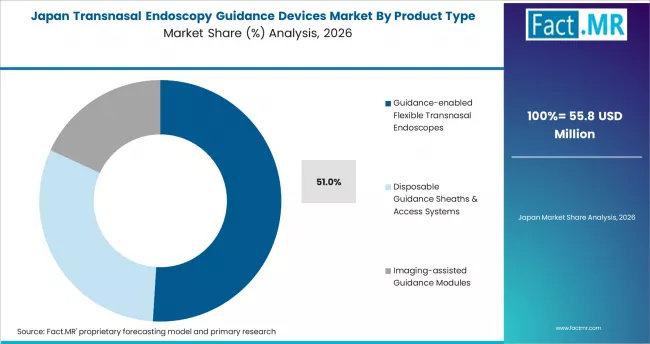
Transnasal Endoscopy Guidance Devices Market Japan Market Share Analysis By Product Type | Source: Fact.MR
Asia Pacific is the fastest-growing region. Outpatient diagnostics and hospital expansion are driving demand. India and China are the key growth markets. Olympus Corporation and FUJIFILM lead through distributor networks and training programmes. The region is shifting toward higher-specification guidance-enabled platforms.
- India: Outpatient infrastructure expansion is accelerating adoption. Growth is projected at 9.1% CAGR through 2036. Ayushman Bharat funding in 2024 supported district hospital upgrades. This enabled first-time procurement of transnasal systems. Apollo Hospitals expanded GI diagnostics in 2024. Unsedated transnasal procedures were added to outpatient services. Rising ENT demand in private clinics is supporting guidance module uptake. Growth is driven by institutional investment and expanding diagnostic access.
- China: Hospital expansion is increasing procedure volumes. Growth is projected at 8.6% CAGR through 2036. Over 500 county hospitals added endoscopy units by 2024. This created structured procurement demand. NMPA updated approval timelines in 2024, reducing entry barriers. ENT volumes are rising due to urbanisation and pollution-linked conditions. Growth is supported by public health investment and reimbursement expansion.
- Japan: Stable reimbursement is supporting consistent demand. Growth is projected at 7.2% CAGR through 2036. National insurance covers transnasal procedures. FUJIFILM received approval for updated systems in 2025. Olympus Corporation expanded training programmes in 2024. Adoption is increasing across community clinics. Growth is driven by screening utilisation and technology upgrades.
Fact.MR’s analysis of Asia Pacific covers India, China, Japan, South Korea, and ASEAN. Includes procedure volumes, reimbursement data, and regulatory timelines.
North America Transnasal Endoscopy Guidance Devices Market Analysis
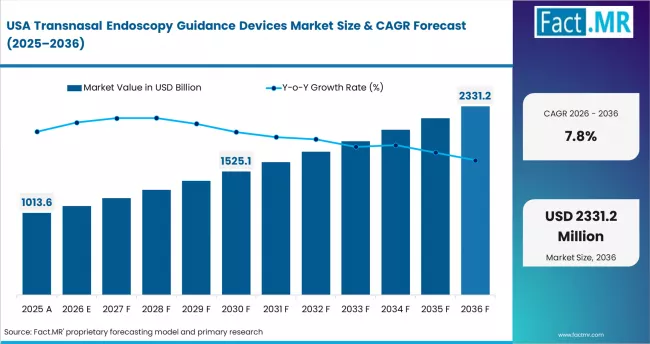
Transnasal Endoscopy Guidance Devices Market Country Value Analysis | Source: Fact.MR
North America is the largest value market. Demand is driven by ambulatory care expansion and reimbursement clarity. Minimally invasive diagnostics are widely adopted. Boston Scientific, Medtronic, and Olympus Corporation lead supply.
- United States: Office-based procedure migration is accelerating demand. Growth is projected at 7.8% CAGR through 2036. CMS updated reimbursement codes in 2024 for unsedated procedures. This enabled direct billing in outpatient settings. Medtronic expanded its GI portfolio through a 2024 agreement. Guidelines in 2025 supported broader clinical adoption. Growth is driven by reimbursement clarity and practice-level uptake.
Fact.MR’s analysis of North America covers the United States, Canada, and Mexico. Includes reimbursement trends, ambulatory adoption, and procurement dynamics.
Europe Transnasal Endoscopy Guidance Devices Market Analysis
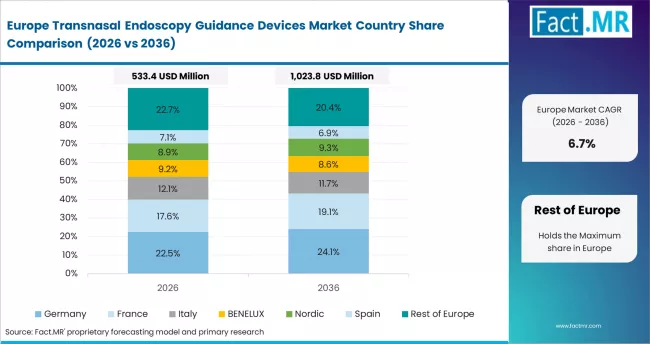
Transnasal Endoscopy Guidance Devices Market Europe Country Market Share Analysis, 2026 & 2036 | Source: Fact.MR
Europe is a compliance-driven and guideline-led market. ESGE guidelines and MDR standards define procurement. Pentax Medical and Karl Storz lead supply. Certified product portfolios support adoption.
- Germany: Regulatory compliance is driving procurement cycles. Growth is projected at 7.5% CAGR through 2036. MDR enforcement in 2024 required re-certification of devices. This triggered replacement demand in hospitals. Clinical guidelines support unsedated transnasal use. Karl Storz benefited from domestic preference in tenders. Growth is linked to compliance refresh and clinical adoption.
Fact.MR’s analysis of Europe covers Germany, France, the UK, Italy, and Spain. Includes MDR impact, procurement cycles, and guideline adoption trends.
Competitive Aligners for Market Players
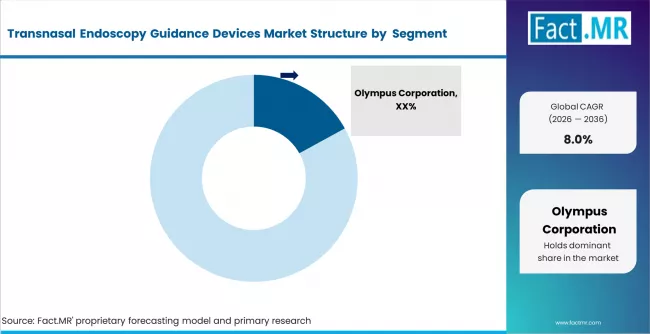
Transnasal Endoscopy Guidance Devices Market Analysis By Company | Source: Fact.MR
The competitive landscape of the transnasal endoscopy guidance devices market is shaped by a combination of technology capability, clinical acceptance, and access to care settings. A small group of global players, including Olympus Corporation, FUJIFILM, Boston Scientific, Medtronic, and Karl Storz, maintain strong positions due to their established endoscopy portfolios and global distribution reach. Their advantage lies in integrating imaging, guidance, and workflow compatibility into a single platform that clinicians already trust.
Competition is increasingly centered on ease of use and adaptability to non-hospital settings. As procedures shift toward clinics and ambulatory centers, devices must support unsedated protocols, faster turnaround times, and simplified operation. Companies that can offer compact systems with intuitive guidance features are better positioned to capture this shift. Disposable and hybrid systems are also becoming important, especially where infection control and operational efficiency are priorities.
Another key factor is clinical validation. Hospitals and outpatient providers require strong evidence of safety, diagnostic accuracy, and patient comfort before adopting new systems. This creates a barrier for smaller or newer entrants. Established companies benefit from long-standing relationships with clinicians and the ability to support training and post-installation services. Procurement decisions are also influenced by reimbursement alignment and total procedure cost. Providers are increasingly evaluating not just device pricing, but overall efficiency gains from reduced sedation and shorter procedure times. As a result, players that can demonstrate both clinical and economic value are gaining traction, while those focused only on hardware sales face increasing pressure.
Key Players
- Olympus Corporation
- FUJIFILM Holdings Corporation
- HOYA Corporation (Pentax Medical)
- Karl Storz SE & Co. KG
- Boston Scientific Corporation
- Medtronic plc
Bibliography
- [1] Olympus Corporation. TN-1000 Transnasal Endoscopy System Product Launch. 2024. olympus-global.com/medical
- [2] FUJIFILM Holdings Corporation. Eluxeo Transnasal Platform Expansion with AI-assisted Guidance Modules. January 2025. fujifilm.com/us/en/healthcare
- [3] American Society for Gastrointestinal Endoscopy. Single-use Endoscope Adoption Survey Report 2024. November 2024. asge.org
- [4] Boston Scientific Corporation. GI Transnasal Access System Development Programme Disclosure. 2024. bostonscientific.com/investor-relations
- [5] Karl Storz SE & Co. KG. ENT Transnasal Rigid-Flexible Hybrid Guidance System with 4K Imaging Launch. 2025. karlstorz.com
- [6] European Society of Gastrointestinal Endoscopy. Updated Upper GI Screening Guidelines Including Unsedated Transnasal Endoscopy as First-line Option. 2024. esge.com
This Report Addresses
- Strategic intelligence on transnasal endoscopy guidance device demand across hospital, ambulatory surgical center, and office-based diagnostic settings globally.
- Market forecast from USD 2.1 billion in 2026 to USD 4.7 billion by 2036 at a CAGR of 8.0%.
- Growth opportunity mapping across India outpatient diagnostics expansion, China hospital procurement programmes, US CMS reimbursement-driven office adoption, Germany MDR compliance procurement, and Japan national screening utilisation.
- Segment analysis by product type (flexible endoscopes, disposable sheaths, imaging modules), application (GI diagnostics, ENT, office-based screening), and end use (hospitals, ASCs, clinics).
- Regional outlook covering Asia Pacific outpatient diagnostic infrastructure growth, North America office-based procedure reimbursement, and Europe MDR and ESGE guideline-driven device adoption.
- Competitive analysis of Olympus Corporation, FUJIFILM, HOYA/Pentax Medical, Karl Storz, Boston Scientific, and Medtronic. Focus on guidance integration, clinical training ecosystems, and disposable platform development.
- Regulatory impact analysis covering CMS reimbursement coding updates, ESGE clinical guideline revisions, FDA 510(k) clearance pipeline, MDR 2017/745 compliance requirements, and NMPA transnasal device approval pathways.
- Report delivered in PDF, Excel datasets, and presentation formats. Supported by primary interviews, procedure volume data, reimbursement coding databases, and endoscopy society publication benchmarks.
Transnasal Endoscopy Guidance Devices Market Definition
The market covers endoscopic guidance devices used in transnasal procedures for gastrointestinal, ENT, and airway diagnostics. Includes guidance-enabled flexible endoscopes, disposable access sheaths, and imaging-assisted modules.
Transnasal Endoscopy Guidance Devices Market Inclusions
Covers global and regional forecasts from 2026 to 2036. Includes product type, application, and end-use segment breakdowns. Covers hospitals, ambulatory surgical centers, and clinics. Includes reimbursement trends, regulatory approval data, and office-based procedure adoption.
Transnasal Endoscopy Guidance Devices Market Exclusions
Excludes standard flexible and rigid gastrointestinal endoscopes without transnasal guidance capability. Omits downstream consumables such as biopsy forceps and irrigation tubes. Also excludes robotic endoscopy platforms and capsule endoscopy systems outside transnasal access protocols.
Transnasal Endoscopy Guidance Devices Market Research Methodology
- Primary Research
- Interviews with gastroenterologists, ENT surgeons, endoscopy suite procurement managers, and ambulatory care directors across key procedure markets.
- Desk Research
- Uses FDA 510(k) clearance data, CMS reimbursement updates, ESGE and ASG clinical guidelines, and company disclosures from Olympus, FUJIFILM, and Karl Storz (2024–2025).
- Market-Sizing and Forecasting
- Hybrid model using procedure volume data by indication, device penetration rates, and average selling prices by product type across end-use settings.
- Data Validation and Update Cycle
- Validated through procedure registry data, reimbursement coding databases, and expert interviews. Cross-checked with clinical association guidelines. Updated annually.
Segmentation
Scope of Report
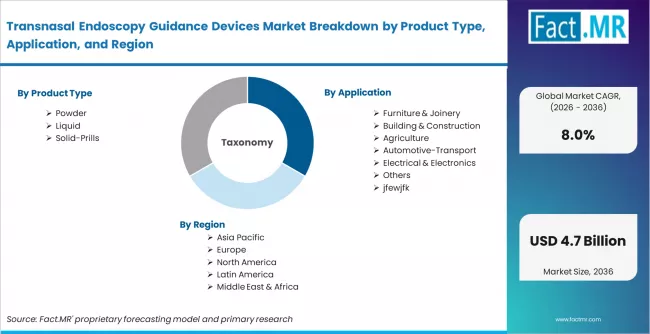
Transnasal Endoscopy Guidance Devices Market Breakdown By Product Type, Application, And Region | Source: Fact.MR
| Attribute | Details |
|---|---|
| Quantitative Units | USD 2.0 billion (2026) to USD 4.4 billion (2036), at a CAGR of 8.0% |
| Market Definition | Guidance-enabled endoscopic devices for transnasal GI, ENT, and airway diagnostics, including flexible endoscopes, disposable sheaths, and imaging-assisted modules used in hospital, ambulatory, and office-based settings. |
| Product Type Segmentation | Guidance-enabled Flexible Transnasal Endoscopes, Disposable Guidance Sheaths & Access Systems, Imaging-assisted Guidance Modules |
| Application Segmentation | Gastrointestinal Diagnostics, ENT Procedures, Office-based Screening |
| End Use Segmentation | Hospitals, Ambulatory Surgical Centers, Clinics |
| Application Coverage | Unsedated upper GI screening, ENT nasal and laryngeal diagnostics, office-based Barrett's surveillance, sinonasal assessment, and airway evaluation in outpatient and ambulatory settings. |
| Regions Covered | North America, Europe, Asia Pacific, Latin America, Middle East and Africa |
| Countries Covered | USA, Canada, Mexico, Germany, UK, France, Italy, Spain, Nordic, BENELUX, China, Japan, South Korea, India, ASEAN, Australia and New Zealand, Brazil, Argentina, Saudi Arabia, GCC, Turkey, South Africa, Rest of MEA |
| Key Companies Profiled | Olympus Corporation, FUJIFILM, HOYA Corporation (Pentax Medical), Karl Storz, Boston Scientific, Medtronic |
| Forecast Period | 2026 to 2036 |
| Approach | Hybrid top-down and bottom-up model using endoscopy procedure volumes by indication and setting, device penetration rates by product type, average selling prices, reimbursement coding data, and primary interviews with gastroenterologists, ENT surgeons, and procurement managers. |
Source: Fact.MR analysis. Updated Apr 22, 2026
Transnasal Endoscopy Guidance Devices Market by Segments
-
By Product Type:
- Guidance-enabled Flexible Transnasal Endoscopes
- Disposable Guidance Sheaths & Access Systems
- Imaging-assisted Guidance Modules
-
By Application:
- Gastrointestinal Diagnostics
- ENT Procedures
- Office-based Screening
-
By End Use:
- Hospitals
- Ambulatory Surgical Centers
- Clinics
-
By Region:
- North America
- United States
- Canada
- Mexico
- Latin America
- Brazil
- Mexico
- Argentina
- Chile
- Rest of Latin America
- Western Europe
- Germany
- United Kingdom
- France
- Italy
- Spain
- Nordic Countries
- BENELUX
- Rest of Western Europe
- Eastern Europe
- Russia
- Poland
- Hungary
- Balkan and Baltic
- Rest of Eastern Europe
- East Asia
- China
- Japan
- South Korea
- South Asia and Pacific
- India
- ASEAN
- Australia and New Zealand
- Rest of South Asia and Pacific
- Middle East and Africa
- Kingdom of Saudi Arabia
- Other GCC Countries
- Turkey
- South Africa
- Rest of Middle East and Africa
- North America
Frequently Asked Questions
How large is the global transnasal endoscopy guidance devices market in 2025?
What will the market size be in 2026?
What is the projected market size by 2036?
What is the expected CAGR from 2026 to 2036?
Which product type segment is poised to lead the market?
Which application segment holds the largest share?
Which end-use segment dominates?
Which country shows the fastest growth?
What is driving demand for transnasal endoscopy guidance devices?
What is the key challenge in this market?
Who worked on this report


Preview the report firsthand - request a free sample
Free SampleGet the brochure for pricing and purchase details
Download PDF