- Market Value (2025): USD 1.4 Bn
- Estimated Value (2026): USD 1.5 Bn
- Forecast Value (2036): USD 2.8 Bn
- CAGR (2026-2036): 6.6%
What is the Baby Nasal Aspirator Market forecast to be worth by 2036?
USD 1.5 billion in 2026 to USD 2.8 billion by 2036, at a 6.6% CAGR.
The parent purchase case sits close to Fact.MR's Baby Care Products Market, because aspirators compete inside a broader basket of infant health and hygiene items.
- The baby nasal aspirator market reached USD 1.4 billion in 2025 as parents and medical-device suppliers spent against a clear use case: safe removal of infant nasal mucus when babies cannot clear congestion themselves.
- Demand is projected to increase from USD 1.5 billion in 2026 to USD 2.8 billion by 2036, at a 6.6% CAGR.
- The market is forecast to record a 6.6% CAGR from 2026 to 2036. Demand is tied to safer, easier mucus removal for infants who cannot clear congestion themselves.
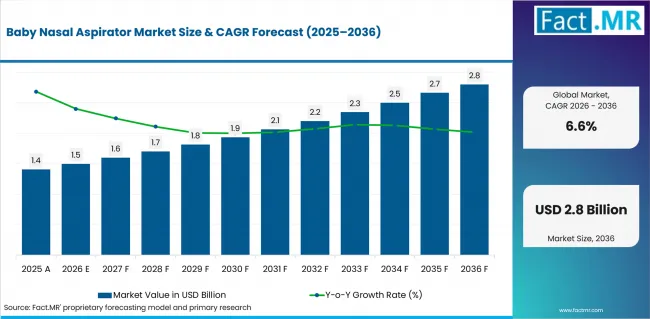
Baby Nasal Aspirator Market Value Analysis | Source: Fact.MR
What are the defining numbers behind Baby Nasal Aspirator Market growth?
USD 1.3 billion absolute opportunity is expected by 2036.
Safety messaging can be read beside Fact.MR's Baby Monitor Market, since parents apply similar trust checks before buying devices used around infants.
- Demand Drivers in the Market
- Electric nasal aspirators lead as they reduce the physical effort and uncertainty associated with manual suction. Parents pay for controlled suction, softer tips and easier cleaning.
- Household use leads because most congestion care happens before feeding, sleep or routine home care. Clinics influence guidance, but parents make the repeat purchase decision.
- Newborns remain a key end-user group because they cannot blow their nose and require gentle mucus clearance. This makes safety, suction control and tip softness central to product acceptance.
- Online retail leads because parents compare reviews, cleaning steps, suction levels, replacement tips and safety claims before buying, especially during cold and flu periods.
- Key Segments Analyzed
- By Product Type: Electric Nasal Aspirators is projected to hold 37.6% share in 2026. Electric nasal aspirators lead as they offer controlled suction and reduce the learning curve for parents who are uncomfortable with bulb or oral suction.
- By Application: Household Use is projected to hold 30.1% share in 2026. Household use leads because congestion care usually happens before feeding, sleep or routine home care.
- By End User: Newborns is projected to hold 29.7% share in 2026. Newborns lead as small nasal passages and limited ability to clear mucus make gentle aspiration more relevant in early infancy.
- By Distribution Channel: Online Retail is projected to hold 29.7% share in 2026. Online retail leads because parents compare device safety, suction levels, cleaning design and reviews before purchasing.
- By Material: Medical-Grade Silicone is projected to hold 37.6% share in 2026. Medical-grade silicone leads because soft, cleanable contact parts are important for infant comfort, hygiene and repeated use.
- Analyst Opinion at Fact.MR
- Shambhu Nath Jha, Sr. Consultant at Fact.MR, opines, "Baby nasal aspirators are bought in moments of parental concern. The market grows when the product feels gentle, hygienic and easy to use, while still staying within clear pediatric-care guidance."
- Strategic Implications
- Brands should show suction levels, age guidance, cleaning steps and replacement-part availability in plain language.
- Retailers should separate routine congestion care from clinical respiratory products so parents do not overread the claim.
- Companies should treat soft tips, sealed motors and cleanable parts as core product proof rather than minor accessories.
USA continues to be a leading market and is projected to grow at a CAGR of 8.61%; other key markets include Japan, Germany, UK, Canada, South Korea and Australia.
How does the Baby Nasal Aspirator Market break down by segment?
Electric Nasal Aspirators leads Product Type at 37.6%.
Respiratory concern also links to Fact.MR's Baby Breathing Monitor Market, although aspirators remain a home-care product for nasal congestion.
Why does Electric Nasal Aspirators lead Product Type?
Electric Nasal Aspirators is projected to account for 37.6% share in 2026.
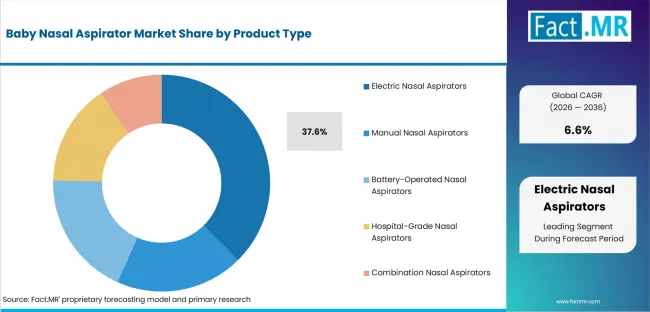
Baby Nasal Aspirator Market Analysis By Product Type | Source: Fact.MR
Electric nasal aspirators lead as they offer controlled suction and reduce the learning curve for parents who are uncomfortable with bulb or oral suction.
Why does Household Use lead Application?
Household Use is projected to account for 30.1% share in 2026.
Household use leads because parents usually clear congestion before feeding, sleep and routine home care, while clinics mainly influence guidance.
Why does Newborns lead End User?
Newborns is projected to account for 29.7% share in 2026.
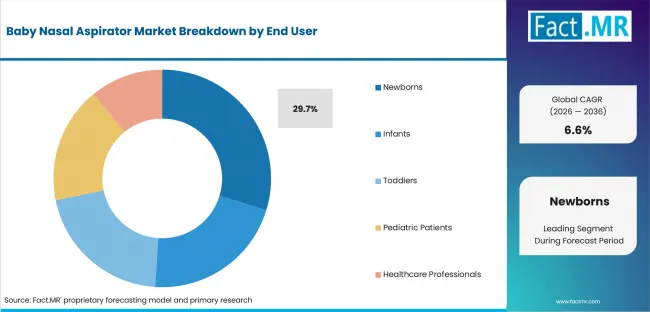
Baby Nasal Aspirator Market Analysis By End User | Source: Fact.MR
Newborns lead as small nasal passages and limited ability to clear mucus make gentle aspiration more relevant in early infancy.
Why does Online Retail lead Distribution Channel?
Online Retail is projected to account for 29.7% share in 2026.
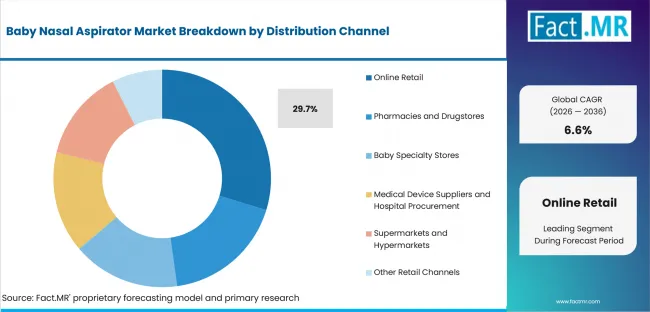
Baby Nasal Aspirator Market Analysis By Distribution Channel | Source: Fact.MR
Online retail leads because parents compare device safety, suction levels, cleaning design and reviews before purchasing.
Why does Medical-Grade Silicone lead Material?
Medical-Grade Silicone is projected to account for 37.6% share in 2026.
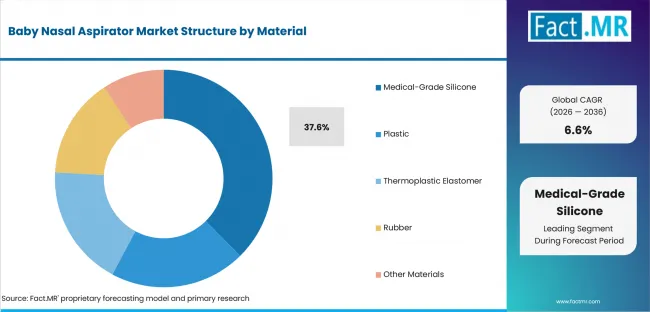
Baby Nasal Aspirator Market Analysis By Material | Source: Fact.MR
Medical-grade silicone leads because soft, cleanable contact parts are important for infant comfort, hygiene and repeated use.
What is accelerating Baby Nasal Aspirator Market adoption, and what is holding it back?
Adoption is strongest where caregivers can see gentle suction, clear cleaning steps and age-appropriate use guidance. Over-suctioning concerns, low-cost manual alternatives and hygiene burden slow trade-up.
Retail placement should connect with Fact.MR's Baby Personal Care Market, where caregivers compare hygiene products by ease of use and material safety.
Drivers Impact Analysis
| DRIVER | QUALITATIVE RELEVANCE | GEOGRAPHIC RELEVANCE | IMPACT TIMELINE |
|---|---|---|---|
| Controlled electric suction | High | South Korea | Short term (<=2 years) |
| Household congestion care | High | USA | Short term (<=2 years) |
| Newborn comfort and feeding support | Moderate | Canada | Medium term (2-4 years) |
| Online review-led product comparison | Selective | Germany | Medium term (2-4 years) |
Source: Fact.MR analysis. Updated Jul 30, 2026
- Controlled electric suction: Electric nasal aspirators lead as they reduce the physical effort and uncertainty associated with manual suction. Parents pay for controlled suction, softer tips and easier cleaning.
- Household congestion care: Household use leads because most congestion care happens before feeding, sleep or routine home care. Clinics influence guidance, but parents make the repeat purchase decision.
- Newborn comfort and feeding support: Newborns remain a key end-user group because they cannot blow their nose and require gentle mucus clearance. This makes safety, suction control and tip softness central to product acceptance.
- Online review-led product comparison: Online retail leads because parents compare reviews, cleaning steps, suction levels, replacement tips and safety claims before buying, especially during cold and flu periods.
Opportunity Impact Analysis
| OPPORTUNITY | QUALITATIVE RELEVANCE | GEOGRAPHIC RELEVANCE | IMPACT TIMELINE |
|---|---|---|---|
| Rechargeable washable designs | High | South Korea | Medium term (2-4 years) |
| Saline and replacement-tip bundles | Moderate | USA | Medium term (2-4 years) |
| Pediatric and pharmacy education | Selective | Canada | Medium term (2-4 years) |
Source: Fact.MR analysis. Updated Jul 30, 2026
- Rechargeable washable designs: Rechargeable devices with washable parts can gain share when cleaning is simpler than bulb syringes.
- Saline and replacement-tip bundles: Bundles with saline drops, replacement tips and storage cases can raise basket value while improving correct use.
- Pediatric and pharmacy education: Pharmacy and pediatric-channel education can reduce misuse and position aspirators as a safe support product, not a cure for illness.
Restraints Impact Analysis
| RESTRAINT | QUALITATIVE RELEVANCE | GEOGRAPHIC RELEVANCE | IMPACT TIMELINE |
|---|---|---|---|
| Over-suctioning and misuse concern | High | South Korea | Short term (<=2 years) |
| Low-cost manual alternatives | Moderate | USA | Medium term (2-4 years) |
| Cleaning and hygiene burden | Selective | Canada | Medium term (2-4 years) |
Source: Fact.MR analysis. Updated Jul 30, 2026
- Over-suctioning and misuse concern: Over-suctioning concern can reduce pediatric trust if instructions are vague or parents use the product too frequently.
- Low-cost manual alternatives: Low-cost manual aspirators and bulb syringes limit trade-up unless electric devices clearly improve comfort and cleaning.
- Cleaning and hygiene burden: Hygiene worries around mucus contact parts can hurt repeat use when products are hard to disassemble or sanitize.
Which countries are scaling Baby Nasal Aspirator Market fastest?
Country rates show where buying conditions and supplier proof are already stronger.
Clinical settings are adjacent to Fact.MR's Neonatal Infant Care Market, but the aspirator report keeps its scope on devices bought for everyday congestion relief.
- South Korea: The market is expected to grow at a CAGR of 5.31% from 2026 to 2036. South Korea's demand is supported by premium baby-care buying, online comparison and parental interest in compact electric devices.
- USA: The market is expected to grow at a CAGR of 8.61% from 2026 to 2036. USA growth is shaped by pediatric guidance, strong DTC baby-care brands and pharmacy availability during cold and flu periods.
- Canada: The market is expected to grow at a CAGR of 5.93% from 2026 to 2036. Canada follows similar household-care patterns, with buyers placing weight on safety claims, cleaning and replacement parts.
- Germany: The market is expected to grow at a CAGR of 7.30% from 2026 to 2036. Germany's adoption is steadier because parents and pharmacies scrutinize safety documentation and hygiene design.
- Australia: The market is expected to grow at a CAGR of 4.65% from 2026 to 2036. Australia benefits from online baby-care retail and seasonal respiratory demand, but consumers remain sensitive to product durability.
- UK: The market is expected to grow at a CAGR of 6.61% from 2026 to 2036. UK demand is tied to baby-care retail, pharmacy advice and household congestion routines, with trade-up depending on ease of cleaning.
- Japan: The market is expected to grow at a CAGR of 7.91% from 2026 to 2036. Japan favors compact, quiet and gentle devices. Product footprint and soft-contact materials matter strongly in purchase evaluation.
The full report provides country-level CAGR analysis across North America, Latin America, Europe, East Asia, South Asia and Oceania, and the Middle East and Africa.
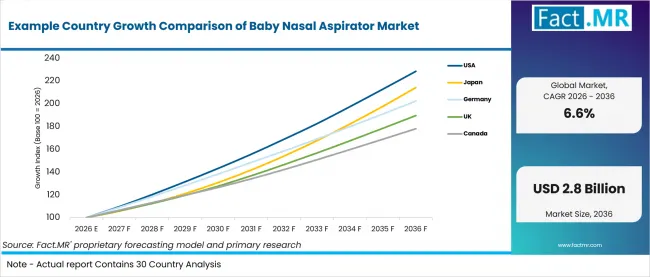
Example Country Growth Comparison Of Baby Nasal Aspirator Market | Source: Fact.MR
| Country | CAGR (2026-2036) |
|---|---|
| South Korea | 5.31% |
| USA | 8.61% |
| Canada | 5.93% |
| Germany | 7.30% |
| Australia | 4.65% |
| UK | 6.61% |
| Japan | 7.91% |
Source: Fact.MR analysis. Updated Jul 30, 2026
What is shaping South Korea's outlook through 2036?
5.31% CAGR from 2026 to 2036.
South Korea's demand is supported by premium baby-care buying, online comparison and parental interest in compact electric devices.
What is shaping USA's outlook through 2036?
8.61% CAGR from 2026 to 2036.
USA growth is shaped by pediatric guidance, strong DTC baby-care brands and pharmacy availability during cold and flu periods.
What is shaping Canada's outlook through 2036?
5.93% CAGR from 2026 to 2036.
Canada follows similar household-care patterns, with buyers placing weight on safety claims, cleaning and replacement parts.
What is shaping Germany's outlook through 2036?
7.30% CAGR from 2026 to 2036.
Germany's adoption is steadier because parents and pharmacies scrutinize safety documentation and hygiene design.
What is shaping Australia's outlook through 2036?
4.65% CAGR from 2026 to 2036.
Australia benefits from online baby-care retail and seasonal respiratory demand, but consumers remain sensitive to product durability.
Who leads the Baby Nasal Aspirator Market?
FridaBaby; Graco Children's Products; Nosiboo; Pigeon Corporation are among the visible providers in the baby nasal aspirator market.
FridaBaby and Graco Children's Products are among the most visible providers. Competition is shaped by product proof, channel access and buyer trust.
Between 2026 and 2036, market rivalry is likely to center on clearer positioning around Electric Nasal Aspirators, stronger documentation and better support at the point of purchase.
Which companies are the key providers?
Key companies include FridaBaby; Graco Children's Products; Nosiboo; Pigeon Corporation; Beurer GmbH; Medline Industries, LP; AdvaCare Pharma; B-Arm Medical Technologies Pvt. Ltd..
- FridaBaby
- Graco Children's Products
- Nosiboo
- Pigeon Corporation
- Beurer GmbH
- Medline Industries, LP
- AdvaCare Pharma
- B-Arm Medical Technologies Pvt. Ltd.
Bibliography
- American Academy of Pediatrics, Newborn Nasal Congestion.
- AAP News, Clearing up Congestion in Infants.
- U.S. FDA, 510(k) Baby Nasal Aspirator BN002.
- U.S. FDA, 510(k) Electronic Nasal Aspirator.
- Nationwide Children's Hospital, Suctioning the Nose with a Bulb Syringe.
- Fact.MR, Baby Care Products Market.
This Report Answers
- The report provides strategic intelligence on the Baby Nasal Aspirator Market across segment choices that shape the 2026 market structure.
- Segment analysis covers Electric Nasal Aspirators and Household Use as the share leaders within the 2026 market.
- Country outlook evaluates the listed markets by CAGR and explains the adoption conditions in each country.
- Competitive analysis profiles the named providers and evaluates competition around product proof, channel access and buyer trust.
- Related coverage connects this report with adjacent baby-care and pediatric respiratory-care markets.
What does the Baby Nasal Aspirator Market cover?
The Baby Nasal Aspirator Market covers manual, electric, battery-operated, hospital-grade and combination nasal aspirators used for newborn, infant and toddler nasal mucus removal in household, pediatric-clinic, daycare, maternity and home-healthcare settings.
The Baby Nasal Aspirator Market covers manual, electric, battery-operated, hospital-grade and combination nasal aspirators used for newborn, infant and toddler nasal mucus removal in household, pediatric-clinic, daycare, maternity and home-healthcare settings.
Adjacent spending is included only when it is part of the same purchase decision or operating use case.
What is included in the scope?
The scope includes Product Type, Application, End User, Distribution Channel, Material and regional demand.
Coverage includes adjacent segment options only when they are purchased for the same defined market use.
What is excluded from the scope?
nebulizers, inhalers, humidifiers, general respiratory monitors, saline-only products and hospital suction systems not sold as baby nasal aspirators.
The scope excludes nebulizers, inhalers, humidifiers, general respiratory monitors, saline-only products and hospital suction systems not sold as baby nasal aspirators.
How Was the Analysis Built?
The analysis combines primary research with desk research focused on the baby nasal aspirator market, its segment structure and country-level demand.
- Primary Research: Interviews and validation discussions test buyer priorities, adoption barriers, pricing logic and operating requirements.
- Desk Research: The assessment reviews company disclosures, public datasets, regulatory material, technical literature and industry records relevant to the market.
- Market Sizing and Forecasting: Estimates combine top-down and bottom-up checks across demand signals, segment shares, country activity, company participation and adoption constraints.
- Data Validation and Update Cycle: Findings are validated against public evidence, company activity and country-level adoption patterns before final use.
Segmentation
What is the report's scope and coverage?
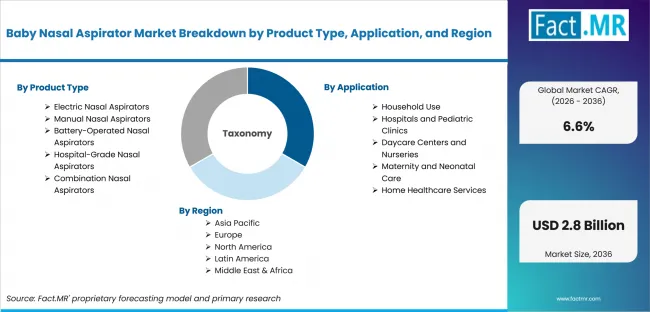
Baby Nasal Aspirator Market Breakdown By Product Type, Application, And Region | Source: Fact.MR
| Attribute | Details |
|---|---|
| Quantitative Units | USD 1.5 billion in 2026 to USD 2.8 billion by 2036, at a 6.6% CAGR. |
| Market Definition | Baby Nasal Aspirator Market covers manual, electric, battery-operated, hospital-grade and combination nasal aspirators used for newborn, infant and toddler nasal mucus removal in household, pediatric-clinic, daycare, maternity and home-healthcare settings. |
| Product Type | Electric Nasal Aspirators; Rechargeable Electric Aspirators; Corded Electric Aspirators; Manual Nasal Aspirators; Bulb Aspirators; Oral Suction Aspirators; Battery-Operated Nasal Aspirators; Standard Battery-Powered Aspirators; Automatic Battery-Powered Aspirators; Hospital-Grade Nasal Aspirators; Clinical Suction Aspirators; Professional Pediatric Aspirators; Combination Nasal Aspirators; Aspirator and Nasal Rinse Systems; Multi-Function Infant Nasal Care Devices |
| Application | Household Use; Newborn and Infant Home Care; Cold and Congestion Management; Hospitals and Pediatric Clinics; Pediatric Inpatient Care; Outpatient Pediatric Care; Daycare Centers and Nurseries; Infant Care Centers; Childcare Facilities; Maternity and Neonatal Care; Neonatal Care Units; Maternity and Postnatal Care; Home Healthcare Services; Home Nursing Services; Pediatric Home Healthcare |
| End User | Newborns; Term Newborns; Preterm Newborns; Infants; Young Infants; Older Infants; Toddlers; Young Toddlers; Older Toddlers; Pediatric Patients; Children with Respiratory Conditions; Children with Chronic Nasal Congestion; Healthcare Professionals; Pediatricians and Nurses; Home Healthcare Professionals |
| Distribution Channel | Online Retail; E-Commerce Marketplaces; Brand-Owned Direct-to-Consumer Websites; Pharmacies and Drugstores; Chain Pharmacies; Independent Pharmacies; Baby Specialty Stores; Baby Care Retail Chains; Specialty Infant Product Stores; Medical Device Suppliers and Hospital Procurement; Medical Device Distributors; Hospital and Clinic Procurement; Supermarkets and Hypermarkets; Supermarkets; Hypermarkets; Other Retail Channels; Department Stores; Convenience and Specialty Retailers |
| Material | Medical-Grade Silicone; Food-Grade Silicone; Medical-Grade Liquid Silicone; Plastic; PP Plastic; ABS Plastic; Thermoplastic Elastomer; Soft TPE Components; Medical-Grade TPE; Rubber; Natural Rubber; Synthetic Rubber; Other Materials; Stainless Steel Components; Hybrid Material Assemblies |
| Regions Covered | North America; Latin America; Europe; East Asia; South Asia and Oceania; Middle East and Africa |
| Countries Covered | South Korea; USA; Canada; Germany; Australia; UK; Japan |
| Key Companies Profiled | FridaBaby; Graco Children's Products; Nosiboo; Pigeon Corporation; Beurer GmbH; Medline Industries, LP; AdvaCare Pharma; B-Arm Medical Technologies Pvt. Ltd. |
| Forecast Period | 2026 to 2036 |
| Approach | Hybrid top-down and bottom-up assessment using demand indicators, segment mix, country growth, company participation and public evidence relevant to the category. |
Source: Fact.MR analysis. Updated Jul 30, 2026
How is the market segmented?
-
By Product Type:
- Electric Nasal Aspirators
- Rechargeable Electric Aspirators
- Corded Electric Aspirators
- Manual Nasal Aspirators
- Bulb Aspirators
- Oral Suction Aspirators
- Battery-Operated Nasal Aspirators
- Standard Battery-Powered Aspirators
- Automatic Battery-Powered Aspirators
- Hospital-Grade Nasal Aspirators
- Clinical Suction Aspirators
- Professional Pediatric Aspirators
- Combination Nasal Aspirators
- Aspirator and Nasal Rinse Systems
- Multi-Function Infant Nasal Care Devices
-
By Application:
- Household Use
- Newborn and Infant Home Care
- Cold and Congestion Management
- Hospitals and Pediatric Clinics
- Pediatric Inpatient Care
- Outpatient Pediatric Care
- Daycare Centers and Nurseries
- Infant Care Centers
- Childcare Facilities
- Maternity and Neonatal Care
- Neonatal Care Units
- Maternity and Postnatal Care
- Home Healthcare Services
- Home Nursing Services
- Pediatric Home Healthcare
-
By End User:
- Newborns
- Term Newborns
- Preterm Newborns
- Infants
- Young Infants
- Older Infants
- Toddlers
- Young Toddlers
- Older Toddlers
- Pediatric Patients
- Children with Respiratory Conditions
- Children with Chronic Nasal Congestion
- Healthcare Professionals
- Pediatricians and Nurses
- Home Healthcare Professionals
-
By Distribution Channel:
- Online Retail
- E-Commerce Marketplaces
- Brand-Owned Direct-to-Consumer Websites
- Pharmacies and Drugstores
- Chain Pharmacies
- Independent Pharmacies
- Baby Specialty Stores
- Baby Care Retail Chains
- Specialty Infant Product Stores
- Medical Device Suppliers and Hospital Procurement
- Medical Device Distributors
- Hospital and Clinic Procurement
- Supermarkets and Hypermarkets
- Supermarkets
- Hypermarkets
- Other Retail Channels
- Department Stores
- Convenience and Specialty Retailers
-
By Material:
- Medical-Grade Silicone
- Food-Grade Silicone
- Medical-Grade Liquid Silicone
- Plastic
- PP Plastic
- ABS Plastic
- Thermoplastic Elastomer
- Soft TPE Components
- Medical-Grade TPE
- Rubber
- Natural Rubber
- Synthetic Rubber
- Other Materials
- Stainless Steel Components
- Hybrid Material Assemblies
-
By Region:
- North America
- Latin America
- Europe
- East Asia
- South Asia and Oceania
- Middle East and Africa
Frequently Asked Questions
Which Product Type leads the market?
Which Application leads the market?
Which End User leads the market?
Which Distribution Channel leads the market?
Which Material leads the market?
Which country records the highest listed CAGR?
What is the primary driver in this market?
What is the main restraint?
Who worked on this report


Preview the report firsthand - request a free sample
Free SampleGet the brochure for pricing and purchase details
Download PDF