- Market Value (2025): USD 3.1 Bn
- Estimated Value (2026): USD 3.3 Bn
- Forecast Value (2036): USD 6.6 Bn
- CAGR (2026-2036): 7.2%
What is the Natural Fat Replacement Proteins Market forecast to be worth by 2036?
USD 3.3 billion in 2026 to USD 6.6 billion by 2036 at a 7.2% CAGR.
- The Natural Fat Replacement Proteins Market reached USD 3.1 billion in 2025.
- Demand is projected to increase from USD 3.3 billion in 2026 to USD 6.6 billion by 2036.
- The market is forecast to record a 7.2% CAGR from 2026 to 2036 as manufacturers use proteins to preserve lower-fat texture.
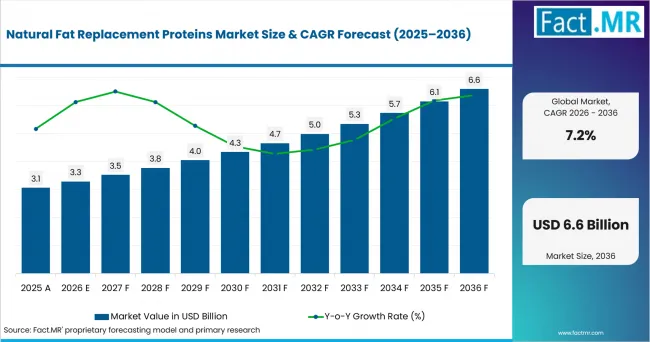
Natural Fat Replacement Proteins Market Value Analysis | Source: Fact.MR
What are the defining numbers behind Natural Fat Replacement Proteins Market growth?
An absolute opportunity of USD 3.3 billion is expected between 2026 and 2036.
- Demand Drivers in the Market
- Dairy companies use proteins to keep lower-fat products creamy and stable. The U.S. Department of Agriculture Economic Research Service reported on June 11, 2026, that inflation-adjusted U.S. food spending reached USD 2.51 trillion in 2025.
- Prepared-food companies use proteins to keep sauces and ready meals smooth after heating and storage. Proteins also help to maintain the product thickness after reheating and during large-scale production.
- Food companies use proteins to reduce calories and saturated fat without losing taste and texture. These proteins can also increase the protein content of the product.
- Key Segments Analyzed
- By Natural Protein Platform: Dairy protein is expected to hold a 37.0% share in 2026.
- By Replacement Mechanism: Microparticulation is projected to hold a 36.0% share in 2026 because small protein particles help to replace the smooth texture of fat.
- By Nutrition Position: Calorie reduction is expected to hold a 33.0% share in 2026.
- By Application: Dairy is estimated to hold a 29.0% share in 2026 because proteins help maintain texture in yogurt and dairy drinks.
- Analyst Opinion at Fact.MR
- Fact.MR Principal Consultant Shambhu Nath Jha states, “Fat-replacement proteins need to work well in the final product. Suppliers that test their proteins in different food products are more likely to get repeat orders.”
- Strategic Implications
- Dairy ingredient suppliers can test how their proteins affect texture in lower-fat yogurt and drinks during production.
- Plant-protein suppliers can reduce unwanted taste and rough texture. Clear mixing and heating instructions can help food companies choose the right protein.
- Food companies can test proteins at different heat and mixing levels before production. This also helps to maintain nutrition and texture during production and storage.
UK is expected to grow at 8.5% CAGR through 2036, owing to food and dairy production. Japan follows at 7.3% as processed-food production and dietary guidelines support lower-fat foods. The USA is expected to grow at 7.0% due to high dairy and foodservice use. Germany stands at 6.7%, owing to dairy and ready-meal production. France follows at 6.4% as demand is supports dairy and dessert production.
How does the Natural Fat Replacement Proteins Market break down by segment?
Dairy protein leads Natural Protein Platform at 37.0%; microparticulation leads Replacement Mechanism at 36.0%.
Which Natural Protein Platform dominates?
Dairy protein is expected to hold 37.0% share in 2026.
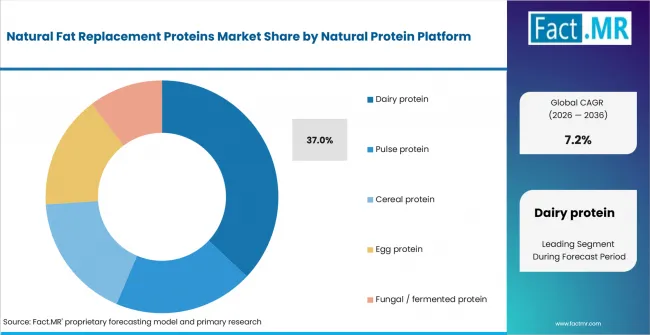
Natural Fat Replacement Proteins Market Analysis By Natural Protein Platform | Source: Fact.MR
Milk proteins make lower-fat foods creamy, smooth and stable. Pulse and cereal proteins offer choices for plant-based foods, and egg and fermented proteins improve texture. Small whey protein particles keep lower-fat dairy products smooth.
What leads the Replacement Mechanism segment?
Microparticulation is projected to account for 36.0% share in 2026.
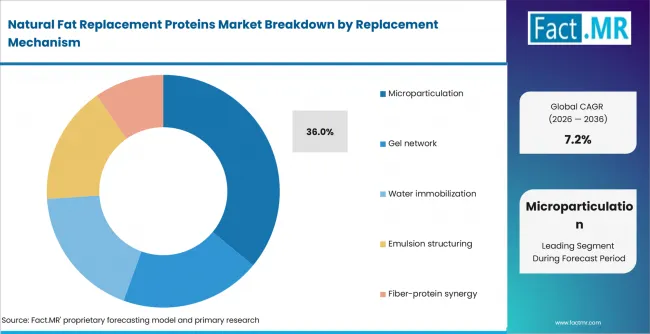
Natural Fat Replacement Proteins Market Analysis By Replacement Mechanism | Source: Fact.MR
Microparticulation stand out because it creates small protein particles that give food a creamy texture similar to fat. Protein gels add firmness, while water control maintains moisture. Emulsion systems keep ingredients mixed during processing.
How does Nutrition Position shape demand?
Calorie reduction is anticipated to capture 33.0% share in 2026.
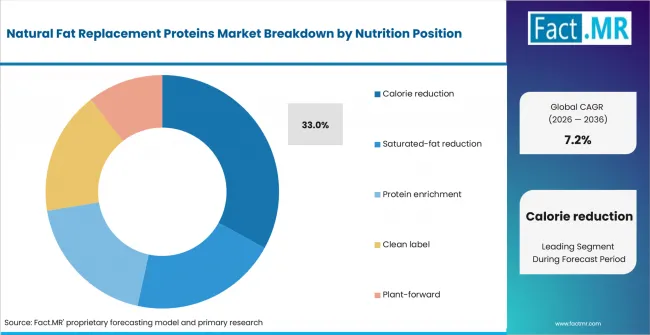
Natural Fat Replacement Proteins Market Analysis By Nutrition Position | Source: Fact.MR
Calorie reduction has the largest share as reducing fat can change the texture of food and proteins keep it. Proteins are also used to reduce saturated fat and increase protein levels. Your choice of protein also depends on simple ingredients and plant based foods.
What supports Dairy within Application?
Dairy is estimated to represent 29.0% share in 2026.
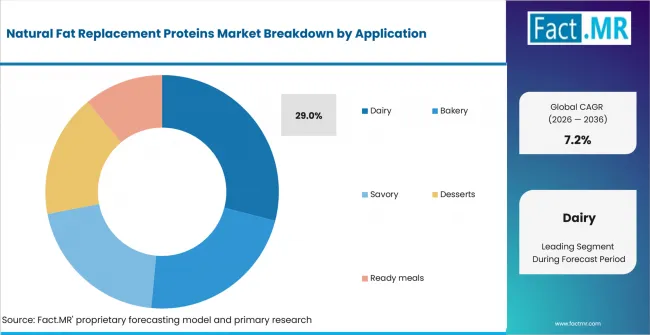
Natural Fat Replacement Proteins Market Analysis By Application | Source: Fact.MR
Dairy segment holds the largest share because if you reduce the fat in yogurt and ice cream, it makes it less creamy. Desserts and beverages face the same problem, so proteins keep them smooth and stable during processing and cold storage.
What is accelerating Natural Fat Replacement Proteins Market adoption, and what is holding it back?
Better texture and nutrition increase adoption, while taste and production issues can slow recipe changes.
Drivers Impact Analysis
| DRIVER | (~) % IMPACT ON CAGR | GEOGRAPHIC RELEVANCE | IMPACT TIMELINE |
|---|---|---|---|
| Reduced-fat dairy reformulation | +1.3% | North America, Europe, Japan | Short term (<= 2 years) |
| Calorie and saturated-fat reduction | +1.0% | Global | Medium term (2-4 years) |
| Protein enrichment alongside texture | +0.8% | North America, Europe, East Asia | Medium term (2-4 years) |
| Plant-forward product development | +0.6% | Europe, North America, Japan | Long term (>= 4 years) |
Opportunity Impact Analysis
| OPPORTUNITY | (~) % IMPACT ON CAGR | GEOGRAPHIC RELEVANCE | IMPACT TIMELINE |
|---|---|---|---|
| Microparticulate protein in dairy and desserts | +1.0% | North America, Europe | Short term (<= 2 years) |
| Pulse proteins in savory and ready meals | +0.8% | Europe, North America, Japan | Medium term (2-4 years) |
| Dual nutrition and texture systems | +0.6% | Global | Long term (>= 4 years) |
Restraints Impact Analysis
| RESTRAINT | (~) % IMPACT ON CAGR | GEOGRAPHIC RELEVANCE | IMPACT TIMELINE |
|---|---|---|---|
| Flavor and mouthfeel trade-offs | -0.6% | Global | Short term (<= 2 years) |
| Heat, pH and shear sensitivity | -0.5% | Global | Medium term (2-4 years) |
| Ingredient-cost and reformulation pressure | -0.4% | North America, Europe, Japan | Medium term (2-4 years) |
Which countries are scaling the Natural Fat Replacement Proteins Market through 2036?
- The country comparison spans 2.1 percentage points across the five profiled markets and shows different formulation routes across mature food-processing systems.
- The UK remains 1.2 percentage points above Japan as its food-manufacturing base supports lower-fat recipe changes across several processed-food categories.
- Japan remains 0.3 percentage point above the USA as processed-food scale and nutrition guidance shape recipe priorities.
- The USA remains 0.3 percentage point above Germany as dairy and foodservice channels create broad application coverage.
- Germany remains 0.3 percentage point above France as prepared-food and dairy applications support protein texture systems.
- France closes the displayed range as dairy processing and dessert applications sustain reformulation activity.
Different supplier routes may still emerge from comparable CAGRs, as food categories and processing conditions differ from country to country. Coverage spans North America; Latin America; Western Europe; Eastern Europe; East Asia; South Asia & Pacific; and Middle East & Africa.
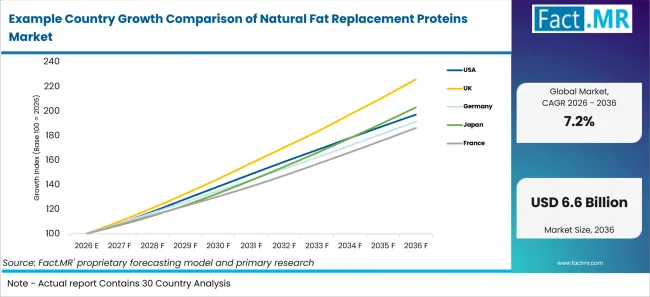
Example Country Growth Comparison Of Natural Fat Replacement Proteins Market | Source: Fact.MR
| Country | CAGR (2026-2036) |
|---|---|
| United Kingdom | 8.5% |
| Japan | 7.3% |
| United States | 7.0% |
| Germany | 6.7% |
| France | 6.4% |
What supports United Kingdom adoption?
8.5% CAGR, supported by food production and lower-fat dairy products.
UK food companies use proteins in lower-fat dairy, bakery products and prepared foods. The Office for National Statistics reported on 24 July 2026 that in 2025, food manufacturing accounted for 22.9% of the product sales of UK manufacturers.
How is Japan developing demand?
Japan is anticipated to lead 7.3% CAGR through 2036.
Japan’s processed-food industry uses proteins in lower-fat dairy, frozen foods, and prepared meals. The U.S. Department of Agriculture Foreign Agricultural Service reported on April 1, 2026, that Japan’s food-processing sector was valued at USD 174 billion in 2025. Food companies prefer proteins that keep products smooth without changing the taste.
What supports USA adoption?
7.0% CAGR, led by broad food applications and reformulation activity.
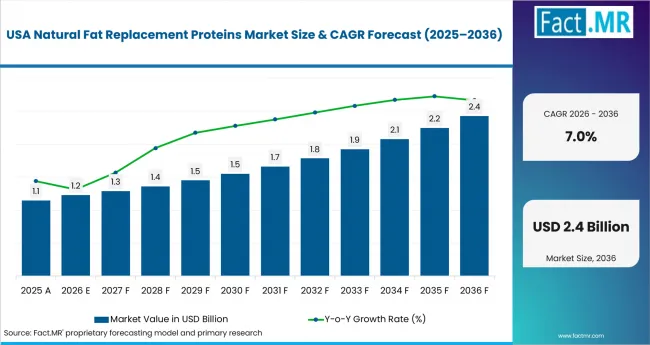
Natural Fat Replacement Proteins Market Country Value Analysis | Source: Fact.MR
U.S. food companies employ proteins for smoothness in lower-fat dairy, bakery and foodservice products. The U.S. Bureau of Labour Statistics reported today, January 13, 2026, that prices for food-at-home increased 2.4% for the 12 months ending December 2025.
What is supporting Germany's adoption?
6.7% CAGR, backed by prepared-food output and dairy formulation depth.
In the German dairy and convenience-food industry proteins are used to maintain the texture. Destatis reported that in 2024, Germany produced 1.7 million tons of ready meals in January 14, 2026. Proteins keep these foods thick and moist after heating and storage.
How does France perform?
6.4% CAGR, shaped by dairy processing and dessert applications.
France uses proteins in lower-fat dairy products and desserts to maintain texture. Agreste reported in June 2026 that France collected about 2.111 billion litres of cow milk in April 2026. Proteins are used in yogurt, chilled desserts, and dairy drinks to keep them smooth.
Who leads the Natural Fat Replacement Proteins Market?
Kerry Group offers dairy and plant proteins for reduced fat dairy products, ice cream, bakery foods and savoury foods. Its ingredients keep these products smooth and stable during production.
Cargill supplies plant proteins and other ingredients for dairy and dairy alternatives. Roquette sells pea and wheat proteins for plant-based foods. Arla Foods Ingredients supplies whey protein for high-protein and lower-fat dairy products to maintain a smooth and creamy texture.
Which companies are the key providers?
Companies profiled include Kerry Group; CP Kelco; Cargill; Glanbia Nutritionals; Roquette; and Arla Foods Ingredients.
- Kerry Group
- CP Kelco
- Cargill
- Glanbia Nutritionals
- Roquette
- Arla Foods Ingredients
Bibliography
- Zeballos, E., & Sinclair, W. (2026, June 11). Total U.S. food spending reached $2.51 trillion in 2025. U.S. Department of Agriculture, Economic Research Service.
- U.S. Department of Agriculture, National Agricultural Statistics Service. (2026, April 30). Milk production, disposition, and income 2025 summary.
- Office for National Statistics. (2026, July 24). UK manufacturers’ sales by product: 2025.
- U.S. Department of Agriculture, Foreign Agricultural Service. (2026, April 1). Food processing ingredients annual (Report No. JA2026-0012).
- U.S. Bureau of Labor Statistics. (2026, January 13). Consumer Price Index—December 2025.
- Statistisches Bundesamt (Destatis). (2026, January 14). Produktion von Fertiggerichten binnen fünf Jahren mengenmäßig um 25,6 % gestiegen [Production of ready meals increased by 25.6% in volume within five years].
- Touati-Houari, N. (2026, June 12). Lait. Avril 2026 : la collecte de lait toujours en hausse sur un an. Agreste.
- Roquette. (2025, June 17). Roquette grows NUTRALYS® plant protein portfolio with addition of new textured wheat and pea proteins.
- International Flavors & Fragrances. (2025, April 2). Cracking the code on high-protein dairy.
This Report Answers
- The report explains how natural proteins replace part of fat's sensory role across protein platform and replacement mechanism.
- Segment analysis identifies leading subsegments and the formulation reasons manufacturers select them.
- Country analysis links the five profiled markets to processing scale, nutrition guidance and cost pressure.
- Competitive analysis reviews active dairy, pulse and functional-protein providers through product fit and application positioning.
- Application analysis compares texture needs across dairy and bakery. The comparison extends to savory foods and desserts as well as ready meals.
What does the Natural Fat Replacement Proteins Market cover?
It covers dairy and pulse proteins as well as cereal and egg sources. Fungal or fermented proteins are included when they improve texture after fat reduction.
The assessment aligns with broader protein ingredients and plant protein ingredients categories. Inclusion depends on a direct fat-replacement or fat-mimetic function in food formulation. Protein nutrition remains a related but separate use case.
What is included in the scope?
The scope includes protein systems that work by microparticulation and gel formation. Water immobilization and emulsion structuring are included when they support the same texture objective. Formulations using enzymatic protein texturizers or functional binders are included for the same reason.
Applications cover dairy and bakery as well as savory foods and desserts. Ready meals form a separate application group where protein can restore body after fat reduction. Adjacent functional food texture systems and food texturizing agents are relevant only where protein is part of the fat-replacement function.
What is excluded from the scope?
The scope excludes protein ingredients used only for fortification when their role is nutritional. Stand-alone starch and gum systems remain outside the scope. Lipid systems are treated the same way even when they appear in the broader fat replacer market.
General stabilizers remain outside the market boundary when another ingredient provides the main fat-replacement function. Related food stabilizers enter the scope when a natural protein provides the texture or emulsion function being purchased.
Proteins developed mainly for heat stability remain outside the intended function when fat replacement is absent. Heat-stable plant protein texturizing agents can overlap in ready meals when heat performance supports the required texture role.
How Was the Analysis Built?
The analysis draws on 120+ sources, 35+ company portfolios, 25+ countries, and more than 20 industry interviews.
- Primary Research: Primary research includes discussions with manufacturers, service providers, technology developers, distributors, end users, and subject-matter experts. These conversations examine purchasing priorities, product adoption, operational challenges, approval requirements, competitive positioning, and the factors that influence wider market acceptance.
- Desk Research: Desk research covers government statistics, regulatory publications, company filings, trade data, technical studies, industry associations, standards, public policy, and other authoritative sources. Every source used in the analysis is documented in the bibliography.
- Market Sizing and Forecasting: Market estimates combine historical performance, demand indicators, pricing and volume trends, segment shares, company participation, country-level growth, adoption patterns, investment activity, and barriers to market expansion.
- Data Validation and Update Cycle: Findings are validated by comparing primary interviews with public data, company activity, regulatory changes, trade patterns, and industry developments. Regular updates review new product launches, capacity changes, partnerships, approvals, and shifts in commercial adoption.
What is the report’s scope and coverage?
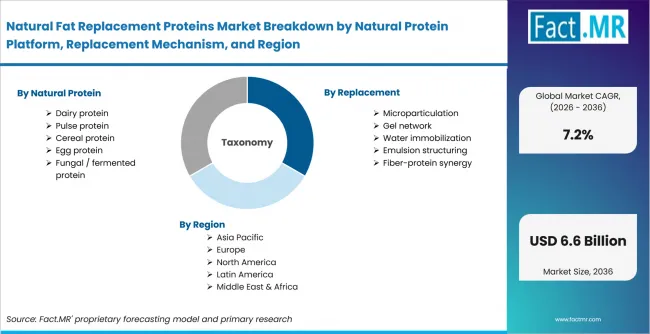
Natural Fat Replacement Proteins Market Breakdown By Natural Protein Platform, Replacement Mechanism, And Region | Source: Fact.MR
| Attribute | Details |
|---|---|
| Quantitative Units | USD billion in 2026 to USD billion by 2036 at a CAGR |
| Market Definition | Food proteins used to replace part of the functional and sensory role of fat by supporting creaminess, body, water control, gel structure or emulsion stability in lower-fat formulations. |
| Natural Protein Platform | Dairy protein; Pulse protein; Cereal protein; Egg protein; Fungal / fermented protein |
| Replacement Mechanism | Microparticulation; Gel network; Water immobilization; Emulsion structuring; Fiber-protein synergy |
| Nutrition Position | Calorie reduction; Saturated-fat reduction; Protein enrichment; Clean label; Plant-forward |
| Application | Dairy; Bakery; Savory; Desserts; Ready meals |
| Regions Covered | North America; Latin America; Western Europe; Eastern Europe; East Asia; South Asia & Pacific; Middle East & Africa |
| Countries Covered | United States; United Kingdom; Germany; Japan; France |
| Key Companies Profiled | Kerry Group; CP Kelco; Cargill; Glanbia Nutritionals; Roquette; Arla Foods Ingredients |
| Forecast Period | 2026 to 2036 |
| Approach | Hybrid top-down and bottom-up approach using food-processing activity, dairy output, application demand, segment structure, country growth and provider portfolio review. |
How is the market segmented?
-
By Natural Protein Platform
- Dairy protein
- Pulse protein
- Cereal protein
- Egg protein
- Fungal / fermented protein
-
By Replacement Mechanism
- Microparticulation
- Gel network
- Water immobilization
- Emulsion structuring
- Fiber-protein synergy
-
By Nutrition Position
- Calorie reduction
- Saturated-fat reduction
- Protein enrichment
- Clean label
- Plant-forward
-
By Application
- Dairy
- Bakery
- Savory
- Desserts
- Ready meals
-
By Region
- North America
- Latin America
- Western Europe
- Eastern Europe
- East Asia
- South Asia & Pacific
- Middle East & Africa