- Market Value (2025): USD 890.9 Mn
- Estimated Value (2026): USD 980.0 Mn
- Forecast Value (2036): USD 2542.0 Mn
- CAGR (2026-2036): 10.0%
What is the Natural Texture Gums Market forecast to be worth by 2036?
USD 980.0 million in 2026 to USD 2,542.0 million by 2036, implying a 10.0% CAGR.
- The natural texture gums market reached USD 890.9 million in 2025.
- Demand is projected to increase from USD 980.0 million in 2026 to USD 2,542.0 million by 2036.
- The market is forecast to record 10.0% CAGR from 2026 to 2036 as dairy alternative brands, confectionery makers and beverage formulators standardize natural texture systems.
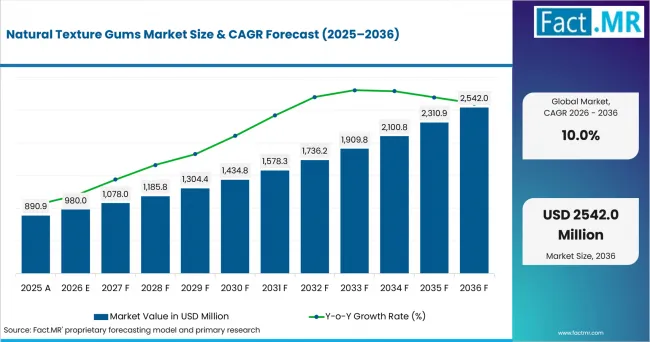
Natural Texture Gums Market Value Analysis | Source: Fact.MR
What are the defining numbers behind Natural Texture Gums Market growth?
An absolute opportunity of USD 1,562.0 million is expected between 2026 and 2036.
- Demand Drivers in the Market
- Dairy alternative developers need reliable gel strength and fat-like mouthfeel as plant-based yogurts, desserts and drinks move into mainstream retail sets.
- Confectionery teams require low-sugar gelation that keeps chew, clarity and cut stability when brands reduce added sugar.
- Beverage formulators use natural gums to suspend particulates and proteins while avoiding a heavy drinking texture.
- Sauce and dressing manufacturers need heat and shear tolerance so texture remains stable during filling, transport and home storage.
- Key Segments Analyzed
- By Product: Low-methoxyl pectin is expected to hold 39.0% share in 2026 as formulators use calcium-set systems for lower-sugar gels and fruit preparations.
- By Function: Gelling is projected to account for 37.0% share in 2026 due to demand for defined bite, set and slice behavior in dairy alternatives and confectionery.
- By Application: Dairy alternatives are anticipated to capture 34.0% share in 2026 as brands need creaminess, protein stability and spoonable texture without dairy solids.
- By Grade: Food grade is estimated to represent 44.0% share in 2026 owing to documentation needs around purity, allergen control and batch consistency.
- Analyst Opinion at Fact.MR
- Shambhu Nath Jha, Principal Consultant at Fact.MR, states, “Texture gums are no longer bought only as background thickeners. Formulators now ask how a pectin or gum blend behaves in the finished food after processing, storage and serving. Suppliers that combine clean documentation with application testing are expected to hold a stronger place in reformulation work.”
- Strategic Implications
- Ingredient suppliers should document gel curves, calcium response and heat tolerance by application so product teams can shorten bench trials.
- Food brands should compare pectin and gum blends by finished-product behavior in place of ingredient cost alone.
- Distributors should hold technical samples for dairy alternatives, gummies and beverage suspensions since small trials often decide repeat purchases.
- Sourcing teams should track citrus peel, seaweed and acacia availability because raw material shifts can change lead times and formulation cost.
The USA is projected to record 11.0% CAGR through 2036, led by high packaged-food spending and reformulation pressure. Germany is anticipated to post 10.5% CAGR as food retail and technical ingredient demand support use in dairy and confectionery. Japan is forecast to advance at 9.8% CAGR through export-led quality expectations. France is estimated to reach 9.4% CAGR with dairy and beverage formulation depth. Brazil is expected to record 9.0% CAGR as food processing scale supports local texture demand.
How does the Natural Texture Gums Market break down by segment?
Low-methoxyl pectin leads Product at 39.0%; food grade leads Grade at 44.0%.
Which Product leads adoption?
Low-methoxyl pectin holds 39.0% share in 2026.
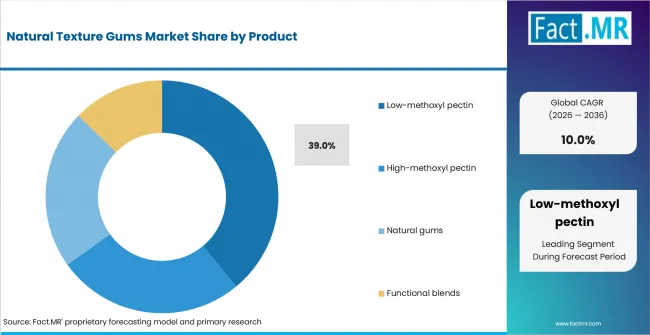
Natural Texture Gums Market Analysis By Product | Source: Fact.MR
Low-methoxyl pectin leads because it forms gels with calcium and needs less sugar than high-sugar pectin systems. It suits reduced-sugar fruit spreads, dairy alternatives and fortified desserts where brands need a clean set. Adjacent citrus pectin use reinforces the same need for controlled gel behavior.
Product developers also use low-methoxyl pectin when they need a softer bite and stable water binding. That makes it useful in fruit preparations, yogurt alternatives and layered desserts where texture changes quickly become visible to consumers.
What supports Function demand?
Gelling accounts for 37.0% share in 2026.
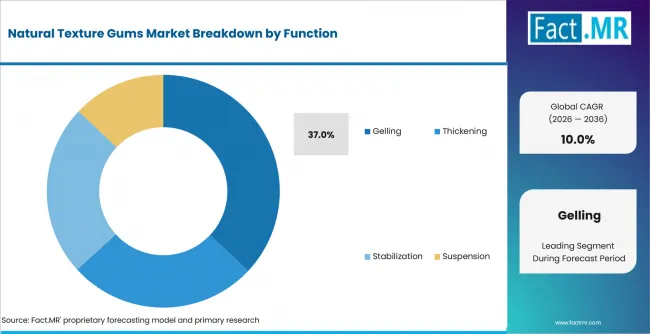
Natural Texture Gums Market Analysis By Function | Source: Fact.MR
Gelling carries the main functional share because many natural texture gums are purchased to create a defined set. Confectionery makers need gummies and jellies that demold cleanly. Dairy alternative brands need spoonable gels that remain stable during shelf life. Related natural gelling agents demand shows the same application focus.
Cargill, Incorporated showcased a cost-effective pectin replacer for gummies and jellies at AAHAR 2025 in March 2025, highlighting efforts to combine functional formulation requirements with ingredient cost control in confectionery applications.
How does Application shape demand?
Dairy alternatives capture 34.0% share in 2026.
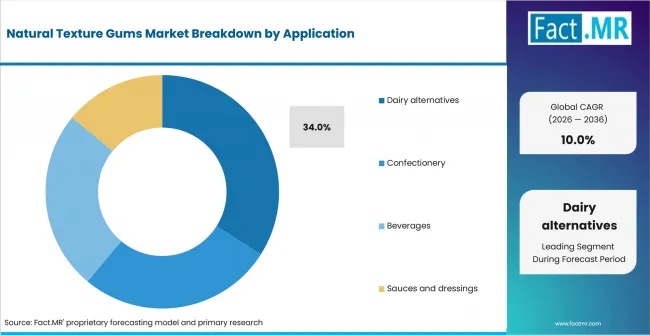
Natural Texture Gums Market Analysis By Application | Source: Fact.MR
Dairy alternatives lead the application mix because plant proteins and fats need support to mimic dairy creaminess. Texture gums help stabilize water binding and reduce graininess in yogurts, drinks and desserts. The same formulation pressure appears in the plant-based dairy category.
Application work is especially technical in chilled products. Formulators must protect viscosity after heat treatment, maintain spoonability after storage and avoid separation when plant proteins interact with acids or minerals.
What leads the Grade segment?
Food grade represents 44.0% share in 2026.
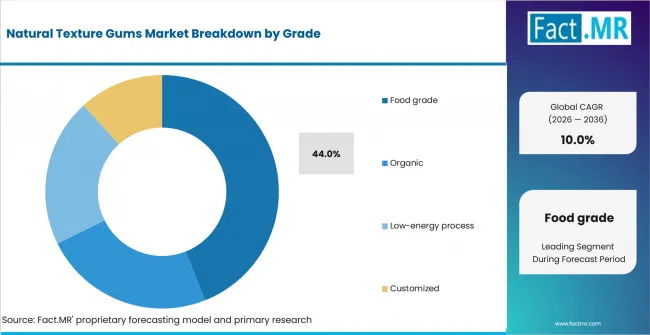
Natural Texture Gums Market Analysis By Grade | Source: Fact.MR
Food stabilizers rely on consistent purity files, microbiological limits and allergen documentation. Food grade leads because most demand comes from packaged food, beverages and foodservice formulations. Buyers need repeatable batches that pass internal approval before a recipe moves into commercial production.
Food grade pectin and gums are also easier to scale across several product lines. Organic, low-energy process and customized grades serve more selective programs where label claims or process targets justify a higher testing burden.
What is accelerating Natural Texture Gums Market adoption, and what is holding it back?
Demand is expected to rise through clean-label texture needs, while adoption is limited by raw material volatility and validation work.
Drivers Impact Analysis
| DRIVER | (~) % IMPACT ON CAGR | Geographic Relevance | Impact Timeline |
|---|---|---|---|
| Low-sugar gelation in confectionery and fruit systems | +1.3% | Global | Short term (<= 2 years) |
| Dairy alternative mouthfeel and stability requirements | +1.1% | North America, Europe, East Asia | Medium term (2-4 years) |
| Beverage suspension and protein stabilization needs | +0.8% | Global | Medium term (2-4 years) |
| Food-grade documentation and supplier validation | +0.6% | North America, Europe | Long term (>= 4 years) |
- Low-sugar gelation in confectionery and fruit systems: Lower sugar formulations place more weight on calcium-set pectin and blend design. This makes low-methoxyl pectin relevant for fruit systems and confectionery where set strength must hold after storage.
- Dairy alternative mouthfeel and stability requirements: Plant-based dairy creates water-binding and protein-stability issues. Natural gums give formulators a practical way to protect creaminess and spoonability. This demand links closely with dairy stabilizers where texture stability is central to finished product quality.
- Beverage suspension and protein stabilization needs: Natural gums help particles, pulp and proteins remain evenly dispersed during distribution. This supports repeatable mouthfeel in juice drinks, protein beverages and flavored dairy alternatives.
- Food-grade documentation and supplier validation: Food brands need allergen files, microbial limits and batch traceability before reformulation. That makes documentation a purchase gate for gum hydrocolloids used in packaged food lines.
Opportunity Impact Analysis
| OPPORTUNITY | (~) % IMPACT ON CAGR | Geographic Relevance | Impact Timeline |
|---|---|---|---|
| Low-energy pectin processing and traceable citrus inputs | +0.9% | Europe, North America | Medium term (2-4 years) |
| Functional blends for cost-controlled gummies and dairy desserts | +0.8% | Global | Short term (<= 2 years) |
| Organic and customized grades | +0.5% | North America, Western Europe, Japan | Long term (>= 4 years) |
- Low-energy pectin processing and traceable citrus inputs: Process efficiency is becoming part of supplier evaluation. Energy and water reductions can strengthen supplier acceptance when buyers review ingredient risk across a full recipe.
- Functional blends for cost-controlled gummies and dairy desserts: Blends give formulators a way to balance gel strength with total recipe cost. The same need appears in gelatin substitutes where plant-based gelling performance has direct formulation value.
- Organic and customized grades: Premium brands need texture systems that match their label claims and sensory targets. Customized grades therefore create room for suppliers with application labs and short sampling cycles.
Restraints Impact Analysis
| RESTRAINT | (~) % IMPACT ON CAGR | Geographic Relevance | Impact Timeline |
|---|---|---|---|
| Citrus peel and botanical raw material variability | -0.4% | Global | Short term (<= 2 years) |
| Validation cycles before formulation approval | -0.3% | Global | Medium term (2-4 years) |
| Price competition from starches and synthetic stabilizers | -0.3% | Latin America, Asia | Long term (>= 4 years) |
- Citrus peel and botanical raw material variability: Pectin and several natural gums depend on agricultural inputs. Changes in crop quality can affect extraction yield, color and gel strength. This keeps buyer attention on citrus peel fibre and pectin supply depth.
- Validation cycles before formulation approval: Texture gums often change mouthfeel and process behavior. Manufacturers therefore need stability tests before switching supplier or replacing a familiar stabilizer system.
- Price competition from starches and synthetic stabilizers: Cost-sensitive food categories may choose starch or simpler stabilizers when label claims carry less weight in shopper decisions.
Which countries are scaling the Natural Texture Gums Market through 2036?
- The country comparison spans 2.0 percentage points and forms three practical growth bands across the forecast period.
- The USA remains 0.5 percentage point above Germany through food spending scale and active sugar-reduction policy attention.
- Germany remains 0.7 percentage point above Japan as food retail and manufacturing demand support technical ingredient use.
- Japan remains 0.4 percentage point above France through export quality targets and premium packaged food applications.
- France remains 0.4 percentage point above Brazil through dairy, confectionery and beverage reformulation depth.
- Brazil closes the displayed range as crop availability and food processing scale support local texture-system demand.
Comparable CAGRs create different entry conditions due to ingredient sourcing, food price pressure, processing depth and retailer standards. Full report coverage includes North America, Latin America, Western Europe, Eastern Europe, East Asia, South Asia & Pacific, Middle East & Africa.
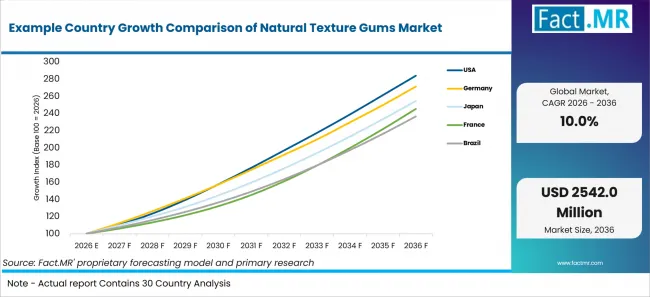
Example Country Growth Comparison Of Natural Texture Gums Market | Source: Fact.MR
| Country | CAGR (2026-2036) |
|---|---|
| United States | 11.0% |
| Germany | 10.5% |
| Japan | 9.8% |
| France | 9.4% |
| Brazil | 9.0% |
What supports USA adoption?
11.0% CAGR through 2036, supported by food spending scale and reformulation economics.
The USA benefits from large packaged-food programs where texture changes are tested across national brands before launch. BLS reported in August 2026 that U.S. food prices were 3.0% higher year over year in July 2026.
What supports Germany adoption?
10.5% CAGR through 2036, supported by food retail depth and manufacturing discipline.
Germany combines technical ingredient evaluation with a large grocery and private-label base. Destatis reported in May 2026 that the food and non-alcoholic beverage CPI index stood at 138.6 in April 2026. Price pressure makes texture efficiency useful because manufacturers need stable gels and suspension without repeated recipe changes across dairy desserts, sauces and beverages.
How does Japan perform?
9.8% CAGR through 2036, led by export quality needs and premium texture expectations.
Japan’s packaged-food brands place high value on mouthfeel, clarity and consistency in confectionery and beverage products. MAFF reported in February 2026 that agricultural, forestry, fishery and food exports reached JPY 1.7005 trillion in 2025. Export-oriented quality control supports demand for food-grade pectin and gums that maintain sensory performance during chilled storage and distribution.
What supports France adoption?
9.4% CAGR through 2036, supported by dairy, confectionery and beverage reformulation.
France has deep formulation demand across dairy desserts, fruit preparations, beverages and premium confectionery. INSEE reported on January 15, 2026 that food prices rose 1.7% year over year in December 2025.
How is Brazil developing demand?
9.0% CAGR through 2036, supported by food-processing scale and agricultural input availability.
IBGE reported in November 2025 that its October 2025 estimate for Brazilian orange production stood at 13.9 million tonnes, up 8.0% from the previous month’s estimate. Orange production is a more directly relevant public indicator for citrus-linked pectin supply than aggregate Brazilian grain production.
Who leads the Natural Texture Gums Market?
Cargill, Incorporated competes through pectin, xanthan, carrageenan and functional systems that help food brands manage texture across confectionery, dairy and ice cream. Its ingredient breadth supports brands that need stabilizing, gelling and mouthfeel control across several product formats.
Ingredion Incorporated participates through hydrocolloids, clean-label ingredient solutions and texture formulation expertise. In July 2026, Ingredion Incorporated said its IFT FIRST 2026 showcase would highlight texture, clean labels and positive nutrition.
Which companies are the key providers?
Key companies include Tate & Lyle PLC (CP Kelco); Cargill, Incorporated; Ingredion Incorporated; Nexira; and Alland & Robert.
- Tate & Lyle PLC (CP Kelco)
- Cargill, Incorporated
- Ingredion Incorporated
- Nexira
- Alland & Robert
Bibliography
- U.S. Bureau of Labor Statistics. (2026, August 12). Consumer Price Index—July 2026.
- Cargill. (2025, March 4). Cargill showcases full range of innovative food solutions at AAHAR 2025.
- Brazilian Institute of Geography and Statistics. (2025, November 13). IBGE: Harvest estimate for 2026 is 332.7 million tonnes, 3.7% lower than in 2025. IBGE News Agency.
- Federal Statistical Office (Destatis). (2026, May 12). CORRECTION: Inflation rate at +2.9% in April 2026.
- Ingredion Incorporated. (2026, July 6). Ingredion to spotlight next-generation solutions for texture, clean labels and positive nutrition at IFT FIRST 2026.
- Institut national de la statistique et des études économiques. (2026, January 15). In December 2025, consumer prices increased by 0.1% over one month and rose by 0.8% year on year.
- Tate & Lyle PLC. (2025, April 1). Tate & Lyle welcomes government officials to Lille Skensved, formerly of CP Kelco, to celebrate completion of carbon reduction and energy efficiency project.
- Zeballos, E., & Sinclair, W. (2026, June 11). Total U.S. food spending reached $2.51 trillion in 2025. U.S. Department of Agriculture, Economic Research Service.
This Report Answers
- The report explains where natural texture gums are used by product, function, application and grade.
- Segment analysis identifies the leading subsegments and the formulation reasons behind their shares.
- Country analysis examines the listed markets and the food-processing mechanisms supporting adoption.
- Competitive analysis reviews providers across pectin, natural gums, blends and application support.
- Application analysis considers how gel strength, mouthfeel and documentation influence purchase decisions.
What does the Natural Texture Gums Market cover?
The Natural Texture Gums Market covers food-grade pectin, botanical gums and functional blends used to shape texture in packaged foods and beverages. It includes products that create gels, thicken liquids and stabilize particulates. Closely related food thickening agents show the same buyer focus on viscosity control.
The assessment covers low-methoxyl pectin, high-methoxyl pectin, natural gums and functional blends. It also reviews carrageenan gum where seaweed-derived texture systems overlap with food-grade gum selection.
What is included in the scope?
The scope includes natural texture gums sold to food and beverage manufacturers for dairy alternatives, confectionery, beverages and sauces. It includes food-grade, organic, customized and low-energy process grades used for texture control.
The assessment includes adjacent hydrocolloid categories only where they fit natural texture use. Examples include food-grade gellan gum in beverage suspension and gelled confectionery applications.
What is excluded from the scope?
The scope excludes synthetic stabilizers, industrial gums outside food use and pharmaceutical excipients. Commodity starches are excluded when they are sold only as basic thickeners without natural gum or pectin functionality.
Adjacent alternative hydrocolloids are considered only where they overlap with natural gum use. Texture recovery hydrocolloids are considered only when they fit food-grade formulation work.
How Was the Analysis Built?
The analysis draws on 120+ sources, 35+ company portfolios, 25+ countries, and more than 20 industry interviews.
- Primary Research: Primary research includes discussions with manufacturers, service providers, technology developers, distributors, end users, and subject-matter experts. These conversations examine purchasing priorities, product adoption, operational challenges, approval requirements, competitive positioning, and the factors that influence wider market acceptance.
- Desk Research: Desk research covers government statistics, regulatory publications, company filings, trade data, technical studies, industry associations, standards, public policy, and other authoritative sources. Every source used in the analysis is documented in the bibliography.
- Market Sizing and Forecasting: Market estimates combine historical performance, demand indicators, pricing and volume trends, segment shares, company participation, country-level growth, adoption patterns, investment activity, and barriers to market expansion.
- Data Validation and Update Cycle: Findings are validated by comparing primary interviews with public data, company activity, regulatory changes, trade patterns, and industry developments. Regular updates review new product launches, capacity changes, partnerships, approvals, and shifts in commercial adoption.
What is the report’s scope and coverage?
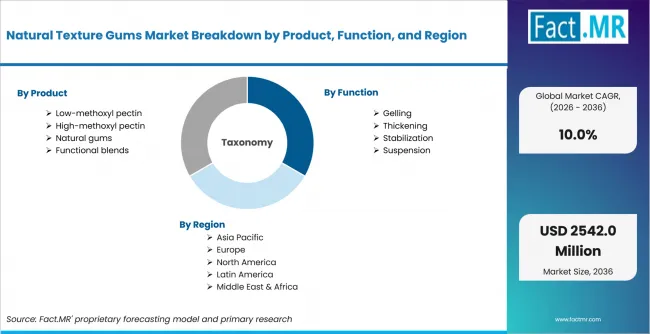
Natural Texture Gums Market Breakdown By Product, Function, And Region | Source: Fact.MR
| Attribute | Details |
|---|---|
| Quantitative Units | USD million |
| Market Definition | Natural pectin, gum and blend-based food ingredients used to create gelling, thickening, stabilization and suspension in packaged foods and beverages. |
| Product | Low-methoxyl pectin; High-methoxyl pectin; Natural gums; Functional blends |
| Function | Gelling; Thickening; Stabilization; Suspension |
| Application | Dairy alternatives; Confectionery; Beverages; Sauces and dressings |
| Grade | Food grade; Organic; Low-energy process; Customized |
| Regions Covered | North America; Latin America; Western Europe; Eastern Europe; East Asia; South Asia & Pacific; Middle East & Africa |
| Countries Covered | United States; Germany; Japan; France; Brazil |
| Key Companies Profiled | Tate & Lyle PLC (CP Kelco); Cargill, Incorporated; Ingredion Incorporated; Nexira; Alland & Robert |
| Forecast Period | 2026 to 2036 |
| Approach | Hybrid top-down and bottom-up approach using product shares, application use, country adoption, provider portfolios and food formulation evidence. |
How is the market segmented?
-
By Product:
- Low-methoxyl pectin
- High-methoxyl pectin
- Natural gums
- Functional blends
-
By Function:
- Gelling
- Thickening
- Stabilization
- Suspension
-
By Application:
- Dairy alternatives
- Confectionery
- Beverages
- Sauces and dressings
-
By Grade:
- Food grade
- Organic
- Low-energy process
- Customized
-
By Region:
- North America
- Latin America
- Western Europe
- Eastern Europe
- East Asia
- South Asia & Pacific
- Middle East & Africa